






Updated 3 months ago
Complete Guide to Garden Watering Tools for Wholesale Buyers: Watering Cans, Hoses, Sprinklers and Drip Irrigation
ScarecrowGarden
💡About Scarecrow Garden Supplier Co., Ltd.
Scarecrow Garden Supplier Co., Ltd. is a China-based sourcing and wholesale partner specializing in garden tools, landscaping equipment, and outdoor supplies for international wholesalers, distributors, contractors, and brands.
With hands-on experience rooted in real garden use scenarios, we focus on durable materials, functional design, and stable large-volume supply. Our product range covers pruning tools, watering systems, hand tools, outdoor hardware, and customized garden solutions to support both retail and professional landscaping markets.
Beyond products, we help our partners navigate supplier selection, quality control, compliance requirements, and long-term sourcing strategies in China. Through our blog, we share practical insights on product selection, material comparisons, industry trends, and cost-effective purchasing—helping global buyers build stronger, more competitive supply chains.
Wholesale Garden Watering Tools: The Ultimate B2B Sourcing Guide | Scarecrow Garden Supplier
Every summer, the same thing happens. A heatwave hits, hosepipe bans follow, and your customers show up looking for watering cans, drip kits and water butts — only to find half-empty shelves. If you distribute garden products in Europe, you already know this cycle. What you might not realise is how much it has accelerated.
The UK Met Office now calls record-breaking heat and rainfall the “new normal.” Average temperatures over 2015–2024 were 1.24 °C above the 1961–1990 baseline, and are climbing at roughly 0.25 °C per decade. As temperatures rise, more water utilities impose restrictions — and each restriction sends a spike of demand straight to the watering-tool aisle.
But here is the part that catches buyers off guard: watering tools are not one category. A 5L indoor watering can, a 30 m reinforced garden hose and a drip-irrigation starter kit share almost nothing — different materials, different factories, different QC standards, different packaging logic. When you try to source them as a single “watering” line, the complexity multiplies fast.
The key to sourcing watering tools is not thinking about products — it is thinking about scenarios. The same garden centre needs six different supply chains for what looks like one category. This guide shows you how those supply chains differ, how to match them to your customers’ scenarios, and how to get the right products on shelves before the season starts.
First Understand the Watering Scenarios, Not the Products
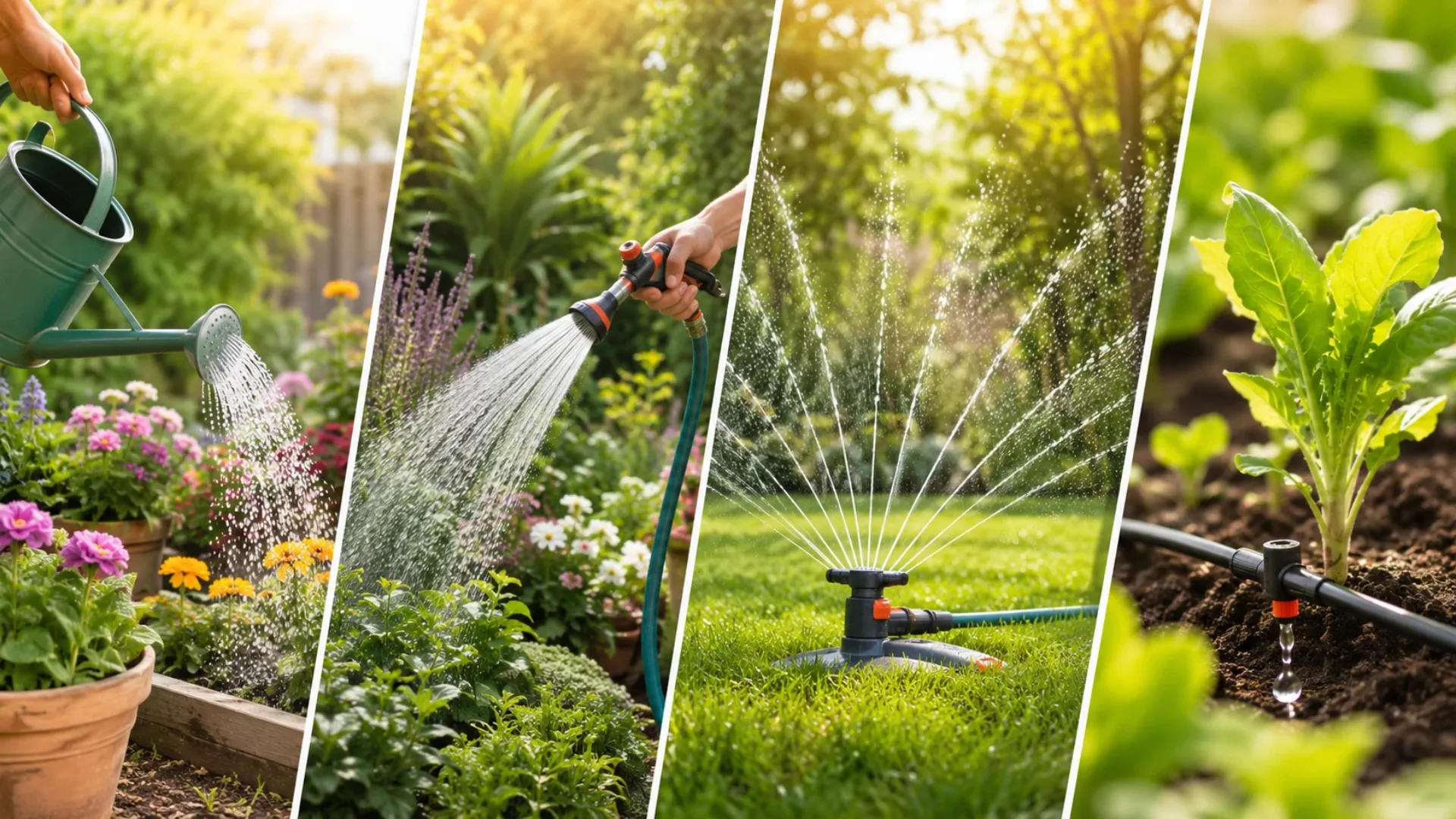
Before you build a product list, look at how your end customers actually water. The tools change depending on what is being watered, where it sits and how much time the gardener has. These five scenarios follow a clear progression — from precision to coverage to system — and each one demands a different supply chain.
Seedlings and young plants — precision watering. These need a gentle shower — not a deluge. A fine-rose watering can (the detachable sprinkler head on a can) delivers soft, even droplets that will not flatten delicate stems. Misting bottles and capillary mats also sell here, mainly to greenhouse and propagation customers. The supply chain here is plastics injection-moulding — lightweight, high-volume, low unit cost.
Containers, window boxes and balconies — precision at scale. Same logic as seedlings, but more SKUs and more SKUs per customer. Small cans (1–5 L) with long spouts reach past foliage to the soil. Self-watering spikes and micro-drip kits appeal to apartment gardeners who cannot water every day. This is your highest-margin, smallest-footprint segment — and the one most online stores lead with.
Vegetable beds and raised beds — area coverage with efficiency. The logic shifts from precision to coverage, but coverage that does not waste water. Drip irrigation and soaker hoses deliver water to the root zone with minimal loss. The EPA estimates that up to half of outdoor water is lost to evaporation, wind and overwatering (based on US data, but the waste pattern is the same in European gardens); drip systems can significantly reduce that waste by delivering water directly to the root zone. Add a mechanical or digital timer, and you have a complete “set-and-forget” solution that also qualifies for use under most hosepipe bans. The supply chain here is completely different from cans — tubing extrusion, emitter insertion, fitting assembly — often from factories that specialise in irrigation, not in plastic housewares.
Lawns — area coverage at speed. Oscillating sprinklers cover rectangular areas evenly. Rotary sprinklers handle circular zones. Impulse sprinklers reach further but need higher water pressure. The key buying risk: coverage claims on the box are usually tested at 3–4 bars. At 2 bar — common in older European homes — the actual coverage can drop by half. Sprinkler factories are yet another cluster — moulded plastics with metal internals, different QC protocols, and different packaging.
Large gardens and allotments — system-level watering. Hose reels, spray guns and multi-pattern nozzles. This is where connector standards matter most: UK customers expect Hozelock-compatible fittings; continental buyers look for Gardena click-fit. Stock the wrong standard and the returns start arriving before the season ends. The supply chain here is the most complex — hoses from one factory, reels from another, guns from a third, fittings from a fourth — and getting them to work together is a sourcing challenge in itself.
Notice the pattern: as you move from seedlings to large gardens, the supply chain gets more complex, the number of factories involved increases, and the cost of getting it wrong goes up. This is why treating “watering tools” as one category is a trap — each scenario has its own supply logic, and your product mix needs to respect that.
Main Product Categories in a Wholesale Watering Range
Six product categories make up a complete watering-tool assortment — but not every channel needs all six. The two that matter most for your business depend on whether you serve casual gardeners (cans + hoses) or dedicated growers (drip + timers). Here is how the categories compare.
| Category | Key Products | Best-For Scenario | Main Buying Risk | Deep-Dive Guide |
| Watering Cans | Plastic 5 L / 10 L, metal decorative | Seedlings, containers, balconies | Rose leaks; handle breaks under load | Wholesale Watering Cans Guide → |
| Hoses & Reels | PVC / rubber / expandable hoses; wall-mount & cart reels | Large gardens, lawns | Kinking; connector standard mismatch; CBM | Garden Hose Wholesale Guide → |
| Spray Guns & Nozzles | Multi-pattern guns, wands, misters | Large gardens, containers | Trigger breakage; leak at the connector | Spray Gun Sourcing Guide → |
| Sprinklers | Oscillating, rotary, impulse, spot | Lawns | Coverage overclaimed; plastic UV-brittle | Garden Sprinkler Guide → |
| Drip Irrigation & Soaker Hoses | Kit-in-a-box, micro-drip, porous hose | Raised beds, vegetable plots | Missing fittings; emitter clogging | Drip Irrigation Kit Guide → |
| Water-Saving & Heatwave Products | Water butts, timers, moisture meters, soaker hoses | Hosepipe-ban periods, drought response | Timer waterproofing; butt seal leaks | Water-Saving Products Guide → |
A few things worth noting across categories:
- 5 L is the volume seller. The industry treats 10 L as the default specification, but in practice 5 L cans tend to move faster off the shelf — they are lighter to carry (one-handed at roughly 5 kg full) and suit the most common household tasks. A full 10 L can weighs around 10 kg and needs two hands. Smart buyers run a 5 L + 10 L mixed MOQ.
- Connector standards split the market — especially for hoses and spray guns. Hozelock (UK) and Gardena (continental Europe) use different click-fit systems. A hose reel that ships with the wrong connectors is a return waiting to happen. Confirm the standard before you order.
- Drip irrigation uses roughly 7 litres per 10 minutes, compared with 91 litres from an open hose. That 13× difference is the single most compelling number in the water-saving argument — and it is why drip kits sell out during hosepipe bans.
How to Build a Practical Wholesale Product Mix
Not every buyer needs the full range. Here are four assortment bundles that match common retail channels.
Entry-Level Range — Small Retailers & Online Stores
- 5 L plastic watering can (2 colours)
- 15 m PVC garden hose with Hozelock or Gardena connectors
- 7-pattern spray gun
- Basic oscillating sprinkler
This gives you four SKUs that cover the most common tasks. Low risk, manageable CBM, and the can + hose + gun combo is a natural cross-sell.
Garden Centre Assortment — Mid-Range
- 5 L and 10 L plastic cans (3–4 colours, including sage green and cream)
- 1 decorative metal can for the gift/display shelf
- 25 m reinforced hose + wall-mount reel
- Multi-pattern spray gun (mid-range)
- Oscillating sprinkler + rotary sprinkler
- Drip-irrigation starter kit (15 m, for raised beds)
- Mechanical water timer
This range covers all five scenarios. The metal can and the timer are your margin drivers; the 5 L can and the hose are your traffic builders.
Heatwave / Drought-Response Bundle
- 5 L and 10 L cans (hosepipe-ban compliant)
- Drip-irrigation kit with timer (often exempt from bans if fitted with a pressure reducer and timer)
- Water butt (100 L or 210 L) with diverter kit
- Moisture meter
This is the bundle that sells out when restrictions hit. The trick is having it in stock before the ban is announced — which means ordering by November for March delivery. Once the news breaks, every garden centre in the country is chasing the same products at the same time.
Raised Bed & Container Bundle
- Long-spout 1.5 L indoor can
- 5 L outdoor can
- Drip-irrigation kit (specifically sized for raised beds)
- Soaker hose (7.5 m or 15 m)
- Digital water timer
Raised-bed gardening has been one of the fastest-growing segments in European horticulture. A drip kit paired with a metal raised bed is a natural upsell — and the timer makes it a “complete system” rather than a pile of parts.
Planning a summer watering range? Tell us your target market and channel → We can help you select the right mix of cans, hoses and irrigation kits — and confirm packaging, CBM and lead times before you commit.
Supplier Checklist: What to Confirm Before You Order
Whether you are buying watering cans, hoses or drip kits, some questions apply across the board. Use this checklist before you sign off on any order.
| What to Confirm | Why It Matters | Red Flag |
| Material grade (e.g. HDPE vs LDPE for cans; 3-layer vs 5-layer for hoses) | Determines durability, UV resistance and feel | The supplier cannot specify the grade |
| Connector standard (Hozelock / Gardena / universal) | Wrong standard = returns | “Universal fit” claim without testing |
| Sample vs production consistency | Sample quality is not always production quality | No pre-production sample offered |
| Leak test method | Cans: fill and invert; hoses: pressurise to stated bar; guns: connect and run | “We test” with no details |
| UV resistance claim | Plastic roses, sprinkler bases and hose fittings degrade in sunlight | No UV-stabiliser additive specified |
| Packaging & CBM | SRP (shelf-ready packaging) takes up 35–40% more container space than bulk nesting for watering cans | Quoted CBM seems too good — may be bulk-only |
| Carton markings & barcodes | Retail chains require specific label formats | The supplier asks you to provide barcode specs late in the process |
| After-sales parts (replacement roses, washers, connectors) | Extends product life; reduces returns; builds brand trust | Parts not available separately |
Here is what this looks like in practice. When goods from different suppliers arrive at our warehouse, four dedicated quality inspectors pull a sample from each batch and compare it against the reference sample you approved. They check the rose fit on watering cans, the connector seal on hoses, and the spray-pattern alignment on guns. If something does not match, it does not ship.
That is not a service most sourcing agents offer — because they do not have a warehouse. We do.
Common Buying Mistakes
After years of helping buyers source watering tools, the same issues come up again and again. The first two are cost problems — they eat your margin. The next three are experiencing problems — they generate returns and lose customers. If you can only fix one thing, fix the connector standard. It is the single most common cause of watering-tool returns.
1. Comparing unit price and ignoring CBM. A 10 L watering can in shelf-ready packaging (SRP) is easy to merchandise — but it can reduce your container load by 35–40% compared with bulk nesting. The per-unit price looks attractive until you calculate the landed cost per can. Always ask for two CBM quotes: SRP and bulk.
2. Buying hoses without confirming the fitting standard. A hose reel that arrives with Gardena connectors in the UK market is almost useless. Confirm the standard in writing before production starts. This is the one mistake that generates the most returns for the least reason — it takes one email to prevent.
3. Skipping the leak test on samples. It sounds obvious, but many buyers approve a sample based on appearance and never run water through it. Fill the can, invert it, and check the rose seal. Connect the hose, pressurise it, and watch the joints. Five minutes of testing saves a container of complaints.
4. Ignoring after-sales parts. Replacement roses, washers and connectors are cheap to source but expensive to be without. If your customer cannot get a replacement washer for a £3 hose connector, they return the whole reel. Stock spare parts — or choose suppliers who include extras in the carton.
5. Underestimating seasonal lead time. If you want watering tools on shelves in March, you need to lock factory capacity by November. Sea freight from China to Europe typically takes 25–45 days (longer when Red Sea rerouting is active). Add production time, QC and documentation, and the window closes fast. Remember the cycle from the start of this article: rising temperatures lead to more water restrictions, and every restriction sends demand spiking. The buyers who capture that spike are the ones who ordered in autumn — not the ones scrambling in January when spring shelves are already stocked by competitors.
How Scarecrow Garden Supplier Supports Mixed Watering-Tool Sourcing
A single container of watering tools might include 10 L cans from one factory, 5 L cans from another, hoses from a third, and drip kits from a fourth. Each factory has its own lead time, quality standard and packaging method. Getting all of this into one shipment — inspected, consolidated and documented — is where most buyers lose time and confidence.
This is what we do.
Our team of eight people manages relationships with over 200 verified supplier partners across the garden-product supply chain. When you send us a product list, we do not just forward it to a factory. We match each item to the right supplier, request samples, compare them side by side and send you photos and test notes so you can approve before production begins.
When goods arrive at our 3,200 sq ft warehouse in Nanjing — organised as a flow-through operation for receiving, inspecting and consolidating, not for long-term storage — our quality inspectors receive, check and repack them in a streamlined process. A container with 15 different SKUs from six factories gets consolidated into one shipment — one set of documents, one customs clearance, one delivery to your door.
We are not a sourcing agent. A sourcing agent finds you a factory. We make sure what comes out of that factory matches what you ordered — and we organise it so it arrives the way you need it. We are a supply support team with warehouse execution capability. The difference matters.
Ready to build your watering-tool assortment? Send us your product list, target market and packaging requirements → We will come back with supplier matches, sample options and a CBM-optimised packing plan within 48 hours.
FAQ
Can I order watering cans, hoses and drip kits in one shipment? Yes. That is exactly what our warehouse consolidation service handles. You place one order covering multiple product categories; we source from the appropriate factories, inspect everything at our warehouse and ship it as a single consignment.
What connector standard should I choose — Hozelock or Gardena? It depends on your market. Hozelock is the dominant standard in the UK and Ireland. Gardena click-fit is more common in Germany, the Netherlands and Scandinavia. If you serve both markets, order connectors separately and let us pack the right set for each destination.
Do drip-irrigation kits work during a hosepipe ban? In most UK water company definitions, drip irrigation fitted with a pressure regulator and a timer is classified as “efficient” and is permitted even when a hosepipe ban is in force. Always check the specific water company’s rules, but this is the general principle — and it is a strong selling point for drip kits.
How much water does drip irrigation actually save compared with a hose? A drip system uses roughly 7 litres per 10 minutes. An open garden hose delivers about 91 litres in the same period. That is a 13× reduction — enough to matter on a water bill and enough to keep a garden alive under restrictions.
What is the difference between HDPE and LDPE watering cans? HDPE (high-density polyethylene) is rigid, holds its shape and resists impact — most outdoor cans are HDPE. LDPE (low-density polyethylene) is softer and more flexible, which makes the can slightly squeezable but also more prone to denting and wall thinning over time. For wholesale, HDPE is the safer default; LDPE works for soft-touch or decorative lines where feel matters more than durability.
How far in advance should I order for the spring season? Lock factory capacity by November for March–April delivery. Production typically takes 2–3 weeks, sea freight 25–45 days (longer during Red Sea disruptions), and you need time for QC, documentation and customs clearance. Ordering in January means you are already behind.
Can I get mixed MOQ across sizes — for example, 5 L and 10 L cans in one order? Yes. Mixed MOQ is one of the advantages of working with a supply-support team rather than a single factory. We consolidate your 5 L and 10 L requirements into a combined production run and pack them together for shipping.
What packaging options are available for watering cans? Three main formats: bulk nesting (lowest CBM, highest quantity per container, but no retail presentation), individual colour boxes (essential for e-commerce and traditional retail, but higher CBM), and shelf-ready packaging / SRP (best for garden-centre display, but takes up 35–40% more container space than bulk). We can provide CBM comparisons for all three so you can choose based on your channel and margin targets.
Next Step: Build Your Summer Watering Range
- Review your current range. Which of the five watering scenarios are you covering? Which are you missing?
- Request a product list and quote. Tell us what you need → — cans, hoses, sprinklers, drip kits or a full assortment. We will send supplier matches, sample options and landed-cost estimates.
- Confirm samples before production. We ship reference samples to you, run leak and fit tests at our warehouse, and only release production once you approve.
You focus on selling. We help you source, verify, organise and ship.
Ready to Build Your Watering-Tool Assortment?
Send us your product list, target market and packaging requirements — we will come back with supplier matches, sample options and a CBM-optimised packing plan within 48 hours.
Written by
ScarecrowGarden
💡About Scarecrow Garden Supplier Co., Ltd.
Scarecrow Garden Supplier Co., Ltd. is a China-based sourcing and wholesale partner specializing in garden tools, landscaping equipment, and outdoor supplies for international wholesalers, distributors, contractors, and brands.
With hands-on experience rooted in real garden use scenarios, we focus on durable materials, functional design, and stable large-volume supply. Our product range covers pruning tools, watering systems, hand tools, outdoor hardware, and customized garden solutions to support both retail and professional landscaping markets.
Beyond products, we help our partners navigate supplier selection, quality control, compliance requirements, and long-term sourcing strategies in China. Through our blog, we share practical insights on product selection, material comparisons, industry trends, and cost-effective purchasing—helping global buyers build stronger, more competitive supply chains.