

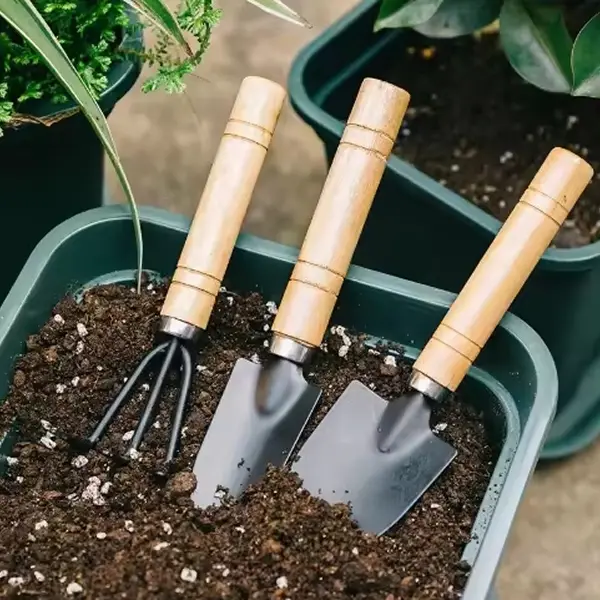





stainless steel garden trowel for landscaping companies
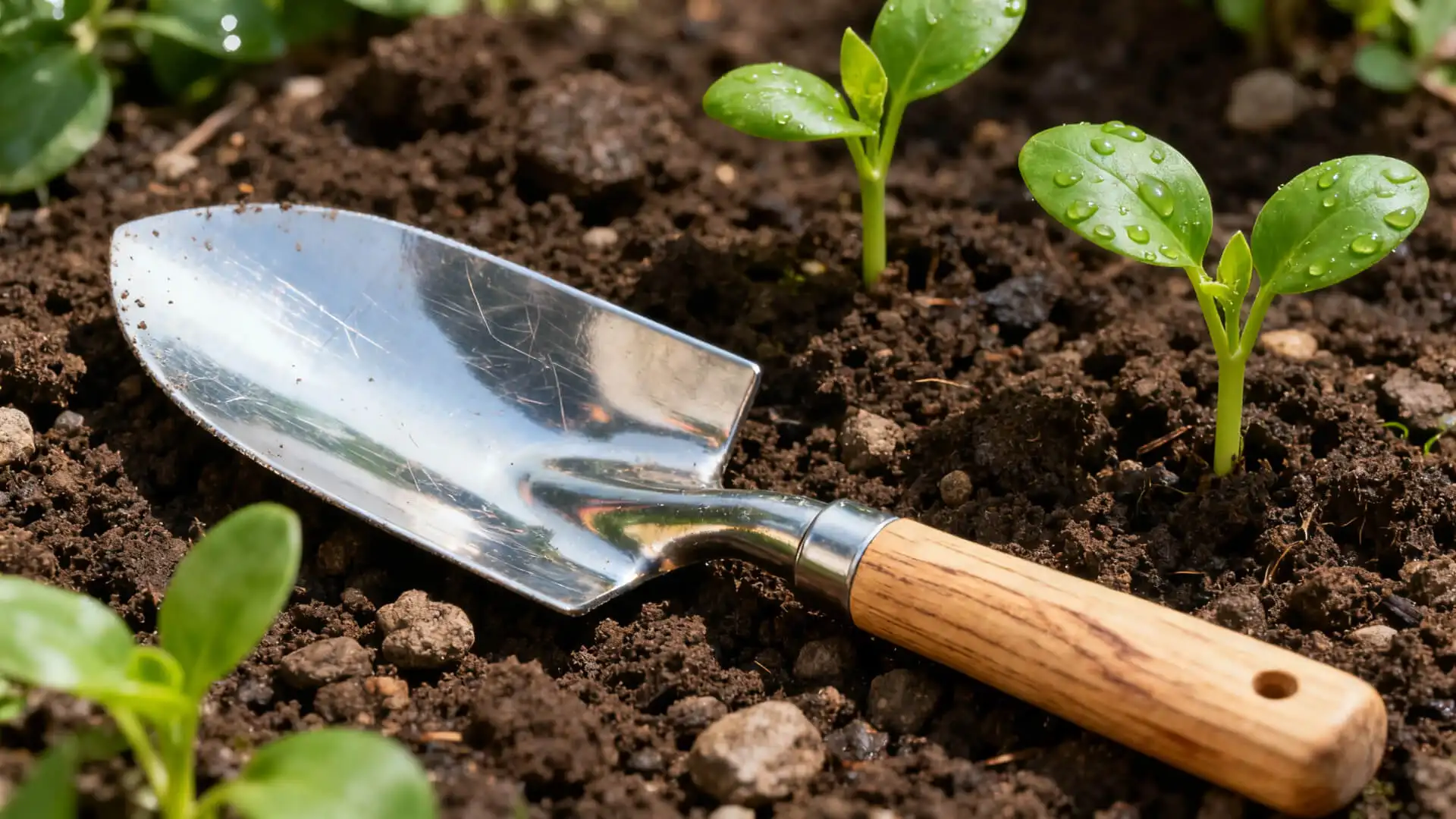
Two trowels sit side by side on a garden centre shelf. Both look like “a stainless steel hand trowel.” But one has a 0.7 mm stamped blade welded to a short tang, while the other is 1.0 mm one-piece forged with a full tang running through the handle. The first will bend in clay soil and crack at the neck within a season. The second will last years.
That gap — between what a trowel looks like and what it actually is — is what this garden trowel buying guide is about. If you have ever received a shipment where half the trowels cracked at the neck within weeks, or had a customer return a “stainless steel” tool covered in rust spots, you already know this gap. It costs real money — in returns, in reputation, in shelf space occupied by products that do not hold up.
Material names alone do not predict performance. Stainless steel does not mean rust-proof. Carbon steel is not automatically stronger. Aluminum cannot be judged by weight alone. What matters is the combination: material grade, blade thickness, tang construction, handle connection, surface finish, and packaging. We will walk through types, materials, construction, cost drivers, QC checkpoints, and packaging — so you can specify the product, not just the material name.
Quick Answer — Which Trowel Fits Which Market?
No single trowel serves every buyer. If you are wondering how to choose garden trowels for your channel, the right answer depends on your customer, climate, price point, and sales channel. Here is a starting point — not a final answer, because final specifications must be confirmed with samples and test data.
| If Your Market Needs | Consider This Direction | Why |
| Premium / humid climate | Polished stainless, one-piece or reinforced tang, wood or ergonomic handle | Passive film resists corrosion; strong neck reduces failure in wet, heavy soil |
| Cost-sensitive kits or promotions | Coated carbon steel, stamped + welded, PP handle, bulk or sleeve packaging | Lower unit cost; coating provides adequate protection if intact |
| Lightweight / container gardening / older users | Aluminum alloy, one-piece cast, cushioned grip | ~1/3 the density of steel; one-piece eliminates neck failure |
| Precise transplanting | Narrow transplanter with depth marks | Blade shape and depth markings suit close-spacing work |
| Gift sets or branded ranges | Stainless or coated carbon, color box or tool set packaging | Presentation and perceived value drive gift purchases |
| Heavy clay or rocky soil | Forged or thick-gauge carbon steel with reinforcement rib | Stiffness and edge durability matter more than corrosion resistance |
Model-specific specifications must be verified. The table above gives direction, not guarantees.
Not Sure Which Trowel Material Fits Your Market? Talk to Us →
Main Types of Garden Trowels
Not every hand shovel is a trowel. The differences in blade shape, depth, and width determine what each tool does well — and B2B buyers who stock only one type leave gaps in their range.
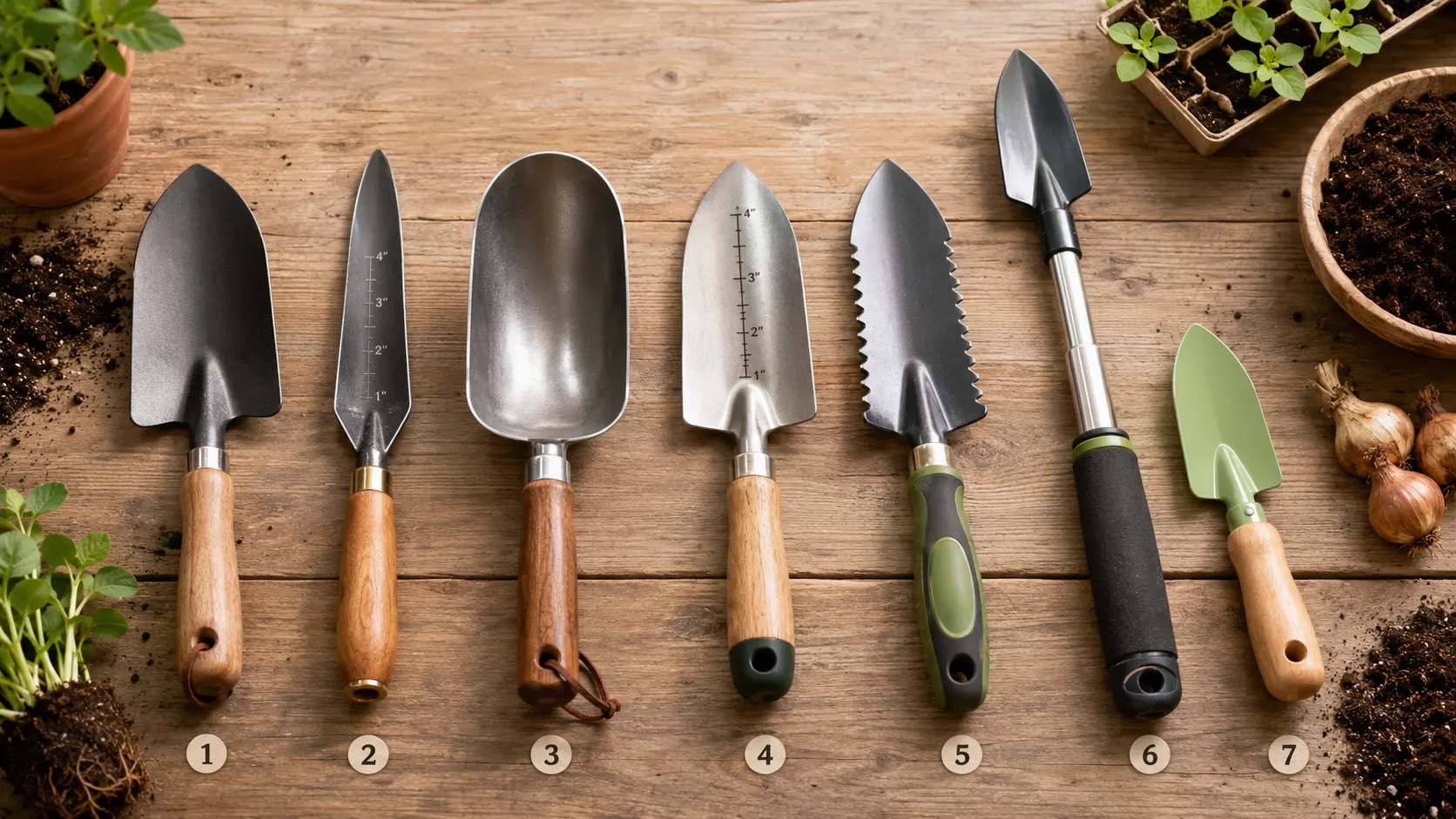
Standard Hand Trowel. The workhorse. A wide blade (typically 5–7 cm), rounded or pointed tip, and moderate depth. Used for digging, transplanting, weeding, and general soil work. This is the SKU most garden centres and hardware stores lead with.
Transplanter (Narrow Trowel). A long, narrow blade (3–5 cm wide) with a pointed tip, often with depth markings molded or etched into the blade surface. Designed for precise transplanting of seedlings and working in tight spacing. The Corona GT 3080, for example, combines a heat-treated carbon steel blade with an extendable aluminum handle.
Soil Scoop. A deep, bowl-shaped blade with high capacity. Built for moving bulk material — potting soil, compost, mulch — rather than precision digging. A soil scoop is not a deeper trowel; it serves a different task. The Burgon & Ball FloraBrite trowel, with its 7 cm wide polished stainless head, is a useful reference point for buyers considering a wider-blade option that bridges trowel and scoop territory.
Depth-Marked Trowel. A standard or transplanter blade with graduated markings (e.g., 1-inch increments). Useful for customers who plant bulbs or seedlings at specific depths. The Corona CT 3314 integrates 1-inch depth marks into its stainless blade.
Serrated / Root-Cutting Trowel. Blade edges carry notches, saw-tooth patterns, or V-shaped notches for cutting through roots and breaking up hard soil. The Radius Root Slayer Trowel uses a tempered, powder-coated carbon steel blade with a root-cutting tip — a functional design, not just a marketing feature.
Long-Handled Trowel. An extended or telescoping handle (18–32 inches) for reduced bending. Not a replacement for a hand trowel; a complement for users who cannot easily kneel. The Corona GT 3080 combines a heat-treated carbon steel transplanter blade with an extendable aluminum handle that locks from 18 to 32 inches — the same tool head, but with reach that changes who can use it.
Children’s Trowel. Smaller blade, lighter weight, shorter handle. Often sold in gift or educational sets. The Burgon & Ball Children’s Trowel uses a stainless steel head with an FSC-certified hardwood handle — but FSC claims apply only when the supplier holds a valid certificate and chain of custody.
Key distinctions: a trowel digs holes; a transplanter places seedlings precisely; a soil scoop moves material. Stocking only standard trowels means missing customers who need transplanters, scoops, or long-handled options.
Stainless Steel vs Carbon Steel vs Aluminum
The stainless steel vs carbon steel garden trowel question is common — but it misses the aluminum option and, more importantly, misses that the material name on a spec sheet tells you less than you think. “Stainless steel” covers more than 100 alloy grades with different chromium, nickel, and carbon contents. “Carbon steel” can mean anything from a low-carbon stamping to a hardened and tempered blade. “Aluminum” might be a die-cast alloy or a forged one. What actually determines performance is grade + construction + finish — not the material family alone. Any serious garden trowel material comparison must look past the label to the specification behind it.
Stainless Steel
Stainless steel’s corrosion resistance comes from a chromium-rich oxide film (the passive layer) that forms naturally on the surface and repairs itself in the presence of oxygen. This is the mechanism behind the “stainless” label — not a coating, and not a guarantee of immunity.
The passive layer has limits. In chloride-rich environments — coastal areas, salt spray, acidic soil — stainless steel can develop pitting corrosion, crevice corrosion, or stress corrosion cracking. “Stainless” does not mean “never rusts.”
Common grades in garden trowels: 420/420J2 (martensitic, hardenable, moderate corrosion resistance), 430 (ferritic, good formability), and 304 (austenitic, superior corrosion resistance but lower hardness). When a supplier lists “stainless steel” without a grade, the performance range is wide — two trowels both called “stainless” can behave very differently.
Stainless trowel blades are typically thinner (0.7–1.0 mm) than carbon steel equivalents and rely on structural design — reinforcement ribs, full tangs, deeper blade curvature — to compensate.
Carbon Steel
Carbon steel lacks sufficient chromium to form a passive film. It depends entirely on a protective coating — powder coat, paint, galvanization, or CO2-cured coatings — to prevent corrosion. Once that coating is breached, the exposed steel corrodes rapidly.
Carbon steel performance depends on three variables: grade (common designations include 45#, 50#, and 65Mn), heat treatment (quenching and tempering can produce hardness above most stainless grades), and coating quality (adhesion testable via ASTM D3359 tape test).
Carbon steel trowel blades are typically thicker (0.8–1.2 mm) and, when properly heat-treated, harder than stainless equivalents. The Radius Root Slayer uses a tempered carbon steel blade with powder-coated enamel — tempering for stiffness, coating for corrosion protection. The main failure risk: coating damage leads to rapid base-metal corrosion.
Aluminum Alloy
Aluminum’s natural oxide film provides good corrosion resistance in most atmospheric environments without additional coating. Its density is roughly one-third that of steel, making it the lightest common trowel material.
But aluminum’s performance depends on alloy grade (ADC12 for die-cast, 6061 for extruded — very different behaviors), forming process (die-cast, forged, or extruded), and section design (because aluminum is less stiff than steel, it requires thicker sections or reinforcement ribs for comparable rigidity).
The Corona CT 3010I uses a one-piece polished aluminum alloy construction — eliminating neck and weld failure risks entirely, but with blade hardness typically lower than steel. Aluminum trowels fit a specific niche: lightweight tools for container gardening, older users, and humid markets where corrosion resistance matters more than raw stiffness. They are not a universal replacement for steel.
Three-Way Material Comparison
| Dimension | Stainless Steel | Carbon Steel (Coated) | Aluminum Alloy |
| Corrosion resistance | Good — passive film self-repairs, but pitting possible in chloride environments | Depends on coating integrity — once breached, base corrodes fast | Good — natural oxide film, but vulnerable to strong acids/alkalis |
| Weight | Medium | Medium–Heavy | Light (~1/3 of steel) |
| Stiffness / Strength | Medium–High (depends on grade and gauge) | High (depends on grade and heat treatment) | Low–Medium (depends on alloy and section design) |
| Surface finish | Polished / brushed / coated | Must be coated (powder / paint / galv) | Anodized / polished |
| Maintenance | Low — clean and dry | Medium–High — coating damage needs repair | Low |
| Typical retail positioning | Mid-premium / gift | Entry–Mid | Lightweight / special-use |
| Main failure risk | Pitting in chloride environments; edge curling on thin blades | Coating delamination → base corrosion; neck cracking | Bending in hard soil; edge wear |
| Typical blade thickness | 0.7–1.0 mm | 0.8–1.2 mm | 1.0–2.0 mm (thicker to compensate for lower stiffness) |
All comparisons above are conditional. Actual performance depends on grade, thickness, heat treatment, coating, construction, and use environment. No material is universally “better.”
Want to Compare Materials Side by Side? Let Us Send You Samples →
Construction Determines Strength
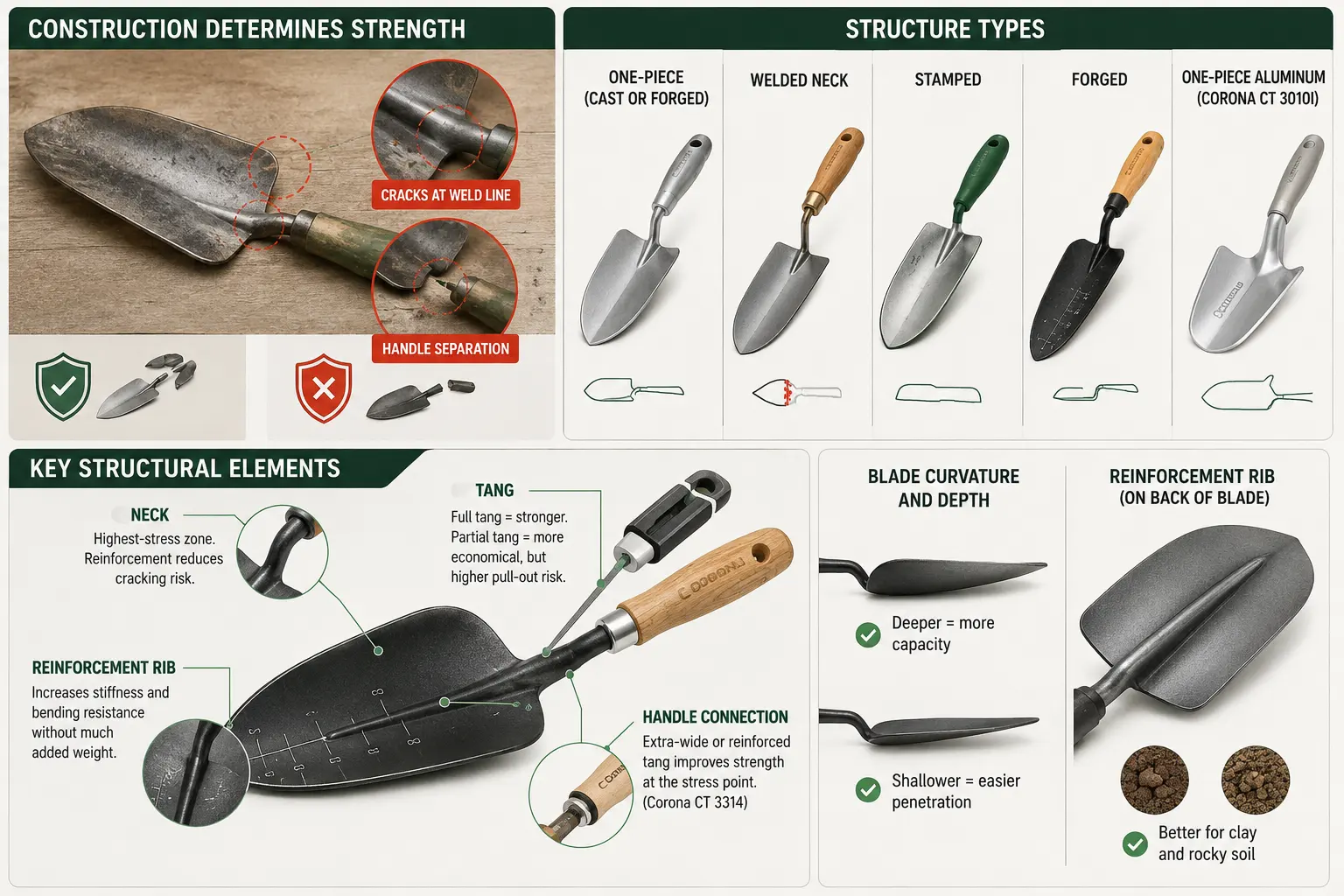
A thick, high-grade blade will still fail if the neck cracks or the tang pulls out of the handle. In trowels, geometry and connection design often matter more than material choice.
Here is what that looks like in practice: a distributor opens a carton of 200 trowels. Twelve have cracks at the weld line. Three handles have already separated from the tang. The material is fine — the construction failed. That is the difference between a trowel that sells once and a trowel that sells again.
Structure Types
One-piece (cast or forged). Blade and tang formed as a single unit. No welds, no joints under stress. The Corona CT 3010I is one-piece aluminum — eliminating neck failure entirely. One-piece forged steel is the strongest construction but the most expensive.
Welded neck. Blade and tang manufactured separately, then joined. The most common mid-range construction. The weld zone is a stress concentrator — poor weld quality (incomplete penetration, porosity, misalignment) leads to neck cracking under repeated loading.
Stamped. Blade cut and formed from sheet steel in a press. Low cost, but thickness is limited. Stamped blades depend on curvature and ribs for stiffness.
Forged. Heated metal shaped under pressure, producing continuous grain flow. Stronger than stamped or cast equivalents of the same material, but higher tooling cost.
Key Structural Elements
- Tang. The extension of the blade that enters the handle. A full tang runs the entire handle length — the strongest connection. A partial tang enters only partway — more economical but more prone to pull-out under heavy use. The Corona CT 3314 specifies an “extra-wide reinforced tang,” which increases the cross-section at the stress point.
- Neck. The transition zone between blade and handle — the highest-stress region on any trowel. A reinforced neck, wider tang, or smooth radius reduces the stress concentration that causes cracking.
- Reinforcement rib. A raised spine along the back of the blade. It increases the section’s moment of inertia, improving bending resistance without adding much weight. If your customers work in clay or rocky soil, a ribbed blade is a practical upgrade over a flat one.
- Blade curvature and depth. A deeper blade holds more soil but may be harder to push into dense ground. A shallower blade penetrates more easily but carries less per scoop. The right profile depends on your market’s soil conditions.
Common Failure Modes
| Failure Mode | Cause | High-Risk Construction |
| Blade bending | Insufficient section stiffness or material hardness | Thin stamped blades; aluminum in hard soil |
| Neck cracking | Stress concentration + fatigue | Welded necks with poor weld quality; narrow tangs |
| Weld failure | Poor weld penetration, porosity, or misalignment | Welded construction with inadequate QC |
| Handle pull-out | Tang too short or handle connection too weak | Partial tang with press-fit connection |
For buyers: When comparing trowels from different suppliers, look at the neck and tang before you look at the material label. A carbon steel trowel with a reinforced tang and good weld will outlast a stainless trowel with a thin, weak neck. Every time.
Handle Materials and Ergonomics
The handle is where your customer’s hand meets the tool. A trowel with an excellent blade and an uncomfortable or fragile handle will be returned. A garden centre customer picks up two trowels — same blade, same price. One has a bare PP handle; the other has TPR overmold. The second one goes in the basket, because it felt right in the hand. Handle material is not a secondary spec; it is the first thing your customer touches.
Handle Materials
| Material | Advantages | Limitations | Channel Fit |
| Wood (hardwood) | Classic feel, warm touch, FSC certifiable | Swells or cracks if wet; needs maintenance | Mid-premium / gift |
| PP (polypropylene) | Lightweight, economical, weather-resistant | Hard surface, no cushioning, slippery when wet | Entry–Mid |
| TPR overmold | Soft grip, shock absorption, wet-hand traction | Overmold can delaminate over time | Mid–Premium |
| Fiberglass / all-metal | Extreme durability, all-weather | Heavy, cold feel, higher cost | Professional / industrial |
Ergonomic Parameters That Matter
- Grip diameter. Too thick reduces grip force; too thin increases pressure on the palm.
- Hand clearance. Space for fingers — especially important when users wear gardening gloves.
- Wet grip. TPR and overmolded handles outperform bare PP or lacquered wood when hands are wet or muddy.
- Finger guard. A stop or flange between blade and handle that prevents the hand from sliding forward onto the blade edge. The Corona CT 3314 includes this feature.
- Hanging hole. A small detail that matters for retail display and storage.
- Handle length. Affects leverage and posture. Longer handles reduce wrist strain but reduce precision.
A Note on Ergonomic Claims
Ergonomic trowel designs — curved handles, angled blades, oversized grips — can reduce wrist strain for some users. But a study comparing an ergonomic trowel (35.5 cm, 333 g) with a standard one (28 cm, 155 g) found that the ergonomic model’s weight was significantly higher, and weight matters too (Tebben & Thomas, American Journal of Occupational Therapy, 2004). “Ergonomic” is not automatically better; it is a design trade-off.
FSC Claims
If a trowel handle is marketed as “FSC-certified,” the claim is only valid if the supplier holds a current Forest Stewardship Council certificate with a matching chain of custody. B2B buyers must verify the certificate and scope before making the same claim in their own marketing.
What Actually Changes the Cost?
Listing a “factory price” for trowels is misleading, because the unit cost depends on at least eleven variables. Understanding these variables — the core of any garden trowel sourcing guide — helps you compare quotes on equal terms and spot where a low price hides a specification compromise.
| Cost Variable | Effect on Unit Cost | What to Check |
| Material grade | 304 SS > 420 SS > carbon steel > aluminum alloy (in typical material cost per kg) | Grade on mill certificate — “stainless” without a grade is not a specification |
| Blade thickness | Thicker = more material + harder forming | Measure with a micrometer on the sample |
| Forming method | Stamped < cast < forged | Forged is the strongest but most expensive |
| Heat treatment | Quench + temper adds process cost | Required for most carbon steel; grade-dependent for stainless |
| Surface finish | Matte < polished < powder-coated | Coating type and thickness affect both cost and durability |
| Construction | Stamped + welded < one-piece cast < one-piece forged | The biggest cost driver after material |
| Handle | PP < TPR overmold < wood < fiberglass | FSC certification for wood adds cost and documentation |
| Depth marks | Adds a step (molded or etched) | Verify marking accuracy on the sample |
| Logo/branding | Silkscreen, laser engraving, or embossing | One-time setup fee + per-unit cost |
| Packaging | Bulk OPP < sleeve < hang card < color box | Packaging can represent an estimated 10–30% of unit cost (varies by product and market) |
| MOQ | Lower MOQ = higher unit price | 1,000 pieces is a common starting point |
One-time costs vs. per-unit costs. Custom blade shapes require tooling (mold or die). Logo printing and color box artwork require setup fees. These are paid once and amortized across the order. Do not compare a per-unit quote that includes tooling amortization with one that lists tooling separately. In bulk trowel sourcing, the specification sheet is your only equalizer — without it, you are comparing apples to oranges.
No single factory quote represents an industry average. Price depends on specification, quantity, payment terms, and date. We have seen quotes for the same trowel specification vary by 40% across factories — not because one is overcharging, but because they were quoting on different blade thicknesses, different coating processes, and different MOQ tiers. That is why the specification sheet matters more than the price line. When you request quotes, send the same specification sheet to multiple suppliers and compare like-for-like.
Garden Trowel QC Checklist
Before you commit to a bulk order, confirm that what you approved on the sample is what you will receive in production. This checklist covers the critical checkpoints for garden trowels — not a generic “check appearance” list, but specific tests tied to real failure modes.
| # | Checkpoint | Method / Standard | Fail Condition |
| 1 | Material verification | Mill certificate, spectrometer analysis, or magnetic test (austenitic SS is non-magnetic or weakly magnetic) | Grade does not match specification |
| 2 | Dimensions / weight / thickness | Caliper, micrometer, electronic scale — compare against spec sheet | Outside tolerance |
| 3 | Blade symmetry and burrs | Visual + tactile inspection — no sharp burrs on edges | Asymmetry or burrs that could cut hands |
| 4 | Bend / deformation | Static load bend test — buyer and supplier agree on load and deflection limit | Permanent deformation exceeds agreed limit |
| 5 | Neck / weld | Visual inspection; non-destructive testing for welded construction | Cracks, incomplete penetration, porosity |
| 6 | Handle pull | Pull-out test — buyer and supplier agree on force and direction | Handle loosens or separates |
| 7 | Coating adhesion | ASTM D3359 tape test | Adhesion rating below agreed grade |
| 8 | Corrosion resistance | ASTM B117 salt spray — buyer and supplier agree on exposure time and pass criteria | Base metal corrosion or coating blistering |
| 9 | Depth marking accuracy | Caliper measurement of marking intervals | Deviation exceeds agreed tolerance |
| 10 | Logo durability | Rub test or tape test | Logo peels, smears, or becomes illegible |
| 11 | Packaging protection | ASTM D5276 free-fall drop test or ISTA 1A / 3A | Product damaged after test |
Important Notes on Test Standards
- ASTM B117 specifies the salt spray apparatus and operating procedure. It does not set a universal exposure time or pass/fail criteria for any product. Buyer and supplier must agree on hours of exposure, number of samples, and what constitutes failure before testing begins.
- ASTM D3359 provides the tape-test method for coating adhesion. The classification (0B through 5B) must be agreed in the purchase contract — there is no default “pass” grade for trowel coatings.
- ASTM D5276 and ISTA 1A / 3A describe drop-test procedures for loaded containers and parcel shipments. Without an actual test report, you cannot claim “drop-test certified.”
- ISO 2859-1:2026 provides sampling plans indexed by AQL. Common AQL levels for hand tools: Critical 0, Major 1.0–2.5, Minor 2.5–4.0. AQL is negotiated — it is not a fixed universal value.
Need a Trowel QC Checklist for Your Next Order? Talk to Us →
Packaging and Freight Planning
Trowels are low unit-price items. That means garden trowel packaging and freight can represent a significant share of landed cost — sometimes more than the tool itself. Choosing the right packaging is not just a presentation decision; it is a cost and protection decision.
Packaging Types
| Type | Description | Best For |
| Bulk (OPP bag) | Each piece in a thin plastic bag, loose in carton | Distributors, re-packers, lowest freight cost |
| Sleeve | Printed cardboard sleeve over the blade | Distributors, basic retail info at low cost |
| Hang card | Blister or tie-mount on a printed card with peg hook | Garden centres, hardware stores — peg-wall display |
| Open box | Windowed box showing the product | Garden centres — shelf display with visibility |
| Color box | Full-print retail box with branding | Gift lines, branded ranges, mid-premium retail |
| Tool set | Multiple tools in a single box or tray | Gift sets, e-commerce bundles, higher per-set value |
What to Check in Packaging
- Pieces per inner and master carton. Typical configurations range from 6 to 50 pieces per carton depending on tool size and packaging type.
- Carton dimensions and CBM. Bulk-packed trowels pack more densely than hang-carded ones. A 1,000-piece order in bulk may occupy significantly less CBM than the same order on hang cards — and CBM drives sea freight cost.
- Net weight and gross weight. Needed for freight calculation and customs declaration.
- Edge and point protection. The blade tip and the neck-to-handle junction need padding or card protection to prevent puncture damage and coating scratches during transit.
- Mixed-container loading. Trowels can share containers with other hand tools. Actual loading plans should use real CBM data for each product — estimates are not a substitute for measurements.
Do not write “drop-test certified” unless you have a test report that specifies the procedure, conditions, and results for your actual product and packaging.
Need Carton Data and Packaging Options for Your Order? Talk to Us →
How Buyers Can Build a Trowel Product Range
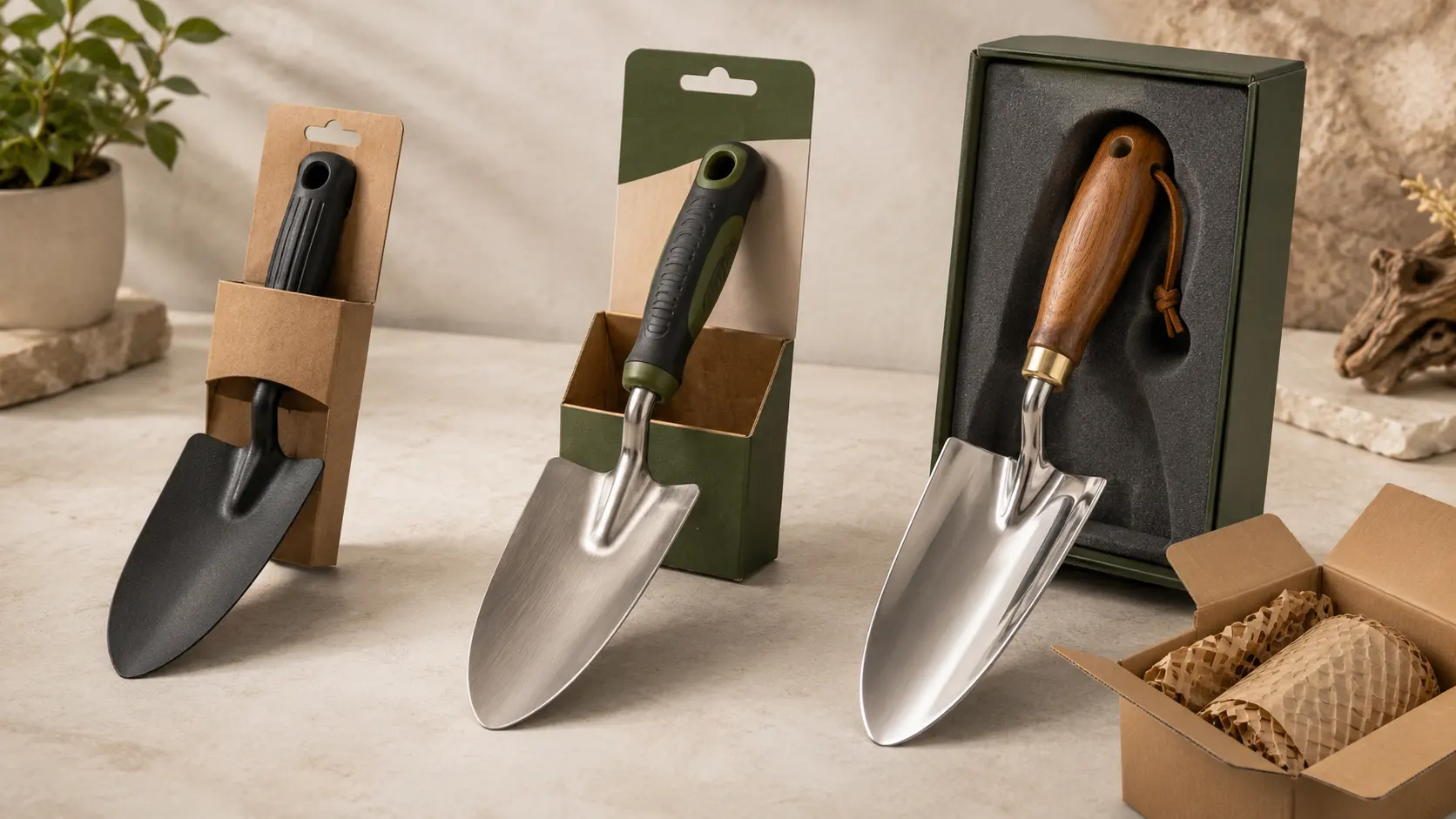
A product range built around material names (“we stock stainless and carbon”) misses the point. If you are learning how to choose garden trowels for your channel, the right approach is to build around specification + structure + packaging combinations that match your channels and customers — and trowel selection for retailers works best when it starts from the end user’s task, not from the material label.
Three-Tier Framework
Entry. Coated carbon steel, stamped + welded, PP handle, bulk or sleeve. Price-competitive — for promotions, kit inclusions, and markets where low unit cost matters. A well-made entry trowel with adequate coating and a decent weld beats a poorly made “stainless” one at the same price.
Mid-market. Verified-grade stainless or well-coated carbon steel, reinforced tang, TPR overmold or wood handle, hang card or open box. The core of a garden centre or hardware range — good enough for regular use, presentable on a peg hook, priced to turn.
Premium / Gift. Polished stainless or forged construction, wood or ergonomic handle, color box or tool set. Perceived value, presentation, and gift appeal drive the sale.
Material does not equal tier. A forged, powder-coated carbon steel trowel with a TPR handle can legitimately sit in the mid-market or even premium tier. A thin, stamped stainless blade with a basic PP handle belongs in the entry tier. Grade, construction, and finish — not the material family — determine positioning. This is why garden trowels for B2B buyers should be specified by their full combination, not by material alone.
E-Commerce Considerations
For online sales, three factors matter more than in-store:
- Weight — affects shipping cost and return likelihood if the tool feels “too heavy” or “too flimsy.”
- Protection — parcel delivery involves more drops and impacts than palletized store delivery. E-commerce packaging needs extra cushioning.
- Specification clarity — online returns often come from “not what I expected.” Blade dimensions, material, and intended use must be stated precisely in the listing.
Sample Approval Checklist
Before bulk production begins, freeze these specifications against your approved sample. Any deviation in production should trigger a hold and re-check.
| # | What to Confirm | Method |
| 1 | Overall dimensions (length, blade width, blade depth) | Caliper |
| 2 | Weight | Electronic scale |
| 3 | Blade thickness | Micrometer |
| 4 | Material and surface finish | Mill certificate + visual |
| 5 | Blade flex under agreed load | Bend test |
| 6 | Neck / tang condition | Visual + dimensional |
| 7 | Handle comfort and connection | Hand test + pull-out test |
| 8 | Logo (position, size, clarity, durability) | Visual + rub/tape test |
| 9 | Unit packaging (size, protection, information) | Visual + drop test |
| 10 | Carton data (dimensions, piece count, NW/GW, CBM) | Tape measure + scale |
Establish a golden sample. Keep one approved sample as the reference standard. When production arrives, compare against the golden sample — not against memory or a photo.
FAQ
Is stainless or carbon steel better for garden trowels? Neither is universally better. Stainless offers better inherent corrosion resistance but may be thinner and less stiff at the same price point. Carbon steel, when properly heat-treated and coated, can be harder and stiffer — but depends entirely on coating integrity. The right choice depends on climate, customer expectations, and the specific garden trowel materials in question.
Why do some trowels bend? Insufficient section stiffness — a blade too thin, a material too soft, or a design without a reinforcement rib. Aluminum in heavy clay is particularly vulnerable. Construction (ribbed vs. flat, forged vs. stamped) often matters more than the material name.
What is the difference between a trowel and a transplanter? A trowel has a wider blade (5–7 cm) for general digging. A transplanter has a narrow blade (3–5 cm), often with depth markings, for precise seedling placement. They serve different tasks and both belong in a well-stocked range.
How should buyers test the handle connection? Request a pull-out test: apply an agreed force along the handle axis and measure whether the handle loosens or separates. There is no universal standard force — buyer and supplier must agree on the test value before production.
Can trowels share containers with other hand tools? Yes. Use real CBM data for each product to plan mixed loading. Ensure blade tips are protected to prevent damage to adjacent tools.
What affects MOQ and freight? MOQ is driven by production run efficiency, packaging setup, and custom requirements. Lower MOQs carry higher per-unit prices. Freight is driven by CBM and weight — bulk packaging minimizes both.
Conclusion: Specify the Product, Not Just the Material
A “stainless steel trowel” is not a complete specification. Neither is a “carbon steel trowel” or an “aluminum trowel.” What you need to specify — and what your customers need you to get right — is the full package: material grade, blade thickness, construction type, tang design, handle material and connection, surface finish, depth marks, logo method, packaging type, and carton data.
That is what this garden trowel buying guide has walked through: types, materials, construction, cost drivers, QC checkpoints, packaging, and range design. Each section adds a variable you can specify, test, and verify — instead of relying on a material name and hoping for the best. Specify the product. Not just the material.
For garden trowel wholesale options, specifications, and packaging plans, send us your product list, reference photos, target market, estimated quantities, and packaging requirements. We will help you compare options, verify specifications, and put together a sourcing plan that works.
Building a Trowel Range? Let’s Figure It Out Together →
Source notes available on request. All brand product specifications cited in this article are from official product pages and represent only the named model. ASTM and ISO standards are referenced for test method descriptions only — they do not constitute certification or compliance claims. FSC claims require valid supplier certificates and chain of custody documentation.
Written by
ScarecrowGarden
💡About Scarecrow Garden Supplier Co., Ltd.
Scarecrow Garden Supplier Co., Ltd. is a China-based sourcing and wholesale partner specializing in garden tools, landscaping equipment, and outdoor supplies for international wholesalers, distributors, contractors, and brands.
With hands-on experience rooted in real garden use scenarios, we focus on durable materials, functional design, and stable large-volume supply. Our product range covers pruning tools, watering systems, hand tools, outdoor hardware, and customized garden solutions to support both retail and professional landscaping markets.
Beyond products, we help our partners navigate supplier selection, quality control, compliance requirements, and long-term sourcing strategies in China. Through our blog, we share practical insights on product selection, material comparisons, industry trends, and cost-effective purchasing—helping global buyers build stronger, more competitive supply chains.