








Types of Garden Shears: A Complete Guide for Home Gardeners | Scarecrow Garden Supplier
A garden centre buyer stocks three SKUs of pruning shears — all bypass, all the same size. Come spring, customers ask for flower snips. None in stock. An orchard distributor orders a pallet of hand pruners but no pole pruners — then watches his customers go elsewhere for high-branch tools. An e-commerce seller lists a pruner as “cuts up to 25 mm” without specifying green or dry wood — and the returns roll in.
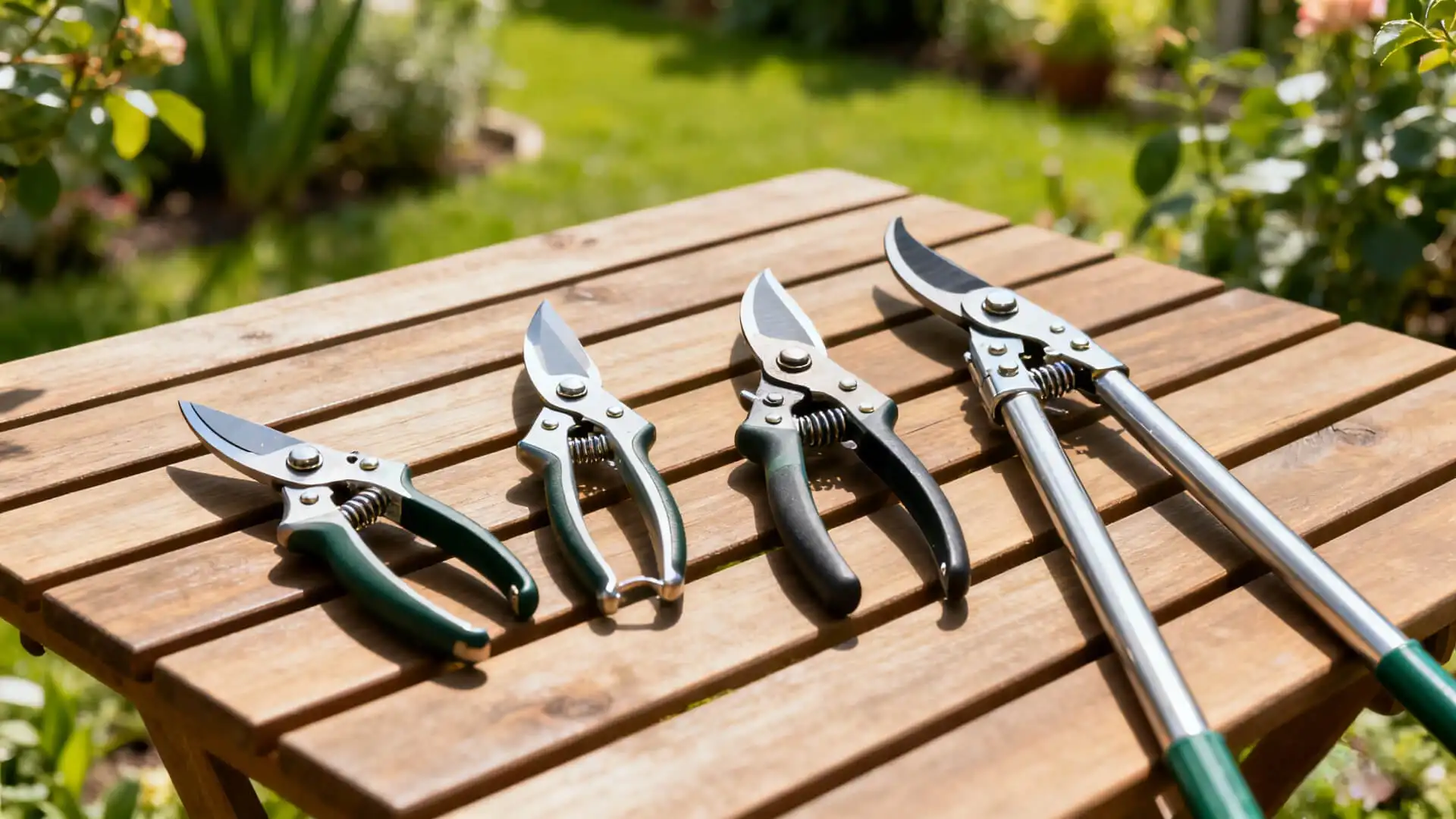
These are not hypothetical problems. They happen when buyers treat “garden shears” as one product category rather than a set of tools designed for different tasks, different plants, and different users. The main types of garden shears — pruning shears, flower snips, loppers, hedge shears, and pole pruners — differ in cutting action, blade shape, handle length, and the plants they are meant to cut. Understanding these differences is the first step to building a product range that matches what your customers actually do in their gardens.
This guide covers the different types of garden shears by cutting action and task, explains the specifications that matter for wholesale buyers, provides a QC checklist for incoming inspection, and shows how to build channel-specific product combinations. It is written for garden centres, nurseries, hardware retailers, distributors, landscaper suppliers, and e-commerce buyers sourcing garden tools from China.
Quick Comparison of the Main Types of Garden Shears
Use this table to match tool types to your customers’ tasks before reading the detail sections.
| Type | Cutting Action | Typical Task | Branch / Plant Context | Primary Buyers | Principal QC Risk |
| Pruning shears (bypass) | Two curved blades pass like scissors | Live-stem pruning, shaping | Green stems, live branches up to approx. 20 mm | Garden centres, e-commerce, professional gardeners | Blade alignment and gap; lock reliability |
| Pruning shears (anvil) | Single blade presses onto flat anvil | Dead wood, dry branches | Hard, dry wood up to approx. 25 mm | Orchards, landscape maintenance | Anvil surface wear; crushing damage on live stems |
| Pruning shears (ratchet) | Multi-step ratchet lever | Thick branches, users with reduced grip strength | Branches up to approx. 24 mm | Garden centres, elderly-gardening ranges | Ratchet mechanism wear; not suited to fast pruning |
| Flower snips | Straight or slightly curved fine blades | Flower stems, herbs, harvesting | Soft stems up to approx. 10 mm | Garden centres, floristry, e-commerce | Tip deformation; pivot looseness; packaging puncture |
| Loppers | Bypass or anvil with long handles for leverage | Thick branches beyond hand-pruner range | Branches from 20 mm to approx. 50 mm | Orchards, landscape, hardware stores | Handle fracture; joint bolt looseness; telescopic lock failure |
| Hedge shears (manual) | Long straight blades shear multiple stems at once | Hedge shaping, bush trimming | Multiple thin, green stems simultaneously | Garden centres, landscape | Blade straightness; closing gap; bolt looseness |
| Pole pruners | Rope-and-pulley or gear mechanism on extension pole | High branches, overhead pruning | Branches up to approx. 30 mm, at height | Orchards, professional arborists | Extension lock; rope jam; parts detachment; drop risk |
Cutting capacity values are approximate and model-specific. A pruner rated for “20 mm” on soft green wood may struggle with 15 mm of hard, dry wood. Always confirm the manufacturer’s rated capacity for the specific model and test against the wood types your customers commonly cut.
Need help deciding which pruning tools to stock? Send us your target market, sales channel, and current product list — we will recommend a shortlist with model numbers, specifications, and packaging options. Get a Pruning Tool Shortlist
How Garden Shears Are Classified
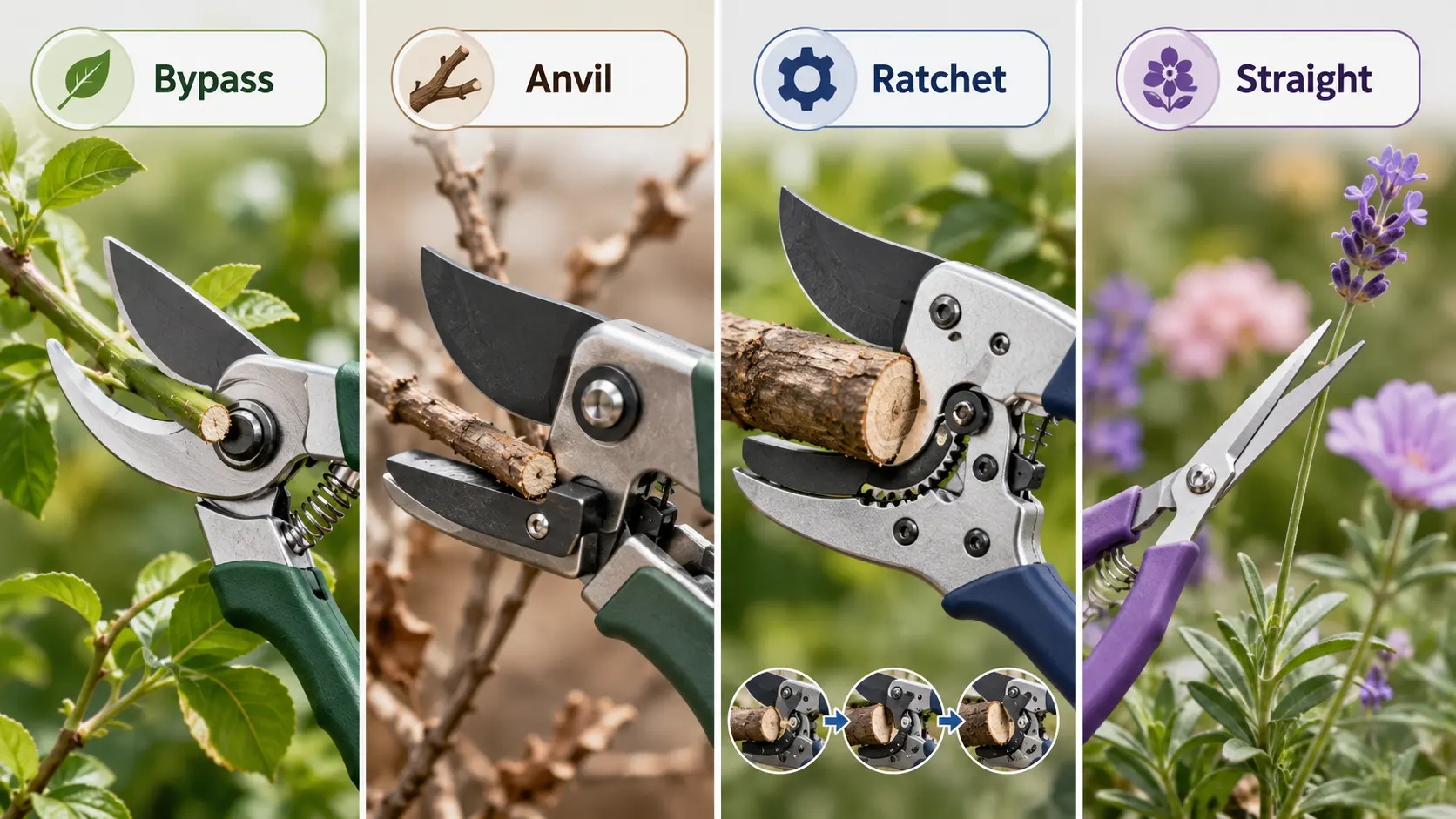
Garden shears can be sorted two ways: by the mechanical action that does the cutting, and by the gardening task the tool is designed for. These are two different dimensions — a bypass action appears in both hand pruners and loppers, and a single task (cutting thick branches) can be served by either a ratchet pruner or a lopper depending on the user and the height of the branch.
By Cutting Action
Bypass — Two curved blades pass each other like scissors. One is the cutting blade, the other the hook or counter-blade that holds the branch. Bypass cuts are clean on live wood because the blades slice through rather than crush. This is the most common action for general-purpose pruning shears. [C001]
Anvil — A single straight blade chops down onto a flat metal or plastic surface (the anvil). The action is like a knife on a cutting board. Anvil cuts are fast and effective on dry, hard wood but can crush or bruise live stems because the branch is squeezed against the anvil before it severs. [C002]
Ratchet / Compound — A ratchet mechanism lets the user cut through a thick branch in several incremental squeezes rather than one hard grip. Each squeeze advances the blade a step; the ratchet holds position between squeezes. This reduces the hand force required, making ratchet pruners useful for users with limited grip strength or for branches at the upper end of a hand pruner’s range. The trade-off: cutting is slower because each cut requires multiple pumps. [C003]
Straight / Scissor — Two thin, straight blades meet at the tip like scissors. This action is used in flower snips and harvesting shears, where precision matters more than power. [C004]
By Task
| Task | Tool Category | What This Means for Your Range |
| Precision cutting (flowers, herbs, harvest) | Flower snips | Add to any range serving floristry or herb gardening; strong gift-set and e-commerce potential |
| Live-stem pruning (roses, shrubs, fruit trees) | Bypass pruners / secateurs | Default core SKU for most channels; stock at least one model |
| Dead wood removal (dry branches, old growth) | Anvil pruners | Secondary for general retail; primary for orchard and landscape channels |
| Thick branches beyond hand strength | Ratchet pruners or loppers | Ratchet for older gardeners; loppers for professional and heavy-duty use |
| Hedge and bush shaping | Manual hedge shears | Seasonal demand spike in spring; pair with long-handled loppers in display |
| High or overhead branches | Pole pruners | Niche but essential for orchard and tree-care channels; check pole material for safety |
Bypass vs. Anvil: A Quick Summary
Bypass pruners cut like scissors — two blades pass each other, producing a clean slice ideal for live stems. Anvil pruners chop like a knife on a board — one blade presses onto a flat surface, which works well for dry wood but can bruise live tissue. For a full comparison of cutting performance, blade geometry, maintenance, and which buyers should prioritise each type, see our dedicated guide: Bypass vs. Anvil Pruners.
Pruning Shears and Secateurs
Pruning shears (called secateurs in British English, hand pruners in American English) are the single most sold category of garden cutting tools. They are hand-held, one-handed tools used for cutting stems and branches up to roughly 25 mm depending on the model.
Bypass, Anvil, and Ratchet: Purchasing Roles
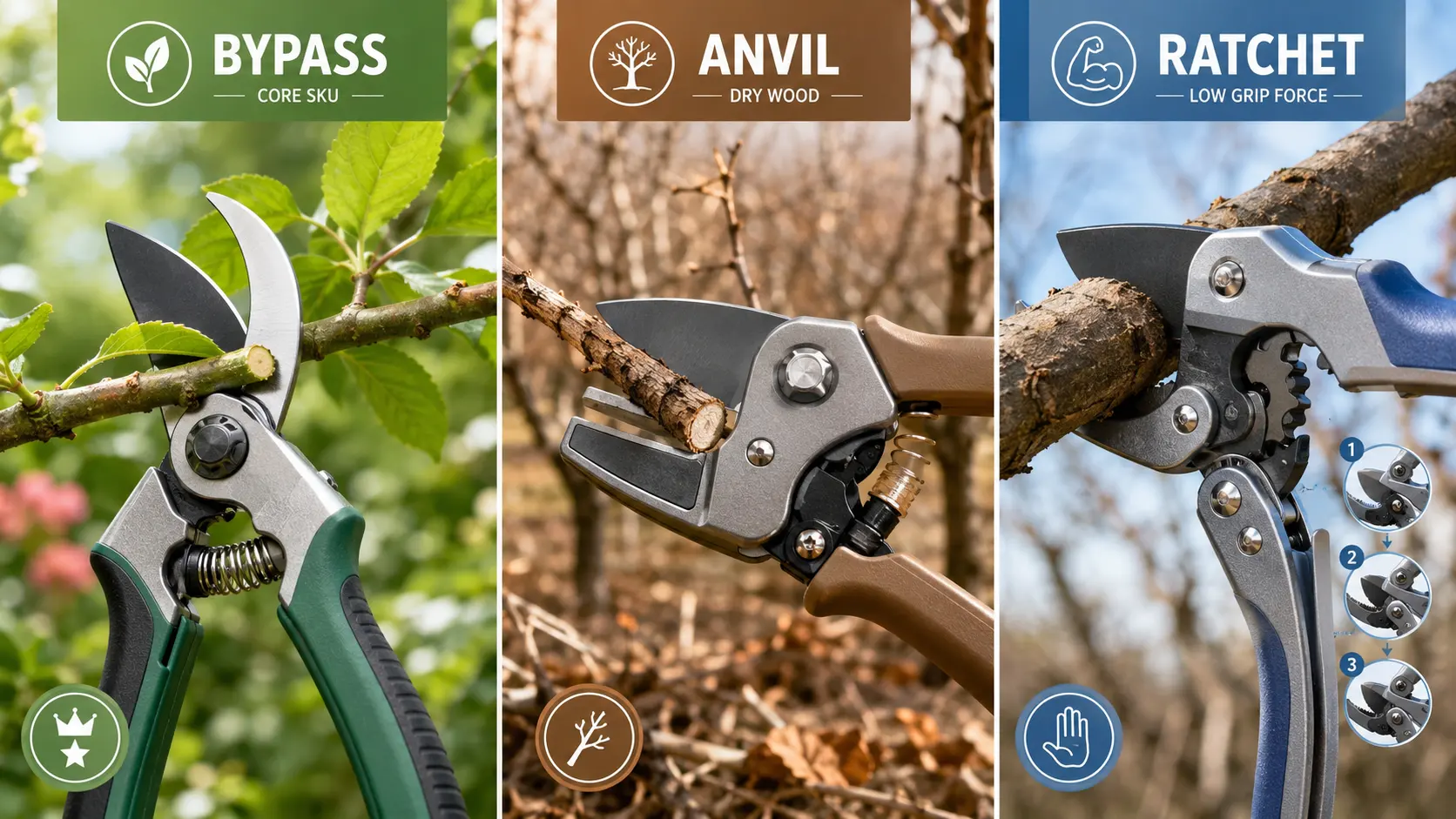
Bypass pruners are the default choice for general pruning — the core SKU that most channels should stock first. They produce clean cuts on live wood, which helps plants heal quickly. If you carry only one pruning shear, make it a bypass. [C001]
Anvil pruners serve customers who primarily cut dead or dry wood — orchard maintenance, clearing old growth, end-of-season cleanup. They are a secondary SKU for most garden retailers but a primary one for orchard and landscape suppliers. [C002]
Ratchet pruners address a specific need: users who cannot generate enough grip force for a standard pruner. This includes older gardeners, people with arthritis or hand injuries, and anyone regularly cutting branches near the tool’s maximum capacity. They are a niche but valuable addition to a range that serves an ageing customer base. The trade-off is speed — each cut requires multiple pumps of the handle, so they are not suited to fast, repetitive pruning. [C003]
Key Specifications to Confirm Per Model
| Specification | Why It Matters for Buyers | What to Ask |
| Cutting capacity (mm) | Determines the maximum branch diameter the tool is designed for | “Is this rated for green wood, dry wood, or both? Under what test conditions?” |
| Handle size / hand fit | A pruner too large or too small for the user’s hand causes fatigue and poor control | “Do you offer small / medium / large handle sizes? Is there a left-handed version?” |
| Blade material and treatment | Affects edge retention, rust resistance, and replacement frequency | “What steel grade is used? Is there a heat treatment specification? What coating?” |
| Safety lock type | Must hold reliably open and closed; accidental closure causes injuries | “What type of lock (thumb catch, wire latch, squeeze-to-open)? How many cycles tested?” |
| Spring type and retention | Coil springs can detach; flat springs can fatigue | “Is the spring captive (held in place even if it unseats)? How is it retained?” |
| Pivot mechanism | Loose pivots cause blade separation and rough cuts | “Is the pivot adjustable? What fastener type (nut, rivet, screw)?” |
| Replaceable parts | Affects product lifespan and after-sales revenue | “Which parts are replaceable — blade, spring, lock, handle? Are they available separately?” |
On hand size: FELCO, a Swiss manufacturer, measures hand size as the distance from fingertip to the base of the palm: small (≤ 17.5 cm), medium (17.5–20 cm), and large (> 20 cm). This is one brand’s method; other manufacturers may use different sizing. The point for buyers: if your market includes a significant proportion of smaller-handed users (common in East Asian and some European markets), verify that the models you stock fit those hands. [C012, C013, C016]
On cutting capacity: A pruner labelled “cutting capacity 20 mm” typically means it can sever a 20 mm branch of soft, green wood in a single squeeze by a user with average grip strength. The same tool may not cut 20 mm of hard, dry oak. Rated capacity is model-specific and condition-specific — it is not a universal guarantee. [C005]
Flower Snips and Harvesting Shears
Flower snips (also called harvesting shears, herb scissors, or floral snips) are precision cutting tools designed for soft stems, flower stalks, herbs, and light harvesting. They are not pruning shears — the blades are thinner, the tips are finer, and the cutting capacity is much lower (typically ≤ 10 mm). [C004]
What Makes Flower Snips Different from Pruning Shears
| Feature | Pruning Shears | Flower Snips |
| Blade shape | Curved, robust | Straight or slightly curved, fine-tipped |
| Cutting action | Bypass or anvil | Straight / scissor |
| Cutting capacity | 15–25 mm | ≤ 10 mm |
| Typical weight | 170–260 g | 80–100 g |
| Lock mechanism | Thumb catch or wire latch | Often none, or small slide lock |
| Primary use | Woody stems, branches | Soft stems, flowers, herbs |
| Typical buyer | General gardener, professional | Floristry, herb gardener, harvest worker |
What to Verify Before Ordering
- Tip durability: Fine tips bend easily if the user tries to cut woody stems. Check that the tip material and thickness are adequate for the intended use, and that the product description does not encourage use beyond its capacity.
- Pivot tightness: A loose pivot on a lightweight snip causes the blades to separate rather than cut cleanly. Test by cutting thin flower stems — if the stem folds rather than severs, the pivot is too loose.
- Sap and residue cleaning: Some plants (e.g., succulents, roses) produce sticky sap that gums up the blades. Stainless or coated blades are easier to clean. If your customers grow these plants, recommend models with non-stick coatings.
- Packaging puncture risk: The sharp, fine tips of flower snips can puncture thin blister packs or card inserts. Verify that the packaging protects the tips during shipping and display — a snip that pierces its own packaging creates both a safety hazard and a returns problem.
Retail and E-Commerce Opportunities
Flower snips pair well with other products in gift sets and starter kits: a snip + a bundle of plant labels + a pair of thin gardening gloves makes an attractive gift package. For e-commerce, their light weight (under 100 g) and compact size make them inexpensive to ship.
Consider this combination: a 3-piece floral gift set — flower snips, bamboo plant labels, and thin nitrile gloves — in a printed kraft box. The set retails at an estimated $15–20, ships as a small parcel (under 500 g), and appeals to the same urban gardener who buys herb kits and windowsill planters. For the buyer, the set increases average order value while the individual components cost relatively little — and the kraft box packaging survives parcel shipping without excessive void fill.
Loppers for Thick Branch Cutting
Loppers are two-handed, long-handled cutting tools used for branches beyond the capacity of hand pruners — typically from about 20 mm up to 50 mm, depending on the model. The long handles provide leverage; the cutting head uses either bypass or anvil action. [C005]
Types of Loppers
| Type | How It Works | Best For | Trade-Off |
| Bypass lopper | Two curved blades pass like scissors | Live branches, clean cuts | Can jam on very hard wood |
| Anvil lopper | Single blade onto flat anvil | Dead, dry wood | May crush live stems |
| Compound / gear lopper | Gear mechanism multiplies force | Very thick branches, reduced effort | Heavier; more moving parts to maintain |
| Telescopic lopper | Handles extend and lock at chosen length | Variable reach | Lock mechanism is a common failure point; heavier at full extension |
What to Verify Before Ordering
- Handle material and joint strength: This is the most critical QC point for loppers. In 2014, CPSC recalled a Fiskars bypass lopper because the handles could break during use, creating a laceration hazard. The recall involved a specific model and batch — it does not mean all loppers are unsafe. But it illustrates why handle integrity and the handle-to-head joint must be verified for every model you stock. [C010]
- Joint bolt and pivot: The bolt connecting the handles to the cutting head must be tight and durable. A loose bolt causes blade misalignment and uneven cutting. Ask for the fastener specification and whether it can be retightened.
- Telescopic lock mechanism: If you stock telescopic models, test the lock at full extension under load. Locks that slip under cutting force are a safety risk and a return reason.
- Shock absorbers: Some loppers include rubber bumpers that cushion the impact when the handles close. These reduce hand strain but can detach or degrade over time. Verify that the bumper is securely attached.
- Declared cutting capacity vs. real wood: As with hand pruners, the rated cutting capacity is typically measured on soft green wood. Confirm what conditions the manufacturer used, and consider testing on the wood types common in your market.
Packaging and Shipping Considerations
Loppers are long (typically 450–800 mm) and relatively heavy (400–900 g per unit). This affects both shelf display and shipping cost. For e-commerce, verify that the packaging length does not trigger oversize shipping surcharges, and that the cutting head is protected from shifting during transit.
Hedge Shears
This section covers manual hedge shears only — the long-bladed, two-handed tools used for shaping hedges and trimming bushes by hand. Powered hedge trimmers (cordless or corded) are a different product category with different safety standards, motor specifications, and compliance requirements. If you source powered trimmers, those fall under a separate category. [C007]
Straight vs. Wavy Blades
| Blade Type | How It Cuts | Advantage | Limitation |
| Straight blade | Clean scissor cut along the full length | Precise, clean lines on formal hedges | Stems can slide toward the pivot |
| Wavy blade | Serrations grip stems as they cut | Prevents stems from sliding out; good for cutting multiple varied stems | Less precise lines; harder to sharpen |
Key Specifications
- Blade length: Typically 200–250 mm. Longer blades cover more area per stroke but require more force and are harder to control on detailed shaping.
- Tension adjustment: Some hedge shears have a central bolt that lets users adjust blade tension. This is a useful feature — blades that are too loose produce ragged cuts; too tight makes the tool hard to open.
- Shock buffers: Rubber stops between the handles absorb impact on closing. They reduce hand fatigue and prevent the metal handles from banging together.
- Handle length: Longer handles (450 mm+) give more reach; shorter handles (300 mm) offer better control for close-up shaping.
QC Focus for Hedge Shears
- Blade straightness: Hold the closed shears up to a light source and check for gaps along the blade length. Any visible light between the blades indicates a gap that will produce ragged or incomplete cuts.
- Closing gap: Close the shears slowly and feel for a smooth, consistent contact along the entire blade. Gaps near the tip or the pivot mean misaligned blades.
- Bolt tightness: The central pivot bolt must be firm enough to hold alignment but not so tight that the blades cannot move smoothly. A bolt that loosens after a few dozen cuts will cause the blades to separate.
- Handle-to-blade connection: The handles must be securely fastened to the blade assembly. Any wobble at this joint is a structural defect.
Pole Pruners and Long-Reach Shears
Pole pruners are cutting tools mounted on extension poles, allowing the user to prune high branches from the ground. They typically combine a rope-and-pulley cutting head with an extension pole, and many models also include a pruning saw attachment for larger branches. [C006]
Key Specifications
| Specification | Why It Matters |
| Extension length and locking mechanism | Determines reach and safety; a lock that slips under load is dangerous |
| Cutting head type | Rope-and-pulley is most common; gear-drive provides more force but adds weight |
| Rope / pulley system | Must operate smoothly without jamming; frayed ropes are a failure point |
| Saw attachment | Some models include a folding saw at the tip for branches beyond the cutter’s capacity |
| Weight distribution | A heavy cutting head makes the pole top-heavy and tiring to hold overhead |
| Maximum cutting capacity | Typically 25–30 mm for the cutter head; saw attachment handles larger branches |
Safety and Liability Considerations
Pole pruners carry risks that other garden shears do not:
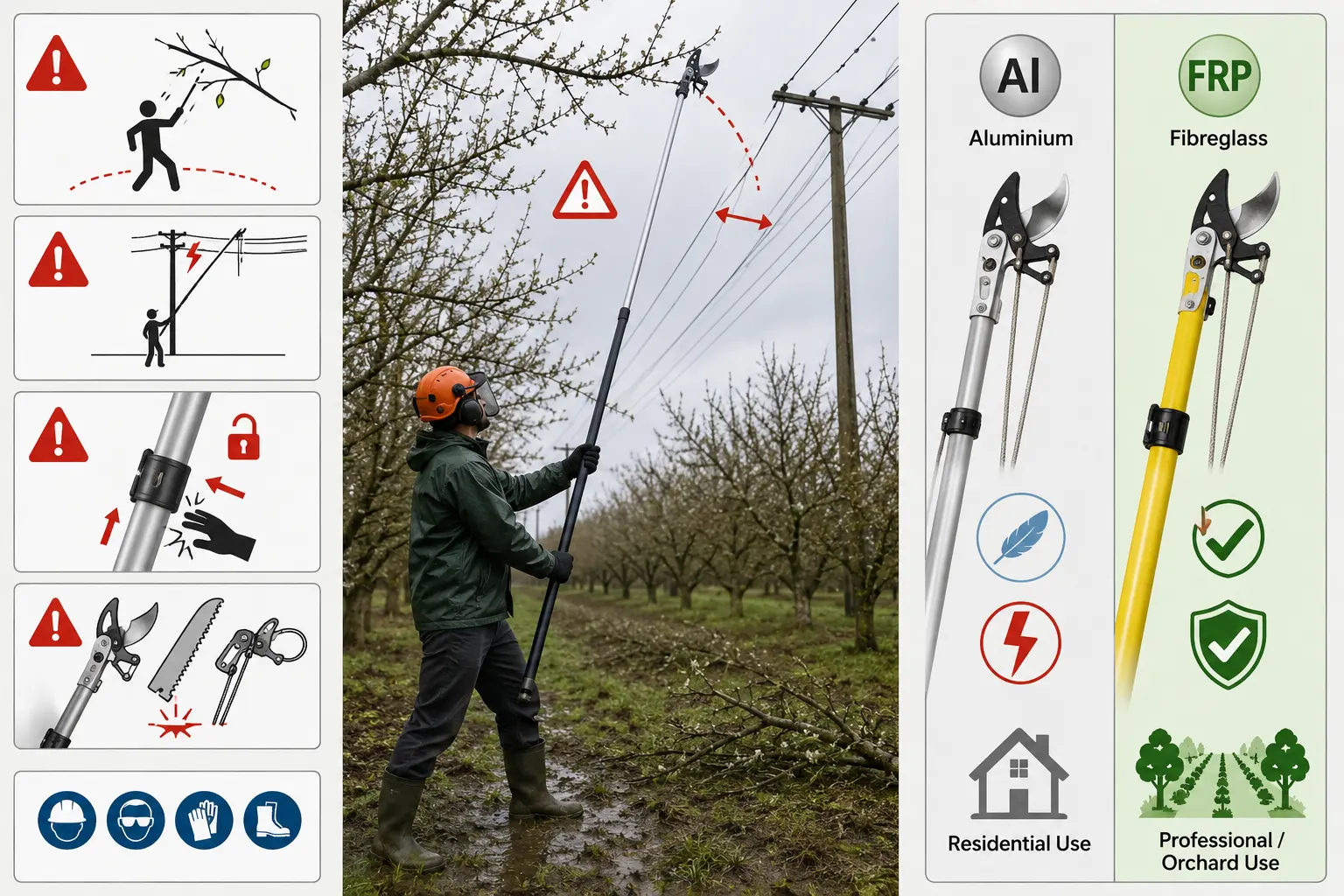
- Falling branches: Cut material drops from height. Users must be warned to stand clear.
- Overhead power lines: Using a conductive pole near power lines is extremely dangerous. Aluminium poles are lighter but conductive; fibreglass poles are heavier but non-conductive.
- Extension lock failure: A lock that releases unexpectedly while the pole is extended overhead can cause the inner section to slide down, potentially pinching fingers or dropping the cutting head.
- Parts detachment: The cutting head, saw, or rope components must be securely attached. A dropped component from height is a serious hazard.
Picture an orchard worker on wet grass, pruning overhead with an aluminium pole pruner. The pole is top-heavy, the footing is slippery, and the nearest power line is closer than it looks. This is why professional-grade pole pruners increasingly use fibreglass poles despite the weight penalty — and why your product listing should clearly state the pole material, especially if your market includes professional users. If you supply both aluminium and fibreglass models, position the aluminium model for residential use (where power lines are less likely to be an issue) and the fibreglass model for professional and orchard use.
Packaging and Shipping
Pole pruners are among the longest garden hand tools. Even disassembled, the extension pole section may exceed standard parcel length limits. Verify packaging dimensions against your target market’s parcel size thresholds. The cutting head should be fixed in the packaging to prevent movement that could damage the rope or mechanism.
Blade, Handle and Mechanism Materials
Materials are not a simple “budget vs. premium” label — they are a specification system that affects cutting performance, durability, weight, rust resistance, and replacement cost. Understanding the trade-offs helps you match the right product to the right price tier and customer expectation.
Blade Materials
| Material | Typical Properties | Where It Is Used | Trade-Off |
| SK5 high-carbon steel | Carbon content 0.8–0.9%; hardness HRC 58–62 after heat treatment; holds a sharp edge well | Mid-range and professional pruners | Excellent edge retention but poor rust resistance; needs coating or oiling |
| 65Mn spring steel | Hardness approximately HRC 30–55 depending on heat treatment; commonly around HRC 53 for pruning tool applications; lower cost than SK5 | Budget and mid-range pruners | Adequate sharpness at typical treatment levels but edge wears faster than SK5; hardness varies significantly by factory heat treatment |
| Stainless steel | Good rust resistance; hardness varies by grade | Flower snips, snips used in wet conditions | Softer edge than high-carbon steel; requires more frequent sharpening |
| Hardened steel (brand-specific) | Heat treatment specifications vary by manufacturer | Professional-grade tools (e.g., FELCO) | Performance depends on the specific treatment; brand specifications should be consulted |
Important: SK5 is widely used but it is not an industry-wide standard that all pruners must meet. Different steel grades serve different price points and use cases. A budget pruner with 65Mn steel is not “inferior” — it is designed for a different market segment. The key is that the blade material matches the claimed performance and price tier. [C008, C009]
On hardness testing: Rockwell hardness (HRC) is measured per ASTM E18. The test location on the blade matters — the cutting edge may have a different hardness than the blade body. A single HRC number without context (test location, sample size, method) is not meaningful for comparing products. [C018]
Handle Materials
| Material | Properties | Typical Use |
| Forged aluminium | Light, strong, durable | Professional pruners |
| Cast aluminium | Light, lower cost than forged | Mid-range pruners |
| Steel | Strong, heavier | Loppers, heavy-duty tools |
| PP (polypropylene) + TPR (thermoplastic rubber) | Comfortable grip, low cost | Budget and mid-range pruners |
| Fibreglass composite | Light, strong, non-conductive | Pole pruners, premium snips |
| Wood (ash, beech) | Traditional feel, absorbs shock | Heritage-style hedge shears |
Springs, Locks, Pivots and Fasteners
These small components determine whether a pruner works reliably over time:
- Springs: Coil springs are common but can unseat. Flat springs are more compact but may fatigue. A captive spring (held in place by the handle design) is less likely to pop off during use. [C020]
- Locks: Thumb-catch locks are the most common. Wire-latch locks are simpler but can bend. Squeeze-to-open locks require deliberate action to close, reducing accidental closure. Whatever the type, test that the lock holds firmly in both open and closed positions. [C020]
- Pivots: An adjustable pivot (usually a nut or screw) allows the user to tighten the blade alignment as it wears. A riveted pivot cannot be adjusted — once it loosens, the tool is effectively done. For professional-grade tools, adjustable pivots are commonly expected. [C020]
- Fasteners: Stainless or coated fasteners resist rust. Uncoated steel fasteners in a pruning tool that will be used in damp conditions will corrode and seize.
QC Checklist for Garden Shears
This checklist turns the article from a product guide into an inspection tool. Use it when evaluating samples or inspecting bulk shipments. Each item includes what to check, why it matters, and a suggested method.
| # | Check | Risk If Failed | Suggested Method |
| 1 | Blade alignment and gap | Misaligned blades produce ragged cuts, crush stems, and increase cutting effort | Close the tool slowly; hold up to light; check for visible gaps along the blade contact line |
| 2 | Edge condition and burrs | Dull or burred edges tear rather than cut; burrs can scratch the user | Run a fingertip lightly along the blade edge (not the cutting edge); feel for burrs or rough spots |
| 3 | Pivot tightness | Loose pivot causes blades to separate; tight pivot makes the tool stiff to open | Open and close 20 times; check for blade separation at the tip during cutting |
| 4 | Lock reliability | Lock that releases unexpectedly is a safety hazard; lock that will not engage makes the tool unusable | Engage and disengage the lock 20 times; verify it holds firmly in both open and closed positions |
| 5 | Spring retention | Spring that pops off during use stops the tool from self-opening | Open and close rapidly 50 times; check that the spring remains seated |
| 6 | Handle integrity | Cracks, burrs, or sharp edges on handles cause discomfort and injury | Inspect handles visually and by touch; check for cracks at stress points (near pivot, near lock slot) |
| 7 | Coating adhesion | Coating that flakes or peels looks defective and may expose bare steel to rust | Lightly scratch an inconspicuous area with a fingernail; coating should not flake off. This is a quick screening check, not a substitute for adhesion testing per ASTM D3359 or equivalent. |
| 8 | Declared cutting capacity | Tool that cannot cut its rated capacity will be returned | Cut sample branches at the rated diameter using green and dry wood; compare performance |
| 9 | Repeated-opening test | Fatigue failure of spring, pivot, or lock after moderate use | Open and close the tool 200–500 times (or use a test jig); check for degradation |
| 10 | Packaging protection | Tool that shifts in packaging arrives damaged; sharp tips can puncture packaging | Shake the packaged tool; check for movement; verify tip protection and cutting-head padding |
On sampling and acceptance criteria: ISO 2859-1:2026 provides a framework for acceptance sampling by attributes, but the specific AQL (Acceptable Quality Level) and inspection level must be agreed between buyer and supplier based on risk tolerance. There is no universal “pass” threshold for garden shears — it depends on your market, your price tier, and your return policy. [C018]
On drop testing for shipping packaging: ASTM D5276 describes a free-fall drop test method for loaded shipping containers. ISTA provides a range of test procedures for different shipping modes. If your products are sold online and shipped by parcel, drop testing the packaged product is a practical way to verify that the packaging protects the tool through a typical shipping cycle. An internal drop test is useful but should not be described as “certified” unless conducted and documented by an accredited testing body. [C019]
Want specifications, MOQ, and packaging options for pruning tools? Send us your target market, required specifications, and estimated quantities — we will prepare a comparison with models from verified suppliers. Request Pruning Tool Specifications
How Buyers Should Build a Product Range
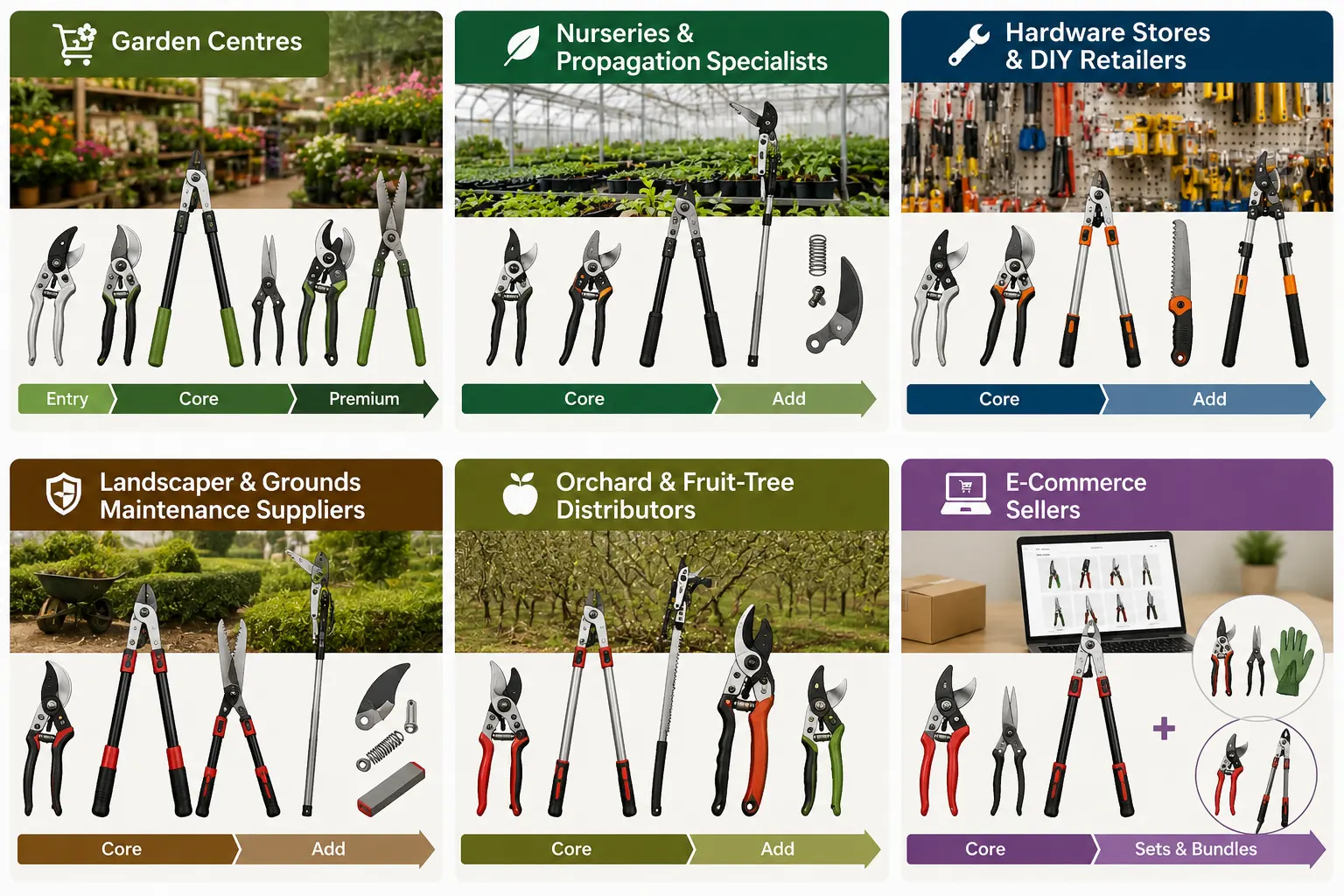
Not every buyer should stock every type of garden shear. The right product range depends on who your customers are, what they grow, and how they buy. Here are six channel-specific combinations.
Garden Centres
Garden centres serve the widest range of customers — from casual gardeners to experienced enthusiasts. A well-rounded pruning section needs:
- Entry: One bypass pruner (aluminium handle, SK5 or equivalent blade) — the universal starting point
- Core: Add an anvil pruner, a pair of flower snips, and a small-to-medium lopper
- Premium: Add a ratchet pruner (for older gardeners), a professional-grade bypass pruner, and a pair of hedge shears
This gives the garden centre a display that covers the most common tasks, with clear price steps from entry to premium.
Nurseries and Propagation Specialists
Nurseries focus on plant production rather than retail tool sales. Their customers buy tools for intensive, repeated use:
- Core: Heavy-duty bypass pruner, flower snips for cuttings and grafts, a robust lopper
- Add: Pole pruner for field maintenance, replacement blades and springs as consumables
Hardware Stores and DIY Retailers
Hardware shoppers buy tools as part of a broader home-maintenance mission. Pruning tools compete for shelf space with construction and repair tools:
- Core: One bypass pruner, one anvil pruner, one lopper — three SKUs that cover the basics
- Add: A folding pruning saw (adjacent category) and a telescopic lopper for the “reach” use case
- Display tip: Hang shears on pegboard with the cutting capacity and blade material visible on the label — hardware shoppers compare specifications
Landscaper and Grounds Maintenance Suppliers
Professional users prioritise durability, replaceable parts, and efficiency over price:
- Core: Professional bypass pruner with replaceable blade, heavy-duty lopper, manual hedge shears
- Add: Pole pruner, replacement blades and springs, sharpening tools
- Key selling point: Tools with full parts availability and adjustable pivots reduce downtime
Orchard and Fruit-Tree Distributors
Orchard work involves a lot of dead-wood cutting and high-branch pruning:
- Core: Anvil pruner, anvil lopper, pole pruner with saw attachment
- Add: Ratchet pruner for workers with varying grip strength, bypass pruner for live-tissue cuts
- Seasonal note: Pruning season drives concentrated demand — order well before the season opens
E-Commerce Sellers
Online buyers cannot handle the tool before purchase, so specification clarity and packaging quality are critical:
- Core: Bypass pruner, flower snips, a small lopper — the three most-searched types
- Sets and bundles: Pruner + snips + gloves; or pruner + lopper combo — sets increase average order value and reduce per-item shipping cost
- Critical: Product listings must state exact cutting capacity, blade material, handle material, weight, and hand size guidance. Vague listings (“sharp and durable”) generate returns.
MOQ, OEM and Packaging Questions
This section answers the questions buyers ask after they have selected their product range. The information below is based on general supply chain practices for garden shears sourced from China. Specific MOQs, pricing, and lead times vary by factory, model, and order complexity — confirm with your supplier for each product.
Standard MOQ
| Item | Typical MOQ Range | Notes |
| Standard model, no logo | 500–1,000 units | Varies by factory and model popularity |
| Custom colour handle | 1,000–2,000 units | May require a new production run for handle moulding |
| Custom logo (laser engraving or printing) | 500–1,000 units | Laser engraving has lower MOQ than pad printing |
| Custom retail box | 2,000–3,000 units | Box printing setup cost requires volume to amortise |
| Custom blister card | 3,000–5,000 units | Blister tooling is a separate cost item |
Mixed-Model Orders
Many buyers want to order several models in one shipment. Whether this is possible depends on the supplier:
- Same factory, different models: Usually possible with per-model minimums (e.g., 300 units per model across 3 models = 900 total)
- Different factories: Requires consolidation — each factory ships separately to a consolidation point, where products are inspected, repacked if needed, and combined into one shipment
Sample Process
Before committing to a bulk order, request samples. A typical sample process:
- Request 1–2 units of each model you are considering
- Test each sample against the QC checklist above
- Retain one unit as the reference sample for bulk comparison
- Lock the bill of materials (BOM) and process parameters with the factory
- Inspect the first production batch against the retained reference sample
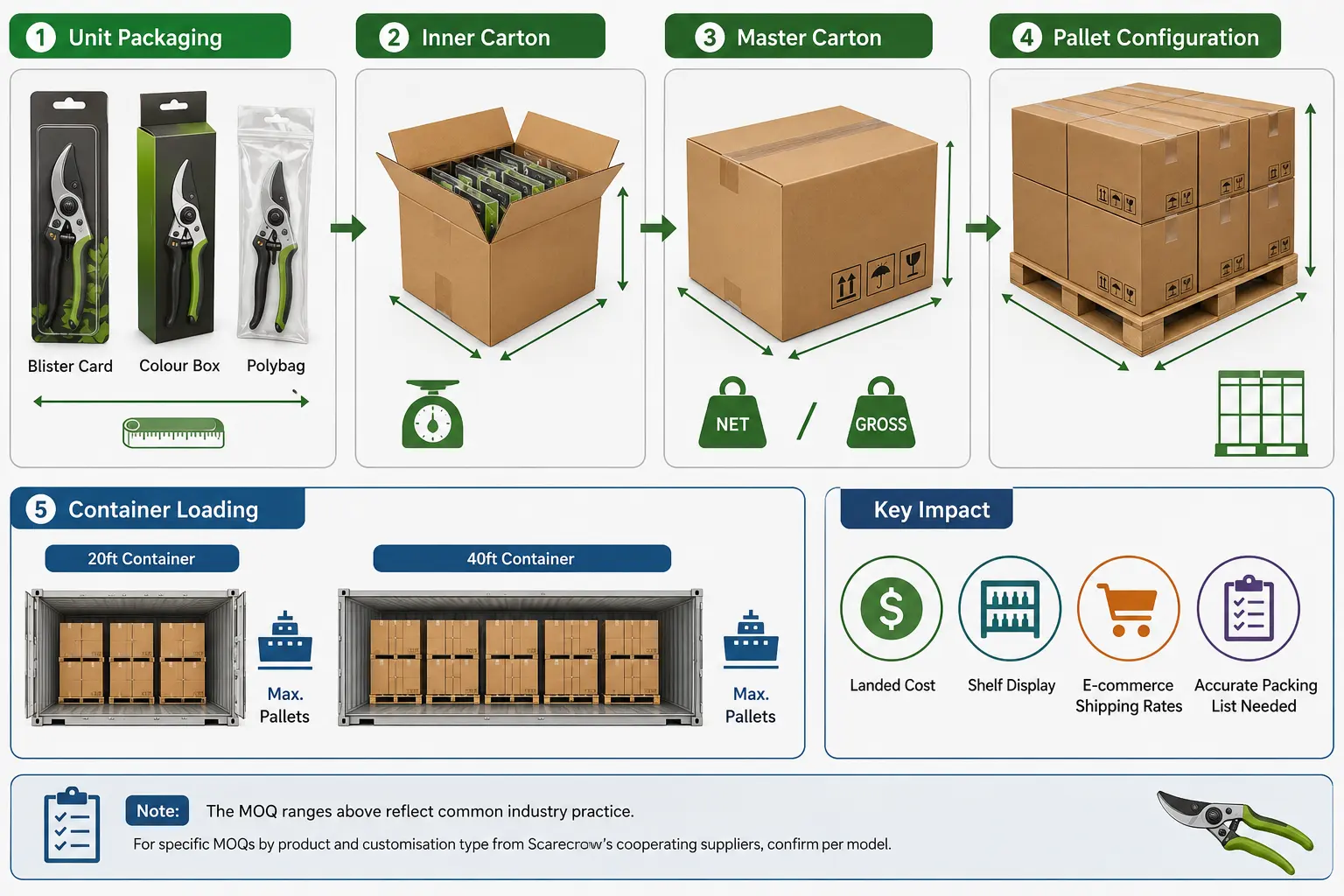
Packaging Specifications
When confirming packaging, ask for:
- Unit packaging: Blister card, colour box, or polybag — which type, and what are the dimensions?
- Inner carton: How many units per inner box? Dimensions and gross weight?
- Master carton: How many inner cartons per master? Dimensions, net weight, gross weight?
- Pallet configuration: If shipping by container, how many cartons per pallet, and how many pallets per 20-foot or 40-foot container?
These numbers directly affect your landed cost, shelf display, and e-commerce shipping rates. Do not estimate — request the actual packing list from the supplier for each model.
Note: The MOQ ranges above reflect common industry practice. For specific MOQs by product and customisation type from Scarecrow’s cooperating suppliers, confirm per model.
FAQ
Q: What are the main types of garden shears? A: The five main types are pruning shears (also called secateurs or hand pruners), flower snips, loppers, manual hedge shears, and pole pruners. Each type uses a different cutting action and is designed for a different range of branch diameters and plant conditions. Within pruning shears, the three most common sub-types are bypass, anvil, and ratchet.
Q: What is the difference between pruning shears and hedge shears? A: Pruning shears are one-handed tools for cutting individual stems and branches, typically up to about 25 mm. Hedge shears are two-handed tools with long blades designed to trim multiple thin stems at once — they cut like large scissors across the face of a hedge. They serve different tasks and are not interchangeable.
Q: What blade information should wholesale buyers confirm? A: Four things: (1) Steel grade (e.g., SK5, 65Mn, stainless) — not just “high-carbon steel” without specification. (2) Heat treatment or hardness range, if available. (3) Surface coating (PTFE, non-stick, chrome, black oxide, or none). (4) Whether the blade is replaceable. A listing that says only “sharp blade” or “premium steel” without these details is a risk — your customers will ask, and you need answers.
Q: How should importers inspect garden shears? A: Use the 10-point QC checklist in this article. The highest-priority items for incoming inspection are: blade alignment and gap, pivot tightness, lock reliability, and handle integrity. For bulk orders, agree on an AQL and inspection level with your supplier per ISO 2859-1 before production starts. Retain a reference sample from the pre-production sample run and compare bulk production against it.
Q: Can different tools be packed in one retail set? A: Yes — pruner + snips + gloves, or pruner + lopper combos are common. However, each set needs its own SKU, barcode, and compliant labelling. The components must be securely fixed within the set packaging to prevent movement and damage. Sharp tips must be protected. And all components should meet a consistent quality standard — a premium pruner paired with a budget glove creates a credibility gap.
Q: What affects MOQ for garden shears? A: The main factors are: customisation level (standard models have lower MOQ than custom-logo or custom-colour), packaging type (blister cards require higher MOQ than polybags due to tooling), factory capacity and schedule, and whether you are ordering a single model or mixing models. Confirm per model and per factory — there is no universal MOQ for all garden shears.
Build the Range Around Tasks, Not Labels
The types of garden shears a buyer should stock are determined by what their customers cut — not by what a supplier lists first. A garden centre needs bypass pruners, flower snips, and a lopper. An orchard supplier needs anvil tools and pole pruners. An e-commerce seller needs specification-rich listings and bundle-friendly packaging.
Start with the task, choose the cutting action, confirm the specifications, verify with a QC checklist, and build the combination that fits your channel. If you are planning a wholesale pruning tools range, send us your target market, current product list, and packaging requirements — we can help you compare models, verify specifications, consolidate products from multiple factories, and prepare a practical sourcing plan.

Written by
ScarecrowGarden
💡About Scarecrow Garden Supplier Co., Ltd.
Scarecrow Garden Supplier Co., Ltd. is a China-based sourcing and wholesale partner specializing in garden tools, landscaping equipment, and outdoor supplies for international wholesalers, distributors, contractors, and brands.
With hands-on experience rooted in real garden use scenarios, we focus on durable materials, functional design, and stable large-volume supply. Our product range covers pruning tools, watering systems, hand tools, outdoor hardware, and customized garden solutions to support both retail and professional landscaping markets.
Beyond products, we help our partners navigate supplier selection, quality control, compliance requirements, and long-term sourcing strategies in China. Through our blog, we share practical insights on product selection, material comparisons, industry trends, and cost-effective purchasing—helping global buyers build stronger, more competitive supply chains.