











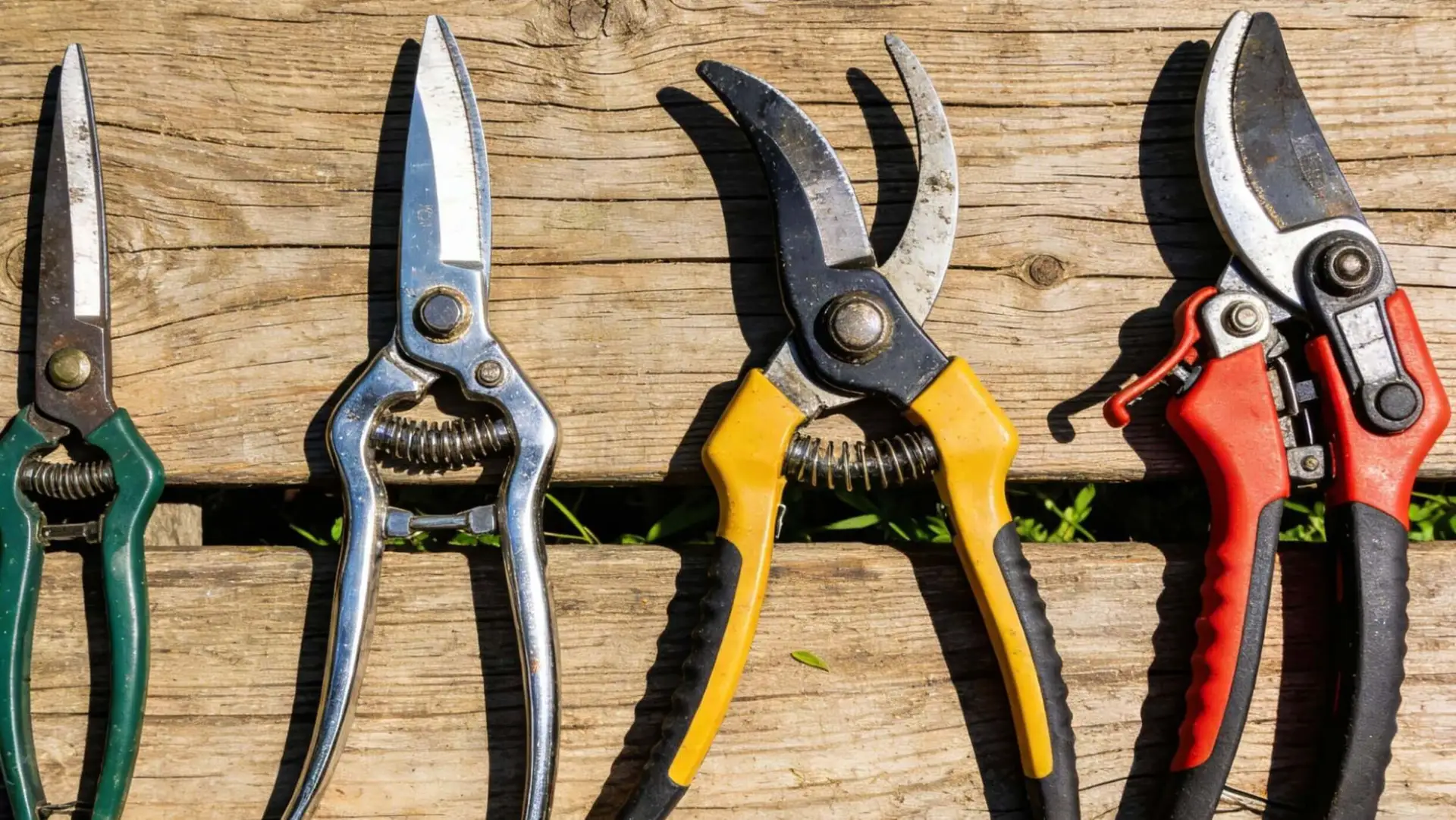
Bypass vs Anvil Pruners: Which Is Better for Gardening?
Most garden pruning guides give the same advice: use bypass pruners on live wood, use anvil pruners on dead. That guidance is a reasonable starting point for your customers — but it is not the full picture for a buyer building a product range.
Cut quality depends on far more than the tool type stamped on the handle. Blade sharpness, alignment, branch diameter and species, operator technique, and cut placement all influence the wound a pruner leaves behind. Recent research from the University of Florida challenges the simple “bypass good, anvil bad” narrative. The only peer‑reviewed comparison study found that bypass pruners actually caused more initial cambium damage than anvil models — though neither emerged as a clear winner over five years of healing.
This article compares bypass and anvil pruners by cutting mechanism, cut quality evidence, blade and body construction, ergonomics, QC risks, and assortment logic — so you can decide which types to stock, and in what proportion, for the channels you serve.
Quick Answer and Side-by-Side Comparison
If you need a fast answer for a customer or a purchase order: bypass pruners slice — two blades pass each other like scissors — and are commonly recommended for live stems where a clean cut matters. Anvil pruners crush — a single blade closes against a flat or shaped anvil — and are commonly recommended for dead or hardened wood where a clean cambium edge is not a concern.
But “commonly recommended” is not the same as “always better.”
| Aspect | Bypass Pruners | Anvil Pruners |
| Cutting action | Slicing — curved blade passes counter blade | Compression — blade closes against anvil surface |
| Typical use | Live stems, green wood, fine pruning | Dead wood, dry branches, woody cleanup |
| Cut on live wood | Commonly recommended; slicing action aims to limit cambium damage | Possible, but crushing may damage surrounding tissue |
| Cut on dead wood | Works, but blade may dull faster on hard, dry material | Designed for this; crushing action effective on rigid material |
| Maintenance focus | Blade gap, alignment, edge contact | Anvil contact uniformity, anvil wear |
| Common failure mode | Blade deflection, gap widening, edge rubbing | Anvil deformation, uneven contact, blade overshoot |
| Typical buyer/channel fit | Garden centres, nurseries, floristry suppliers | Orchard suppliers, landscaping, hardware stores |
Model‑specific specifications must be verified on individual spec sheets; no single row represents a universal standard.
Compare Pruner Samples for Your Market → — Send us your target market, hand‑size range and price‑tier plan. We can arrange paired bypass and anvil samples so you can test both before committing to a range. Contact us to discuss sample options.
How the Two Cutting Actions Work
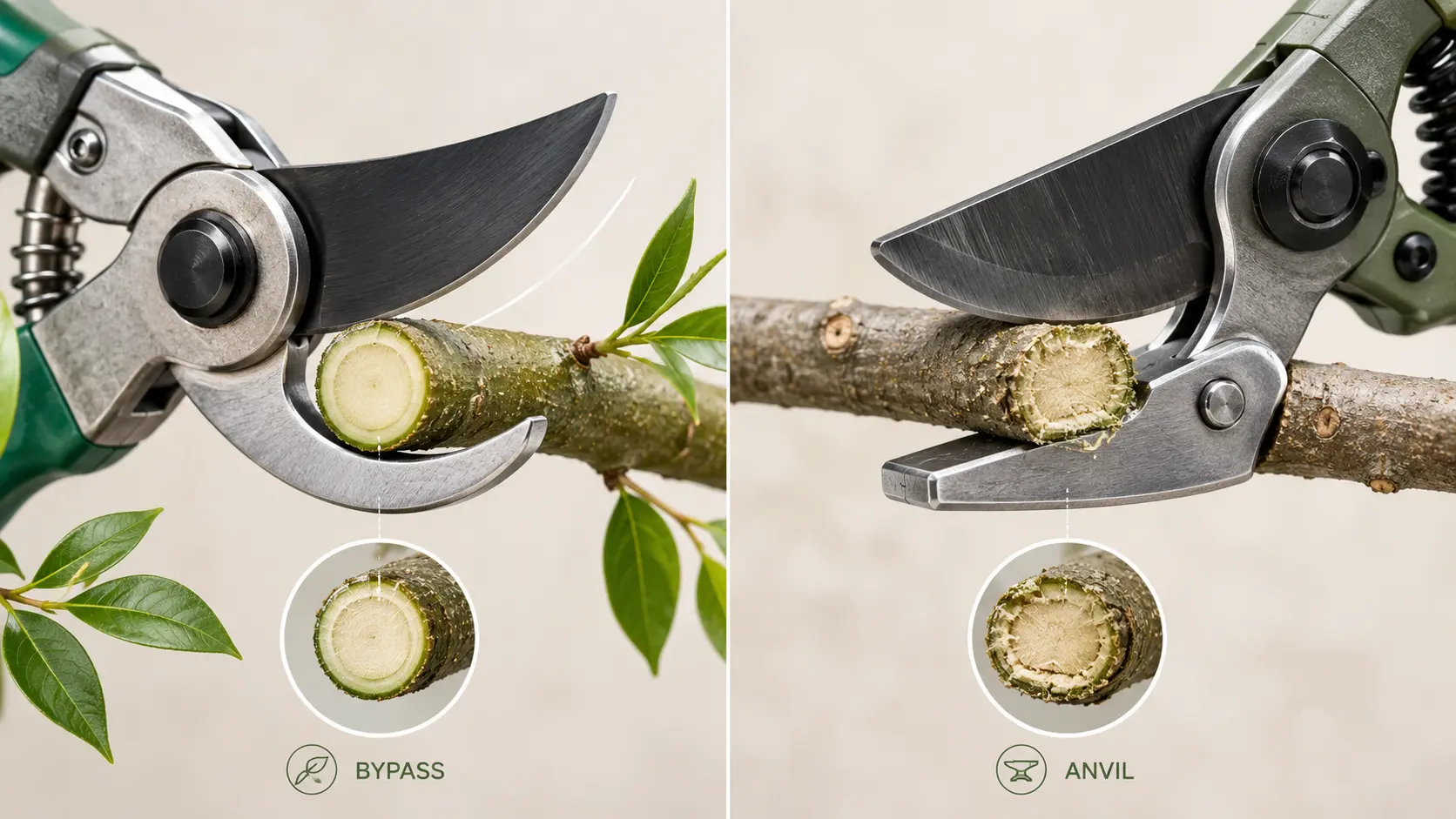
Understanding the mechanism helps you explain the difference to retail staff and customers — and helps you judge whether a sample actually performs as it should.
Bypass: Slicing Action
A bypass pruner works like a pair of scissors. One sharp, curved blade slides past a thicker, unsharpened counter blade (sometimes called a hook). The branch sits in the curve of the counter blade while the cutting blade sweeps through. Because the cut is made by a slicing action, the cambium — the living tissue just under the bark — is, in theory, severed cleanly along the line of the cut, with damage limited to the portion being removed.
The critical variables are blade alignment and blade gap. If the cutting blade does not pass the counter blade at the correct distance and angle, the branch can slip, tear, or be partially crushed rather than sliced.
Anvil: Compression Action
An anvil pruner works like a knife coming down on a cutting board. A single sharpened blade closes against a flat or contoured anvil. The branch is trapped between the two surfaces and compressed until it separates. The crushing zone extends slightly beyond the cut line, which is why anvil cuts on live wood can damage the cambium on the remaining stem.
The critical variables here are anvil contact and anvil condition. The blade must land evenly across the anvil surface. If the anvil is worn, deformed, or the blade lands at an angle, part of the branch may not be severed cleanly, leaving a ragged stub.
What This Means for Buyers
Both mechanisms are mechanically sound when well executed. The question is not which action is “better” in the abstract — it is which action matches the task, the material, and the user. A sharp, well‑aligned anvil pruner on dry wood will outperform a dull, misaligned bypass pruner on the same material. The mechanism sets the starting point; execution determines the result.
Live Wood, Dead Wood and Cut Quality
This is where the bypass vs anvil pruners debate gets interesting — and where most garden‑care content oversimplifies.
The Traditional Advice
University extension services across the United States consistently recommend bypass pruners for live wood and anvil pruners for dead. The reasoning is straightforward: slicing action produces a clean cut that minimises cambium damage on living tissue, while compression action is effective on dry, hard material where cambium health is no longer a concern.
This guidance comes from UC Agriculture and Natural Resources, the University of New Hampshire Extension, and Missouri Extension, among others. It is practical, experience‑based advice that has served gardeners and horticulture professionals for decades.
It is also, strictly speaking, not supported by controlled experimental data comparing the two tool types on the same plant material under the same conditions — because, until recently, almost no such data existed.
What the Research Actually Shows
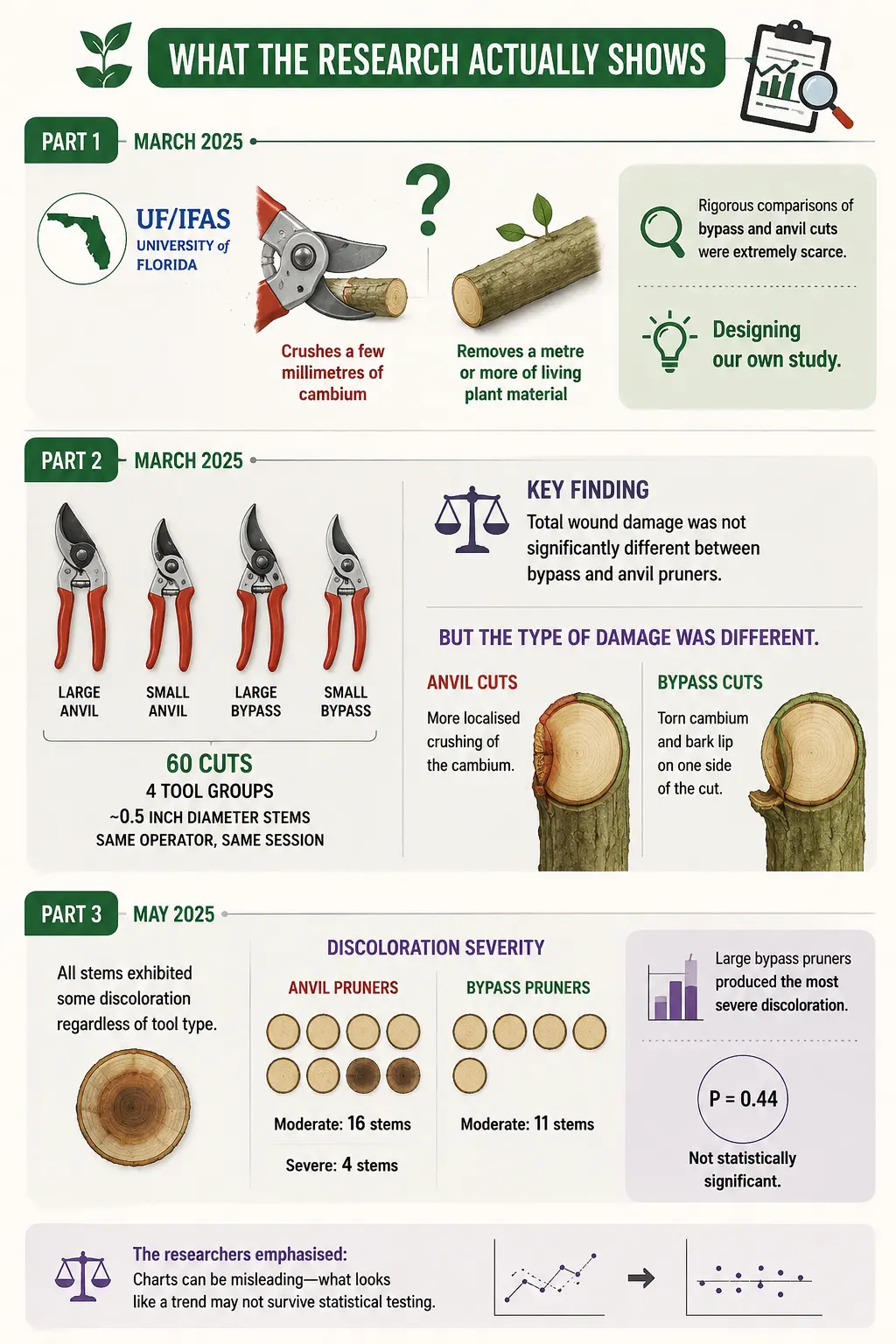
In 2025, researchers at the University of Florida Institute of Food and Agricultural Sciences (UF/IFAS) launched a series they titled “Show Us the Data!” — precisely because they recognised how little empirical evidence underpinned the conventional wisdom.
Part 1 (March 2025): Andrew Koeser, an associate professor of landscape ecology, raised the core question. An anvil pruner crushes a few millimetres of cambium — but it also removes a metre or more of living plant material. How much does that localised crushing actually matter to the plant’s recovery? He noted that rigorous comparisons of bypass and anvil cuts were extremely scarce and began designing his own study.
Part 2 (March 2025): Alyssa Vinson reported initial results from 60 pruning cuts across four tool groups (large and small anvil, large and small bypass), all on stems of approximately 0.5 inches in diameter, made by the same operator in the same session. The key finding: total wound damage was not significantly different between bypass and anvil pruners — but the type of damage was different. Anvil cuts produced more localised crushing of the cambium. Bypass cuts left a torn cambium and bark lip on one side of the cut.
Part 3 (May 2025): Follow‑up measurements showed that all stems exhibited some discoloration regardless of tool type. Large bypass pruners produced the most severe discoloration. Anvil pruners caused moderate discoloration on 16 stems and severe discoloration on 4; bypass pruners caused moderate discoloration on 11 stems. Despite the visual impression that anvil damage was worse, the difference was not statistically significant (P = 0.44). The researchers emphasised that charts can be misleading — what looks like a trend may not survive statistical testing.
The Only Peer‑Reviewed Comparison: Marchi et al. (2013)
The UF/IFAS Journal Club reviewed the only published study that directly compared bypass and anvil pruning cuts under controlled conditions. Marchi et al. (2013) made 36 removal cuts on young English oak (Quercus robur) using three tool types: double‑bladed pruners, anvil pruners, and bypass pruners.
The results were counterintuitive:
- Initial cambium damage: Bypass pruners caused approximately 67 degrees of damage (~18% of the stem circumference) — roughly double the anvil pruners’ ~9% and quadruple the double‑bladed pruners’ ~4.5%.
- After 15 months: Anvil and bypass pruners had nearly identical wound closure rates (~65%).
- After 5 years: Bypass wounds had closed 90.6%, anvil wounds 71.9% — but the difference was not statistically significant due to the small sample size. The clear winner was the double‑bladed pruner, which achieved full closure.
The authors concluded that the bypass‑vs‑anvil comparison was “less clear” than commonly assumed and that neither tool type could be declared a simple winner.
What This Means for Your Product Range
These findings do not invalidate the traditional advice — they complicate it. Here is what a buyer should take away:
- The old rule of thumb (bypass for live, anvil for dead) remains a practical starting point for customer education and product labelling. It is easy to communicate and, in most real‑world conditions, produces acceptable results.
- Cut quality is not determined by tool type alone. Sharpness, alignment, branch diameter, species, operator technique, and cut placement all matter — often more than the bypass/anvil distinction itself.
- Do not assume anvil pruners are inherently inferior. The available evidence does not support that claim as an absolute.
- Do not assume bypass pruners always produce cleaner cuts. On the limited evidence available, bypass pruners caused more initial damage than anvil pruners in the Marchi study.
- Treat healing‑rate claims with caution. The UF/IFAS research is ongoing, and the Marchi study had a small sample on a single species. No responsible source should promise specific wound‑closure percentages for all plants and conditions.
Blade, Anvil and Body Construction
When buyers compare bypass and anvil pruners, the conversation often jumps to blade steel grades. Steel matters — but it is one variable among several, and it must be verified per model, not assumed across a category.
Blade Grade, Heat Treatment and Coating
Common blade materials in the wholesale market include SK5 high‑carbon steel, 65Mn spring steel, various stainless‑steel grades, and high‑carbon steel without a specific grade callout. SK5 can be heat‑treated to a range of hardness values; some models target approximately HRC 58–62, but the actual value must be confirmed on the spec sheet for each model — not assumed as an industry standard.
When a supplier tells you the blade is SK5, the question is not whether SK5 is a good steel — it is whether this particular heat treatment and coating match the cutting tasks your customers will perform. A blade that is too hard for the application will chip; one that is too soft will dull quickly.
Coatings serve different purposes: PTFE (Teflon) coatings reduce sap adhesion; chrome plating adds corrosion resistance; black oxide provides a basic protective layer. None of these are universal — each is a choice made by the manufacturer for a specific model and price point.
As illustration, the Burgon & Ball Professional Bypass Secateur uses a precision‑ground, heat‑treated high‑carbon steel blade — but that description applies to that model, not to all bypass pruners at that price tier.
Anvil Material and Replaceability
Anvil material directly affects durability and long‑term cut quality. Common options include cast aluminium, hardened steel, and — on budget models — rigid plastic. A worn or deformed anvil is the most common cause of declining cut quality in anvil pruners, because the blade can no longer make full, even contact.
Some models offer replaceable anvils; others are riveted and must be replaced as a complete unit. This distinction matters for your customers: professional users who maintain their tools may prefer replaceable anvils, while price‑sensitive buyers may accept fixed anvils at a lower cost.
Sap Groove, Blade Replacement and Pivot Adjustment
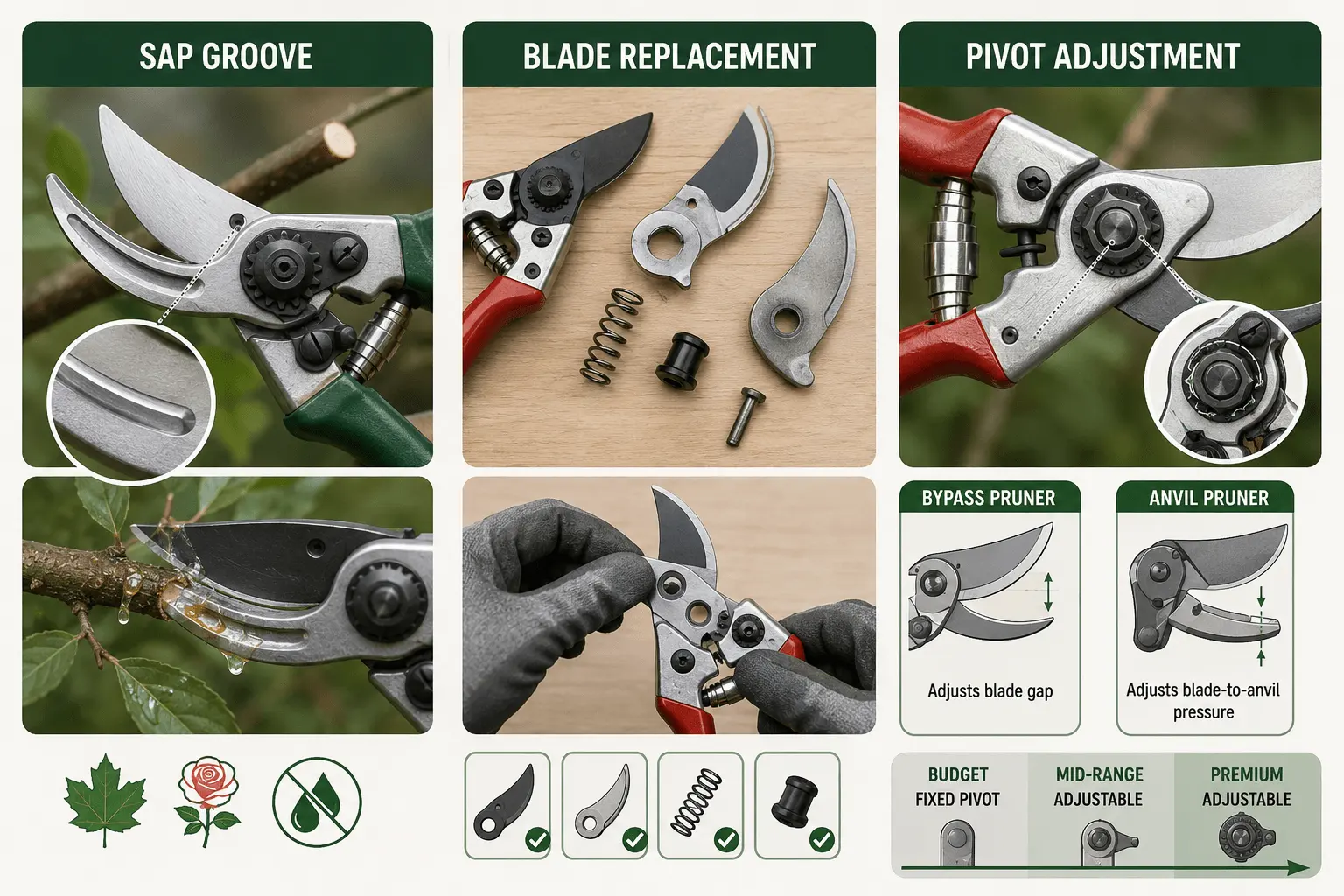
Several design features differentiate models within each type — and each one becomes a decision point when you are matching a product to a specific customer:
- Sap groove: A channel on the counter blade that directs sap away from the cutting edge. This matters when your customers prune sappy species like maples or roses in spring — without it, the blade gums up, the cut degrades, and the user reaches for a different tool. The Burgon & Ball Professional Bypass Secateur includes one.
- Blade replacement: FELCO designs all components — blades, counter blades, springs, shock absorbers — to be replaceable. This matters when your customers are professionals who maintain their tools rather than replace the entire unit. Not all manufacturers follow this approach; if your market values long‑term serviceability, check this before you commit.
- Pivot adjustment: Some models allow the user to tighten or loosen the pivot, which affects blade gap on bypass pruners and blade‑to‑anvil pressure on anvil models. This matters when your customers work in varying conditions and need to retune the tool over time. Adjustable pivots are more common on mid‑range and premium tools; budget models are typically riveted and set at the factory.
Handle, Body, Lock and Spring
Handle materials range from forged aluminium (FELCO) and alloy (Burgon & Ball) to fibreglass‑reinforced plastic and PVC. Lock types include thumb catches and sliding locks. Spring types include captive springs (which are less likely to pop out during use) and open springs.
The connection method — one‑piece forging, riveting, or bolted assembly — affects both repairability and cost. Forged, bolted construction allows part replacement; riveted construction is cheaper but limits service life to the first component failure.
Ergonomics, Hand Size and User Effort
A pruner that does not fit the user’s hand is the fastest path to a return — regardless of how well the blade is made. Ergonomics is one of the most overlooked variables in wholesale pruner selection, and one of the most common reasons for customer complaints and re‑orders that never happen.
Hand Size and Dexterity
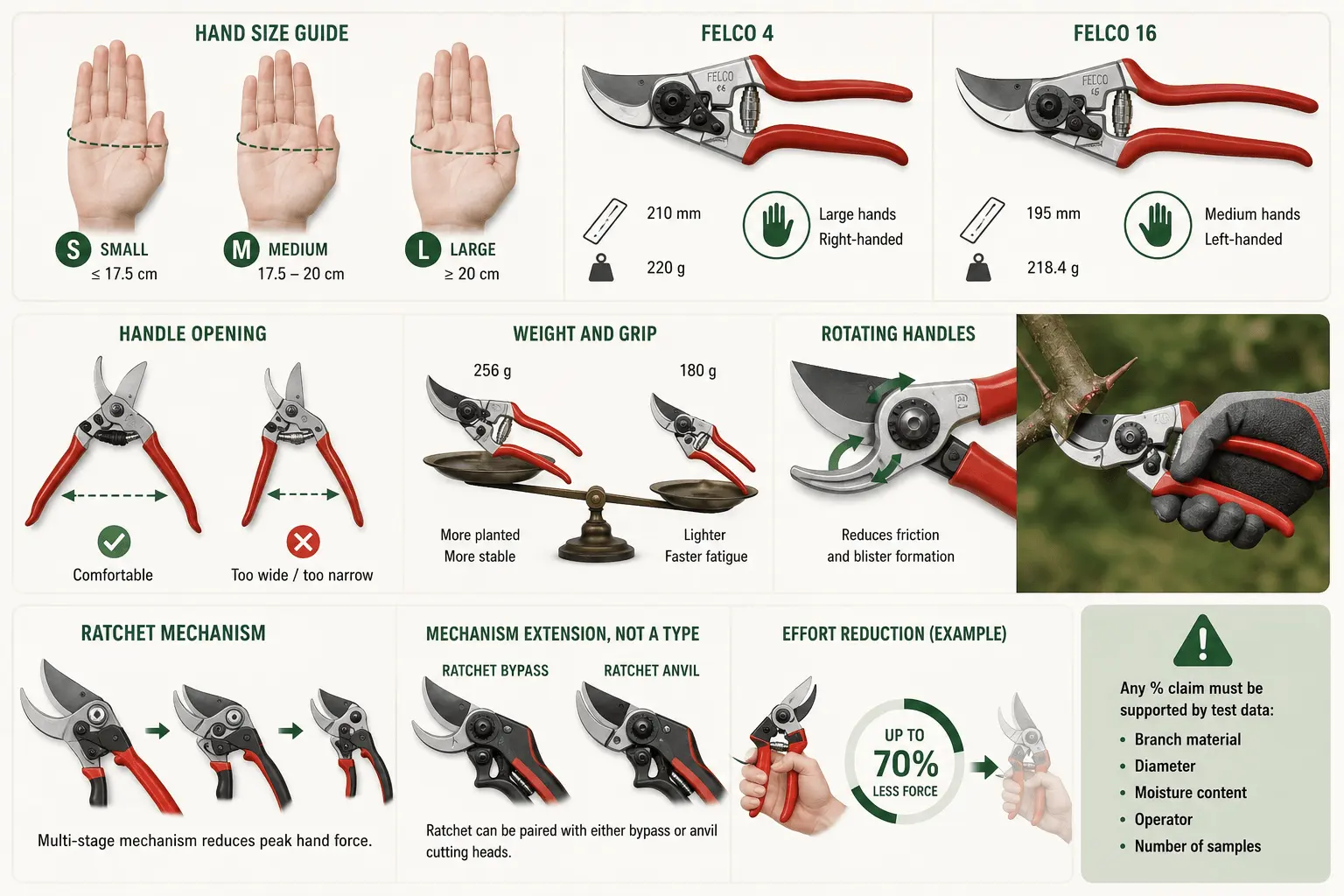
FELCO provides a hand‑measurement system that illustrates the principle: Small (hand circumference ≤ 17.5 cm), Medium (17.5–20 cm), and Large (≥ 20 cm). The FELCO 4, at 210 mm overall length and 220 g, is sized for large hands and right‑handed users. The FELCO 16, at 195 mm and 218.4 g, is designed for medium hands and left‑handed users.
These are model‑specific examples, not industry standards — but they highlight a real issue: a pruner that is too large for the user’s hand reduces control and increases fatigue; one that is too small may not generate enough leverage. If your garden centre customers are primarily older women pruning roses, a 220 g pruner sized for large hands will generate complaints, not re‑orders. Most budget pruners are produced only in right‑handed configurations, which means left‑handed users in your customer base may be underserved.
Handle Opening, Weight and Grip
Handle opening — the maximum distance between the grips when the pruner is open — determines who can comfortably use the tool. A handle that opens too wide strains smaller hands; one that opens too little limits the cutting arc.
Weight is not simply “lighter is better.” A 256 g pruner (like the Burgon & Ball Professional Bypass) may feel more planted and stable during a cut than a 180 g budget model, but it will fatigue a user faster during extended pruning sessions. Match the weight to the expected user and task duration.
Rotating handles (as on the FELCO 12) reduce friction and blister formation during prolonged use — a feature worth considering for professional‑grade lines.
Ratchet Mechanism: An Extension, Not a Type
Ratchet pruners use a multi‑stage mechanism that allows the user to close the blade incrementally, reducing peak hand force. This is a mechanism extension, not a synonym for “anvil.” Ratchet systems can be paired with either bypass or anvil cutting heads. We mention this because some suppliers list ratchet pruners as a separate category — they are not. The ratchet is a mechanism that can be paired with either cutting head, and the choice of head still matters.
Some extension materials cite reductions in peak hand force of up to 70% for ratchet pruners. That figure, if used at all, must be attributed to its original source and test conditions — it cannot be presented as a universal performance claim.
Effort‑Reduction Claims in Marketing
Any percentage claim about effort reduction (e.g., “50% less effort,” “3× easier cutting”) must be supported by test data that specifies the branch material, diameter, moisture content, operator, and number of samples. Without those conditions, the claim is marketing copy, not a specification your buyers should rely on.
QC Risks Buyers Should Compare
Quality risks differ between bypass and anvil pruners in ways that directly affect return rates, customer complaints, and re‑order decisions. Understanding these differences helps you write better spec sheets and inspect more effectively.
Both types are subject to these common defects:
| Check | What to Look For |
| Edge / burr | Nicks, rolled edges, grinding marks on the cutting bevel |
| Alignment | Blade and counter blade (or anvil) not parallel when closed |
| Pivot | Loose (wobbly, inconsistent cut) or over‑tight (stiff, slow to open) |
| Lock | Fails to engage, disengages during use, or cannot be operated one‑handed |
| Spring | Insufficient opening force, spring detached, or spring wire deformed |
| Handle | Cracks in forged or moulded components, coating flaking, grip separation |
| Coating | Uneven or missing anti‑corrosion treatment, particularly at pivot and tip |
Bypass‑Specific Risks
| Check | What to Look For |
| Blade gap | Gap too large → branch slips or tears instead of being cut; gap too small → blades rub and dull |
| Blade contact / rubbing | Blades touch in the non‑cutting zone → heat, wear, and premature dulling |
| Blade deflection | Blade bends under load → cut skews to one side, especially near cutting‑capacity limit |
Anvil‑Specific Risks
| Check | What to Look For |
| Anvil contact | Blade does not make full, even contact with anvil surface → partial cut, ragged stub |
| Anvil wear / deformation | Anvil surface dished, chipped, or uneven → progressive decline in cut quality |
| Closing position | Blade overshoots or undershoots the anvil → residual uncut material or blade‑to‑anvil impact damage |
Cut Testing: Conditions Matter
Any cut test used for quality approval must specify:
- Branch species and condition (live or dead, green or seasoned)
- Branch diameter range
- Number of cuts and sample size
- Operator or test fixture
- Pass/fail criteria (e.g., “no fibres remaining uncut,” “no blade deflection exceeding X mm”)
A cut test that does not record these conditions cannot be compared to another test, and its results should not be generalised.
Real‑World Failure: CPSC Recall
The U.S. Consumer Product Safety Commission recalled Fiskars 32‑Inch Bypass Lopper Shears (model 6954) after reports that the handles broke during cutting, creating laceration and injury risks. The recall was first issued in 2014 and re‑announced in 2016 following additional injury reports. The product was manufactured in China.
This case illustrates that structural failure — not just cutting performance — is a real QC risk. Handle integrity, pivot strength, and lock reliability should be checked on every production batch, not just the first sample.
Request a Pruner QC and Sample Comparison → — Send us your spec requirements and we can arrange a paired bypass/anvil sample check, including cut tests on specified branch material, blade gap and anvil contact measurements, and packaging integrity review. Contact us to discuss your QC requirements.
Which Type Should Different Buyers Stock?
The question is not “which is better?” — it is “which combination serves my customers, reduces my returns, and fits my shelf or catalogue?”
Decision Dimensions
Rather than prescribing fixed ratios, consider these variables for each channel:
| Dimension | Questions to Ask |
| Primary task mix | Do your customers mostly prune live plants (roses, shrubs, topiary) or clear dead wood (orchard cleanup, seasonal cutback)? |
| User profile | What hand sizes and dexterity needs are common in your customer base? Is there demand for left‑handed options? |
| Price‑tier strategy | Are you covering entry, core, and premium? Bypass dominates the premium tier in most markets; anvil is strong in the value tier. |
| Return risk | Anvil pruners used on live wood → crushed stems → customer complaints. Bypass pruners used on hard dead wood → blade damage → warranty returns. Both scenarios are real. |
| Parts and service | Can your customers replace blades, springs, or anvils? If not, lower‑priced fixed‑component tools may be more appropriate. |
| Packaging and display | Hang cards for impulse display at garden centres, or boxed sets for hardware trade counters? Packaging affects which SKUs you can carry profitably. |
Channel Guidance
Garden centres and nurseries typically stock more bypass than anvil, because their customers are primarily pruning live ornamentals. A garden centre that stocks only bypass pruners will lose the customer who walks in asking for something to cut back dead raspberry canes — and that customer may not come back. A common starting point is a bypass‑heavy range with one or two anvil options for customers who ask about dead‑wood clearing.
Hardware stores and home‑improvement retailers often carry both types in roughly equal numbers, serving a mixed customer base that includes casual gardeners, property maintainers, and DIY landscapers. Here, the question is less about which type to stock and more about whether the packaging and labelling make the bypass/anvil distinction clear at the point of sale.
Orchard suppliers and landscaping companies may lean toward anvil pruners (and ratchet models) for the volume of dead‑wood and heavy‑branch cutting their users perform — supplemented by bypass pruners for grafting, training, and fine work. For these buyers, a bypass pruner is a specialist tool rather than the default.
E‑commerce sellers should consider whether their product listing, images, and descriptions clearly communicate the bypass/anvil distinction. Customer confusion between the two types is a common source of returns and negative reviews. If you sell both anvil and bypass pruning shears, make the difference visible in the product title, hero image, and first bullet point.
Sample Approval, MOQ, OEM and Packaging
Before committing to a bulk order, buyers should confirm that the product they sampled is the product they will receive.
Sample Pair Approval
Request one bypass and one anvil sample from the same supplier at the same time. Test both on the same branch material, at the same diameter, with the same operator. This paired comparison tells you more than testing either tool in isolation. A buyer who tests only the bypass sample and orders both types may discover too late that the anvil version from the same supplier has a different pivot design — and the blade does not close flush against the anvil. Testing both at the same time catches this before the order is placed.
Golden Sample and Spec Sheet
Once you approve a sample, set it aside as your golden sample — the physical reference point for production. Create a spec sheet for each model independently. Do not mix specifications between models, even if they share the same handle or blade steel.
Cut Test Protocol
Define the branch material, diameter range, and number of cuts for your approval test. Record the results. If the factory cannot replicate your test conditions, agree on an equivalent protocol and document it.
MOQ, OEM and Customisation
Minimum order quantities vary by model, colour, logo application, packaging type, and the supplier’s willingness to mix models within a shipment. There is no universal MOQ — confirm each variable separately:
- Per‑model MOQ (standard colour, no logo)
- Logo or colour customisation MOQ
- Packaging MOQ (hang card, printed box, or bulk)
- Mixed‑model consolidation (can you combine bypass and anvil SKUs in one container?)
Packaging Integrity
Pruners are sharp tools shipped in bulk. Common packaging issues include:
- Blade tips piercing through hang cards or thin boxes
- Locks disengaging during transit, leaving blades exposed
- Insufficient corrosion protection for sea‑freight humidity
Verify that the lock is secured, the blade is covered or sheathed, and that the packaging survives a free‑fall drop test (ASTM D5276 provides a standard method). A container of pruners that arrives with blades exposed through pierced hang cards is not just a packaging problem — it is a safety and liability problem that your warehouse team will have to handle before the product reaches the shelf. If you are consolidating multiple SKUs in one shipment, confirm that the packaging protects each unit during the additional handling that consolidated orders require.
FAQ
Are bypass pruners better for live branches?
Commonly recommended, yes — but “better” depends on sharpness, alignment, branch diameter, and operator technique. The available research does not support an absolute claim that bypass pruners always produce superior cuts on live wood. Traditional extension‑service advice remains a practical guide, not a guaranteed outcome.
Are anvil pruners only for dead wood?
They are commonly recommended for dead and hardened wood, where the crushing action is effective and cambium damage is not a concern. However, anvil pruners can cut live wood — the question is whether the resulting wound is acceptable for the plant and the user. For fine pruning of valuable live plants, most professionals prefer bypass.
Do anvil pruners damage plants?
Anvil pruners can crush the cambium at the cut site. Whether that damage is significant depends on the plant species, branch diameter, tool sharpness, and the plant’s capacity to compartmentalise the wound. Recent research (UF/IFAS, 2025) found that total wound damage was not significantly different between bypass and anvil pruners, though the type of damage differed. The claim that anvil pruners always damage plants more than bypass pruners is not supported by the available evidence.
Which type is easier to maintain?
Bypass pruners require attention to blade gap and alignment; anvil pruners (or anvil secateurs) require attention to anvil contact and wear. Neither is inherently easier — the maintenance focus is different. The bypass vs anvil secateurs distinction follows the same mechanism and maintenance principles. Models with replaceable blades, anvils, and springs (such as FELCO’s) are generally easier to service than riveted, non‑serviceable models, regardless of cutting type.
What should buyers inspect before a bulk order?
Check edge quality (no nicks or burrs), blade alignment, pivot tension, lock function, spring action, handle integrity, and coating coverage. For bypass pruners, measure the blade gap at the tip and mid‑blade. For anvil pruners, verify that the blade makes full, even contact with the anvil surface when closed. Conduct a cut test on representative branch material and record the conditions.
Should retailers stock both types?
In most cases, yes. The two types serve different tasks and different users. A garden centre customer buying a rose pruner expects a bypass; a property maintainer clearing dead branches expects an anvil. Stocking only one type leaves a portion of your customer base unserved — or sends them to a competitor. The proportion depends on your channel and customer mix, not on a universal rule. For buyers comparing bypass pruners vs anvil pruners at the assortment level, the practical question is not which type wins — it is what ratio of each type matches the tasks your customers actually perform.
Stock by Task, User and Product Grade
There is no single winner in the bypass vs anvil pruners comparison. Bypass pruners are the right starting point for most live‑wood pruning tasks; anvil pruners are the right tool for most dead‑wood and heavy‑branch work. But the line between them is not as sharp as garden‑care tradition suggests — and the quality of the cut depends at least as much on sharpness, alignment, and operator skill as on the mechanism stamped on the handle.
For wholesale buyers, the practical decision is not “bypass or anvil?” but “what mix of both types serves my customers, reduces my return risk, and fits my price tiers?” The same bypass‑vs‑anvil logic extends to loppers, but loppers are a different product category with different structural demands — longer handles, larger cutting capacities, and different failure modes. Do not assume that a pruner comparison translates directly to lopper selection.
If you are building a pruning‑tool range, start with the tasks your customers actually perform, then match each task to the right tool type, hand size, and product grade. For a broader view of all pruning‑tool categories — loppers, hedge shears, pole pruners, and flower snips — see our guide to types of garden shears. When you are ready to discuss specifications, samples, and assortment options for wholesale pruning tools, we can help you compare options, verify key details, and prepare a practical sourcing plan.
Compare Bypass and Anvil Pruner Options → — Send us your product list, target market, estimated quantities, and packaging requirements. We can help you compare bypass and anvil options, verify specifications, consolidate SKUs, and prepare a sourcing plan that matches your channels.

Written by
ScarecrowGarden
💡About Scarecrow Garden Supplier Co., Ltd.
Scarecrow Garden Supplier Co., Ltd. is a China-based sourcing and wholesale partner specializing in garden tools, landscaping equipment, and outdoor supplies for international wholesalers, distributors, contractors, and brands.
With hands-on experience rooted in real garden use scenarios, we focus on durable materials, functional design, and stable large-volume supply. Our product range covers pruning tools, watering systems, hand tools, outdoor hardware, and customized garden solutions to support both retail and professional landscaping markets.
Beyond products, we help our partners navigate supplier selection, quality control, compliance requirements, and long-term sourcing strategies in China. Through our blog, we share practical insights on product selection, material comparisons, industry trends, and cost-effective purchasing—helping global buyers build stronger, more competitive supply chains.