








Wholesale Garden Sprinklers: B2B Sourcing Guide & Pressure Secrets | Scarecrow Garden Supplier
You have seen it on the packaging: “Covers 200 m².” Your customer takes it home, connects it to their garden tap, and watches it water about half that area. Then the complaint arrives. Then the return. Then the one-star review that mentions your brand by name.
Here is what most wholesale buyers miss about sprinklers: a sprinkler is not one product. It is four completely different coverage types — Oscillating, Rotary, Impulse, and Spot — each designed for a different garden shape, each sourced from a different factory cluster, and each carrying a different margin structure. Choosing the wrong type for your customer base is more expensive than choosing the wrong brand.
And then there is the number on the box. The coverage area printed on sprinkler packaging is, in most cases, measured at 3–4 bar water pressure. In older European homes — which describes a significant share of the UK, France, and Germany — the tap pressure is often closer to 2 bar. At that pressure, the actual coverage can drop to roughly half the claimed area (est., based on industry experience). The biggest single source of sprinkler complaints is not a defect. There is a gap between the number on the box and the water pressure at the tap.
We will come back to that number — because it is the single most expensive misunderstanding in this category. First, you need to understand why a sprinkler is not one product but four.
Four Coverage Types, Four Different Products
Most wholesale catalogues list sprinklers as a single category. The reality: Oscillating, Rotary, Impulse, and Spot sprinklers serve four different garden shapes, appeal to four different buyer profiles, and come from four different supply chains in China.
| Oscillating | Rotary | Impulse | Spot | |
| Coverage shape | Rectangle | Circle (adjustable 90°–360°) | Circle (adjustable arc) | Circle/semi-circle |
| Typical claimed area | 100–350 m² | 80–200 m² | 200–500+ m² | 5–50 m² |
| Min. effective pressure | 1.5–2 bar | 1.5–2 bar | 2–4 bar | 1 bar |
| Typical material | ABS base + aluminium tube | ABS/PP base + POM gears | Plastic/zinc alloy/brass | ABS/PP |
| UK retail price (est.) | £8–30 | £6–25 | £10–35 | £5–15 |
| Approx. ex-works price (est.) | $0.80–4.80 | $0.60–3.00 | $0.30–16.00 | $0.03–0.50 |
| Best channel fit | GMA/DIY, garden centres | GMA/DIY, garden centres | Trade, agricultural | Garden centres, online |
For smaller hand-watering applications, buyers may also compare this category with garden spray guns for wholesale.
Sources: supplier quotation data, Hozelock/Kärcher/Gardena UK retail pricing, factory platform data
Oscillating sprinklers are the lawn standard. A row of nozzles on an aluminium tube sweeps back and forth, laying down a rectangle of water. They are what most people picture when they hear “sprinkler.” The factories are concentrated in Ningbo and Yuyao, Zhejiang — injection-moulding plants that also produce garden hose connectors and spray guns. The volume is high, the ex-works price is low, and the margin opportunity is in the mid-range: an oscillating sprinkler with an anodised aluminium tube and UV-stabilised base costs more to produce but retails for significantly more than a basic all-plastic model.
Rotary sprinklers use gear-driven rotation instead of a sweeping arm. They are quieter and gentler than oscillating models — the water lands softly, which makes them a better fit for flower beds and newly planted areas where a hard spray would damage seedlings. The gear mechanism requires engineering plastics (typically POM) for durability, which pushes the ex-works price above a basic oscillating model. Factories in Zhuji and Yuyao produce these, often sharing production lines with plumbing fittings.
Impulse sprinklers are the heavy-duty option. A water-driven arm swings out and snaps back, throwing water in a wide arc. The reach is long — 9 to 15 metres for plastic models, 15 to 25 metres for metal — and the coverage area is the largest of the four types. They are the standard for large lawns, smallholdings, and agricultural use. The factory cluster shifts: Fuzhou in Fujian and Shandong produce most impulse models, with a focus on agricultural-grade rather than garden-pretty. The price range is extreme — a basic plastic impulse head can leave the factory for $0.30, while a brass-bodied model with stainless-steel components runs $5–16 ex-works (est., based on supplier data). They are also the most pressure-sensitive of the four types — we will come back to this.
Spot sprinklers are the simplest: a fixed nozzle, no moving parts, a small circle of water. They are cheap, reliable, and ideal for individual plants, new trees, or small flower beds. The ex-works price can be as low as $0.03 for a micro-sprayer. The margin per unit is tiny, but the add-on potential is significant — they pair naturally with drip irrigation kits and soaker hoses.
The Water Pressure Problem: Smaller Area, Uneven Water, and Sometimes No Rotation at All
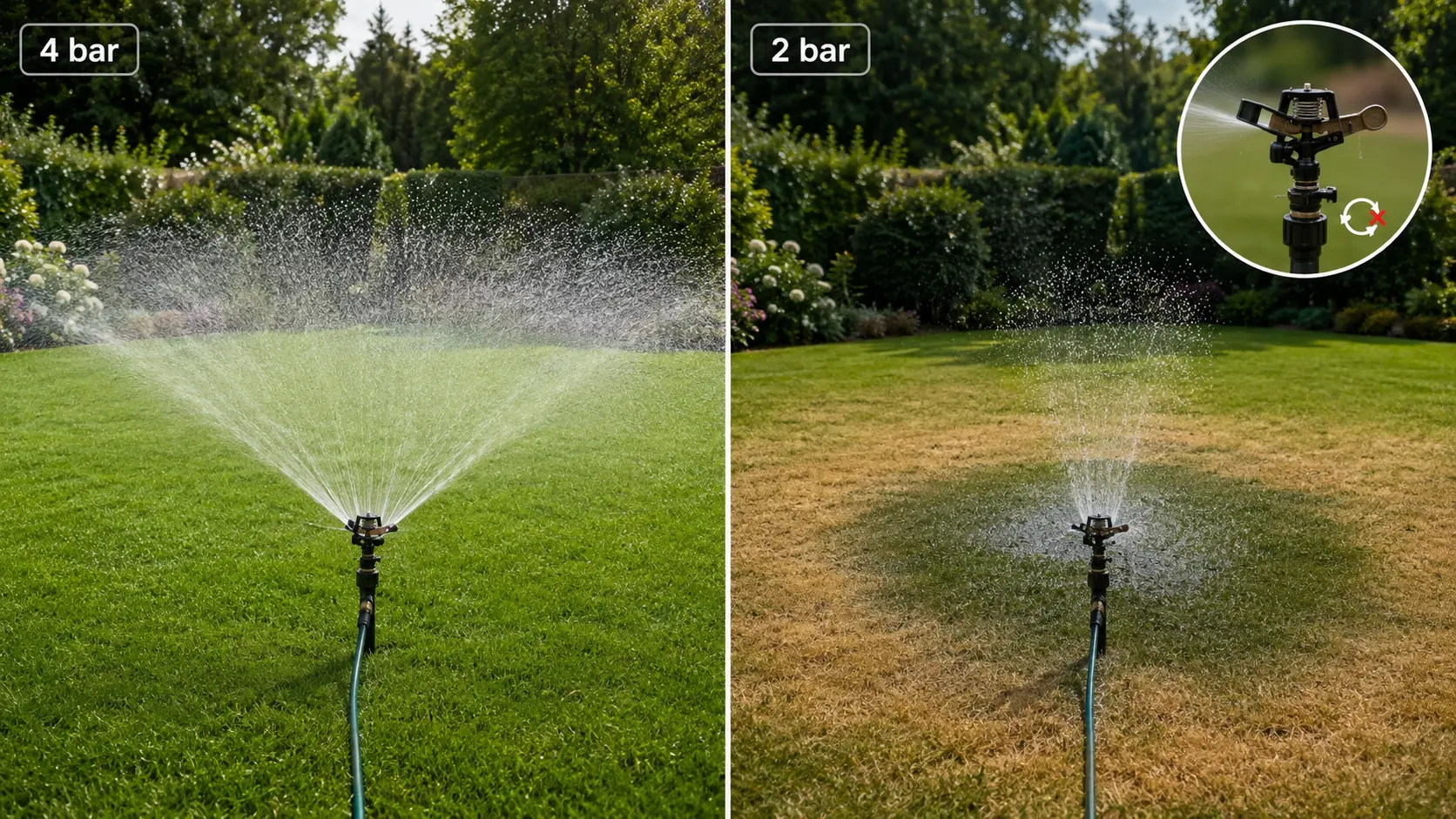
Here is the single most important thing to understand about sprinkler specifications: the coverage area printed on the box is not a lie, but it is not your customer’s reality either.
Hozelock’s AquaSave Pro 350 XL claims “Max Coverage 350 m².” Gardena’s AquaZoom S claims “9–150 m².” Neither brand states the water pressure at which these measurements were taken. Gardena at least provides a range, which implicitly acknowledges that coverage varies — though it still does not explain why. Hozelock’s single “Max” leaves no room for interpretation. This is standard industry practice — not a Hozelock problem or a Gardena problem, but an industry-wide practice that leaves the buyer uninformed.
The testing condition behind most coverage claims is 3–4 bars. At 2 bar — common in older European homes — the actual coverage area drops significantly. Based on industry experience, coverage at 2 bar is roughly 50–60% of the claimed area at 4 bar (est.). Academic research on pop-up sprinklers confirms the direction: one study found that reducing pressure from 3 bar to 2 bar decreased flow rate by 28% and distribution uniformity by 12%; reducing to 1.5 bar cut flow by 42% and uniformity by 24% (note: these figures are from pop-up sprinkler tests; specific values for oscillating and rotary garden sprinklers may differ, but the pressure-dependency pattern is consistent across types).
This is not a minor discrepancy. This is the difference between a sprinkler that waters the whole lawn and one that leaves the edges brown. It is also the number-one driver of consumer complaints and returns.
But the problem does not stop in the area. Even when the coverage area is roughly correct, the water may not be evenly distributed. Low-cost oscillating sprinklers often have nozzle arrangements that concentrate water in the centre of the spray pattern and leave the edges dry. The cause is simple: fewer nozzles at the ends of the tube, more in the middle. It saves material and simplifies the mould. The result is a lawn that is soaked in the centre and parched at the borders.
Distribution Uniformity (DU) is the metric that measures this. A DU of 75% or higher indicates even coverage — the minimum standard for a quality sprinkler per irrigation industry standards (ASAE/IA). Products at the budget end can fall to 50–60% DU (est.), meaning nearly half the water is wasted on areas that are already saturated, while other areas receive almost nothing.
And here is where low pressure makes a bad problem worse: the DU drops right along with the coverage area. A sprinkler that delivers 75% DU at 4 bar can fall to 50–60% DU at 2 bar (est., based on industry experience). The edges that were barely getting water now get almost none.
Hozelock addresses distribution in its AquaSave Pro series with what it calls “3D Control” — a nozzle arrangement designed to ensure uniform coverage across the entire pattern. Whether this claim holds at 2 bar is a different question, and one worth testing.
And for impulse sprinklers, low pressure is not just a performance issue — it is a showstopper. Among the four types, impulse sprinklers are the most sensitive to water pressure; below 2 bar, the arm may not rotate at all. Oscillating and rotary sprinklers at least keep working — they just cover less area and water less evenly. An impulse sprinkler that does not rotate is a product that simply does not function. If your customer base includes older homes with low pressure, this is not the type to lead with.
What to do about it:
- Require your factory to provide coverage data at 2 bar, 3 bar, and 4 bar. Most factories test at multiple pressures internally — they just do not publish the lower numbers.
- Request DU test data, or ask for a spray-test video showing the sprinkler operating on a dry surface at your target pressure. If the factory cannot provide either, that is useful information in itself.
- If your factory cannot provide multi-pressure data, test it yourself: set up the sprinkler at 2 bar on a dry surface and measure the wetted area. One test, ten minutes, and you know what your customer will actually experience.
- Printing “Coverage tested at X bar” on your packaging is a genuine differentiator in a market where nobody else does it.
Water pressure and connector choice also affect hose products, so review garden hoses for wholesale buyers before confirming the range.
If you are sourcing sprinklers for the European market, the water-pressure gap is not optional information — it is the difference between a product that gets re-ordered and one that gets returned. Ask our team for multi-pressure coverage test data on the sprinkler models you are considering.
Plastic and UV: The Season-Long Countdown
A sprinkler sits in the sun for hours, sometimes days, every time it is used. Then it sits in the sun between uses. Over a season, the UV exposure adds up. Over two or three seasons, the plastic starts to show it.
ABS is the most common material for sprinkler bases and bodies — and the most vulnerable to UV degradation. The butadiene rubber component in ABS has double-bond structures that are highly susceptible to UV-initiated oxidation. This is the primary cause of embrittlement, not the aromatic ring structures in the styrene component (a common misconception). Without UV stabilisers, ABS sprinkler parts can begin to show surface cracking and yellowing within 1–2 seasons of outdoor exposure (est., based on industry experience). The plastic does not just fade — it becomes brittle. A base that was flexible in spring can crack under hand pressure by mid-summer the following year.
PP (polypropylene) is significantly more resistant. Its aliphatic carbon chain has no double bonds for UV to attack directly, making it inherently more stable than ABS in outdoor applications. With added UV stabilisers (typically HALS — hindered amine light stabilisers), PP components can last an estimated 5–7 seasons (est., based on industry experience — specific lifespan depends on climate, stabiliser concentration, and part thickness).
POM (polyacetal/polyformaldehyde) is the premium choice for gear mechanisms and rotating parts. It has excellent UV resistance and dimensional stability. With stabilisers, POM components can last an estimated 7+ seasons (est.). The cost is higher, but for parts that must maintain precise tolerances — gear teeth, pivot points, rotating heads — the performance justifies it.
Adding HALS or UV absorbers can extend the outdoor lifespan of polyolefin components by roughly 2–3 times (est., based on industry experience — the actual multiplier depends on the polymer type, stabiliser concentration, and local UV index). The cost increase at the factory level is typically small. The return-rate reduction is significant.
| Material | UV resistance | Outdoor life (no stabiliser) | Outdoor life (with UV stabiliser) | Typical use |
| ABS | Low | 1–2 seasons (est.) | 3–5 seasons (est.) | Budget bases and bodies |
| PP | Moderate | 2–3 seasons (est.) | 5–7 seasons (est.) | Mid-range bases |
| POM | Good | 3–4 seasons (est.) | 7+ seasons (est.) | Gears, rotating parts |
Procurement specification: At a minimum, require PP for the base and POM for any rotating or gear-driven component. Require UV stabilisers for all outdoor plastic parts. If the factory cannot confirm UV stabiliser content, request a QUV accelerated weathering test — 500 hours is a reasonable benchmark for a product that claims multi-season durability.
Bad Reviews and the Root Cause
We analysed consumer complaints across top-selling sprinklers on UK and European retail platforms. The first three root causes — coverage gap at real-world pressure, uneven distribution, and UV embrittlement — are detailed above. Here are the two that most buyers overlook:
| # | Complaint | What is actually happening | Procurement fix |
| 1 | Nozzles clogged with limescale | No built-in filter; hard water deposits block nozzle holes | Require integrated filter mesh (standard on Hozelock/Gardena premium models) |
| 2 | The adjustment dial keeps slipping | Plastic friction-lock mechanism wears down | Check adjustment locking mechanism; prefer a metal detent or screw-lock design |
Both of these are specification decisions, not quality failures. A sprinkler without a filter works fine in soft-water regions — and fails in hard-water regions. A friction-lock adjustment holds on day one — and slips after a season of UV exposure and thermal cycling. The fix is not a better factory. The fix is a better specification.
Sprinkler Procurement Checklist
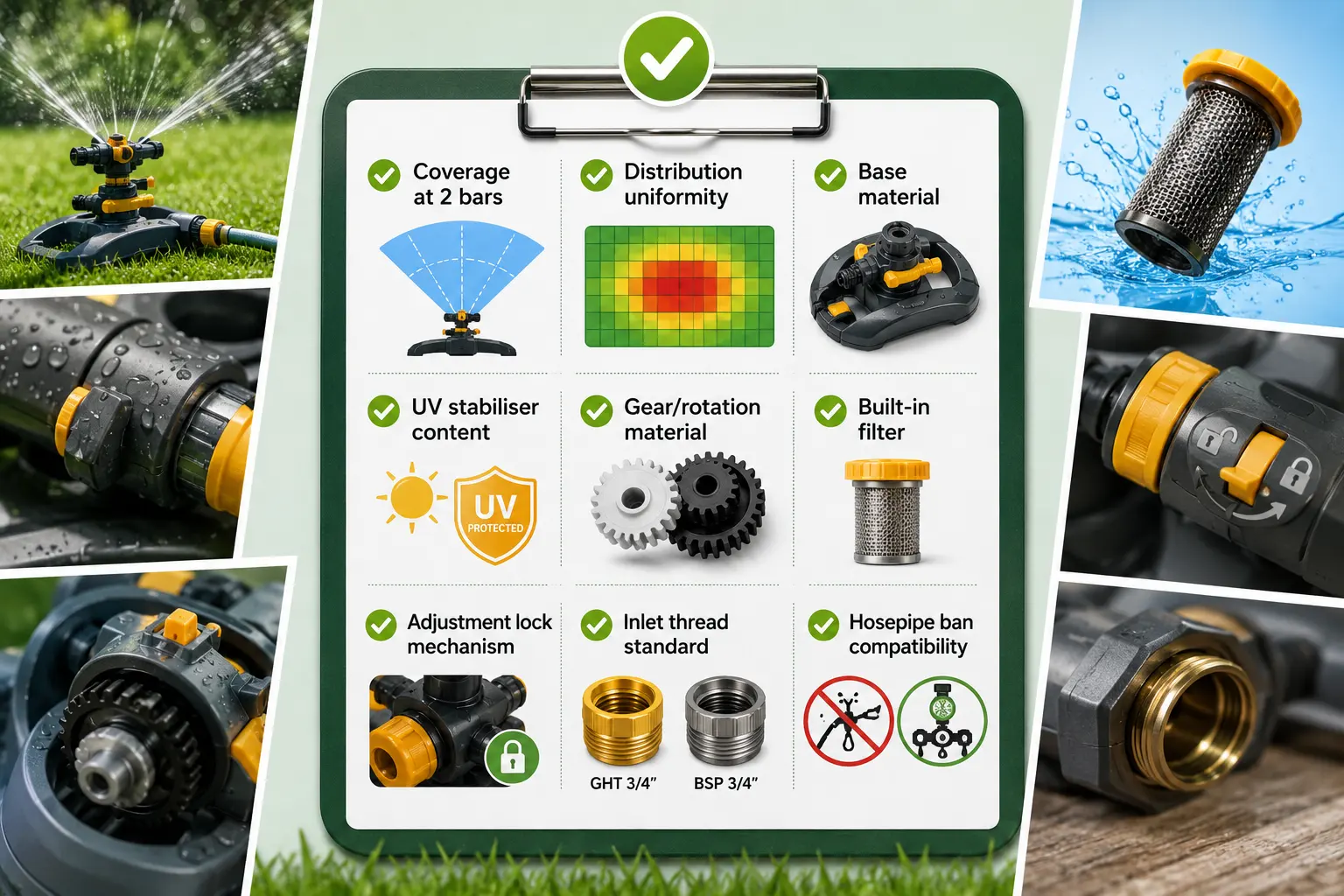
| Check Item | Why It Matters | How to Verify |
| Coverage at 2 bars | Claimed area measured at 3–4 bar; at 2 bar, coverage drops est. 50–60% | Require factory data at 2, 3, and 4 bar; or test on-site at 2 bar |
| Distribution uniformity | DU below 75% means edges stay dry; budget models can hit 50–60% DU | Request DU test data or spray-test video at your target pressure |
| Base material | ABS cracks in 1–2 seasons without stabiliser (est.) — PP minimum for base | Specify PP minimum; require UV stabiliser confirmation |
| UV stabiliser content | HALS extends outdoor life by est. 2–3×; cost increase is small | Require UV stabiliser spec in writing; request QUV 500-hour test for premium lines |
| Gear/rotation material | POM gears outlast ABS gears significantly; precision parts need a stable material | Specify POM for all gear and rotating components |
| Built-in filter | Limescale blocks fine nozzle holes in hard-water regions; the filter prevents this | Confirm filter mesh included; metal mesh preferred over plastic |
| Adjustment lock mechanism | Plastic friction locks slip after repeated use + UV exposure | Inspect sample; prefer metal detent or screw-lock over friction-only |
| Inlet thread standard | UK/EU (BSP) vs US (GHT) require different fittings — wrong thread = unusable product | Confirm inlet thread matches target market; most garden sprinklers use GHT 3/4″ or BSP 3/4″ |
| Hosepipe ban compatibility | Sprinklers are banned during UK hosepipe bans; drip systems with timers are not | Plan seasonal assortment: shift to drip kits and water timers during ban season |
In hosepipe-ban markets, sprinklers should be reviewed together with water-saving garden products for heatwaves and hosepipe bans.
If your range includes both sprinklers and drip irrigation, the seasonal shift from sprinklers to drip kits during hosepipe bans is a marginal opportunity most buyers miss. Get our seasonal watering product plan — sprinklers for spring, drip kits for summer bans.
FAQ
Oscillating or rotary — which is better for lawns? Oscillating. The rectangular spray pattern matches the shape of most lawns better than a circular pattern, which wastes water on paths and borders at the corners. Rotary sprinklers are better suited to irregularly shaped beds where a gentle, circular coverage is preferred.
What water pressure are sprinkler coverage claims based on? Typically 3–4 bars. Neither Hozelock nor Gardena states the test pressure on their packaging or product pages. At 2 bar — common in older European homes — the actual coverage area is roughly 50–60% of the claimed figure (est., based on industry experience). This is the single largest source of consumer complaints in the sprinkler category.
How long do plastic sprinklers last outdoors? It depends on the material and whether UV stabilisers are present. ABS without stabilisers can begin to embrittle within 1–2 seasons (est.). PP with UV stabilisers can last an estimated 5–7 seasons (est.). POM with stabilisers, 7+ seasons (est.). The primary degradation mechanism for ABS is UV-initiated oxidation of the butadiene rubber component — not, as is often assumed, the aromatic ring structures in the styrene phase.
Do sprinklers need built-in filters? In hard-water regions — which include most of southern and eastern England, and much of France and Germany — yes. Limescale deposits will eventually block fine nozzle openings. Premium models from Hozelock and Gardena include metal filter mesh as standard. Budget models often omit it. If your market includes hard-water areas, specify an integrated filter.
Are sprinkler and hose connectors compatible? Most garden sprinklers use a standard 3/4″ inlet thread — either GHT (Garden Hose Thread, common in North America) or BSP (British Standard Pipe, common in the UK and Europe). The thread standard needs to match your market. The sprinkler itself typically does not ship with a connector attached; the buyer fits one that matches their hose system (Hozelock, Gardena, or generic). Confirm the inlet thread with your factory before production.
What type of sprinkler should I choose for a large lawn? Impulse. The water-driven arm throws water significantly further than oscillating or rotary types — 15–25 metres for metal models — and can cover areas of 200–500+ m². The trade-off is water pressure sensitivity: impulse sprinklers require at least 2 bar to rotate reliably, and perform best at 3–4 bar. They also deliver water with more force, which makes them less suitable for delicate plantings. For a large, open lawn with adequate pressure, impulse is the practical choice.
Next Step: Review Your Sprinkler Sourcing Plan
Order a sample set covering the four sprinkler types — with at least one model tested at 2 bar. Check the base material (PP, not ABS, unless UV-stabilised). Run the sprinkler on a dry surface and measure the actual wetted area. Compare it to the number on the box. Then decide.
Talk to our team about your sprinkler sourcing plan. You focus on selling. Scarecrow Garden Supplier can help you source, verify, organise, and ship.
Ready to Build Your Watering-Tool Assortment?
Send us your product list, target market and packaging requirements — we will come back with supplier matches, sample options and a CBM-optimised packing plan within 48 hours.

Written by
ScarecrowGarden
💡About Scarecrow Garden Supplier Co., Ltd.
Scarecrow Garden Supplier Co., Ltd. is a China-based sourcing and wholesale partner specializing in garden tools, landscaping equipment, and outdoor supplies for international wholesalers, distributors, contractors, and brands.
With hands-on experience rooted in real garden use scenarios, we focus on durable materials, functional design, and stable large-volume supply. Our product range covers pruning tools, watering systems, hand tools, outdoor hardware, and customized garden solutions to support both retail and professional landscaping markets.
Beyond products, we help our partners navigate supplier selection, quality control, compliance requirements, and long-term sourcing strategies in China. Through our blog, we share practical insights on product selection, material comparisons, industry trends, and cost-effective purchasing—helping global buyers build stronger, more competitive supply chains.