









Updated 3 months ago
Cold Frame Packaging and Shipping: KD Assembly, Hinge Protection, and Moisture Control Determine Whether Your Order Arrives Usable

ScarecrowGarden
💡About Scarecrow Garden Supplier Co., Ltd.
Scarecrow Garden Supplier Co., Ltd. is a China-based sourcing and wholesale partner specializing in garden tools, landscaping equipment, and outdoor supplies for international wholesalers, distributors, contractors, and brands.
With hands-on experience rooted in real garden use scenarios, we focus on durable materials, functional design, and stable large-volume supply. Our product range covers pruning tools, watering systems, hand tools, outdoor hardware, and customized garden solutions to support both retail and professional landscaping markets.
Beyond products, we help our partners navigate supplier selection, quality control, compliance requirements, and long-term sourcing strategies in China. Through our blog, we share practical insights on product selection, material comparisons, industry trends, and cost-effective purchasing—helping global buyers build stronger, more competitive supply chains.
Cold Frame Wholesale Sourcing: KD Packaging & Shipping Standards | Scarecrow Garden Supplier
Your cold frame container has arrived. You open the first carton. The hinges are compressed out of shape — the lid won’t close properly. The auto-vent’s wax fill has leaked; temperature-controlled ventilation is gone. The PC panels were stacked without separators — evHinges are precision componentsery surface is scratched. The hardware bag burst open, and the screws are loose across the bottom of the box. Your customer waits three days for a replacement parts shipment before they can assemble a single unit.
This is not a hypothetical. This is the most common arrival scenario in cold frame sourcing.
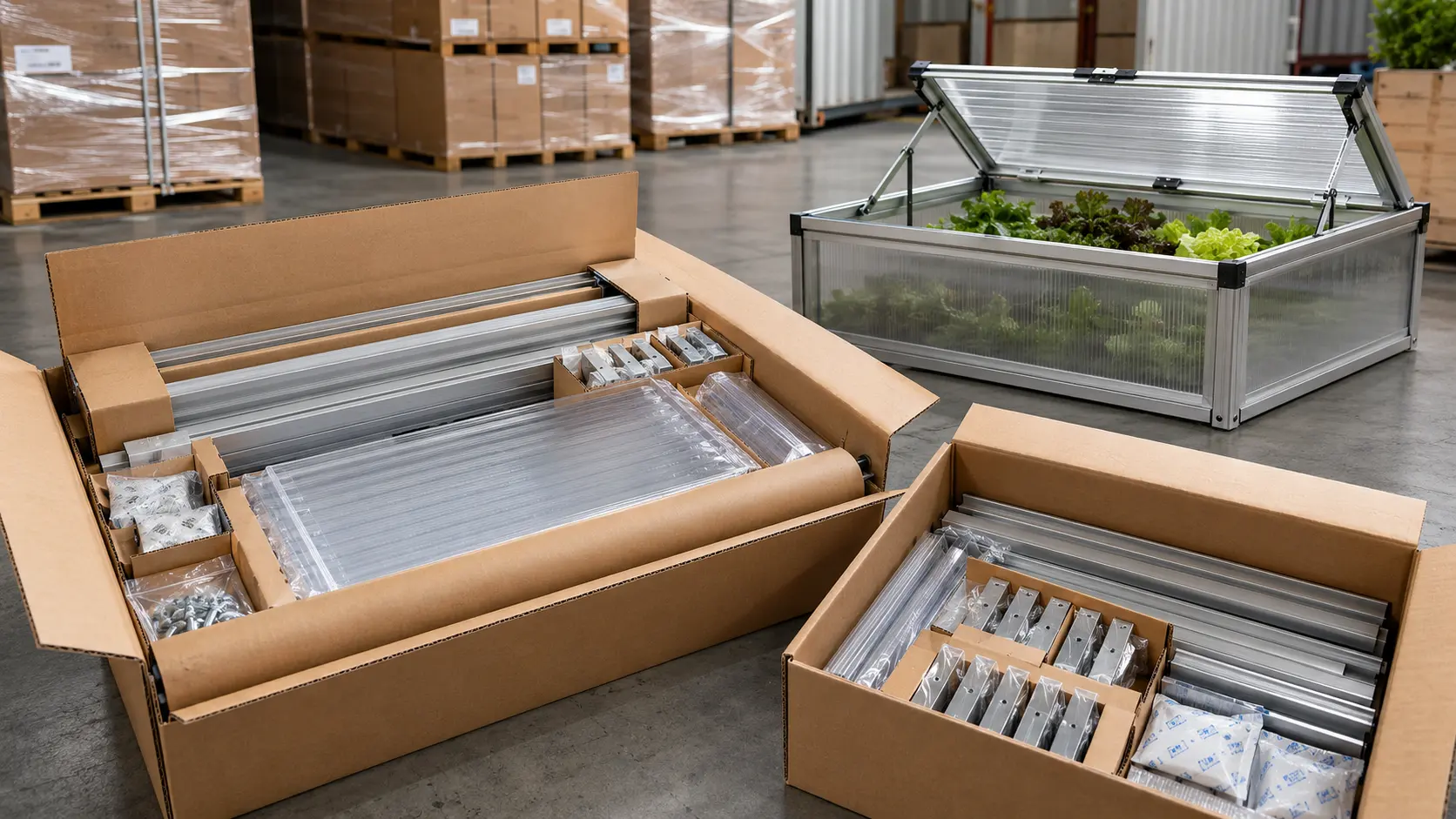
Cold frames are different from frost covers and plant cloches. They ship as KD (knock-down) assemblies — frame tubes, glazing panels, hinges, auto-vents, connectors, and fasteners, all packed separately. That structure determines the complexity: you are not protecting a finished product. You are protecting a kit of parts that must survive 30 days at sea, multiple handling cycles, and still assemble into a fully functional cold frame.
This article answers one question: where do cold frame packaging and shipping go wrong most often, and how do you prevent it?
Cold Frame KD Packaging: Why It Is Harder Than Protecting a Finished Product
KD assembly saves 40–60% CBM compared to fully assembled units (industry reference values). Frame tubes laid flat take up roughly half the volume of an assembled frame, and nesting thinner tubes inside thicker ones saves another 15–20% (industry reference values). That is the freight advantage.
But knock-down also introduces three risks that frost covers and plant cloches never face.
Hinge Deformation: 1 mm of Compression Can Kill the Function
Cold frame lids open and close on hinges. Hinges are precision components — compress them 1 mm out of alignment and the lid will not seat properly or will not close at all. Stacking pressure during ocean freight, impacts during handling — both can deform a hinge. This is not a cosmetic issue. It is a functional failure. Lid will not open = no ventilation. Lid will not close = no insulation. The cold frame’s core function is gone.
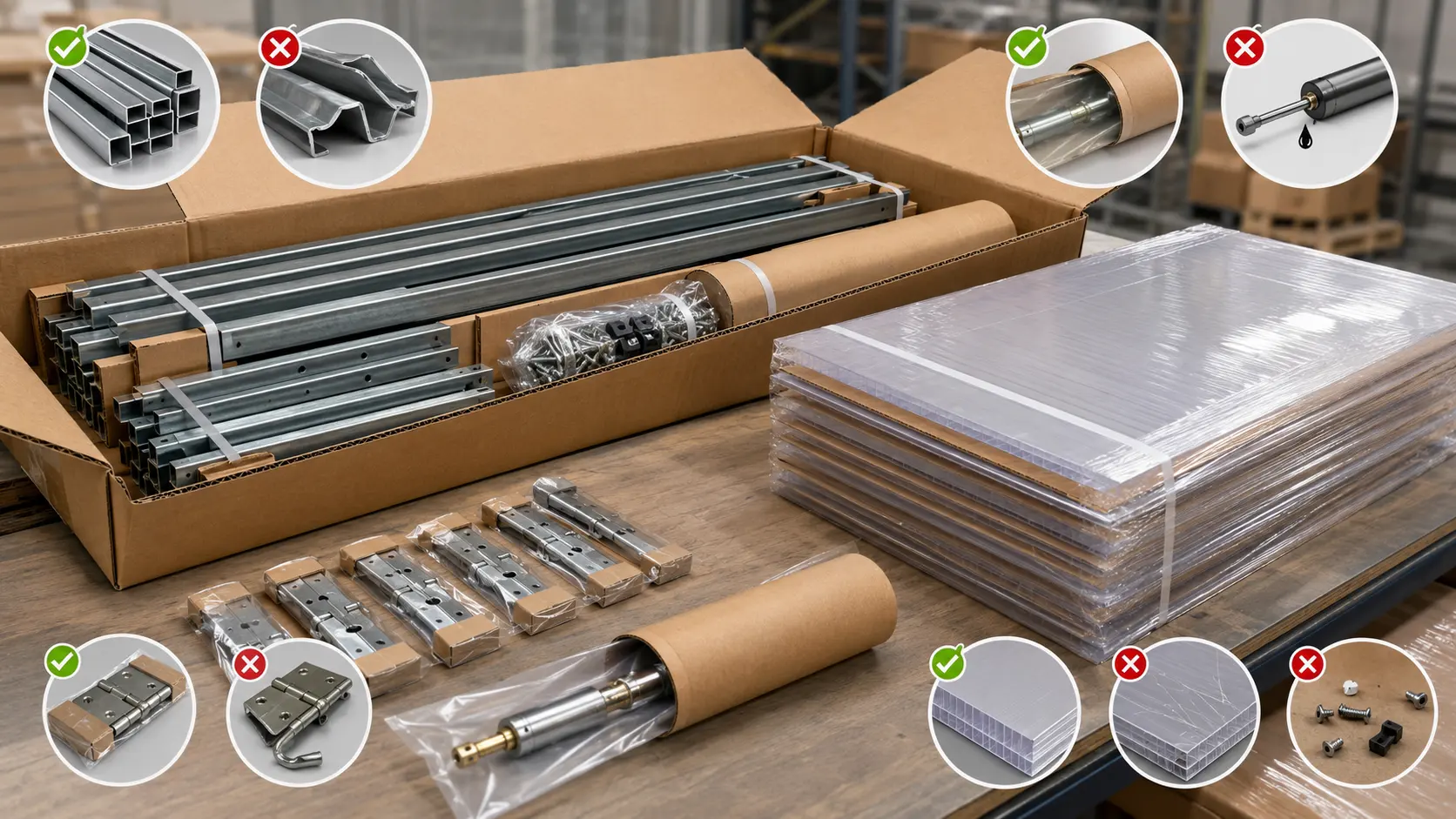
Packaging requirement: Each hinge must be individually wrapped in PE film with cardboard protection. Hinges must not be packed loose with frame tubes, and must never be placed at the bottom of a carton under heavier components.
Auto-Vent Damage: Wax Leak = Ventilation Failure
Cold frames equipped with automatic vent openers rely on a wax-filled cylinder. When the wax reaches its set temperature, it expands and pushes the lid open. During shipping, this component is vulnerable to two things: bending (a deformed cylinder will not extend or retract) and impact leakage (if the wax fill leaks out, the mechanism is dead). Like the hinge, this is not a cosmetic defect — it is a functional write-off.
Packaging requirement: Each auto-vent must be individually bagged in PE film and protected inside a cardboard tube. The tube diameter should be 5–10 mm larger than the vent body to provide crush space (industry reference value).
PC Twin-Wall Panel Scratching: Stacked Without Separators = Unsellable at Retail
Cold frame PC panels are large — the lid panel plus side panels cover significantly more area than a Barn or Tunnel cloche. Twin-wall construction is more vulnerable to surface damage than solid sheet. When two panels are stacked face to face, micro-vibration during transit creates friction between the surfaces, leaving a fine network of scratches. Wholesale channels may accept this; retail channels will not — a garden centre customer will not buy a scratched PC panel.
Packaging requirement: Every two PC panels must be separated by a sheet of cardboard. The entire panel stack must be wrapped in PE film and stored flat, with no heavy items placed on top.
Missing Hardware: The Number-One Complaint
Cold frame hardware lists are long — frame tubes, connectors, hinges, auto-vents, glazing panels, screws, clips. One missing screw and the end user cannot complete assembly. Hardware scatter is the single most common complaint in cold frame sourcing, bar none.
The fix: Spend an extra ¥2–3 per carton (industry reference value) to secure all hardware inside the tube bundle using cable ties or shrink film. That is far cheaper than spending three days after arrival trying to match and replace scattered parts.
Three Frame Materials, Three Packaging Approaches
A cold frame’s frame material determines its packaging requirements. Timber, aluminium, and galvanised steel differ in weight, vulnerability, and moisture protection needs.
| Packaging Factor | Timber-Frame CF | Aluminium-Frame CF | Steel-Frame CF |
| Frame weight | Medium | Light | Heavy |
| Unique risk | Mould growth | Tube bending | Rust |
| Moisture protection | Teak oil coating + PE bag seal | PE bag wrap | VCI film or rust preventative oil + PE bag seal |
| Tube protection | Bundled + PE film | Bundled + PE film (bend prevention) | Bundled + PE film |
| Glazing | PC or glass | PC twin-wall | PC twin-wall |
| Carton spec | Double-wall corrugated + moisture-resistant liner | Double-wall corrugated | Double-wall corrugated |
| Units per carton | 1 set/carton | 1 set/carton (small models may fit 2) | 1 set/carton |
| Stacking limit | No more than 3 high (industry reference value) | No more than 4 high (industry reference value) | No more than 5 high (industry reference value) |
Read that table by column, not by row. If you are sourcing timber cold frames, the column that matters most is “Moisture protection” — here is why.
Timber-frame cold frames cause the most problems at sea. Wood begins to mould in high-humidity environments within 5–7 days (industry reference estimate). If the timber has not been coated with teak oil and sealed in a PE bag before leaving the factory, you may open the carton to find a layer of white mould — the wood has absorbed moisture, swollen, and shifted the hinge mortises. The lid will not fit. Aluminium frames have a different weak point: thin tube walls that bend under stacking pressure, especially on longer tubes. Steel frames handle compression best, but carry the highest rust risk — bare steel or zinc-damaged surfaces in humidity above 65% may develop rust spots within days (industry reference estimate). Rust prevention is not optional.
Glass-glazed cold frames need additional protection — bubble wrap, cardboard separators, and EPE foam corner blocks. Breakage risk is Critical-grade. If you sell through e-commerce channels, glass panels have a far lower drop-test pass rate than PC panels. For e-commerce, prioritise PC-glazed models.
Moisture and Rust Control: The Ocean Freight Baseline
The environment inside an ocean container is more extreme than most people realise. Internal temperatures can exceed 60°C. The day-night temperature cycle causes condensation to form repeatedly — container rain — and humidity swings far above 65% RH. In this environment, cold frames face three simultaneous threats: metal corrosion, timber mould, and carton softening.
Moisture Control Checklist
| Measure | Cost | Quantified Effect | Applies To |
| 5 g silica gel desiccant per bag | Very low | Absorbs moisture within sealed bag | All components |
| PE bag seal | Very low | Isolates from external humidity | All components |
| Double-wall corrugated carton | Approx. ¥2–3 more per carton vs. single-wall | Single-wall carton damage rate approx. 8% after ocean freight; double-wall drops to approx. 2% (industry reference values; actual rates vary with route and handling) | All products |
| Moisture-resistant liner inside carton | Low | Additional moisture barrier | Timber-frame CF |
Double-wall corrugated cartons are the ocean freight baseline. Single-wall cartons soften, deform, and sometimes rupture after 30 days at sea at a far higher rate than double-wall. Once the carton softens, internal fixing fails. Components shift inside. Hinges get crushed. The chain reaction starts here.
Rust prevention is not optional. Bare steel or zinc-damaged galvanised steel frames exposed to humidity above 65% during ocean transit may develop rust spots within days (industry reference estimate). If your customer is a garden centre, their reaction to rust on arrival is not “can this be wiped off?” — it is “I am not accepting this shipment.”
VCI: A Cleaner Alternative to Oil
Traditional rust prevention means coating steel frames with oil. It works, but it creates a mess — your customer has to clean the oil off before assembly, and the oil can stain cardboard and PE film inside the carton.
VCI (Volatile Corrosion Inhibitor) packaging offers a cleaner alternative. VCI molecules evaporate from the packaging material and form a molecular-level protective layer on metal surfaces, blocking oxygen and moisture. When the product is unpacked, the VCI layer dissipates completely — no cleaning required. Companies like ArcelorMittal, POSCO, and other major industrial users rely on VCI packaging for metal components in transit (based on industry sources). VCI products come in several forms: VCI crepe paper for wrapping individual parts, VCI film for enclosing full assemblies, and VCI desiccant capsules that combine corrosion inhibition with moisture absorption. They can comply with REACH, RoHS, and other relevant standards.
For cold frame shipments, a practical approach is: VCI film around steel frame bundles + silica gel desiccant inside the PE bag + PE bag seal. This combination handles both moisture and corrosion without the mess of oil. VCI and oil each have a place — for a product that may sit in a container for six weeks, VCI’s premium is often justified; for a short domestic run where the buyer will clean the frame anyway, oil may be the pragmatic choice.
Moisture control is the baseline. But if you sell through e-commerce, there is another hurdle you must clear: the drop test.
The Drop Test: Non-Negotiable for E-Commerce
If you sell cold frames through e-commerce channels, ISTA drop testing is not a suggestion — it is a requirement. E-commerce logistics involve far more handling intensity than wholesale or retail. Parcel sorting, last-mile delivery, consumer self-pickup — every stage is a potential drop event.
ISTA 2A Drop Heights by Package Weight
ISTA 2A:2011 is a partial-simulation performance test for packages weighing up to 150 lb (68 kg). It includes temperature and humidity conditioning, compression, vibration, and drop testing — six mandatory steps in total. This is more rigorous than ISTA 1A, which is a non-simulation integrity test without environmental conditioning.
| Package Gross Weight | Drop Height (ISTA 2A:2011) |
| 0–21 lb (0–10 kg) | 30 in (760 mm) |
| 22–40 lb (10–18 kg) | 24 in (610 mm) |
| 41–60 lb (18–27 kg) | 18 in (460 mm) |
| 61–100 lb (27–45 kg) | 12 in (305 mm) |
| Over 100 lb (over 45 kg) | 8 in (200 mm) |
Source: ISTA 2A:2011. Note: ISTA 1A (non-simulation test) uses the same drop heights as 2A for most weight ranges, but does not include the temperature/humidity conditioning step. If your customer specifies ISTA 1A, follow 1A parameters — but understand that 1A does not simulate the moisture and temperature stress of real shipping.
Cold Frame Drop-Test Pass/Fail Criteria
A drop test is not “the carton survived, so we pass.” For cold frames, the criteria must cover every functional component:
| Component | Pass Criterion | Failure Consequence |
| PC twin-wall panel | No cracks, no fractures, no visible scratching | Unsellable at retail |
| Glass panel | No breakage | Critical — full carton return |
| Hinge | No deformation; lid opens and closes normally | Functional failure — no ventilation or insulation |
| Auto-vent | No wax leak; automatic ventilation functions | Functional failure — ventilation control lost |
| Frame tube | No bending or deformation | Difficult or impossible assembly |
| Hardware | No scatter, no missing pieces | Customer cannot complete assembly |
Hinges and auto-vents are cold-frame-specific test criteria — frost covers and plant cloches do not have these components. If your cold frame goes through e-commerce, focus your drop-test inspection on these two: does the hinge still open and close? Has the auto-vent leaked? If these two pass, the other components usually hold up.
A practical suggestion: For your first e-commerce cold frame shipment, run the ISTA 2A lab test first, then send a sample batch through your actual logistics chain. The gap between lab conditions and real-world shipping is sometimes wider than you expect.
CBM Calculation and Mixed-Order Loading: Measure Everything Yourself
Carton Dimensions: Do Not Trust Supplier Data
Supplier-reported carton dimensions often differ from actual measurements by 2–3 cm (industry reference value). That gap looks small, but scaled across a shipment it is real money — 200 cartons with a 2 cm discrepancy add roughly 0.7 CBM, increasing freight cost by approximately $280 (industry reference estimate). The money you save by measuring yourself pays for two extra carton inspections.
The right approach: During inspection, measure every carton SKU with a tape measure — length × width × height — and calculate actual CBM (L × W × H ÷ 1,000,000, to three decimal places). Do not use supplier-provided dimensions for container loading plans.
40 ft High-Cube Container Reference Data
| Parameter | Value |
| Internal dimensions | 12,032 × 2,352 × 2,695 mm |
| Volume | Approx. 76 m³ |
| Maximum payload | Approx. 27,660 kg |
Mixed-Order Loading Sequence
A container rarely carries just one cold frame model. The core principle of mixed-order loading: heavy items on the bottom, crush-sensitive items on top, panels in the middle.
| Layer | What Goes Here | Why |
| Bottom | Large steel-frame CF tube bundles, heavy accessories | High weight, high crush resistance |
| Middle | Medium aluminium-frame CFs, PC panels (stored flat) | Medium weight, needs protection from crushing |
| Top | Small timber-frame CFs, hinges, auto-vents, lightweight hardware | Light weight, crush-sensitive — compressed hinges = returns |
Two rules you cannot break: PC panels must be stored flat and must not have heavy items on top. Hinges and auto-vents must never go on the bottom layer. Violate either of these, and the return rate after arrival will redefine your understanding of “packaging cost.”
But rules on paper do not survive contact with a factory that skipped the cardboard separators, or a supplier who swapped 5 mm glass for 4 mm without telling you. You can write the perfect loading plan — if nobody checks what actually went into those cartons, the plan is just a document.
This is where mixed-order loading becomes more than just stacking cartons. When your container holds cold frames in three frame materials, four size variants, and PC versus glass glazing options, the loading sequence determines whether every SKU arrives intact or whether your most fragile items get crushed under someone else’s heavy steel-frame order. Scarecrow’s team opens every carton before loading and checks what other suppliers often skip: is the hinge protected from the tube bundle above it? Is the auto-vent’s cardboard tube still intact, or has it already been crushed in the factory’s pre-pack? Are the PC panels actually separated by cardboard, or did the factory skip that step? We reorganise the loading plan based on what we find — not based on what the packaging sheet says.
Next Step: Review Your Cold Frame Packaging Plan
Cold frame packaging problems are not about whether the carton is thick enough. Cold frames are KD assemblies — hinge deformation, auto-vent leakage, panel scratching, missing hardware. Any one of these fails, and the result at destination is not “slightly damaged” — it is “functionally unusable.”
If you are planning a cold frame order, confirm these 10 packaging approval points before you seal the sample:
| # | Check Item | Method | Key Point |
| 1 | Carton dimensions | Tape measure on actual carton | Do not use supplier data |
| 2 | Net / gross weight | Scale weighing | Must match quotation |
| 3 | CBM calculation | Measured L × W × H ÷ 1,000,000 | Three decimal places |
| 4 | Internal fixturing | Shake test | No significant movement inside carton |
| 5 | Hardware completeness | Check against BOM | Must match packing list |
| 6 | Hinge protection | Visual + manual test | No deformation; cardboard protection present |
| 7 | Auto-vent protection | Visual inspection | Cardboard tube present; no wax leak |
| 8 | PC panel separators | Visual inspection | Cardboard between every two panels |
| 9 | Moisture measures | Check contents | Desiccant + PE bag seal + rust prevention |
| 10 | Drop test | ISTA standard or agreed protocol | Mandatory for e-commerce |
We open every cold frame carton and check what other products do not need: whether the hinge has been compressed 1 mm out of shape, whether the auto-vent’s wax fill has leaked, whether the PC twin-wall panels have separators between them, whether the hardware is fully secured inside the tube bundle — these are problems frost covers and cloches do not have, but they are the top reasons cold frames get returned after arrival. Scarecrow Garden Supplier will check the actual packed result, not the supplier’s packaging proposal. Talk to us about your cold frame mixed-order loading plan.
Get cold frame carton data and quotation → Confirm CBM, gross weight, and packing method — then build your container plan on measured numbers.
Get cold frame three-frame packaging comparison video → See the actual packaging differences for timber, aluminium, and steel frames, including hinge protection and auto-vent securing.
Get cold frame samples → Run a shake test and a drop test on arrival — more convincing than any packaging proposal.
FAQ
Q: Why does cold frame packaging fail more often than frost cover or cloche packaging?
A: Because cold frames ship as KD (knock-down) assemblies with multiple precision components — hinges, auto-vents, glazing panels, and hardware — that must all arrive undamaged and complete for the product to function. Frost covers and cloches are simpler products with fewer failure points. One missing screw can prevent cold frame assembly; one deformed hinge can disable ventilation.
Q: Is VCI film really better than rust-preventative oil for steel frames?
A: It depends on your shipment. VCI (Volatile Corrosion Inhibitor) forms a molecular protective layer on metal surfaces without the mess of oil. It dissipates completely when unpacked, so your customer does not need to clean anything before assembly — that makes it the cleaner choice for long ocean shipments. Oil works too, but it stains packaging and requires wiping off, which may be acceptable for short domestic runs where the buyer will clean the frame anyway. Major industrial users — ArcelorMittal, POSCO, and others — rely on VCI for metal component protection in transit (based on industry sources).
Q: Do I really need ISTA 2A testing, or is ISTA 1A enough?
A: It depends on your channel. ISTA 1A is a non-simulation test — it checks whether the package survives drops and vibration, but does not simulate the temperature and humidity stress of real shipping. ISTA 2A adds environmental conditioning (typically 72 hours at specified temperature and humidity, such as 38°C / 85% RH for tropical climates) before the mechanical tests. If you sell through e-commerce or ship to humid-climate markets, ISTA 2A is the more realistic test. For wholesale shipments where handling is gentler, ISTA 1A may be sufficient — but confirm with your customer.
Q: My supplier says their carton dimensions are accurate. Why should I measure myself?
A: Supplier-reported dimensions often differ from actual measurements by 2–3 cm (industry reference value). Supplier data is typically based on nominal or internal dimensions, not the external measurements that determine CBM. Across a full shipment, that gap can add 0.5–1.0 CBM of unexpected freight cost. Measuring takes minutes; the savings are significant.
Q: What is the single most important packaging check for cold frames?
A: Hinge and auto-vent protection. These two components are unique to cold frames — frost covers and cloches do not have them — and they are the most common cause of functional failure after arrival. If the hinge is deformed, the lid will not open or close. If the auto-vent has leaked, temperature-controlled ventilation is gone. Check these first, check them carefully.
Q: Can glass-glazed cold frames be sold through e-commerce?
A: Technically yes, but the drop-test pass rate for glass panels is significantly lower than for PC twin-wall. Glass requires extra protection — bubble wrap, cardboard separators, EPE foam corner blocks — and even then, breakage during parcel handling is a real risk. For e-commerce channels, PC-glazed models are the safer choice.
Need Help Building a Reliable Frost Cover Range?
Send us your product list, target market, estimated quantities, and packaging requirements. We can help compare product options, verify important specifications, consolidate items from multiple factories, and prepare a sourcing plan suited to your market.
Written by
ScarecrowGarden
💡About Scarecrow Garden Supplier Co., Ltd.
Scarecrow Garden Supplier Co., Ltd. is a China-based sourcing and wholesale partner specializing in garden tools, landscaping equipment, and outdoor supplies for international wholesalers, distributors, contractors, and brands.
With hands-on experience rooted in real garden use scenarios, we focus on durable materials, functional design, and stable large-volume supply. Our product range covers pruning tools, watering systems, hand tools, outdoor hardware, and customized garden solutions to support both retail and professional landscaping markets.
Beyond products, we help our partners navigate supplier selection, quality control, compliance requirements, and long-term sourcing strategies in China. Through our blog, we share practical insights on product selection, material comparisons, industry trends, and cost-effective purchasing—helping global buyers build stronger, more competitive supply chains.