








Updated 3 months ago
How Cold Frames Perform in Extreme Conditions: Heat, Cold, UV, Humidity, and Coastal Environments

ScarecrowGarden
💡About Scarecrow Garden Supplier Co., Ltd.
Scarecrow Garden Supplier Co., Ltd. is a China-based sourcing and wholesale partner specializing in garden tools, landscaping equipment, and outdoor supplies for international wholesalers, distributors, contractors, and brands.
With hands-on experience rooted in real garden use scenarios, we focus on durable materials, functional design, and stable large-volume supply. Our product range covers pruning tools, watering systems, hand tools, outdoor hardware, and customized garden solutions to support both retail and professional landscaping markets.
Beyond products, we help our partners navigate supplier selection, quality control, compliance requirements, and long-term sourcing strategies in China. Through our blog, we share practical insights on product selection, material comparisons, industry trends, and cost-effective purchasing—helping global buyers build stronger, more competitive supply chains.

Cold Frame Sourcing Guide: How to Avoid the 2-Year Failure Trap | Scarecrow Garden Supplier
In July 2022, the UK recorded 40.3 °C for the first time in its history. In May 2026, Kew Gardens hit 35.1 °C — breaking the May record two days in a row. For most people, these are headlines. For anyone sourcing cold frames, they mean something else entirely: your product is being pushed past its design limits.
A closed cold frame runs 15–25 °C hotter than the outside air (industry reference value; actual rise depends on solar intensity and seal quality). When it is 35 °C outside, the inside can reach 55–65 °C. Most common garden plants die within hours above 50 °C. On an extreme-heat day, a cold frame without automatic ventilation is not protecting plants — it is cooking them.
And that is only the start. UV radiation yellows and embrittles PC panels in 2–3 years. Coastal salt spray eats through Z275 galvanised frames in the same window. Freeze-thaw cycles loosen hinges, rot timber, and break seals. Cold frames also carry three risks that frost covers and cloches never face: hinge wear, lid-seal “dual displacement,” and automatic vent wax-cylinder leaks.
This article breaks down five extreme conditions — heat, cold, UV, humidity, and coastal — and shows you which component fails first, when it fails, and what to specify before you place your order. The checklist at the end is ready to drop straight into a supplier contract.
If your customers sell near the coast, or your market has seen record heat in the past two years, this article will help you spot the hidden risks that drive returns and negative reviews. Want to see how different materials actually hold up under stress? Get cold frame extreme-condition comparison videos — watch PC yellowing, galvanised-layer corrosion, and hinge seizure in real time.
Extreme Heat: When a Cold Frame Becomes an Oven
The Inside Is Hotter Than You Think
This is the most direct, most lethal threat a cold frame faces in extreme conditions.
A sealed cold frame runs 15–25 °C above ambient (industry reference value). Do the maths:
| Outside Temp | Cold Frame Inside (Sealed) | Plant Status |
| 20 °C | 35–45 °C | Some plants begin heat stress |
| 25 °C | 40–50 °C | Above 40 °C, significant risk of heat-stress death |
| 30 °C | 50–60 °C+ | Above 50 °C, most common garden plants die within hours |
| 35 °C | 55–65 °C+ | All plants die rapidly |
This is not theoretical. During the UK’s first 40 °C event in July 2022, plants inside greenhouses and cold frames were killed not by the outside temperature itself but by heat buildup in sealed spaces. The May 2026 record proved it again: extreme heat is no longer a once-in-a-century event. It is a sourcing reality.
What Happens to Each Component in Extreme Heat
PC twin-wall panels. The coefficient of thermal expansion is 3.8 × 10⁻⁵/°C (Covestro official data). A one-metre panel expands roughly 1.9 mm over a 50 °C temperature swing. If no expansion gap is left during assembly, the panel warps. This is not just cosmetic — warping breaks the seal, rainwater enters the twin-wall channels, and both light transmission and insulation drop. PC’s heat-deflection temperature is well above any outdoor condition (approximately 130–140 °C; non-reinforced grades ~125–135 °C, annealed grades up to 135–140 °C) — thermal deformation is not the risk. The real risk is seal displacement from thermal expansion.
Automatic vent wax cylinders. Common models open fully at 25–30 °C (reference values for common models; adjustable range 16–25 °C depending on brand). On an extreme-heat day, the vent stays fully open for hours. The wax-cylinder seal is under constant pressure. Picture a mechanism designed for intermittent operation being forced to hold full-open for eight straight hours — the wax over-expands, and the seal may leak. Once a wax cylinder leaks, the vent loses its temperature-responsive function. The next heatwave, the cold frame becomes an oven again.
Timber frames. High heat dries timber out. When moisture content drops from 20 % to 8 %, tangential shrinkage can reach 2–4 % (industry reference value; varies significantly by species). At the same moment, the PC panel is expanding. One component shrinks, the other swells — this is “dual displacement,” and the lid seal gets torn between two opposing forces.
Galvanised steel frames. Heat alone does not damage the zinc layer, but heat plus humidity accelerates surface oxidation. Inside a shipping container, temperatures can reach 60 °C; at that temperature, zinc-layer oxidation runs 2–3 times faster than at 25 °C (industry reference value, based on Arrhenius-equation estimation).
EPDM seals. Normal service range −40 °C to +120 °C. Extreme heat days do not affect EPDM. It is the one component that survives high temperatures without issue.
Heat Sourcing Checklist
- Automatic ventilation is non-negotiable. A cold frame without an auto-vent on a 35 °C day is a plant-killer. This is not a “nice-to-have” — it is a must.
- Confirm the wax cylinder’s high-temperature limit. Ask the supplier: if the vent stays fully open for eight hours at 40 °C ambient, does the wax-cylinder seal hold?
- Specify an expansion gap in the purchase contract. Panels must have ≥ 2 mm clearance from the frame.
Extreme Cold and Freeze-Thaw Cycles: The Real Killer Is Not the Cold — It Is the Cycling
Cold Alone Is Not the Problem
Here is a widely misunderstood fact: PC twin-wall panels outperform glass in cold by a wide margin. PC’s brittle point is −135 °C — not −40 °C, but −135 °C. A normal European winter (down to roughly −20 °C) has zero effect on PC. Even below −40 °C, PC retains about 50–60 % of its room-temperature impact strength (solid PC data; twin-wall may be lower due to rib stress concentration), still far ahead of glass.
So if you have customers in the Scottish Highlands or Scandinavia, PC twin-wall is the safer choice — not because PC “does not mind the cold,” but because glass shatters in low temperatures far more readily than PC bends.
Freeze-Thaw Cycling Is the Real Killer
A typical UK winter freeze-thaw cycle (southern England): night −2 to −5 °C, day 2–5 °C. This cycle repeats daily for months. For a cold frame, it is more dangerous than a single extreme-cold event.
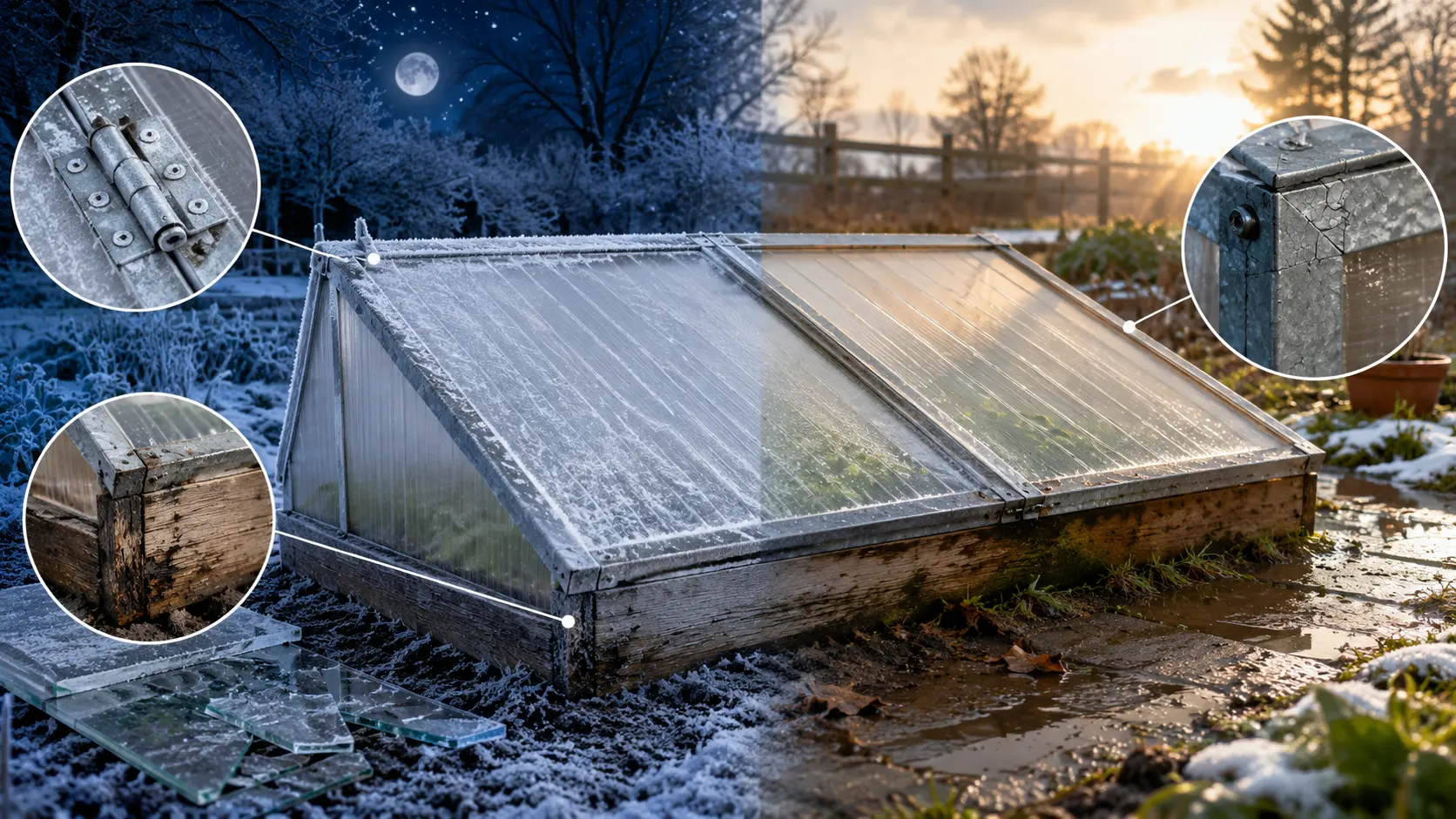
Timber frames. During the day, timber absorbs moisture (moisture content rises). At night, that moisture freezes and expands inside the wood. The next day, it thaws and evaporates, and the timber shrinks. This absorb-freeze-expand-dry cycle runs hundreds of times each winter. Untreated softwood at the soil-contact line starts rotting after 2–3 seasons. This is not a “might happen” — browse any UK gardening forum and cold-frame base rot is the most common complaint.
Galvanised steel frames. During freeze-thaw cycles, moisture seeps into micro-cracks in the zinc layer. Freezing expands the cracks; thawing lets more moisture in. Each cycle widens the cracks a little. It is slow corrosion — not as visible as salt spray — but after 2–3 years, frame strength starts to decline.
Hinges. In cold, metal contracts and hinges can seize. More dangerous is the repeated action of freeze-thaw: during the day the hinge opens and closes normally; at night, metal contraction locks it shut. Forcing it open accelerates wear. One to three openings per day × 120 freeze-thaw days = 120–360 extra wear cycles. Cold-frame hinge durability is typically rated at ≥ 500 open-close cycles without loosening or fracture (industry reference benchmark) — one freeze-thaw season can consume more than half of that design life.
Cold-Frame Insulation Reference
| Panel Type | Insulation Gain (Industry Reference Value) | Notes |
| PC twin-wall 4 mm | Approx. 2–3 °C | Air-layer insulation |
| PC twin-wall 6 mm | Approx. 3–5 °C | Thicker air layer, better insulation |
| Single-layer glass | Approx. 2–4 °C | Similar insulation to PC but fragile |
| Well-sealed cold frame | Up to 5–8 °C | Depends on seal quality and frame material |
These numbers mean: a cold frame’s protection has limits. At −10 °C outside, the inside may only be −2 to −5 °C. It extends the growing season; it does not create miracles. Setting the right expectation with end customers matters — over-promising on insulation is a fast track to negative reviews.
Cold Sourcing Checklist
- Timber frames must have preservative treatment at the base, or use pressure-treated timber from the start. Base rot after 2–3 years is otherwise inevitable.
- In freeze-thaw-heavy regions, upgrade galvanised steel to Zn-Al-Mg coating. Zn-Al-Mg far outlasts pure zinc under cycling conditions.
- Hinge durability must be in the contract: ≥ 500 open-close cycles without loosening or fracture.
UV Radiation: The Countdown on PC Panels
Unprotected PC Starts Yellowing in 2–3 Years
The most UV-vulnerable component on a cold frame is not the frame or the hinges — it is the PC twin-wall panel.
| Time | Unprotected PC | PC with UV Stabiliser | PC + Acrylic Coat |
| 6 months | Slight yellowing; light transmission −5–10 % | No visible change | No visible change |
| 1–2 years | Noticeable yellowing + micro-cracks; light transmission −15–20 % | Slight change | No visible change |
| 2–3 years | Severe yellowing + embrittlement; light transmission −30 %+ | Slight yellowing | Slight change |
| 5 years | 20 µm surface layer eroded; protection function lost | Moderate yellowing | Slight yellowing |
| 8–10 years | — | Noticeable yellowing + micro-cracks | Moderate yellowing |
| 10–15 years | — | — | Noticeable yellowing |
Data source: CF-A3 research report, PC-A6 research report (industry reference values; PC + acrylic coat 10–15-year moderate yellowing is an industry estimate).
What does this timeline mean? If your supplier uses unprotected PC, the product sits in a warehouse for a year, reaches the end customer, and gets another year of use — just as it enters the rapid-degradation phase. Returns and negative reviews cluster in years 2–3.
Note the inflection point: 2–3 years. Unprotected PC goes from “looks fine” to “clearly degraded” in that window because PC yellowing is a self-accelerating, irreversible process — initial photo-oxidation produces yellow chromophores, and later-stage oxidative degradation takes over, accelerating as it goes.
UV Protection Options Compared
| Option | Weatherability Gain | Cost Premium (Industry Reference Value) | Target Market |
| Coextruded UV cap layer | 2–3× lifespan extension | +10–20 % | Mid-range; 5–8-year warranty |
| Acrylic topcoat | 2–3× weatherability improvement | +15–25 % | Premium; 10-year warranty |
| No protection | Baseline | 0 | Not recommended — yellowing in 2–3 years, failure in 5 |
Coextruded UV cap layers concentrate UV stabilisers in the surface skin — best value for money. Acrylic topcoats work differently: PMMA absorbs far less UV in the 300–400 nm band than PC does, effectively giving the panel a “UV shield.” The protection is the strongest available.
Research also reveals a detail that is easy to miss: humidity accelerates early-stage yellowing in PC. Under long-term high humidity, a photo-bleaching effect can make the surface look less yellow — but in low-humidity environments, other optical properties (light transmission, gloss, haze) degrade more severely. The takeaway: “it does not look very yellow” does not mean the UV protection is holding up.
UV Effects on Other Components
- EPDM seals: UV accelerates surface chalking but has limited impact on overall lifespan (10–15 years). Not a priority concern.
- Galvanised steel frames: UV alone does not directly affect zinc, but UV + heat + humidity together accelerate zinc oxidation. The triple combination is the risk.
- Timber frames: UV causes surface greying, but structural impact is limited. Wood wax oil or preservative stain protects against it.
- Automatic vents: Metal parts are not UV-affected; the wax cylinder sits inside the frame and is not directly exposed.
UV Sourcing Checklist
- The purchase contract must specify a UV protection method. Coextruded UV cap layer is the minimum — it is not optional.
- ASTM G154 QUV accelerated weathering test: require ≥ 50 % retention after 500 hours. Note — ASTM G154 is a test-method standard and does not set pass/fail thresholds. The 500 h / 50 % figure is an industry reference benchmark, not a requirement of the standard itself.
- Unprotected PC is never acceptable. Even if the supplier’s price is 15–20 % lower, the return costs after 2–3 years will far exceed the savings.
UV yellowing is the hidden risk buyers overlook most easily — products look identical at the factory, but diverge dramatically after 2–3 years. Want to see the difference with your own eyes? Get cold frame samples for extreme-condition testing — put them in a QUV chamber for 500 hours and the yellowing gap speaks for itself.
High Humidity: Invisible Rot in Timber Frames
UV is not the only invisible threat. In the UK, winter humidity does to timber what UV does to PC — slow, invisible damage that shows up too late to fix. One destroys the panel; the other destroys the frame.
A UK Winter Is a Perfect Mould Incubator
Average UK winter relative humidity: 80–90 % (higher near the coast). Typical temperature: 5–10 °C. These two numbers together mean one thing: timber moisture content > 20 % + temperature > 5 °C = active mould conditions. A UK winter meets those conditions almost every day.
Picture this: November in southern England. Two weeks of continuous rain, 90 % humidity, 7 °C. Your customer sets up a cold frame with an untreated softwood frame in the garden. Rain seeps into the gap between panel and frame; soil moisture wicks up from the base. By January, the bottom of the frame feels soft — the timber has started to rot. By the following spring, you can dig out the bottom 2–3 cm of wood with your fingers.
This is not an exaggeration. It is the real-world performance of untreated softwood in a UK winter. Base rot after 2–3 seasons is the single most common cold-frame failure mode.
Component-by-Component Risk in High Humidity
Timber frames — the most vulnerable component. Mould becomes active when moisture content exceeds 20 %. Inside a shipping container, the situation is even more extreme: high heat, high humidity, and no ventilation. Untreated timber can develop surface mould within 5–7 days.
Galvanised steel frames — bare steel or zinc-layer-damaged frames may develop rust spots within days in environments with > 65 % humidity. To be clear: this is not “all galvanised steel rusts in 2–3 days” — it is “bare steel or frames with damaged zinc layers can show rust spots quickly in high-humidity environments.” An intact zinc layer does not rust rapidly under normal humidity, but damaged spots are the starting point for corrosion.
The bigger risk is zinc-layer misrepresentation. Imagine this scenario: you use a magnetic thickness gauge on a sheet labelled Z275, and the reading shows only 15 µm — that means the actual coating is below Z60, and red rust can appear after roughly 200 hours of salt-spray exposure (industry reference value). Buyers cannot tell Z275 from Z60 by eye — this requires a magnetic thickness gauge. Galvanised steel labelled Z275 but actually Z60–Z80 will show red rust after approximately 200 hours in salt-spray testing (industry reference value).
Condensation — the day-night temperature gap causes condensation on the inside of the cold frame. This is not a frame problem, but it directly harms plants: droplets on leaves act as lenses in sunlight, burning the foliage; constant wetness at night promotes fungal disease.
Humidity Sourcing Checklist
- Timber frames must specify preservative treatment. Pressure-treated timber lasts 10–15 years (industry reference value, depends on treatment grade and environment); wood wax oil needs annual re-application; preservative stain requires re-coating every 3–5 years.
- Galvanised steel frames: confirm zinc-layer integrity. Ask the supplier for zinc-coating thickness test results, or check with a magnetic thickness gauge during inspection.
- Condensation is solved through ventilation design. Specify ventilation area ≥ 5 % of the covered area.
Coastal Environments: The Secret Behind 2–3-Year Rust-Through
Z275 Galvanised Layers Last Only 2–3 Years in Salt-Spray Conditions
This is the most easily underestimated extreme condition. Inland buyers often do not appreciate how aggressive coastal corrosion is — airborne salt content runs 10–100× higher than inland, and wind speeds are 30–50 % greater. Salt spray + high humidity + strong wind is the harshest environment a cold frame will ever face.
| Coating Type | Salt-Spray Environment Lifespan (Industry Reference Value) | Normal Environment Lifespan (Industry Reference Value) | ASTM B117 Salt-Spray Test |
| Z275 hot-dip galvanised | 2–3 years (within 500 m of coastline, direct exposure) | 8–15 years | 500–700 h no red rust |
| Zn-Al-Mg coating | 5–8 years | 15–25 years | ≥ 1,500 h no red rust |
| 304 stainless steel | 10+ years (pitting possible) | 20+ years | — |
Data source: PC-A6 research report, CF-A3 research report.
Two to three years. That means a coastal customer who buys a Z275 galvanised cold frame will see the frame rust through in year three — while the same product lasts 8–15 years inland. Buyers must tell their coastal-channel customers this upfront, or year-three returns and complaints will catch them off guard.
Research also uncovered a more troubling pattern: galvanised-steel corrosion in marine atmospheres is not linear. Early corrosion products provide some resistance, but as the structure of those products changes over time, corrosion actually accelerates later. “Looks fine in year two” does not mean “will be fine in year three.”
Coastal Effects on Each Component
Galvanised steel frames — the most direct casualty. Z275 corrodes in 2–3 years in salt-spray environments; an upgrade is essential.
Hinges — the most common functional failure on a coastal cold frame is not frame rust-through but hinge seizure. Salt plus moisture gets into the hinge pin, and within 1–2 years the hinge will not open (industry estimate). A cold frame whose lid will not open is scrap.
Screws and fasteners — same as hinges. Salt-spray corrosion loosens screws. The frame may still be intact, but the joints have already failed.
Automatic vents — metal parts are vulnerable to salt-spray corrosion. Specify stainless-steel vents or anti-corrosion coatings.
PC panels — no direct salt-spray corrosion, but surface salt deposits reduce light transmission. Regular cleaning is enough; this is not a structural risk.
Timber frames — salt accelerates timber rot. Pressure-treated timber + preservative coating is the minimum specification for coastal timber frames.
Coastal Sourcing Checklist
- Coastal channels must specify Zn-Al-Mg coating or 304 stainless-steel frames. Z275 rusting through in 2–3 years near the coast is unacceptable.
- Hinges and screws must be upgraded to stainless steel. Otherwise, 1–2 years to seizure — and a cold frame that cannot open is a write-off.
- Coastal channels deserve their own specification. When quoting coastal customers, lead with the upgrade package — Zn-Al-Mg frame + stainless hinges + stainless screws + treated timber. The 8–12 % cost premium buys 3–5 extra years of service life and eliminates the year-2–3 return spike that kills margin.
Cold-Frame-Specific Risks: Hinges, Seal Dual Displacement, and Wax-Cylinder Leaks
These three risks distinguish cold frames from frost covers and cloches. Frost covers use PP nonwoven fabric — no hinges, no seals, no vent cylinders. Cloches (bell, barn, tunnel, pop-up) have ventilation needs, but their seal and hinge complexity is far lower than a cold frame’s. Buyers who previously sourced frost covers or cloches tend to overlook these cold-frame-specific points.
Hinge Wear: 1 mm of Play = Functional Failure
Hinges are the highest-risk component on a cold frame. One to three openings per day (based on typical gardening use patterns) × a 120-day growing season = 120–360 cycles. Add freeze-thaw wear, and a single season can consume more than half the hinge’s rated design life.
Different frame types carry different hinge risks:
- Timber frames: Screw-fixed hinges. Repeated opening enlarges the screw holes in the wood, and the screws loosen. You have seen a door hinge that has gone soft — the screw rocks in the hole, the hole gets bigger, the bigger hole lets more rocking. A vicious cycle.
- Aluminium frames: Riveted hinges. Rivet integrity is the key — if the rivet quality is poor, the entire hinge is a single point of failure.
- Galvanised steel frames: Bolted hinges. Bolts are replaceable — an advantage — but they need anti-loosening features (spring washers or thread-locking adhesive), or vibration and thermal cycling will back them off.
Durability requirement: ≥ 500 open-close cycles without loosening or fracture. This number belongs in your purchase contract.
Lid-Seal Dual Displacement: Two Forces Pulling in Opposite Directions
This is the most unique extreme-condition risk a cold frame carries.
Picture a sunny July day. The outside temperature climbs from 15 °C to 35 °C. The PC panel thermally expands, pushing outward in every direction. At the same time, the timber frame is drying out and shrinking. One component swells, the other contracts — and the lid seal is pulled in two opposite directions at once, day after day.
EPDM seal strips are the solution, but they can absorb only so much displacement. If the PC expands 1.9 mm per metre while the timber shrinks 2–4 %, the seal may displace or tear under the opposing forces. During inspection, use a visual check plus the paper test: close the lid, slide a sheet of paper between the seal and the panel, and pull gently — if the paper slides out easily, the seal has a gap.
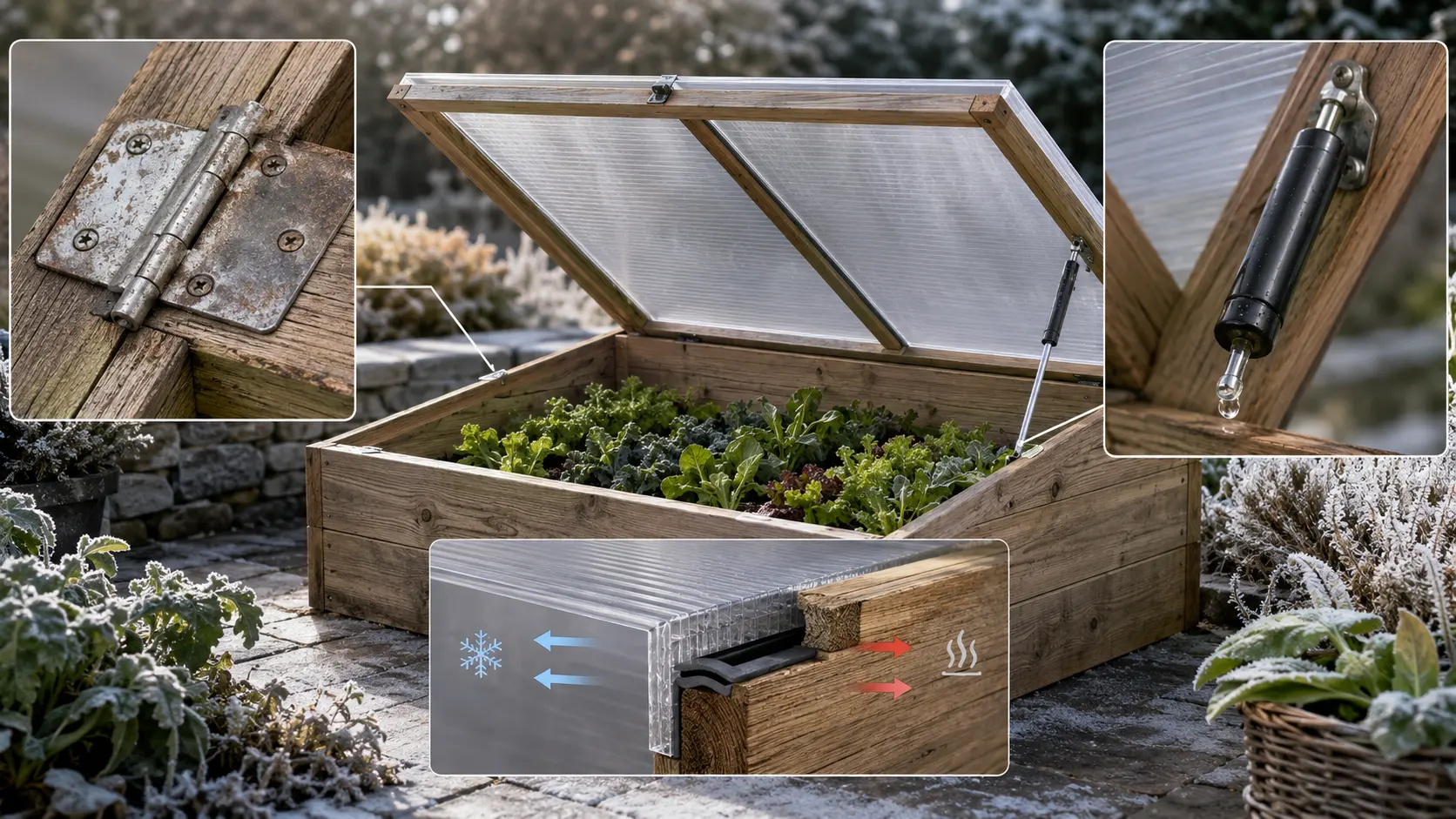
Automatic Vent Wax Cylinders: A Leak = Ventilation Paralysis
Automatic vents like the Bayliss MK7 use a wax-expansion principle — not a “temperature-sensitive liquid,” but wax. As the temperature rises, the wax expands and pushes the vent open; as it falls, the wax contracts and the vent closes.
Temperature parameters (reference values for common models): opening temperature 18–22 °C, fully open 25–30 °C, closing 15–18 °C. Adjustable range across brands: 16–25 °C.
Risks under extreme conditions:
- Extreme heat: The wax over-expands. The vent stays fully open for extended periods, and the wax-cylinder seal is under constant pressure — it may leak. Once it leaks, the vent loses its temperature-responsive function, and the next heatwave arrives with the lid shut.
- Extreme cold: The wax over-contracts and the vent stays closed. This does not damage the seal, but ventilation stops — the cold frame reverts to a sealed box.
- Freeze-thaw cycles: The wax expands and contracts repeatedly, accelerating seal ageing. Every freeze-thaw season chips away at the cylinder’s integrity.
During inspection, check the wax-cylinder seal visually: look for any wax residue on the outside of the cylinder body. It is a simple check, but it can catch a leak before the product ships.
Loose hinges, displaced seals, leaking wax cylinders — these three cold-frame-specific risks are the easiest to miss in a standard QC inspection. You are negotiating a 200-unit cold frame order. The supplier says Z275, no problem — but you have no way to verify that. Your coastal-channel customer is three months from their first salt-spray season, and you do not know if the hinges will last. The supplier’s quote does not mention UV protection, expansion gaps, or wax-cylinder leak testing — because they assume you will not ask. This is where extreme-condition parameters become contract clauses. We help buyers write these eight checks into every line item: auto-vent full-open temperature ≤ 25 °C, PC panel expansion gap ≥ 2 mm, hinge durability ≥ 500 cycles without loosening, coastal channels default to Zn-Al-Mg coating + stainless hinges. When a supplier sees that you have even specified wax-cylinder leak prevention in your contract terms, they know — this buyer knows the business, and cutting corners will not fly. If you are preparing your next cold-frame purchase contract, talk to Queenie about your product list and sourcing plan — we can help you write extreme-condition parameters into every line item.
Extreme-Condition Checklist: 8 Things to Confirm Before You Order
| # | Check Item | What to Confirm | Risk Level |
| 1 | Automatic ventilation | Is an auto-vent fitted? Is the full-open temperature ≤ 25 °C? | �� No vent on a hot day = dead plants |
| 2 | PC panel UV protection | Coextruded UV cap layer or acrylic topcoat? Unprotected PC is not acceptable | �� Yellowing in 2–3 years, failure in 5 |
| 3 | PC panel expansion gap | Is ≥ 2 mm clearance left between panel and frame during assembly? | �� Warping leads to seal failure |
| 4 | Timber frame preservative | Pressure-treated timber or preservative stain? Extra protection at the base? | �� Base rot in 2–3 years without it |
| 5 | Zinc-layer thickness | Does labelled Z275 measure up on a thickness gauge? Can the supplier provide a coating-thickness test report? | �� Mislabelled Z275 may actually be Z60–Z80 |
| 6 | Coastal upgrade package | For coastal channels: Zn-Al-Mg frame + stainless hinges + stainless screws? | �� Z275 rusts through in 2–3 years near the coast |
| 7 | Hinge durability | ≥ 500 open-close cycles without loosening or fracture? Written into the contract? | �� Freeze-thaw cycles accelerate wear |
| 8 | Wax-cylinder seal | Does the cylinder hold under extreme heat? Can the supplier provide high-temperature test data? | �� A leak = ventilation function lost |
Next Step: Review Your Cold Frame Sourcing Plan for Extreme Conditions
Extreme conditions are not edge cases that “might” happen. The UK broke 40 °C in 2022 and set new records in May 2026. Europe is warming at more than twice the global average rate. Your customers are living through these events. Your product has to survive them.
Five takeaways from this article:
- Extreme heat is the biggest threat — a sealed cold frame can reach 55–65 °C inside. No auto-vent = a plant-killer, not a plant-protector.
- Under UV exposure, PC twin-wall is the most vulnerable component — unprotected panels yellow in 2–3 years and fail in 5; thermal expansion displaces seals.
- Freeze-thaw cycling is more dangerous than extreme cold — hinges wear, timber rots, zinc-layer cracks all accelerate under cycling.
- Coastal environments are a hidden killer — Z275 galvanised layers last 2–3 years in salt spray; hinges seize in 1–2 years.
- Cold frames face three risks that frost covers and cloches never encounter — hinge wear, seal dual displacement, and wax-cylinder leaks — and these are the easiest to miss in a standard QC inspection.
If you are preparing for the next sourcing season, three things are worth doing now:
- Get cold frame model and price lists — compare Z275 vs Zn-Al-Mg pricing for coastal channels: the upgrade adds roughly 8–12 % to cost, but may significantly reduce complaint rates (industry estimate).
- Get cold frame extreme-condition comparison videos — see PC yellowing, galvanised-layer corrosion, and hinge seizure in real time.
- Get cold frame samples for extreme-condition testing — put samples in a QUV chamber or salt-spray cabinet and let the data do the talking.
You focus on selling. We help you source, verify, organize, and ship.
FAQ
Q1: Do I really need automatic ventilation, or is manual propping good enough?
Manual propping works on days when someone is home and remembers to open the lid. On extreme-heat days, the temperature inside a sealed cold frame can kill plants in hours. An automatic vent opens on its own when the internal temperature hits the set point — no human intervention needed. If your customers are home gardeners who work during the day, auto-venting is not a luxury; it is insurance.
Q2: My supplier says their PC panels are “UV-treated.” How do I know if that means a coextruded cap layer or just UV stabiliser mixed into the resin?
Ask them directly: “Is the UV protection a coextruded surface cap layer, or is the stabiliser blended throughout the panel?” A coextruded cap layer concentrates UV stabilisers at the surface where they are needed most. Stabiliser blended into the full resin thickness is less effective because the stabiliser is diluted throughout the panel volume. If the supplier cannot answer clearly, request a cross-section photo or a technical data sheet that specifies the protection method.
Q3: How quickly does Z275 galvanised steel actually rust in a coastal environment?
In a salt-spray environment within 500 m of the coastline with direct exposure, Z275 hot-dip galvanised steel typically lasts 2–3 years before rust-through (industry reference value). Inland, the same coating can last 8–15 years. If your market includes coastal areas, specify Zn-Al-Mg coating (5–8 years in salt-spray conditions) or 304 stainless steel (10+ years).
Q4: What is the simplest way to check the lid seal during a factory inspection?
Use the paper test. Close the cold frame lid, slide a sheet of paper between the EPDM seal and the PC panel, and pull gently. If the paper slides out with little resistance, the seal has a gap. Also run your finger along the seal line to feel for uneven compression. These two checks take under a minute per unit and catch the most common seal problems.
Q5: Can I use the same cold frame specification for both inland and coastal customers?
You can, but it will cost you in returns. A Z275 galvanised frame that performs well inland for 8–15 years may rust through in 2–3 years on the coast. Hinges and screws that last a decade inland can seize in 1–2 years in salt air. The safest approach is to offer two specifications: a standard inland package and a coastal upgrade package (Zn-Al-Mg or stainless frame + stainless hinges + stainless screws + treated timber). The upgrade typically adds 8–12 % to cost — far less than the return and complaint costs you would face otherwise.
Q6: How do I know if my supplier’s wax-cylinder auto-vent will leak under extreme heat?
Ask the supplier for high-temperature test data: specifically, what happens when the vent is held fully open for 8+ hours at 40 °C ambient. If they cannot provide test data, request a small sample batch and run your own test — leave the vents in a hot environment (a closed car on a summer day works as a rough proxy) and check for wax residue on the cylinder body after 24 hours. Any visible leakage is a red flag.
Let’s Build a Practical Frost Cover Range for Your Market
We can help you compare suitable product options, verify key specifications, consolidate products from multiple factories, and prepare a practical sourcing plan for the autumn and winter season. Start by sending us your basic purchasing requirements.
- Your product list
- Your target market
- Estimated quantities
- Packaging requirements
Written by
ScarecrowGarden
💡About Scarecrow Garden Supplier Co., Ltd.
Scarecrow Garden Supplier Co., Ltd. is a China-based sourcing and wholesale partner specializing in garden tools, landscaping equipment, and outdoor supplies for international wholesalers, distributors, contractors, and brands.
With hands-on experience rooted in real garden use scenarios, we focus on durable materials, functional design, and stable large-volume supply. Our product range covers pruning tools, watering systems, hand tools, outdoor hardware, and customized garden solutions to support both retail and professional landscaping markets.
Beyond products, we help our partners navigate supplier selection, quality control, compliance requirements, and long-term sourcing strategies in China. Through our blog, we share practical insights on product selection, material comparisons, industry trends, and cost-effective purchasing—helping global buyers build stronger, more competitive supply chains.