







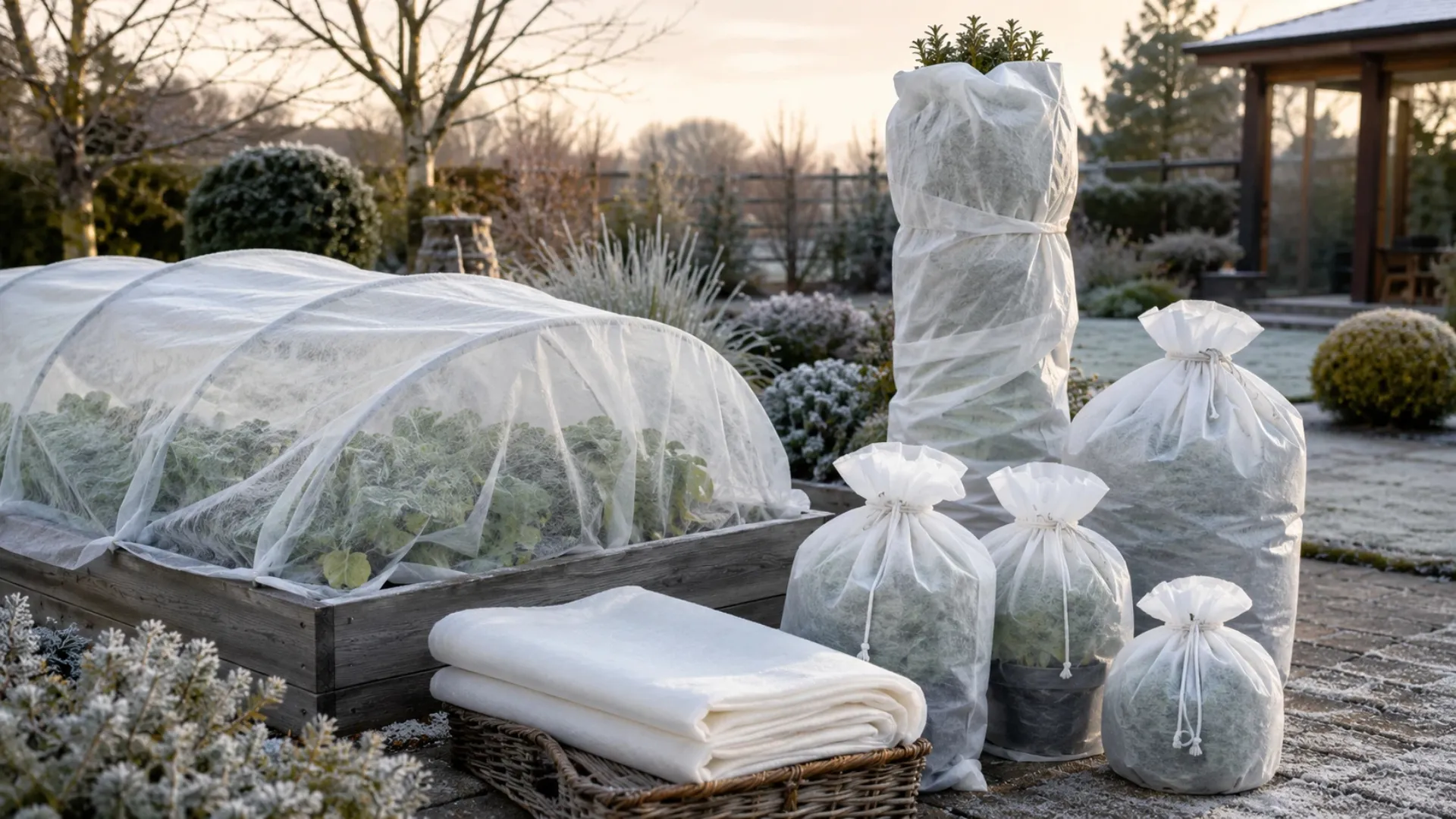
Wholesale Frost Cover Sourcing Guide: Match Specs to Avoid Returns | Scarecrow Garden Supplier
Same 30gsm fleece. The garden centre sells through. E-commerce seller gets returns. What happened?
Same product, two channels, two outcomes. The difference is not the product. It is the match between the plant, frost severity, and how your customer sells.
Frost cover selection is not “pick a product.” It is three variables to align: what protection the plant needs, how severe the frost is, and how your customer sells it. Get anyone wrong, and returns follow.
This article starts from RHS hardiness ratings and helps you translate “my customer needs frost protection” into specific specs, GSM, and packaging choices.
This article is the scenario-matching deep dive in the Frost Cover sourcing hub. If you have not read the type classification and base specs yet, start with the Wholesale Frost Cover Buyer’s Guide.
Step 1: Know What Level of Protection the Plant Needs
The RHS (Royal Horticultural Society) classifies plant hardiness from H1a to H7—eight ratings in total. You do not need to memorise them all. You need one line: H3 and below requires protection; H4 and above usually does not—except during spring flowering.
| Hardiness Rating | Minimum Temperature | Representative Plants | Frost Protection Need |
| H1a–H1c | Above 5°C | Citrus, pelargoniums, tropical plants | Requires greenhouse/indoor; frost cover is not applicable |
| H2 | 1–5°C | Tender fuchsia hybrids¹, canna, dahlia | Damaged by light frost. South-west UK coastal areas may manage with a 50gsm jacket; inland requires framed type |
¹ Hardy fuchsia varieties (e.g., F. magellanica) are H4; only tender bedding types fall into H2. | H3 | -5–1°C | Olive (sheltered position), bay laurel | Inland/exposed areas need 50gsm jacket; sheltered positions may not | | H4 | -10–-5°C | Hydrangea, lavender | Winter protection usually not needed, but spring flowering requires 30gsm—this is the SKU garden centres most often overlook | | H5 | -15–-10°C | Strawberry, most hardy shrubs | Winter protection not needed, but spring new growth needs 30gsm—a core nursery repeat-order scenario | | H6 | -20–-15°C | Apple trees, pines | No protection needed (apple blossom in spring is the exception—30gsm over the canopy can save the entire year’s crop) | | H7 | Below -20°C | Extremely hardy plants | Protection usually not needed |
Two traps that catch buyers out:
- Sudden frost is more dangerous than sustained cold. Hardy plants need several days of cold weather to “harden off”—accumulating antifreeze compounds and adjusting cell sap concentration. The first sudden drop in autumn can damage even H4-rated plants.
- Hardy plants are vulnerable during spring flowering. Apple trees (H6–H7) do not mind winter cold, but a late frost in March can destroy the entire year’s crop. Hydrangeas (H4–H5) are winter-hardy, but early spring new growth is equally vulnerable to sudden frost. This is a scenario many buyers overlook.
Need deeper detail on material grades, GSM verification, and cost implications? Read Frost Cover Materials Explained: What Wholesale Buyers Should Specify.
Step 2: Match Frost Scenarios to Product Types
Knowing what protection the plant needs is step one. Step two is choosing the right product type. Frost cover is not one-size-fits-all—the same fleece performs differently, flat-laid versus jacketed.
Light Protection Scenarios (17–30gsm)
Spring and autumn light frost, summer insect barrier—these scenarios prioritise light transmission and breathability, not maximum insulation.
| Season | Scenario | Recommended Type | GSM | Key Spec |
| Spring | Late frost protection for seedlings/new growth | Flat-lay fleece | 17–30gsm | Light transmission ≥70%; use with hoops |
| Spring | Pre-warming soil for germination | Flat-lay fleece | 17–30gsm | Lay directly on the ground |
| Spring | Fruit tree blossom late frost protection | Flat-lay fleece | 30gsm | Coverage area 20–30% larger than the canopy |
| Summer | Insect barrier (flea beetle/cabbage white butterfly) | Flat-lay fleece | 17gsm | Full coverage + sealed edges |
| Autumn | Extending the tender crop season by 2–4 weeks | Flat-lay fleece | 30gsm | Width matched to bed size |
| Autumn | Overwintering hardy crop protection | Flat-lay fleece | 30–50gsm | UV stabilisation is essential |
But when frost goes from light overnight to sustained sub-zero, 30gsm runs out of road. The scenarios change—and so do the specs. Light transmission matters less; insulation and structural integrity matter more. You are no longer extending a season—you are keeping a plant alive through winter.
Heavy Protection Scenarios (50gsm+)
Winter overwintering, container plant frost protection, heavy frost regions—these scenarios prioritise insulation and durability. Light transmission can be compromised.
| Season | Scenario | Recommended Type | GSM | Key Spec |
| Winter | Evergreen shrub overwintering | Jacket | 50–80gsm | Size matched to plant + 20cm margin |
| Winter | Container plant frost protection | Jacket + pot wrap | 50–80gsm | Pot needs bubble wrap separately |
| Winter | Multiple plants / heavy frost region | Framed type | 50gsm+ | Tube diameter ≥16mm, wall thickness ≥0.5mm |
| Winter | Additional insulation inside the greenhouse | Heavy fleece wrap | 50gsm | Liner/wrap style |
Covering Method Determines Insulation Ceiling
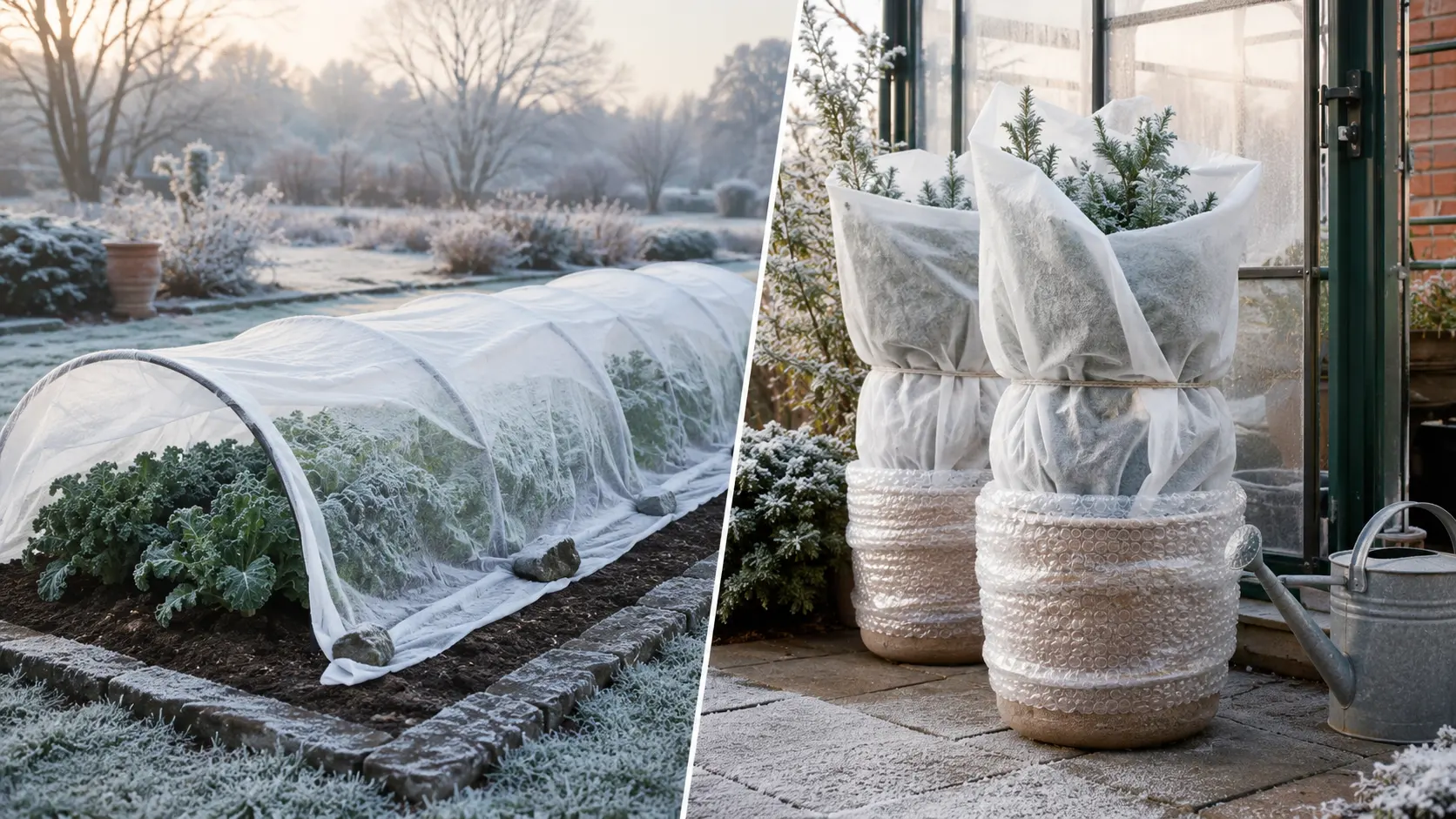
Same 30gsm fleece, different results. Laid flat directly on plants versus draped over hoops—the insulation gap is significant. Why? Because insulation comes from the air layer, not the material itself. The same 30gsm fleece, loosely draped over hoops, outperforms the same material pulled tight against the plant—it is not the material that changed, it is the air gap. Practical feedback: flat-lay gains approximately 1–2°C of buffer; hoop-supported gains approximately 3–5°C—the difference is that layer of air (industry experience estimate, based on field feedback).
| Covering Method | Insulation Effect | Reason | Suitable Scenario |
| Flat-lay direct | Lowest (~1–2°C)* | The plant contact surface can still freeze | Short-term light frost, insect barrier |
| Hoop-supported | Medium (~3–5°C)* | Creates an air layer; avoids contact frost damage | Standard frost protection |
| Jacket | Medium | Snug wrap; suits container plants | Container plant overwintering |
| Framed type | Highest | Complete microclimate; ventilatable | Heavy frost regions, multiple plants |
*Industry experience estimate, based on field feedback; actual performance varies with wind, humidity, and fleece GSM.
One critical reminder: fleece is not a greenhouse. Below -10°C, even an 80gsm framed cover only buys you a few degrees of buffer. If your customer sells frost cover in the Scottish Highlands, the positioning must be honest—“buys time,” not “guarantees safety.”
Step 3: Container vs. In-Ground—The Fork Most Buyers Get Wrong
This is the most common mistake in scenario selection: using flat-lay fleece to protect container plants.
Container plant roots are exposed to air. They freeze faster than in-ground roots. Flat-lay fleece only protects above-ground growth—roots freeze in the pot, and protecting the top is pointless.
| In-Ground | Container | |
| Root protection | Soil insulates; roots are safe | Roots exposed to air; more vulnerable |
| Recommended type | Flat-lay fleece (hoop-supported) | Jacket + pot wrap |
| Pot treatment | Not applicable | Bubble wrap / old blanket around the pot |
| Portability | Cannot be moved | Best option: move indoors / into a greenhouse |
| GSM | 30gsm (standard) to 50gsm (overwintering) | 50–80gsm (overwintering essential) |
Sourcing implication: If your customer is a garden centre, container jackets are a must-stock SKU—because garden centre customers have a high proportion of container plants, and jackets are the only frost cover type that protects container roots. 30gsm rolls alone will not cover the need.
Step 4: Match SKU Combinations by Customer Type
Each channel does not need “a product”—it needs a coordinated set of SKUs. Here are recommended combinations for six buyer scenarios.
Garden Centre: A 4-Tier Autumn Display
Frost cover in a garden centre appears in the autumn display zone, alongside bulbs, garlic, and autumn planting supplies. Customers move from entry to premium; you need four price tiers:
| Tier | Product | Spec | Retail Price Reference | Display Requirement |
| Entry | 30gsm roll | 2×5m | £5–7 (Amazon UK at time of research; check current prices) | Peg-hole pack, hook display |
| Mid | 30gsm roll | 8×1.5m | Approx. £10 (same caveat) | Peg-hole pack, hook display |
| Premium | 50gsm jacket | Multi-size | £12–18 | Blister card, clear information |
| Flagship | Framed frost tent | Medium | £30–60 | Floor display or stand |
Packaging determines display. Garden centre display space is limited—peg-hole packs save space, blister cards improve presentation. If your fleece has no peg holes, it cannot go on a hook. It ends up stacked in a corner.
E-commerce: Two Workhorse SKUs with Low Return Risk
For e-commerce, return rate is the profit metric. Two core SKUs:
| SKU | GSM | Target | Return Risk Point |
| 30gsm roll (multi-size) | 30gsm | Standard frost protection; broad coverage | GSM overstatement → insufficient insulation → returns |
| 80gsm jacket (3–4 sizes) | 80gsm | Container overwintering; higher ticket | Size mismatch → returns |
Return reduction keys: Product page must state actual GSM (not nominal), jackets must include a size chart (plant height × width → recommended size), framed products must state applicable wind zone.
Nursery / Grower: Value-per-Square-Metre Logic
Nurseries do not care about retail packaging. They care about: cost per square metre, and how many seasons it lasts.
| Need | Recommendation | Reason |
| Large-area crop coverage | 30–50gsm bulk roll, 3.2m width × 100m+ | Fewer joins; higher efficiency |
| Overwintering crop protection | 50gsm + UV stabilisation | Needs to last 2–3 seasons |
| Seedbed short-term protection | 17–30gsm | Light transmission priority; cost-sensitive |
UV stabilisation is non-negotiable for nurseries. Fleece without UV becomes brittle after one season, but a nursery’s repeat-order logic is “it must last three seasons to be worth it.” The maths: a nursery covering 2,000m² of beds from October to March, 3.2m × 100m bulk rolls are the most economical choice. But if they save the 5–10% cost of UV stabiliser (industry experience estimate), the fleece goes brittle by March of year two—and replacing the entire batch costs far more than the UV upgrade would have.
Distributor: Full Range + OEM Brand
Distributors need 17–80gsm full range plus framed products. Their competitive edge comes from range completeness and own-brand labelling.
Mixed-order consolidation is the core operational pain: one container might hold 30gsm rolls, 50gsm jackets, and framed frost tents—from different factories, with different lead times. Coordinating those lead times is where distributors lose the most time.
Consider a typical order: a distributor receives requests from three retail channels in the same week. A garden centre wants peg-hole 30gsm packs for a hook display. A hardware store wants seasonal display packs with retail-ready printing. An e-commerce seller wants lightweight polybag 80gsm jackets to keep shipping costs down. These products come from four factories—fleece from one, jackets from another, framed products from a third, and the hardware store’s printed packs need a packaging step that the fleece factory cannot do. Four lead times, one container, one ship date. Getting all of this to arrive at the warehouse in the same week—without paying for partial shipments or air freight—is where a distributor’s margin lives or dies.
Hardware Store: Seasonal Peg-Hook Display
Frost cover in a hardware store is a seasonal add-on category, appearing alongside autumn/winter tools. It needs peg-hook display packaging with product information that is instantly readable—customers will not ask staff; they decide from the pack. Information that must be visible at a glance: applicable temperature range, plant type, coverage area.
30gsm rolls are the core SKU; one or two specs are enough. But the buying window is only 6–8 weeks—miss the autumn shelf date, and that stock sits in the warehouse until next year.
Landscaper: Project-Based Customisation
Landscaper demand is project-driven—each garden needs different sizes and quantities. Framed types and heavy fleece are the workhorses; custom sizes and fast installation are key.
Typical scenario: a landscaper takes on a project to protect six mature olive trees. Standard jacket sizes are too small; they need custom 80gsm oversized jackets plus frame supports. This project-based demand means you need a supplier who can respond quickly to custom specs—not a factory that only offers a standard catalogue.
Whatever channel you serve, mixed-order coordination across multiple factories is a constant. Tell us the final spec combination you need, and we will align four factories’ lead times to one ship date.
The Cost of Wrong Scenario Matching
The Pillar article covers quality defects. This section covers a different problem: the product is fine, but the scenario is wrong.
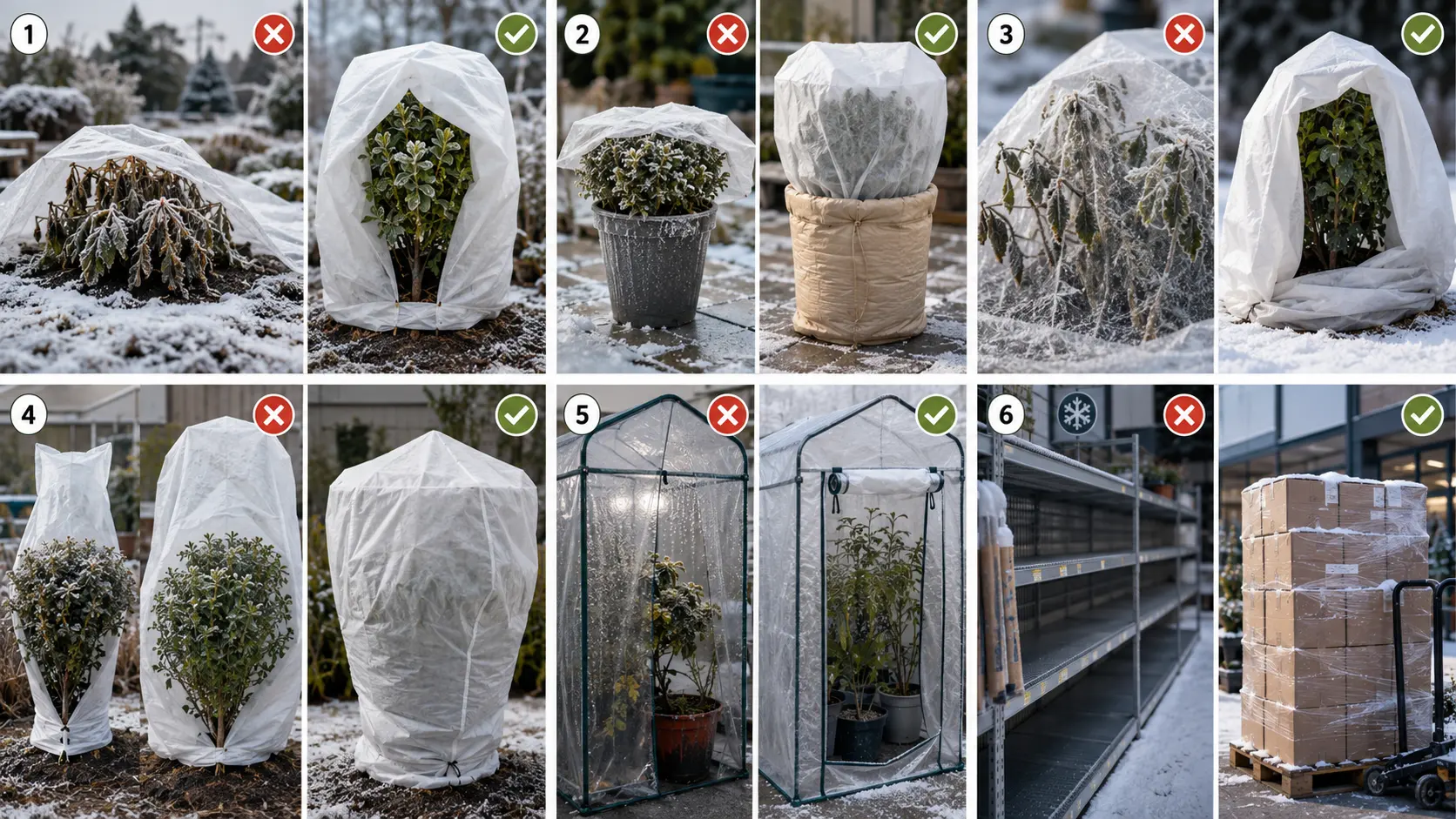
| Scenario Error | Specific Mismatch | Consequence | Correct Match |
| 30gsm used at -8°C | GSM too low; not a product defect | Insufficient insulation → plant frost damage → returns | 50gsm jacket or framed type |
| Flat-lay fleece on container plants | Wrong type; not a quality issue | Roots unprotected → plant death → negative reviews | Jacket + pot wrap |
| Insect barrier fleece is sold as frost protection | 17gsm insufficient for frost | Light frost penetrates → protection fails → returns | Frost protection starts at 30gsm |
| Jacket lists height only, no width | Incomplete spec information | Width mismatch → cannot fit or too loose → returns | List both height × width recommendations |
| Framed type with no ventilation | Incomplete feature set | Sunny-day heat build-up → plant rot → returns | A zip window or flip lid is essential |
| Order placed in winter | Timing mismatch | Missed sourcing window → empty shelf → lost season | Work back 90–180 days from the selling season |
The pattern across all six: the product was fine, the scenario was wrong. Before you spec any frost cover, run through the three variables—plant need, frost severity, channel requirement. One mismatch is all it takes.
Hidden costs exceed returns. One e-commerce seller’s lesson: they listed 17gsm insect barrier fleece as “frost protection.” Customers used it at -3°C, plants were damaged, negative reviews accumulated, product rating dropped, and search visibility followed it down (industry experience estimate, based on field feedback). The product was not defective—the scenario description was wrong.
Scenario Matching Checklist
Before you send an enquiry to any supplier, confirm you can answer these:
- What hardiness rating are my customers’ plants? (H1–H3 must be protected; H4+ needs spring flowering protection)
- What is the frost scenario? (Spring late frost/autumn extension/winter overwintering—determines GSM and type)
- Are the plants in-ground or in containers? (Containers need jackets + pot wrap; flat fleece alone is not enough)
- Does the covering method create an air layer? (Flat-lay is weakest; hoop-supported is better)
- What packaging does the channel require? (Garden centre needs peg holes; e-commerce needs lightweight; nursery needs plain pack)
- Does UV stabilisation match the usage cycle? (Nursery repeat-order logic needs UV; e-commerce single-season may not)
- Do jacket sizes cover mainstream container plants? (At least 3–4 size tiers)
- Do framed products have ventilation? (No vents = plant rot risk)
- Has the sourcing calendar been worked back from the selling season? (July order → October arrival → November on shelf)
Next Step: Match Your Frost Cover to Your Customer’s Real Scenarios
Still working out which spec fits which scenario? Tell us your customer mix and Scarecrow Garden Supplier will map it to the right SKU combination—frost cover type, GSM, and packaging, consolidated from multiple factories into one shipment.
Talk to Queenie about your frost cover scenario plan → Start the conversation
FAQ
Q: Can I use the same 30gsm fleece for both spring and winter?
A: Physically, yes. But the scenarios are different. In spring, 30gsm flat-lay over hoops protects seedlings from light overnight frost. In winter, the same 30gsm flat-laid directly on plants provides only 1–2°C of buffer—not enough for sustained sub-zero conditions. If your customer needs winter protection, 50gsm jackets or framed types are the practical minimum.
Q: Why do garden centres need jackets if they already sell fleece rolls?
A: Because their customers have container plants. Flat-lay fleece protects above-ground growth but does nothing for roots exposed in pots. Jackets wrap the entire plant—including the pot—and that is the only way to protect container root systems. Garden centres with a high proportion of container-plant customers will see “does not fit” returns on fleece alone.
Q: How do I prevent size-mismatch returns on jackets?
A: List both height and width on the product page and packaging. Most jacket returns come from customers who matched by height alone—then found the jacket too narrow for a bushy plant. A simple size chart (plant height × canopy width → recommended jacket size) eliminates most of these returns.
Q: Is UV stabiliser worth the cost for a budget product?
A: It depends on your positioning. If the product is marketed as single-season, budget frost protection, UV is not essential. But if the description says “reusable” or “multi-season,” UV stabiliser is mandatory—fleece without UV becomes brittle after one winter, and the mismatch between promise and performance shows up in reviews. For nurseries, UV is always worth it because their cost-per-season calculation depends on 2–3 seasons of use.
Q: What is the most common scenario mistake new frost cover buyers make?
A: Using flat-lay fleece on container plants. The fleece protects the foliage, but the roots freeze in the pot. This is the single most frequent mismatch in the market—buyers assume “frost cover = fleece roll” when the correct answer for container plants is “jacket + pot wrap.” If your customer base includes patio gardeners or balcony growers, jackets should be your first SKU, not an afterthought.
Q: When should I recommend a framed frost tent instead of fleece?
A: Three scenarios: (1) temperatures regularly below -5°C, where fleece alone cannot provide enough buffer; (2) the customer needs to protect multiple plants in one structure; (3) the customer wants to walk into the protection to tend plants. If none of these apply, fleece or jackets are the simpler, lower-cost option.
Prepare Your Frost Cover Range Before the Season Starts
Send us your product list, target market, estimated quantities, and packaging requirements. We can help compare suitable options, verify key specifications, coordinate products from multiple factories, and prepare a practical sourcing plan for your autumn and winter range.
- Product list and target market
- Estimated order quantities
- Packaging and branding needs

Written by
ScarecrowGarden
💡About Scarecrow Garden Supplier Co., Ltd.
Scarecrow Garden Supplier Co., Ltd. is a China-based sourcing and wholesale partner specializing in garden tools, landscaping equipment, and outdoor supplies for international wholesalers, distributors, contractors, and brands.
With hands-on experience rooted in real garden use scenarios, we focus on durable materials, functional design, and stable large-volume supply. Our product range covers pruning tools, watering systems, hand tools, outdoor hardware, and customized garden solutions to support both retail and professional landscaping markets.
Beyond products, we help our partners navigate supplier selection, quality control, compliance requirements, and long-term sourcing strategies in China. Through our blog, we share practical insights on product selection, material comparisons, industry trends, and cost-effective purchasing—helping global buyers build stronger, more competitive supply chains.