






Updated 3 months ago
How a Mini Greenhouse for Seedlings Creates a Protective Microclimate

hqt
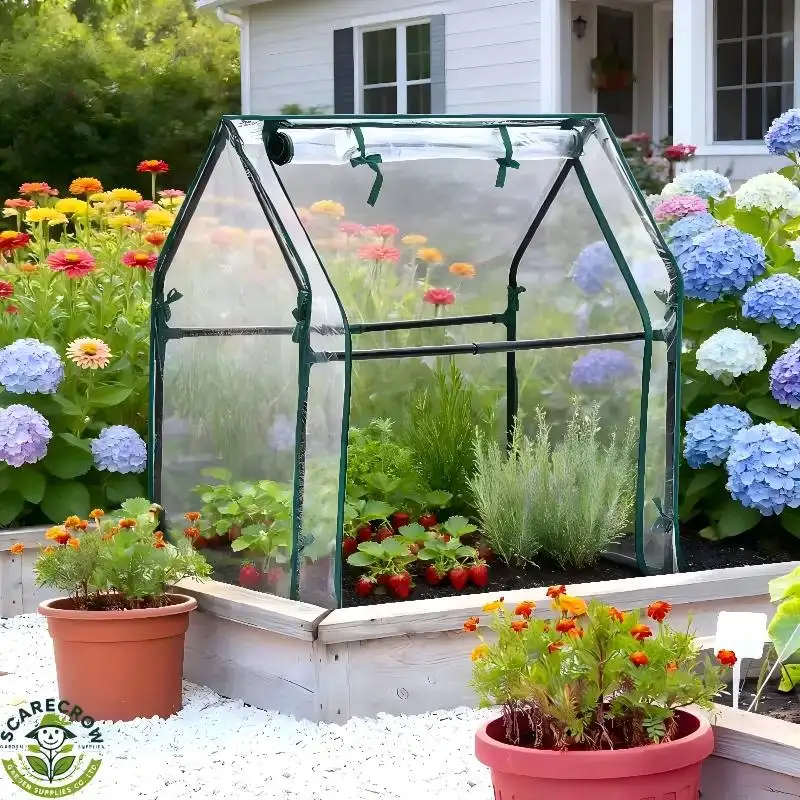
Mini Greenhouse for Seedlings
During germination and establishment, seedlings are especially susceptible to environmental conditions. Their roots have not yet developed, their stems are delicate, and broad changes associated with temperature, moisture, and airflow can disrupt growth. A seedling mini greenhouse can be used to create a small protected space to grow seedlings with less variability, while still allowing access for maintenance.
For garden centers, nurseries, distributors, and seed-starting brands, the main value of a Mini Greenhouse for Seedlings is not a guaranteed temperature or humidity level. It is the ability to create a more manageable microclimate.
Why Seedlings Need Microclimate Protection
Newly sprouted plants can lose moisture before their roots have a chance to absorb water. Growth can be hindered during the night when temperatures drop but can be stunted during the day due to dry air, strong drafts, and direct sunlight.
The Mini Greenhouse for Seedlings proposes functional answers for the following temperature-related problems:
• Temperature: For the issue of temperature control, the Greenhouse Cover helps to minimize the loss of heat. Since the rate of warmth loss is directly proportional to the airflow exchange, the cover also slows down the cooling process and reduces the exchange.
• Humidity: Rapid drying out of the planting surface is reduced by the Greenhouse which also traps moisture that has evaporated.
• Drafts: The openings can be customized to facilitate the desired airflow and reduce drafts.
• Protection: The enclosure prevents the trays from exposure to outside contaminants and protects the trays from animals and unnecessary human interaction.
The enclosure should not remain fully closed under every condition. Strong sunlight can cause overheating, while continuously wet, stagnant air can increase disease risk. Greenhouse and cloche guidance therefore emphasizes adjustable ventilation during warm conditions.
How a Mini Greenhouse for Seedlings Shapes the Environment
A transparent cover allows available light to reach the trays while slowing convective heat and moisture loss. The internal air may become warmer and more humid than the surrounding environment, but actual conditions depend on sunlight, room temperature, watering, ventilation, and location.
| Environmental Factor | Enclosure Function | Required Management |
| Temperature | Slows rapid temperature changes | Vent during warm, sunny periods |
| Humidity | Reduces moisture loss | Avoid excessive watering and condensation |
| Air movement | Limits direct drafts | Increase ventilation after emergence |
| Water runoff | Base helps contain spills | Prevent trays from standing in water |
| Light | Transparent cover maintains access | Add suitable lighting when necessary |
Ventilation becomes especially important after germination. Damping-off is caused by several fungi and fungus-like organisms and is associated with wet growing conditions, overwatering, cool media, and other conditions that slow seedling growth. A Mini Greenhouse for Seedlings should therefore be managed as an adjustable environment rather than a permanently sealed container.
Construction Features That Influence Performance
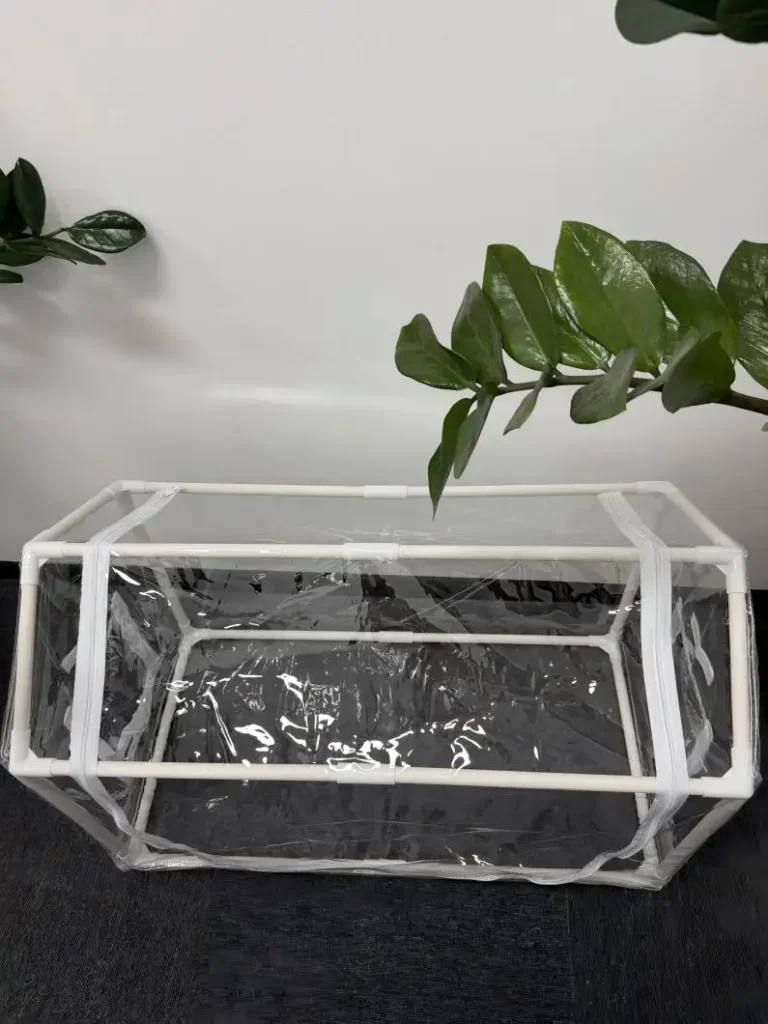
Scarecrow Garden Supplier's Mini Portable Greenhouse with Waterproof Base and Humidity Dome for Seedlings, model SKU2509063, combines a compact frame, transparent cover, ventilation access, and removable waterproof base.
1. Coated Iron Frame
Iron frames are rust-resistant and coated with electrophoretic coatings. Plastic connectors allow for seasonal storage and assembly without tools.
2. Transparent PVC Cover
The transparent PVC cover provides warmth, moisture, and an easy way to check the growth progress of plants without the need to unzip the cover. It has a roll-up zippered door to provide access for watering and/or removing growing trays and provides controlled ventilation.
3. Waterproof Base Pad
A hook-and-loop fastening system attaches the base pad to the frame. It protects surfaces from the effects of uncontrolled drainage and captures irrigation run-off.
The base pad is meant to be used with drainage trays. Seed containers left on the pad can create an unhealthy growing environment by facilitating the growth of diseases that attack plants and by creating an unhealthy aeration environment for the seedlings.
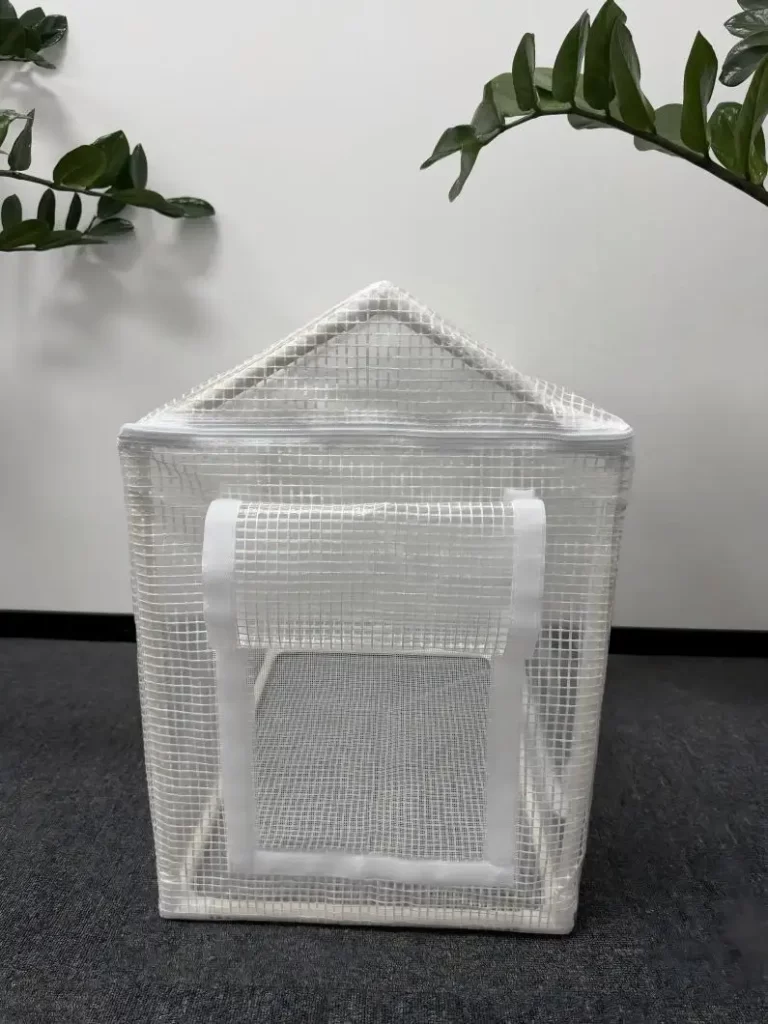
4. Adjustable Ventilation
The moisture and heat that are retained can be released through the top vents to facilitate the movement of air while the seedlings adjust to the lower humidity and the movement of air outdoors. Leaves have small holes that help them ventilate their tops. Plants grown in greenhouses or indoors before bringing them outside permanently need to adapt to the outdoor conditions for some period of time.
5. Heat-Mat Compatibility
The base may be paired with a correctly sized seedling heat mat when bottom heat is required. Users should follow the heat-mat manufacturer's instructions, monitor growing-medium temperature, and reduce or remove bottom heat after germination when appropriate.
University of Maine Extension guidance recommends removing bottom heat and the plastic covering when approximately half of the seeds have emerged, although requirements can vary by crop and growing environment.
Key Application Scenarios
A Mini Greenhouse for Seedlings can support the following:
•Seed germination and early nursery propagation
•Humidity management for selected plant cuttings
•Indoor herb, vegetable, and ornamental seed starting
•Short-term protection from cool drafts or mild outdoor chill
•Nursery and garden-center demonstration displays
•Retail kits bundled with trays, labels, sprayers, or plant markers
Wholesale Buying Considerations
Commercial buyers should evaluate construction quality as well as appearance.
| Buying Factor | What to Check |
| Frame | Corrosion protection, connector fit, and stability |
| Cover | Material consistency, stitching, zipper movement, and cleanability |
| Ventilation | Adjustable airflow without complete cover removal |
| Base | Secure fastening and resistance to leakage |
| Packaging | Flat-pack efficiency and carton protection |
| Customization | Dimensions, color, logo, accessories, and packaging |
| Quality control | Frame fit, zipper function, connectors, and base inspection |
Scarecrow Garden Supplier supports OEM and ODM changes to product dimensions, frame finish, cover material, color, branding, and packaging. Accessory bundling can also turn the Mini Greenhouse for Seedlings into a complete retail seed-starting kit.
Specifications at a Glance
| Item | Supplier-Provided Detail |
| Model | SKU2509063 |
| Frame | Iron with electrophoretic coating |
| Connectors | Plastic; tool-free assembly |
| Cover | Transparent PVC |
| Base | Waterproof pad with hook-and-loop fastening |
| Package Size | 91 × 14 × 11 cm |
| Gross Weight | 1.95 kg per unit |
| MOQ | 500 units |
| Customization | OEM/ODM, logo, color, dimensions, and packaging |
| Indicative Lead Time | 15 days for orders up to 500 units |
A Mini Greenhouse for Seedlings performs best when humidity, ventilation, light, irrigation, and temperature are managed together. For wholesale buyers, a stable frame, adjustable airflow, accessible cover, and secure waterproof base are the features most likely to support reliable use across repeated growing cycles.
FAQs
Q1: What payment methods do you support?
A: We support multiple international payment methods including T/T and L/C. For sample orders, PayPal or Western Union may also be available.
Q2: What shipping options are available?
A: In terms of shipping, we work with trusted forwarders to offer sea freight, air freight, or express delivery. Shipping terms such as FOB, CIF, and DDP can be arranged according to your needs.
Q3: Can I request a sample before bulk order?
A: Yes, sample orders are welcome for quality evaluation.
Q4: Do you provide warranty or after-sales support?
A: Yes, we provide product warranty and responsive after-sales support for our customers.