









Cold Frame Quality Control: Inspection Checklist for B2B Buyers | Scarecrow Garden Supplier
A garden centre client placed an order for 200 cold frames in March. The shipment arrived looking fine — clear PC panels, solid frames, everything intact. Two months later, the complaints started: lids wouldn’t close properly, cold air was pouring in, and seedlings were getting frost damage. When they took the units apart, the hinge screws had worked loose in the timber holes, and the lids had dropped 7°.
This is not an unusual case. In cold frame sourcing, the most common failures aren’t dramatic collapses. They’re quiet failures in small components — a hinge loosening, a seal degrading, an auto-vent stopping work. These defects are nearly invisible at inspection but turn into return requests two or three years down the line.
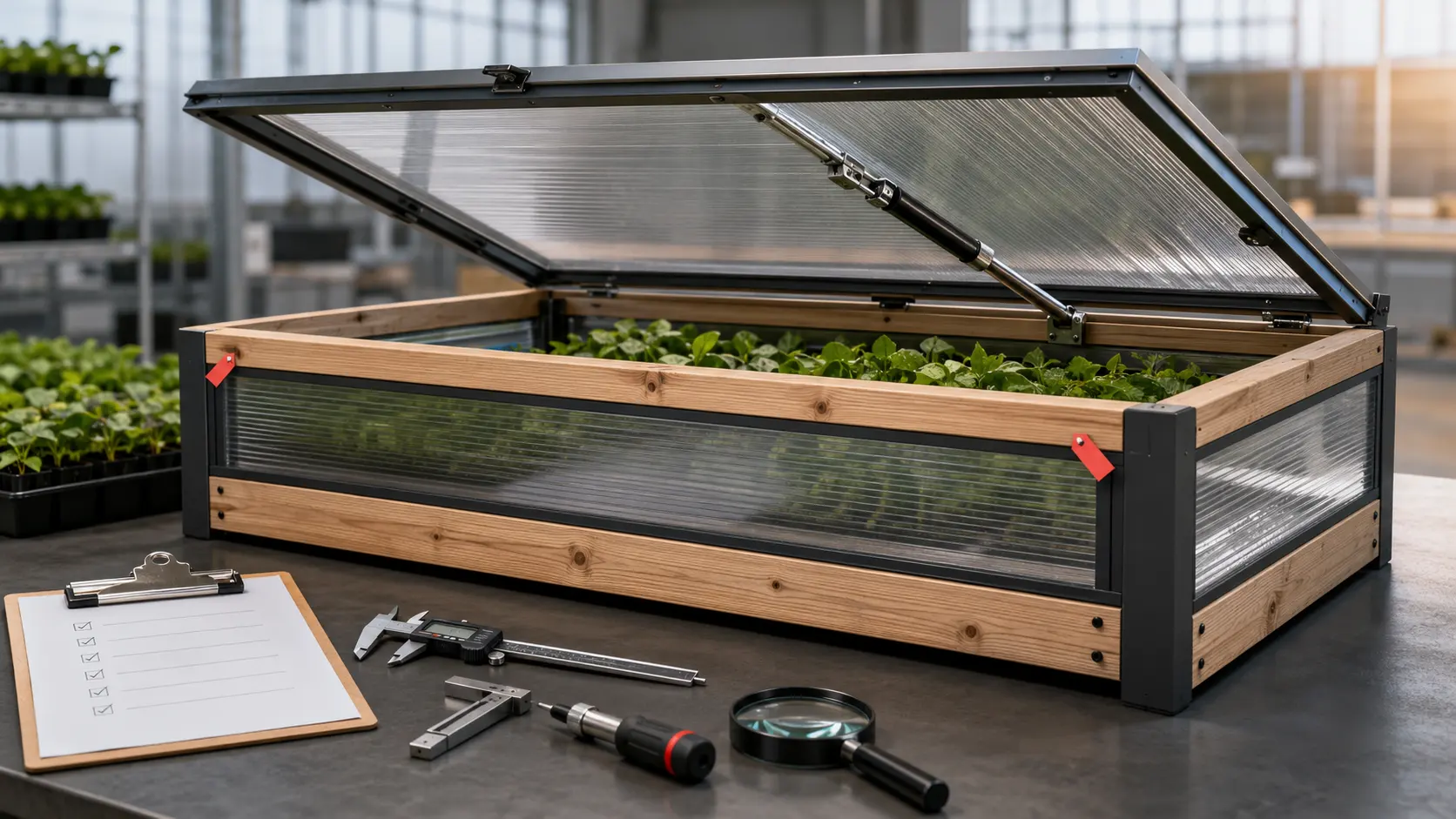
This article translates the most common cold frame failure modes into a practical testing and inspection plan. We cover glazing, frames, hinges, and ventilation — each with specific test methods, acceptance criteria, and defect classifications. At the end, you’ll find a 20-item pre-shipment inspection checklist you can take straight to the warehouse floor.
There is no unified international QC standard for cold frames. Like frost covers and plant cloches, inspection parameters must be agreed with your supplier in advance and written into your contract. But there are plenty of reference standards: ASTM A123 (galvanized coatings), ASTM G154 (UV weathering), ASTM B117 (salt spray), ANSI/ASQ Z1.4 (AQL sampling). Where this article uses “industry reference value,” those criteria need your confirmation before they go into any purchase agreement.
Glazing Tests: The UV Coating Is Your PC Sheet’s Lifeline
PC Twin-Wall Sheet: Three Must-Check Items
Twin-wall polycarbonate is the dominant glazing material for cold frames. The inspection priority is clear: UV coating > solid wall thickness > edge sealing. Miss any one of these, and you’re shortening the product’s usable life.
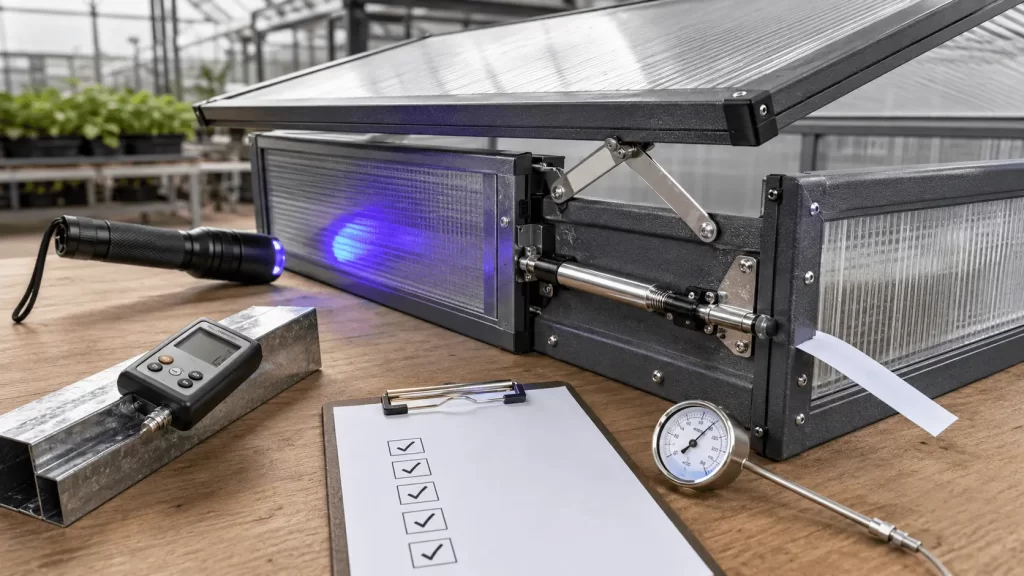
UV Coating Verification — this is the step you cannot skip. Shine a 365 nm UV torch on both sides of the PC sheet. The side with a UV coating will produce a blue-violet fluorescence; the side without one won’t. If neither side fluoresces, the sheet has no UV coating at all.
Why does this matter? Twin-wall PC without UV protection degrades 5–8 times faster than coated sheet (based on industry feedback; actual rates vary with local UV intensity):
| Time | Uncoated PC Condition | Light Transmission Loss |
| 6 months | Slight yellowing | 5–10% |
| 1–2 years | Noticeable yellowing + micro-cracks | 15–20% |
| 2–3 years | Severe yellowing + embrittlement | 30%+ |
Industry reference values; actual rates vary with local UV intensity and climate.
Coated twin-wall PC can last up to 10 years under normal outdoor exposure (industry reference value). Without the coating, embrittlement begins within 1–2 years. Your customer won’t complain at month six — they’ll come back at month eighteen, when the sheet has gone yellow and brittle, and demand a replacement.
One more detail: UV coatings are usually applied to one side only. Confirm with your supplier that the coated side faces outward (toward the sun). A coated sheet installed backwards offers no protection.
Solid Wall Thickness — thickness overstatement is the most common form of cost-cutting. A 4 mm twin-wall PC sheet should have a solid wall thickness (total outer and inner wall, excluding ribs) of ≥3.8 mm (industry reference value). What actually arrives can be as thin as 3.2–3.5 mm.
Measure with a micrometer (0.01 mm precision). Don’t measure the “total thickness” including ribs — that doesn’t reflect actual insulation or impact resistance.
Edge Sealing Check — this defect is easy to overlook but generates a high rate of B2B complaints. Both ends of a twin-wall PC sheet must be sealed with aluminium foil tape. If left unsealed, moisture enters the channels and mould grows inside — it cannot be cleaned, so the entire sheet has to be replaced.
A visual check is sufficient: both ends should have intact aluminium foil tape, no peeling, no gaps.
PC Sheet Inspection Table
| Test Item | Method | Equipment | Acceptance Criteria | Defect Class |
| UV coating | UV torch illumination | 365 nm UV torch | Coated side produces blue-violet fluorescence | Major |
| UV weathering resistance | QUV accelerated ageing (ASTM G154, UVA-340) | QUV chamber | ≥50% retention after 500 h (industry reference standard) | Major |
| Solid wall thickness | Micrometer measurement | 0.01 mm precision | 4 mm spec ≥3.8 mm (industry reference value) | Major |
| Light transmission | Spectrophotometry | Spectrophotometer | 4 mm: 75–85% (reference value) | Minor |
| Weight per area | Precision weighing | 0.01 g precision | 0.8–1.0 kg/m² (4 mm reference value) | Minor |
| Visual defects | Visual inspection | — | No bubbles / black spots / scratches penetrating UV layer | Major (penetrating UV layer) / Minor (surface micro-scratch) |
| Edge sealing | Visual inspection | — | Both ends sealed with intact aluminium foil tape | Major |
Glass Glazing (If Applicable)
Not every cold frame uses PC. If your customer is a heritage garden supplier or a premium garden centre that values visual clarity and scratch resistance over impact strength, they may specify glass glazing. Some premium cold frames use 3 mm toughened safety glass instead of PC. The inspection focus shifts:
| Test Item | Method | Acceptance Criteria | Defect Class |
| Glass type | Visual + tap test | Toughened (3 mm is the common thickness) | Major (non-toughened = safety hazard) |
| Edge treatment | Visual + touch | Edges rounded, no sharp edges | Critical (sharp edge = laceration risk) |
| Fracture pattern | Destructive sample test (sample stage only) | Toughened glass fractures into small blunt granules | Major (sharp shards = non-toughened) |
| Seal material | Material confirmation | EPDM, not PVC | Major (PVC degrades in 2–3 years under sustained outdoor UV) |
The fracture pattern is the most reliable way to distinguish genuine toughened glass from ordinary glass. If you have doubts about a supplier’s “toughened” claim, do a destructive test at the sample stage: genuine toughened glass breaks into small blunt granules; ordinary glass shatters into sharp shards. The latter entering the market is a Critical defect — laceration risk.
A note on thermal shock: cold frames typically use annealed (non-toughened) float glass, which can withstand a temperature differential of roughly 40–50 °C. Toughened glass can handle 200 °C+. If you’re writing thermal shock requirements, specify which glass type you mean.
Frame Tests: Three Materials, Three Sets of Standards
Your PC sheet with a UV coating can last 10 years — but if the frame rusts through in two, the best glazing in the world won’t save the product.
Cold frame frames come in three main materials: aluminium, galvanized steel, and timber. Each has a completely different inspection focus. Applying one set of standards to all three is one of the most common mistakes in cold frame inspection.
Aluminium Frames
The inspection core for aluminium is wall thickness and surface finish.
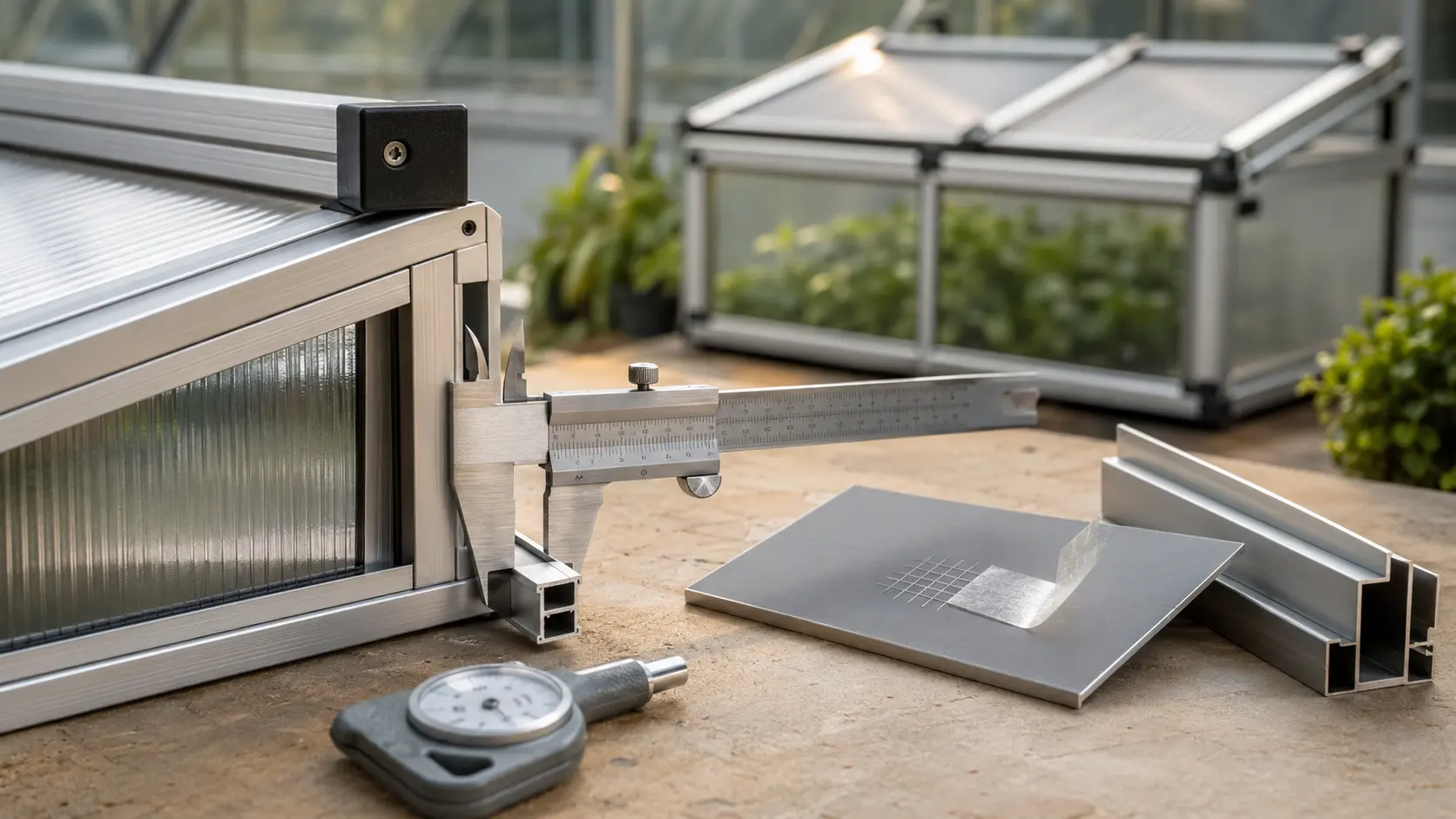
Wall thickness should be ≥1.0 mm (industry reference value). Below that, the frame may deform under wind or snow load. Measure with a vernier caliper (0.02 mm precision).
Surface finish (anodised or powder-coated) — verify adhesion with a cross-hatch test: score a grid, apply tape, and pull. The coating should not peel off.
| Test Item | Method | Acceptance Criteria | Defect Class |
| Wall thickness | Vernier caliper | ≥1.0 mm (industry reference value) | Major |
| Surface finish | Visual + cross-hatch test | Anodised / powder-coated, no peeling | Major (peeling) / Minor (slight colour variation) |
| Cross-section dimensions | Vernier caliper | Within ±0.5 mm of drawing | Minor |
| Connector fit | Manual push-pull | Tight fit, no looseness | Major |
Galvanized Steel Frames
The inspection core for galvanized steel is zinc coating thickness — and this is the biggest trap in B2B sourcing.
A Z275 designation means a single-side zinc layer of approximately 19–20 μm (per ASTM A653 / industry convention). But what actually arrives can be as low as Z60–Z80, meaning only 6–8 μm of zinc. You cannot tell the difference by eye — a magnetic thickness gauge is the only way to detect this.
If the measured value deviates from the stated specification by more than 10%, classify it as zinc overstatement — a Major defect. This isn’t a quality issue; it’s deceptive delivery.
Weld points are the Achilles’ heel of galvanized steel. The heat of welding destroys the zinc layer, and bare welds in high-humidity environments (persistent condensation or salt spray) can develop rust spots within days. Inspect every weld point visually: each must have zinc repair or a protective coating.
For coastal applications, you must upgrade to Zn-Al-Mg coating. Z275 galvanized layer endures 500–700 h without red rust in ASTM B117 testing (industry reference value); Zn-Al-Mg coating can reach 1,500 h+ (industry reference value). If your customer sells in coastal regions, this upgrade is not optional.
| Test Item | Method | Equipment | Acceptance Criteria | Defect Class |
| Zinc thickness | Magnetic thickness gauge | 1 μm precision | Z275: single-side 19–20 μm | Major |
| Salt spray endurance | ASTM B117 | Salt spray chamber | Z275: 500–700 h no red rust; coastal: Zn-Al-Mg ≥1,500 h | Major |
| Zinc overstatement check | Magnetic gauge + comparison | — | Measured vs. stated deviation ≤10% (industry practice) | Major |
| Weld point protection | Visual | — | Zinc repair or coating present | Major |
| Tube wall thickness | Vernier caliper | 0.02 mm precision | ≥0.5 mm (industry reference value) | Major |
If you inspect only one frame metric, make it the zinc layer — it’s the biggest trap in B2B cold frame sourcing, and you absolutely cannot distinguish Z275 from Z60 by appearance.
Timber Frames
The inspection core for timber is moisture content and preservative treatment method — these two indicators determine whether the frame is still standing after 2–3 years or already warped and cracked.
Moisture content should be ≤18% (industry reference value). Measure with a moisture meter. Timber shipped with excessive moisture will shrink and crack in dry heated environments, or swell and warp in damp winters. This is a delayed bomb — it detonates after the product reaches the customer, often past the warranty period.
Preservative treatment method: use a cross-section observation to judge. Pressure-treated timber shows preservative penetration throughout the entire cross-section; dip-coated timber only has preservative on the surface. Dip-coated timber needs re-treatment within 1–2 years; pressure-treated timber can last 5–8 years for softwood, or 10–15 years for naturally durable hardwoods like oak or cedar (industry reference values).
Timber frames carry a unique risk — the “dual-displacement” problem. Timber swells and shrinks with moisture changes, while PC sheet has a thermal expansion coefficient of 3.8 × 10⁻⁵/°C (Covestro official data). Both act simultaneously on the lid seal. Picture a damp autumn: the timber frame swells, pushing the seal groove outward by a fraction of a millimetre; a sunny afternoon follows, and the PC lid expands in the other direction. The seal is being pulled two ways at once, day after day. This is the most vulnerable point in any cold frame: the seal must use EPDM and include an expansion allowance.
| Test Item | Method | Acceptance Criteria | Defect Class |
| Preservative treatment | Cross-section observation | Pressure-treated (full cross-section penetration) | Major (dip-coated only = re-treatment needed in 1–2 years) |
| Timber type | Supplier declaration + visual | Hardwood naturally durable 10–15 years (industry reference value); softwood with preservative 5–8 years | Minor (but affects lifespan expectation) |
| Cracking / warping | Visual + dimensional check | Cracks ≤3 mm; warping ≤2 mm/m | Major (>3 mm cracks = structural risk) / Minor (≤3 mm) |
| Moisture content | Moisture meter | ≤18% (industry reference value) | Major |
| Splinters / sharp edges | Touch + visual | None | Critical (laceration risk) |
Hinge Inspection: The Heart of a Cold Frame
Hinges are what set cold frames apart from frost covers and cloches in terms of QC risk. Frost covers don’t have hinges; cloches only occasionally use them on barn-type models. But every type of cold frame has hinges — and they carry heavier loads and higher opening frequencies.
A cold frame lid gets opened 1–3 times per day based on typical gardening use patterns (ventilation, watering, checking plants), with additional stress from snow and wind. When a hinge fails, the chain reaction looks like this:
Lid drops → won’t close → seal fails → cold air pours in → plants get damaged → customer files a claim
Three Frame Types, Three Hinge Risks
| Frame Type | Hinge Type | Inspection Focus | Common Failure Mode |
| Timber | Screw-fixed hinges | Screw loosening, timber hole enlargement | Screws work loose after 2–3 years → lid drops → won’t close |
| Aluminium | Riveted hinges | Rivet security | Rivets loosen → lid shifts → seal fails |
| Galvanized steel | Bolted hinges | Bolt replaceability + anti-loosening structure | Bolt seizes with rust → can’t replace → hinge fails → frame scrap |
Timber frames with screw-fixed hinges are the highest-risk combination. If you inspect only one component, make it the hinges.
Hinge Durability Testing
| Test Item | Method | Acceptance Criteria | Defect Class |
| Repeated opening/closing | Mechanical or manual cycling | ≥500 cycles without loosening or breakage (must be agreed with supplier in advance) | Major |
| Lid self-weight sag | Open to maximum angle, hold 24 h | Sag angle ≤5° (must be agreed with supplier) | Major |
| Screw / bolt torque | Torque wrench | Per agreed specification with supplier | Major |
| Corrosion resistance | Visual + salt spray test | No visible corrosion | Major (corrosion) / Minor (light oxidation) |
The 500-cycle figure needs to be agreed with your supplier and written into the contract — there is no international standard specifying cold frame hinge durability. Five hundred cycles is a conservative estimate based on 1–3 daily openings over 1.5–2 years of use.
Lid self-weight sag test: open the lid to its maximum angle, hold for 24 hours. If the sag exceeds 5°, classify as a Major defect. This test simulates the common real-world scenario where a customer props the lid half-open for ventilation.
Ventilation Inspection: Hidden Defects Are More Dangerous Than Visible Ones
Ventilation problems in cold frames aren’t as obvious as a broken hinge — they’re insidious. A customer might not realise the ventilation system has failed until they come home on a sunny day to find the cold frame interior above 40 °C and their plants dead.
Manual Ventilation
The most basic requirement: there must be a vent. This isn’t a suggestion — it’s a safety baseline. A sealed cold frame can exceed 40 °C within two hours on a sunny day, causing irreversible heat damage to most plants.
| Test Item | Method | Acceptance Criteria | Defect Class |
| Vent presence | Visual (100% check) | Must have at least one vent | Major (no vent = sealed interior exceeds 40 °C, plants die) |
| Vent function | Physical operation (≥5 units per batch) | Opens and closes properly | Major |
| Vent area ratio | Tape measure calculation (≥3 units per batch) | ≥5% of glazing area (industry reference value) | Minor |
Manual ventilation is the baseline. But the real safety net is the automatic vent opener — it opens the vent when you’re not there.
Automatic Vent Openers: The Silent Safety Device
Automatic vent openers are unique to cold frames among garden protection products. They use a wax-filled cylinder — as the temperature rises, the wax expands and pushes the vent open; as it drops, the wax contracts and closes the vent. The Bayliss MK7 is a common model in the UK market; a replacement cylinder costs around £44.
The risk with auto-vents is that when they fail, the customer may not notice. Unlike a broken hinge, there’s no obvious physical signal. The vent simply stops opening when it should, or stays open when it shouldn’t — until plants overheat or freeze, and only then does the customer realise something is wrong.
| Test Item | Method | Acceptance Criteria | Defect Class |
| Opening temperature | Climate chamber / outdoor test | Opens within 16–25 °C range (common models reference: 18–22 °C) | Major |
| Fully open temperature | Climate chamber / outdoor test | Fully open at 25–30 °C (reference values for common models) | Major |
| Closing temperature | Climate chamber / outdoor test | Closes at 15–18 °C (reference values for common models) | Major |
| Piston thrust | Weight / force gauge | Sufficient to support lid weight + 5 kg snow load (industry reference value) | Major |
| Wax cylinder seal | Visual + 24 h high-temp exposure | No wax seepage | Major |
The piston thrust test is often skipped. A lid with 5 kg of snow on it will stay shut if the opener can’t push hard enough — the ventilation system becomes useless. During inspection, confirm with a weight or force gauge that the opener can support the lid weight plus a 5 kg snow load.
Wax cylinder seal test: place the opener in a high-temperature environment (40–50 °C) for 24 hours and check for wax seepage. Any seepage means the cylinder seal has been compromised and the temperature-control function will soon fail.
Ventilation System Effectiveness Check
This is the final validation of the ventilation system: place the cold frame outdoors for 2 hours (with vents open) and use a dual-channel thermometer to measure interior and exterior temperatures simultaneously.
| Test Item | Acceptance Criteria | Defect Class |
| Interior temperature | ≤40 °C (vents open) | Major (>40 °C = plant heat stress risk) |
| Interior-exterior differential | ≤15 °C (vents open) | Minor |
If the interior temperature still exceeds 40 °C with vents open, the vent area is insufficient or the vent design has a problem.
Sampling Plans, Equipment, and Defect Classification
AQL Sampling Plan
Cold frame pre-shipment inspection uses the ANSI/ASQ Z1.4 standard, Inspection Level II, Normal Inspection:
| Lot Size | Code Letter | Sample Size | Critical (Ac/Re) | Major 2.5 (Ac/Re) | Minor 4.0 (Ac/Re) |
| 501–1,200 | J | 80 | 0/1 | 5/6 | 7/8 |
| 1,201–3,200 | K | 125 | 0/1 | 7/8 | 10/11 |
| 3,201–10,000 | L | 200 | 0/1 | 10/11 | 14/15 |
Critical defects have AQL = 0: finding even one means the entire lot is rejected. Major AQL = 2.5; Minor AQL = 4.0.
But AQL is just the sampling rule — how you classify each defect as Critical, Major, or Minor is what actually determines the inspection outcome.
Defect Classification Definitions
| Class | AQL | Definition | Typical Cold Frame Mapping |
| Critical | 0 | Violates mandatory regulations; health/safety hazard | Frame sharp edges/burrs, non-toughened glass shards, REACH SVHC exceedance |
| Major | 2.5 | Affects product function or significantly reduces value | PC without UV coating, loose/broken hinge, zinc overstatement, vent failure, PVC seal |
| Minor | 4.0 | Minor cosmetic/packaging issue, no functional impact | Slight colour variation, PC micro-scratch (not penetrating UV layer), label misalignment |
Required Inspection Equipment
| Equipment | Use | Precision |
| Micrometer | PC solid wall thickness | 0.01 mm |
| Vernier caliper | Frame dimensions / wall thickness | 0.02 mm |
| Magnetic thickness gauge | Galvanized coating thickness | 1 μm |
| UV torch (365 nm) | UV coating verification | — |
| Precision balance | Weight / area weight | 0.01 g |
| Torque wrench | Hinge screw/bolt torque | ±3% |
| Dual-channel thermometer | Sealed temperature test | ±0.5 °C |
| Moisture meter | Timber moisture content | ±1% |
This equipment kit doesn’t cost much, but it covers over 80% of cold frame inspection needs. The magnetic thickness gauge is the best value-for-money item in the set — without it, zinc overstatement is completely undetectable.
Pre-Shipment Inspection Checklist: 20 Items
This checklist is ordered by inspection flow: glazing → frame → hinges/ventilation → overall/compliance. Print it and take it to the warehouse — check off each item on the spot.
Glazing (5 Items)
| # | Check Item | Method | Acceptance Criteria | Class | Reasoning |
| 1 | UV coating | UV torch illumination | Coated side produces blue-violet fluorescence | Major | No coating cuts lifespan from ~10 years to 1–2 years |
| 2 | Solid wall thickness | Micrometer measurement | 4 mm spec ≥3.8 mm | Major | Overstatement >10% → reduced insulation and impact resistance |
| 3 | Edge sealing | Visual | Aluminium foil tape intact on both ends | Major | Unsealed → moisture enters → internal mould, cannot be cleaned |
| 4 | Visual defects | Visual | No bubbles / black spots / penetrating scratches | Major (penetrating UV layer) / Minor (surface micro-scratch) | Penetrating UV layer = localised protection failure |
| 5 | Seal material | Confirm material | EPDM, not PVC | Major | PVC degrades in 2–3 years under sustained outdoor UV, leaks |
Frame (6 Items)
| # | Check Item | Method | Acceptance Criteria | Class | Reasoning |
| 6 | Zinc thickness (galvanized steel) | Magnetic thickness gauge | Z275: single-side 19–20 μm | Major | Overstatement = deceptive delivery, affects lifespan |
| 7 | Tube/wall thickness | Vernier caliper | Steel ≥0.5 mm; aluminium ≥1.0 mm | Major | Insufficient → deformation risk under wind/snow |
| 8 | Weld point protection | Visual | Zinc repair or coating present | Major | Bare weld = corrosion starting point |
| 9 | Timber moisture content | Moisture meter | ≤18% | Major | Excessive → subsequent warping / cracking |
| 10 | Timber preservative treatment | Cross-section observation | Pressure-treated (full cross-section penetration) | Major | Dip-coated only → re-treatment needed in 1–2 years |
| 11 | Sharp edges / burrs | Touch + visual | None | Critical | Laceration risk |
Hinges / Ventilation (4 Items)
| # | Check Item | Method | Acceptance Criteria | Class | Reasoning |
| 12 | Hinge operation | Open and close 10 times | Smooth, no sticking | Major | Looseness → lid drops → seal fails → cold air enters |
| 13 | Lid closure seal | Visual + paper strip test | Paper strip cannot be pulled out when lid is closed | Major | Seal failure = cold air ingress |
| 14 | Vent function | Physical operation | Opens and closes properly | Major | No vent → sealed interior exceeds 40 °C = plants die |
| 15 | Auto-vent temperature response | Climate chamber / warm water test | Opens within stated temperature range | Major | Temperature control failure → vent stays closed = plants overheat |
Overall / Compliance (5 Items)
| # | Check Item | Method | Acceptance Criteria | Class | Reasoning |
| 16 | Full assembly | Blind assembly test | One person can complete independently | Minor | Doesn’t affect function but affects unboxing experience |
| 17 | Accessories complete | BOM check | Matches material list | Major | Missing parts = incomplete assembly |
| 18 | REACH compliance | SVHC declaration + test report | 253 SVHC substances not exceeded | Critical | Regulatory violation |
| 19 | Packaging integrity | Visual | No moisture damage / breakage | Minor | Doesn’t affect product function (but check if product is damaged) |
| 20 | Labels / instructions | Visual | Correct language, complete warning information | Minor | Doesn’t affect function |
Next Step: Review Your Cold Frame QC Plan
Cold frame quality problems share a common trait: they’re nearly invisible at inspection but turn into return requests after 2–3 years in the customer’s hands. Loose hinges, degraded seals, overstated zinc coatings, mouldy PC sheets — these aren’t defects that show up on arrival. They’re delayed risks.
What you can do is intercept those risks at the inspection stage:
- UV torch — shine it on the PC sheet for 30 seconds to confirm the UV coating exists (coated side produces blue-violet fluorescence)
- Magnetic thickness gauge — measure the zinc layer in 2 minutes to rule out overstatement
- Open and close 10 times — check hinges; reject immediately if anything feels loose
- Paper strip test — close the lid; if you can pull the strip out, the seal doesn’t pass
- Auto-vent temperature response — confirm the vent opens within the stated temperature range
None of these tests require complex equipment. But they do require you to agree on acceptance criteria with your supplier before you place the order — and write them into the contract.
You’re negotiating a 200-unit cold frame order. The supplier says “Z275, no problem” — but you have no way to verify that. You could write “quality inspection per industry standards” in the contract, but what does that actually mean when the dispute comes? We help you turn these 20 acceptance criteria into contract-ready parameter tables — hinge durability cycles, auto-vent temperature ranges, measured zinc values, dual-displacement seal allowances. Every item specified with a test method and a number, so your inspection has a clear basis and your supplier knows exactly what they’re delivering to. There’s no unified international QC standard for cold frames, but your contract can become your own standard.
Get the cold frame inspection parameter list and quotation → Confirm your product specifications and inspection standards with the Scarecrow Garden team
You can also request actual footage of zinc thickness measurement, UV coating verification, and hinge durability testing — or get a physical sample first and run your own tests.
FAQ
Q: Do I really need a magnetic thickness gauge? Can’t I just trust the supplier’s Z275 designation? A: No. Zinc overstatement is the single most common complaint in cold frame sourcing. Z275 and Z60 look identical to the naked eye. A magnetic thickness gauge costs relatively little but is the only tool that can detect this. Without it, you’re taking the supplier’s word on faith.
Q: How do I test auto-vent temperature response without a climate chamber? A: For a quick field check, you can use warm water: submerge the opener’s cylinder in water heated to the stated opening temperature (typically 18–22 °C for common models) and observe whether the piston extends. It’s not as precise as a climate chamber, but it will catch a completely non-responsive unit.
Q: What’s the difference between EPDM and PVC seals, and why does it matter so much? A: EPDM (ethylene propylene diene monomer) rubber handles outdoor exposure for 10–15 years — it resists UV, ozone, and temperature extremes from −40 °C to +120 °C (continuous), with short-term peaks to +150 °C. PVC seals harden and crack within 2–3 years of sustained outdoor UV exposure. In a cold frame, a failed seal means water ingress and cold air leaks. Quick field test: EPDM is elastic and springs back quickly; PVC is stiff and recovers slowly.
Q: The 500-cycle hinge durability — where does that number come from? A: There’s no international standard for cold frame hinge durability. The 500-cycle figure is a conservative estimate based on 1–3 daily openings over 1.5–2 years. You can adjust this up or down depending on your customer’s expected use intensity — but whatever you agree on, write it into the contract.
Q: My supplier says their PC sheets are “UV-stabilised.” Is that the same as a UV coating? A: Not necessarily. “UV-stabilised” can mean the UV absorber is mixed into the polycarbonate resin (bulk-stabilised), which provides some protection but degrades faster than a coextruded UV cap layer. A true UV coating (coextruded cap layer) sits on the surface and provides significantly better long-term protection. Use the UV torch test — if the sheet fluoresces, it has a surface coating. If it doesn’t, it may be bulk-stabilised only, which is a lower tier of protection.
Q: What if my customer is in a coastal area — what changes in the inspection? A: Two critical upgrades: (1) Galvanized steel frames must use Zn-Al-Mg coating instead of standard Z275 galvanizing — salt spray endurance jumps from 500–700 h to 1,500 h+ (industry reference values). (2) All hardware (screws, bolts, hinges) must be stainless steel (304 minimum). Standard zinc-plated hardware corrodes rapidly in salt-laden air.
Planning a Frost Cover Range?
Send us your product list, target market, estimated quantities, and packaging requirements. We can help you compare options, verify key specifications, consolidate products from multiple factories, and prepare a practical sourcing plan.
- Product comparison
- Specification checks
- Mixed-order consolidation
- Packaging support

Written by
ScarecrowGarden
💡About Scarecrow Garden Supplier Co., Ltd.
Scarecrow Garden Supplier Co., Ltd. is a China-based sourcing and wholesale partner specializing in garden tools, landscaping equipment, and outdoor supplies for international wholesalers, distributors, contractors, and brands.
With hands-on experience rooted in real garden use scenarios, we focus on durable materials, functional design, and stable large-volume supply. Our product range covers pruning tools, watering systems, hand tools, outdoor hardware, and customized garden solutions to support both retail and professional landscaping markets.
Beyond products, we help our partners navigate supplier selection, quality control, compliance requirements, and long-term sourcing strategies in China. Through our blog, we share practical insights on product selection, material comparisons, industry trends, and cost-effective purchasing—helping global buyers build stronger, more competitive supply chains.