






Wholesale Water-Saving Garden Products: Sourcing Guide for Droughts | Scarecrow Garden Supplier
When a hosepipe ban is announced, three things happen at once. Gardeners panic-buy watering cans and water butts. Drip-irrigation kits sell out within days. And every retailer who did not stock up in advance starts scrambling for the same products from the same suppliers — at the same time.
But here is what most retailers miss: not all watering methods are banned. Some are explicitly allowed — and one category is actually encouraged by the regulators. Drip irrigation fitted with a timer and a pressure reducer is typically classified as “efficient” watering, which means it remains legal even when a hosepipe ban is in force. That distinction turns a drip-irrigation kit from a “nice-to-have” into a legal way to keep a garden alive when a hose cannot be used.
The UK Met Office confirms that record-breaking heat has become the “new normal,” with average temperatures over the most recent decade (2015–2024) running 1.24 °C above the 1961–1990 baseline. As temperatures rise, more water utilities impose restrictions — and each restriction creates a demand spike that rewards retailers who understand which products are still legal and which are not.
This guide covers the products that sell during heatwaves and hosepipe bans, the legal framework that determines what your customers can and cannot use, and the sourcing decisions you need to make before summer — not during it.
What a Hosepipe Ban Actually Restricts (and What It Does Not)
Understanding the legal framework is essential for one reason: it tells you which products your customers can still use when restrictions hit — and that determines what you need to stock. In the UK, the relevant legislation is the Water Use (Temporary Bans) Order 2010. When a water company issues a Temporary Use Ban (commonly called a hosepipe ban), it restricts the use of hosepipes and similar apparatus for watering gardens, washing cars and filling pools.
But here is what many retailers — and quite a few suppliers — get wrong: not all watering methods are banned.
| Watering Method | Allowed During Hosepipe Ban? | Notes |
| Garden hose (unattended) | ❌ No | The core restriction |
| Garden hose (hand-held) | ❌ No | Even holding it does not exempt you |
| Watering can | ✅ Yes | Filled from a tap or water butt |
| Bucket/watering can from a tap | ✅ Yes | Manual filling is permitted |
| Drip irrigation with timer + pressure reducer | ✅ Yes (usually) | Classified as “efficient” under most water-company definitions |
| Soaker hose (unattended) | ⚠️ Varies | Some water companies allow it; check locally |
| Water butt (rainwater collection) | ✅ Yes | Rainwater is not mains supply |
| Sprinkler (any type) | ❌ No | Unattended irrigation is restricted |
If your range includes hose-end tools, also check the sourcing risks in garden spray guns for wholesale.
The key insight for wholesale buyers: Drip irrigation with a timer and pressure reducer is typically exempt from hosepipe bans. This is not a loophole — it is a deliberate policy choice. Drip systems use roughly 7 litres per 10 minutes (for a typical 10-emitter kit at 2 L/hour per emitter), compared with 91 litres from an open hose. That 13× efficiency gain is why regulators treat drip as “efficient” watering rather than wasteful use.
This distinction is your single most powerful selling point during restrictions. A drip-irrigation kit with a timer is not just a product — it is a legal way to keep a garden alive when a hose cannot be used.
Product Categories for Heatwave and Drought Response
Three product categories matter most when restrictions hit. Here is how they compare.
| Category | Key Products | Hosepipe-Ban Status | Peak Demand Trigger | Main Sourcing Risk |
| Watering cans | 5 L / 10 L plastic, metal decorative | ✅ Allowed | First 48 hours after the ban announcement | Rose leaks; handle breaks under load |
| Drip irrigation kits | Complete kits with timer + pressure reducer | ✅ Usually allowed (exempt as “efficient”) | Ban announcement + raised-bed season | Missing fittings; emitter clogging |
| Water butts & accessories | 100 L / 210 L butts, diverters, stands, pumps | ✅ Allowed (rainwater) | Pre-summer (prepared buyers) + ban announcement | Seal leaks; diverter fit issues |
Watering cans are one of the safest hosepipe-ban products; see the separate guide to wholesale watering cans.
Three supporting products complete the range but do not need their own table rows:
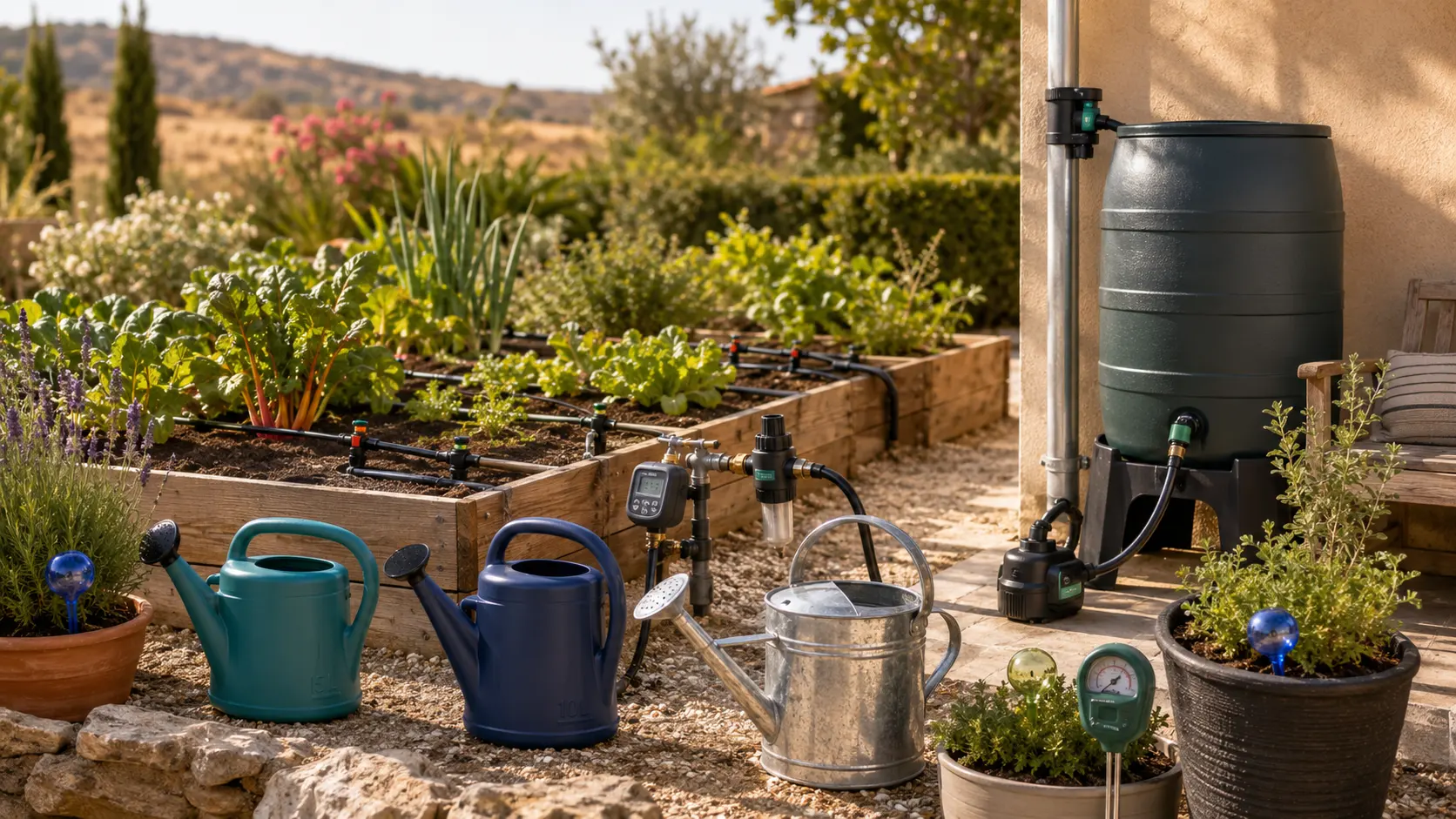
- Water timers (mechanical £10–20, digital £20–45, smart WiFi £35–70) are the enabler — without a timer, drip irrigation may not qualify for the hosepipe-ban exemption. If you stock drip kits, stock timers alongside them.
- Moisture meters (analogue £5–12, digital £10–25) address the counter-intuitive problem of overwatering during heatwaves. Analogue meters are the safer wholesale default — lower cost, fewer returns.
- Self-watering spikes and globes sell mainly to holiday gardeners who need plants kept alive while they are away. Fragile and inconsistent in flow rate, but a useful impulse-buy item for the checkout display.
Key Sourcing Dimensions for Water-Saving Products
Water Butts: Size, Material and Accessory Bundling
Water butts come in the two most common sizes for the residential market: 100 L (compact, for small gardens) and 210 L (standard, for medium gardens). The butt itself is usually made from recycled polyethylene — but the accessories are where quality varies.
What to confirm before ordering:
- Lid fit. A loose lid lets debris in and mosquitoes breed. A tight-fitting lid with a filter screen is worth the small cost increase.
- Tap/valve quality. Cheap plastic taps crack after one winter. Brass or reinforced-plastic taps last longer and justify a higher retail price.
- Diverter compatibility. The rain diverter must fit standard UK round downpipes (68 mm) and square downpipes (65 mm). If your market includes continental Europe, confirm compatibility with local pipe sizes.
- Stand stability. A 210 L butt weighs approximately 210 kg when full (water alone), plus the weight of the butt itself. The stand needs to support that load on uneven ground.
Bundling strategy: A “complete water-saving kit” — butt + stand + diverter + tap — sells better than individual components. It also increases your average order value and reduces the chance that a customer returns the butt because they could not figure out how to connect it.
Drip Irrigation Kits: What Makes a Kit “Ban-Ready”
Not all drip kits qualify for the hosepipe-ban exemption. To be classified as “efficient” under most water-company definitions, the system needs:
- A pressure regulator — to reduce mains pressure to the low flow that drip emitters require
- A timer — so the system operates automatically, not with an open hose left running
- Drip emitters (not sprinklers) — delivering water to the root zone, not spraying into the air
If you source drip kits, make sure the kit includes — or clearly lists as required — the pressure regulator and timer. A kit that ships without these is a kit that may not be legal to use during a ban, which is exactly when your customer needs it most.
For component-level checks, read the full guide to drip irrigation kits for wholesale.
Water Timers: Mechanical vs Digital vs Smart
| Type | Price Range (UK Retail) | Pros | Cons | Best For |
| Mechanical | £10–20 | Simple, no batteries, reliable | Limited scheduling; cannot skip rainy days | Budget kits; first-time users |
| Digital | £20–45 | Flexible scheduling; some have a rain delay | Batteries needed; display can fade in the sun | Mainstream garden centres |
| Smart WiFi | £35–70 | App control; weather-responsive; data on water use | Requires WiFi; setup complexity | Premium garden centres; tech-savvy buyers |
Sourcing risk: Timer waterproofing is the most common failure point. A timer that is not properly sealed will fail in its first rainstorm — which, ironically, is exactly when you want it to skip a watering cycle. Ask suppliers for IP rating (IPX5 minimum for outdoor use) and test a sample under running water before approving production.
Moisture Meters: The Overwatering Problem
Heatwaves create a counter-intuitive problem: gardeners overwater. They see wilting leaves and reach for the hose, not realising that overwatering in hot weather can rot roots faster than underwatering. Moisture meters address this by telling the gardener what the soil actually needs.
Two types:
- Analogue (£5–12): No batteries, probe goes into soil, needle moves. Simple, cheap, and surprisingly popular. The main quality issue is probe corrosion — cheap probes rust after one season.
- Digital (£10–25): LCD display, sometimes with light and pH readings. More information, but more things to go wrong (battery, display, sensor calibration).
For wholesale, analogue meters are the safer default — lower cost, fewer returns. Digital meters work as upsell items for the premium shelf.
Stocking up for summer? Tell us your target market and which water-saving categories you need → We can match you with suppliers, send samples and confirm packaging and lead times.
Bad Reviews and How to Avoid the Same Failures
The most common complaints about water-saving products are not about the products themselves — they are about the experience of using them. Here are the top pain points and how to source around them.
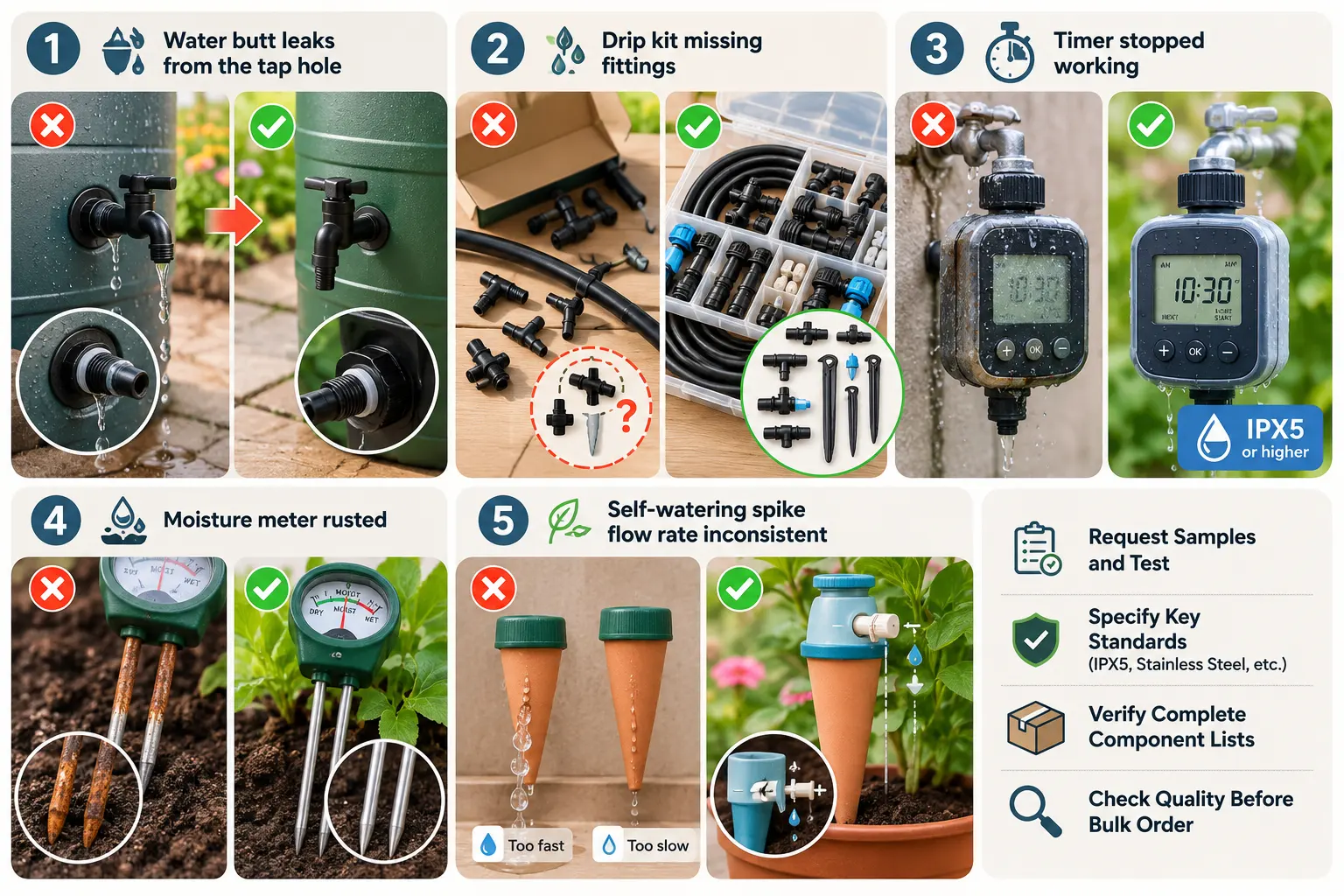
1. “The water butt leaks from the tap hole.” This is almost always a manufacturing issue: the tap fitting is not properly sealed during production. Solution: order a sample, fill it, and leave it for 24 hours. If the tap weeps, the production run will too. Confirm the sealing method with the factory before committing.
2. “The drip kit was missing half the fittings.” This is one of the most common complaints about drip-irrigation kits on Amazon UK. The factory packs a standard set of components, but the kit description promises more. Solution: ask for a complete component list with quantities, and have your quality team verify it against the actual carton contents on a random sample.
3. “The timer stopped working after two weeks.” Usually a waterproofing failure. Water gets into the battery compartment or the display housing. Solution: specify IPX5 minimum, test a sample under running water, and ask the factory what testing they do. If the answer is vague, the testing probably is too.
4. “The moisture meter rusted.” Cheap probes use untreated steel that corrodes in damp soil. Solution: specify stainless-steel probes. The cost difference is minimal; the return-rate difference is significant.
5. “The self-watering spike delivers water too fast / too slow.” Flow rate is hard to control with cheap ceramic spikes. Solution: look for spikes with adjustable flow or a consistent pore structure. Test by filling a spike with water and timing how long it takes to empty — then compare that to the claimed duration.
Procurement Checklist: Water-Saving Products
| What to Confirm | Why It Matters | Red Flag |
| Water butt tap material (brass vs plastic) | Brass lasts years; plastic cracks after one frost | The supplier cannot specify the tap material |
| Diverter pipe compatibility (68 mm round / 65 mm square for UK) | Wrong size = cannot connect to downpipe | “Universal fit” claim without dimensions |
| Drip kit component list (with quantities) | Missing fittings = customer returns whole kit | The factory provides a photo but no itemised list |
| Timer IP rating (IPX5 minimum) | The outdoor timer must survive rain | No IP rating specified |
| Moisture meter probe material (stainless steel) | Rusty probe = one-season product | Supplier says “metal” without specifying grade |
| Self-watering spike flow rate | Too fast = empty in hours; too slow = plant dies | No flow-rate specification or test data |
| Packaging & CBM | Water butts are bulky — CBM matters more than unit price | The quote does not include packaging dimensions |
| Regulatory compliance (hosepipe-ban exemption) | Kit must include a timer + pressure reducer to qualify | Kit ships without these critical components |
Building a drought-response range? Send us your product list and target market → We will match you with verified suppliers, run sample checks and consolidate everything into one shipment.
FAQ
What products can I legally sell during a hosepipe ban? All of the products in this guide can be sold and used during a hosepipe ban — that is the point. Watering cans, water butts, drip irrigation (with timer and pressure reducer), moisture meters and self-watering spikes are all permitted. Garden hoses, hose-end sprinklers and unattended soaker hoses (in some water-company areas) are restricted.
Does drip irrigation really use 13 times less water than a hose? Based on Hozelock’s published data, a typical 10-emitter drip kit running at roughly 2 litres per hour per emitter delivers about 7 litres in 10 minutes. An open garden hose delivers about 91 litres in the same period. That is roughly a 13× difference. Actual rates vary with the number of emitters, water pressure and hose diameter — but the order of magnitude is consistent. If your customer asks, a 20-emitter kit would use roughly 14 litres in 10 minutes, still far less than an open hose.
How far in advance should I order water-saving products? For the UK market, order by November for March–April delivery. Water butts and drip kits have longer production lead times than watering cans because they involve more components and assembly. If you wait until a hosepipe ban is announced to place orders, you will be competing with every other retailer for the same factory capacity.
Are smart water timers worth the premium price? For the right customer, yes. Smart timers connect to WiFi and adjust watering based on local weather data — which means they skip cycles when it rains and increase watering during dry spells. This is genuinely useful in a market where hosepipe bans are becoming more frequent. For price-sensitive channels, mechanical and digital timers remain the volume sellers.
Can I bundle water butts with drip-irrigation kits? Yes, and you should. A water butt + pump + drip kit + timer is a complete rainwater-irrigation system that works even under the strictest hosepipe ban. It is also a high-value bundle that increases your average order value and differentiates your range from competitors selling individual components.
What is the difference between a soaker hose and a drip-irrigation kit? A soaker hose (also called a porous hose) is a length of hose that seeps water along its entire length. It is simple but imprecise — water goes everywhere the hose touches. A drip-irrigation kit uses individual emitters to deliver water to specific plants. Drip kits are more efficient and more controllable, but also more complex to install. For raised beds, drip kits are the better choice; for borders and hedges, soaker hoses are simpler.
Next Step: Stock Up Before the Ban
- Audit your current range. Do you have watering cans, drip kits with timers, and water butts in stock? If not, you are exposed to the next hosepipe ban.
- Request a product list and quote. Tell us what you need → — water butts, drip kits, timers, moisture meters or a complete drought-response bundle. We will send supplier matches, sample options and landed-cost estimates.
- Confirm samples before production. We test water-butt seals, timer waterproofing and drip-kit component completeness at our warehouse — so you do not discover problems after the goods arrive.
You focus on selling. Scarecrow Garden Supplier can help you source, verify, organise and ship.
Ready to Build Your Watering-Tool Assortment?
Send us your product list, target market and packaging requirements — we will come back with supplier matches, sample options and a CBM-optimised packing plan within 48 hours.

Written by
ScarecrowGarden
💡About Scarecrow Garden Supplier Co., Ltd.
Scarecrow Garden Supplier Co., Ltd. is a China-based sourcing and wholesale partner specializing in garden tools, landscaping equipment, and outdoor supplies for international wholesalers, distributors, contractors, and brands.
With hands-on experience rooted in real garden use scenarios, we focus on durable materials, functional design, and stable large-volume supply. Our product range covers pruning tools, watering systems, hand tools, outdoor hardware, and customized garden solutions to support both retail and professional landscaping markets.
Beyond products, we help our partners navigate supplier selection, quality control, compliance requirements, and long-term sourcing strategies in China. Through our blog, we share practical insights on product selection, material comparisons, industry trends, and cost-effective purchasing—helping global buyers build stronger, more competitive supply chains.