







Wholesale Watering Cans: B2B Sourcing Guide & Quality Checklist | Scarecrow Garden Supplier
Most wholesale buyers default to 10 L when ordering watering cans. It is the “standard” size, the one every garden centre stocks, the one that looks right on the shelf. But in practice, 5 L is the fastest-growing size. It moves quickly in e-commerce channels, appeals to balcony, container, and small-garden growers, and pairs naturally with 10 L in a mixed order. If you are only ordering 10 L, you are leaving margin on the table — and missing the fastest-moving SKU in the category.
The problem runs deeper than size selection. Watering cans look simple — a container, a spout, a handle, maybe a rose (the perforated cap that breaks the water into a spray). But that apparent simplicity hides three sourcing decisions that determine whether your cans sell through or come back as returns: the grade of plastic (HDPE vs LDPE), the fit between the rose and the spout, and the packaging method that determines how much you pay to ship air.
This guide covers the capacity ranges that actually sell, the material traps that cause the worst reviews, and the specific checks you need to make before you commit to a production run.
What You Are Actually Buying When You Buy a Watering Can
A watering can is not one product — it is four, each serving a different gardener, at a different price point, made on a different production line. Understanding this is what separates a wholesale range that sells through from one that sits on the shelf until October.
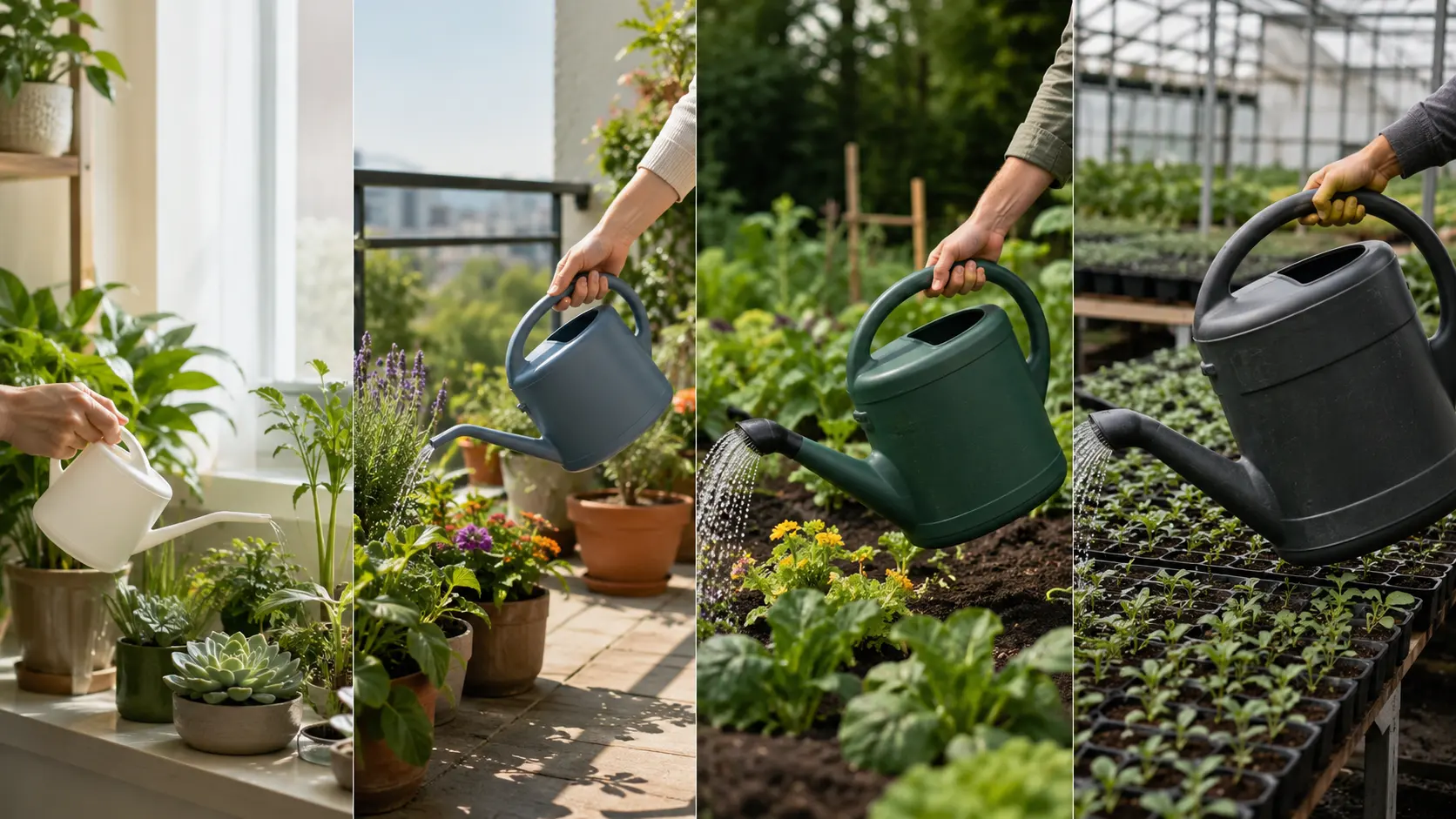
1–2 L: The indoor specialist. Long spout, fine rose, lightweight. Used for houseplants, seedlings, and succulents. These are injection-moulded, often in PP or HDPE, and carry the highest margin per unit. They are also the most likely to be bought as gifts — which means presentation matters (retail box, colour coordination). Production is straightforward, but the fine rose demands precise hole-punching. Cheap tooling shows up fast: uneven spray patterns that drown seedlings instead of misting them.
5 L: The volume seller. This is the size that balcony gardeners, container growers, and casual gardeners reach for. It is light enough to carry one-handed (roughly 5 kg full), small enough for a kitchen tap, and cheap enough to be an impulse buy. For most wholesale channels, 5 L + 10 L mixed MOQ is the optimal combination: 5 L drives volume, 10 L provides the “standard” option.
10 L: The garden-centre staple. The default outdoor size. Every garden centre stocks at least one 10 L can, usually in green or black HDPE. It is the price-reference point — the product your customers compare everything else against. Margins are thin because it is commoditised. The key is not to win on price alone but to offer a 10 L can that does not leak, does not break, and does not come back.
15 L+: The professional niche. Used by nursery workers, allotment holders, and commercial growers. Small volumes, higher unit price, and a different buyer altogether — one who values durability over aesthetics. These are often made in heavier-gauge HDPE or galvanised steel. Not a volume play, but a useful range-filler for trade channels.
The supply-chain implication: 1–2 L cans are typically injection-moulded; 5 L cans are usually blow-moulded (though some complex designs use injection moulding); 10 L and above are almost always blow-moulded. Different processes mean different factories, different tooling, different MOQs. This is one reason why “watering tools are not one category — they are six different supply chains.” A 5 L can and a 10 L can may come from two different factories, even if they share the same colour and logo.
For drought-response ranges, watering cans should be planned together with water-saving garden products for heatwaves and hosepipe bans.
Watering Can Types at a Glance
| Type | Typical Capacity | Material | UK Retail Price Range | Best For | Key Risk |
| Indoor long-spout | 1–2 L | PP or HDPE | £8–18 | Houseplants, seedlings, gifts | Fine rose clogging; uneven holes |
| Outdoor standard | 5–10 L | HDPE | £5–13 | Garden beds, containers, and daily use | Rose leaks; handle breaks |
| Outdoor premium | 5–10 L | Galvanised steel | £25–60 | Serious gardeners; gift market | Rust at weld points if poorly made |
| Decorative / collector | 5–10 L | Copper/brass | £60–85+ | Gift market; brand loyalists | Price limits volume; plastic rose degrades |
| Professional / trade | 15 L+ | Heavy-gauge HDPE or steel | £15–50 | Nurseries, allotments, commercial | Low volume; hard to justify MOQ |
Quick guidance by channel — two questions to start: Does your customer garden indoors or outdoors? And do they buy on price or on presentation? The answers determine which of the five types you need.
- DIY chains (B&Q, Homebase): 5 L and 10 L HDPE in standard colours, plus one “premium” steel option. Volume over margin.
- Independent garden centres: 5 L HDPE in curated colours (Hunter Green, Sage), a decorative steel or copper option, and a 1–2 L indoor range. Margin over volume. Consider a seasonal accent colour — based on industry observation, Klein Blue has gained traction on social media in 2025–2026, though it works best as a display piece, not a core stock colour.
- Trade outlets (Screwfix, Toolstation): 10 L and 15 L heavy-duty cans. Durability claims must be backed by test data — this audience is sceptical of thin plastic.
- E-commerce: 5 L is your hero SKU. Pair it with a 10 L for bundle deals. Focus on review-proof quality — online returns are expensive.
The Three Decisions That Determine Whether Your Watering Cans Sell or Come Back
Three decisions separate a watering-can range that sells through from one that comes back as returns. They build on each other: get the first one wrong, and nothing else matters.
1. Plastic Grade: HDPE vs LDPE — The Trap Most Buyers Walk Into
Get the material right, and you can survive the season. Get it wrong, and it goes brittle after one summer in the sun — which means returns, reviews and a customer who will not order again.
Suppliers list their watering cans as “PE.” That is technically accurate — both HDPE (High-Density Polyethylene) and LDPE (Low-Density Polyethylene) are polyethylene. But the difference in performance is dramatic, and it shows up in the one place your customers notice first: durability.
HDPE (recycling code #2) is rigid, UV-resistant, and holds its shape when full. A 10 L HDPE can feel solid — you can grip the handle, tilt, and pour without the body flexing. LDPE (recycling code #4) is softer, more flexible, and significantly less UV-stable. Outdoors, an LDPE can may become brittle after a single summer. The handle sags under a full load. The body warps. After one season, it cracks.
Here is the problem: suppliers often do not specify which grade they use. Some mix LDPE into the blend to reduce cost. Some use a high proportion of recycled material (which behaves more like LDPE in terms of brittleness). The result is a can that looks identical to an HDPE can in a photo — but fails within months in a garden.
What to do:
- Require a material specification that states HDPE explicitly — not just “PE.”
- Request the recycling code printed on the base of the can (#2 = HDPE, #4 = LDPE).
- Test the sample: press the body firmly. HDPE resists deformation; LDPE flexes visibly. Run a fingernail across the surface — LDPE scratches easily, HDPE does not.
- Ask about the recycled-content percentage. In practice, once recycled content exceeds roughly 20–30%, the physical properties start to shift. That is not necessarily a deal-breaker, but you need to know what you are getting.
2. Rose-to-Spout Fit: Where the Worst Reviews Start
Survival is not enough — a can that lasts the season also has to work the first time your customer picks it up. And that is where the rose-to-spout fit becomes critical.
The rose (the perforated cap that screws or pushes onto the spout) is the single most complained-about component on a watering can. When the fit is wrong, water sprays from the seam between the rose and the spout instead of passing through the holes. When the rose pops off mid-pour, it lands in the flower bed — and the customer writes a one-star review.
This is a tolerance problem. The rose thread and the spout thread need to match within a tight range. Different factories use different tooling, and the difference between a snug fit and a loose fit can be a fraction of a millimetre. The risk is highest when you source roses and cans from different suppliers — which happens more often than you might think, because rose tooling is a separate speciality.
What to do:
- Order the rose and the can from the same factory whenever possible.
- If you must source separately, send the spout sample to the rose supplier and have them test-fit before production.
- Test the sample yourself: fill the can, invert it, and pour 30 times. If the rose loosens, production will be worse.
- Ask the factory how they control thread tolerance. If the answer is vague, the control probably is too.
Rose hole quality is the second issue. Punched holes (the cheap method) leave burrs on the inside that disrupt water flow — you get an uneven spray that drowns some plants and misses others. Laser-cut holes are cleaner and more consistent, but cost more. For a 5 L or 10 L can aimed at the mid-range market, the difference in rose quality is often the difference between a repeat order and a return.
3. Packaging: How You Ship Determines How Much You Make
A can that survives and works is still a loss if you are paying to ship air. And a 10 L watering can is mostly air. How you package it determines whether you ship product or ship air — and that directly affects your landed cost per unit.
| Packaging Method | What It Is | CBM Impact | 20 GP Loading (10 L Can) | Best For |
| Bulk nesting | Cans stacked, handles interleaved | Lowest CBM | Roughly 60–70% more units than the colour box (industry estimate) | Volume sellers; DIY chains |
| Individual colour box | Each can be in its own retail box | High CBM; no nesting | Approximately 35–40% fewer units (industry estimate) | E-commerce; premium ranges |
| SRP / RRP (shelf-ready pack) | Display carton that goes straight onto the shelf | Highest CBM | Approximately 40–50% fewer than bulk (industry estimate) | Garden centres with limited staff |
The key insight: bulk nesting is the default for 5 L and 10 L HDPE cans because it nearly doubles the units per container. The trade-off is presentation — bulk-shipped cans need to be displayed in wire bins or on pallets, not hung on peg hooks. If your channel requires retail-ready packaging (e-commerce, gift shops), colour boxes are necessary but expensive to ship. Calculate your CBM cost before choosing packaging — the difference can exceed the difference in the can’s unit price.
If buyers need automated watering products, compare this category with drip irrigation kits for wholesale.
Selecting a watering-can range? Tell us your target channel and capacity mix → We can send samples in HDPE and LDPE, compare rose fit, and provide CBM quotes for all three packaging options.
Bad Reviews and How to Avoid the Same Failures
The three worst problems in watering-can reviews all trace back to the same root cause: the can looked fine in a photo but could not survive real use.
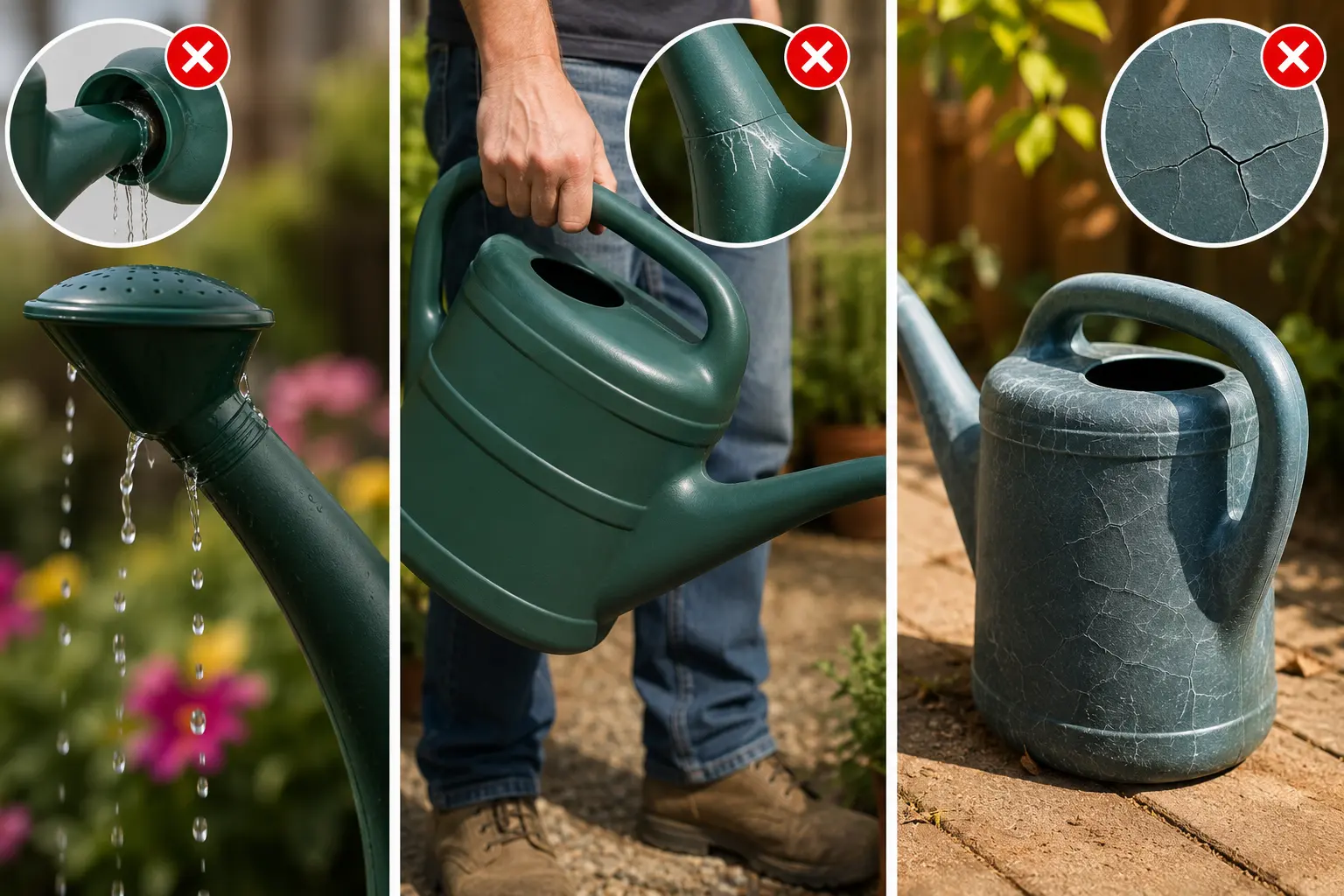
1. “The rose leaks where it meets the spout.” This is the number-one complaint, and it is almost always a tolerance issue. The rose does not seat tightly on the spout, so water escapes from the seam instead of passing through the holes. Solution: test every sample by filling the can, inverting it, and pouring slowly. If water escapes the seam, the production run will be worse — because production tolerances are typically looser than sample tolerances.
2. “The handle snapped off when the can was full.” A 10 L can full of water weighs roughly 10 kg. If the handle is made from thin plastic or the mould line runs across a stress point, it will fail under that load — not on day one, but after a few months of daily use. Solution: fill the sample to capacity, lift it by the handle, and tilt it to pour. Then do it 50 times. If the handle shows any flex or stress whitening (the white lines that appear where plastic is about to crack), it will not survive a season.
3. “The can went brittle and cracked after one summer in the sun.” This is the LDPE problem described earlier — or a high-recycled-content HDPE that behaves like LDPE. The can looks and feels fine when it arrives, but UV exposure accelerates the embrittlement. Solution: specify HDPE explicitly, ask for the recycling code on the base, and ask about UV-stabiliser additives. A can without UV stabiliser will have a dramatically shortened outdoor lifespan.
Procurement Checklist: Watering Cans
| What to Confirm | Why It Matters | Red Flag |
| Material grade (HDPE, not just “PE”) | LDPE and high-recycled-content cans go brittle outdoors | The supplier cannot specify the grade or recycling code |
| Rose-to-spout fit | Loose fit = leaks; popped-off rose = one-star review | Rose and can be sourced from different factories without a test-fit |
| Rose hole quality (punched vs laser-cut) | Punched holes leave burrs; uneven spray damages seedlings | The supplier cannot describe the hole-making method |
| Handle stress test | A 10 kg load will expose weak mould lines | No load testing was done on the sample |
| UV stabiliser | Without it, plastic becomes brittle after one summer | Supplier says “UV resistant” without specifying the additive |
| Capacity mix (5 L + 10 L) | 5 L drives volume; 10 L is the price anchor | Buyer only orders 10 L |
| Packaging & CBM | Bulk nesting fits significantly more units per container vs colour box | The quote only includes one packaging option |
| Colour availability | Sage green, earth tones and Hunter Green are the safe bets for garden centres | Supplier offers only primary colours |
Building a watering-can range? Send us your capacity mix, target colours and packaging preference → We will match you with factories, run rose-fit and load tests on samples, and provide CBM comparisons before you commit.
FAQ
Why should I order 5 L cans when 10 L is the “standard”?
Because 5 L is what actually moves off the shelf. A full 5 L can weighs roughly 5 kg — manageable one-handed. A full 10 L can weighs roughly 10 kg and needs two hands. For balcony gardeners, container growers, and casual users (the largest customer segment), 5 L is the practical choice. The optimal wholesale approach for most channels is a mixed MOQ: 5 L for volume, 10 L for the “standard” option and price anchor.
What is the difference between HDPE and LDPE?
HDPE (recycling code #2) is rigid, UV-resistant, and holds its shape under load — it is the right choice for outdoor cans. LDPE (recycling code #4) is softer, more flexible, and less UV-stable — it works for soft-touch indoor cans but goes brittle outdoors. Many suppliers list their cans as “PE” without specifying which grade. Always confirm: if the base of the can shows recycling code #4, it is LDPE and not suitable for outdoor use.
Can I source the rose from a different factory than the can?
Technically yes, but it increases the risk of fit problems — and rose-to-spout fit is the number-one cause of negative reviews. If you must source separately, send the spout sample to the rose supplier and have them test-fit before production. The safest approach is to source both from the same factory.
What colours sell best in European garden centres?
Sage green, earth tones (cream, sand), and Hunter Green are the safest choices for independent garden centres. Forest green and black are the defaults for DIY chains. Terracotta works in Mediterranean markets. Seasonal accent colours (based on industry observation, Klein Blue has been visible on social media in 2025–2026) can draw attention on the display shelf — but treat them as accents, not core stock.
How much does packaging affect the landed cost?
Significantly. Bulk nesting fits roughly 60–70% more 10 L cans per 20-foot container compared with individual colour boxes. For a 5 L can, the difference is smaller but still material. Always ask for CBM quotes for both bulk and retail packaging before deciding — the packaging cost can exceed the per-unit price difference between two suppliers.
Can I get mixed MOQ across 5 L and 10 L?
Yes. Mixed MOQ is one of the advantages of working with a supply-support team rather than a single factory. We consolidate your 5 L and 10 L requirements into a combined production run and pack them together for shipping.
Next Step: Build Your Watering-Can Range
For larger garden coverage products, review garden sprinklers for wholesale buyers before building the full range.
- Decide your capacity mix. Start with 5 L + 10 L in HDPE. Add 1–2 L indoor if your channel includes gift or houseplant customers.
- Request samples. Tell us your target channel and colour preferences → We will send HDPE samples, run rose-fit and load tests, and provide CBM comparisons for bulk vs retail packaging.
- Confirm before production. We compare production samples against your approved reference — so the cans that arrive match the cans you approved.
You focus on selling. Scarecrow Garden Supplier can help you source, verify, organise and ship.
Ready to Build Your Watering-Tool Assortment?
Send us your product list, target market and packaging requirements — we will come back with supplier matches, sample options and a CBM-optimised packing plan within 48 hours.
Written by
ScarecrowGarden
💡About Scarecrow Garden Supplier Co., Ltd.
Scarecrow Garden Supplier Co., Ltd. is a China-based sourcing and wholesale partner specializing in garden tools, landscaping equipment, and outdoor supplies for international wholesalers, distributors, contractors, and brands.
With hands-on experience rooted in real garden use scenarios, we focus on durable materials, functional design, and stable large-volume supply. Our product range covers pruning tools, watering systems, hand tools, outdoor hardware, and customized garden solutions to support both retail and professional landscaping markets.
Beyond products, we help our partners navigate supplier selection, quality control, compliance requirements, and long-term sourcing strategies in China. Through our blog, we share practical insights on product selection, material comparisons, industry trends, and cost-effective purchasing—helping global buyers build stronger, more competitive supply chains.