







Updated 3 months ago
Drip Irrigation Kits for Wholesale: The Category That Sells Itself (When the Components Actually Fit)

ScarecrowGarden
💡About Scarecrow Garden Supplier Co., Ltd.
Scarecrow Garden Supplier Co., Ltd. is a China-based sourcing and wholesale partner specializing in garden tools, landscaping equipment, and outdoor supplies for international wholesalers, distributors, contractors, and brands.
With hands-on experience rooted in real garden use scenarios, we focus on durable materials, functional design, and stable large-volume supply. Our product range covers pruning tools, watering systems, hand tools, outdoor hardware, and customized garden solutions to support both retail and professional landscaping markets.
Beyond products, we help our partners navigate supplier selection, quality control, compliance requirements, and long-term sourcing strategies in China. Through our blog, we share practical insights on product selection, material comparisons, industry trends, and cost-effective purchasing—helping global buyers build stronger, more competitive supply chains.
Drip Irrigation Kits for Wholesale: Sourcing Guide for B2B Buyers | Scarecrow Garden Supplier
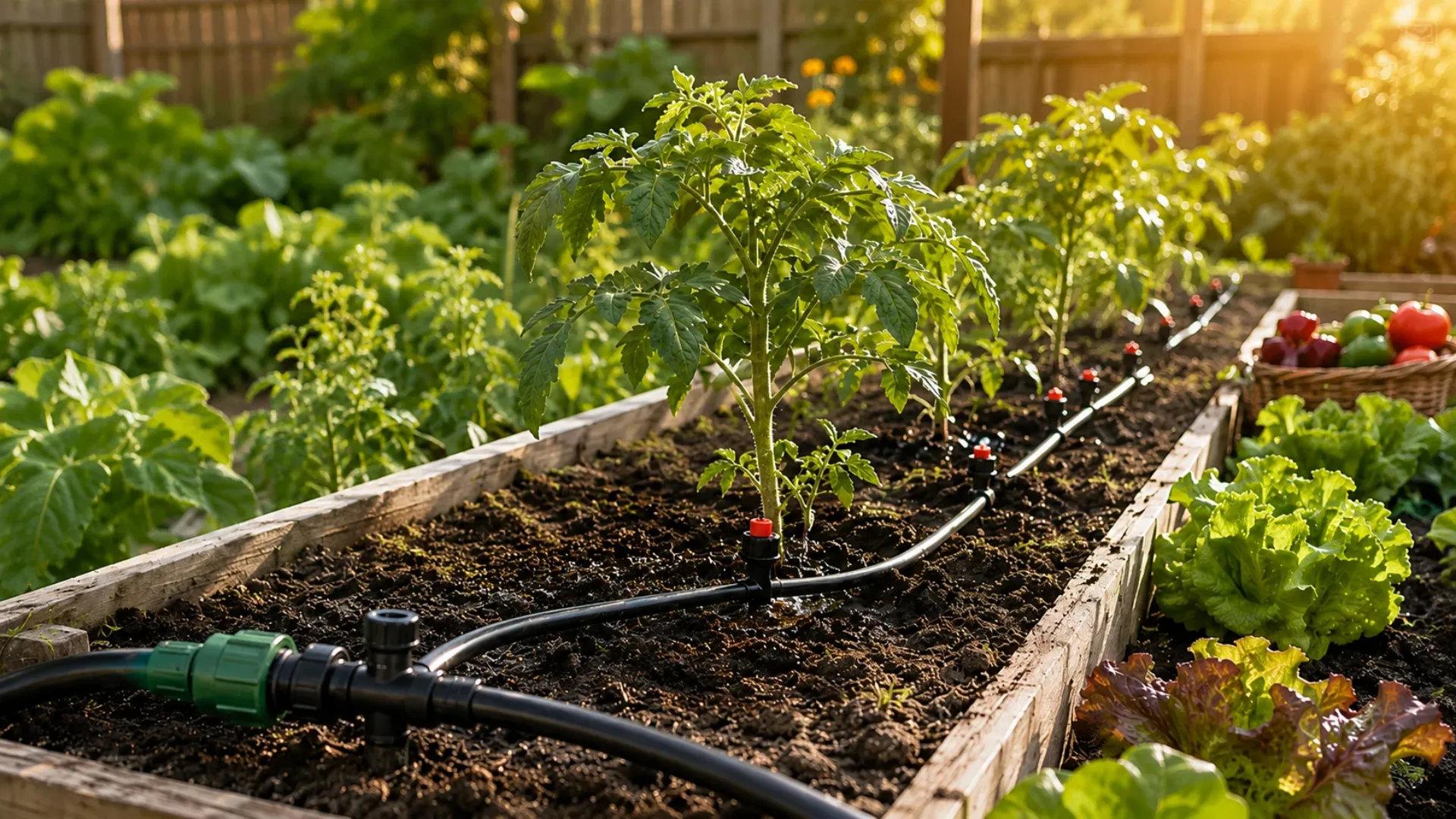
You added drip irrigation kits to your product range for good reasons. The water-saving data is compelling — drip uses roughly 7 litres per 10 minutes versus 91 litres from an open hose (based on industry estimates). During hosepipe bans, drip systems remain legal to operate in most UK water company areas, though specific rules vary by water company. And the margin on a £20–£45 retail kit looks healthy enough.
Then the returns start arriving. “Missing parts.” “Emitters clogged after two weeks.” “Nothing fits together.”
Here is what most wholesale buyers miss: drip irrigation is not a product. It is a system — and the weakest link in that system is not the pipe, it is the fittings. A complete kit contains 20 or more separate components. Miss one, and the whole thing fails. This is why drip irrigation sits at the top of the complexity scale among the six watering-tool supply chains we outlined in our complete guide to garden watering tools for wholesale buyers. It is the category most worth doing — and the easiest to get wrong.
Why Drip Irrigation Is a Different Supply Chain
Most buyers treat drip irrigation as one product category. It is not. The components come from four different manufacturing processes, often four different factories.
If you are planning the full watering range, start with the complete guide to garden watering tools for wholesale buyers.
| Component | Manufacturing Process | Factory Type | Key Quality Control Point |
| Main pipe/distribution tubing | Extrusion | Plastic pipe extrusion plant | Tube diameter tolerance, wall thickness consistency, UV resistance |
| Drip emitters | Precision injection moulding | Precision moulding plant | Flow channel accuracy, flow rate consistency, and anti-clog design |
| Connectors, tees, end caps | General injection moulding | General moulding plant | Dimensional tolerance, seal integrity, snap-fit strength |
| Timers/controllers | Electronics assembly | Electronics factory | Waterproof rating, programme stability, battery life |
Even Netafim, the company that invented drip irrigation, found it could not produce everything in-house. According to a published business analysis, Netafim expanded from manufacturing irrigation pipes to coordinating a network of suppliers — filters, controllers, fittings — because no single factory could cover the full system. If the company that invented the category could not do it alone, a single-factory sourcing approach is almost guaranteed to produce compatibility problems.
This is exactly what we mean when we say watering tools are not one category but six different supply chains. Drip irrigation is the most complex of the six. If your sourcing approach treats it like a single-SKU purchase, you will end up with a container of components that do not work together.
Drip vs Soaker: Two Products, Two Buyers
Before you source, know which product you are actually buying. Drip irrigation kits and soaker hoses solve similar problems, but they are different products for different buyers.
| Drip Irrigation Kit | Soaker Hose | |
| How it works | Emitters deliver water precisely to root zones | Porous hose wall seeps water along its entire length |
| Precision | High — adjustable per plant | Low — uniform output along the hose |
| Installation | Complex — 20+ components to assemble | Simple — connect to the tap and lay down |
| Best for | Raised beds, containers, greenhouses, potted plants | Borders, hedges, vegetable rows |
| Typical buyer | Hands-on gardener, greenhouse grower | Low-maintenance garden owner |
| UK retail price | £15–£45 | £10–£25 |
| Top complaint | Missing parts, difficult assembly | Uneven pressure, hose wall clogging |
| Hosepipe ban | ✅ Typically exempt | ⚠️ Exemption varies |
The key difference for sourcing: soaker hose buyers expect plug-and-play. Drip kit buyers accept some assembly effort — but they have zero tolerance for missing components. If someone has already committed to building a system, discovering that a critical tee connector is absent is far more frustrating than a product that simply does not claim to be precise.
Choose your product mix accordingly. DIY chains and trade counters tend to favour soaker hoses for their simplicity. Garden centres and online retailers do better with drip kits, where the higher price point and system narrative justify the shelf space.
The Component Trap: Where Kits Fail
When a customer opens a drip irrigation kit and finds 20 loose components with no clear instructions on which connects to which — that is where the returns start. The component trap has three layers. Each one costs more to fix than the last — from the cost of a returned box, to the cost of a damaged reputation, to the cost of a market you cannot enter.
1. Component Completeness: Can It Be Assembled?
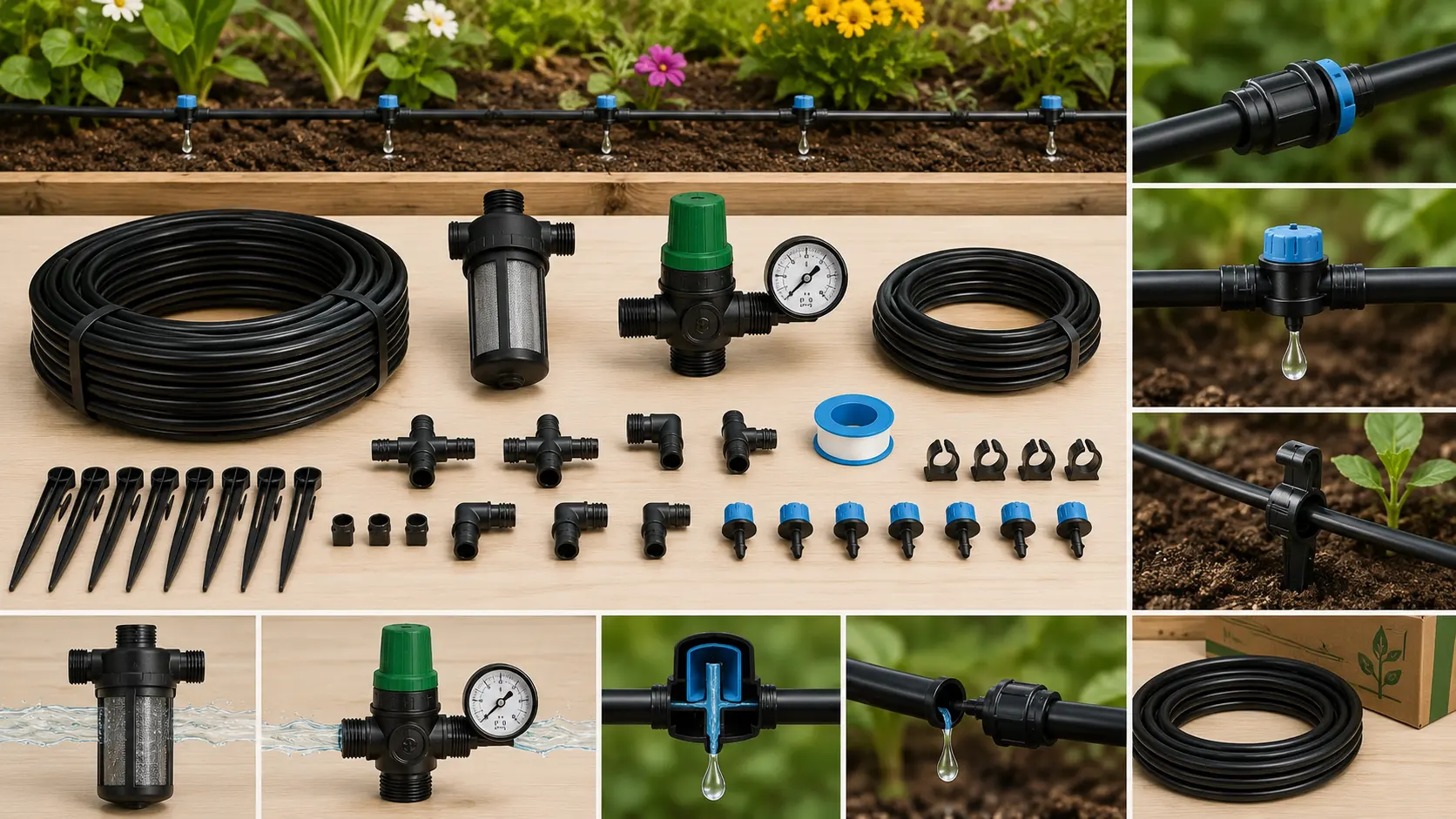
A functional drip irrigation kit requires all of the following:
- Main supply pipe (1/2“ / 13mm)
- Distribution tubing (1/4“ / 4–6mm)
- Drip emitters — adjustable, fixed, or pressure-compensating
- Spray nozzles or misters (optional)
- Tee connectors
- Straight connectors
- Elbows
- End plugs/caps
- Faucet adapter
- Filter — critical, frequently omitted
- Pressure regulator — critical, frequently omitted
- Stakes (to hold emitters in position)
- Pipe clamps
Miss any one of these, and the system cannot be completed. The filter and pressure regulator are the two items most commonly left out — based on our inspection records and confirmed by the Amazon UK reviews we analysed — and the two that cause the most failures when absent. Without a filter, emitters clog. Without a pressure regulator, fittings leak or blow off at mains pressure.
2. Emitter Selection: Will It Keep Working?
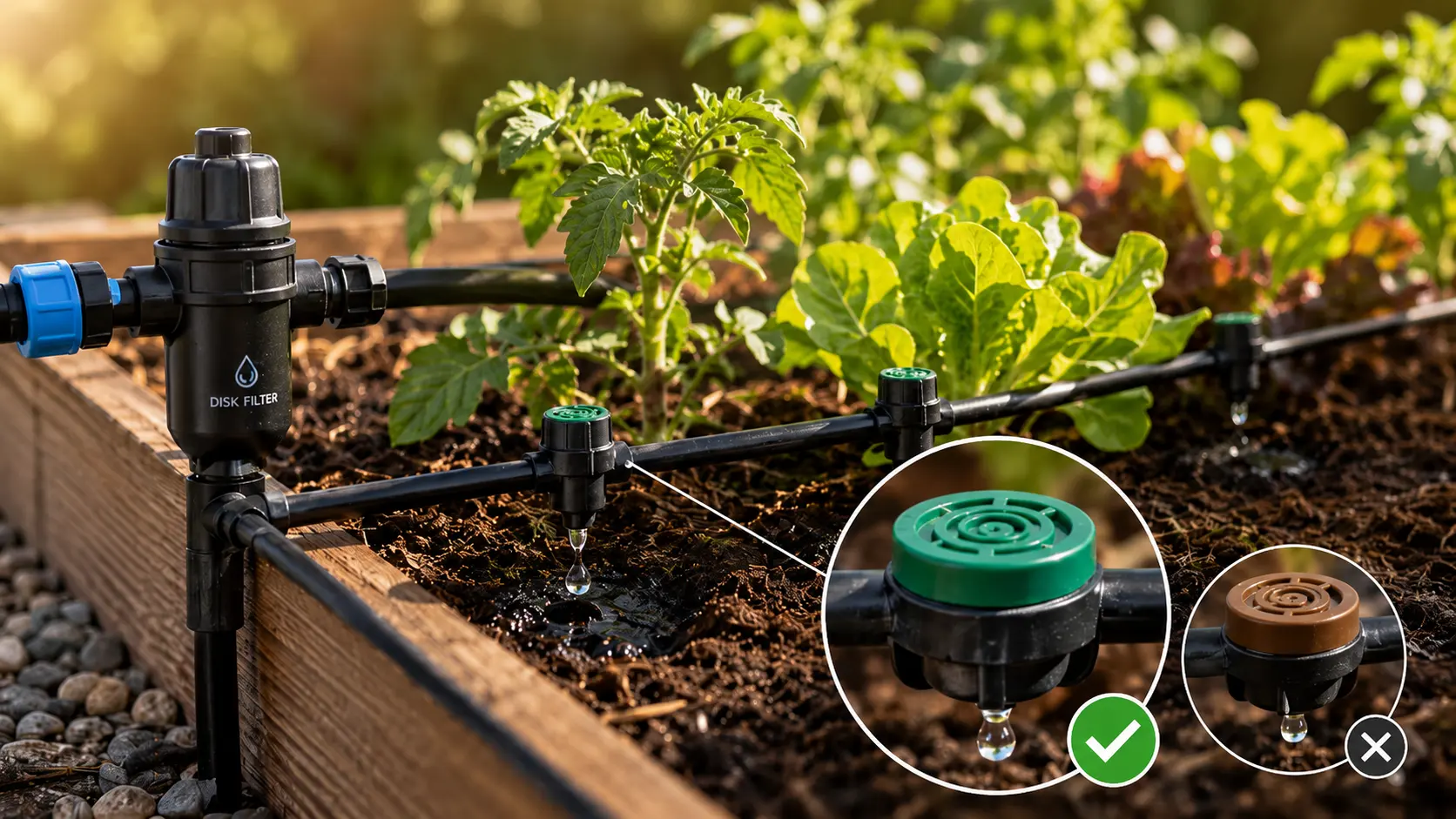
According to a two-season field study published in Water Science and Technology, emitter design — not water quality — was shown to be the most important factor determining the degree of clogging. Emitters with long-flow-path labyrinth channels resisted clogging far more effectively than vortex-type designs.
For wholesale buyers, this means the cheapest emitter is rarely the best choice. Labyrinth-type emitters cost slightly more but significantly reduce return rates. Pressure-compensating (PC) emitters add another layer of reliability by maintaining consistent flow regardless of position along the line.
And the filter question is not optional. A disk filter is the practical choice for home-garden kits — nearly as effective as a gravel media filter for home-garden applications at a fraction of the cost, and far superior to a basic screen filter when the water supply contains any sediment.
3. Connector Standards: Can You Sell It in the Right Market?
This is where drip irrigation intersects with the same connector-divide that affects garden hoses and spray guns:
| Hozelock System (UK / Ireland) | Gardena System (Continental Europe) | |
| Supply pipe | 13mm OD | 13mm OD |
| Micro tubing | 4mm OD | 4.6mm OD |
| Connection type | Push-fit | “Quick and Easy” proprietary |
| Tap thread | UK 3/4“ BSP | EU standard thread |
Connector standards also matter for hose products, so compare this with our guide to garden hoses for wholesale buyers.
These two systems are not compatible. A kit built with Hozelock-dimension fittings will not accept Gardena-dimension tubing, and vice versa. You cannot mix standards within a single kit — the customer will not be able to assemble it.
The practical implication: specify your target market before you order. UK and Ireland orders use Hozelock-compatible dimensions. Continental European orders use Gardena-compatible dimensions. Chinese OEM factories can produce to either standard on the same production line — but you have to tell them which one you need.
Before you commit to a drip irrigation supplier, make sure every component in the kit is compatible. Request our drip irrigation component compatibility checklist — it covers BOM completeness, connector standards, and emitter specifications.
Bad Reviews and the Root Cause
We analysed customer reviews across the top-selling drip irrigation kits on Amazon UK. The same five problems appear repeatedly — even on products rated 4.0 to 4.5 stars.
| # | Complaint | What is actually happening | Procurement fix |
| 1 | Missing parts | Kit BOM is incomplete — usually missing stakes, end caps, or the filter | Demand a complete BOM from the supplier and check every item |
| 2 | Difficult assembly | Instructions are unclear; no visual guide for which fitting connects where | Supply video installation guide; request pre-assembled key junctions |
| 3 | Emitters clog | Low-cost vortex emitters block with sediment; no filter included | Specify labyrinth-type emitters; make filter a mandatory inclusion |
| 4 | Connectors leak | Push-fit joints fail under mains pressure; no pressure regulator supplied | Use lock-nut fittings for key joints; include a pressure regulator |
| 5 | Uneven flow | Non-PC emitters deliver less water at the far end of the line | Specify pressure-compensating (PC) emitters |
All five problems trace back to a single root cause: system thinking is missing. Buyers source a pipe and some emitters. They do not source a system. When the filter is treated as an optional extra, the emitters clog. When the pressure regulator is left out, the fittings leak. When the BOM is incomplete, the customer cannot finish the installation.
The difference shows up in the very first question you ask a supplier. A component thinker asks: “How much for 13mm pipe and 200 emitters?” A system thinker asks: “Does this kit include a filter and pressure regulator as standard — and can you send me the complete BOM?” If your first question is about pipe pricing, you are setting up the exact problems that fill the returns bin.
This is an industry-wide problem, not a supplier-specific one. Kits rated 4.5 stars still generate complaints about missing parts. The fix is not better quality control on individual components — it is treating the kit as a complete system from the sourcing stage.
Drip Irrigation Procurement Checklist
| Check Item | Why It Matters | How to Verify |
| BOM completeness | Missing one component = system failure | Compare the supplier’s packing list against the 13-item minimum BOM above |
| Emitter type | Labyrinth > vortex for clog resistance | Ask the supplier for the emitter flow-path design; request a cross-section photo |
| Filter inclusion | Without it, emitters clog within weeks | Confirm disk filter is in the kit, not listed as “optional” |
| Pressure regulator | Mains pressure destroys push-fit joints | Confirm the regulator is included; check the pressure range rating |
| Connector standard | Hozelock and Gardena are not compatible | Specify target market; confirm dimensions match (4mm vs 4.6mm micro tube) |
| Pipe diameter tolerance | Loose fit = leaks; tight fit = assembly difficulty | Sample check: Does the micro tube seat firmly in the connector? |
| Installation guide | Reduces returns by 30–50% (industry estimate) | Confirm kit includes step-by-step visual instructions or QR code to video |
| Emitter flow consistency | Uneven flow = unhappy customers | Sample test: run water through 5–10 emitters and compare output |
For drought-response assortments, drip kits should also be checked against water-saving garden products for heatwaves and hosepipe bans.
This is the kind of verification that happens at our warehouse before a kit ships — because system thinking has to start at the sourcing stage, not the returns stage. Four quality inspectors check each batch against the approved sample. Not just the pipe and emitters, but every connector, stake, and end cap. We do not sample the expensive parts and skip the small ones, because a missing end cap is just as fatal to a system as a split pipe.
If you sell raised beds or planter boxes, drip irrigation is the natural add-on. Get our drip irrigation + metal raised bed combo plan — including pre-installation options that reduce your customer’s setup time from 45 minutes to 5 (based on internal testing).
FAQ
Can I use drip irrigation during a hosepipe ban? In most UK water company areas, yes. Drip irrigation systems are typically classified as water-efficient and exempt from hosepipe ban restrictions. However, the specific rules vary by water company and by the type of ban declared. Always check the current guidance for your area.
What is the difference between drip irrigation and soaker hoses? Drip irrigation delivers water through individual emitters to specific plants — precise but complex to install. Soaker hoses seep water along their entire length — less precise but simple to set up. See the comparison table above for details.
Why do my drip emitters keep clogging? According to published research, the primary cause is emitter design, not water quality. Labyrinth-type emitters with long flow paths resist clogging far better than vortex-type designs. A disk filter at the system inlet catches sediment before it reaches the emitters. If your kit did not include a filter, that is likely the root cause.
Are Hozelock and Gardena drip irrigation fittings compatible? No. Hozelock uses 4mm micro tubing for the UK and Ireland market; Gardena uses 4.6mm micro tubing for continental Europe. The connectors are dimensionally different and will not fit each other’s tubing. Specify your target market before ordering.
How many emitters do I need for a raised bed? It depends on the plant type and bed size. As a rough guide: one emitter per plant for vegetables, two to three per square metre for dense plantings. A typical 1m × 2m raised bed needs 6–10 emitters.
Do I need a filter for my drip irrigation kit? Yes. A filter is not optional — it is the single most effective way to prevent emitter clogging. A disk filter is the best balance of performance and cost for home-garden kits.
Next Step: Build Your Drip Irrigation Range
Order a drip irrigation sample kit with the full component set — main pipe, distribution tubing, emitters, connectors, filter, pressure regulator, stakes, and end caps. Test the fit. Check the flow. Then decide.
Talk to our team about your drip irrigation sourcing plan. You focus on selling. Scarecrow Garden Supplier can help you source, verify, organize, and ship.
Ready to Build Your Watering-Tool Assortment?
Send us your product list, target market and packaging requirements — we will come back with supplier matches, sample options and a CBM-optimised packing plan within 48 hours.
Written by
ScarecrowGarden
💡About Scarecrow Garden Supplier Co., Ltd.
Scarecrow Garden Supplier Co., Ltd. is a China-based sourcing and wholesale partner specializing in garden tools, landscaping equipment, and outdoor supplies for international wholesalers, distributors, contractors, and brands.
With hands-on experience rooted in real garden use scenarios, we focus on durable materials, functional design, and stable large-volume supply. Our product range covers pruning tools, watering systems, hand tools, outdoor hardware, and customized garden solutions to support both retail and professional landscaping markets.
Beyond products, we help our partners navigate supplier selection, quality control, compliance requirements, and long-term sourcing strategies in China. Through our blog, we share practical insights on product selection, material comparisons, industry trends, and cost-effective purchasing—helping global buyers build stronger, more competitive supply chains.