






Wholesale Garden Hose Sourcing Guide: 3 Supply Chains & Traps | Scarecrow Garden Supplier
A garden hose looks simple. It is a tube. It carries water. How complicated can it be?
Complicated enough that it is one of the most returned categories in garden retail. Kinking, bursting, leaking at the connectors, going brittle after one summer — the complaints are consistent across the UK and European markets. And the root cause is almost never what buyers think.
Here is what most wholesale buyers miss: a garden hose is not one product. It is three completely different supply chains pretending to be the same thing. PVC, rubber, and expandable hoses each come from different factories, use different manufacturing processes, and fail in different ways. Buying them as if they are interchangeable is how you end up with a container of products that look fine on paper and generate complaints from the first week.
And then there is a second trap — less visible but more expensive. If you source hoses with the wrong connector standard for your market, the entire batch is unsellable. Not because the hose is bad, but because it does not fit the taps and accessories your customers already own.
One Hose, Three Supply Chains
Most wholesale buyers treat garden hoses as a single product category. The reality: PVC, rubber, and expandable hoses come from three entirely different manufacturing processes, often three different types of factories. Each has a different cost structure, a different failure mode, and a different role in your product mix.
| PVC Hose | Rubber Hose | Expandable Hose | |
| Manufacturing | Extrusion with braided reinforcement | Vulcanised rubber compound | Inner tube (TPU/latex) + outer woven sleeve + assembly |
| Factory type | Plastic extrusion plant | Rubber vulcanisation plant | Composite assembly (at least 2 factory types) |
| Working pressure | 6–8 bar (standard) / 10+ bar (reinforced) | 10–15 bar | 3–6 bar |
| Burst pressure | 18–30 bar | 30–45 bar | 8–15 bar |
| Temperature range | −5 °C to 65 °C | −20 °C to 80 °C (standard) / −40 °C to 100 °C (EPDM) | 5 °C to 45 °C |
| UV resistance | Requires UV stabiliser; degrades without it | Naturally UV-resistant | The outer sleeve protects the inner tube, but the inner tube still ages |
| Weight (25 m) | 1.5–3 kg | 3–5 kg | 0.5–1.5 kg (empty) |
| Typical lifespan | 2–5 years (est.; depends on UV protection) | 5–10 years (est.) | 1–2 seasons (return hotspot) |
| Approx. ex-works price | $0.15–0.40/m (est.) | $0.50–1.50/m (est.) | $0.50–3.00/unit (est.) |
| UK retail price | £8–25 (est.) | £25–50 (est.) | £10–25 (est.) |
Sources: supplier data, gardenhoseadviser.com, besthose.co.uk
PVC is your volume product. Chinese extrusion factories produce it on an enormous scale. The price gap between a 3-layer and a 6-layer reinforced PVC hose is small at the factory gate but significant at the retail shelf — and enormous in customer satisfaction. A 3-layer hose without proper bonding between the inner tube and the braid will kink at every bend. A 6-layer hose with bonded construction stays open. They look almost identical on the outside. This is where the “same product, different experience” problem starts.
Rubber is your premium product. Heavier, more expensive, and far more durable. It handles frost, UV, and high pressure without complaint. Trade counters and professional buyers prefer rubber for a reason — it survives conditions that destroy PVC in a single season. The margin is better, but the volume is lower.
Expandable is your problem product. It sells on novelty — lightweight, stretches to three times its stored length, and costs less than a rubber hose. But the inner tube is the weak point. Under pressure, it bursts. After a season, it loses elasticity. The connector joint between the inner tube and the end fitting is the most common failure point. We cover this in detail below.
The point is not that one material is better than another. The point is that each one requires a different sourcing approach, a different quality checklist, and a different set of expectations about lifespan and returns. Treating them as interchangeable is the first mistake.
Here is a frame you can use to classify any hose material: look at the factory type and failure mode. Factory type tells you which suppliers to approach and what your procurement path looks like. Failure mode tells you what to inspect and what your customers will complain about. PVC comes from extrusion plants and fails by UV degradation. Rubber comes from vulcanisation plants and fails by mechanical fatigue over the years. Expandable comes from composite assembly and fails at the connector joint within a season. Any new material you encounter — PU hose, stainless-steel braid, or something else — can be slotted into this frame by asking: what factory makes it, and how does it break?
The Connector Trap: Where One Wrong Choice Kills the Whole Order
There is a decision that comes before material selection, before price negotiation, before everything else — and most wholesale buyers do not even know it exists.
Which connector standard does your market use?
Garden hose connectors are not universal. Three systems dominate, and they are physically incompatible with each other:
| Hozelock System (UK / Ireland) | Gardena System (Continental Europe) | GHT Standard (North America) | |
| Hose connection | 12.5 mm (½″) and 15 mm (⅝″) | 13 mm supply pipe + 4.6 mm micro pipe | ¾″ GHT thread |
| Quick-connect type | Aquastop (auto-shutoff) | “Quick and Easy” push-fit | Threaded or push-fit |
| Tap thread | ½″ and ¾″ BSP | ½″ and ¾″ (different fitting shape) | ¾″ GHT (not BSP-compatible) |
| Key retail channels | B&Q, Screwfix, Homebase | Bauhaus, Hornbach, Obi | Home Depot, Lowe’s, Amazon US |
| Compatible with others? | No | No | No |
Source: Amazon UK connector sales data, Gardena product specifications
If you source a hose with Hozelock-compatible connectors and ship it to a German retailer, the connectors will not fit the Gardena accessories that German customers already own. The entire batch comes back — not because the hose is defective, but because it cannot connect to the tap.
This is not a quality problem. It is a market-fit problem.
And it is invisible until the returns start.
Gardena’s connector system creates a de facto ecosystem lock-in — once a consumer owns a Gardena tap connector, every hose, spray gun, and drip fitting they buy after that has to be Gardena-compatible. The system is well-engineered and widely trusted in the DACH region (Germany, Austria, Switzerland). But it locks out every other standard. Hozelock plays the same role in the UK market.
The practical rule: specify your target market before you order. UK and Ireland orders use Hozelock-compatible connectors. Continental European orders use Gardena-compatible connectors. North American orders use GHT. Chinese OEM factories can produce to any of these standards — but you have to tell them which one. If you sell into multiple markets, order connector sets separately and have them assembled at the warehouse for each destination. This is one of the things a supply-support team with warehouse execution capability can handle that a single factory cannot.
One more detail that matters: connector material. Brass connectors outlast zinc alloy, which outlasts engineering plastic. The price difference at the factory gate is small. The difference in return rates is not. Plastic connectors survive one or two summers before UV embrittlement makes them crack (based on industry experience). Brass connectors last for years. If your product sits on an outdoor shelf, specify brass.
Hose connectors also affect spray-gun compatibility, especially when building a combined range of garden spray guns for wholesale.
Expandable Hoses: The Innovation That Returns More Than It Sells
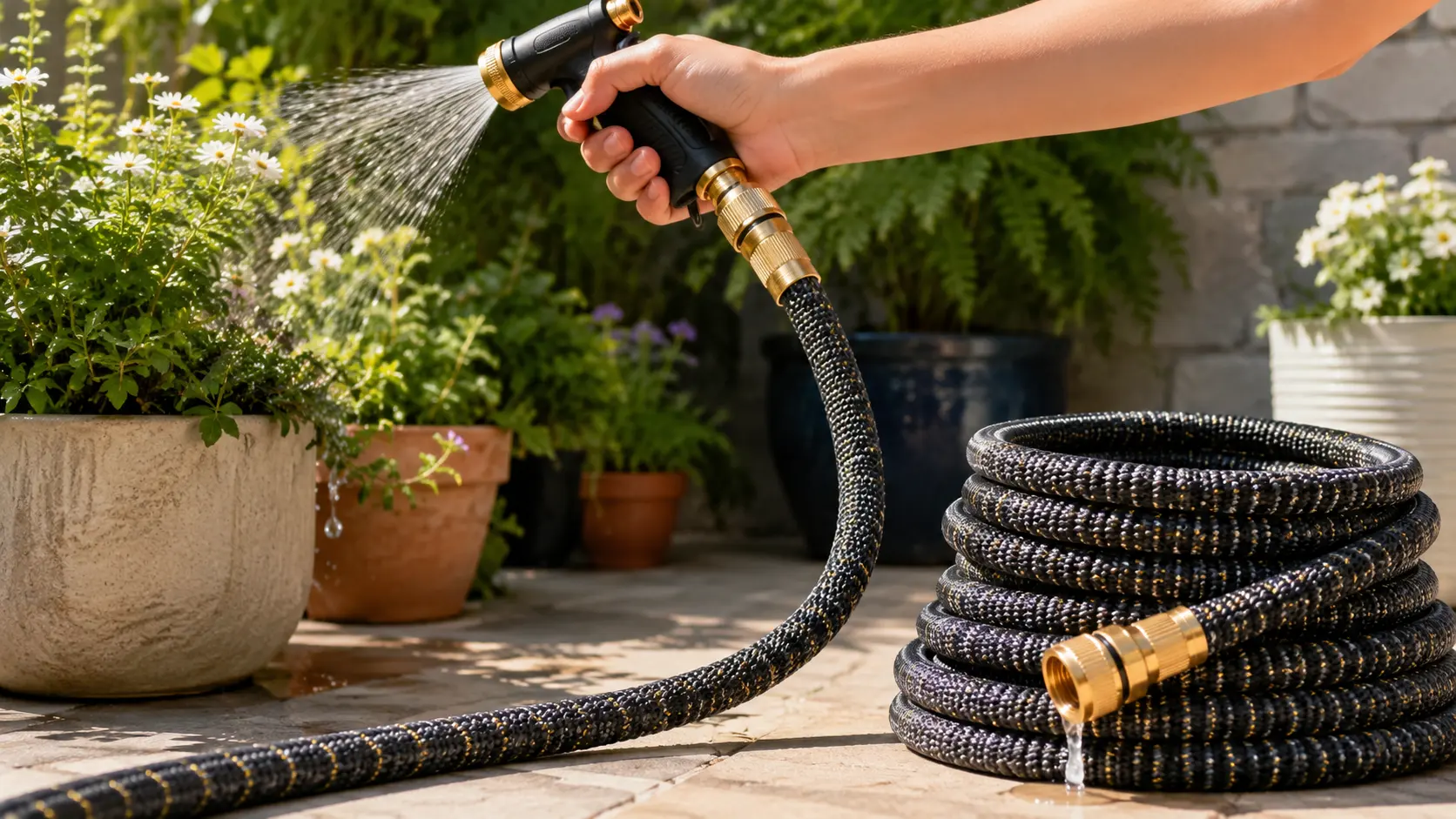
Expandable hoses deserve their own section because they create a specific problem for wholesale buyers: they look like a great product on the shelf, and they generate returns at a rate that no other hose type matches.
The pitch is compelling. An expandable hose weighs under 1.5 kg, shrinks to a third of its extended length for storage, and costs less than a rubber hose. For casual gardeners who water a few pots on a patio, the appeal is obvious.
The problem is durability. Expandable hoses fail in three ways that traditional hoses do not:
- Inner tube burst. The TPU or latex inner tube has a working pressure of 3–6 bar — well below what a standard PVC or rubber hose handles. When water pressure spikes, the inner tube balloons inside the woven sleeve and ruptures.
- Loss of elasticity. After one or two seasons of pressurisation and UV exposure, the inner tube material degrades. The hose no longer retracts fully. It sits in a semi-extended state, taking up more storage space than the customer expected — which was the whole selling point.
- Connector blow-off. The joint where the inner tube meets the end fitting is the weakest point in the entire assembly. Under water hammer (the pressure surge when a tap is turned off quickly), this joint can separate entirely.
UK review sites categorise expandable hoses as “well priced” rather than “durable” — and that distinction matters for wholesale buyers. If you stock expandable hoses, treat them as a seasonal, low-expectation product. Label them clearly: not recommended for commercial or high-frequency use. The customers who buy them for occasional light-duty watering tend to be satisfied. The customers who expect them to replace a 25 m reinforced PVC hose are the ones who return them.
This is not a reason to avoid the category entirely. Expandable hoses sell well, especially on e-commerce channels where the visual demo (shrinking and expanding) works as a conversion tool. But they should not be the only hose you offer, and they should never be positioned as a replacement for a proper garden hose.
Before you commit to a hose supplier, confirm the connector standard matches your market. Request our garden hose connector compatibility checklist — it covers Hozelock, Gardena, and GHT specifications by target market.
Bad Reviews and the Root Cause
We analysed customer complaints across the top-selling garden hoses on UK and European retail platforms. The same five problems appear repeatedly — regardless of brand or price point.
| # | Complaint | What is actually happening | Procurement fix |
| 1 | Kinking | The inner tube and braid are not bonded; the inner tube collapses when bent | Specify bonded (anti-kink) construction; request anti-kink test report |
| 2 | Bursting | The working pressure rating is too low; the connector joint is the weakest point | Require burst pressure test report; minimum working pressure 8 bar |
| 3 | Connector leak | Low-quality O-ring, mismatched connector standard, or UV-embrittled plastic fitting | Use brass connectors with silicone O-rings; match the connector standard to the market |
| 4 | The hose reel fails to retract | Return spring fatigue; the wall bracket cannot support the loaded reel’s weight | Require reel cycle test (5,000+ retracts); verify bracket load rating |
| 5 | Goes brittle after one summer | PVC formulated without UV stabiliser to cut cost | Require UV stabiliser confirmation; rubber hoses are naturally UV-resistant |
All five trace back to the same root cause: buyers treat a hose as a commodity — a tube that carries water — rather than a product category with three distinct supply chains, each requiring its own quality standard. When you source a PVC hose without confirming the UV stabiliser, you get a product that cracks after one summer. When you source an expandable hose without setting durability expectations, you get returns. When you source any hose without specifying the connector standard, you get a product that does not fit the customer’s tap.
The fix is not better inspection after the fact. It is asking the right questions before you order. A buyer who understands that PVC, rubber, and expandable hoses are three different supply chains will ask different questions of each supplier — and will not accept the same quality standard for all three.
Hose reels deserve a special mention here. They are the second profit centre in the hose category — a wall-mount auto-reel retails for £90–130 in the UK (based on Hozelock AutoReel series) — but they also generate disproportionate complaints. Hozelock’s Trustpilot rating sits at 1.9 out of 5, with customers reporting unclear assembly instructions and spring failures. If you stock hose reels, the quality check is different from the hose itself: cycle-test the return spring, verify the bracket can hold a fully loaded reel, and confirm the swivel joint does not leak under pressure.
Garden Hose Procurement Checklist
| Check Item | Why It Matters | How to Verify |
| Material type | PVC, rubber, and expandable materials have different failure modes and price points | Define your target channel and price tier before selecting material |
| Layer count and braid | 3-layer hoses kink; 5–6 layer with bonded construction resists kinking | Request cross-section photo; specify bonded (anti-kink) construction |
| Working pressure | Low-pressure hoses burst under normal mains supply | Minimum 8 bar working pressure; require burst pressure test report (≥3× working pressure) |
| UV stabiliser (PVC) | Without it, PVC degrades in one summer | Require supplier confirmation of UV stabiliser in formulation |
| Connector standard | Hozelock (UK), Gardena (EU), and GHT (US) are incompatible | Specify target market; confirm connector type before production |
| Connector material | Brass > zinc alloy > engineering plastic for longevity | Specify brass for outdoor-retail products; check O-ring material (silicone > PVC) |
| Hose reel cycle test | Spring fatigue is the primary failure mode | Require 5,000+ retract cycle test result (recommended benchmark); verify bracket load rating ≥10 kg |
| Packaging and CBM | Hoses are volume-sensitive — coiled vs boxed packaging can differ by 2–3× in CBM | Compare shipping cost per unit for coiled vs colour-box packaging |
| Expandable hose warning | Returns are highest in this sub-category | Label clearly: not for commercial or high-frequency use |
For buyers building a broader watering-tool range, watering cans are a low-risk add-on category: wholesale watering cans.
This is the kind of verification a supply-support team with warehouse execution capability can handle before shipment — checking not just the hose, but the connectors, the O-rings, and the packaging against the approved sample. A leaking connector costs as much goodwill as a burst hose — which is why connector checks belong on every inspection list.
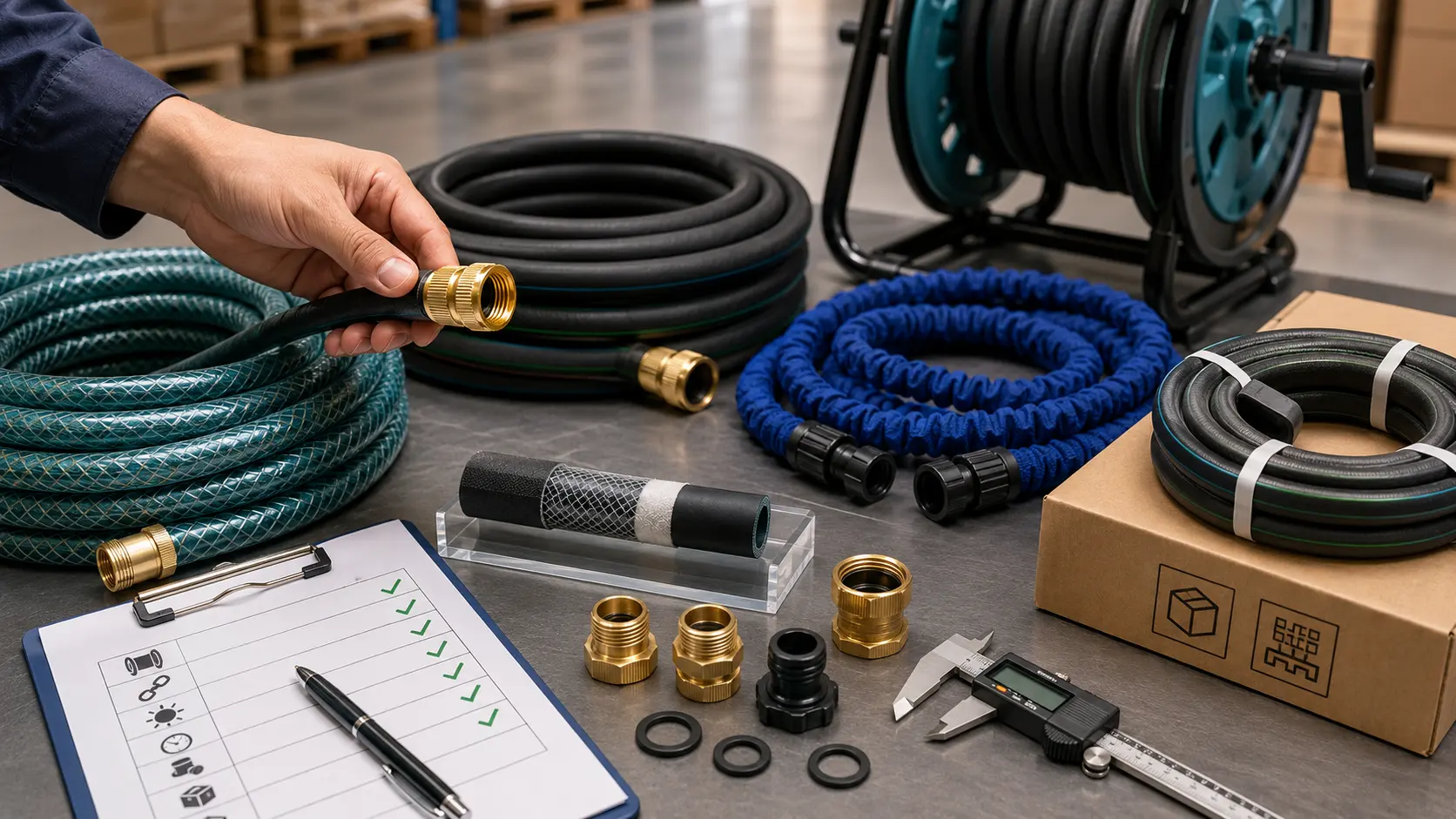
If you also stock hose reels or spray guns, the connector standard has to match across your entire range. Get our hose + reel + spray gun combo plan — with connector standards pre-matched for your target market.
FAQ
Are Hozelock and Gardena hose connectors compatible?
No. Hozelock uses 12.5 mm and 15 mm push-fit connectors for the UK and Ireland market. Gardena uses a proprietary “Quick and Easy” push-fit system with 13 mm supply pipe and 4.6 mm micro pipe for continental Europe. The fittings are dimensionally different and cannot be interchanged. Specify your target market before ordering.
What is the difference between a 3-layer and a 6-layer PVC hose?
Layer count refers to the number of material layers in the hose wall — typically inner tube, reinforcement braid, and outer skin. A 3-layer hose has one braid layer; a 6-layer hose has two. More layers generally mean higher burst pressure and better kink resistance. But the key factor is whether the inner tube is bonded to the braid. An unbonded 6-layer hose can still kink if the inner tube slides inside the braid when bent.
Are expandable hoses worth stocking?
They can be — for the right channel. Expandable hoses sell well on e-commerce platforms where the visual demo (shrinking and expanding) drives conversion. They are best positioned as a light-duty, seasonal product for casual gardeners. They should not be your only hose offering, and they should never be marketed as equivalent to a reinforced PVC or rubber hose.
Why does my hose reel stop retracting?
The most common cause is spring fatigue in the auto-retract mechanism. Cheaper reels use springs that lose tension after a few hundred cycles. A quality reel should be rated for 5,000+ retract cycles (a recommended benchmark for procurement). The second most common cause is a wall bracket that cannot support the weight of a fully loaded reel — the reel sags, and the retraction path misaligns.
How does a hosepipe ban affect garden hose sales?
Directly and severely. A hosepipe ban prohibits the use of garden hoses for watering gardens, washing cars, and filling pools. Violations can result in fines up to £1,000. During a ban, hose sales drop sharply. When the ban is lifted, there is often a surge in demand. Wholesale buyers should time their orders to arrive just before the expected ban-lift period, not during the ban itself. Watering cans and drip irrigation systems, by contrast, are typically exempt from hosepipe bans.
What connector standard should I use for the US market?
North America uses the ¾″ GHT (Garden Hose Thread) standard, which is different from the BSP threads used in the UK and Europe. If you supply both markets, order connector sets separately and assemble per destination.
Next Step: Build Your Garden Hose Range
If hoses are only one part of your range, use the complete guide to garden watering tools for wholesale buyers to plan the full assortment.
Order a sample set covering the three hose types — PVC (reinforced, bonded construction), rubber, and expandable — with connectors matched to your target market. Test the pressure. Check the connectors against your customers’ existing accessories. Then decide.
Talk to our team about your garden hose sourcing plan. You focus on selling. Scarecrow Garden Supplier can help you cource, verify, organise, and ship.
Ready to Build Your Watering-Tool Assortment?
Send us your product list, target market and packaging requirements — we will come back with supplier matches, sample options and a CBM-optimised packing plan within 48 hours.

Written by
ScarecrowGarden
💡About Scarecrow Garden Supplier Co., Ltd.
Scarecrow Garden Supplier Co., Ltd. is a China-based sourcing and wholesale partner specializing in garden tools, landscaping equipment, and outdoor supplies for international wholesalers, distributors, contractors, and brands.
With hands-on experience rooted in real garden use scenarios, we focus on durable materials, functional design, and stable large-volume supply. Our product range covers pruning tools, watering systems, hand tools, outdoor hardware, and customized garden solutions to support both retail and professional landscaping markets.
Beyond products, we help our partners navigate supplier selection, quality control, compliance requirements, and long-term sourcing strategies in China. Through our blog, we share practical insights on product selection, material comparisons, industry trends, and cost-effective purchasing—helping global buyers build stronger, more competitive supply chains.