










Wholesale Garden Spray Guns Sourcing Guide: Stop Trigger Failures | Scarecrow Garden Supplier
A spray gun is the part your customer holds in their hand. It is the most tactile, most visible, most judged component in the entire watering setup — and it is the part most likely to break first.
When the trigger snaps, the customer does not blame the material. They blame the brand. And if that brand is yours, the return lands on your desk.
Here is what most wholesale buyers miss: a spray gun is not one product. It is three completely different materials — ABS plastic, zinc alloy, and aluminium/brass — each coming from a different type of factory, failing in a different way, and carrying a different profit structure. The ex-works price gap between a basic ABS gun and a brass gun can be 50×. The retail price gap is narrower. The return-rate gap is where the real money is lost.
And then there is the trigger problem. “Trigger broke” is the single most common complaint across all spray gun categories. But the root cause is not the same for every gun — it is three different structural failures hiding behind one complaint. If you do not know which material fails which way, you cannot specify the right fix.
One Spray Gun, Three Materials
Most wholesale buyers treat spray guns as a single category. The reality: ABS, zinc alloy, and aluminium/brass guns come from three entirely different manufacturing processes, often three different factory clusters in China. Each has a different cost structure, a different failure mode, and a different role in your product mix.
| ABS Plastic Gun | Zinc Alloy Gun | Aluminium/Brass Gun | |
| Manufacturing | Injection moulding | Die-cast + electroplating | Metal machining + assembly |
| Factory cluster | Yuyao / Ningbo | Yongkang / Ningbo | Zhejiang (Ningbo, Yuhuan) / Sichuan |
| Working pressure | 0–8 bar | 0–8 bar | 0–10 bar |
| Weight | 100–200 g | 200–400 g | 300–600 g |
| Typical lifespan | 1–2 seasons (est.) | 2–4 years (est.) | 5–8 years (est.) |
| Approx. ex-works price | $0.15–2.00/unit (est.) | $2.40–5.00/unit (est.) | $3.10–8.00/unit (est.) |
| UK retail price | £5–15 (est.) | £15–30 | £25–60 (est.) |
Spray guns are normally sold together with hose products, so check the matching garden hoses for wholesale buyers guide.
Sources: supplier quotation data, Hozelock UK retail pricing, consumer review analysis
ABS plastic is your volume product. Injection-moulding factories in Yuyao and Ningbo produce them at staggering scale — a basic 2-pattern gun can leave the factory for as little as $0.15 per unit. The margin per unit is thin, but the volume potential is enormous. DIY chains and budget garden centres stock these by the thousand. The catch: a plastic trigger is a planned limitation. The pivot point — the thinnest section of the moulded part — is where stress concentrates. After one or two seasons of squeezing, micro-cracks form and the trigger snaps. This is not a defect. It is the physical limit of the material.
Zinc alloy is your mid-range product. Die-cast in Yongkang and Ningbo, these guns feel solid in the hand and carry a higher price point. The margin is better. But zinc alloy has its own personality: it is hard but brittle. Under impact loading — someone drops the gun on a patio — a zinc alloy trigger can fracture rather than bend. The electroplated surface that looks premium on day one can blister and peel after a year of outdoor exposure. These are not manufacturing flaws. They are the material’s chemistry at work.
Aluminium and brass is your premium product. Heavier, more expensive, and significantly more durable. The internal mechanisms — O-rings, springs, flow-control valves — are where the real engineering lives. The failure mode shifts from the body to the seals: an O-ring ages, hardens, and the gun starts to dribble. The fix is a 10-cent seal replacement, not a whole new gun. This is why professional buyers and trade counters prefer metal guns — they survive.
The frame for classifying any spray gun material is straightforward: look at what factory makes it and how it breaks. Factory type tells you where to source and what your procurement path looks like. Failure mode tells you what to inspect and what your customers will complain about. ABS comes from injection-moulding plants and fails at the trigger pivot. Zinc alloy comes from die-casting plants and fails by surface degradation and brittle fracture. Aluminium/brass comes from machining plants and fails at the O-ring. Any new material — stainless steel, glass-filled nylon, or something else — can be slotted into this frame by asking: what factory makes it, and how does it break?
The Trigger Broke — But That Is Not the Problem
“Trigger broke” is one of the most common complaints across all spray gun categories. It shows up in reviews for £5 plastic guns and £50 metal guns alike. But the root cause is not the same — it is three different structural failures hiding behind one phrase.
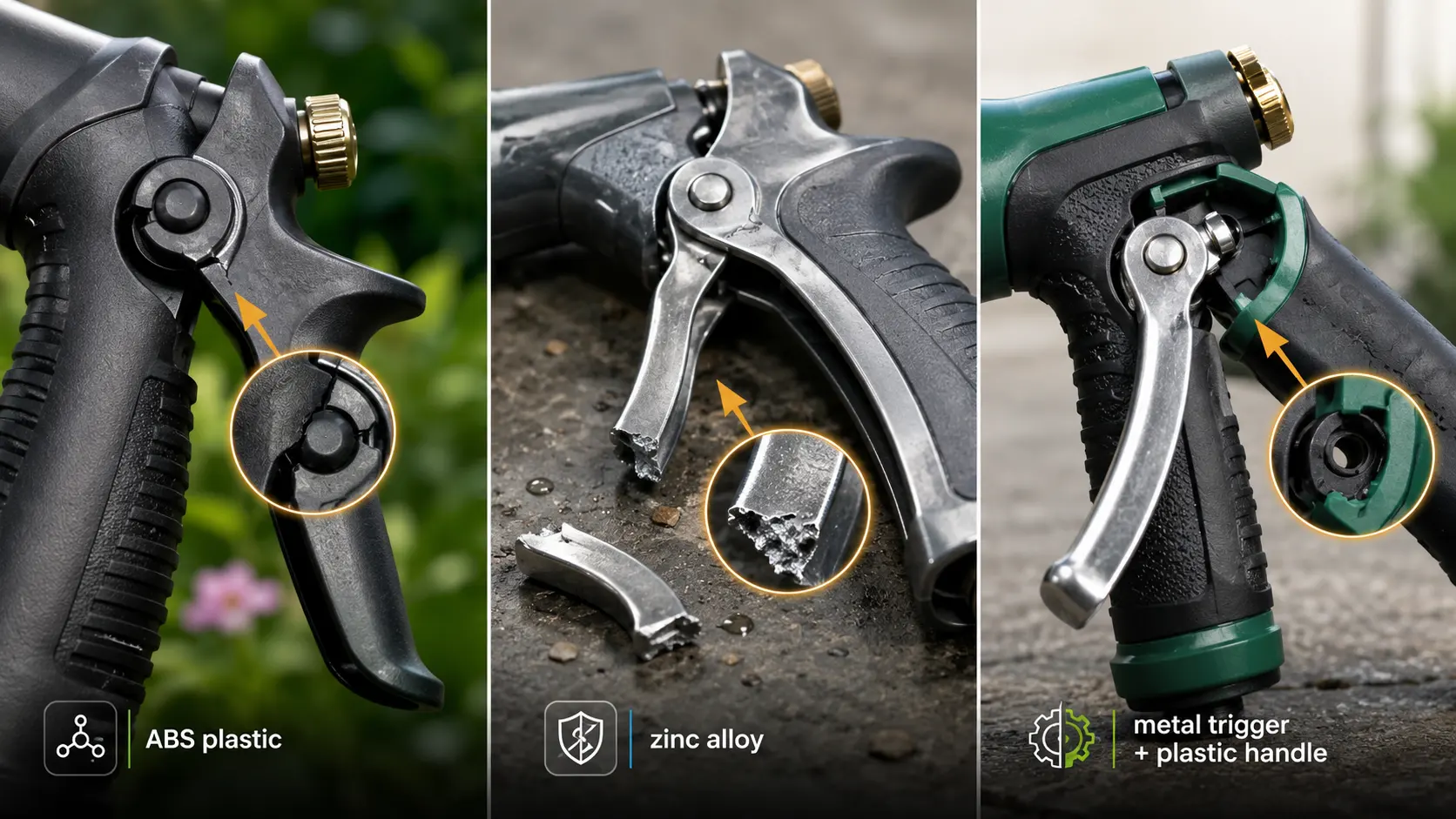
ABS plastic trigger: stress concentration at the pivot. The trigger pivot point is the thinnest section of the moulded part. Every squeeze concentrates force on a cross-section that may be less than 2 mm thick (based on common mould design observation). Over hundreds of cycles, micro-cracks form at the inside radius of the bend — the same place a paperclip snaps when you bend it back and forth. The fix at the factory level is simple: specify a pivot-point wall thickness of at least 2.5 mm (recommended minimum based on industry practice), or require a metal pin reinforcement through the pivot. The cost difference is negligible. The reliability difference is significant.
Zinc alloy trigger: brittle fracture under impact. Zinc alloy is hard — that is why it feels solid when you pick up the gun. But hardness and toughness are not the same thing. Zinc alloy has low impact resistance. When the gun is dropped on a hard surface, or when the trigger is yanked hard, the material fractures rather than deforming. It does not bend. It breaks. The procurement fix: ask for zinc-aluminium alloy (ZA-8 or ZA-12) instead of standard zinc alloy. ZA-8 has roughly 20–30% higher impact strength than conventional zinc alloy (est. based on industry experience), with minimal cost increase. If your supplier cannot provide ZA-8, require a trigger fatigue test — at least 5,000 cycles (recommended benchmark) — before committing to an order.
Metal trigger + plastic handle: the interface failure. Many mid-range guns use a metal trigger mounted in a plastic handle body. The connection point between two materials with different thermal expansion coefficients is a stress concentrator. In outdoor conditions — hot sun, cold nights — the plastic expands and contracts more than the metal (ABS has roughly two to three times the thermal expansion coefficient of zinc alloy). Over time, this differential movement creates cyclic stress at the interface, and it loosens. The trigger wobbles. Then it breaks free. The factory fix is insert moulding — a stainless-steel insert moulded into the plastic at the connection point, giving the two materials a mechanical lock rather than just an adhesive bond. If you source guns with mixed metal-and-plastic construction, check whether the interface uses an insert or relies on glue alone.
One complaint. Three causes. Three different procurement specifications. If you treat “trigger broke” as a single quality problem, you will apply the wrong fix to the wrong material — and the returns will keep coming.
Spray Pattern Numbers Are Marketing Numbers
Walk through any garden centre and you will see spray guns advertising 7, 8, even 10 spray patterns. The number is printed on the packaging in large type. It is the primary differentiator between one gun and the next on the shelf. More patterns looks like more value — an 8-pattern gun next to a 4-pattern gun feels like a better deal. That perception drives the shelf decision.
Here is the problem: four spray patterns cover virtually every real watering scenario.
| Pattern | What It Does | When You Need It |
| Mist | Fine spray, barely visible droplets | Seedlings, cuttings, tropical plants, greenhouse humidity |
| Shower | Gentle, wide coverage | Flower beds, borders, container plants |
| Jet | Concentrated stream | Cleaning paths, filling buckets, reaching distant pots |
| Cone | Angled spray, wider than jet, narrower than shower | Medium beds, shrubs |
Every spray gun that has more than four patterns is filling the extra positions with variations that are functionally indistinguishable. Flat, Angle, Soaker, Aerated, Fast Fill — these are not distinct watering modes. They are positions on a rotating dial that look different in a product photo but feel nearly identical in the hand.
The more patterns a gun offers, the more complex the rotating dial mechanism — and the more likely it is to jam. “Spray mode stuck” is a frequently reported complaint across consumer reviews. The mechanism that selects between 8 or 10 modes has more internal channels, more seals, and more moving parts than a 4-mode gun. More parts. More failure points. More returns.
The B-end judgment: if you are sourcing spray guns for wholesale, 4 patterns covers every real use case. Anything beyond that is retail marketing differentiation, not functional differentiation. If your customers want more options, stock two gun tiers — a 4-pattern plastic gun at the entry price point and a 4-pattern metal gun at the premium price point. Two guns, four patterns each, covers more ground than one gun with eight patterns that jam.
If buyers also need area coverage products, compare spray guns with garden sprinklers for wholesale.
Bad Reviews and the Root Cause
We analysed customer complaints across the top-selling spray guns on UK and European retail platforms. The same five problems appear repeatedly — regardless of brand or price point.
| # | Complaint | What is actually happening | Procurement fix |
| 1 | Trigger broke | Pivot-point stress concentration (ABS), brittle fracture (zinc alloy), or interface failure (mixed metal/plastic) | Specify metal pin reinforcement for ABS; require ZA-8 alloy for zinc; check for insert-moulded interface |
| 2 | Leaking/dribbling | O-ring ageing or a poor seal at the inlet connection | Require EPDM O-rings; specify ≤1% leak rate at factory test |
| 3 | Spray mode stuck | Over-complex rotating dial with too many channels and seals | 4 patterns maximum; avoid 5+ pattern dials |
| 4 | Handle overheating | Dark-coloured or bare metal handle absorbs solar heat | Specify light-coloured TPR overmould or insulated grip |
| 5 | Flow adjustment too stiff | Adjustment knob requires two hands to operate | Require a single-hand thumb-control design |
All five trace back to the same root cause: buyers treat a spray gun as a commodity — a nozzle that sprays water — rather than a product category with three distinct materials, each requiring its own quality specification. When you source an ABS gun without specifying pivot-point reinforcement, you get a trigger that snaps in one season. When you source a zinc alloy gun without requiring ZA-8, you get a trigger that shatters on impact. When you source any gun without checking the O-ring material, you get a product that dribbles from the first week.
The connector question deserves a brief mention here, even though we covered it in depth in our hose guide. Spray guns typically ship without a connector — the buyer attaches one that matches their market standard. But the gun’s inlet thread still has to be compatible. Hozelock-compatible connectors use a different fitting shape than Gardena-compatible connectors, even when the thread size looks the same on paper. If you are sourcing guns for multiple markets, confirm the inlet thread specification for each destination before production. A gun that cannot connect to the customer’s hose is not a quality problem — it is a market-fit problem, and it is invisible until the returns arrive. Request our spray gun connector compatibility sheet — it covers Hozelock, Gardena, and GHT inlet specifications by market.
Spray Gun Procurement Checklist
| Check Item | Why It Matters | How to Verify |
| Material grade | ABS, zinc alloy, and brass have different failure modes and price points | Define your target channel and price tier before selecting material |
| Trigger reinforcement | The trigger pivot is the most common failure point across all materials | For ABS: require metal pin reinforcement or ≥2.5 mm wall thickness at pivot (recommended minimum); for zinc alloy: require ZA-8 or ZA-12 grade |
| Spray pattern count | More than 4 patterns increases complexity and jam risk without adding real function | 4 patterns maximum; avoid 5+ pattern dials for wholesale |
| O-ring material | Standard NBR (nitrile rubber) O-rings harden and leak within a year; EPDM lasts significantly longer | Specify EPDM O-rings; require ≤1% leak rate at factory test |
| Inlet thread standard | Hozelock (UK), Gardena (EU), and GHT (US) use different fitting shapes | Confirm inlet thread matches target market before production |
| Grip design | Bare metal handles overheat in sun; dark-coloured grips absorb heat | Require light-coloured TPR overmould or insulated grip for outdoor products |
| Flow control | Stiff flow-adjustment knobs frustrate users and generate returns | Require single-hand thumb-control design; test one-handed operation on sample |
| Fatigue test | Trigger failure is a leading return reason | Require ≥5,000 cycle trigger fatigue test report (recommended benchmark) for zinc alloy and mixed-construction guns |
| Packaging | Spray guns are relatively small but irregularly shaped — packaging affects CBM | Compare shipping cost per unit for bulk pack vs individual colour box |
This is the kind of verification that prevents the return, not just the defect — a team that checks the trigger pivot, the O-ring material, and the inlet thread against your approved sample before the guns leave the warehouse. A broken trigger costs as much goodwill as a leaking hose — which is why trigger checks belong on every inspection list.
If your product range includes both hoses and spray guns, the inlet thread standard has to match across the entire line — a mismatch here is a cross-category problem. Get our hose + spray gun combo sourcing plan — with connector standards pre-matched for your target market.
FAQ
Are Hozelock and Gardena spray gun connectors compatible?
No. Although spray guns typically ship without a connector attached, the inlet thread and fitting shape differ between Hozelock and Gardena systems. Hozelock uses 12.5 mm and 15 mm push-fit connectors for the UK and Ireland market. Gardena uses a proprietary 13 mm push-fit system for continental Europe. You can fit either connector to most guns — but you must specify which connector type to include in the order. A gun fitted with a Hozelock connector will not click into a Gardena hose end, and vice versa.
What is the difference between a zinc alloy and a ZA-8 spray gun?
Standard zinc alloy (typically Zamak 3) is the most common die-cast material for mid-range spray guns. It is hard but brittle — under impact, it fractures rather than deforming. ZA-8 (zinc-aluminium alloy) contains approximately 8% aluminium, which increases impact strength by roughly 20–30% compared to standard zinc alloy (est. based on industry experience). The cost difference at the factory gate is small. The difference in return rates for trigger breakage is significant.
How many spray patterns does a wholesale spray gun actually need?
Four. Mist, Shower, Jet, and Cone cover every real watering scenario. Guns with 5 or more patterns add positions that are functionally indistinguishable from each other, while increasing the complexity of the rotating dial — and the probability that the dial jams. For wholesale, 4 patterns is the practical maximum.
Why do spray gun triggers break so often?
Because the root cause is different for each material, and most buyers treat it as a single problem. ABS triggers fail at the pivot point due to stress concentration. Zinc alloy triggers fail by brittle fracture under impact. Mixed metal-and-plastic triggers fail at the material interface due to thermal expansion mismatch. Each cause requires a different procurement specification — metal pin reinforcement for ABS, ZA-8 alloy for zinc, insert moulding for mixed construction.
Can I source spray guns and hoses from the same factory?
Rarely. Spray guns and hoses are made in different factory types — injection moulding or die-casting for guns, extrusion or vulcanisation for hoses. A supply-support team that works across multiple factory types can coordinate both, but a single factory will not produce both well.
What is the typical lifespan difference between Garden Spray Guns for Wholesale: Three Materials, One Broken Trigger
A spray gun is the part your customer holds in their hand. It is the most tactile, most visible, most judged component in the entire watering setup — and it is the part most likely to break first.
When the trigger snaps, the customer does not blame the material. They blame the brand. And if that brand is yours, the return lands on your desk.
Here is what most wholesale buyers miss: a spray gun is not one product. It is three completely different materials — ABS plastic, zinc alloy, and aluminium/brass — each coming from a different type of factory, failing in a different way, and carrying a different profit structure. The ex-works price gap between a basic ABS gun and a brass gun can be 50×. The retail price gap is narrower. The return-rate gap is where the real money is lost.
And then there is the trigger problem. “Trigger broke” is the single most common complaint across all spray gun categories. But the root cause is not the same for every gun — it is three different structural failures hiding behind one complaint. If you do not know which material fails which way, you cannot specify the right fix.
One Spray Gun, Three Materials
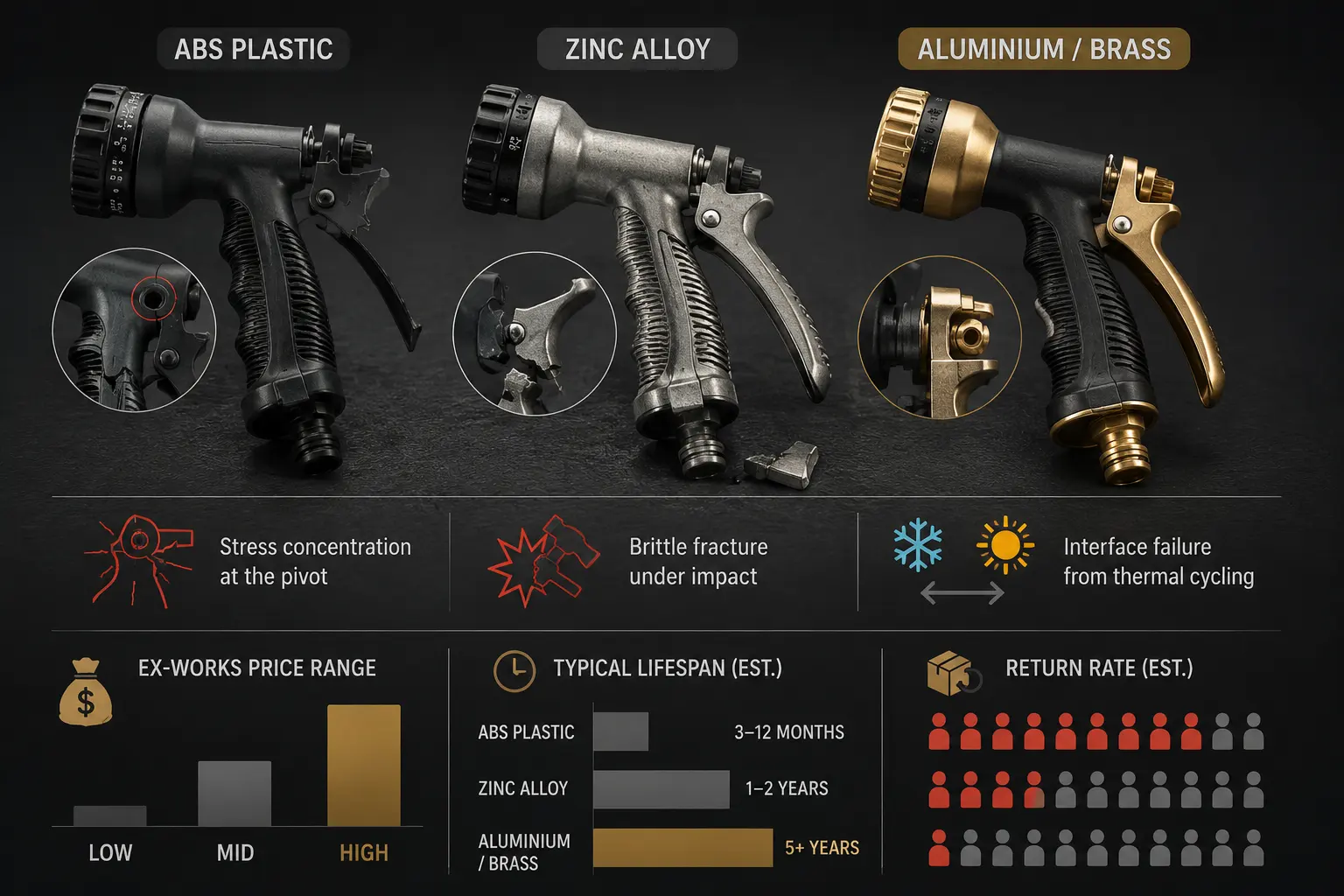
Most wholesale buyers treat spray guns as a single category. The reality: ABS, zinc alloy, and aluminium/brass guns come from three entirely different manufacturing processes, often three different factory clusters in China. Each has a different cost structure, a different failure mode, and a different role in your product mix.
| ABS Plastic Gun | Zinc Alloy Gun | Aluminium/Brass Gun | |
| Manufacturing | Injection moulding | Die-cast + electroplating | Metal machining + assembly |
| Factory cluster | Yuyao / Ningbo | Yongkang / Ningbo | Zhejiang (Ningbo, Yuhuan) / Sichuan |
| Working pressure | 0–8 bar | 0–8 bar | 0–10 bar |
| Weight | 100–200 g | 200–400 g | 300–600 g |
| Typical lifespan | 1–2 seasons (est.) | 2–4 years (est.) | 5–8 years (est.) |
| Approx. ex-works price | $0.15–2.00/unit (est.) | $2.40–5.00/unit (est.) | $3.10–8.00/unit (est.) |
| UK retail price | £5–15 (est.) | £15–30 | £25–60 (est.) |
Sources: supplier quotation data, Hozelock UK retail pricing, consumer review analysis
ABS plastic is a volume product. Injection-moulding factories in Yuyao and Ningbo produce them at staggering scale — a basic 2-pattern gun can leave the factory for as little as $0.15 per unit. The margin per unit is thin, but the volume potential is enormous. DIY chains and budget garden centres stock these by the thousand. The catch: a plastic trigger is a planned limitation. The pivot point — the thinnest section of the moulded part — is where stress concentrates. After one or two seasons of squeezing, micro-cracks form and the trigger snaps. This is not a defect. It is the physical limit of the material.
Zinc alloy is your mid-range product. Die-cast in Yongkang and Ningbo, these guns feel solid in the hand and carry a higher price point. The margin is better. But zinc alloy has its own personality: it is hard but brittle. Under impact loading — someone drops the gun on a patio — a zinc alloy trigger can fracture rather than bend. The electroplated surface that looks premium on day one can blister and peel after a year of outdoor exposure. These are not manufacturing flaws. They are the material’s chemistry at work.
Aluminium and brass are your premium products. Heavier, more expensive, and significantly more durable. The internal mechanisms — O-rings, springs, flow-control valves — are where the real engineering lives. The failure mode shifts from the body to the seals: an O-ring ages, hardens, and the gun starts to dribble. The fix is a 10-cent seal replacement, not a whole new gun. This is why professional buyers and trade counters prefer metal guns — they survive.
The frame for classifying any spray gun material is straightforward: look at what factory makes it and how it breaks. Factory type tells you where to source and what your procurement path looks like. Failure mode tells you what to inspect and what your customers will complain about. ABS comes from injection-moulding plants and fails at the trigger pivot. Zinc alloy comes from die-casting plants and fails by surface degradation and brittle fracture. Aluminium/brass comes from machining plants and fails at the O-ring. Any new material — stainless steel, glass-filled nylon, or something else — can be slotted into this frame by asking: what factory makes it, and how does it break?
The Trigger Broke — But That Is Not the Problem
“Trigger broke” is one of the most common complaints across all spray gun categories. It shows up in reviews for £5 plastic guns and £50 metal guns alike. But the root cause is not the same — it is three different structural failures hiding behind one phrase.
ABS plastic trigger: stress concentration at the pivot. The trigger pivot point is the thinnest section of the moulded part. Every squeeze concentrates force on a cross-section that may be less than 2 mm thick (based on common mould design observation). Over hundreds of cycles, micro-cracks form at the inside radius of the bend — the same place a paperclip snaps when you bend it back and forth. The fix at the factory level is simple: specify a pivot-point wall thickness of at least 2.5 mm (recommended minimum based on industry practice), or require a metal pin reinforcement through the pivot. The cost difference is negligible. The reliability difference is significant.
Zinc alloy trigger: brittle fracture under impact. Zinc alloy is hard — that is why it feels solid when you pick up the gun. But hardness and toughness are not the same thing. Zinc alloy has low impact resistance. When the gun is dropped on a hard surface, or when the trigger is yanked hard, the material fractures rather than deforming. It does not bend. It breaks. The procurement fix: ask for zinc-aluminium alloy (ZA-8 or ZA-12) instead of standard zinc alloy. ZA-8 has roughly 20–30% higher impact strength than conventional zinc alloy (est. based on industry experience), with minimal cost increase. If your supplier cannot provide ZA-8, require a trigger fatigue test — at least 5,000 cycles (recommended benchmark) — before committing to an order.
Metal trigger + plastic handle: the interface failure. Many mid-range guns use a metal trigger mounted in a plastic handle body. The connection point between two materials with different thermal expansion coefficients is a stress concentrator. In outdoor conditions — hot sun, cold nights — the plastic expands and contracts more than the metal (ABS has roughly two to three times the thermal expansion coefficient of zinc alloy). Over time, this differential movement creates cyclic stress at the interface, and it loosens. The trigger wobbles. Then it breaks free. The factory fix is insert moulding — a stainless-steel insert moulded into the plastic at the connection point, giving the two materials a mechanical lock rather than just an adhesive bond. If you source guns with mixed metal-and-plastic construction, check whether the interface uses an insert or relies on glue alone.
One complaint. Three causes. Three different procurement specifications. If you treat “trigger broke” as a single quality problem, you will apply the wrong fix to the wrong material — and the returns will keep coming.
Spray Pattern Numbers Are Marketing Numbers
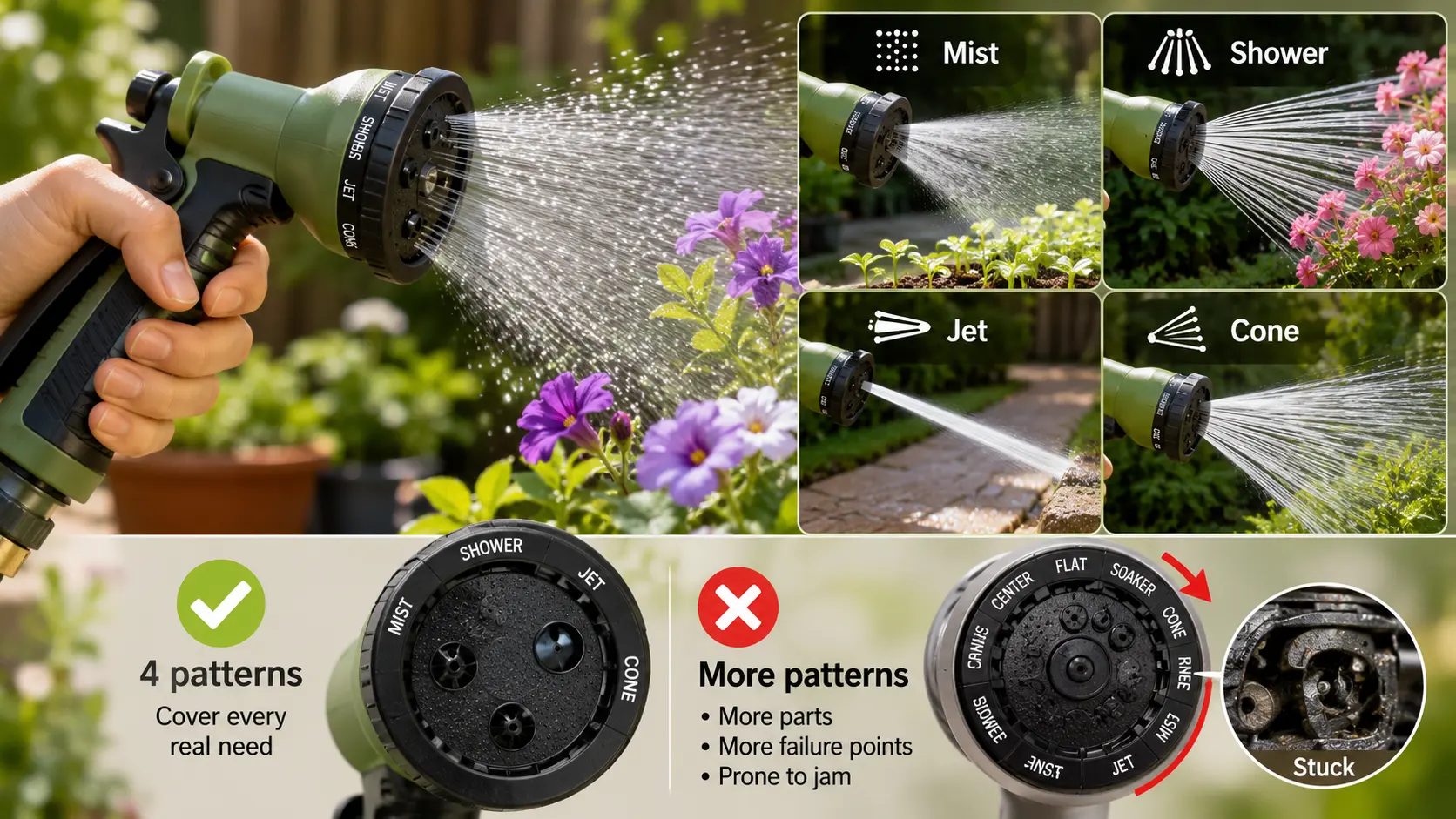
Walk through any garden centre and you will see spray guns advertising 7, 8, or even 10 spray patterns. The number is printed on the packaging in large type. It is the primary differentiator between one gun and the next on the shelf. More patterns look like more value — an 8-pattern gun next to a 4-pattern gun feels like a better deal. That perception drives the shelf decision.
Here is the problem: four spray patterns cover virtually every real watering scenario.
| Pattern | What It Does | When You Need It |
| Mist | Fine spray, barely visible droplets | Seedlings, cuttings, tropical plants, greenhouse humidity |
| Shower | Gentle, wide coverage | Flower beds, borders, container plants |
| Jet | Concentrated stream | Cleaning paths, filling buckets, reaching distant pots |
| Cone | Angled spray, wider than jet, narrower than shower | Medium beds, shrubs |
Every spray gun that has more than four patterns fills the extra positions with variations that are functionally indistinguishable. Flat, Angle, Soaker, Aerated, Fast Fill — these are not distinct watering modes. They are positions on a rotating dial that look different in a product photo but feel nearly identical in the hand.
The more patterns a gun offers, the more complex the rotating dial mechanism — and the more likely it is to jam. “Spray mode stuck” is a frequently reported complaint across consumer reviews. The mechanism that selects between 8 or 10 modes has more internal channels, more seals, and more moving parts than a 4-mode gun. More parts. More failure points. More returns.
The B-end judgment: if you are sourcing spray guns for wholesale, 4 patterns cover every real use case. Anything beyond that is retail marketing differentiation, not functional differentiation. If your customers want more options, stock two gun tiers — a 4-pattern plastic gun at the entry price point and a 4-pattern metal gun at the premium price point. Two guns, four patterns each, cover more ground than one gun with eight patterns that jam.
Bad Reviews and the Root Cause
We analysed customer complaints across the top-selling spray guns on UK and European retail platforms. The same five problems appear repeatedly — regardless of brand or price point.
| # | Complaint | What is actually happening | Procurement fix |
| 1 | Trigger broke | Pivot-point stress concentration (ABS), brittle fracture (zinc alloy), or interface failure (mixed metal/plastic) | Specify metal pin reinforcement for ABS; require ZA-8 alloy for zinc; check for insert-moulded interface |
| 2 | Leaking/dribbling | O-ring ageing or a poor seal at the inlet connection | Require EPDM O-rings; specify ≤1% leak rate at factory test |
| 3 | Spray mode stuck | Over-complex rotating dial with too many channels and seals | 4 patterns maximum; avoid 5+ pattern dials |
| 4 | Handle overheating | Dark-coloured or bare metal handle absorbs solar heat | Specify light-coloured TPR overmould or insulated grip |
| 5 | Flow adjustment too stiff | The adjustment knob requires two hands to operate | Require a single-hand thumb-control design |
All five trace back to the same root cause: buyers treat a spray gun as a commodity — a nozzle that sprays water — rather than a product category with three distinct materials, each requiring its own quality specification. When you source an ABS gun without specifying pivot-point reinforcement, you get a trigger that snaps in one season. When you source a zinc alloy gun without requiring ZA-8, you get a trigger that shatters on impact. When you source any gun without checking the O-ring material, you get a product that drips from the first week.
The connector question deserves a brief mention here, even though we covered it in depth in our hose guide. Spray guns typically ship without a connector — the buyer attaches one that matches their market standard. But the gun’s inlet thread still has to be compatible. Hozelock-compatible connectors use a different fitting shape than Gardena-compatible connectors, even when the thread size looks the same on paper. If you are sourcing guns for multiple markets, confirm the inlet thread specification for each destination before production. A gun that cannot connect to the customer’s hose is not a quality problem — it is a market-fit problem, and it is invisible until the returns arrive. Request our spray gun connector compatibility sheet — it covers Hozelock, Gardena, and GHT inlet specifications by market.
Spray Gun Procurement Checklist
| Check Item | Why It Matters | How to Verify |
| Material grade | ABS, zinc alloy, and brass have different failure modes and price points | Define your target channel and price tier before selecting material |
| Trigger reinforcement | The trigger pivot is the most common failure point across all materials | For ABS: require metal pin reinforcement or ≥2.5 mm wall thickness at pivot (recommended minimum); for zinc alloy: require ZA-8 or ZA-12 grade |
| Spray pattern count | More than 4 patterns increases complexity and jam risk without adding real function | 4 patterns maximum; avoid 5+ pattern dials for wholesale |
| O-ring material | Standard NBR (nitrile rubber) O-rings harden and leak within a year; EPDM lasts significantly longer | Specify EPDM O-rings; require ≤1% leak rate at factory test |
| Inlet thread standard | Hozelock (UK), Gardena (EU), and GHT (US) use different fitting shapes | Confirm inlet thread matches target market before production |
| Grip design | Bare metal handles overheat in sun; dark-coloured grips absorb heat | Require light-coloured TPR overmould or insulated grip for outdoor products |
| Flow control | Stiff flow-adjustment knobs frustrate users and generate returns | Require single-hand thumb-control design; test one-handed operation on sample |
| Fatigue test | Trigger failure is a leading return reason | Require ≥5,000 cycle trigger fatigue test report (recommended benchmark) for zinc alloy and mixed-construction guns |
| Packaging | Spray guns are relatively small but irregularly shaped — packaging affects CBM | Compare shipping cost per unit for bulk pack vs individual colour box |
This is the kind of verification that prevents the return, not just the defect — a team that checks the trigger pivot, the O-ring material, and the inlet thread against your approved sample before the guns leave the warehouse. A broken trigger costs as much goodwill as a leaking hose — which is why trigger checks belong on every inspection list.
If your product range includes both hoses and spray guns, the inlet thread standard has to match across the entire line — a mismatch here is a cross-category problem. Get our hose + spray gun combo sourcing plan — with connector standards pre-matched for your target market.
FAQ
Are Hozelock and Gardena spray gun connectors compatible?
No. Although spray guns typically ship without a connector attached, the inlet thread and fitting shape differ between Hozelock and Gardena systems. Hozelock uses 12.5 mm and 15 mm push-fit connectors for the UK and Ireland market. Gardena uses a proprietary 13 mm push-fit system for continental Europe. You can fit either connector to most guns — but you must specify which connector type to include in the order. A gun fitted with a Hozelock connector will not click into a Gardena hose end, and vice versa.
What is the difference between a zinc alloy and a ZA-8 spray gun? Standard zinc alloy (typically Zamak 3) is the most common die-cast material for mid-range spray guns. It is hard but brittle — under impact, it fractures rather than deforming. ZA-8 (zinc-aluminium alloy) contains approximately 8% aluminium, which increases impact strength by roughly 20–30% compared to standard zinc alloy (est. based on industry experience). The cost difference at the factory gate is small. The difference in return rates for trigger breakage is significant.
How many spray patterns does a wholesale spray gun actually need? Four. Mist, Shower, Jet, and Cone cover every real watering scenario. Guns with 5 or more patterns add positions that are functionally indistinguishable from each other, while increasing the complexity of the rotating dial — and the probability that the dial jams. For wholesale, 4 patterns is the practical maximum.
Why do spray gun triggers break so often? Because the root cause is different for each material, and most buyers treat it as a single problem. ABS triggers fail at the pivot point due to stress concentration. Zinc alloy triggers fail by brittle fracture under impact. Mixed metal-and-plastic triggers fail at the material interface due to thermal expansion mismatch. Each cause requires a different procurement specification — metal pin reinforcement for ABS, ZA-8 alloy for zinc, insert moulding for mixed construction.
Can I source spray guns and hoses from the same factory? Rarely. Spray guns and hoses are made in different factory types — injection moulding or die-casting for guns, extrusion or vulcanisation for hoses. A supply-support team that works across multiple factory types can coordinate both, but a single factory will not produce both well.
What is the typical lifespan difference between plastic and metal spray guns? The gap is large because the three materials fail for completely different reasons. ABS hits a physical limit — the plastic hinge at the trigger pivot fatigues and cracks. Zinc alloy degrades chemically — the electroplated surface blisters, exposing the alloy to corrosion. Metal guns fail at the seals — O-rings harden over time, but a 10-cent replacement restores the gun. This is why metal guns feel “repairable” while plastic and zinc guns feel “disposable”: the failure is in a replaceable part, not the structure itself.
Next Step: Review Your Spray Gun Sourcing Plan
Order a sample set covering the three material tiers — ABS (with metal pin reinforcement), zinc alloy (ZA-8 grade), and aluminium/brass — with inlet threads matched to your target market. Test the trigger. Cycle the spray dial. Check the O-ring material against the spec sheet. Then decide.
To place spray guns inside a full watering assortment, refer to the complete guide to garden watering tools for wholesale buyers.
Talk to our team about your spray gun sourcing plan. You focus on selling. Scarecrow Garden Supplier can help you source, verify, organise, and ship.
Ready to Build Your Watering-Tool Assortment?
Send us your product list, target market and packaging requirements — we will come back with supplier matches, sample options and a CBM-optimised packing plan within 48 hours.

Written by
ScarecrowGarden
💡About Scarecrow Garden Supplier Co., Ltd.
Scarecrow Garden Supplier Co., Ltd. is a China-based sourcing and wholesale partner specializing in garden tools, landscaping equipment, and outdoor supplies for international wholesalers, distributors, contractors, and brands.
With hands-on experience rooted in real garden use scenarios, we focus on durable materials, functional design, and stable large-volume supply. Our product range covers pruning tools, watering systems, hand tools, outdoor hardware, and customized garden solutions to support both retail and professional landscaping markets.
Beyond products, we help our partners navigate supplier selection, quality control, compliance requirements, and long-term sourcing strategies in China. Through our blog, we share practical insights on product selection, material comparisons, industry trends, and cost-effective purchasing—helping global buyers build stronger, more competitive supply chains.