







Wholesale Season-Extension Equipment: Autumn Sourcing Guide for European Garden Suppliers | Scarecrow Garden Supplier
September. Your customer stands in the garden, looking at a frame full of tomatoes that haven’t finished ripening, when a weather alert pops up on her phone: tomorrow night’s low, 4°C.
She just survived a 40°C heatwave — bought shade netting, installed drip irrigation, and added cages to the tomatoes. Two months of effort and investment, all riding on those green tomatoes. If frost arrives, it’s over in a single night.
She asks: is there anything that makes the growing season last a little longer?
She’s not looking for “winter gardening products.” She’s looking for a continuation — a way to stop the time, money and effort she invested during the heatwave from being wiped out by the first frost.
That’s the real selling point of season-extension products: not “you can grow things in winter,” but “don’t let the frost take what you grew this summer.”
This article is about the autumn-winter opportunity after a hot summer: why September is the sales window for season-extension products, how to choose covering and structural products, regional demand differences, and what to watch out for when sourcing.
This article is part of our series on how Europe’s hotter summers are changing garden product sourcing. For storm-ready plant support and crop protection, see storm-ready plant support and crop protection products. For raised beds and planters as a climate-adapted growing environment, see raised beds and planters for hotter, drier and stormier gardens.
Why “After a Hot Summer” Is the Sales Window for Season-Extension Products
Three factors converge to make this September’s demand for season-extension products more urgent than usual:
First, early frost after September is a near certainty. Weather risk reports confirm that September–November brings autumn volatility and early frost risk across Europe. Scandinavia (Sweden, Denmark, Finland) can see frost as early as September; the UK, Germany and Poland need stock by late August; southern Europe is later but experiences sharp temperature drops by October. This isn’t “might happen” — it’s “will happen,” the only question is when.
Second, customers have already built a protection mindset during the heatwave. A customer who bought shade netting has already accepted the idea that “I need to actively protect my plants.” You don’t need to convince her from scratch — you just say: “Shade netting is for sun; fleece is for frost. Same logic.”
Third, customers don’t want their investment to vanish. The customer who bought a raised bed during the heatwave needs a raised bed cover in autumn. The one with a greenhouse needs bubble insulation. The one with tomato cages needs fleece to extend the harvest. These aren’t new customers — they’re repeat buyers.
Key insight: During the heatwave you sold sun protection and hydration. During storm season you sold securing and support. Now in autumn you sell insulation and continuation. The products change, but the customer’s core need stays the same: “I don’t want to be at the mercy of the weather.”
If you’re stocking up for autumn and winter, Scarecrow can help you put together a SKU list for season-extension products — fleece, tunnel hoops, cold frames, greenhouse insulation — matched to your market and climate zone. → Get your season-extension product list
Covering Products — From Light Frost to Overwintering, Choose by Insulation Level
The core logic of season-extension products is simple: put a layer between the plants and the cold air. What you add, and how thick, depends on what you’re protecting against — an occasional light frost or a sustained two-week cold spell.
Covering Product Comparison
| Product | Material | Insulation Effect | Light Transmission | Lifespan | Best For |
| Horticultural fleece | Polypropylene non-woven, 17–30 g/m² | Raises temperature 2–4°C | 85–90% | 1–2 seasons | Light frost protection; can be laid directly on plants |
| Heavy-duty fleece | Polypropylene non-woven, 50 g/m² | Raises temperature 4–6°C | 70–80% | 2–3 seasons | Moderate frost; winter vegetables |
| Polythene cloche | Clear PVC / PE | Raises temperature 3–5°C | 90%+ | 2–3 seasons | Single-plant frost protection |
| Tunnel cloche | PE film + galvanised steel hoops | Raises temperature 3–5°C | 85–90% | 1–2 seasons (film) / 5+ years (hoops) | Continuous row coverage |
| Polytunnel | PE film + galvanised steel frame | Raises temperature 5–10°C | 80–90% | 3–5 years (film) / 10+ years (frame) | Large-area overwintering |
How to Choose — Three Questions
1. What are you protecting against? Occasional light frost → fleece is enough. Sustained low temperatures → tunnel cloche or polytunnel. Single valuable plant → cloche.
2. How large an area? A single row of vegetables → tunnel cloche (6 hoops cover a 3 m row). An entire vegetable patch → polytunnel. A few pots → fleece laid directly.
3. How much maintenance will your customer accept? Fleece is lightweight, but needs to be removed every time temperatures rise and replaced when they drop — if that’s too much hassle, a tunnel cloche with zip-front fleece is less effort.
RHS Recommendations
The RHS recommends fleece and crop covers as the first choice for frost protection. Cloches can be made from glass or rigid clear plastic, and individual cloches can be joined together to provide continuous protection. Tunnel cloches are continuous low tunnels using flexible plastic film — less labour than individual cloches.
Critical Warning: Fleece Isn’t “Cover and Forget”
When temperatures rise under the cover, you must open it for ventilation — otherwise plants will literally cook. The RHS advises opening fleece during warm weather. This isn’t optional — unventilated fleece on a sunny day can push internal temperatures above 40°C, which is more lethal than no cover at all.
Structural Products — Cold Frames, Mini Greenhouses, Raised Bed Covers and Greenhouse Insulation
Covering products are “putting clothes on plants.” Structural products are “building a house for plants” — more expensive, more durable, stronger protection, but requiring more upfront investment and space.
Structural Product Comparison
| Product | Material | Specification | Function | Sourcing Notes |
| Cold frame | Timber/aluminium frame + polycarbonate panels | From 60×100 cm | Hardening off seedlings, early spring propagation | Polycarbonate is safer than glass; folding versions save warehouse space |
| Mini greenhouse | Galvanised steel frame + PE film/PC panels | 1–2 shelves | Balcony/patio propagation | Folding versions save warehouse space; zip doors for ventilation |
| Raised bed cover | Aluminium / steel frame + fleece / PC panels | Matched to raised bed dimensions | Extending raised bed growing season | Bundle with raised beds — heatwave customers are natural repeat buyers |
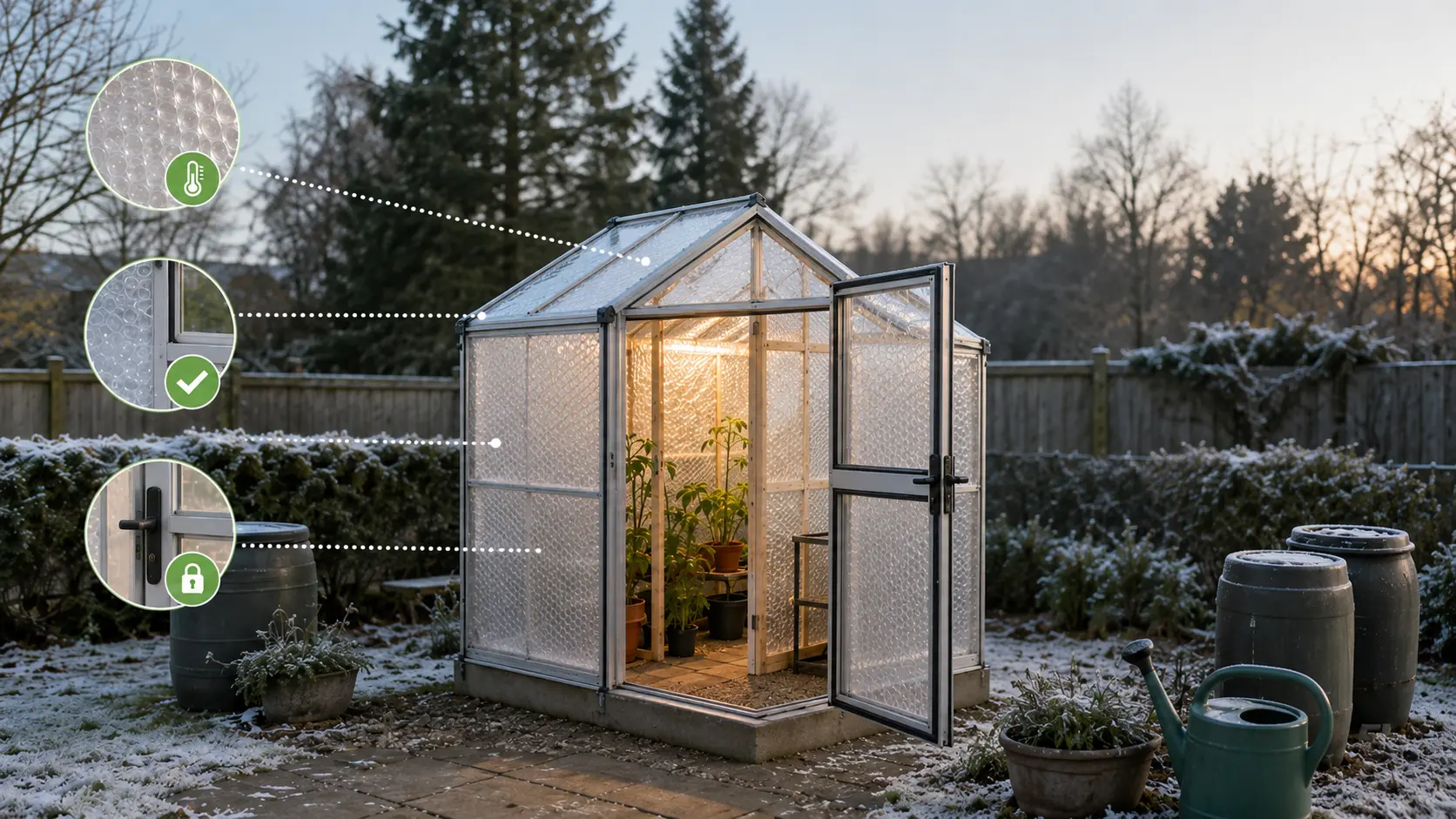
| Greenhouse insulation | Bubble wrap / double glazing | Cut to greenhouse dimensions | Reducing greenhouse heat loss | Bubble wrap reduces approx. 10% light transmission — RHS says it’s usually worth it |
RHS Greenhouse Insulation Advice — The Value of Bubble Wrap
The RHS has specific guidance on greenhouse insulation:
- The main heat loss in a greenhouse comes from gaps and structural conduction — fix broken panes first, ensure vents and doors seal tightly
- Adding a layer of bubble wrap insulation reduces about 10% of light transmission, but the RHS says it’s usually worth it for the heating cost savings
- In a large greenhouse with few plants, partition off a smaller area with bubble wrap and timber battens, and heat only that zone — far more efficient than heating the entire structure
For B2B buyers, the implication is clear: bubble wrap is the entry-level greenhouse insulation product — low unit price, high repeat purchase rate, and almost every customer with a greenhouse needs it. You don’t need to sell complex heating systems — start with bubble wrap.
Raised Bed Covers — The Natural Repeat Purchase for Heatwave Customers
This is a key cross-sell point: customers who bought raised beds during the heatwave need raised bed covers in autumn. The cover frame matches the bed dimensions, with fleece or polycarbonate panels, upgrading the raised bed from a “controllable growing environment” to a “mini greenhouse.”
When sourcing, confirm: does the cover frame match the raised bed dimensions you sell? Is the covering material fleece (cheap, replaceable) or PC panels (durable, better insulation)? Is there a ventilation design?
Autumn-Winter Planting Accessories — Don’t Just Sell Covers
Selling only fleece and tunnel hoops means you’re selling “protection.” Add autumn vegetable seeds, bulbs and indoor propagation kits, and you’re selling “you can still grow things in autumn and winter” — upgrading from protection to a planting solution.
Autumn-Winter Planting Products
| Product | Function | Sourcing Notes |
| Autumn vegetable seeds / plug plants | Overwintering vegetables (kale, winter spinach, garlic) | Bundle with covering products — “garlic + fleece” kit |
| Garlic planting kit | Plant in autumn, harvest next year | High-value gift direction — 3 bulbs + planting guide card |
| Bulb planting kit | Plant bulbs in autumn, flowers in spring | Bundle with fleece — “plant hope + protect it through winter” |
| Indoor propagation kit | Seed trays, propagation lids, heat mats | Extends into indoor growing — customers without outdoor space can still participate |
Here’s what that looks like at retail: A customer buys a garlic planting kit plus a fleece roll in September. By December, she’s still harvesting winter spinach under the same fleece. She didn’t just “protect” — she produced. That’s the upgrade from selling protection to selling a planting solution, and it’s what lifts basket value from a single fleece roll to a kit.
Sourcing decisions for autumn planting products:
- Seed and bulb viability matters more than price. Autumn-planted bulbs (garlic, tulips, daffodils) have a narrow planting window — if they sit in a warehouse too long, viability drops. Confirm supplier lead times and pack dates before committing to large quantities. Smaller, pre-packed kits (3 garlic bulbs + planting guide card) turn this risk into a retail advantage: the customer gets a complete solution, and you don’t hold bulk stock past its prime.
- Indoor propagation kits have their own SKU logic. Seed trays, propagation lids and heat mats are year-round products, but they sell fastest in two windows: spring sowing and autumn overwintering. If you stock them, confirm whether the supplier offers a “slim” kit (tray + lid only) and a “full” kit (tray + lid + heat mat + grow light) — two price points, two customer segments, one product family.
Different Markets, Different Timelines
Season-extension products have an even tighter stocking window than storm protection — frost dates are hard deadlines, and once they pass, the products are useless until next year.
| Region | Autumn Risk | Key Products | Stocking Deadline |
| Scandinavia | Frost possible from September | Greenhouse insulation, indoor propagation kits | July–August |
| UK / Ireland | Early frost + strong winds + wet | Fleece, tunnel hoops, greenhouse insulation | August–September |
| Germany / Poland / Czech Republic | Early frost + sharp temperature drops | Cold frames, fleece, mini greenhouses | August–September |
| Northern France / Benelux | Early frost + heavy rain | Tunnel hoops, fleece, ground pegs | August–September |
| Southern Europe (Spain / Italy / Greece) | Autumn downpours + temperature swings | Insect mesh (post-heat pest pressure) + lightweight fleece | September–October |
Stocking timeline note: If your customers are in Scandinavia, products need to arrive by July–August. UK and central Europe by August–September. Southern Europe can be later but must be in place by late September. Sea freight from China takes approximately 4–6 weeks — ordering now hits the window.
Your customers bought raised beds, shade netting and drip irrigation during the heatwave — now they need to extend that investment into autumn and winter. Scarecrow can consolidate fleece, tunnel hoops, raised bed covers and greenhouse insulation into a complete season-extension kit, inspected and packed at our warehouse, shipped in one go. → Talk to us about season-extension combo orders
Retail Kits — From Protection to Planting, Complete Solutions
Season Extension Starter Kit
- 6× galvanised steel tunnel hoops (covers a 3 m row)
- 1× fleece roll (2×10 m, 30 g/m²)
- 15× ground pegs
- 1× pack of plant clips (10 pcs)
Greenhouse Winter Prep Kit
- Bubble wrap insulation roll (cut to size)
- Silicone sealant
- Vent sealing strip
- Thermometer (min/max recording)
Autumn Planting Bundle
- Garlic planting kit (3 bulbs + planting guide card)
- Fleece (1×5 m)
- Ground pegs (10 pcs)
Cross-Sell Opportunities
| Combination | Logic | Basket Value Lift |
| Raised bed + raised bed cover | Heatwave customer repeat — upgrade from controllable environment to mini greenhouse | Sell cover as add-on at bed purchase |
| Tomato cages + fleece | Storm protection customer repeat — cages still there, add a layer to extend harvest | Summer product → autumn repeat purchase |
| Greenhouse + bubble wrap | Nearly 100% of greenhouse owners need insulation | Low unit price, high conversion |
| Shade net + fleece + hoops | “All-season protection” — sun + frost + securing | Three-season products in one order |
Online product page title suggestion: “Season Extension Kit — Hoops + Fleece + Pegs — Keep Growing After Summer.” Your customers aren’t searching for “fleece” in September — they’re searching for “how to ripen tomatoes before frost.”
Sourcing Pitfalls — Five Mistakes That Directly Affect Returns
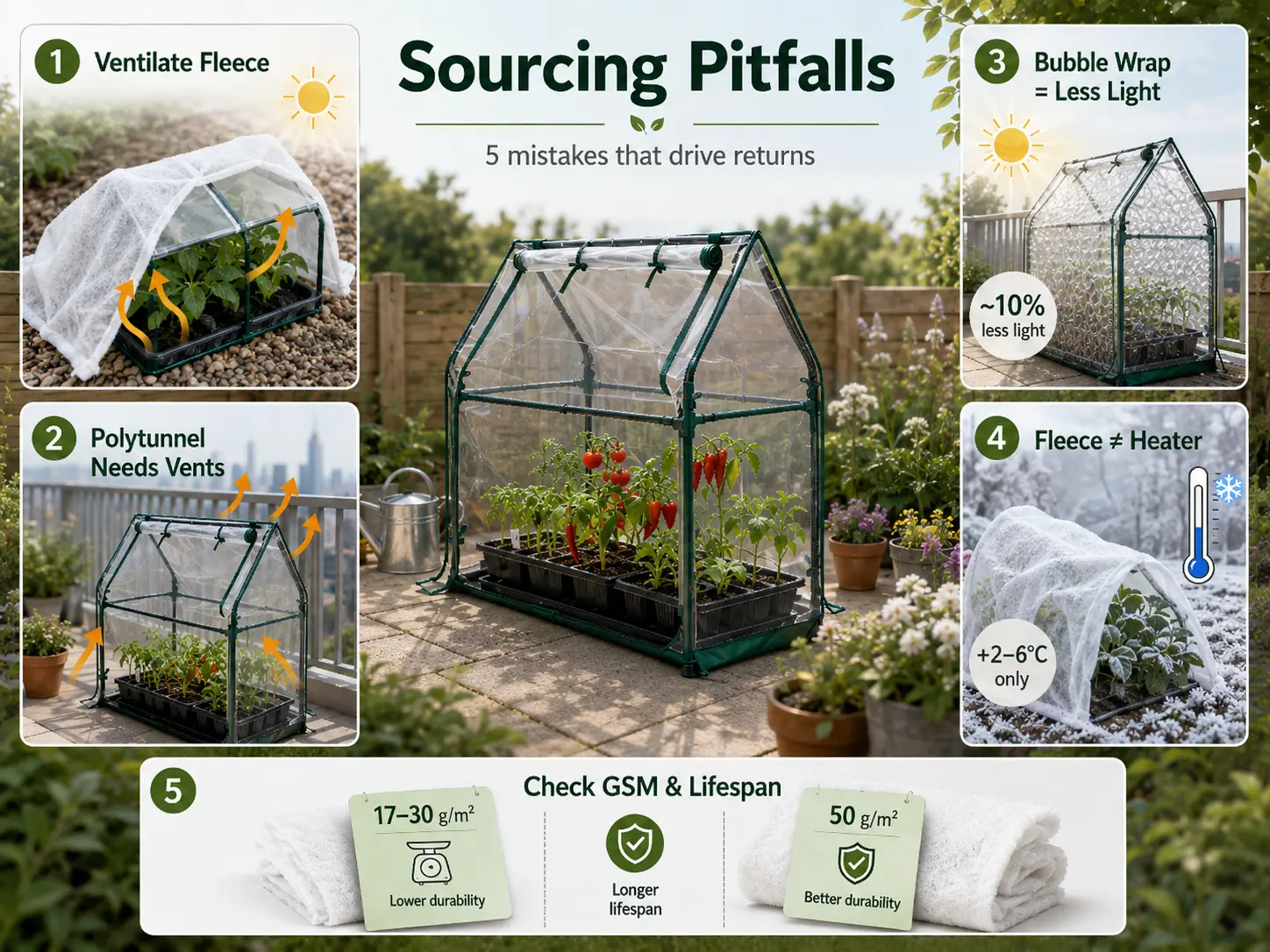
1. Fleece Ventilation — Covering Without Opening Is Deadlier Than Not Covering
Unventilated fleece on a sunny day can push internal temperatures above 40°C. The RHS advises opening fleece during warm weather. When sourcing, confirm: does your fleece packaging include a ventilation warning? If not, return rates will teach your customers this lesson for you.
2. Polytunnel Overheating — Low Structures Are More Dangerous Than Tall Greenhouses
Polytunnel internal temperatures on a sunny day can be 10–20°C above ambient. A September afternoon at 20°C outside can push the polytunnel to 35–40°C within hours — if your customer has autumn vegetables inside, that’s enough heat damage in thirty minutes to undo weeks of growth. Low structures concentrate hot air more than tall greenhouses, making overheating faster and more severe. Ventilation design is essential — end doors, side-roll film or top vents.
When sourcing, confirm: does the polytunnel have ventilation openings? Can end doors be opened? Can side film be rolled up? A polytunnel without ventilation on a sunny September day is an oven.
3. Bubble Wrap Light Reduction — Approximately 10% Less Light, a Trade-Off in Winter
The RHS confirms that bubble wrap reduces approximately 10% of light transmission. With winter light already weak, that 10% can affect plant growth. The RHS judges it “usually worth it” — but “usually” doesn’t mean “always.” If your customers grow light-sensitive crops (tomatoes, peppers), they need to weigh insulation against light.
When sourcing, confirm: is the bubble wrap single or double layer? Single layer reduces about 10% light, double layer about 20% — double is warmer but costs more light.
4. Fleece Is Not a Substitute for Greenhouse Heating — It Only Raises 2–6°C
This is the most common source of customer complaints. Standard fleece works in light frost conditions (raises 2–4°C), heavy-duty fleece in moderate frost (raises 4–6°C). But for overwintering tropical or subtropical plants (which need to stay above 10°C), fleece alone isn’t enough — you need a greenhouse plus heating.
When sourcing, confirm: does your product packaging state the insulation range? Fleece without a stated range leads to inflated customer expectations.
5. Fleece Lifespan — Standard Grade Lasts Only 1–2 Seasons
Standard 17–30 g/m² fleece becomes brittle and tears after 1–2 seasons under UV exposure and weather. Heavy-duty 50 g/m² lasts 2–3 seasons. Don’t source on unit price alone — standard fleece is cheaper, but if customers expect “buy once, use for three years,” the returns and bad reviews in year two are yours.
When sourcing, confirm: what’s the weight in g/m²? Is expected lifespan stated?
FAQ
What’s the difference between fleece and insect mesh?
Different functions. Fleece primarily insulates against frost — it’s breathable but doesn’t exclude insects. Insect mesh primarily blocks pests physically — it’s breathable but provides minimal insulation (only about 0.5–1°C). If a customer needs both “insect exclusion + frost protection,” layer insect mesh first, then fleece on top — two layers, each doing its job.
What’s the difference between a tunnel cloche and a polytunnel?
Height and access. Tunnel cloches are 30–50 cm tall — you can’t walk inside, you access plants by lifting one side. Polytunnels are 2–2.5 m tall — you walk inside to work. The former is inexpensive (6 hoops + a roll of film); the latter is a semi-permanent structure. For home gardeners, tunnel cloches are more practical. For commercial growers, polytunnels are the better choice.
What can still be planted in September?
Overwintering vegetables: kale, winter spinach, garlic, onion sets. These crops keep going until December or through the winter under fleece or tunnel cloches. Bulbs (tulips, daffodils, crocuses) go in September–November for spring flowering — bundle with fleece as “plant hope + protect it through winter.”
How do you attach bubble wrap inside a greenhouse?
Use specialist clips or clear tape to fix it to the inside of the greenhouse frame, bubble side facing the glass. Don’t attach it outside — wind and rain will pull it off. The RHS recommends partitioning a large greenhouse with timber battens and bubble wrap to create a smaller zone that can be heated efficiently — far more energy-efficient than heating the whole structure.
Fleece covers vs polycarbonate panels for raised bed covers — which makes more sense for B2B?
Different trade-offs. Fleece covers are cheap, lightweight and flat-pack — low shipping cost, high margin per cubic metre of cargo space, but they last 1–2 seasons and customers replace them. Polycarbonate panel covers are durable (5+ years), provide better insulation, but they’re bulky to ship and the unit cost is significantly higher. For a first order, fleece covers are the lower-risk entry — you can always add PC panel options once you know the market. The key sourcing question: does the cover frame match the raised bed dimensions you already sell? If it doesn’t, you’re selling two separate products instead of one upgrade path.
Next Step: Prepare Season-Extension Solutions for Your Customers
The heatwave taught your customers sun protection and hydration. The storms taught them securing and support. Now autumn arrives — and they need a third lesson: insulation and continuation. Fleece, tunnel hoops, raised bed covers, greenhouse insulation — these aren’t “winter products.” They’re the insurance that stops everything your customers invested during the heatwave from being wiped out by the first frost.
Three things you can do now:
- Get the season-extension product list. Tell Scarecrow your target market and climate zone. We’ll send a curated SKU list — fleece (in various weights), tunnel hoops, cold frames, raised bed covers, bubble wrap, mini greenhouses — all with specifications, matched to your climate zone needs. → Request your product list
- Order a season-extension comparison sample box. Different fleece weights feel completely different in hand, and bubble wrap vs polycarbonate insulation needs to be seen side by side. Scarecrow can consolidate samples from multiple suppliers — 17 g vs 30 g vs 50 g fleece, standard vs heavy-duty PE film, single vs double-layer bubble wrap — so you can compare before committing. → Request your sample box
- Build a season-extension combo order. Fleece + tunnel hoops + ground pegs + raised bed cover is a complete solution, not four separate products. Scarecrow can consolidate these items from different factories into a single shipment — your customer receives a “keep growing after summer” solution, not a bag of parts. → Contact us about season-extension combo orders
Your customers have already learned to protect their plants from the heat. Now help them extend the growing season beyond the first frost.
Looking for the Right Heat-Insulation and Water-Saving Products?
Want to know which heat-insulation and water-saving products are suitable for your target market? Discuss your target country and retail model with us — we can help you plan the right product mix.

Written by
ScarecrowGarden
💡About Scarecrow Garden Supplier Co., Ltd.
Scarecrow Garden Supplier Co., Ltd. is a China-based sourcing and wholesale partner specializing in garden tools, landscaping equipment, and outdoor supplies for international wholesalers, distributors, contractors, and brands.
With hands-on experience rooted in real garden use scenarios, we focus on durable materials, functional design, and stable large-volume supply. Our product range covers pruning tools, watering systems, hand tools, outdoor hardware, and customized garden solutions to support both retail and professional landscaping markets.
Beyond products, we help our partners navigate supplier selection, quality control, compliance requirements, and long-term sourcing strategies in China. Through our blog, we share practical insights on product selection, material comparisons, industry trends, and cost-effective purchasing—helping global buyers build stronger, more competitive supply chains.