






Storm-Ready Plant Supports Wholesale: B2B Crop Protection Guide | Scarecrow Garden Supplier
A customer walks in and says her tomatoes are all on the ground. Not from the heat — from the thunderstorm that hit after the heatwave. Two days earlier, those tomatoes were struggling through 40°C, barely hanging on. Then a half-hour of heavy rain and gusting wind ripped the two-metre stakes out of the ground and left the fruit sitting in mud.
She asks: is there anything that keeps plants standing through a storm?
Your customers think the heatwave is the biggest threat. But the thunderstorms, high winds and hail that follow a heatwave are the “second hit” — and most people are completely unprepared for it.
During a heatwave, plants exhaust their reserves: cell turgor drops, stems lose water and become brittle, root systems suffer in the heat. Then a storm arrives, and it’s like shoving someone who’s just finished a marathon — they go down faster and harder than they would have otherwise.
This article is about that second hit: why post-heatwave storms are highly likely, which plants are most vulnerable, what products keep them standing, and what to watch out for when sourcing.
This article is part of our series on how Europe’s hotter summers are changing garden product sourcing. For heatwave-specific products, see our guide to heatwave gardening products for European garden centres. For raised beds and planters as a climate-adapted growing environment, see raised beds and planters for hotter, drier and stormier gardens.
After the Heat Likely Comes the Storm — This Isn’t Coincidence, It’s Physics
European heat dome events don’t happen in isolation. In late July 2025, central, eastern and Balkan Europe saw moderate to heavy rainfall after sustained high temperatures — localised downpours of 40–80 mm, accompanied by intense short-duration rain and thunderstorm-force winds. This wasn’t random. It’s the physical consequence of a heat dome collapsing.
The mechanism is straightforward: a heat dome is a high-pressure system in the upper atmosphere that traps hot air near the ground. When that high-pressure system weakens or shifts, the accumulated hot air rises violently, meets cooler air, and triggers severe convective activity — thunderstorms, gusting winds, hail. All at once.
For your customers, this means one thing: the shade nets and drip irrigation they bought during the heatwave can become useless in a storm — if they’re not properly secured. Shade nets torn by wind, drip lines blown askew, planters knocked over — these aren’t product quality issues. They’re securing and protection failures.
Your customers learned “sun protection” and “water management” during the heatwave. Now they need a third lesson: securing and supporting.
If you’re stocking up for storm season, Scarecrow can help you put together a SKU list for support and protection products — stakes, insect mesh, ground pegs, securing accessories — matched to your market and channel. → Get your storm protection product list
Plant Support — Keep Your Tomatoes Off the Ground
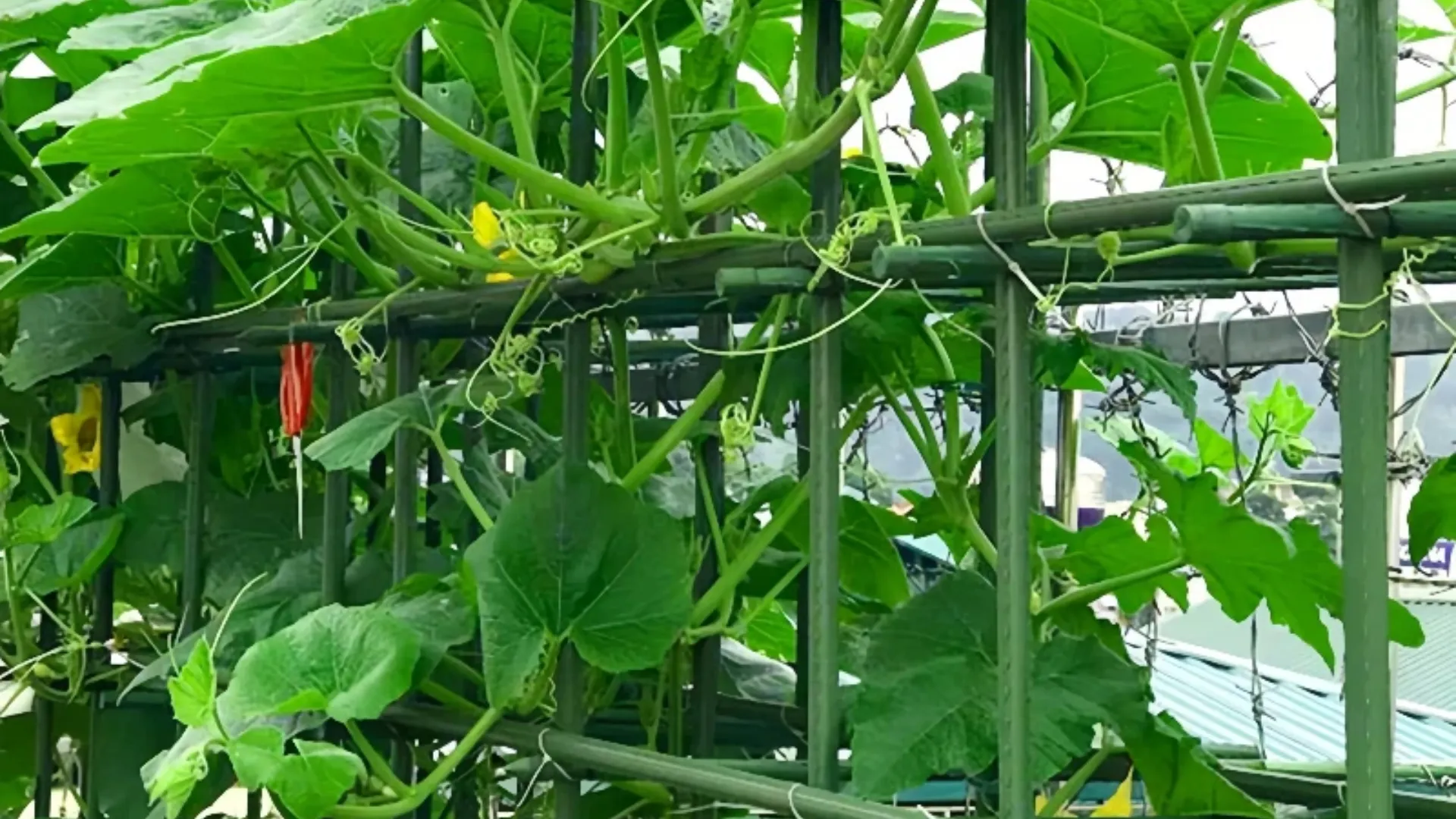
When a tomato plant goes down, it’s not just “a plant fell over.” Fruit touching the ground rots within days. Stems that snap mean the entire plant is lost. Rain-splashed mud spreads late blight — a single thunderstorm can wipe out an entire summer’s harvest.
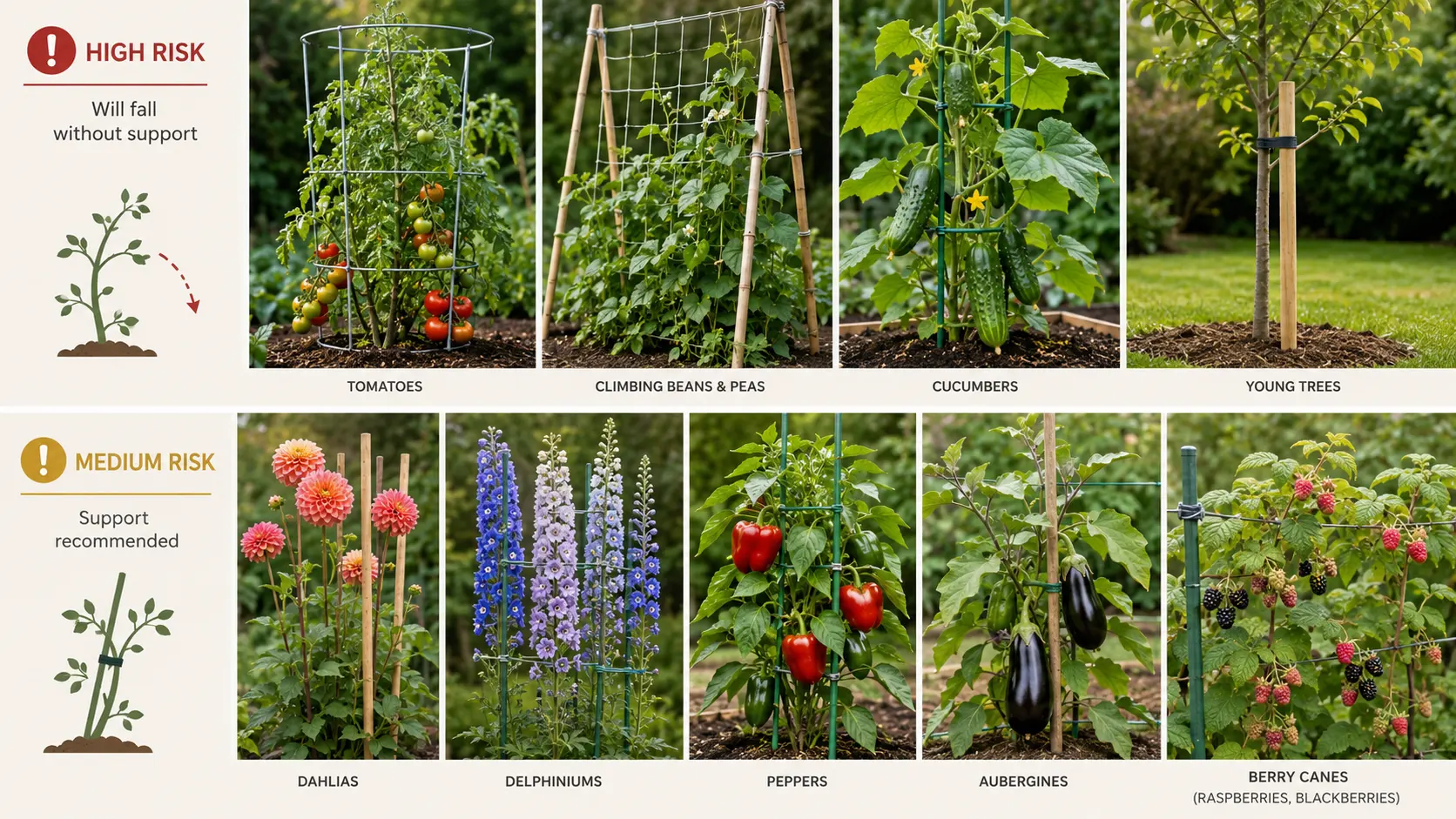
Which Plants Need Support
High risk — will fall without support:
- Tomatoes (cordon varieties can reach 2 m+; heavy fruit; snap easily in wind and rain)
- Beans and peas (climbing stems; blow over in any gust)
- Cucumbers (vining habit; heavy fruit; rot on contact with soil)
- Young and newly planted trees (root systems not yet established)
Medium risk — support recommended:
- Tall ornamentals (dahlias, delphiniums, etc.)
- Peppers and aubergines (when fruit is heavy)
- Berry bushes (blackberries, raspberries during fruiting)
If your customer base is vegetable-garden oriented (Germany, Poland, Czech Republic, Hungary and other central European markets), tomato cages and stakes are not optional — they’re prerequisites. You don’t sell these as “recommended accessories.” You sell them as “don’t grow tomatoes without these.”
Choosing the Right Support Products
| Product | Material | Best For | Sourcing Notes |
| Garden stakes | Bamboo/wood/PVC-coated steel/galvanised steel | Single-plant support (tomatoes, young trees) | PVC coating prevents rust; bamboo is eco-friendly but short-lived |
| Tomato cages | Galvanised wire/powder-coated steel | Tomatoes, peppers | Powder coating outlasts bare wire; 3–4 rings, 30–45 cm diameter |
| Spiral tomato stakes | Galvanised/coated steel | Tomatoes (no tying needed) | Plant climbs naturally; reduces labour |
| Trellis netting | HDPE / nylon | Beans, cucumbers, peas | White net is more visible, reducing accidental cutting; 10×15 cm to 15×20 cm mesh |
| Obelisks | Wrought iron/powder-coated steel | Climbing flowers, container plants | Decorative + functional; 0.4–0.6 m wide, 1.5–2.5 m tall |
| Plant clips | Plastic/spring steel | Attaching stems to supports | Quick-release clips are reusable |
| Soft ties | Rubber-coated wire/foam wire | Securing without damaging stems | Safer than bare wire; won’t cut into stems |
Critical Warning: Over-Supporting Kills Trees
This may be the most important warning in this article: Rigidly staking young trees weakens trunk strength.
A sapling held rigidly in place never experiences the sway that triggers trunk thickening and root anchoring. When the stakes come off, it’s less able to withstand wind than a tree that was never staked at all. This is the “use it or lose it” principle — trunks need moderate movement to develop strength.
The right approach: use flexible ties (soft ties) that allow some sway. Rigid support should only be used for the first growing season after planting, then gradually removed.
China Supply Chain Advantage
Wrought iron arches and climbing frames are a strength of the Chinese supply chain. Jinhua (Zhejiang) and Anxi (Fujian) are the main production hubs, with specifications ranging from 0.8 m to 3.5 m wide and 2.0–2.5 m tall, heavy-gauge iron with anti-rust treatment. These products sell in European garden centres on their “decorative plus functional” dual value — they’re not just supports, they’re garden features.
Insect Mesh — Not Just for Insects, the First Line of Defence in a Storm
Most buyers know insect mesh keeps out cabbage white butterflies and flea beetles. But the RHS (Royal Horticultural Society) confirms something many people don’t: insect mesh also provides wind, rain and hail protection.
This isn’t marketing spin. It’s physics:
- Wind reduction: the mesh structure breaks up airflow, reducing wind speed
- Rain protection: intercepts large raindrops, reducing soil structure damage and mechanical injury to seedlings
- Hail protection: mesh disperses hailstone impact, preventing leaves from being punctured
- Reduced soil splash: during heavy rain, mud doesn’t splash onto leaf crops — which also reduces disease transmission (particularly tomato late blight, which spreads through rain splash)
The RHS also notes that insect mesh provides better control of carrot fly and cabbage root fly than pesticides. For European markets that are actively reducing pesticide use, this is a hard selling point.
Since insect mesh is a three-in-one product, getting the right specification is even more critical — mesh size determines what it actually stops.
Mesh Size Selection Guide
Mesh aperture is the single most critical specification for insect mesh — get it wrong and you’ve bought something useless. Too small and ventilation suffers, causing overheating in summer; too large and target pests walk straight through.
| Target Pest | Recommended Aperture | Notes |
| Cabbage white butterfly, diamondback moth | 0.6–0.8 mm | Good ventilation; suitable for spring/autumn brassicas |
| Aphids, whitefly | 0.3–0.4 mm | Balances ventilation and pest exclusion; general-purpose choice |
| Thrips, leafminers | <0.25 mm | Requires supplementary cooling; avoid in midsummer without ventilation |
| Diamondback moth (slender body) | <0.3 mm | Adult body length 6 mm but slender enough to pass through a larger mesh |
European market reference — Wondermesh UK product range:
- Standard: 1.33 mm mesh (large moths and butterflies)
- Medium: 0.8 mm mesh
- Fine: 0.6 mm mesh (available in 45 g and 90 g/m² weights)
- Ultra-fine: 0.3 mm mesh (thrips protection)
Material and Lifespan
- HDPE (high-density polyethylene): most common, UV-stabilised, 3–6 year outdoor lifespan
- Silver-grey mesh provides 20–25% shading and has aphid-repelling properties
- According to Chinese agricultural trial data, mesh achieves 94–97% exclusion of cabbage caterpillars and diamondback moth, and approximately 90% exclusion of aphids
Critical Warning: Smaller Mesh Means Less Ventilation
A mesh with an aperture below 0.3 mm can cause overheating inside the covered area during summer. If your customers use ultra-fine mesh during a heatwave, they must provide supplementary ventilation or cooling — otherwise they exclude the insects and cook the plants.
Your customers bought shade nets and drip irrigation during the heatwave — now they need to secure those items and add insect mesh to their vegetables. Scarecrow can consolidate stakes, insect mesh, ground pegs and securing accessories into a complete storm protection kit, inspected and packed at our warehouse, shipped in one go. → Talk to us about storm protection combo orders
Wind Protection and Securing — Unsecured Nets and Covers Are Useless
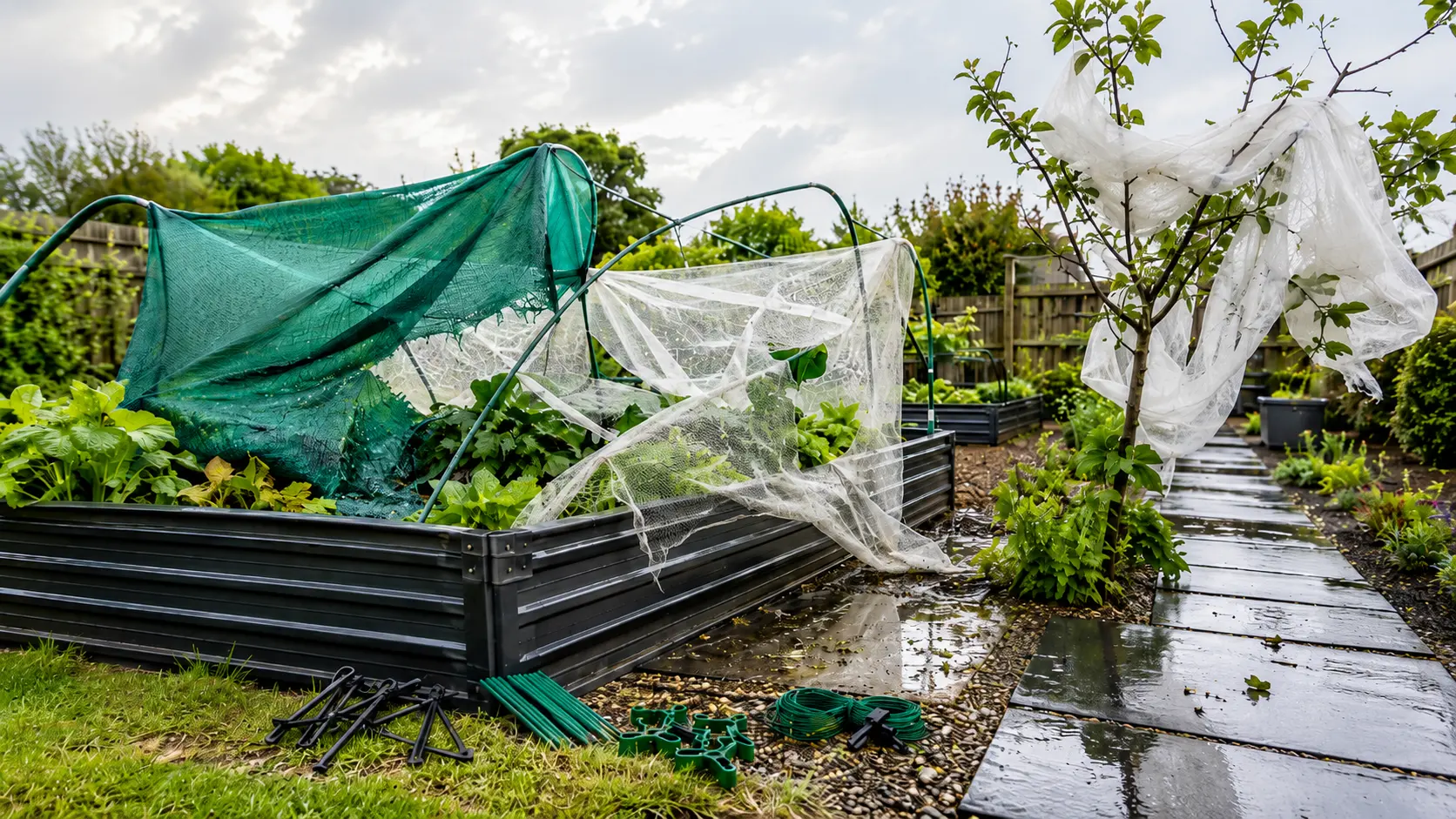
What’s the most common sight after a thunderstorm?
Not plants blown over — shade nets gone, insect mesh torn, fleece wrapped around the neighbour’s tree.
The products themselves are fine. The problem is securing. A container of shade nets, insect mesh and fleece arrives from different factories, but ground pegs, hoops and securing accessories are often overlooked — because buyers figure they’ll “just weigh it down with something.”
That doesn’t work. Wind isn’t something you “weigh down.”
Choosing the Right Security Products
| Product | Material | Function | Sourcing Notes |
| Ground pegs | Galvanised steel/plastic | Securing nets, fleece, and tunnel hoops | Galvanised steel is far more secure than plastic; minimum 15 cm length |
| Tunnel hoops | Galvanised steel / PVC pipe | Supporting insect mesh/fleece to form mini tunnels | Bundling hoops with mesh is a growing trend; 6 hoops per set cover a 3 m row |
| Windbreak netting | HDPE | Reduces wind speed by up to 50–80%, depending on specification | Must allow 10–20% airflow — solid barriers create stronger turbulence on the leeward side |
| Fleece | Polypropylene non-woven | Frost, wind and heavy rain protection | Lightweight enough to lay directly on plants; 17–30 g/m² standard, 50 g/m² heavy-duty |
The “Permeability” Mistake — The Most Common Error with Windbreak Netting
Buyer intuition says: the denser the windbreak, the better — block all the wind. Wrong.
A completely solid windbreak creates turbulence on the leeward side — wind speed can actually be higher than with no barrier at all. The correct approach is to allow 10–20% airflow, letting some wind pass through slowly and creating a calm zone on the downwind side. This is the same principle used in shelterbelt design: not a solid wall, but a permeable barrier.
When sourcing, confirm with the factory: what’s the weave density? What’s the airflow percentage? Don’t just look at “shading rate” — shading rate and airflow rate are not the same thing.
Reinforced Shade Netting — Dual Function in a Storm
Standard shade netting tears easily in strong winds. Reinforced shade netting has structural ribs woven into the warp and weft — according to Chinese field testing data, it can withstand force 8 gales. For European markets where heatwaves and thunderstorms occur in quick succession, reinforced netting isn’t an “upgrade option” — it’s the standard specification.
Different Markets, Different Priorities
Storm protection isn’t a one-size-fits-all product mix. Different regions face different “second hits,” and your stocking priorities should reflect that.
| Region | Storm Profile | Stocking Priority |
| Germany / Poland / Czech Republic / Hungary / Romania | Post-heat convective storms + heavy rain | Tomato cages, stakes, insect mesh, ground pegs — strong vegetable garden market |
| UK / Netherlands / Belgium | Sustained gales + persistent wind + wet | Windbreak netting, soft ties, planter anchors — large container plant market |
| France / Italy / Spain | Post-heat convective storms + pest outbreaks | Stakes, insect mesh, shade net securing accessories — pest pressure spikes after heat |
| Scandinavia (Sweden / Denmark / Finland) | Autumn gales + early frost | Fleece, tunnel hoops, ground pegs — frost can arrive as early as September |
Stocking timeline note: Storm protection products have a shorter sales window than heatwave products. Heatwave items sell from May onwards, but storm protection concentrates in July–September — after the heat, before the frost. If you’re sourcing from China, ordering now hits the window.
Retail Kits — Sell Solutions, Not Individual Items
Your customers don’t want to buy a tomato cage, insect mesh, ground pegs and soft ties separately. They want a “keep my vegetables alive through the storm” solution.
Tomato and Vegetable Protection Kit
- 3× galvanised steel tomato cages (or spiral stakes)
- 1× soft tie roll (5 m)
- 1× pack of plant clips (20 pcs)
- 1× insect mesh roll (0.8 mm mesh, 2×5 m)
- 10× ground pegs
- Optional add-on: tunnel hoops (6 pcs/set)
Cross-Sell Opportunities
| Combination | Logic | Basket Value Lift |
| Stakes + insect mesh + ground pegs | Complete vegetable protection | Single stake → three-piece kit |
| Tomato cages + fleece | Season extension into autumn | Summer product → autumn repeat purchase |
| Obelisk + trellis netting + soft ties | Garden decoration + support | Decorative → functional category |
| Shade net + insect mesh + securing accessories | Heatwave-to-storm full coverage | Single shade net → three-piece kit |
Online product page title suggestion: “Storm-Ready Vegetable Protection Kit — Cages + Mesh + Pegs + Ties.” Your customers aren’t searching for “tomato cage” after a heatwave — they’re searching for “how to keep tomatoes alive in a thunderstorm.”
Sourcing Pitfalls — Five Mistakes That Directly Affect Returns
These are the most common sourcing errors — each one has a direct impact on return rates and customer complaints.
1. Over-Supporting Trees — Rigid Staking Weakens Trunks
The “use it or lose it” principle was covered earlier. Here’s what to confirm at sourcing:
Are your soft ties rubber-coated wire or bare wire? Bare wire can cut into stems, causing ring-barking — effectively girdling the plant. Don’t source ties on price alone.
2. Insect Mesh Ventilation — Excluding Pests, Cooking Plants
A mesh with an aperture below 0.3 mm can cause overheating inside the covered area during summer. If your customers use ultra-fine mesh in July–August, you need to remind them: open the sides for ventilation when temperatures exceed 25°C, or combine with shade netting.
When sourcing, confirm: how many mesh sizes do you stock? Carrying only the “finest” mesh seems universal, but it has the highest summer return rate.
3. Windbreak Permeability — Solid Barriers Make Things Worse
Windbreak netting must allow 10–20% airflow. A completely solid barrier creates stronger turbulence on the leeward side than no barrier at all.
When sourcing, confirm: what airflow percentage does the factory specify? Don’t confuse “shading rate” with “airflow rate” — they measure different things.
4. Ground Peg Material — Plastic Pegs Snap in Frozen Ground
Galvanised steel ground pegs cost only slightly more than plastic, but they perform completely differently in hard, frozen or compacted soil. Plastic pegs snap when driven into autumn’s frozen ground — by then, your customer has no time to reorder.
When sourcing, confirm: peg length at least 15 cm, material is galvanised steel, not plastic.
5. Tomato Late Blight — The Hidden Killer After Heatwave-Then-Rain
Warm, humid conditions (heatwave followed by heavy rain) create perfect conditions for tomato late blight outbreaks. Insect mesh can reduce rain-splash transmission — but only if it’s in place before the rain arrives. If your customers didn’t cover their tomatoes during the heatwave, covering after the storm is too late.
When sourcing, confirm: does your insect mesh packaging mention “rain and splash protection”? That feature is a stronger selling point in European markets than “insect exclusion” alone.
FAQ
Does insect mesh really reduce wind?
Yes, but effectiveness depends on installation. Loosely draped mesh provides limited wind reduction — it needs to be tensioned over stakes or tunnel hoops to form a taut surface. The RHS confirms that insect mesh can intercept large raindrops, reduce hail impact and lower wind speed. It’s not a dedicated windbreak, but as a three-in-one “insect + wind + rain” product, it offers exceptional value for home gardens.
Tomato cages or spiral stakes — which is better?
It depends on the tomato variety. Cordon types (single-stem) work well with spiral stakes — the plant climbs naturally without tying. Bush types (determinate) are better suited to tomato cages — multi-directional support. If you stock only one, choose cages — they’re more versatile. But spiral stakes have a strong retail appeal with their “no tying needed” selling point.
Where should windbreak netting be positioned in a garden?
On the windward side. The effective protection distance of a windbreak is approximately 5–8 times its height — a 1.5 m tall windbreak protects plants within approximately 8–12 m downwind. Don’t place it in the middle of the garden — half the garden will be protected, and the other half exposed to turbulence.
How much more does reinforced shade netting cost compared to standard?
Based on Chinese supply chain data, reinforced netting costs approximately 20–30% more than standard netting of the same specification. But factoring in replacement cost — standard netting torn by wind needs to be repurchased and reinstalled — reinforced netting often has a lower total cost over the season. For the European market, we recommend reinforced netting as the default specification.
How much wind can a wrought iron garden arch withstand?
It depends on the installation. The arch itself is structurally strong — the weak point is anchoring. Ground-insertion arches (pushed directly into soil) can loosen in strong wind; expansion-bolt arches (fixed to hard surfaces) are far more stable. When sourcing, confirm: how deep are the ground inserts? Are reinforcing base plates included?
Next Step: Prepare Storm Protection Solutions for Your Customers
The heatwave taught your customers about sun protection and water management. But the thunderstorms, high winds and hail that follow are the second hit — and most of them are completely unprepared. Stakes, insect mesh, ground pegs, securing accessories — these aren’t “add-ons.” They’re the insurance that stops everything your customers invested during the heatwave from being wiped out by a single storm.
Three things you can do now:
- Get the storm protection product list. Tell Scarecrow your target market and customer type. We’ll send a curated SKU list — tomato cages, spiral stakes, insect mesh (in various mesh sizes), ground pegs, soft ties, tunnel hoops, wrought iron arches — all with specifications, matched to your channel needs. → Request your product list
- Order a protection product comparison sample box. Different materials and mesh sizes feel completely different in hand. Scarecrow can consolidate samples from multiple suppliers — 0.3 mm vs 0.6 mm vs 0.8 mm insect mesh, galvanised steel vs plastic ground pegs, standard vs reinforced shade netting — so you can compare side by side before committing. → Request your sample box
- Build a storm protection combo order. Stakes + insect mesh + ground pegs + soft ties is a complete solution, not four separate products. Scarecrow can consolidate these items from different factories into a single shipment — your customer receives a “keep vegetables alive through the storm” solution, not a bag of parts. → Contact us about storm protection combo orders
Your customers have already learned to protect their plants from the heat. Now help them survive the second hit.
Plan the Right Product Mix for Your Market
Want to know which heat-insulation and water-saving products are suitable for your target market? Discuss your target country and retail model with us — we can help you plan the right product mix.

Written by
ScarecrowGarden
💡About Scarecrow Garden Supplier Co., Ltd.
Scarecrow Garden Supplier Co., Ltd. is a China-based sourcing and wholesale partner specializing in garden tools, landscaping equipment, and outdoor supplies for international wholesalers, distributors, contractors, and brands.
With hands-on experience rooted in real garden use scenarios, we focus on durable materials, functional design, and stable large-volume supply. Our product range covers pruning tools, watering systems, hand tools, outdoor hardware, and customized garden solutions to support both retail and professional landscaping markets.
Beyond products, we help our partners navigate supplier selection, quality control, compliance requirements, and long-term sourcing strategies in China. Through our blog, we share practical insights on product selection, material comparisons, industry trends, and cost-effective purchasing—helping global buyers build stronger, more competitive supply chains.