









Heatwave Garden Supplies Wholesale: Summer Inventory Guide for Garden Centres | Scarecrow Garden Supplier
It is Monday morning after the first 40°C weekend. Your garden centre’s return counter has a queue. A woman holds a crisp brown hydrangea — leaves curled, flowers drooping past recovery. A man carries a shade net still in its plastic sleeve, complaining that it came with nothing to attach it with. Your plant area has gaps on the shelves where potted stock was sitting on Friday.
By afternoon, the damage has spread beyond your car park. Your Google Business profile has two new one-star reviews: “Bought a hydrangea on Saturday, dead by Sunday — no care advice given” and “Shade net with no fittings, useless.” Someone has posted a photo of a scorched fuchsia on the local community Facebook group with your name tagged. Your online shop has three return requests before lunch.
This is not a hypothetical Monday. In June 2026, WMO confirmed a record-breaking heatwave across Europe. France hit a national average temperature record on 24 June. England and Wales had just come through their warmest spring on record. The heat arrived earlier and hit harder than most garden centres were stocked for.
The heat is real. The question is what your shop looks like when it arrives.
When a heatwave hits, your customers do not browse — they arrive with problems. And when they do not find solutions, they do not just return the product. They leave reviews. They post photos. The cost of being unprepared is not just lost sales — it is reputation damage that stays visible long after the weather breaks.
This article lays out what to stock, where to put it, and how to help your customers use it — so that next Monday, the queue at your return counter is shorter, your review profile stays clean, and the queue at your till is longer.
The Five Product Zones Your Garden Centre Needs This Summer
Most garden centres organise by product category: watering in one aisle, netting in another, plant care in a third. That works in a normal summer. In a heatwave, your customer is not browsing categories — they are looking for a solution to one urgent problem: “How do I keep my plants alive this week?”
Reorganise your floor around five zones. Each one answers a different question your customer is already asking.
Zone 1: Entrance — The Heatwave Rescue Display
This is your first impression. A customer walking in during a 38°C week should see, immediately, that you understand what they are dealing with.
What to put here:
- Pre-packed Heatwave Plant Rescue Kit (standard 7-piece and upgraded 10-piece — detailed later in this article)
- Shade net rolls with fixing clip packs displayed alongside, not in a separate aisle
- A sign: “Is your garden struggling in the heat? Start here.”
Why the entrance: Your customer is stressed. They do not want to hunt through aisles. Put the answer in their path the moment they walk in. This is also the zone online shoppers see first if you photograph it for your homepage or social media — one image of a ready-made rescue kit communicates more than ten individual product shots.
Zone 2: Plant Area — Protection Next to What Needs Protecting
Your plant display is where the emotional connection happens — and where the damage is most visible. Customers see wilting hydrangeas and feel urgency. Put the solution right next to the problem.
What to put here:
- Shade net clips and tension kits on a hook strip beside shade-loving plants (hydrangeas, ferns, hostas)
- Plant saucers and self-watering pot inserts next to container plants
- A small printed card at the till point in the plant area: “Container plants need water daily in this heat. Ask us about drip kits.”
- Mulch mats or coco coir blocks beside newly planted stock
Why next to the plants: A customer who just picked up a hydrangea is primed to buy protection for it. If the shade clips are three aisles away, they may not make the connection — or may not find them. If they are right there, the add-on sale is nearly automatic.
Zone 3: Watering Solutions — Not Just Hoses and Cans
In a heatwave, the watering aisle needs to shift from “garden leisure” to “plant survival.” And in many European countries, hosepipe bans change what you can legally sell.
What to put here:
- Long-spout watering cans — the ban-compliant default
- Drip irrigation starter kits — may be exempt from hosepipe bans (check locally)
- Water butts and rain barrel connectors — free water, no restriction applies
- Soil moisture meters — the diagnostic tool most customers do not know they need
- Water-retaining granules in small retail packs — check certification for your market
Why reframe as survival: When a hosepipe ban is in force, selling a sprinkler is not just pointless — it signals that you are out of touch. Stocking drip kits and watering cans signals that you understand the regulatory reality your customer is living in. In the UK, some water companies exempt drip irrigation from hosepipe bans, but others include it in the restriction — your customer needs to check. France’s drought restrictions vary by département. Spain’s water management is handled at the basin and regional level. Your customer needs to know which rules apply to them — and so do you.
Zone 4: Greenhouse and Cold Frame — Cooling, Not Heating
So far we have covered the customer who walks in stressed and the customer who reaches for a plant. Now: the customer who already has a greenhouse — and thinks closing the door will help.
What to put here:
- External shade net (pre-cut to standard greenhouse sizes)
- Vent clips and automatic vent openers
- Shade paint or liquid shading compound
- Misting/fogging kits
- Max-min thermometers
Why cooling not heating: A max-min thermometer next to the shade net makes the case: when your customer sees 55°C on the dial, they buy the shade kit without persuasion.
Zone 5: Checkout — The Last-Chance Add-Ons
The till is where impulse purchases happen. In a heatwave, the impulse is not chocolate — it is a spray bottle.
What to put here:
- 1L plant misting spray bottles — the cheapest, most useful heatwave tool
- Small packs of water-retaining granules (50g retail packs)
- Heatwave care cards (printed, free — “Four things not to do in a heatwave”) — given with every plant purchase
- Shade net fixing clip packs — because the customer who already bought the net yesterday will be back for the clips today
Why the checkout: These are low-price, high-urgency items. Your customer may not have come in for a spray bottle, but when they see one at the till while paying for a plant, they will add it. The care card costs you almost nothing to print but may save a plant — and a review.
Five zones. Each one matches a moment in your customer’s heatwave journey: arriving stressed → seeing a plant they want to save → realising they need to water differently → remembering their greenhouse → grabbing one last thing at the till. Get these zones right, and your shop becomes the place that helped — not the place that sold them a plant and wished them luck.
Your customers are already walking in with problems. The products that solve those problems — shade net kits, drip irrigation, greenhouse cooling, care cards — need to be on your shelves before the next heatwave, not ordered after. Get a heatwave product list matched to your garden centre’s format, climate zone and floor plan. Tell Scarecrow what you need; we will send you a curated SKU list with specifications for all five zones.
Shade Net Kits: The SKU That Sells Out First
Shade netting is the product every customer wants in a heatwave — and the one most of them get wrong.
The problem is not the net itself. The problem is everything that comes after: how to attach it, how to tension it, how to take it down when the weather changes. Sell a shade net without fixings and you are selling half a product. Your customer will come back frustrated — or leave a review saying it was useless.
What a Complete Shade Net Kit Contains
A shade net that your customer can actually install needs these components:
| Component | Purpose | What to tell your customer |
| Shade net (3-needle silver-grey or 4-needle black) | The cover itself | Silver-grey reflects more heat; black gives a heavier shade for shade-loving plants |
| Fixing clips (8–12 per net) | Lock the net edge without tearing it | One press to lock, will not damage the net material |
| Nylon pull cord (×2) | Open and close the net like a curtain | Essential — without this, the net stays up 24/7 and plants starve for light |
| Steel wire rope (4mm) | Main support cable | Should be 1m longer than the net for proper tensioning |
| S-hooks | Connect the net to the wire rope | Height-adjustable so the net sits above the plants, not on them |
| Turnbuckles (tensioners) | Keep the net taut | Prevents sagging and wind damage |
| Wall anchors/expansion bolts | Fix the wire rope to walls or posts | Required at all four corners minimum |
The full fixing kit — wire rope, S-hooks, clips, turnbuckles, anchors — costs a fraction of the net itself. Selling them separately is like selling a lock without a key.
The Five Mistakes Your Customers Make with Shade Netting
These are the problems that generate returns, complaints, and one-star reviews. Your staff should know them, and your packaging should prevent them.
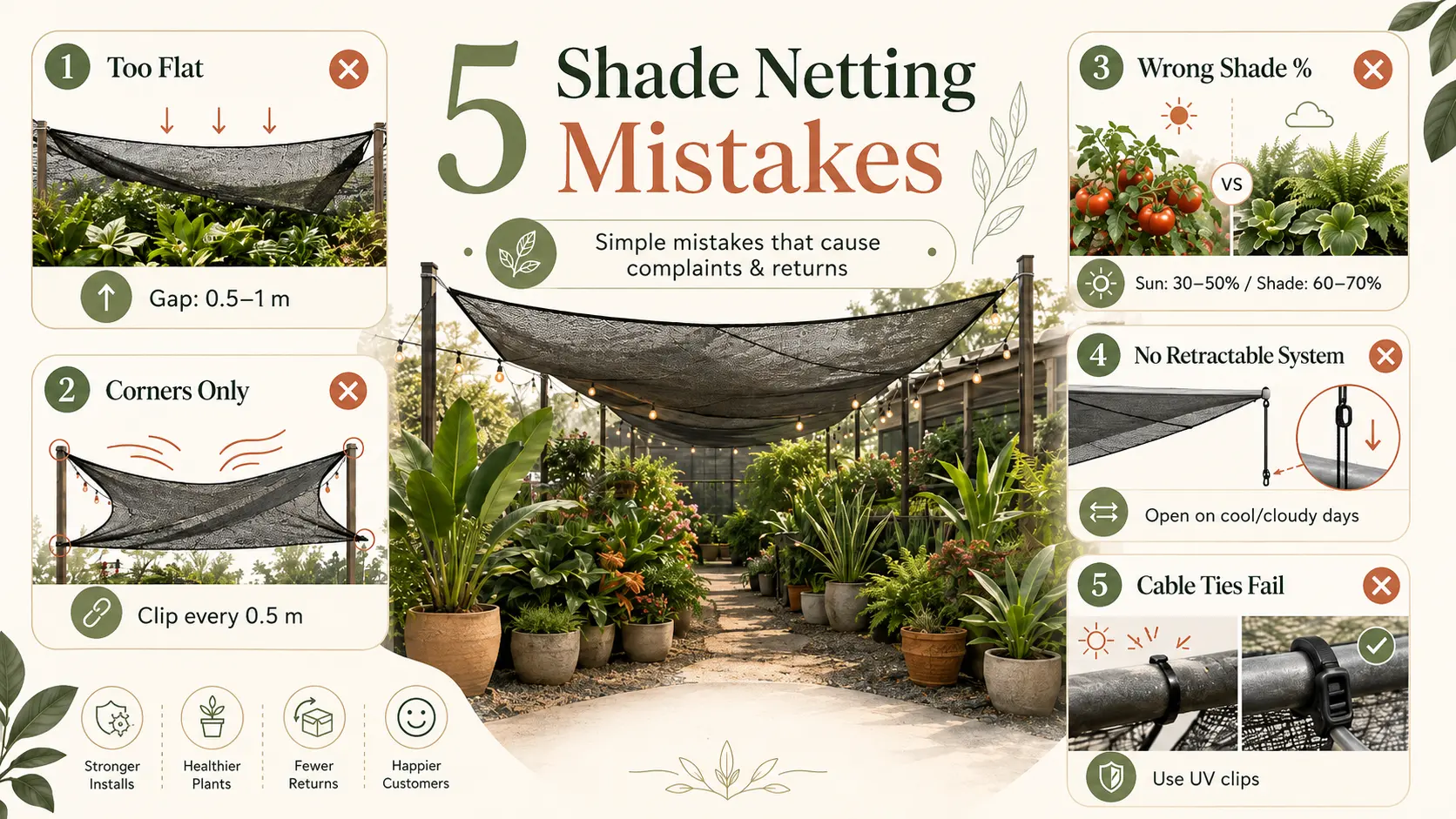
1. Fixing the net flat against the roof or plant canopy. When the net sits directly on the surface, heat conducts straight through. The gap between net and plant is what creates the cooling effect — shade net mounted 0.5–1m above the canopy can lower the temperature beneath it by 5°C or more under typical garden conditions — a spacing refined through decades of commercial greenhouse practice in China’s hottest growing regions. Flat-mounted net is barely better than no net at all.
2. Fixing only the four corners. Wind catches the middle of an unsecured net like a sail. In a gust, the whole sheet tears free — and may take your customer’s newly staked tomato plant with it. Fixing clips should be placed every 0.5m along each edge.
3. Choosing the wrong shade rate. A 6-needle black net (80%+ shade) on a tomato plant will produce tall, leggy growth and no fruit. Sun-loving plants need 30–50% shade; shade-lovers like ferns and hostas need 60–70%. Stock both, and label them clearly.
4. No retractable mechanism. A shade net that stays up all day, every day, starves plants of light. On overcast days or cooler weeks, your customer needs to open it. A pull-cord system takes 30 seconds to operate. Without one, the net either comes down entirely (and never goes back up) or stays up permanently (and the plants etiolate).
5. Using cable ties or ordinary string. UV exposure makes standard cable ties brittle — in strong UV conditions, they can fail within one summer. They snap, the net collapses, and the customer blames the product. Shade net fixing clips are UV-stabilised and designed to grip without piercing the material.
What Your Retail Packaging Should Look Like
The ideal heatwave shade net pack is a single box or hang-sell that contains:
- Shade net (2m×3m or 3m×5m — small enough for a patio, large enough for a bed)
- Fixing clips × 10
- Nylon pull cords × 2
- Illustrated installation card — showing the gap between net and plant, clip spacing, and the retractable cord system
Upgrade pack (displayed alongside): steel wire rope set + expansion bolts + turnbuckles — for customers fixing to walls or permanent posts.
One box. One purchase. One successful installation. That is how you avoid the “no fittings” review.
Greenhouse Cooling: The Mistake That Kills Plants Overnight
A small greenhouse — the 6×4ft or 8×6ft type that sits in thousands of European back gardens — is the most dangerous place for a plant during a heatwave. Not because it lacks cooling options, but because most owners do the one thing they should never do: close the door.
On a 35°C day, a closed greenhouse can reach 50°C in a matter of hours. At that temperature, plant cells begin to break down. Tomatoes stop setting fruit at 35°C. Leaves scorch at 40°C for many common garden plants. Many ornamental plants suffer fatal or permanent damage at 45°C. The greenhouse does not just fail to protect — it accelerates the killing.
Six Cooling Options, Ranked by What Your Customer Will Actually Do
Not every customer will install a wet-wall system. The question is: what will they realistically implement, and how much does it help?
| Method | Cost | Temperature reduction | Who this is for |
| Open the door, windows and roof vents | Free | 2–3°C | Every greenhouse owner — this is step one, not optional |
| External shade net over the roof | Low | 5–7°C | Every greenhouse owner — and it must be external, not internal |
| Shade paint / liquid shading | Low–medium | 3–10°C depending on dilution | Glass greenhouse owners — apply in spring, wash off in autumn |
| Internal circulation fan | Low | Improves air movement, prevents hot spots | Greenhouses with a power supply |
| Misting or fogging system | Medium | 5–8°C | Greenhouses with a water supply — effective in dry heat |
| Wet wall (cooling pad) + extractor fan | Medium–high | 5–10°C | Enclosable greenhouses with power and water — the serious option |
The first two rows are non-negotiable. If your customer does nothing else, opening all vents and draping an external shade net over the roof will keep most plants alive through a 3-day heatwave. Everything else is incremental improvement.
Three Things Your Customer Probably Does Not Know
External shade beats internal shade. An internal shade screen — the type that clips to the frame inside the greenhouse — still lets solar energy enter through the glass. The heat is inside before the screen can block it. An external net stops the energy at the glass surface. The difference can be 5°C or more inside.
A bucket of water on the floor helps. Evaporation from an open container of water inside the greenhouse raises humidity and lowers temperature by 1–2°C. It is not sophisticated, but it costs nothing and your customer can do it in five seconds.
Automatic vent openers are the best low-cost investment. A wax-filled cylinder that pushes the roof vent open when the temperature rises — no electricity, no programming, no app. They cost a few euros each and they solve the single biggest risk: the greenhouse that stays closed because nobody is home to open it.
Which Plants Die First — And Why It Matters for Your Shelf Tags
Three days. That is how long a sustained heatwave takes to cause real, visible damage to garden plants. Not three weeks. Not three months. Researchers studying heatwave impacts on trees have found that three consecutive hot days are enough to cause measurable harm. Garden plants — with shallower roots and less established systems — are even more vulnerable.
Knowing which plants fail first, and how fast, tells you two things: which plants need protection most urgently, and what shelf label to put next to them.
The Three Tiers of Heatwave Damage
Tier 1 — Fails in 1–2 days. These are the plants your customer will bring back on Monday — the ones that were fine on Friday and crisped over the weekend.
| Plant | What happens | Why it fails so fast | What to recommend |
| Hydrangeas | Leaves and flowers wilt → leaf edges scorch → entire leaves dry out | Shallow roots + massive leaf surface area for transpiration | Shade net + deep watering + mulch |
| Container plants (pots, hanging baskets) | Wilt → leaf scorch → roots “cook” | Root zone temperature is 5–11°C higher than in light-coloured pots | Move to shade + switch to light-coloured pots + water daily |
| Leaf vegetables (lettuce, spinach) | Bolt (flower prematurely) → leaves turn bitter → wilt | Begin bolting above 25°C for most common varieties | Harvest immediately + shade net over bed |
| Newly transplanted seedlings | Apparent death → root shock → die | Roots not established, no deep water access | Shade net + water-retaining granules + do not move |
Tier 2 — Fails in 3–5 days. These are the mid-week complaints — the customer who calls on Wednesday saying their tomatoes have dropped all their flowers.
| Plant | What happens | Why | What to recommend |
| Tomatoes | Pollen dies → flowers drop → no fruit set; leaf scorch at 45°C (tomatoes tolerate higher leaf temperatures than most ornamentals) | Pollen becomes sterile above 35°C; growth stops at 40°C | Shade net (30–50% rate) + mist flowers in the early morning |
| Japanese maples | Leaf scorch → early leaf drop | Shallow roots + large thin leaves | Deep root watering + shade |
| Rhododendrons, clematis | Leaves bleach white, then scorch | Cool-climate plants in acute heat shock | Shade + mist foliage in the evening |
| Soft fruit (strawberries, currants) | Fruit sunburn → sudden leaf drop | Excessive transpiration | Shade net over fruit + keep soil moist |
Tier 3 — Fails after 5+ days. These are the slow casualties — the ones your customer may not connect to the heatwave until it is too late.
| Plant | What happens | Why | What to recommend |
| Roses | Blind shoots, bud scorch, blackspot surge | Moderately heat-tolerant but vulnerable to heat + humidity disease | Fungicide after heatwave + remove damaged buds only |
| Conifers (spruce, fir) | Needles yellow and drop | Drought + spider mite attack | Deep watering + check for mites |
| Bulbs (tulip, lily) | Soil heat “cooks” the bulb → rot | Sustained high soil temperature | Mulch heavily to insulate the soil |
The Container Plant Problem — Your Biggest Hidden Loss
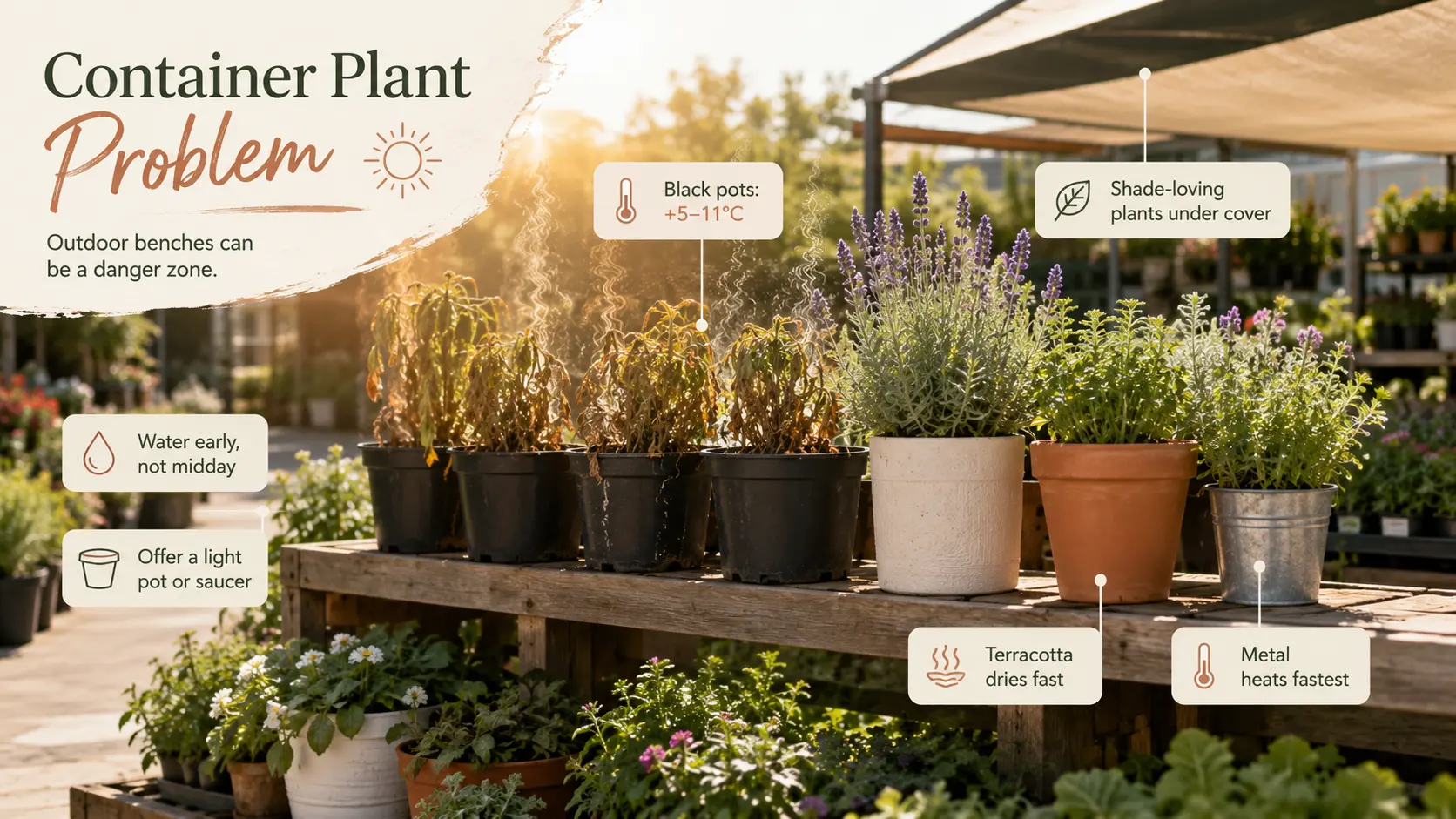
Container plants deserve special attention because they are the stock most likely to die on your own display benches — not just in your customers’ gardens.
A dark plastic pot in full sun can reach root-zone temperatures 5–11°C higher than in a light-coloured container. At 38°C outside, the roots inside a black pot may be experiencing temperatures that are lethal for most ornamental plants. That is lethal for most ornamental plants. Terracotta pots dry out fastest because the clay is porous. Metal containers conduct heat most aggressively and should carry a heatwave warning label.
What this means for your garden centre: During a heatwave, your outdoor plant display is a death zone for potted stock. Move shade-loving lines under cover. Water display stock at opening time, not midday. And when you sell a plant in a dark pot, offer a light-coloured pot or a plant saucer at the same time — it may be the difference between a living plant and a return.
Need help matching shade net, mulch, and watering SKUs to these plant tiers? Your customers buy plants first and protection second — but only if the protection is right there next to the plant. Scarecrow can map the right products to each tier and consolidate them in a single shipment. Send us your plant range and we will send back a matched protection product list.
What Customers Get Wrong — And How a Care Card Fixes It
Your customer is not stupid. They are doing what seems logical: the plant looks wilted, so they water it. The soil looks dry, so they water it again. The plant is struggling, so they feed it. Every one of these instincts is wrong in a heatwave — and every one of them will kill the plant faster than the heat itself.
The Four Things Not to Do During a Heatwave
These four rules should be on a card that goes out with every plant sold between June and September. They are not complicated. They are counter-intuitive — which is exactly why your customers need to be told.
1. Do not water at midday. When the soil surface is hot, cold water shocks the roots — causing “physiological drought” where the plant cannot absorb water despite it being available. At midday, a significant portion of the water you pour evaporates before it reaches the roots — overhead sprinkling in hot sun can lose 40–60% to evaporation and drift before water reaches the soil. Water early morning (6–8 a.m.) or after sunset. Not at lunch.
2. Do not fertilise. In extreme heat, most plants enter semi-dormancy. They cannot absorb nutrients. Fertiliser applied now sits in the soil, building up salt levels that burn the roots. If your customer insists on feeding something, a widely recommended safe option is a foliar spray of very dilute potassium dihydrogen phosphate (0.3% solution) — and even that should wait until evening.
3. Do not transplant or repot. Root disturbance plus high temperature equals near-certain failure. The plant cannot establish new root contact with the soil fast enough to take up water before the existing roots are damaged. Wait until temperatures drop below 25°C.
4. Do not prune heavily. Open wounds in high heat cannot heal. Pathogens enter. In drought-prone areas, pruning debris can even create a fire risk. Remove only dead flowers and clearly yellow leaves. Save the shaping for cooler weather.
The Six Mistakes Your Customers Make — Ranked by Damage
Beyond the four rules above, these are the specific behaviours that generate the most plant deaths and the angriest reviews:
- Seeing wilt and flooding the plant with water. The most common and most damaging mistake. Wilt in a heatwave is often heat stress, not water shortage. Overwatering a heat-stressed plant causes root rot — which is fatal, unlike temporary wilt, which the plant usually recovers from overnight.
- Watering at midday “to cool the plant down.” This is the same impulse as pouring cold water on someone who has heatstroke. It makes the situation worse.
- Feeding “to help the plant through the stress.” The plant is in survival mode. It cannot use the food. The fertiliser burns the roots.
- Moving indoor plants outside “for some sun.” Houseplants acclimated to indoor light levels will scorch within 1–2 days in full sun. If they must go outside, they need a week of gradual exposure under shade first.
- Using dark or metal containers. A black plastic pot in full sun becomes a convection oven for roots. A metal container is worse. Light-coloured plastic or terracotta (with saucer) is the minimum.
- Leaving shade netting up 24 hours a day. Plants under permanent shade become etiolated — weak, pale, and leggy. This is harder to fix than mild heat stress. The net needs to come off when the sun does.
The Care Card That Prevents Returns
Print this on a card the size of a plant label. Give one with every plant sold during heatwave season. It costs less than the pot the plant comes in.
Front:
Heatwave Plant Care — Four Things NOT to Do ❌ Do not water at midday → Water early morning or after sunset ❌ Do not feed → Wait until the heatwave passes ❌ Do not repot → Wait until temperatures are below 25°C ❌ Do not prune heavily → Remove only dead flowers and yellow leaves
Wilted leaves in the afternoon are normal. If the plant recovers by morning, it does not need more water.
Back:
If your plant is still wilted in the morning:
- Check the soil 5cm below the surface — if dry, water slowly at the base
- Move container plants to shade
- Do not flood the pot — slow, deep watering at the root zone
Questions? Bring a photo to our plant desk — we can help diagnose the problem.
That card may be the single most cost-effective product in your shop. It cannot be reviewed poorly. It cannot be returned. And it may be the reason a plant survives — which means the customer comes back next season, instead of leaving a one-star review this one.
The Heatwave Plant Rescue Kit: Ready-Made, Ready to Sell
Everything in this article leads here. Your customer walks in with a wilting hydrangea and a panicked expression. You could sell them individual items from five different aisles and hope they figure out how to use them. Or you can hand them one box that contains everything they need.
The Heatwave Plant Rescue Kit is not a gimmick. It is a pre-selected set of products that addresses the four immediate threats a garden faces in a heatwave: sun exposure, rapid moisture loss, root-zone overheating, and customer error. Each item has been covered earlier in this article — the kit simply packages them together.
Standard Kit — 7 Items
| # | Item | Purpose | Why it is in the kit |
| 1 | Shade net (3-needle silver-grey, 2m×3m) | Cover the most vulnerable plants | The first thing a heatwave garden needs |
| 2 | Fixing clip set (10 clips) | Install the shade net | Without these, the net is useless |
| 3 | Nylon pull cords (×2) | Open and close the net | Prevents 24/7 shading that starves plants of light |
| 4 | Long-spout watering can (5L) | Water at the root zone, not the leaves | Delivers water where the plant can actually use it |
| 5 | Plant misting spray bottle (1L) | Cool foliage and raised humidity in the evening | Temporary relief for heat-stressed leaves |
| 6 | Water-retaining granules (50g pack) | Mix into potting soil to extend moisture | Slowly releases absorbed water back into the root zone, reducing watering frequency — super absorbent polymers have been used in Chinese agriculture for over two decades |
| 7 | Heatwave care card | The four rules + morning diagnostic steps | Prevents the customer from killing the plant through overwatering |
Upgraded Kit — 10 Items (Standard + 3)
| # | Item | Purpose | Why upgrade |
| 8 | Mini drip irrigation kit (5-plant set) | Automatic watering | For customers who work during the day or go away for the weekend |
| 9 | Mulch block (coco coir brick or bark chip pack) | Cover the soil surface to reduce evaporation | The missing layer in most small gardens — soil left bare loses water fastest |
| 10 | Foliar feed (small bottle, potassium-based) | Recovery feeding after the heatwave | When the heat breaks, this is what helps the plant bounce back — not during |
How to Display and Sell the Kit
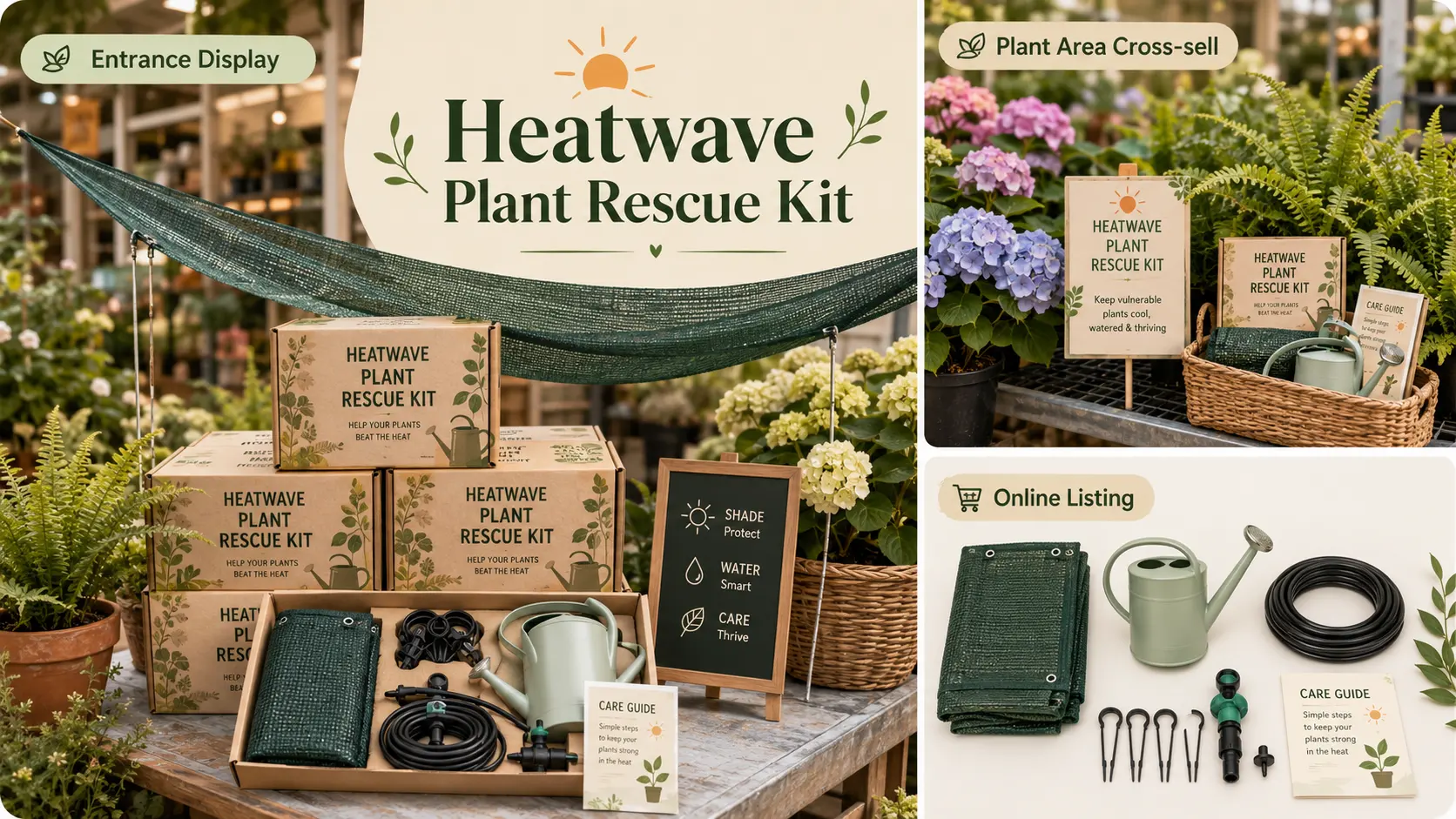
Entrance position: A table or end-cap with the kit boxes stacked, a shade net draped above as a visual anchor, and the sign: “Is your garden struggling in the heat? This kit has everything you need to protect your plants today.”
Plant area cross-sell: When a customer buys a hydrangea, fern, or any Tier 1 plant, your till staff says: “This plant is very vulnerable in hot weather. The rescue kit has a shade net and clips that will take 30 minutes to set up — it will make a real difference.”
Online listing: Photograph the kit as a single product with all items visible. Write the listing title as “Heatwave Plant Rescue Kit — Shade Net, Watering Can, Drip Feed & Care Guide.” This is the search term your customer is typing at 10 p.m. when their hydrangea is drooping and the garden centre is closed.
Three Retail Talking Points
These are not scripts. They are the three facts your staff needs to know, phrased the way a customer needs to hear them.
“The shade net in this kit takes 30 minutes to put up.” Most customers assume shade netting is a major installation project. It is not — with clips and cords, one person can cover a 2m×3m area in half an hour. The kit removes the “I’ll do it this weekend” excuse.
“If there is a hosepipe ban where you live, check whether the drip kit in the upgraded set is exempt — some water companies allow it, others do not.” This is the regulatory fact your customer needs to hear. Drip irrigation is classified differently from hosepipes in some European water-use regulations, but not all. Your customer needs to check with their local water authority — and so does your staff.
“Do not water at midday — the card inside tells you when and how.” This is the single most important sentence your staff can say. It prevents the number-one cause of heatwave plant death. The card backs it up so the customer does not forget.
Heatwave Product Sourcing Checklist
The products in this article are organised for your buying list.
| Product Category | Key SKUs | Specification | Display Zone | Notes |
| Shade netting | 3-needle silver-grey, 4-needle black | 2m×3m, 3m×5m; 30–50% rate for sun-lovers, 60–70% for shade-lovers | Zone 1, Zone 2 | Must sell with fixing clips — never net alone |
| Shade net fixings | Clip sets, pull cords, wire rope, turnbuckles, wall anchors | Clip every 0.5m along edges | Zone 1, Zone 5 | Upgrade pack for wall/post mounting |
| Watering | Long-spout can (5L), misting spray bottle (1L) | — | Zone 3, Zone 5 | Reframe as “plant survival,” not leisure |
| Drip irrigation | 5-plant starter kit, 10-plant kit | — | Zone 3 | Check local exemption rules |
| Water retention | Super absorbent polymer granules | 50g retail pack | Zone 3, Zone 5 | Used in Chinese agriculture for 20+ years; ensure the product carries certification for your market |
| Greenhouse cooling | External shade net (pre-cut), vent clips, auto vent openers, shade paint | 6×4ft, 8×6ft sizes | Zone 4 | External shade always; auto vent openers are the best low-cost investment |
| Greenhouse monitoring | Max-min thermometer | — | Zone 4 | Sells the shade kit — customer sees 55°C and buys without persuasion |
| Soil protection | Coco coir bricks, bark chip packs, mulch mats | — | Zone 2, Zone 3 | Bare soil loses water fastest — this is the missing layer |
| Plant containers | Light-coloured pots, plant saucers | — | Zone 2 | Dark pots are 5–11°C hotter at the root zone than light-coloured ones — offer a swap at the point of sale |
| Care cards | Printed heatwave care card | Four rules + morning diagnostic | Zone 5 | Goes with every plant sold June–September; costs almost nothing, prevents returns |
| Rescue kit | Standard 7-piece, Upgraded 10-piece | See the full SKU list in the article | Zone 1 | The single product that answers every heatwave question |
Frequently Asked Questions
Should I water my plants every day during a heatwave?
Not necessarily every day — and never at midday. Water early morning (6–8 a.m.) or after sunset. Container plants may need daily watering; established garden plants typically need deep watering every 2–3 days. The mistake is not frequency but timing: midday watering loses a significant portion to evaporation and can shock the roots with cold water on hot soil.
Which plants need shade netting most?
Hydrangeas, ferns, hostas, rhododendrons, and newly transplanted seedlings are the most vulnerable — they can show damage within 1–2 days of extreme heat. Container plants in dark pots also need shade, because root-zone temperatures can be 5–11°C higher than in light-coloured pots. Tomatoes need shade too, but at a lower rate (30–50%) — heavy shade (80%+) will stop them from producing fruit.
How far in advance should I stock heatwave products?
At least 4–6 weeks before your peak heat season. If you are sourcing from overseas, allow time for production, quality checks, shipping, and customs clearance. The retailers who have products on the shelf when the first 35°C week arrives are the ones who ordered in spring — not the ones who reordered during the heatwave. By the time your customer needs a shade net, the delivery truck is too late.
Can shade netting be used on home gardens, not just commercial greenhouses?
Yes — in fact, home gardens are where most shade netting is sold in a heatwave. The key is selling a complete kit with fixing clips, pull cords, and an installation card. Without fixings, the net is half a product. Home installation of a 2m×3m net with clips takes about 30 minutes.
What temperature kills plants inside a closed greenhouse?
A closed greenhouse on a 35°C day can reach 50°C in a matter of hours. Many common garden plants suffer leaf scorch at 40°C, and many ornamental plants suffer fatal damage at 45°C. The single most important action is to open all doors, windows, and roof vents — and keep them open. Automatic vent openers solve this for customers who are not home during the day.
Next Step: Stock What Sells When It Matters Most
A heatwave does not give you time to reorder. By the time your customer needs a shade net, the delivery truck is too late. The products in this article — shade net kits, drip irrigation, greenhouse cooling, rescue kits, care cards — are the ones that sell in a panic and save a garden. They need to be on your shelves before the temperature hits 35°C.
Three things you can do right now:
- Get your heatwave product list. Tell Scarecrow your garden centre’s size, climate zone, and customer profile. We will send you a curated SKU list for all five product zones — with specifications, shade rates, kit contents, and retail packaging options, sourced from verified suppliers we already work with. → Request your product list here.
- Order a mixed sample box. See the shade net quality, test the fixing clips, and check the drip kit fittings. Scarecrow Garden Supplier can organise samples, compare suppliers, check packaging details, and consolidate mixed products in our warehouse — so you evaluate everything before committing to a full order. → Request your sample box here.
- Set up a seasonal restocking plan. Heatwave products are not one-time buys — they are seasonal essentials that will repeat every summer. We can organise a standing order that arrives before the hot season starts, so you are never caught short. → Talk to us about a seasonal restocking plan.
The queue at your return counter next Monday depends on what you do today.
Looking for the Right Heat-Insulation and Water-Saving Products?
Want to know which heat-insulation and water-saving products are suitable for your target market? Discuss your target country and retail model with us — we can help you plan the right product mix.

Written by
ScarecrowGarden
💡About Scarecrow Garden Supplier Co., Ltd.
Scarecrow Garden Supplier Co., Ltd. is a China-based sourcing and wholesale partner specializing in garden tools, landscaping equipment, and outdoor supplies for international wholesalers, distributors, contractors, and brands.
With hands-on experience rooted in real garden use scenarios, we focus on durable materials, functional design, and stable large-volume supply. Our product range covers pruning tools, watering systems, hand tools, outdoor hardware, and customized garden solutions to support both retail and professional landscaping markets.
Beyond products, we help our partners navigate supplier selection, quality control, compliance requirements, and long-term sourcing strategies in China. Through our blog, we share practical insights on product selection, material comparisons, industry trends, and cost-effective purchasing—helping global buyers build stronger, more competitive supply chains.