






Wholesale Water-Saving Garden Products: European Retail Buyer's Guide | Scarecrow Garden Supplier
It is the first morning after the hosepipe ban. Your phone is ringing before you open the shop. A customer wants to return the sprinkler she bought last week — "No one told me it would be illegal to use." Another asks what she is supposed to water her tomatoes with. Your online shop has two new one-star reviews: "Still selling hose reels when a ban was coming" and "No alternatives in stock — useless."
Your sprinkler display, which was your bestseller in May, is now a wall of products your customers cannot legally use. Your watering aisle has watering cans and not much else.
This is the moment that separates prepared retailers from scrambling ones. The ban does not kill your business. It redefines what your customers can buy. The retailers who understand this — who stock drip kits, watering cans, rain barrels, and mulch before the restriction hits — make more money during a ban than before it. The ones who wait lose the season.
Across Europe, water restrictions are no longer rare exceptions. In recent summers, the European Drought Observatory has reported drought conditions across significant portions of European territory. France experienced severely depleted groundwater levels in 2022, and conditions in 2026 have intensified. The UK has experienced multiple hosepipe bans in recent years. Spain is restricting agricultural irrigation.
When water restrictions hit, European garden retailers need drip irrigation kits (check local exemption rules), long-spout watering cans, rainwater collection systems, mulch, and water-retaining products — not sprinklers and hose reels. This article covers what to stock, what to stop selling, and how to help your customers keep their gardens alive within the law. For heatwave-specific products like shade netting and greenhouse cooling, see our Heatwave Gardening Products article.
Your customers are about to discover that half your watering aisle is suddenly illegal to use. The retailers who reposition before the ban keep selling; the ones who react after lose the season. Get a water-saving product list matched to your market’s regulations. Tell Scarecrow which countries and customer types you serve; we will send you a curated SKU list with compliance notes for each market.
When the Ban Hits: What Your Customers Can and Cannot Use
Water restrictions in Europe are not uniform. Each country — and often each region within a country — has its own framework. But the practical implications for your product range are surprisingly consistent: certain products become illegal to use overnight, while others are explicitly permitted or exempt.
Three Markets, Three Systems
| UK | France | Spain | |
| Regulation | Temporary Use Ban (hosepipe ban) | Arrêté sécheresse (multi-level drought decree) | Drought management plans at the basin and regional level |
| Who declares it | Individual water companies | Préfet (departmental prefect) | River basin authorities |
| Garden watering | Hosepipes and sprinklers banned | Restricted by level → fully banned at "Crise" level | Agricultural irrigation quotas; residential restrictions vary |
| Drip irrigation | Some companies are exempt, others are not ⚠️ | Usually permitted at lower levels; may be restricted at higher levels ⚠️ | Agricultural drip prioritised ✅ |
| Watering can | Allowed ✅ | Allowed at lower levels; time-restricted at higher levels | Allowed ✅ |
| Rainwater collection | Fully allowed ✅ | Encouraged ✅ | Encouraged ✅ |
| Maximum fine | Up to £1,000 | Fines apply (vary by département) | Varies by region |
What This Means for Your Shelf
Stop promoting: Sprinklers, hose reels, oscillating sprinklers, and any "water feature" that connects to a hose. When a ban is in force, selling these is not just a missed opportunity — it signals that you have not been paying attention.
Start promoting: Drip irrigation kits, long-spout watering cans, rainwater barrels, and mulch. These are the products that keep gardens legal and alive under restrictions.
The insight your customers need: In the UK, a hosepipe ban does not ban all garden watering — it bans delivery by hosepipe. A watering can is legal. Drip irrigation may be exempted by some water companies, but not all — the 2010 Flood and Water Management Act gave companies the power to include it. Rainwater collected in a butt is not mains water at all, so no restriction applies. Your customer who thinks "I can’t water my garden" is wrong. What they cannot do is water it the way they always have.
The Cost of Being Unprepared
When hosepipe bans have hit in the UK, garden plant sales have declined in the first half of the year. The customers did not stop gardening — they stopped buying from centres that offered only hose-dependent solutions. The centres that stocked drip kits and watering cans before the ban was announced kept their customers. The ones that scrambled after the announcement lost them.
This is the pattern: the retailers who reposition their water category before the restriction hits capture the demand. The ones who react after losing the season.
Drip Irrigation: The Product That Keeps Gardens Legal
Drip irrigation is not a new idea for European gardens. It was adopted at scale in Chinese agriculture years before it appeared on European patios — China’s water-saving irrigation area reached 37.8 million hectares by 2020 and has continued to expand. The product range, component quality, and system reliability available today are the result of decades of large-scale agricultural use.
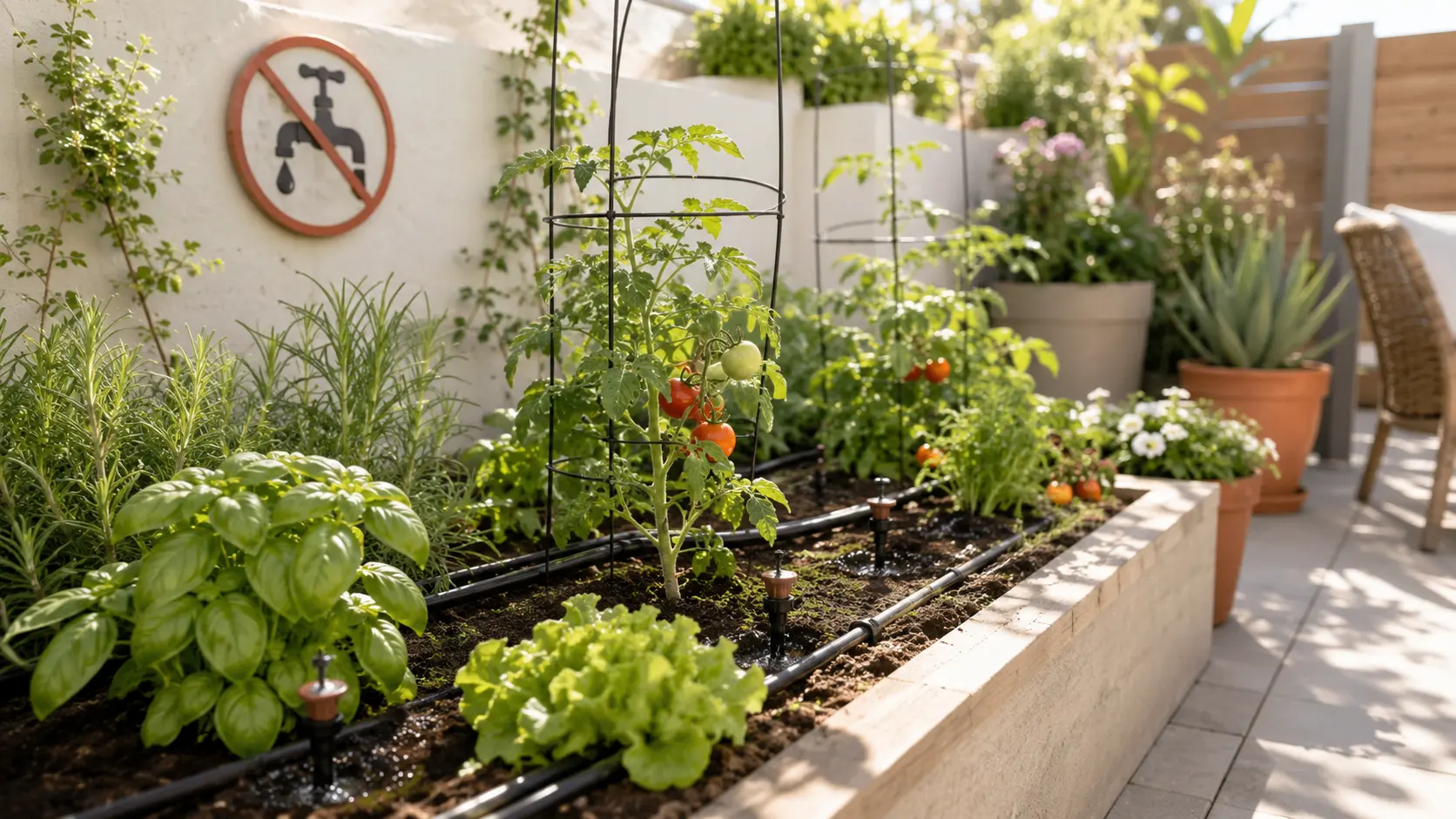
The reason drip matters under a water restriction is simple: drip systems deliver water directly to the root zone with typically over 90% efficiency when properly installed, compared to 50–70% for sprinklers. Because of this efficiency, some water companies and regulatory bodies classify drip irrigation differently from hosepipes — and may exempt it from restrictions. But this is not guaranteed: the 2010 Flood and Water Management Act gave UK water companies the power to include drip irrigation in hosepipe bans, and some have done so.
This is not a niche technical point. It is the single most important fact your customer needs to hear when a ban is announced — and it comes with a caveat they also need to hear.
Drip vs Sprinkler: The Numbers
| Metric | Drip irrigation | Sprinkler |
| Water use efficiency | Over 90% | 50–70% |
| Where water goes | Directly to the root zone | Sprayed over soil and foliage |
| Evaporation loss | Minimal | Significant, especially in hot or windy conditions |
| Runoff | Virtually none | Common on slopes and compacted soil |
| Foliage wetness | Dry (reduces disease) | Wet (increases fungal risk) |
| Legal status under bans | May be exempt (check locally) | Typically banned |
A customer who switches from a sprinkler to a drip kit uses less water, waters more effectively, and stays within the law. That is not a hard sell.
What to Stock: Home Drip Irrigation Kits
Your customer is not a farmer. They need a kit they can set up in an afternoon without professional installation.
| Product | Specification | Best for | Retail positioning |
| Drip starter kit | 5–10 plant positions | Patio, balcony, containers | "Keeps 10 plants alive during a ban" |
| Drip extension kit | 20–30m tubing + emitters | Borders, vegetable beds | "One kit for the whole garden" |
| Soaker hose | 7.5m or 15m | Borders, raised beds | "Lay it down, turn it on — no assembly" |
| Micro-spray kit | 360° or 180° heads | Seed beds, greenhouses | "For delicate plants that need gentle coverage" |
| Timer (single or dual outlet) | Battery-operated | All setups | "Water while you are on holiday" |
| Pressure regulator | 1–3 bar | Areas with inconsistent water pressure | "Prevents blow-outs" |
How to Sell Drip Kits in a Ban
Two talking points. Your staff should know both.
"Some water companies exempt drip kits from hosepipe bans — but not all. Check with your local water company." In the UK, water companies have different policies: some exempt drip irrigation, others include it in the ban. Southern Water’s 2025 ban, for example, explicitly prohibited dripper hoses. In France, drip is usually permitted at lower drought levels but may be restricted at higher levels. Advise your customer to check — the kit itself is not the risk; ignorance of the local rule is.
"It uses approximately 60% less water than a sprinkler — your plants get more and your meter runs less." For customers on metered water (increasingly common across Europe), this is a financial argument as well as a practical one. A drip kit can pay for itself in water savings within one summer for customers on metered water.
Want help selecting drip irrigation SKUs with the right emitter rates and tubing sizes for your market? Drip kits come in dozens of configurations — emitter spacing, flow rate, tubing diameter — and the wrong combination means dead plants and returned products. Scarecrow can match the right kit configurations to your customer profile and climate zone. Tell us what you need; we will send you a drip irrigation SKU list with specifications.
Rainwater Collection: The Water Source No Ban Can Restrict
Rainwater is not mains water. No hosepipe ban, no drought decree, no irrigation quota restricts your right to collect rain from your own roof and use it in your own garden. For your customer, a rain barrel is not just a water-saving device — it is a legally untouchable water source.
The Maths That Sells Rain Barrels
One millimetre of rain on one square metre of roof yields one litre of water. A typical UK house has a roof area of 60–80m². A single summer thunderstorm delivering 10mm of rain puts 600–800 litres into the gutters — enough to fill a standard water butt three times over. Most of that water currently runs down the drain.
Your customer does not need to be convinced that rainwater is free. They need to be shown how much of it they are currently wasting.
What to Stock
| Level | Product | Capacity | Best for | Key feature |
| Entry | Water butt (rigid plastic) | 100–300L | Small garden, patio | Stand-alone, fits under a downpipe |
| Mid-range | Collapsible rain barrel (PVC) | 500–1,000L | Medium garden | Folds flat for winter storage; UV-resistant; zip-top mesh lid keeps out debris and insects |
| Premium | Above-ground rain tank | 1,000–5,000L | Large garden, small commercial | Higher capacity, pump-ready |
| System | Full rainwater harvesting system | Custom | New build, renovation | Filtration, pump, plumbed into irrigation |
The collapsible rain barrel deserves special attention as a retail product. PVC folding barrels from 100L to 1,000L, with SGS or CE certification, fold flat when not in use — solving the "where do I store it in winter?" objection that kills rigid barrel sales. They include a bottom tap for hose or watering-can filling, a mesh lid to keep out leaves and mosquitoes — important in regions where standing water can attract disease-carrying insects — and are rated for multiple years of UV exposure. Chinese factories produce these in large volumes — supply is not the constraint. Retail positioning and consumer education are.
How to Display Rainwater Products
- Pair the barrel with a downpipe connector — sell them together, not separately. The connector is what makes the barrel work; without it, the customer has a barrel and no way to fill it.
- Display the maths on a sign: "1mm rain × 60m² roof = 60 litres of free water. This 200L butt fills from one moderate shower."
- Position near the watering aisle — the customer who just learned they cannot use a hosepipe is the same customer who needs an alternative water source.
- Online listing: Include "hosepipe ban compliant" in the title. This is the search term.
Mulch and Water-Retaining Granules: Low-Tech, High Impact
So far we have covered where your customer’s water comes from under a ban — drip kits and rain barrels. Now: how to make every litre of that water count.
Not every water-saving product requires installation, plumbing, or even a downpipe. The two most effective low-tech solutions work as a pair: mulch stops water escaping from the top, and water-retaining granules stop it escaping from within. Together, they are the two layers between your customer’s plant and a dry death — and neither requires a hosepipe.
Mulch: Cover the Soil, Save the Water
A 2–4 inch (5–10cm) layer of organic mulch — bark chips, coir, straw, or leaf mould — reduces soil surface evaporation by 25–50% under typical conditions, and up to 70% under hot, dry conditions. That is not a marginal improvement. It means that for every 10 litres of water your customer applies, 5–7 litres that would have evaporated from bare soil instead stay in the ground where roots can reach them.
Mulch requires no installation. No plumbing. No power. No technical knowledge. Your customer spreads it on the soil surface and it works. This makes it the single lowest-barrier water-saving product you can sell — and one of the most effective.
| Type | Product | Water-saving effect | Additional benefits |
| Organic | Bark chips | High | Suppresses weeds, improves soil as it decomposes |
| Organic | Coir (coco coir bricks) | High | Lightweight, sustainable, compact to ship and shelf |
| Organic | Straw | Medium–high | Traditional choice for vegetable beds |
| Inorganic | Gravel / crushed stone | Medium | Long-lasting, decorative |
| Inorganic | Weed membrane/landscape fabric | Medium | Suppresses weeds, reduces evaporation from the soil beneath |
Coir bricks are the retail standout here. A compressed coir brick expands to several times its volume when watered, making it cheap to ship and compact on the shelf. For a garden centre, that is a product with a high margin and low storage cost — and it pairs naturally with drip irrigation: "Drip + Mulch can dramatically reduce water waste."
Water-Retaining Granules: Hold Water in the Soil
Mulch covers the surface. Granules work from within. Super absorbent polymer (SAP) granules absorb hundreds of times their own weight in water, then slowly release it back into the soil as the surrounding moisture drops. Mixed into potting compost at planting time, they reduce watering frequency — sometimes by half — particularly in containers and hanging baskets that dry out fastest.
These granules have been used in Chinese agriculture for over two decades, where they are a standard component of drought-resilient planting in arid and semi-arid regions. The consumer garden product is the same technology in a smaller pack. For a pre-packaged option, our Heatwave Plant Rescue Kit includes a 50g pack of water-retaining granules alongside shade netting and a care card.
| Product form | How to use | Retail pitch |
| Granules (small pack, 50–200g) | Mix into potting soil before planting | "Water your containers half as often" |
| Discs/tablets | Place at the bottom of pots | "Container plant specialist — put it in and forget" |
| Decorative gel beads | Mix into decorative containers | "Looks good, works hard" |
Two things your customer needs to know:
- Potassium-based granules are better for garden use than sodium-based ones. Sodium types can degrade soil structure over time. If you are sourcing these products, specify potassium polyacrylate.
- Check certification for your market. SAP products sold in Europe may require REACH registration or equivalent compliance. Ensure any water-retaining product you stock carries appropriate certification for your target market — this is standard due diligence, not an optional extra.
The cross-sell that works: Mulch + granules + drip kit. Three products, one system. Drip delivers water to the root zone. Mulch stops it from evaporating from the surface. Granules hold it in the soil. Sell them together and your customer’s garden uses a fraction of the water it did before — and stays legal under any restriction.
Self-Watering Planters: Making Every Drop Count
There is a particular cruelty to European heatwaves: they arrive in July and August, when your customer is most likely to be on holiday. Your customer is packing for a week in Mallorca. Their garden is about to hit 38°C. They have two choices: ask a neighbour to water every day, or set up a reservoir planter before they leave. One of these is reliable.
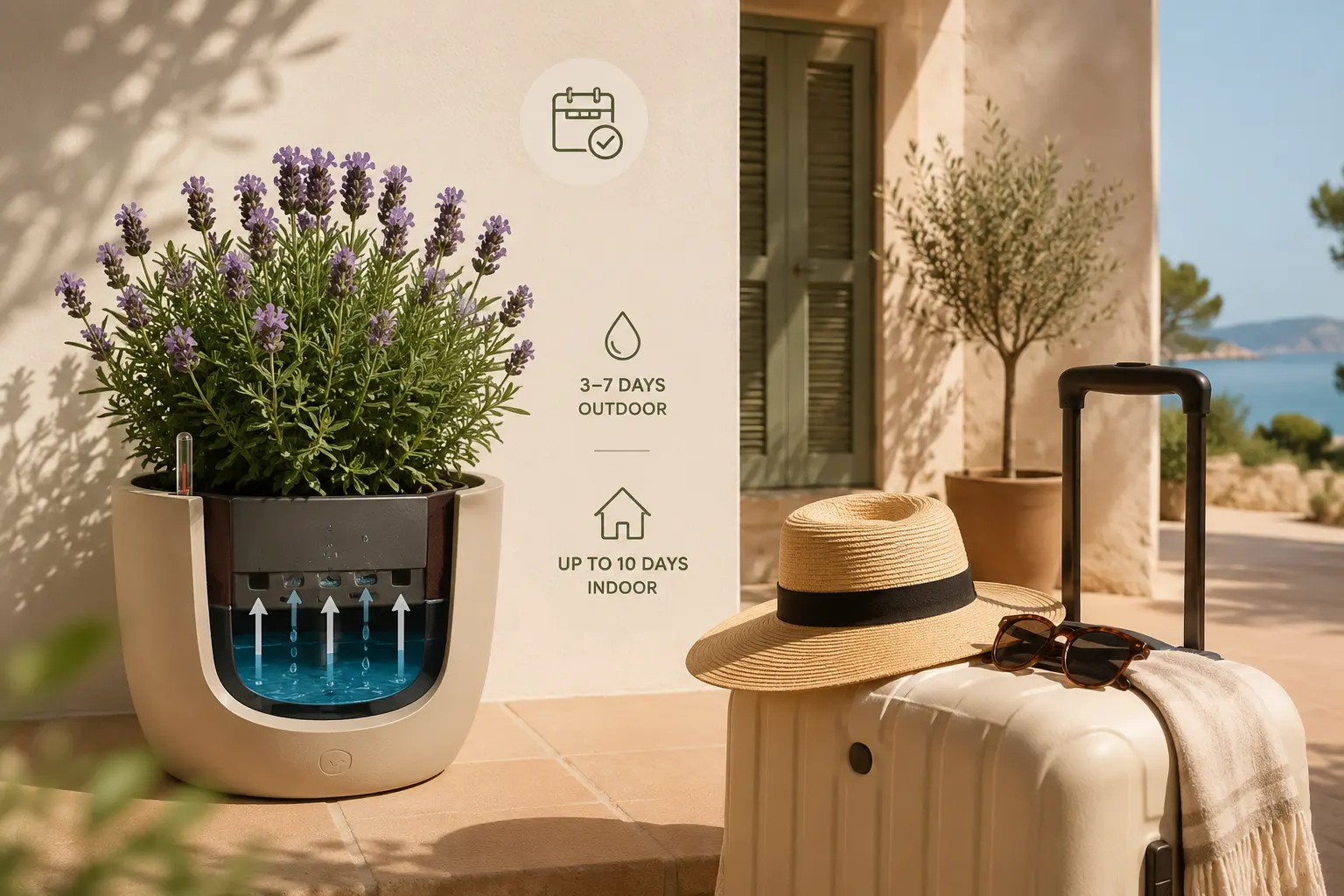
Self-watering planters and reservoir systems do not eliminate this problem — but they extend the window. A container with a built-in water reservoir can sustain a plant for 3–7 days without attention, depending on conditions. Combined with water-retaining granules, that window can stretch up to 10 days in moderate indoor conditions — though outdoor plants in summer heat will still need more frequent attention. For a customer going away for a week, that is the difference between coming home to a living garden and coming home to a compost project.
What to Stock
| Product | How it works | Best for | Retail pitch |
| Self-watering pot (reservoir base) | Water is stored in a bottom chamber; the wicking mat draws moisture up to the roots | Patio containers, balcony plants | "7 days without watering" |
| Reservoir planter box | Double-wall construction with overflow drain | Raised beds, terrace planters | "Fills once, waters for days" |
| Tree watering bag | Zip-around bag that slowly drips water to the root ball | Newly planted trees and shrubs | "One bag, one tree, one week of water" |
| Watering globe (glass) | Inserted into the soil; it releases water as the soil dries | Houseplants, small containers | "Fill it, stick it in, go on holiday" |
The Retail Logic
Self-watering products are not just about convenience. Under water restrictions, they serve a specific function: making every permitted watering count. If your customer is allowed to water only in the early morning, a reservoir planter stores that morning’s water and releases it gradually through the day, rather than letting it drain straight through. The result is more effective use of less water — which is the entire point of a restriction-compliant garden.
Cross-sell opportunity: Self-watering pot + water-retaining granules + a care card that says "Fill the reservoir before you leave. The granules will extend the moisture for up to 10 days indoors." Three products, one solution, one add-on sale that actually works. If you stock the Heatwave Plant Rescue Kit, the self-watering pot is the natural add-on for customers who travel — the kit handles the heat, the pot handles the absence.
Water-Saving Product Sourcing Checklist
| Product Category | Key SKUs | Specification | Ban-Relevance | Notes |
| Drip irrigation | Starter kit 5–10 plants, Extension kit 20–30m | Emitter rate matched to plant type | ⭐⭐⭐ May be exempt from bans — check locally | Highest priority — the product that keeps gardens legal where exempt |
| Soaker hose | 7.5m, 15m | Porous rubber or recycled material | ⭐⭐⭐ May be exempt — check locally | Zero-assembly option for borders |
| Watering can | 5L, 10L long-spout | Dual scale (litres + gallons) | ⭐⭐⭐ Legal under UK hosepipe ban | The ban-compliant default |
| Rain barrel | 200L rigid, 500L collapsible | PVC folding barrel with tap + mesh lid | ⭐⭐⭐ Not mains water — no restriction applies | Pair with the downpipe connector |
| Mulch | Coir bricks, bark chip bags | Coir: compressed brick; Bark: 50L bag | ⭐⭐ Reduces evaporation 25–70% | Lowest barrier water-saving product |
| Water-retaining granules | 50g, 200g retail packs | Potassium polyacrylate (not sodium) | ⭐⭐ Reduces watering frequency | Check REACH compliance for your market |
| Self-watering planter | Medium, large reservoir | Bottom chamber + wicking mat | ⭐⭐ Maximises each permitted watering | Cross-sell with granules |
| Drip timer | Single/dual outlet, battery | — | ⭐⭐ Automates compliant watering | "Holiday-proof" add-on |
| Tree watering bag | 20–60L capacity | Slow-release zip-around | ⭐ Saves newly planted trees | Seasonal niche — stock in spring |
Frequently Asked Questions
Can customers use grey water (bath or shower water) on their gardens?
In the UK, using grey water on gardens is generally permitted, but it is not recommended for edible crops — the detergents and soaps can leave residues in the soil. For ornamental plants, it is a practical backup during restrictions. In France, some communes allow grey water use in gardens during drought periods; others do not. The key advice for your customer: use it on flowers and lawns, not on vegetables or herbs. And do not store it — use it the same day, before bacteria multiply.
Can I still use a watering can during a hosepipe ban?
Yes. A hosepipe ban in the UK restricts water delivery by hose or sprinkler — not by watering can. The customer can fill a can from a tap and water by hand. This is why long-spout watering cans become essential stock during restriction periods: they are the legal default. In France, watering cans may be restricted to certain hours at higher drought levels.
How much water does a rain barrel actually collect?
A standard UK house roof (60–80m²) yields 60–80 litres from just 1mm of rainfall. A moderate summer shower of 10mm delivers 600–800 litres — enough to fill a 200L water butt three times. And because rainwater is not mains water, no restriction applies to how your customer uses it.
Do water-retaining granules really work?
Yes, when used correctly. Super absorbent polymers absorb hundreds of times their weight in water and release it slowly as the surrounding soil dries. They are most effective in containers and hanging baskets, where soil volume is small and evaporation is fast. They have been used in Chinese agriculture for over two decades. Specify potassium-based granules for garden use — sodium types can degrade soil structure over time.
What should I stop selling when a water restriction is announced?
Sprinklers, hose reels, oscillating sprinklers, and any product that delivers water through a hose under pressure. These become illegal to use overnight. Continuing to promote them during a ban signals that you are out of touch with the regulatory reality — and drives customers to retailers who stock compliant alternatives.
Next Step: Stock the Products That Work When Water Is Restricted
Water restrictions are not going away. As European summers continue to break temperature records, hosepipe bans and drought decrees will become more frequent, not less. The retailers who build a water-saving category now — drip kits, watering cans, rain barrels, mulch, self-watering planters — will be ready when the next ban hits. The ones who wait will be scrambling.
Three things you can do right now:
- Get your water-saving product list. Tell Scarecrow Garden Supplier your target countries, customer type, and retail format. We will send you a curated SKU list with drip kit configurations, rain barrel specifications, mulch product options, and watering can specifications — all matched to the water regulations in your key markets, sourced from verified suppliers we already work with. → Request your product list here.
- Order a mixed sample box. Test the drip kit fittings, check the rain barrel material quality, and compare the coir brick expansion rate. Scarecrow can organise samples, compare suppliers, check packaging and labelling for regulatory compliance, and consolidate mixed products in our warehouse — so you evaluate everything before committing. → Request your sample box here.
- Set up a seasonal restocking plan. Water-saving products sell before and during restrictions — not after. We can organise a standing order that arrives ahead of the dry season, so your shelves are stocked before your customers start calling. → Talk to us about a seasonal restocking plan.
Water restrictions are coming every summer now. The question is whether your shelves are ready before the phone starts ringing.
Build a Smarter Product Mix for Hot and Water-Conscious Markets
Want to know which heat-insulation and water-saving products are suitable for your target market? Discuss your target country and retail model with us — we can help you plan the right product mix.
- Target country review
- Retail model matching
- Product mix planning
Written by
ScarecrowGarden
💡About Scarecrow Garden Supplier Co., Ltd.
Scarecrow Garden Supplier Co., Ltd. is a China-based sourcing and wholesale partner specializing in garden tools, landscaping equipment, and outdoor supplies for international wholesalers, distributors, contractors, and brands.
With hands-on experience rooted in real garden use scenarios, we focus on durable materials, functional design, and stable large-volume supply. Our product range covers pruning tools, watering systems, hand tools, outdoor hardware, and customized garden solutions to support both retail and professional landscaping markets.
Beyond products, we help our partners navigate supplier selection, quality control, compliance requirements, and long-term sourcing strategies in China. Through our blog, we share practical insights on product selection, material comparisons, industry trends, and cost-effective purchasing—helping global buyers build stronger, more competitive supply chains.