








Wholesale Soil & Root Protection Products for Heatwave Prep | Scarecrow Garden Supplier
A customer comes in with a dead hydrangea. Not a sun-scorched hydrangea — a drowned one. “I watered it every day,” she says. “I even watered it twice on Saturday. And it still died.”
Your customer did everything right by instinct and everything wrong by science. She saw wilt, she poured water. The soil looked dry on top, so she poured more. The plant kept wilting, so she kept pouring. By the third day, the roots had drowned in soil that never drained because the water never penetrated in the first place.
This is the heatwave problem most garden centres are not prepared for. It is not a watering problem — it is a soil and root problem.
Here is what happens below the surface.
When European summers hit 35°C and above, garden soil undergoes changes that no amount of surface watering can fix. Organic matter burns off. Soil structure collapses. A water-repellent layer forms beneath the surface. Root zones overheat. The customer who keeps watering a dying plant is not negligent — they are solving the wrong problem.
This article covers what happens to soil and roots during extreme heat, which products address the real problem, and how to help your customers stop killing plants with kindness.
What Heat Does to Soil (That Watering Cannot Fix)
Your customer looks at the surface. The surface looks dry. They water. The surface looks wet. They walk away satisfied. Underneath, nothing has changed — or things have gotten worse.
Here is what is actually happening in the soil during a heatwave, and why adding more water makes it worse, not better.
Four Changes That Happen Below the Surface
1. Organic matter burns off. Soil organic matter is what holds water and nutrients. As temperatures rise, the microorganisms that decompose organic matter become more active — consuming the soil’s reserves faster than they can be replaced. Organic matter is what makes soil loose, porous, and able to hold water. When it disappears, the soil hardens. Water runs off instead of soaking in.
2. Soil structure collapses. Organic matter acts as a glue holding soil particles together in clusters called aggregates. These aggregates create the pores that let water in and roots spread. When the organic matter is consumed, the aggregates fall apart. The soil compacts. Water pools on the surface instead of draining through. Roots cannot push through compacted soil to reach moisture below.
3. A water-repellent layer forms. In prolonged dry heat, long-chain organic compounds accumulate on soil particle surfaces, creating a hydrophobic layer — a zone that actively repels water. This is not a rare phenomenon in sandy soils; it occurs across soil types and its occurrence is expanding in drought-prone regions. Your customer waters, the water runs off, and the soil underneath remains bone dry. The plant wilts, the customer waters more, and the cycle accelerates.
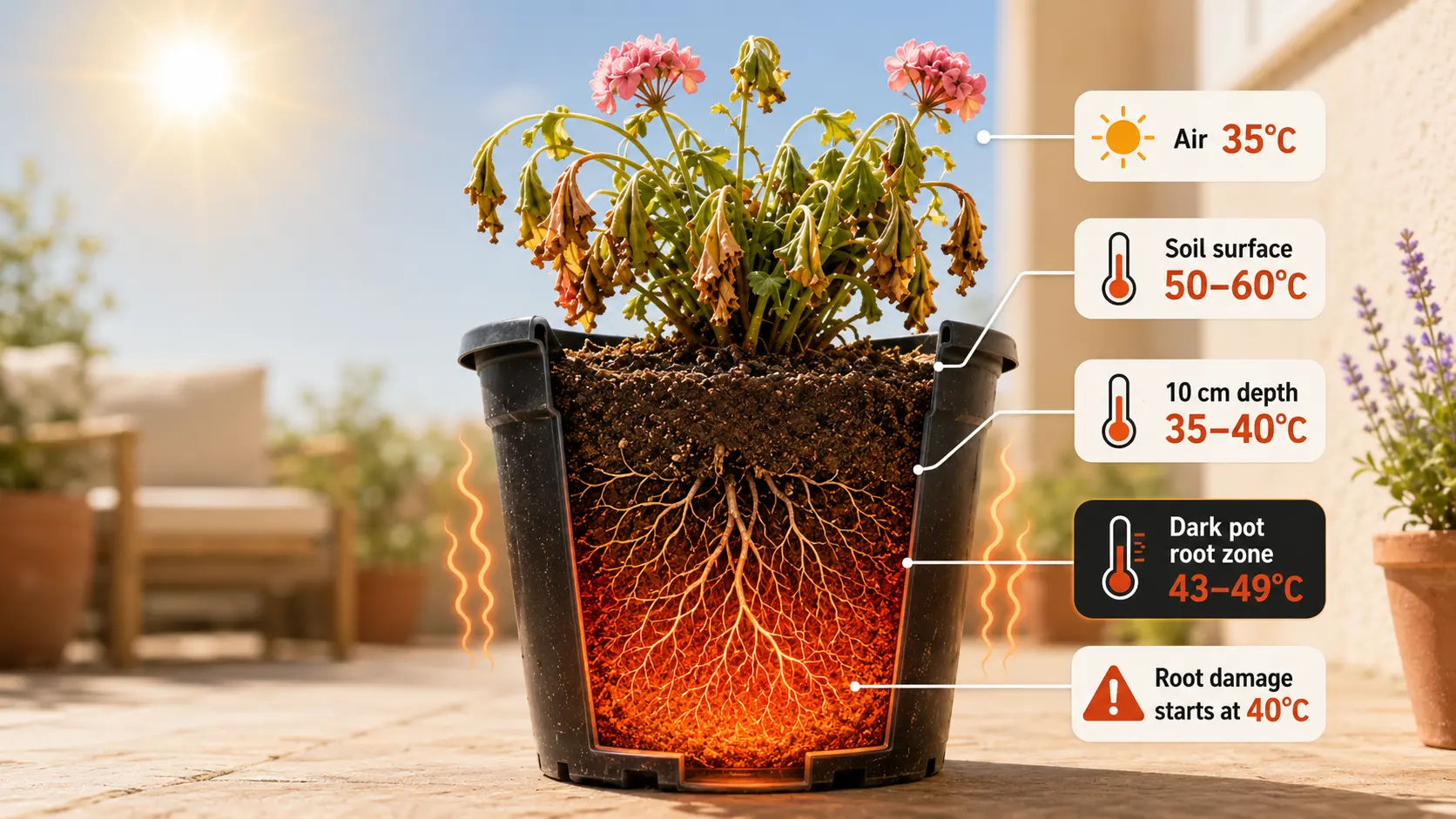
4. Root zones overheat. Over 80% of the fine feeder roots sit in the top 15cm of soil — where temperatures can exceed 40°C on a 35°C day. Roots begin to lose function above 35°C and start dying above 40°C.
The Microbial Paradox
There is a cruel irony in how soil microbes respond to heat. In the early stages of a heatwave, rising temperatures make microbes more active — they consume organic matter faster, accelerating the loss of soil structure. Then, as temperatures climb above 35°C, those same microbes start to die or go dormant. The soil loses its organic matter and its workforce in the same event. Both phases damage the soil. The first phase eats the reserves. The second phase shuts down the repair crew.
Why Your Customer’s Plant Died Despite Daily Watering
What your customer sees: wilt → water → still wilt → water more → plant dies.
What actually happened:
- The hydrophobic layer prevented water from reaching the root zone.
- Root-zone temperatures were so high that roots could not absorb water even when it was available.
- Excess water pooled around the stem, suffocating the roots.
- Organic matter depletion made the soil compact further, making the next watering even less effective.
This is not a watering problem. It is a soil and root problem. And the products that fix it are not watering cans — they are mulch, soil amendments, root-zone tools, and moisture meters.
Your customers are already walking in with drowned plants and the wrong solution. The products that fix the real problem — mulch, moisture meters, root-zone tools, soil amendments — are the ones they do not know to ask for. Get a soil and root protection product list matched to your climate zone and customer profile. Tell Scarecrow what you need; we will send you a curated SKU list with specifications.
Root Zone Temperature: The Number Your Customer Does Not Know
Most garden centre customers can tell you the air temperature. Almost none of them can tell you the soil temperature. This is a problem, because the soil temperature is what determines whether roots function, struggle, or die.
Your customer cannot see this. On a 35°C day with full sun, bare soil surface temperature can reach 50–60°C. At 10cm depth — where most feeder roots live — the temperature can still be 35–40°C. In a dark plastic container, root-zone temperatures can be 5–11°C higher than in a light-coloured one. That means a potted plant on a patio in southern France during a 38°C heatwave has roots sitting in 43–49°C soil. Most ornamental plant roots begin to die at 40°C.
They see wilt and assume the plant needs water. What the plant actually needs is for the root zone to cool down — and water alone does not accomplish that when the soil around the roots is hotter than the roots can tolerate.
The Diagnostic Tool Most Customers Do Not Know They Need
A soil moisture meter solves the single biggest cause of heatwave plant death: the assumption that wilt means thirst.
When a plant wilts in the afternoon and recovers by morning, it is experiencing heat stress — not drought. The roots have water available; they simply cannot absorb it fast enough to replace what the leaves are losing. If your customer pushes a moisture meter into the soil and finds it still moist 5cm below the surface, they know the plant does not need more water. It needs shade and cooler roots — not another soaking.
If the meter reads dry at 5cm, the plant genuinely needs water. But it needs to be delivered slowly, at the root zone, not sprayed over the foliage at midday.
This is why a soil moisture meter is not a gadget — it is a diagnostic tool. It tells your customer the difference between “this plant is hot” and “this plant is dry.” That distinction saves plants and prevents returns.
| Meter type | Price range | Best for | Where to display |
| Analogue probe (no battery) | Low | Impulse buy, quick check | Checkout — next to spray bottles |
| 3-in-1 digital (moisture + pH + light) | Mid-range | Serious gardeners, repeat customers | Watering aisle — next to drip kits |
| Smart sensor (Bluetooth/WiFi) | Higher | Tech-savvy customers, greenhouse owners | Greenhouse zone — next to thermometers |
What to stock for a heatwave: The analogue probe at the checkout. It is cheap enough to add to any basket, it requires no battery, and it answers the one question your customer actually has: “Does this plant need water right now?” The 3-in-1 digital is your watering-aisle staple — it serves customers who want more information and are willing to pay for it.
Mulch: Not Just Decorative — A Root Survival Tool
Mulch is the single most effective, lowest-cost intervention your customer can make to protect roots during extreme heat. It does three things simultaneously: it shades the soil surface, it reduces evaporation, and it keeps the root zone cooler.
A 5–10cm layer of organic mulch reduces soil surface evaporation by approximately 25–50% under typical conditions, and up to approximately 70% under hot, dry conditions. More importantly for root survival, it can lower soil surface temperature by 10°C or more compared to bare soil — though the cooling effect diminishes with depth, with root zone temperatures typically reduced by 3–8°C. That is the difference between roots at 50°C and roots at 40°C — the difference between death and survival for many common garden plants.
Mulch is covered in our Water-Saving Garden Products article from the perspective of water conservation. Here, the focus is on what mulch does for roots — and the mistakes that turn a root-saving tool into a root-killing one.
The Five Mulch Mistakes That Kill Plants in a Heatwave
1. Volcano mulching. This is the most common and most damaging mulch error. Your customer piles mulch in a cone against the tree trunk, like a volcano. The bark stays permanently damp. Fungi invade. The bark rots. Roots grow upward into the mulch instead of outward into the soil — making the tree shallow-rooted and more vulnerable to drought, not less. In storm-prone regions, volcano-mulched trees are more likely to topple because the root flare never develops properly.
The correct shape is a donut, not a volcano: 5–10cm thick, spreading to the drip line, with a 5–10cm gap around the trunk. No mulch should touch the bark.
2. Laying mulch on dry soil. Mulch reduces evaporation — it does not create moisture. If your customer spreads mulch over bone-dry soil, they are locking in dryness. The correct sequence is: water deeply, then mulch. The mulch then holds that moisture in the soil instead of letting it escape.
3. Waiting until the heatwave to mulch. Mulch is a preventative measure, not an emergency cure. Once soil has dried to the point of forming a hydrophobic layer, spreading mulch on top will not fix the problem beneath. Mulch should be laid in spring or early summer, before the heat arrives.
4. Applying too thin a layer. Less than 5cm of mulch provides a significantly reduced benefit. The soil surface is still exposed enough to heat up and dry out. 5cm is the minimum; 7–10cm is better for heatwave protection.
5. Using fresh wood chips. Uncomposted wood chips compete with plants for nitrogen as they break down. In a heatwave, when plants are already stressed, robbing the soil of nitrogen makes things worse. Use composted bark, coir, or well-rotted leaf mould instead.
What to Stock
| Product | Best for | Retail pitch |
| Coir bricks (compressed) | Small gardens, containers, postage-friendly | “One brick expands to cover a square metre — soak it, spread it, protect your roots” |
| Composted bark chips (50L bag) | Borders, beds, trees | “5cm of this keeps roots 10°C cooler than bare soil” |
| Straw bales | Vegetable gardens, allotments | “The traditional choice for veg beds — cheap, effective, and you can dig it in at season's end” |
| Landscape fabric + gravel | Low-maintenance decorative areas | “Weed suppression plus root insulation — permanent protection” |
The cross-sell that works: Coir brick + moisture meter. “Soak the brick, spread the mulch, then use the meter to check whether your soil actually needs watering. Stop guessing.”
Soil Amendments That Hold Water Where Roots Need It
Mulch protects the surface. But the soil beneath the surface also needs help holding water where roots can reach it. These are the products that work inside the soil — and they pair naturally with mulch to create a two-layer defence: mulch on top to stop evaporation, amendments within to hold moisture in the root zone.
Water-Retaining Granules
Super absorbent polymer (SAP) granules have been widely used in Chinese agriculture for over two decades as a component of drought-resilient planting. For a full product breakdown — absorption rates, potassium vs sodium types, REACH compliance, and sourcing specifications — see our Water-Saving Garden Products article.
What matters here is how granules help roots specifically: mixed into the soil at planting time, they create moisture reservoirs right in the root zone. In containers and hanging baskets — where soil volume is small and roots have nowhere to escape — this can be the difference between a plant surviving a 3-day heatwave and not.
Living Soil Amendments: Fungi + Biochar
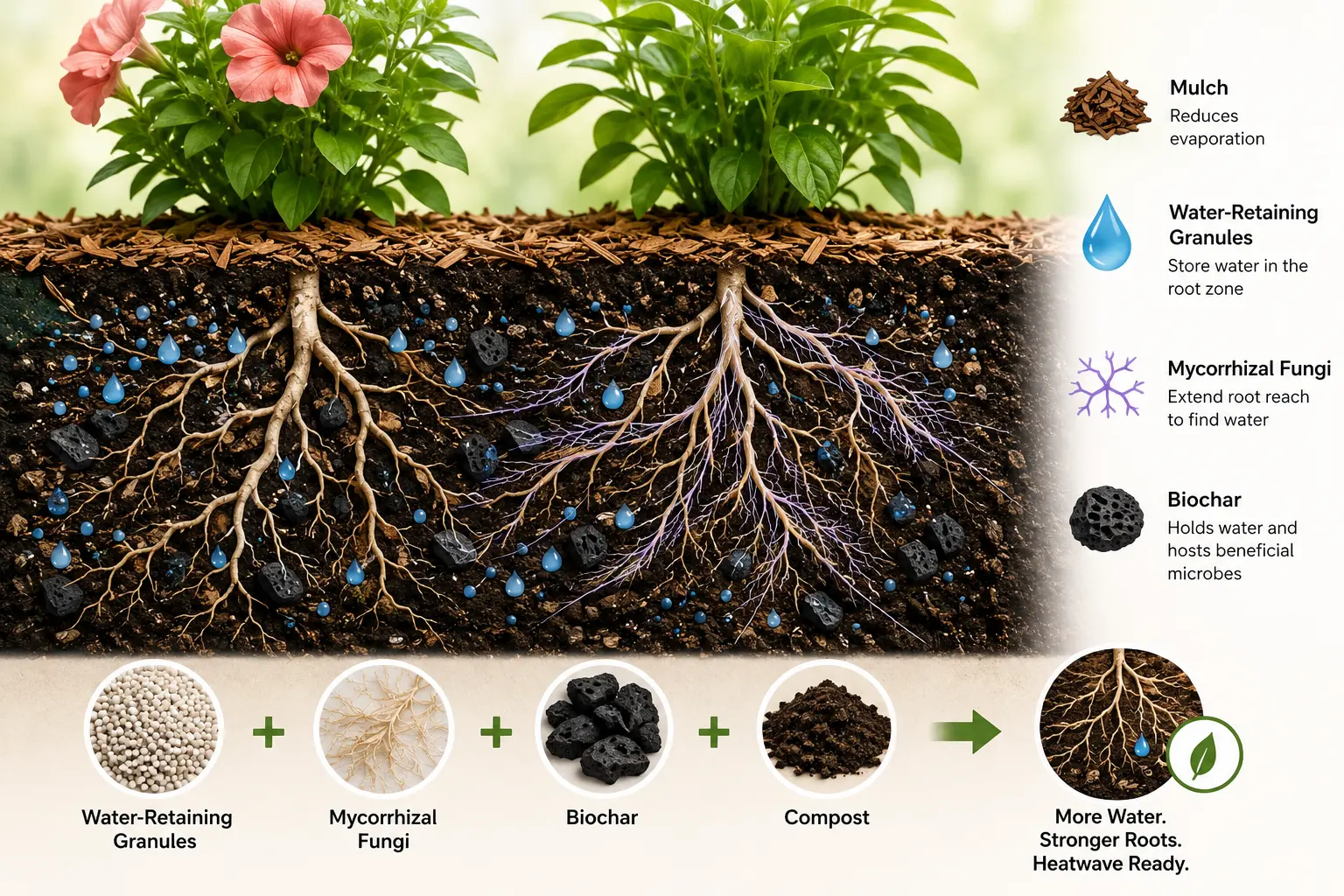
SAP granules hold water mechanically. But the soil also has a living water-holding system — and it works better when you give it the right partners. Mycorrhizal fungi and biochar are complementary: one extends the root’s reach, the other creates the porous structure that holds water and hosts the fungi. Together, they turn inert soil into a living reservoir.
Mycorrhizal fungi — a second set of roots. These fungi form a symbiotic relationship with plant roots. The fungal network extends far beyond the root system itself, accessing water and nutrients that the plant cannot reach alone. In drought conditions, this extended network can be the difference between a plant that finds water and one that does not.
Research has shown that arbuscular mycorrhizal fungi (AMF) significantly improve plant survival and growth under drought stress. Multiple studies across different plant species and climates confirm that inoculated plants maintain higher leaf water potential, better nutrient uptake, and greater biomass under water-limited conditions compared to uninoculated controls. In tropical dry forests, AMF associations are considered critical for plant survival because the dry season directly limits growth.
Mycorrhizal fungi need living roots to survive — they cannot be applied to bare soil. Apply at planting time, not after. And high-phosphorus fertiliser suppresses mycorrhizal formation. In a heatwave, the instinct to feed stressed plants actually works against this natural support system. Another reason not to fertilise during extreme heat.
Biochar — the long-term sponge. Biochar is produced by heating biomass in the absence of oxygen. Its highly porous structure gives it an enormous surface area — it absorbs and holds water and nutrients, provides habitat for beneficial microorganisms, and is extraordinarily stable, persisting in soil for hundreds of years. Unlike SAP granules, which absorb and release water on a short cycle, biochar acts as a permanent sponge within the soil structure.
For heatwave preparation, biochar’s value is specific: mixed into potting compost or sandy soil, it increases the soil’s capacity to hold water at root depth. It does not replace mulch or granules — it complements them.
Important: Biochar itself contains almost no nutrients. It must be used alongside compost or organic fertiliser. Applied alone to nutrient-poor soil, it can actually reduce fertility by absorbing what little is available and holding it away from roots. The correct application is biochar + compost: the biochar holds water and nutrients, the compost provides them.
Why they work together: Biochar provides the porous habitat that mycorrhizal fungi colonise. The fungi move into biochar pores, protected from desiccation, and extend their hyphae out into the surrounding soil. This is why combination products — biochar pre-inoculated with mycorrhizal fungi — exist. The biochar is the house; the fungi are the occupant; together they create a living water-holding network in the soil.
Product forms:
- Mycorrhizal fungi: root dip powder (bare-root transplants), granular inoculant (planting hole), tablets (root level)
- Biochar: small bags of horticultural-grade (1–5kg), biochar + compost blends, biochar + mycorrhizal fungi combinations
- Retail pitch: “This powder gives your plants a second root system. The biochar gives that system a home. Together, they hold water where your plant needs it most.”
Root Protection Products: Beyond Mulch and Amendments
Mulch and soil amendments work over time. But some plants need immediate, direct root-zone intervention — particularly newly planted trees and shrubs, container plants in full sun, and any plant whose root zone is already overheating.
Tree Watering Bags
A tree watering bag wraps around the trunk and slowly releases water through micro-perforations at the base, typically over 5–10 hours depending on the model. All the water goes directly to the root zone — no evaporation, no runoff, no waste.
Why this matters in a heatwave: Newly planted trees have not yet established the deep root system that allows mature trees to access groundwater. Surface watering with a hose or sprinkler loses a significant portion to evaporation before the water reaches the root ball. A watering bag delivers the full volume where it is needed, at a rate the soil can absorb.
| Specification | Details |
| Capacity | 15–20 gallons (55–75 litres); some 50-litre versions available |
| Material | UV-stabilised PVC or PE-coated polyethylene |
| Release time | Typically 5–10 hours from full |
| Installation | Zip around trunk; multiple bags can be linked for larger trees |
| Best for | Newly planted trees and shrubs in their first 1–2 seasons |
Retail pitch: “Fill it once. It waters your tree for a week.” This is the product for the customer who just planted a Japanese maple in April and is now watching it crisp in June.
Deep Watering Pipes
A deep watering pipe is a perforated PVC tube, 30–60cm long, inserted into the soil at root depth. Your customer pours water into the top of the pipe; it exits through the perforations directly at the root zone.
When this beats surface watering: In compacted or hydrophobic soil where surface water runs off instead of soaking in. For newly planted large shrubs and trees where the root ball is deep. For large container plants where surface watering never reaches the lower roots.
Product form: PVC pipe with pre-drilled holes, 5–8cm diameter, usually sold in 2-packs. Simple, cheap, and effective — the kind of product that sells itself once the customer understands the problem it solves.
Root Zone Cooling: Practical Steps for Containers
Academic research in Japanese greenhouse strawberry production has demonstrated that root-zone cooling significantly improves plant performance under heat stress. The commercial version uses ground-source heat pumps and buried cooling pipes — not practical for a home gardener. But the principle translates:
- Wet towel wrap: After watering, wrap the outside of a dark pot with a wet towel. Evaporation cools the pot wall, lowering root-zone temperature by a few degrees. Not elegant, but it works in an emergency.
- Double-potting: Place the plant in its current dark pot inside a larger light-coloured pot, with a gap for air insulation. The outer pot reflects sunlight; the air gap slows heat transfer.
- Gravel tray with water: Place the pot on a tray of wet gravel. Evaporation from the gravel cools the air around the pot base and raises local humidity.
- Move to shade. The simplest and most effective root-zone cooling for containers: get the pot out of direct sun. Even a few hours of shade during the hottest part of the day can keep root temperatures below the lethal threshold.
These root-zone products — tree watering bags, deep watering pipes, moisture meters, mulch, amendments — come from different factories and different materials. Evaluating them one by one is slow. Scarecrow can consolidate samples from multiple suppliers into one shipment: you test the tree bag release rate, check the moisture meter accuracy, feel the biochar texture, and compare the coir brick expansion — all from a single box. Request a mixed sample box for your soil and root protection range.
The Soil Rescue Kit: What to Stock and How to Display
Everything in this article leads to a single retail proposition: your customer’s plant is dying not because it needs more water, but because the soil and roots need a different kind of help. The Soil Rescue Kit packages that help into one box.
Standard Kit — 6 Items
| # | Item | Purpose | Why it is in the kit |
| 1 | Coir brick (compressed) | Mulch the soil surface | Covers roots, reduces evaporation, keeps soil cool |
| 2 | Water-retaining granules (50g, potassium-based) | Hold moisture in the root zone | Creates water reservoirs where roots need them |
| 3 | Analogue soil moisture meter | Diagnose before watering | Tells your customer whether the plant needs water or shade |
| 4 | Mycorrhizal inoculant (small pack) | Extend the root’s reach | Gives plants a fungal network that finds water beyond the root zone |
| 5 | Deep watering pipe (2-pack) | Deliver water to the root zone | Bypasses hydrophobic surface layers |
| 6 | Soil care card | The rules your customer needs | “Water first, then mulch” + “Donut, not volcano” + “Check 5cm down before watering” |
Upgraded Kit — 9 Items (Standard+3)
| # | Item | Purpose | Why upgrade |
| 7 | Biochar (1kg horticultural grade) | Long-term soil water holding | A permanent sponge in the soil — use with compost |
| 8 | Tree watering bag (20-gallon) | Deep root watering for new trees | One fill, one week of water, zero waste |
| 9 | 3-in-1 digital soil meter | Precise moisture, pH and light readings | For the customer who wants data, not guesswork |
How to Display and Sell the Kit
Next to the plant area: This is where the emotional connection happens. A customer buying a hydrangea sees the kit and thinks, “Will this keep it alive?” Yes. The soil care card alone may save the plant.
Near the watering aisle: The customer reaching for a sprinkler gets redirected. “Your plant probably does not need more water — it needs better soil. This kit fixes the real problem.”
Online listing: “Soil Rescue Kit — Mulch, Moisture Meter, Root Zone Watering & Care Card.” The customer typing this search at 10 p.m. has already watered their plant three times today and watched it keep wilting. They know watering is not working. This kit offers a different answer.
At the checkout: The Soil Care Card is free with every plant sale — it costs almost nothing and prevents the most common mistake. The analogue moisture meter is the add-on that every customer buying a hydrangea should walk out with.
Three Retail Talking Points
“If your plant is wilting but the soil is still wet 5cm down, it does not need more water — it needs cooler roots.” This is the sentence that stops your customer from drowning their plant. The moisture meter in the kit proves it.
“Mulch first, then water — not the other way round.” Most customers water and then spread mulch. The correct sequence is the reverse: water deeply, then mulch to hold that moisture in. The care card in the kit makes this clear.
“Donut, not volcano — never let mulch touch the trunk.” Volcano mulching is the most common mulch mistake and one of the most damaging. The care card shows the correct shape. One visual is worth a thousand words of explanation.
Soil and Root Protection Product Sourcing Checklist
| Product Category | Key SKUs | Specification | Display Zone | Notes |
| Mulch — organic | Coir bricks, composted bark chips, straw | Coir: compressed brick; Bark: 50L bag; Straw: bale | Plant area, watering aisle | Coir is the retail standout — compact, high margin, easy to ship |
| Mulch — inorganic | Landscape fabric, gravel | — | Decorative area | Low maintenance, permanent |
| Water retention | SAP granules (potassium polyacrylate) | 50g, 200g retail packs | Watering aisle, checkout | Check REACH compliance; see Water-Saving article for full specs |
| Mycorrhizal fungi | Root dip, granular inoculant, tablets | Small retail packs | Plant area | Apply at planting time — needs living roots |
| Biochar | Horticultural-grade bags | 1–5kg | Plant area, watering aisle | Must be used with compost — not alone |
| Soil moisture meter | Analogue probe, 3-in-1 digital | — | Checkout (analogue), watering aisle (digital) | The diagnostic tool that prevents overwatering |
| Tree watering bag | 15–20 gallon, UV-stabilised PVC | Zip-around, slow release | Plant area, tree section | For newly planted trees in first 1–2 seasons |
| Deep watering pipe | PVC, 5–8cm diameter, 30–60cm | 2-pack | Watering aisle | Bypasses hydrophobic surface soil |
| Soil care card | Printed | 3 key rules + mulch diagram | Checkout — free with every plant sale | Costs almost nothing; prevents the most common mistakes |
Frequently Asked Questions
Can I lay mulch during a heatwave, or is it too late?
It is better to mulch during a heatwave than not at all — but it is far less effective than mulching beforehand. If the soil has already dried to the point of forming a water-repellent layer, mulch on top will not fix the problem beneath. The correct approach is: water deeply to re-wet the soil, then apply mulch to hold that moisture in. For next year, mulch in spring before the heat arrives.
Can I use SAP granules in clay soil?
With caution. Clay soil already holds water effectively — adding SAP can make it waterlogged, especially in containers. For clay soil, biochar blended with compost is a better choice: it improves structure and drainage while still holding moisture. Reserve SAP granules for sandy soil, containers, and hanging baskets where the soil dries out fast.
How often should I reapply mulch during a hot summer?
Organic mulch decomposes faster in extreme heat. A 5cm layer applied in spring may thin to 2–3cm by mid-August as the material breaks down and settles. Check in August and top up to 5cm if needed. Inorganic mulch (gravel, landscape fabric) does not need replenishing but should be checked for gaps where bare soil is exposed.
Do mycorrhizal fungi really help plants survive drought?
Research consistently shows that arbuscular mycorrhizal fungi (AMF) improve plant survival and growth under drought conditions. The fungal network extends well beyond the plant’s own root system, accessing water and nutrients the roots cannot reach. However, AMF must be applied at planting time — they need living roots to establish. And high-phosphorus fertiliser suppresses mycorrhizal formation, so avoid feeding during heatwaves.
Should I sell biochar to customers with clay soil?
With caution. Biochar improves water-holding capacity in sandy soils, but in heavy clay it can reduce drainage further if not used correctly. If your customer has clay soil, recommend biochar blended with compost — the organic matter improves structure while the biochar holds moisture. Never recommend biochar alone for clay.
Next Step: Protect the Roots Your Customers Cannot See
The plants your customers lose in a heatwave are rarely killed by the heat itself. They are killed by soil that repels water, roots that cook beneath bare ground, and well-meaning customers who drown plants in an attempt to save them. The products in this article — mulch, moisture meters, root-zone tools, soil amendments — address the real problem. They need to be on your shelves before the next heatwave, not ordered after.
Three things you can do right now:
- Get your soil and root protection product list. Tell Scarecrow your target climate zones, your customer profile, and which soil types dominate your market. We will send you a curated SKU list — coir bricks, composted bark, SAP granules, mycorrhizal inoculants, biochar, moisture meters, tree watering bags, deep watering pipes, soil care cards — all with specifications, matched to the conditions your customers face, and sourced from verified suppliers we already work with. → Request your product list here.
- Order a mixed sample box. You need to touch these products before you commit. Scarecrow can consolidate samples from multiple suppliers into one shipment — test the coir brick expansion rate, check the moisture meter accuracy, feel the biochar texture, time the tree bag release rate. Everything arrives in one box, checked and repacked by our warehouse team. → Request your sample box here.
- Pair soil products with your heatwave range. The Soil Rescue Kit complements the Heatwave Plant Rescue Kit — one protects the leaves and stems, the other protects the roots and soil. Stock them side by side and your customer leaves with both. Scarecrow can organise both ranges in a single consolidated shipment from our warehouse. → Talk to us about a combined heatwave + soil protection order.
Your customers are already drowning their plants. The products in this article give them a different answer — and give you a shelf that solves the real problem.
Choose Better Products for Dry, Hot or Water-Saving Markets
Want to know which heat-insulation and water-saving products are suitable for your target market? Discuss your target country and retail model with us — we can help you plan the right product mix.

Written by
ScarecrowGarden
💡About Scarecrow Garden Supplier Co., Ltd.
Scarecrow Garden Supplier Co., Ltd. is a China-based sourcing and wholesale partner specializing in garden tools, landscaping equipment, and outdoor supplies for international wholesalers, distributors, contractors, and brands.
With hands-on experience rooted in real garden use scenarios, we focus on durable materials, functional design, and stable large-volume supply. Our product range covers pruning tools, watering systems, hand tools, outdoor hardware, and customized garden solutions to support both retail and professional landscaping markets.
Beyond products, we help our partners navigate supplier selection, quality control, compliance requirements, and long-term sourcing strategies in China. Through our blog, we share practical insights on product selection, material comparisons, industry trends, and cost-effective purchasing—helping global buyers build stronger, more competitive supply chains.