







A customer walks in and says her vegetable patch has flooded for the third time this summer. Last time, torrential rain had nowhere to drain. The time before that, weeks of dry heat baked the soil into a hard crust — water just ran off the surface. She asks: is there any way to grow things without being at the mercy of the weather?
She’s not looking for a pot. She’s looking for a controlled growing environment — one that isn’t dictated by soil type, water table depth, or whatever extreme the sky throws down next.
That’s the real value of raised beds and planters in a changing climate. They’re not decorative. They’re tools that shift planting from “hope for the best” to “manage the conditions.”
This article is part of our series on how Europe’s hotter summers are changing garden product sourcing. For heatwave-specific products, see our guide to heatwave gardening products for European garden centres. For soil moisture and root protection, see soil moisture, mulch and root protection products.
Why In-Ground Planting Is Getting Harder
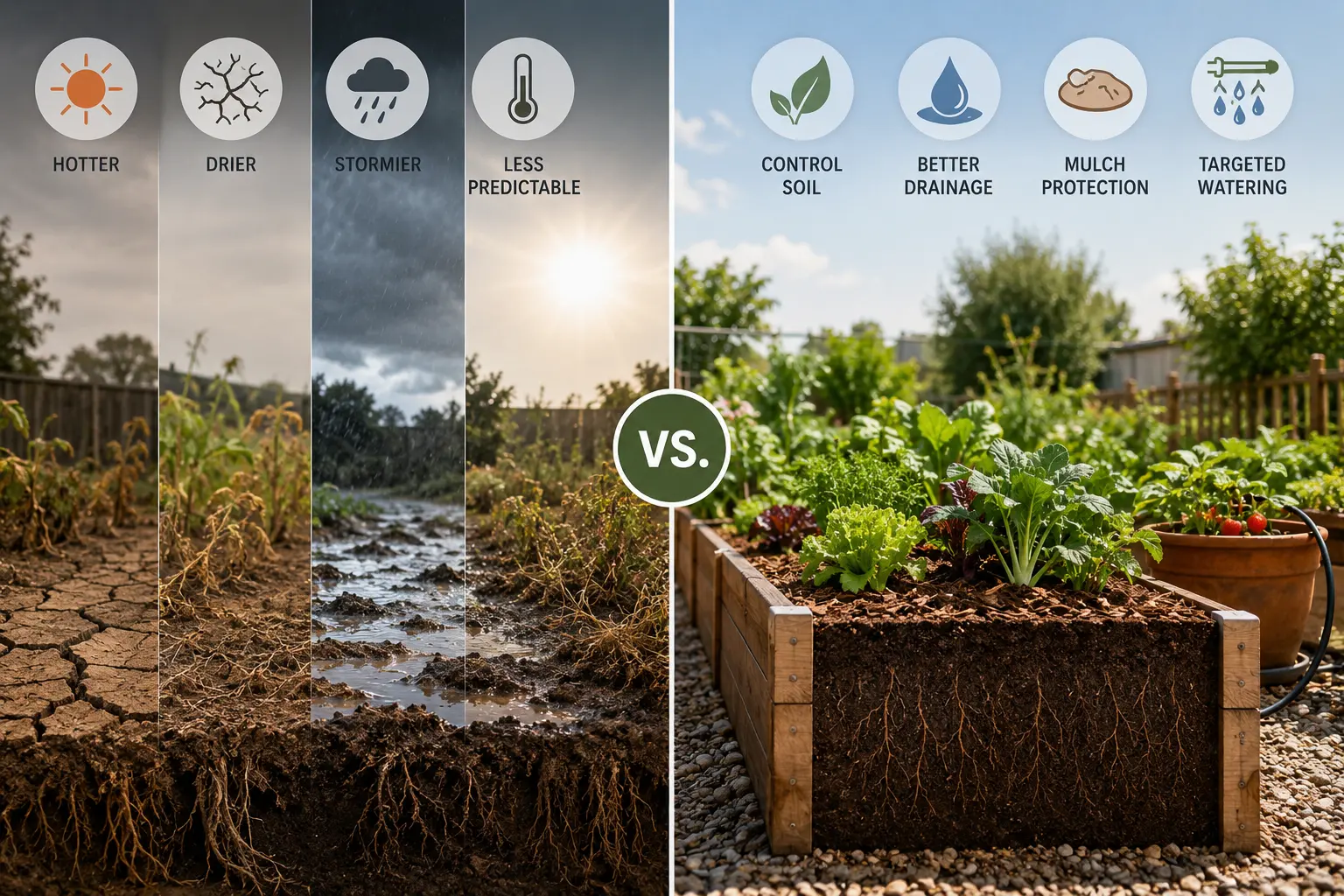
European gardens aren’t facing one problem. They’re facing a set of extremes that amplify each other:
Hotter. In June 2026, France set a national average temperature record. England and Wales experienced their warmest spring on record. Soil surface temperatures can reach 50–60°C — organic matter burns off, soil structure collapses, and water-repellent layers form. We cover these dynamics in detail in our soil moisture and root protection article — but the key point here is this: in-ground gardens sit fully exposed to these changes, with zero buffer.
Drier. Groundwater levels are declining. France experienced severe depletion in 2022, and conditions have intensified by 2026. Hosepipe bans and drought decrees restrict when and how you can water. The deep soil moisture that in-ground plants depend on is no longer reliable.
Stormier. Heavy rain is hitting harder and faster. In-ground drainage depends on soil type — clay gardens turn into bogs during downpours, and sandy gardens turn into deserts during droughts. You can’t swap your soil. But you can use a raised bed to give roots an entirely new zone to grow in.
Less predictable. Three days of heatwave, two days of torrential rain, a week of drought — this kind of wild swing is the new normal. In-ground plants can’t adapt fast enough. Raised beds and planters have a smaller, controllable soil volume: add mulch during a heatwave, pull the plug to drain excess water after a storm, run drip irrigation during a dry spell.
In-ground planting isn’t going away. But in a Europe where extreme weather keeps arriving more often, relying entirely on in-ground planting means relying entirely on luck. Raised beds and planters give your customers a choice.
If you’re sourcing raised beds and planters for the European market, the climate-adaptation angle changes what you stock and how you spec your products. Talk to Scarecrow about sourcing raised beds, planters and matching accessories — we’ll help you build a product list that matches what European buyers actually need right now. → Get your raised bed product list
What Raised Beds and Planters Actually Solve
1. Controllable Soil — No Longer Stuck With What You’ve Got
Your customer’s garden might be heavy clay, pure sand, or construction backfill. In-ground planting means working with whatever’s there. Raised beds and planters let you build soil from scratch: compost + coco coir + perlite + biochar, tailored to what the plants need.
For B2B buyers, the implication is clear: soil capacity is the most important planter specification. A planter that holds only 30 litres of soil can dry out in a single day at 35°C. A raised bed holding 80 litres has greater thermal mass and gives roots more buffer. When sourcing, pay attention to depth — at least 25 cm is needed to provide an adequate root zone buffer.
2. Controllable Drainage — No Flooding in Storms, No Cracking in Droughts
In-ground drainage depends on soil type, and you can’t change it. Raised beds and planters have drainage holes — pull the plugs during a downpour and water drains straight out; insert the plugs during a drought and moisture stays in the root zone.
For B2B buyers: drainage holes + plugs + saucers are a three-piece set. None is optional. A drainage hole without a plug becomes a leak during dry spells. A drainage hole without a saucer makes a mess on balconies and patios. When sourcing, confirm: how many drainage holes? Are plugs included? Does a matching saucer exist?
3. Controllable Position — Move Into Shade When It’s Hot
In-ground plants stay where they’re planted. At 35°C in full sun, there’s nowhere to hide. A planter on wheels can chase the shade — morning on the east wall, afternoon under a tree.
For B2B buyers: wheels aren’t an accessory. They’re heatwave survival equipment. A planter with a tomato plant can weigh 30–50 kg — without wheels, it’s not moving. When sourcing, confirm: are wheels included? What’s the load rating? Do they lock?
4. Controllable Temperature — Root Zones Don’t Overheat Like In-Ground Soil
In-ground soil surface temperatures can reach 50–60°C, and that heat conducts straight down into the root zone. Planter soil volumes are smaller, so they heat up and cool down faster — which means root zones do overheat more quickly during a heatwave, but also cool down faster once you shade or water them. The net effect is still positive: you can intervene fast and bring root zone temperatures down in hours, not days. The key is using them with mulch and drip irrigation.
For B2B buyers: planter colour affects root zone temperature. Based on industry experience, dark-coloured planters in full sun can have root zone temperatures 5–11°C higher than light-coloured ones. Metal planters conduct heat fastest and need extra attention. Source light-colour options, or recommend that customers pair dark planters with mulch.
What to Look for When Sourcing Raised Beds and Planters
Your customers won’t ask about these things. But you should know them. Below are the product characteristics B2B buyers need to confirm with factories — each one directly affects end-user experience and return rates.
Core Sourcing Checklist
| Feature | Why It Matters | What to Ask the Factory |
| Soil capacity/depth | Determines root zone buffer; shallow beds dry out in a day during heatwaves | Minimum depth 25 cm; what’s the volume in litres? |
| Drainage holes | Flood relief in storms, moisture retention in droughts | How many holes? Where positioned? Plugs included? |
| Plugs | Close drainage to retain water during dry periods | Material? UV-resistant? Easy to lose? |
| Saucers | Prevent drainage mess on floors; essential for balconies and patios | Matching planter size? Load rating? |
| Wheels | Move planters into shade during heatwaves | Included? Load rating? Locking? |
| Material | Affects durability, root zone temperature, and food safety | Metal (galvanised / Aluzinc / polymer-coated) vs plastic vs wood? |
| UV resistance | Plastic planters degrade and crack under strong UV | UV stabiliser percentage? Outdoor lifespan? |
| Assembly method | Affects retail packaging and end-user experience | Bolt-together with pre-drilled holes? Tools required? One-person assembly? |
| Surface treatment | Rust prevention and food safety for metal beds | Coating type? Food-grade certified? |
| Packaging | Mail-order friendliness determines online channel viability | Flat-pack? Printed retail box? Shipping protection? |
Material Comparison: Metal vs Plastic vs Wood
Material choice is where most sourcing decisions get made — and where most mistakes happen.
| Metal (Galvanised / Aluzinc Steel) | Plastic (PP / PE) | Wood (Pine / Fir) | |
| Durability | 5–20+ years, depending on thickness and coating | 3–7 years, depending on UV stabilisers | 3–8 years, depending on treatment |
| Root zone temp | Conducts heat fast; dark colours overheat in full sun | Moderate; light colours perform better | Best insulation; most stable root zone temps |
| Weight | Medium (0.6 mm steel) to heavy (1.2 mm+) | Light | Medium |
| Drainage | Requires drainage hole plugs | Usually self-draining | Wood absorbs water and swells |
| Food safety | Depends on coating — confirm food-grade | PP is generally considered safe | Depends on treatment — CCA-treated is not safe |
| Assembly | Bolt-together; tools required | Usually moulded in one piece | Requires assembly |
| Retail packaging | Flat-pack; mail-order friendly | Bulky; high shipping cost | Flat-pack |
| Return risk | Cut edges may be sharp — confirm safety edge trim | UV degradation and cracking are the main return causes | Wood rot and warping are the main return causes |
Key point on thickness and material. Metal planter thickness directly determines durability and feel. The current market mainstream is 0.4 mm and 0.6 mm. 0.4 mm is the budget option (light, thin, prone to deformation during shipping). 0.6 mm is the standard grade (solid feel, noticeably better durability). Don’t source on price alone — a 0.4 mm “budget” bed may arrive at your warehouse already dented.
The more important distinction isn’t thickness — it’s substrate material. 0.6 mm galvanised steel vs 0.6 mm Aluzinc-magnesium colour-coated steel: the latter’s corrosion resistance far exceeds the former and is increasingly becoming a preferred material for mid-to-high-end raised beds. Gauge conversion: 0.4 mm ≈ 27 gauge, 0.6 mm ≈ 24 gauge.
When your customers ask “which metal bed should I buy?” — the answer depends on thickness and substrate, not just price. Scarecrow works with multiple factories producing beds across the full range of specs. Tell us your target market and price tier, and we’ll match you with the right supplier — plus handle sample consolidation so you can compare side by side. → Talk to us about sourcing metal raised beds
Which Plants Work in Raised Beds and Planters
Not every plant is suited to container growing. But heatwaves and drought are pushing some plants from “fine in the ground” to “better off in a raised bed” — because the soil and moisture in a bed are controllable.
Heatwave Winners for Raised Beds
| Plant | Why It Works in a Bed | Bed Specs | Pair With |
| Tomatoes | Need precise watering — in-ground supply is unreliable during droughts | Depth ≥ 30 cm; volume ≥ 40 L | Cage / stake + drip irrigation |
| Strawberries | Fruit off the ground reduces rot; controllable soil prevents disease | Depth ≥ 20 cm; can be edge-mounted | Mulch + saucer |
| Herbs (basil, thyme, rosemary) | Shallow roots, drought-tolerant, small space is sufficient | Depth ≥ 15 cm | Mulch |
| Salad leaves (lettuce, rocket) | Quick harvest; easy to move into shade during heatwaves | Depth ≥ 15 cm | Shade cloth + mulch |
| Dwarf fruit trees (lemon, blueberry) | Acidic soil needs — difficult to amend in-ground, easy in a bed | Depth ≥ 35 cm; volume ≥ 60 L | Acidic mix + wheels |
| Ornamentals (geraniums, petunias) | Move to shade in heatwaves; move under cover during storms | Depth ≥ 20 cm | Saucer + mulch |
Retail talking point: “When tomatoes are in the ground, you can’t control the drought or the downpour. In a raised bed, you control the soil, the water, the position — too hot, wheel it away; too wet, pull the plug.”
How to Display Raised Beds in a Garden Centre
Raised beds and planters aren’t standalone products — they’re the core of a planting system. Display them as part of a complete solution.
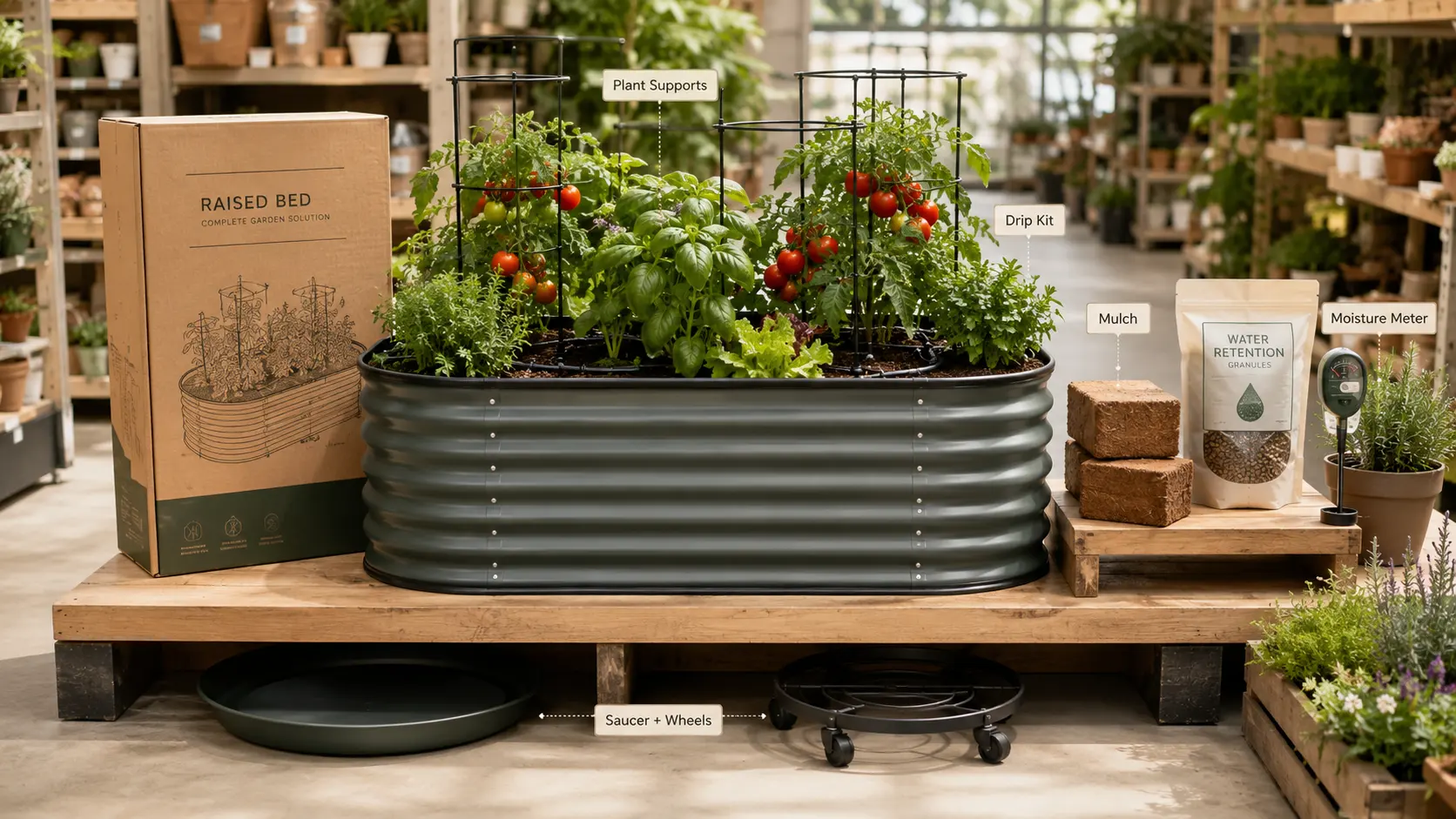
The Raised Bed Solution Display
| Position | What to Display | Why |
| The bed itself | Metal raised bed (assembled) + flat-pack (showing retail packaging) | Let customers see both the finished product and the packaging |
| Beside the bed | Mulch (coco coir blocks) + water-retention granules + moisture meter | “Bed + these three items = double the heatwave survival rate” |
| Under the bed | Saucer + wheels | “Standard setup for balconies and patios — drainage + mobility” |
| Inside the bed | Drip irrigation kit demo | “Set it up once, it runs all summer” |
| Above the bed | Plant supports (cages/stakes) | “Essential for tomatoes and dwarf fruit trees” |
Cross-sell formula: Bed + saucer + mulch + drip kit + moisture meter = a complete climate-adapted planting solution. Selling the bed alone is selling a container. Selling the five-piece set is selling a solution — and based on industry experience, the basket value more than doubles.
Online product page: Title it “Climate-Ready Raised Bed Kit — Bed + Saucer + Mulch + Drip + Moisture Meter.” That’s what your customers are searching for after a heatwave — not “plant pot,” but “how do I keep plants alive in extreme heat.”
FAQ
Do metal raised beds get too hot in summer?
Yes — but it’s manageable. Dark metal beds in full sun do have higher root zone temperatures than light-coloured plastic or wooden ones. Solutions: choose light colours or polymer-coated finishes, add 5 cm+ of mulch as insulation, position in partial shade, or fit wheels so the bed can be moved during heatwaves. Don’t rule out metal beds because “metal gets hot” — their durability and flat-pack advantages are things plastic and wood can’t match. The key is pairing them with the right usage practices.
How do raised beds and planters prevent waterlogging?
Drainage holes + plugs + saucers — the three-piece set. During a downpour, pull the plugs and water drains through the holes; the saucer catches excess and keeps the floor clean. During a drought, insert the plugs and moisture stays in the root zone. A drainage hole without a plug is basically a leak during dry spells — this is one of the most common design flaws in raised beds, and a source of returns.
How deep should the soil be in a raised bed?
At least 25 cm. Anything shallower can dry out in a single day during a heatwave, leaving roots with no buffer. Tomatoes and dwarf fruit trees need 30–35 cm or more. Add 5 cm of mulch on top of the soil surface — this layer can reduce root zone temperature by 3–8°C in 35°C weather.
How long do raised beds and planters last?
It depends on the material and thickness. Based on industry experience, 0.6 mm Aluzinc steel beds can last 10+ years under normal outdoor conditions; 0.4 mm galvanised steel approximately 3–5 years; 0.6 mm Aluzinc-magnesium colour-coated steel has corrosion resistance several times that of standard galvanised steel, with an estimated lifespan of 15–20+ years based on industry experience. Plastic beds depend on UV stabilisers — without them, cracking starts around year 3; with them, 5–7 years. Wooden beds depend on treatment — untreated wood rots in 2–3 years; treated wood can last 5–8 years. These are industry estimates; actual lifespan depends on climate, maintenance and usage conditions.
Is it safe to grow vegetables in raised beds?
It depends on the material and coating. PP plastic is generally considered food-safe. Metal beds need food-grade coating confirmation — cheap beds may use industrial coatings not suitable for edible crops. Wood needs treatment confirmation — CCA (copper-chromium-arsenic) treated wood is not safe; ACQ-treated wood is generally considered safe. Confirm food-grade certification with the factory when sourcing.
Next Step: Prepare Climate-Adapted Planting Solutions for Your Customers
In-ground gardens are increasingly vulnerable to extreme weather — and your customers are looking for alternatives. Raised beds and planters aren’t just “for small spaces.” They’re for anyone who wants to keep growing things in a hotter Europe.
Three things you can do now:
- Get the raised bed and planter product list. Tell Scarecrow your target market, customer type and channel (garden centre / online / wholesale). We’ll send a curated SKU list — metal beds in various thicknesses and substrates, plastic planters in various sizes, saucers, wheels, drainage plugs — all with specs, matched to your channel needs. → Request your raised bed product list
- Order a comparison sample box. Different materials and thicknesses feel completely different in hand. Scarecrow can consolidate samples from multiple suppliers — 0.4 mm vs 0.6 mm galvanised steel, 0.6 mm galvanised steel vs 0.6 mm Aluzinc-magnesium colour-coated steel, light vs dark colours — so you can compare side by side before committing. → Request your sample box
- Build a raised bed + climate product combo order. Bed + saucer + mulch + drip irrigation + moisture meter is a complete solution, not five separate products. Scarecrow can consolidate these items from different factories into a single shipment — your customer receives a solution, not a container. → Contact us about raised bed + climate product combo orders
Your customers don’t want to keep gambling with the weather. Raised beds and planters give them a controlled growing environment — you give them the complete solution.
Send Your Requirement, We Help You Check the Right Option
Suitable for garden centers, wholesalers, importers, and e-commerce sellers who want to compare products before bulk purchasing.
Written by
ScarecrowGarden
💡About Scarecrow Garden Supplier Co., Ltd.
Scarecrow Garden Supplier Co., Ltd. is a China-based sourcing and wholesale partner specializing in garden tools, landscaping equipment, and outdoor supplies for international wholesalers, distributors, contractors, and brands.
With hands-on experience rooted in real garden use scenarios, we focus on durable materials, functional design, and stable large-volume supply. Our product range covers pruning tools, watering systems, hand tools, outdoor hardware, and customized garden solutions to support both retail and professional landscaping markets.
Beyond products, we help our partners navigate supplier selection, quality control, compliance requirements, and long-term sourcing strategies in China. Through our blog, we share practical insights on product selection, material comparisons, industry trends, and cost-effective purchasing—helping global buyers build stronger, more competitive supply chains.