








How Hotter European Summers Are Reshaping Garden Product Sourcing | Scarecrow Garden Supplier
It is late June 2026. A garden centre manager in Kent answers the phone — again. A customer’s hydrangeas are wilting by noon. Another caller wants to know if it is legal to use a hosepipe right now. A landscaper walks in looking for shade netting, any shade netting, today. The temperature outside has been above 35 °C for five consecutive days. The Hosepipe Ban just came into effect.
This is not a one-off. In the last week of June 2026, a heat dome settled over Europe and broke records across the continent. France hit 44.3 °C in the southwest. Germany and Austria recorded their highest-ever June temperatures. Poland and the Czech Republic saw readings 5–12 °C above the seasonal norm — heat levels these regions have almost never experienced. Southern Spain and Italy pushed past 44 °C. Even parts of Scandinavia saw unusually high temperatures, a range entirely outside the historical norm for those latitudes. [Source: WMO, Copernicus, European Drought Observatory]
For garden centres, wholesalers, importers, and online sellers, this is not a weather story. It is a sourcing story. The products your customers are searching for right now — shade netting, drip irrigation kits, self-watering planters, moisture-retaining mulch, heat-resistant containers — are not the same products you were stocking five years ago. And the way you source them needs to change, too.
For a more product-level breakdown of shade, watering and rescue-kit ranges, read our guide to heatwave gardening products for European garden centers.
Europe’s Garden Season Is No Longer Predictable
The old rhythm of European gardening — a cool, wet spring followed by a reliably mild summer — is gone. What replaces it is volatility: earlier heatwaves, longer dry spells, sudden storms, and temperature swings that stress plants in ways most gardeners have not dealt with before.
The data is unambiguous:
- May 2026 brought an exceptionally early and intense heatwave to Western Europe. Parts of France and England saw daily temperatures more than 10 °C above the 1991–2020 average — before summer had even started. [Source: Copernicus Climate Change Service]
- Spring 2026 brought record-breaking warmth to England and Wales. Plants broke dormancy early, then hit extreme heat before root systems were fully developed. [Source: UK Met Office]
- June 2026 saw record-breaking heat spread across the full width of Europe, from the Iberian Peninsula to the Balkans. The World Meteorological Organization confirmed multiple all-time records broken, with impacts on health, agriculture, and infrastructure. [Source: WMO]
- Compared to the infamous 2003 heatwave, preliminary analysis suggests 2026 temperatures are reaching similar or higher peaks earlier in the season; night-time temperatures have risen even more significantly, meaning plants cannot recover overnight. [Source: World Weather Attribution]
- The European Drought Observatory shows drought warnings and alerts expanding across the UK, Central Europe, Eastern Europe, and the Iberian Peninsula as of late June 2026.
Why this matters for sourcing: These are not isolated events that will “go back to normal next year.” The WMO’s seasonal outlook for July–September 2026 shows a strengthened probability of above-normal temperatures across European land areas, with the strongest warm signal over Southern Europe. The trend is structural. Garden product buyers who wait for a “normal summer” will find themselves out of stock when their customers need help the most.
If you source garden products for European markets, the question is no longer whether to adjust your product range. It is how fast you can do it.
What Hotter Summers Mean for Garden Centres and Wholesalers
The shift is not about stocking a few extra watering cans. It is a fundamental change in what your customers come to you for — and when they come.
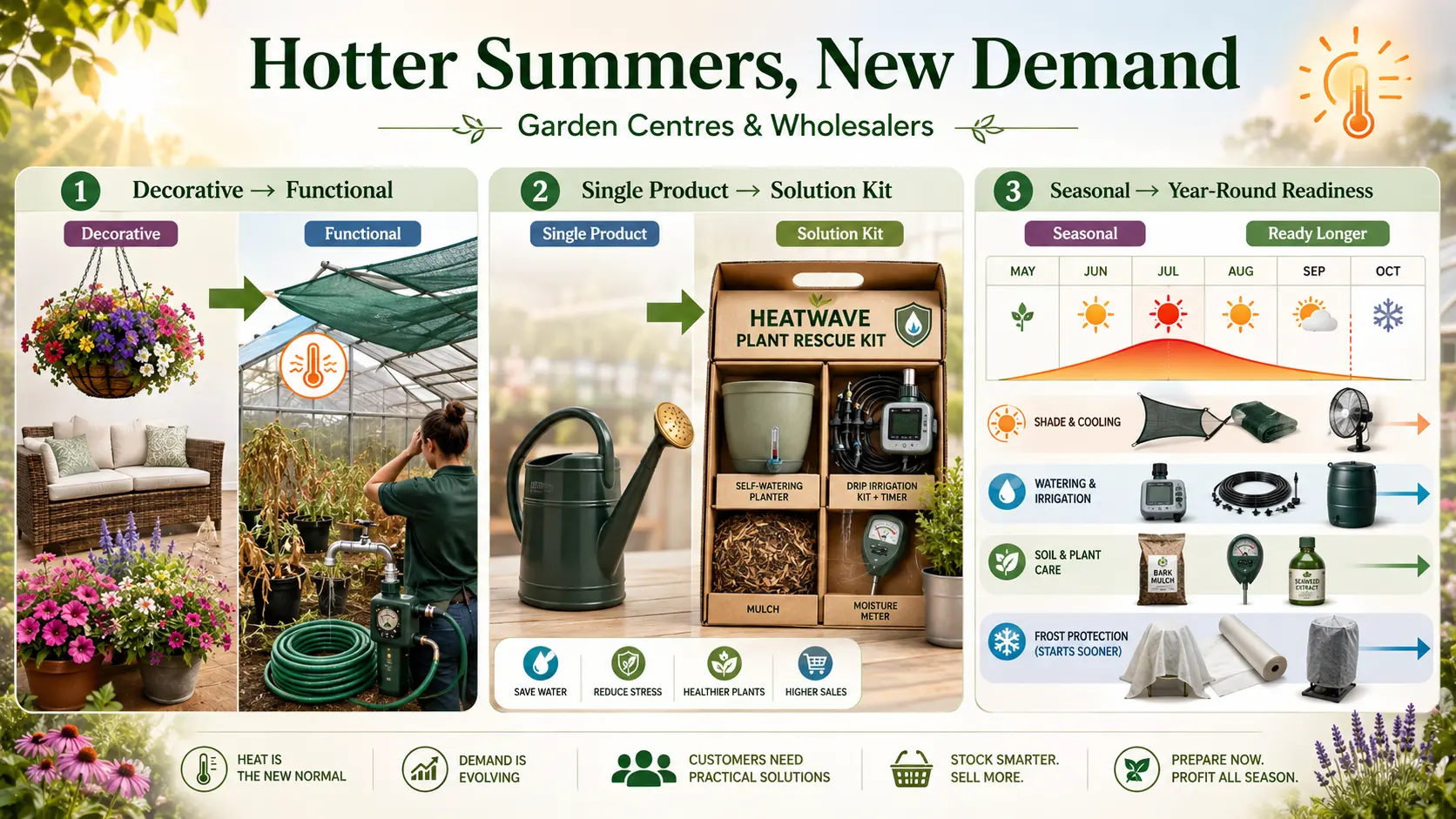
From decorative to functional. Five years ago, a garden centre’s summer bestsellers were hanging baskets, patio furniture, and ornamental plants. Today, the urgent queries are different. A landscaper in southern England wants to know how to keep a client’s garden alive under a Hosepipe Ban. A grower in Bavaria is watching tomato blossoms drop in 38 °C heat and needs shade netting — not next month, but this week. A garden centre in Kraków, a region with almost no historical experience of 40 °C heat, is getting panicked calls about greenhouse plants literally cooking under glass.
From single products to solution kits. Customers no longer ask for “a watering can.” They ask: “How do I keep my container plants alive when I cannot use a hosepipe and I am away for the weekend?” The answer is not one product — it is a combination: a self-watering planter with a reservoir, a drip kit on a timer, and mulch on the soil surface to slow evaporation. Garden centres that sell these items as a coherent “Heatwave Plant Rescue Kit” will serve their customers better — and sell more units per visit.
From seasonal timing to year-round readiness. The old model was: stock summer products in May, clear them by August. But when a heatwave hits in late June and drought warnings persist into September, the demand window stretches and shifts unpredictably. Wholesalers who ordered shade netting for “July delivery” are already too late. Importers who planned autumn restocks based on last year’s sell-through are finding that heat-protection products are still selling in September — while frost-protection products are needed earlier than expected because stressed plants are more vulnerable to early cold snaps.
From one-size-fits-all to region-specific ranges. The problems differ sharply by region:
| Region | Dominant Problem | What Customers Ask For |
| UK & Ireland | Hosepipe bans; hydrangea and Japanese maple scorch; lawn dormancy | Rain barrels, shade cloth, long-spout watering cans, moisture meters, and lawn alternative seed |
| France & Benelux | Extreme heat (40 °C+); leaf scorch on trees; mulch fire risk | Heavy-duty shade netting, drip irrigation, fire-safe mulch, tree watering bags |
| Germany & Austria | Greenhouse overheating; soil moisture deficit; peat-free substrate drying out | Greenhouse shade kits, moisture meters, wetting agents for peat-free compost, and plant supports |
| Spain, Italy & Greece | Long-term drought; xeriscaping; container plant death in the sun | UV-resistant shade cloth, subsurface drip irrigation, self-watering planters, thick-walled terracotta pots |
| Poland, Czechia, Hungary, the Balkans | Sudden extreme heat with no prior experience; greenhouse emergencies | Low-cost shade solutions, greenhouse cooling paint, emergency drip kits, shade tunnels |
| Nordics & Baltics | Short-season heat spikes; cool-climate plant shock; early frost risk | Mini greenhouse shade covers, frost covers, water butts, grow lights for season extension |
This is not a temporary blip. The Royal Horticultural Society, national meteorological offices, and the European Drought Observatory are all pointing in the same direction: hotter, drier, more volatile summers are the new baseline. Garden product sourcing needs to reflect that — not this season, but permanently.
If your current product range was designed for the climate of ten years ago, it is already out of date. The solutions exist — and many of them come from a place that has been dealing with 40 °C summers in agriculture for decades. More on that in the next section.
Want to explore which heat-protection and water-saving products fit your target market? Talk to us about your country focus and retail format — we can help map the right product mix.
What European Gardens Can Learn from Long-Term Farming Practice
Here is something that surprises many European buyers: China has been dealing with extreme heat and drought in agriculture for decades. The country has over 410 million mu (roughly 27 million hectares) under efficient water-saving irrigation — drip, micro-spray, and subsurface systems. The Ministry of Agriculture and Rural Affairs publishes annual technical guidelines for crops under heat and drought stress. Provincial research stations test shade materials, soil amendments, and irrigation schedules under real field conditions every summer.
This matters because the physics of plant stress does not change between a farm and a garden. A tomato plant wilting at 38 °C in a Bavarian allotment has the same problem as a tomato plant wilting at 38 °C in a Shandong field. The solutions transfer — and many of them are simpler than you might expect.
Shade: Not Just “Put a Net Over It”
Chinese farming experience has produced a detailed, practical body of knowledge about shade netting that goes well beyond “cover your plants.”
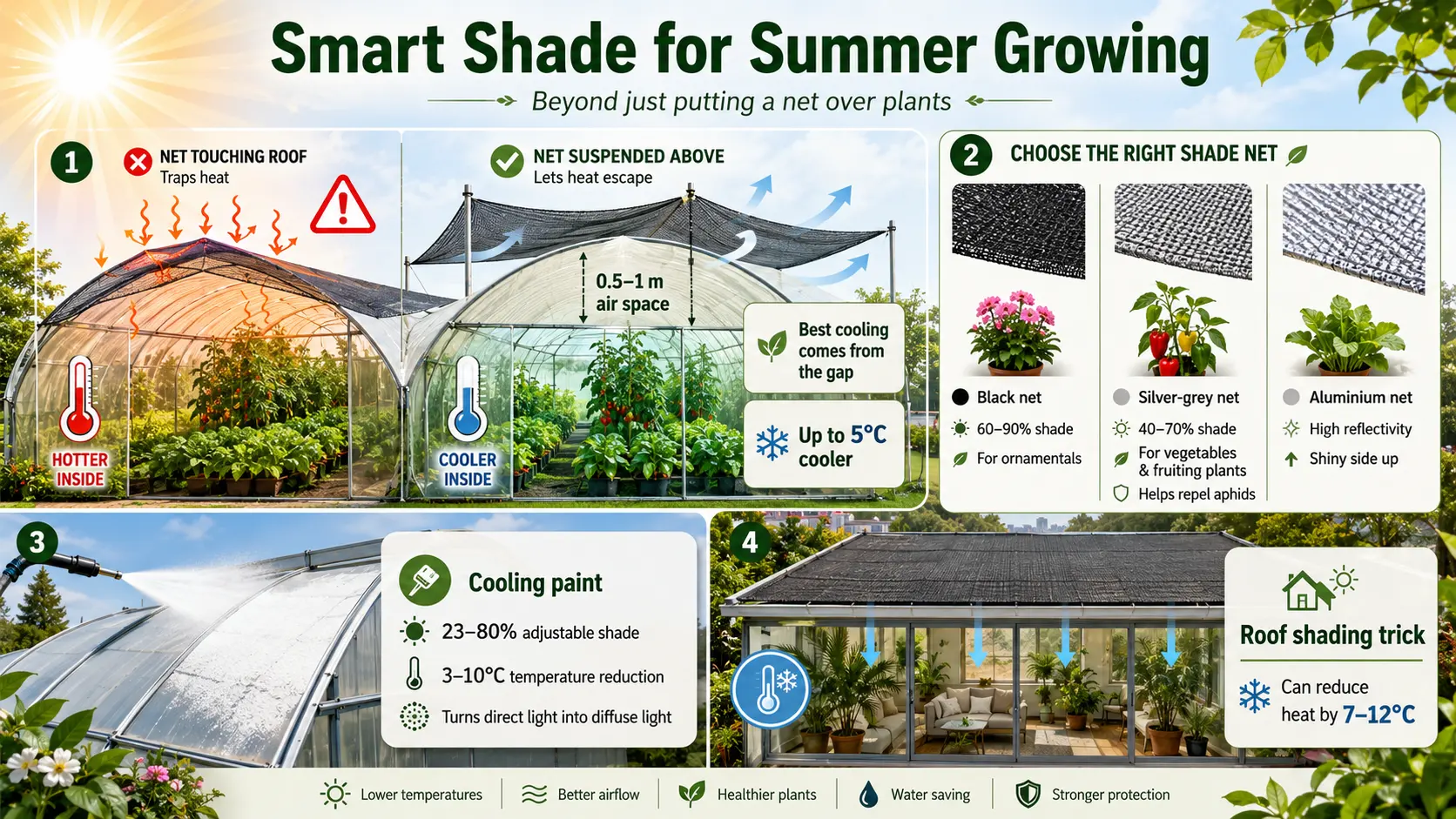
The gap matters more than the net. This is the single most important thing most European gardeners do not know. A shade net placed directly on top of a greenhouse or plant canopy traps heat against the surface — it can actually increase temperatures beneath it. Chinese agronomists consistently recommend maintaining 0.5 to 1 metre of air space between the shade net and the covered surface. Field measurements by Chinese agronomic stations show this gap significantly reduces temperatures compared to direct-contact installation — by approximately 5 °C in typical conditions. On a 38 °C day, that difference keeps greenhouse interiors below 33 °C instead of pushing them above 38 °C.
Choose the right shade rate for the right plant. Chinese practice distinguishes clearly:
- Black shade netting, 3–4 stitches (60–90% shade rate): For heat-sensitive ornamentals (hydrangeas, ferns, Japanese maples) and for the peak of summer. Use only during the hottest hours (10:00–16:00), then remove to allow photosynthesis.
- Silver-grey shade netting, 2–3 stitches (40–70% shade rate): For vegetables and fruiting plants that still need good light. Silver-grey also repels aphids, which can indirectly reduce aphid-transmitted virus spread.
- Aluminium-laminated shade netting: The highest reflectivity. Install with the shiny side facing up. Used in commercial greenhouses for the most extreme conditions.
Greenhouse cooling paint — a solution most European growers have not considered. Chinese greenhouses widely use spray-on shading compounds that can be applied to the outside of glass or poly film. One bucket diluted with water can cover approximately 800 m² (coverage varies by product and dilution rate). The shade rate is typically adjustable from 23% to 80% depending on coating thickness, and it reduces interior temperatures by roughly 3–10 °C. Critically, it converts direct radiation into diffuse light, which reduces disease pressure compared to shade cloth. The coating naturally degrades and washes off over approximately three months — just in time for autumn light levels to return. For the Dutch grower asking “how many microns of reflective paint do I need?”, the Chinese answer is: use a spray-on product with adjustable shade rate, and reapply as conditions change.
What European buyers will ask about cooling paint — and they should. If you are sourcing greenhouse shading paint for European markets, your customers will want to know: Is it safe for food crops? What is in it? Does it comply with REACH? These are the right questions. Most agricultural-grade shading compounds are water-based formulations using mineral reflectants — typically calcium carbonate and titanium dioxide — rather than organic solvents or heavy-metal pigments. They are applied to the exterior of the greenhouse covering, not inside the growing space, and they wash off with rain or mild pressure, leaving no permanent residue on the glazing. That said, not all products are equal. Some cheaper formulations may contain formaldehyde-based binders or heavy-metal pigments. European buyers should request a full Safety Data Sheet (SDS/MSDS) and confirm REACH compliance before committing to volume. This is standard due diligence for any chemical product entering the EU market — and it is exactly the kind of verification we handle during our inspection process when a buyer asks us to source cooling paint.
The roof trick. In rural China, shade netting is routinely laid directly on building rooftops to block heat from entering the structure below. Double-layer reinforced netting — a dense outer layer blocking up to 80% of UV, with an inner layer allowing air convection — can significantly reduce the temperature beneath, with field reports indicating reductions of 7–12 °C on a 38 °C day. For European garden centres with glass-roofed display areas or residential customers with sunrooms, this is a low-cost, high-impact intervention.
Water: Get It to the Root Zone, Not the Air
Chinese agriculture has learned — through necessity — that how you water matters as much as how much.
Water the root zone, not the foliage. This is the core principle behind every drip and subsurface irrigation system. Sprinklers and hosepipes lose a significant portion of water to evaporation, wind drift, and canopy interception before it reaches the soil — field studies suggest net losses of 8–15% even in calm conditions, and substantially more in hot, windy weather. Drip emitters deliver 2–12 litres per hour directly to the root zone. Subsurface drip lines (buried 30–40 cm deep) virtually eliminate surface evaporation. For a European gardener under a Hosepipe Ban, this distinction is critical: some UK water authorities permit drip irrigation even when hosepipe use is banned, because drip uses a fraction of the water — but the 2010 Flood and Water Management Act gave water companies the power to include drip irrigation in bans, and some have done so. Check locally.
When you water is as important as where. Chinese technical guidelines are explicit: never irrigate between 10:00 and 16:00 during heatwaves. At midday, soil temperatures can exceed 35 °C, root systems enter semi-dormancy and cannot absorb water efficiently, and water applied to hot soil can flash-steam around roots. The best windows are early morning (within one hour of sunrise) or evening (two hours after sunset). For the Italian gardener whose soil surface reaches 50–60 °C, the optimal schedule shifts to night-time irrigation between 02:00 and 04:00, when soil temperatures have dropped enough for water to penetrate without cooking roots.
Deep, infrequent watering beats shallow, frequent watering. A thorough soaking that wets the soil to a depth of 30 cm once every 2–3 days encourages roots to grow downward in search of moisture. Shallow daily watering keeps roots near the surface where they are most vulnerable to heat and drying. This is especially important for newly transplanted stock — the very plants that are dying in French and Portuguese nurseries right now because spring rain delayed planting, and shallow root systems hit the heat dome before they were established.
The “water twice” technique for container plants. When potting mix dries out completely — as peat-free coconut coir substrates increasingly do under extreme heat — it becomes hydrophobic. Water runs straight through the drainage holes without wetting the root ball. Chinese growers solve this with a two-pass approach: water once to break the surface tension, wait 3–5 minutes, then water again. The second pass is absorbed properly. Adding a wetting agent to the substrate eliminates this problem at source.
Soil: Protect the Root Zone
Mulch — but mind the fire risk. Chinese tea plantations and vegetable farms routinely spread organic material 5–10 cm deep between rows to reduce soil temperature and retain moisture. This transfers directly to European gardens. But there is a critical safety note that French and Australian landscapers are already raising: in extreme drought, deep bark mulch can ignite from a discarded cigarette or focused sunlight. In fire-prone regions of France, Spain, and Portugal, inorganic mulches — gravel, volcanic rock, or pebbles — are safer. For organic mulch in moderate-risk areas, keep it well watered and avoid depths greater than 10 cm.
Super-absorbent polymers — “micro-reservoirs” in the soil. Potassium-based polyacrylate water-retention crystals can absorb 400–500 times their own weight in water. Mixed into soil at typical rates of 20–80 g/m² (depending on soil type), they form tiny reservoirs that slowly release water to roots during dry periods. Chinese forestry authorities have recognised these as highly effective micro-irrigation materials for drought resistance. In practice, they have been reported to advance lawn green-up and extend the green season in northern climates. For European container plants, raised beds, and newly planted trees, they are a practical insurance policy against the gap between waterings.
Phosphorus-potassium foliar sprays for heat-stressed plants. When soil temperatures exceed 35 °C, roots cannot absorb nutrients efficiently — they are in semi-dormancy. Chinese agricultural extension services commonly recommend foliar application of 0.3–0.5% monopotassium phosphate (KH₂PO₄) plus 0.3% urea, sprayed on leaves in the early morning or late evening, every 7–10 days through the heat period. This bypasses the root system entirely and delivers stress-resistance compounds directly to the foliage. For the French orchardist asking “can I spray amino acid foliar fertiliser to save my scorched fruit trees?” — the answer is yes, and the Chinese standard protocol adds humic acid and potassium phosphite for maximum effect.
Plants: Choose What Survives
A customer walks into your garden centre in Surrey. Their lawn has been yellow for three weeks. They are tired of watering it, tired of looking at it, and they want an alternative. Another customer in Munich wants a border that will not crisp up every July. A third, in Seville, has given up on traditional flower beds entirely. These are not unusual cases — they are the new normal.
Chinese experience with extreme urban and rooftop environments has identified a set of plants that survive — and even thrive — under conditions that kill traditional European garden staples.
Sedum lineare — the plant that survives extreme rooftop heat. For that customer in Surrey who is done with their failing lawn, here is an alternative that actually works. This succulent ground cover is the backbone of Chinese green roof systems. It grows in 3–5 cm of substrate, requires almost no watering once established, tolerates roof surface temperatures up to 50–55 °C, stays green three seasons, and naturally dies back in winter before re-emerging in spring. It never needs mowing. For European customers wanting to replace failing lawns or green exposed roof areas, this is as close to a “plant and forget” solution as exists.
Thyme lawns — fragrance underfoot, no mower required. For the customer who is tired of watching their grass go brown every July but still wants something walkable and attractive — creeping thyme (Thymus serpyllum) forms a dense mat 5–8 cm tall, tolerates drought, poor soil, and cold, blooms with purple flowers in summer, and releases scent when walked on. It is already gaining interest in the UK as a lawn alternative, and Chinese nurseries have propagation experience at scale.
The drought-tolerant border palette. For the Munich landscape architect who needs to design a border that holds its structure without constant watering, Chinese urban landscaping has already worked out the answer. A set of perennials that handle heat and drought with minimal irrigation: Salvia (sage), Echinacea (coneflower), Rudbeckia (black-eyed Susan), Lavandula (lavender), and ornamental grasses. These are the same plants that British and German designers are now specifying for “climate-resilient” borders — the difference is that Chinese nurseries have been producing them in volume for years.
These are not theoretical recommendations. They are field-tested practices from a country that runs the world’s largest agricultural system under some of the most challenging climate conditions on the planet. The products that support these practices — shade netting, drip systems, water-retention crystals, foliar feed formulations, drought-tolerant plant stock — are manufactured at scale and available now.
Want to see how these practices translate into products you can stock? The next section breaks it down by category — with specific SKUs, retail opportunities, and region-specific priorities.
Product Categories to Prepare for Climate-Resilient Gardens
Based on the problems European growers, landscapers, and garden centres are reporting right now, here are the product categories that matter — and the specific SKUs within each one.
1. Shade and Greenhouse Cooling
A garden centre in Kraków called last week: “Do you have any shade netting? Any size. Today.” They had never had that question before. This is the single most urgent category for summer 2026. Every region, from Kent to Kraków, is reporting demand that outstrips supply.
| Product | What It Does | Key Specification | Best For |
| Black shade netting (HDPE) | Blocks 60–90% of solar radiation | 3–4 stitch; reinforced edges; UV-stabilised | Hydrangeas, ferns, Japanese maples, greenhouse crops |
| Silver-grey shade netting | Blocks 40–70%; reflects aphids | 2–3 stitches; lighter weight | Tomatoes, peppers, fruiting plants, early/late season |
| Aluminium-laminated shade netting | Maximum reflectivity | Shiny side up installation | Extreme heat events, commercial greenhouses |
| Greenhouse cooling paint (spray-on) | Adjustable shade rate 23–80%; diffuses light | One bucket covers ~800 m²; degrades naturally in ~3 months | Glass and poly greenhouses; Dutch/French commercial growers |
| Shade net clips and fixing kits | Secures netting with correct air gap | Designed for 0.5–1 m offset from the surface | All shade net installations — the gap is critical |
| Greenhouse vent clips and auto-openers | Increases natural ventilation | Temperature-triggered | Small greenhouses in Northern/Central Europe |
Retail opportunity: Bundle shade netting + clips + a simple instruction card explaining the 0.5–1 m gap rule as a “Greenhouse Shade Kit.” The instruction card alone — explaining something most customers do not know — adds value and justifies a kit premium.
2. Water-Saving Irrigation
A wholesaler in Birmingham reports: “We sold more drip kits in the first two weeks of June than in all of last summer.” With Hosepipe Bans in the UK, water restrictions in France, and chronic scarcity in Southern Europe, this category is shifting from “nice to have” to “essential.”
| Product | What It Does | Key Specification | Best For |
| Drip irrigation kits (DIY) | Delivers water to the root zone, 2–12 L/hr per emitter | 10 m kits with adjustable drippers; expandable | Balcony/patio gardeners, vegetable growers |
| Soaker hoses (porous PE pipe) | Seeps water along the entire length | Buriable; connects to rain barrel or tap | Raised beds, borders, and hedge lines |
| Solar-powered auto-drip systems | Waters on solar timer, no mains power or tap needed | Complete kit with pump, timer, tubing | Balcony gardeners, holiday-makers, allotments |
| Deep watering pipes/tree watering bags | Delivers water slowly to the root zone at 30+ cm depth | Slow-release; fits tree trunk | Newly planted trees, fruit trees in heat stress |
| Watering spikes/plant watering cones | Gravity-fed slow drip from any bottle | Fits standard plastic bottles | Container plants, weekend-away watering |
| Long-spout watering cans | Reaches root zone without wetting foliage | 5–10 L; narrow spout | Hosepipe ban areas, targeted watering |
Retail opportunity: Create a “Water-Saving Garden Starter Kit” — drip kit + soaker hose section + moisture meter + instruction leaflet. Position it against the customer question: “How do I keep my garden alive when I cannot use a hosepipe?”
For buyers preparing around hosepipe bans and drought conditions, see our guide to water-saving garden products European buyers should prepare.
3. Soil Moisture Retention and Mulching
A grower in Bavaria is watching his newly planted fruit trees wilt despite daily watering. The problem is not how much he waters — it is that the soil cannot hold onto the water long enough. This category addresses the problem beneath the surface: soil that dries too fast, roots that cook, and the new challenge of peat-free substrates that refuse to re-wet once dry.
| Product | What It Does | Key Specification | Best For |
| Super-absorbent polymer (SAP) crystals | Absorbs 400–500× own weight in water; slow release | Potassium polyacrylate; 20–80 g/m² application | Container plants, raised beds, new tree plantings, and lawn repair |
| Wetting agents (surfactants) | Enables dry substrate to re-absorb water rapidly | Liquid concentrate; dilute and drench | Peat-free compost, coconut coir substrates |
| Mulch mats/coco fibre mats | Suppresses weeds, retains moisture, moderates soil temp | Pre-cut circles and strips | Fruit trees, raised beds, and container top-dressing |
| Weed control fabric (woven) | Long-term weed suppression with water permeability | UV-stabilised; pegged installation | Borders, beneath gravel paths, xeriscaping |
| Bark mulch / decorative aggregate | Moisture retention and aesthetic finish | 5–10 cm depth; note fire risk in drought zones | All border and bed applications |
Critical note for buyers: In fire-risk regions (southern France, Spain, Portugal, Greece), organic mulches can ignite under extreme drought. Stock inorganic alternatives — gravel, volcanic rock, pebbles — for these markets. This is a safety issue, not just a product preference.
The products above do not work in isolation. A self-watering planter without mulch on top still dries out in hours. A drip kit without a moisture meter is just guessing. The categories overlap — and that is exactly what your customers need help understanding. Not sure which product combinations make sense for your market? We can help map solution kits that actually work together.
4. Heat-Resistant Planters and Containers
A garden centre in Seville has stopped stocking thin plastic pots — they crack after two months in the sun, and customers are returning them. The container problem is acute: small pots dry out in hours, thin plastic cracks under UV, and metal planters become root-cooking “frying pans” in direct sun.
| Product | What It Does | Key Specification | Best For |
| Self-watering planters (double-wall) | Reservoir supplies 3–7 days of water, depending on conditions; capillary wick | Food-grade PP; water level window | Balcony/patio plants, holiday watering, garden centre displays |
| Thick-walled resin/PP planters | UV-stabilised; insulated walls slow root-zone heating | Simulates stone/terracotta appearance at a lighter weight | Full-sun positions, commercial landscaping |
| Raised bed / elevated planters | Greater soil volume = slower drying; better drainage | With optional shade canopy integration | Vegetable growing on patios/balconies (Foodscaping trend) |
| Terracotta-style composite pots | Breathable walls; thick construction insulates roots | Frost-resistant composite material | Mediterranean/Southern European markets |
| Drainage trays/pot saucers | Captures run-off; extends water availability | Matched to popular pot sizes | All container plants |
Retail opportunity: The “Botanical Bento” concept — a complete planting kit: self-watering planter + drought-tolerant plant selection (succulents, silver-leaf herbs, ornamental grasses) + sachet of water-retention crystals + care card. High margin, high gift appeal, solves the “I want a garden but I forget to water” customer segment.
5. Vertical Greening and Plant Support Structures
A landscape architect in Vienna is specifying climbing roses on steel arches to shade a client’s west-facing glass sunroom — living shade that gets better every year instead of worse. This category connects two 2026 trends: the “Good Bones” garden design movement (structural elements that give year-round form) and the practical need for living shade on sun-baked walls.
| Product | What It Does | Key Specification | Best For |
| Iron/steel garden arches | Supports climbing plants for natural shade | Powder-coated; 0.8–3.5 m wide; rust-treated | Roses, clematis, wisteria; west-facing wall shading |
| Obelisks / tuteurs | Vertical climbing support in borders | Steel or iron; 1.5–2.5 m tall | Vegetable gardens (beans, cucumbers), ornamental climbers |
| Trellis panels / decorative screens | Wall-mounted climbing support; doubles as a privacy screen | Laser-cut steel or welded wire | Balcony privacy, wall greening, shade creation |
| Plant clips, soft ties, and training wire | Secures stems without damage | UV-stable; gentle on stems | All climbing and tall plants |
| Green wall / vertical garden modules | Pre-planted living wall panels | With integrated drip irrigation | Commercial and high-end residential projects |
Why this matters now: German and Austrian landscape architects are specifying climbing plants on steel structures as “natural shade barriers” for west-facing walls and glass sunrooms. British designers are building “immersive borders” with structural elements that hold the garden together even when plants are heat-stressed. These are not decorative afterthoughts — they are functional heat-response infrastructure.
6. Rainwater Collection
A customer in Kent walks past the watering cans and heads straight for the rain barrels. Under a Hosepipe Ban, every drop of free water counts.
| Product | What It Does | Key Specification | Best For |
| PVC collapsible rain barrels | Collects roof runoff; folds flat for storage | 50–1000 L capacity; UV-treated PVC | UK domestic gardens, allotments, seasonal use |
| Decorative rain barrels/water butts | Rain collection with aesthetic design | Mimics terracotta, stone, or timber | German/Austrian customers demanding design quality |
| Rain barrel connector kits | Links multiple barrels or feeds to a drip system | Downpipe diverter + overflow + hose connector | All rain barrel setups |
| Downpipe diverters | Channels the roof water into storage | Fits standard round/square downpipes | Retrofit installation |
7. Season Extension (Think Ahead)
A garden centre manager in Copenhagen is already thinking about September — not because the heat will end, but because stressed plants will be more vulnerable to the first frost when it comes. Summer heat is the immediate problem, but the follow-on is equally important: the growing season is shifting unpredictably.
| Product | What It Does | Key Specification | Best For |
| Mini greenhouses / cold frames | Extends season; protects from early frost | With a shade option for dual-season use | Northern/Central Europe, autumn growing |
| Frost covers / plant fleece | Lightweight frost protection to -5 °C | Breathable; light enough to leave on | All regions; early autumn cold snaps |
| Grow lights | Extends daylight for indoor/autumn growing | LED; low power consumption | Nordic/Baltic short-season growers |
| Seed trays and propagators | Starts seedlings under controlled conditions | With a humidity dome | Late summer/autumn sowing under shade |
Sourcing tip: The same garden centre that needs shade products in July will need frost products in October. Source both ranges now, and you have a continuous season from heat protection through to winter growing — instead of a gap between summer clearance and autumn restock.
Quick-scan: What to source first, by region
| Region | Priority 1 (Urgent — Now) | Priority 2 (Next 4–6 Weeks) | Priority 3 (Autumn Preparation) |
| UK & Ireland | Shade netting, rain barrels, long-spout watering cans | Drip kits, self-watering planters, and mulch mats | Frost covers, mini greenhouses |
| France & Benelux | Heavy-duty shade, drip irrigation, and tree watering bags | Wetting agents, fire-safe mulch, self-watering planters | Season extension, plant supports |
| Germany & Austria | Greenhouse shade kits, moisture meters, and shade paint | SAP crystals, drip kits, plant supports | Frost covers, grow lights |
| Spain, Italy, Greece | UV shade cloth, subsurface drip, thick-walled planters | Self-watering planters, drought-tolerant plant kits | — (heat persists through autumn) |
| Central & Eastern Europe | Low-cost shade solutions, greenhouse cooling paint | Emergency drip kits, shade tunnels | Frost covers, seed trays |
| Nordics & Baltics | Shade cloth, water butts | Mini greenhouses, drip kits | Grow lights, frost covers, heat mats |
Need help identifying which specific products and specifications match your market? Send us your target country and product direction — we can organise samples, compare specifications, and prepare a consolidated shipment plan.
Why Mixed Sourcing Matters — And Why It Is Hard
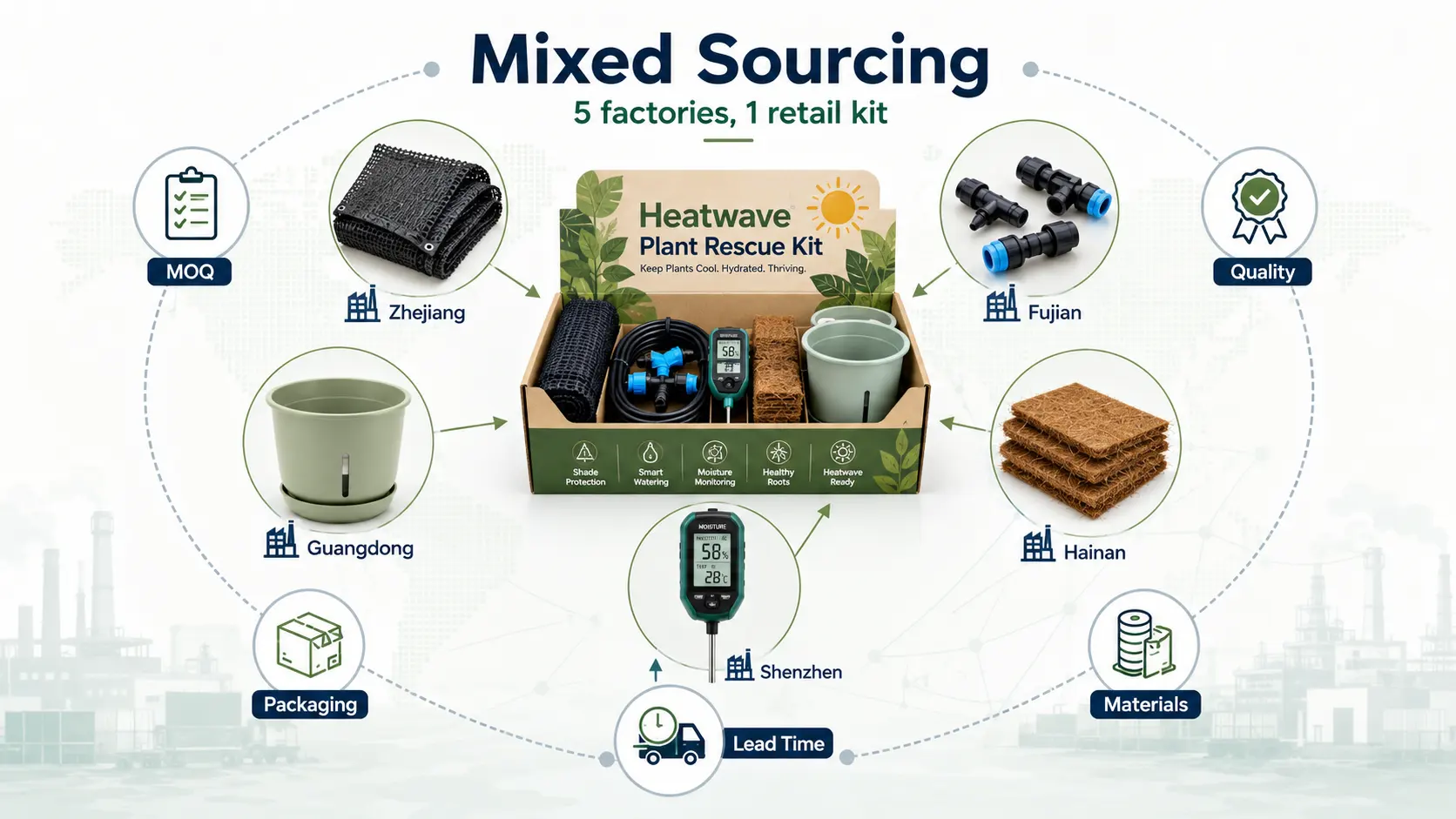
Look at the product tables above. A “Heatwave Plant Rescue Kit” for a UK garden centre might include:
- Shade netting from a plastic weaving factory in Zhejiang
- Drip irrigation fittings from a moulding workshop in Fujian
- Self-watering planters from an injection moulding plant in Guangdong
- Mulch mats from a coconut fibre processor in Hainan
- A moisture meter from an electronics assembler in Shenzhen
That is five factories, five materials, five MOQs, five quality standards, five packaging formats, and five production lead times — for one retail kit.
This is the real problem that most European buyers face when they try to move from single-SKU sourcing to solution-based product ranges. It is not that the products do not exist. It is that organising them into a coherent, quality-controlled, retail-ready shipment requires a kind of coordination that most sourcing agents are not set up to deliver.
What a sourcing agent does
A sourcing agent finds factories. They send you quotes. They might inspect a single order before it ships. That works well for single-SKU orders. But when you need 15 SKUs from 8 factories to arrive in the same container, all checked against the same quality standard, all packed for retail display — that is a different kind of coordination.
What a supply support team with warehouse execution does
This is where it gets real.
When goods from different factories arrive at our warehouse in Nanjing, this is what happens:
Receiving and inspection. Each batch is checked in against your purchase order. Four dedicated quality inspectors pull a sample from every delivery and compare it against the reference sample you approved before production started. They check dimensions, colour, material, finish, and packaging. If a batch does not match, it is set aside and you are informed before it goes any further.
Consolidation. Your 15 SKUs from 8 factories are organised into one shipment. Products that share a retail display — shade netting with clips, drip kits with timers, planters with saucers — are packed together so they arrive at your warehouse ready to merchandise, not as 8 separate deliveries to unpack and sort.
Repackaging. Need retail-ready packaging? We can apply your branded labels, assemble kit components into single retail boxes, and add instruction cards or care leaflets. This is where a “Heatwave Plant Rescue Kit” stops being a list of products and becomes something your customer can pick up off the shelf.
Mixed-order shipping. One container, one customs declaration, one delivery. Instead of managing 8 freight bookings, 8 sets of shipping documents, and 8 delivery dates, you manage one.
This is the difference between buying products and building a product range. In a climate where your customers need solutions, not single items, this difference matters.
We are not a sourcing agent. We are a supply support team with warehouse execution capability. Because we are based here — in the middle of the world’s largest garden product manufacturing network — we can do things that an agent coordinating by email cannot: physically receive goods, inspect them against your standards, rework or replace what does not pass, and ship a consolidated, quality-checked order. You focus on selling. We handle the rest.
Next Step: Review Your Garden Product Sourcing Plan
European summers are not going back to the way they were. The customers walking into your garden centre next June will have the same problems they have this June — and they will expect you to have solutions ready.
The practical next step is not to overhaul your entire product range at once. It is to identify the one or two categories that your customers are asking for right now — and get them sourced, sampled, and on your shelves before the next heatwave announcement.
Three things you can do this month:
- Request product specifications and samples for your priority category. Whether that is shade netting for the UK, drip irrigation for Spain, or self-watering planters for Germany — we can organise samples from verified factories so you can test quality and retail fit before committing to volume. Talk to us about your target market and product direction.
- Request comparison samples across materials and factories. Not all shade netting is equal. Not all self-watering planters work the same way. We can pull samples from multiple factories, label them clearly, and ship them together so you can compare side by side — without managing five separate sample shipments from five separate suppliers.
- Request a mixed-product sample shipment. If you are building a “Heatwave Plant Rescue Kit” or a “Water-Saving Garden Starter Kit,” you need to see how the components look and function together. We can consolidate samples from different factories into one box, checked and packed in our warehouse, so you receive one shipment — not eight.
You focus on selling. Scarecrow Garden Supplier can help you source, verify, organise, and ship.
Frequently Asked Questions
Are European gardens really getting hotter, or is 2026 just a bad year?
The data is clear: this is a trend, not a one-off. The World Meteorological Organization and Copernicus Climate Change Service both confirm that European heatwaves are arriving earlier, lasting longer, and reaching higher temperatures than at any point in the instrumental record. The 2026 June heatwave reached temperatures comparable to the 2003 event that killed an estimated 70,000 people across Europe — but earlier in the season. Seasonal forecasts show above-normal temperatures as the most likely scenario for July–September 2026 and beyond. Garden product ranges designed for the climate of 2016 are already out of date.
Which garden products sell best during heatwaves?
Products that solve immediate, visible problems. Shade netting (because plants are visibly scorching), drip irrigation (because hosepipes are banned), self-watering planters (because container plants are dying between waterings), and moisture meters (because customers cannot tell how dry the soil is beneath the surface). The key shift: customers are buying function, not decoration.
How early should garden centres prepare for summer heat?
Earlier than you think. The 2026 heatwave struck in late May — before many garden centres had even set up their summer displays. The practical approach is to have heat-protection and water-saving products available by early spring, and to keep them in stock through September. Do not clear them in August’s “summer sale.” In a warming climate, September can be as hot as July used to be.
Can drip irrigation be used during a Hosepipe Ban?
In some UK water authority areas, yes — drip irrigation systems that deliver water directly to root zones are exempt from Temporary Use Bans, because they use a fraction of the water compared to hosepipes or sprinklers. However, the 2010 Flood and Water Management Act gave water companies the power to include drip irrigation in bans, and some have done so. The rules vary significantly by authority and drought level, and garden centres should always advise customers to check with their local water company. This is still a strong selling point for drip kits: where permitted, they may be the only legal way to irrigate during restrictions.
Is shade netting effective for home gardens, or is it only for commercial use?
Highly effective for home gardens — and increasingly popular. The critical thing most home gardeners do not know is that shade netting must be installed with an air gap of 0.5–1 metre between the net and the plant canopy or greenhouse surface. Direct contact can trap heat and make things worse. Garden centres that sell shade netting with clear installation instructions (and the clips to create the gap) will have happier customers and fewer returns. Need shade netting samples in different shade rates for your market? Scarecrow Garden Supplier can send comparison samples from multiple factories so you can test before you commit.
Plan the Right Product Mix for Your Market
Want to know which heat-insulation and water-saving products are suitable for your target market? Discuss your target country and retail model with us — we can help you plan the right product mix.

Written by
ScarecrowGarden
💡About Scarecrow Garden Supplier Co., Ltd.
Scarecrow Garden Supplier Co., Ltd. is a China-based sourcing and wholesale partner specializing in garden tools, landscaping equipment, and outdoor supplies for international wholesalers, distributors, contractors, and brands.
With hands-on experience rooted in real garden use scenarios, we focus on durable materials, functional design, and stable large-volume supply. Our product range covers pruning tools, watering systems, hand tools, outdoor hardware, and customized garden solutions to support both retail and professional landscaping markets.
Beyond products, we help our partners navigate supplier selection, quality control, compliance requirements, and long-term sourcing strategies in China. Through our blog, we share practical insights on product selection, material comparisons, industry trends, and cost-effective purchasing—helping global buyers build stronger, more competitive supply chains.