








Updated 3 months ago
Don’t Wait Until the Season Starts: A Complete Beginner’s Guide to Buying Garden Products from China

ScarecrowGarden
💡About Scarecrow Garden Supplier Co., Ltd.
Scarecrow Garden Supplier Co., Ltd. is a China-based sourcing and wholesale partner specializing in garden tools, landscaping equipment, and outdoor supplies for international wholesalers, distributors, contractors, and brands.
With hands-on experience rooted in real garden use scenarios, we focus on durable materials, functional design, and stable large-volume supply. Our product range covers pruning tools, watering systems, hand tools, outdoor hardware, and customized garden solutions to support both retail and professional landscaping markets.
Beyond products, we help our partners navigate supplier selection, quality control, compliance requirements, and long-term sourcing strategies in China. Through our blog, we share practical insights on product selection, material comparisons, industry trends, and cost-effective purchasing—helping global buyers build stronger, more competitive supply chains.

Importing Garden Supplies from China: A Beginner’s B2B Guide | Scarecrow Garden Supplier
Many first-time garden buyers contact Chinese suppliers when the selling season has already started. They want to buy watering cans for the summer, ask about MOQ, logo packaging, prices for 50 or 100 units, express shipping to the UK, and DDP sea freight options.
These are all normal questions. But most first-time buyers share one assumption that is simply wrong: they assume that ordering one month before the season is enough time. It is not — not even close.
Buying garden products from China is not like ordering from a local wholesaler. It involves confirming products, getting samples, arranging production or stock, receiving goods at a warehouse, inspecting and repacking, exporting, clearing customs, and last-mile delivery. Each step takes time. Each step can add cost. And if you are ordering products like watering cans, the shipping cost alone might catch you off guard — not because they are heavy, but because they take up so much space. (Metal raised beds are a different story — they ship flat-pack and are surprisingly compact. More on that below.)
This guide walks through the entire process the way you will actually experience it — by working backwards from your selling date. Every cost, every delay, every decision point gets its place on the timeline. One read, start to finish, and you will know exactly how far in advance to order, what to watch for at each step, and where first-time buyers most often get stuck.
Step 1: Pick Your Selling Date, Then Work Backwards
Garden product sales in Europe follow a clear seasonal pattern:
- March: Sales begin to climb as consumers start spring garden work
- May–June: Peak season — this is when demand is highest
- July–September: Strong sales continue, especially for summer garden items
- October onward: Mainstream garden products wind down — but winter garden products like small garden greenhouses, frost covers, seed starting kits, and grow lights start selling. (If you are planning for the winter season, make sure to check out our detailed small garden greenhouse material selection guide to understand the weight and quality specifications before sourcing).
Let’s say you want products on your shelf by early May. Here is the full timeline, working backwards from that date:
| Step | Days Needed | Cumulative |
| Order confirmation + proforma invoice | 1–2 | 1–2 |
| Payment processing + bank transfer arrival | 3–5 | 4–7 |
| Production/stock prep (starts after payment arrives) | 10–15 | 14–22 |
| Warehouse consolidation + inspection | 3–5 | 17–27 |
| Sea freight (with current rerouting) | 35–50 | 52–77 |
| Customs + delivery | 8–12 | 60–89 |
| Shelf-ready (listing, photos, etc.) | 7–14 | 67–103 days |
Look at that bottom row: 67 to 103 days. That is two to three months minimum — and that assumes nothing goes wrong.
To hit the May peak, you need to place your order by early January. Not February. Not March. January.
That 3–5 day bank transfer window is not optional — Chinese suppliers typically do not begin production until payment has arrived in their account. And the 35–50 day sea freight window is not theoretical — it reflects current reality, where ships are rerouting around the Cape of Good Hope instead of through the Suez Canal, and European ports like Rotterdam are running at 95% terminal utilization with vessels waiting days for a berth.
Here is how far in advance you need to order, by shipping method:
| Shipping Method | Advance Time Needed | For May Peak, Order By |
| Sea freight (current routing) | 3–4 months | January |
| Sea freight (normal Suez route) | 2–3 months | February–March |
| Rail (China–Europe) | ~2 months | March |
| Air freight | 3–4 weeks | Early April |
Most of this guide is about what happens inside those 67–103 days — and where things can go wrong at each step.
Step 2: Confirm Products and Place the Order
Before you can place an order, you need to know what you are buying. For first-time buyers, this step raises three questions that come up every time: MOQ, samples, and whether to go direct to the factory.

MOQ: Can You Order Only 50 or 100 Units?
It is a reasonable question. Many first-time buyers want to start small — 50 watering cans, 100 pairs of gardening gloves, a mixed batch of hand tools. Test the market, see what sells, then scale up.
Here is the reality: most factories have MOQ (Minimum Order Quantity) requirements, and for good reason. Machine setup, production scheduling, packing, and labor all carry fixed costs. For a factory, an order of 50 or 100 units for one SKU is often too small to justify a production run — it may not even keep the line running for half a day.
That does not mean small orders are impossible. It means you need the right supply partner. Scarecrow Garden Supplier works with many garden product factories as a long-term partner. Because we purchase in large volumes across many product categories, we can support more flexible quantities than a factory would normally accept for a single small buyer. We also maintain seasonal stock in our own warehouse for popular garden products, which means many items are available without waiting for a new production run.
For new buyers, this makes a real difference. Instead of trying to meet each factory’s MOQ separately, you can place one mixed order covering multiple SKUs — watering cans, tools, gloves, plant pots and compact accessories like garden mats — and we consolidate everything at our warehouse before shipping. (If you’re unsure which types of mats appeal most to retail buyers, take a look at our professional garden mat buying guide).
Why Going Directly to a Factory Is Not Always Cheaper
A common assumption: if I go straight to the factory, I get the lowest price. That makes sense in theory. In practice, it often does not work that way for small orders.
Garden products cover a wide range of SKUs. If you are starting out, you might want watering cans from one factory, hand tools from another, and plant pots from a third. Each factory has its own MOQ, its own lead time, and its own communication style. Managing three or four separate factory relationships when your total order is only a few hundred units across all products is time-consuming — and you may not get the best price, because your volume at each change adds a duty on top. The factory is too small to negotiate effectively.
Scarecrow purchases from these factories in large volumes year-round. That means we already have the pricing, the relationships, and the production slots. For small mixed orders, working through Scarecrow can often be more practical and cost-effective than trying to buy small quantities from several factories directly.
Our role is not simply to resell products. We help with sourcing, price comparison, product confirmation, quality inspection, warehousing, repacking, mixed-order consolidation, and shipping coordination. You deal with one team instead of four factories.
Samples: Do Not Skip This Step
It is tempting to skip the sample when you are in a rush. Resist that temptation.
A sample is not a delay — it is insurance. The cost of a sample and a few days of shipping is negligible compared to the cost of receiving 500 units with the wrong dimensions, the wrong color, or a functional problem you would have caught immediately.
What to check when you receive a sample:
- Dimensions and capacity — Does the 10-liter watering can actually hold 10 liters?
- Material and finish — Is the metal thickness what you expected? Is the surface finish consistent?
- Color accuracy — Does it match what you saw in the photos? Monitor colors can be misleading
- Functionality — Does the mechanism work smoothly? Does the spout pour without splashing?
- Packaging — How is it packed? Will it survive shipping? Is the retail box presentable?
- Accessories and assembly — Are all parts included? Does it go together easily?
- Labeling and compliance marks — Does it have the required CE mark, safety warnings, or electrical certification?
For garden products, pay attention to things that photos cannot show: the weight in your hand, the flex of a handle, the quality of a weld, and whether a plastic component feels brittle or durable.
Step 3: Pay — Safely
Once you confirm the order, the supplier sends a proforma invoice and you arrange payment. This step takes 3–5 business days for a standard SWIFT bank transfer to reach a Chinese bank account. Those days are already built into the timeline above.
But payment carries a risk that has nothing to do with product quality — and it can cost you everything.
The Threat: Business Email Compromise (BEC)
BEC is a type of fraud where hackers gain access to a supplier’s email account, monitor the conversation between buyer and seller, and — at the moment payment is due — send you a message that looks like it came from the supplier, directing you to wire money to a different bank account. The account belongs to the fraudster, not the supplier.
This is not rare. According to the FBI, BEC fraud caused over $2.7 billion in global losses in 2024, with cumulative losses exceeding $43 billion since 2016.
How It Happens: Real Cases
$600,000 — lost because of one changed letter. A Chinese supplier was exporting raw materials to a Brazilian buyer. Hackers had been monitoring their email chain for weeks. When the payment instruction went out, the fraudsters intercepted it, changed one letter in the bank account number, and registered a nearly identical account at a bank in London. They sent the “updated” payment details to the buyer from the supplier’s compromised email. The buyer wired $600,000 to the wrong account. Under international trade law (CISG), paying the wrong account does not count as a valid payment — the buyer was legally required to pay again.
$300,000 deposit — stolen via a forged email. Hackers infiltrated a Chinese seller’s email and sent the buyer a message saying “our bank details have changed.” The buyer, trusting the email, sent the deposit to the new account. It was only after the supplier asked about the missing payment that both sides realized what had happened.
An Italian company’s final payment — gone in 20 days. A fraudster registered an email address nearly identical to a Chinese supplier’s and sent modified payment instructions. The final payment went to a UK bank account controlled by the scammer. By the time anyone noticed — nearly three weeks later — recovery was impossible.
Rules That Will Save You
- Any time a supplier changes their bank account, confirm by phone or WhatsApp — not by email. The email itself may be compromised. This is the single most important rule.
- Before paying, compare the bank details on the proforma invoice against the account you have on file — character by character.
- For large first-time payments, send a small test transfer first. Wait for the supplier to confirm receipt, then send the balance.
- Watch for email addresses that look almost right but are not. Replacing an “o” with a “0”, an “l” with a “1”, or adding a character are common tricks.
- Use two-factor authentication on your email. Most BEC attacks start with compromised email accounts.
Step 4: Production and Warehouse Consolidation
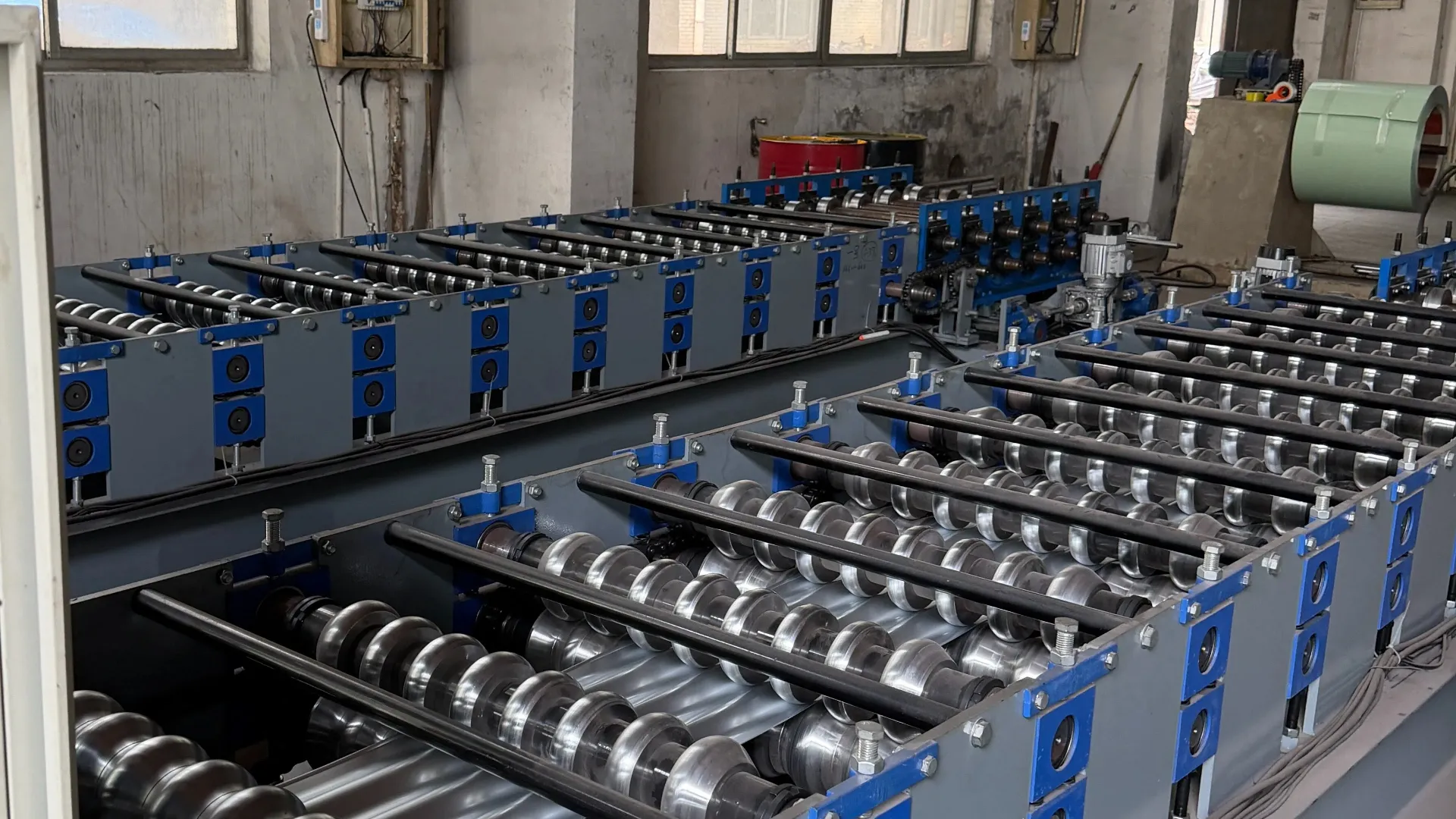
Once payment arrives, the supplier arranges production or pulls stock. This takes 10–15 days. After that, goods arrive at the warehouse for inspection and consolidation — another 3–5 days.
This is where two questions come up for first-time buyers: logo/branding, and custom packaging.
Logo: Two Methods, Two Different MOQ Realities
Laser engraving works on products with a suitable surface — a wooden handle on a garden trowel, the metal shaft of pruning shears, or a stainless steel blade. Because laser engraving is a post-production process (it happens after the product is made, using a laser machine), it does not require a new mold. That means even small quantities can be engraved.
The molded logo is different. Some products have the logo integrated into the mold during production — think of a brand name embossed on a plastic watering can rose or stamped into a die-cast metal part. Changing or adding a logo to a mold requires modifying or making a new mold, which costs thousands of dollars. That cost only makes sense when spread across a large production run.
| Method | Typical MOQ | Cost | Best For |
| Sticker/label | No minimum | Low | Trial orders; fast and flexible |
| Hang tag/insert card | Small quantities OK | Low–medium | Tools, gloves, accessories |
| Laser engraving | Small quantities often OK | Medium | Wooden handles, metal parts, blades |
| Molded logo | High MOQ (typically 1,000+) | High (mold cost) | Long-term products with confirmed sales |
For your first order, start simple. Stickers, hang tags, or insert cards give you branded packaging without the MOQ or cost commitment. Once you know the product sells, invest in laser engraving or a molded logo on the next, larger order.
Custom Packaging: What Scarecrow’s Warehouse Can Do
Scarecrow has an in-house warehouse and packing workshop. We can handle packaging tasks that would normally require a separate packaging supplier:
- Applying branded stickers or labels to products
- Adding hang tags or insert cards
- Packing individual products into custom boxes
- Combining multiple SKUs into a branded gift set or garden starter kit
- Custom carton labeling for retail or e-commerce fulfillment
There is no strict minimum quantity for these services.
The Cost Reality of Small-Batch Custom Packaging
While we can do custom packaging in any quantity, the cost per unit is not the same for small and large runs. The same custom-printed carton that costs $0.80 each at 500 units might cost $1.04 each at 50 units — roughly 30% more per box (based on industry experience; the difference can be larger for complex designs with special finishes).
This is the nature of print production: setup costs (plate making, die cutting, machine calibration, test runs) are the same whether you print 50 boxes or 500. Those fixed costs get spread across fewer units in a small run.
Practical advice: For your first order, use standard packaging with branded stickers or labels. Move to fully custom-printed boxes once your volume justifies the setup cost.
Step 5: Shipping — Where the Cost Surprise Lives
When you work backwards from your selling date, one question keeps coming up at the shipping step: What does this actually cost? The unit price is only the beginning.
Why Garden Products Can Be Expensive to Ship
Not every garden product is difficult to ship. Here is how it actually breaks down:
- Dense, heavy products — cast-iron plant pots, stone garden ornaments — ship by actual weight. No surprise here.
- Products that can be shipped flat or stacked — metal raised beds and garden boxes ship as flat steel panels, taking up very little volume. Plastic plant pots nest inside each other (B2B shipments are not retail: you do not ship one pot per box). Long-handled tool sets can be bundled together in a single long carton. These are manageable.
- Products that are genuinely bulky — watering cans, seedling trays with fixed dividers, pre-assembled greenhouses, garden gloves in individual retail packaging — these are the ones where volumetric weight can far exceed actual weight, and shipping cost catches buyers off guard.
The key point: ask your supplier how the product packs for B2B shipping. A product that looks bulky assembled may ship flat. A product that looks like it needs individual boxes may nest. The packing method determines the CBM, and the CBM determines the shipping cost.
Carriers do not simply weigh your box and charge by the kilo. They compare two numbers:
- Actual weight — what the box weighs on a scale
- Volumetric weight (also called dimensional weight) — a calculated weight based on the box’s dimensions, representing how much space it occupies
You are charged based on whichever number is higher.
For international express (DHL, UPS, FedEx), the formula is:
Length (cm) × Width (cm) × Height (cm) ÷ 5,000 = Volumetric weight (kg)
For air freight, the divisor is 6,000 instead of 5,000 — which means express shipping calculates a higher volumetric weight for the same box.
For sea freight, less-than-container-load (LCL) shipments are charged by CBM (cubic meter — a unit of volume where 1 CBM = a cube measuring 1m × 1m × 1m). The carrier charges per CBM or per ton, whichever is greater. Full container loads (FCL) are charged per container regardless of how full it is.
A Real Example: 10-Liter Watering Cans Shipped to the UK
This is not a theoretical example. It comes from an actual order.
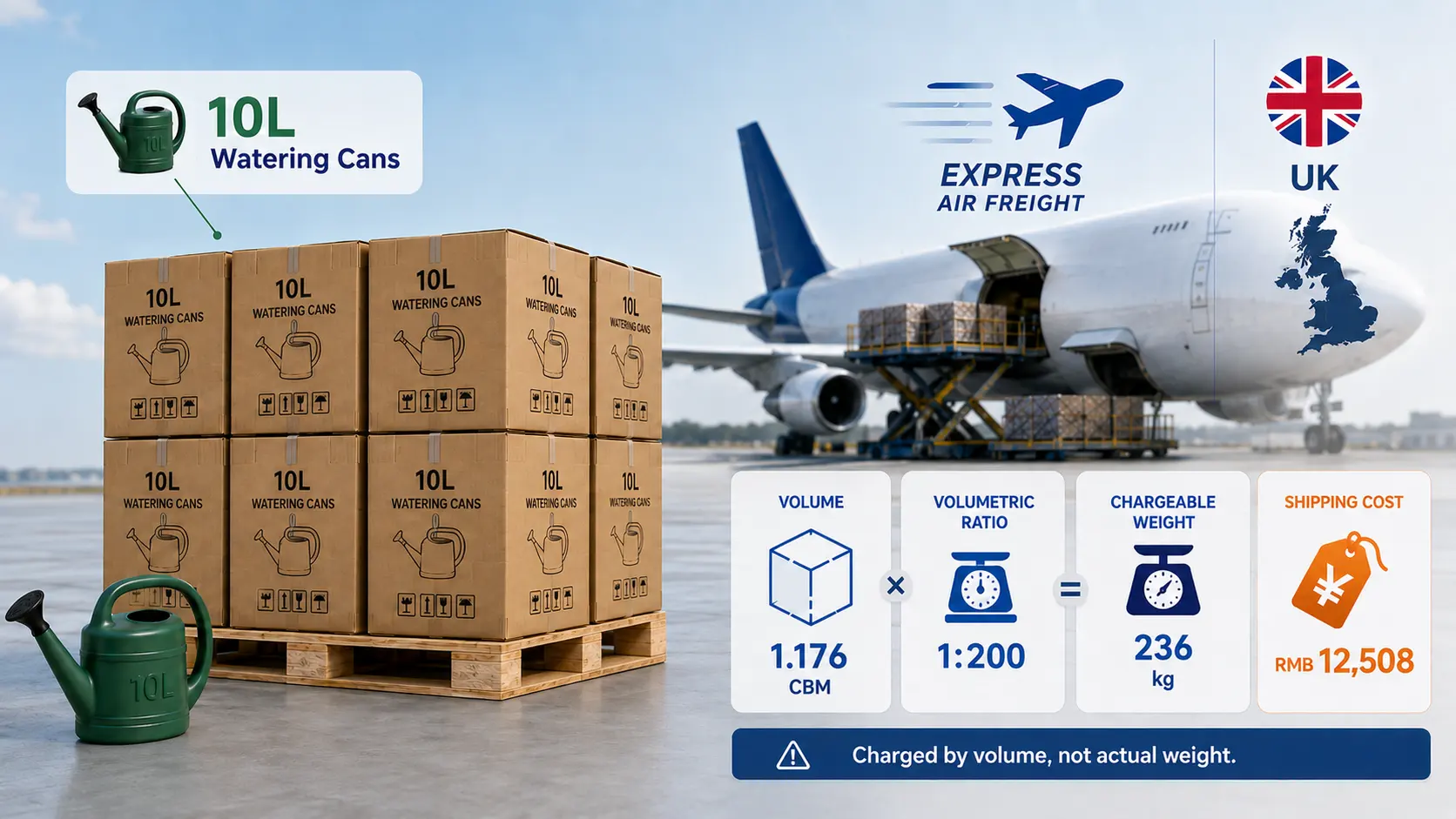
A buyer ordered 10-liter watering cans for the UK. The shipment volume was 1.176 CBM. The express rate was RMB 53/kg, with a volumetric ratio of 1:200 (meaning 1 CBM = 200 kg of volumetric weight).
- Volumetric weight: 1.176 CBM × 200 = 236 kg
- Shipping cost: 236 kg × RMB 53/kg = RMB 12,508
The actual weight of those watering cans? Nowhere near 236 kg. But the carrier does not care about actual weight here — the boxes take up too much space, so you pay by volume.
That is the volumetric weight trap in a single number. If you only looked at the product price and the per-kilo rate, you might expect a much lower shipping cost.
When you request a shipping quote, always ask the supplier to provide the total CBM and total weight for your order.
So shipping cost can surprise you — especially with express. That raises the next question: which shipping method actually makes sense for your order?
Express, Air Freight, or Sea Freight?
| International Express | Air Freight / DDP Air | Sea Freight / DDP Sea | |
| Best for | Samples, urgent small orders, market testing | Medium quantities, time-sensitive orders | Seasonal stock, bulky products, mixed orders |
| Speed | 2–5 days | 5–10 days | 35–55 days (currently longer due to rerouting) |
| Cost | Highest per kg — painful for bulky, low-value items | Moderate — cheaper than express, more than sea | Lowest per unit — but requires planning ahead |
| Key risk | Volumetric weight can make the cost shockingly high | Still expensive for large volumes | Long lead time; port congestion adds 5–15 days |
For a first trial order of 50–100 units, express or air freight is usually the practical choice despite the higher per-unit cost. The goal is to get products in hand quickly and test the market.
For seasonal stock — the order that actually makes you money — sea freight is almost always the better option. The per-unit shipping cost is significantly lower. But it only works if you plan far enough ahead.
What Is DDP — and What It Actually Covers
DDP stands for Delivered Duty Paid. In strict Incoterms terms, it means the supplier handles everything — shipping, customs clearance, import duties, and VAT — and delivers to your door with all costs included.
In practice, many freight forwarders offer “DDP service” in two forms:
- Full DDP — the quote includes freight, duties, and VAT. You pay one price and nothing more at delivery.
- DDP with duties and VAT on actual — the quote includes freight and clearance, but duties and VAT are charged to you after customs assessment, based on the actual amounts. You may receive a separate invoice after delivery for these charges.
Both are common. The difference matters. Before you accept a DDP quote, ask specifically: Does this price include duties and VAT, or are those charged separately upon arrival?
For a first-time buyer, full DDP is the simpler option — one number, no surprises. But if your forwarder uses the second model, you need to budget for the additional duty and VAT that will come due after delivery.
Why Sea Freight Needs Accurate Carton Information
If you request a DDP sea freight quote and the supplier gives you a number without asking for detailed carton dimensions, that number is an estimate, not a quote.
DDP sea freight includes pickup, ocean freight, customs clearance, duty and VAT payment, and last-mile delivery. The last-mile portion depends on total CBM, number of cartons, weight per carton, delivery postcode, and address type (residential vs. commercial). If your final packaging dimensions differ from what was used for the quote, the actual cost may change.
To get a reliable sea freight quote, provide:
- Carton dimensions (length × width × height in cm) for each product
- Weight per carton
- Total number of cartons
- Total CBM and total weight
- Delivery country and postcode
Current Sea Freight Situation
Two factors are affecting sea freight right now, and both add time:
Red Sea rerouting. Since late 2023, major shipping lines have been routing around the Cape of Good Hope instead of through the Suez Canal. Maerske has stated publicly that this is no longer a temporary measure — it has become the new operating reality. The detour adds roughly 10–15 days to Asia-Europe sailings.
European port congestion. As of mid-2026, Rotterdam’s terminal utilization is around 95%. Hamburg’s core terminals are running over capacity. Vessels are waiting 5–10 days for a berth at some ports.
The combined effect: a shipment that used to take 30–35 days from Shanghai to your door now routinely takes 45–60 days.
Step 6: Customs and Duties — The Costs You Cannot Skip
When your shipment arrives in your country, it clears customs. This takes 3–5 days for routine clearance (longer if the shipment is selected for inspection, or if it contains plant-related products that require phytosanitary checks). It also triggers costs that many first-time buyers do not expect.
VAT: It Applies to Everything
VAT (Value-Added Tax) is not optional on imports. It applies regardless of the order value. Here are the standard rates in major European markets:
| Country | Standard VAT Rate |
| United Kingdom | 20% |
| Germany | 19% |
| France | 20% |
| Italy | 22% |
| Netherlands | 21% |
| Belgium | 21% |
| Spain | 21% |
| Sweden | 25% |
| Denmark | 25% |
| Poland | 23% |
| Switzerland | 8.1% |
Garden tools and accessories typically fall under the standard rate. Always confirm with a local tax advisor for your specific situation.
EU Customs Changes: Effective July 1, 2026
As of July 1, 2026, the EU has formally ended the customs duty exemption for small packages valued under €150. During the transition period (July 2026 to July 2028), a flat fee of €3 per product category will apply to low-value shipments. After 2028, the standard duty structure will apply to all imports.
Additionally, from approximately November 2026, a customs processing fee of roughly €2 per parcel may be introduced for direct-to-consumer (B2C) shipments. Combined with the €3 duty, this adds €5–8 per parcel to the cost of small consumer-direct shipments — a meaningful increase for low-value orders.
Important distinction: These flat fees (€3 per category + €2 per parcel) apply primarily to B2C direct-to-consumer shipments — parcels shipped directly to individual buyers. For B2B commercial imports (which is what most readers of this guide are doing), goods clear customs under standard trade procedures: duties are calculated as a percentage of declared value (ad valorem), and the flat per-parcel fees do not apply in the same way. The end of the €150 exemption still matters for B2B — it means all imports must be properly declared regardless of value — but the per-parcel cost impact is mainly a B2C concern.
VAT on imports into the EU has already been mandatory since 2021 — the €22 VAT exemption was removed that year. The new change adds a duty on top. For bulk agricultural and commercial horticultural supplies, ensuring correct HS code classification is now more critical than ever to avoid delays.
💡 Sourcing Tip: If you are importing bulk roll materials, check out our PVC greenhouse film wholesale buyer's guide for expert advice on choosing anti-fog, UV-resistant specifications and classifying heavy horticultural imports properly.
UK: The £135 Threshold Is Going Away
Currently, goods valued under £135 imported into the UK are exempt from customs duty (though VAT at 20% still applies). This exemption is scheduled to end in October 2028. After that, all imports will be subject to duty, typically 2%–12% depending on the product’s HS code.
Other Costs at This Step
| Cost | Typical Amount |
| Customs clearance fee (broker) | €50–150 per shipment |
| Terminal handling/deconsolidation fee (LCL) | €30–80 per CBM |
| Remote area delivery surcharge | Varies — check with the carrier |
| Phytosanitary inspection (if applicable) | Varies by product |
Looking Ahead: EU Carbon Border Tax on Garden Tools
In December 2025, the European Commission proposed extending the Carbon Border Adjustment Mechanism (CBAM) to downstream products made with steel and aluminum. In June 2026, the EU Council reached a common position, expanding the scope from 180 to nearly 400 product categories — covering roughly €160 billion in annual imports. Garden tools with steel or aluminum components exceeding 20% of the product weight — such as lawn mowers, pruning shears, and metal garden furniture — are included.
The expansion is expected to take effect around January 2028. The CBAM certificate price has been set at €75.36 per ton of CO₂ equivalent.
This is no longer just a draft proposal — it has been agreed in principle by the EU Council. While the final legislative steps remain, the direction is clear: the cost of importing steel- and aluminum-based garden products into the EU will increase. Not something to panic about today — but worth building into your long-term pricing.
Step 7: Last-Mile Delivery and Shelf-Ready
The final step: getting the goods from the port or airport to your door (5–7 days), then getting them listed and ready to sell (7–14 days for photos, product descriptions, pricing, and any assembly or quality spot-checks).
Add it all up, and you are at 67–103 days from order to shelf. That is why the answer to “how far in advance should I order?” is measured in months, not weeks.
If You Are Already Late
Reading this in May or June and have not placed an order yet? You still have options — but they come with trade-offs:
| Option | Speed | Cost | Best For |
| Air freight / DDP air | 5–10 days | High (RMB 35–60/kg) | Small urgent orders to catch the tail end of peak season |
| China–Europe rail | 25–30 days | Medium | Medium quantities; can still reach mid-season |
| Sea freight (standard) | 45–60 days | Low | Will likely miss peak; consider this for autumn stock instead |
A practical approach: use air freight for a small test order now, and simultaneously place a larger sea freight order for your next season. You get market feedback quickly while setting up a cost-effective restock.
Winter and Early Spring Products: Same Logic, Earlier Planning
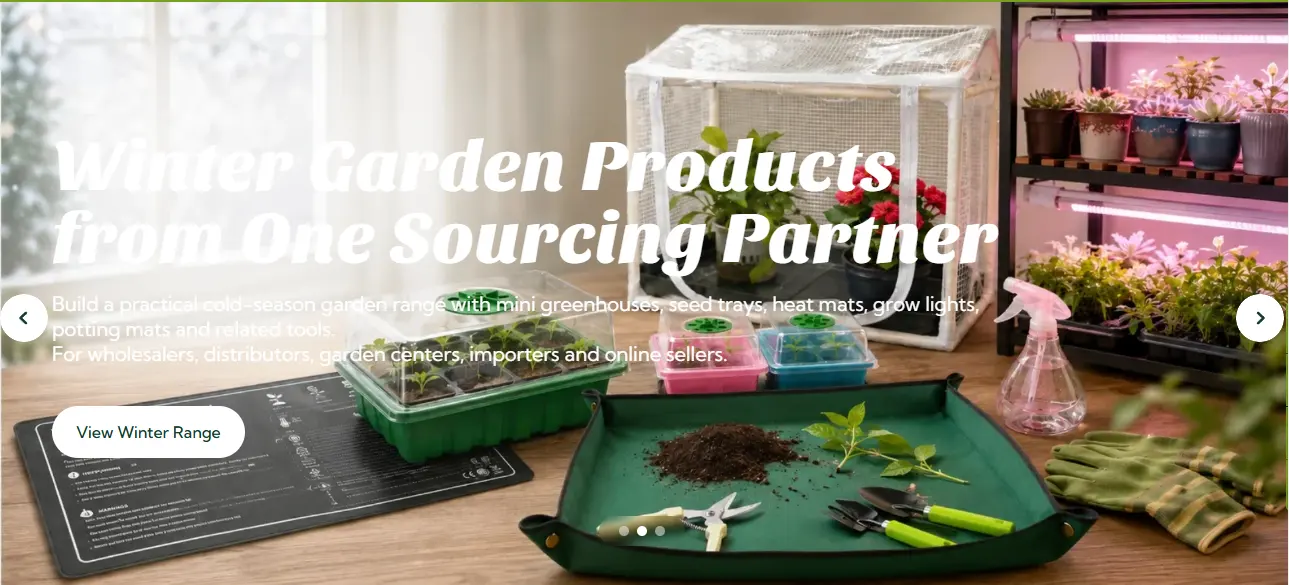
The same timeline applies to off-season products. Mini greenhouses, seedling heat mats, grow lights, frost covers, seed starting kits, and potting mats sell in late autumn through early spring. If you wait until October to start sourcing them, you will miss the selling window.
It feels counterintuitive to discuss winter garden products in the middle of summer. But by the time your customers start looking for frost covers, the goods should already be in your warehouse — not on a container ship somewhere between Shanghai and Rotterdam.
For garden products, sourcing should happen before the season, not after the season has already started.
Trial Order vs. Seasonal Stock: Two Different Goals
| Trial Order | Seasonal Stock Order | |
| Goal | Validate product quality and test market demand | Build inventory before peak season at the best per-unit cost |
| Typical quantity | 50–200 units per SKU | 500+ units per SKU, or multiple SKUs |
| Shipping | Express or air freight — speed matters more than cost | Sea freight — cost per unit matters more than speed |
| Branding | Simple — stickers, hang tags | More invested — laser logo, custom packaging |
| Risk level | Low — you are learning | Higher — you are committing to the inventory |
| Profit expectation | Modest or break-even — this is research | This is where your margin comes from |
A trial order helps you learn. A seasonal stock order helps you make a profit.
The smart approach: start with a trial order, learn what works, then place a seasonal stock order for the winners — with enough lead time for sea freight.
How to Ask for a Useful Quotation
A good quote requires good input. Here is what a supplier needs to give you a meaningful quote:
| Information to Provide | Why It Matters |
| Product name or photo with reference | Identifies the exact item |
| Quantity per SKU | Affects pricing tiers and MOQ |
| Target market/country | Determines compliance requirements and shipping route |
| Delivery country and postcode | Needed for accurate shipping cost, especially DDP |
| Logo/branding requirements | Affects cost and lead time |
| Packaging preferences | Standard, custom box, or gift set? |
| Expected selling season | Helps the supplier recommend the right shipping method and timeline |
| Desired delivery date | Determines whether sea, air, or express is viable |
| Whether you accept stock items | Stock ships faster than new production |
| Whether this is a test order or seasonal stock | Different goals, different logistics recommendations |
Sample Inquiry Message
Hi, I am starting a garden product business and would like to inquire about the following:
Product: 10L watering can (item reference [from catalog or photo]) Quantity: 100 units for first order Target market: United Kingdom Delivery address: [Your full address with postcode] Logo: I would like to add my brand logo — please advise what method works for this product at this quantity Packaging: Standard packaging for now; I may want custom packaging on repeat orders Selling season: I want to have stock by [month]. Is this realistic? Shipping: Please quote both express and DDP sea freight options
Thank you.
First-Time Buyer’s Checklist
Before you place your first order, run through this list:
- I know my selling season and have worked backwards to a realistic order date
- I have requested and reviewed a sample
- I have calculated landed cost (product + shipping + VAT + duties + fees), not just unit price
- I know the total CBM and total weight of my order
- I have confirmed which shipping method fits my timeline and budget
- I have provided accurate carton dimensions and delivery postcode for a shipping quote
- I have confirmed all accessories and included parts in writing
- I have decided on a branding method (sticker/laser/molded) based on my order quantity
- I have verified the supplier’s bank details independently — not just from email
- I have planned for winter/early spring products if I sell them
- I understand the difference between a trial order and a seasonal stock order
How Scarecrow Garden Supplier Helps New Buyers
You do not need to figure all of this out alone. Here is what we do for new buyers specifically:
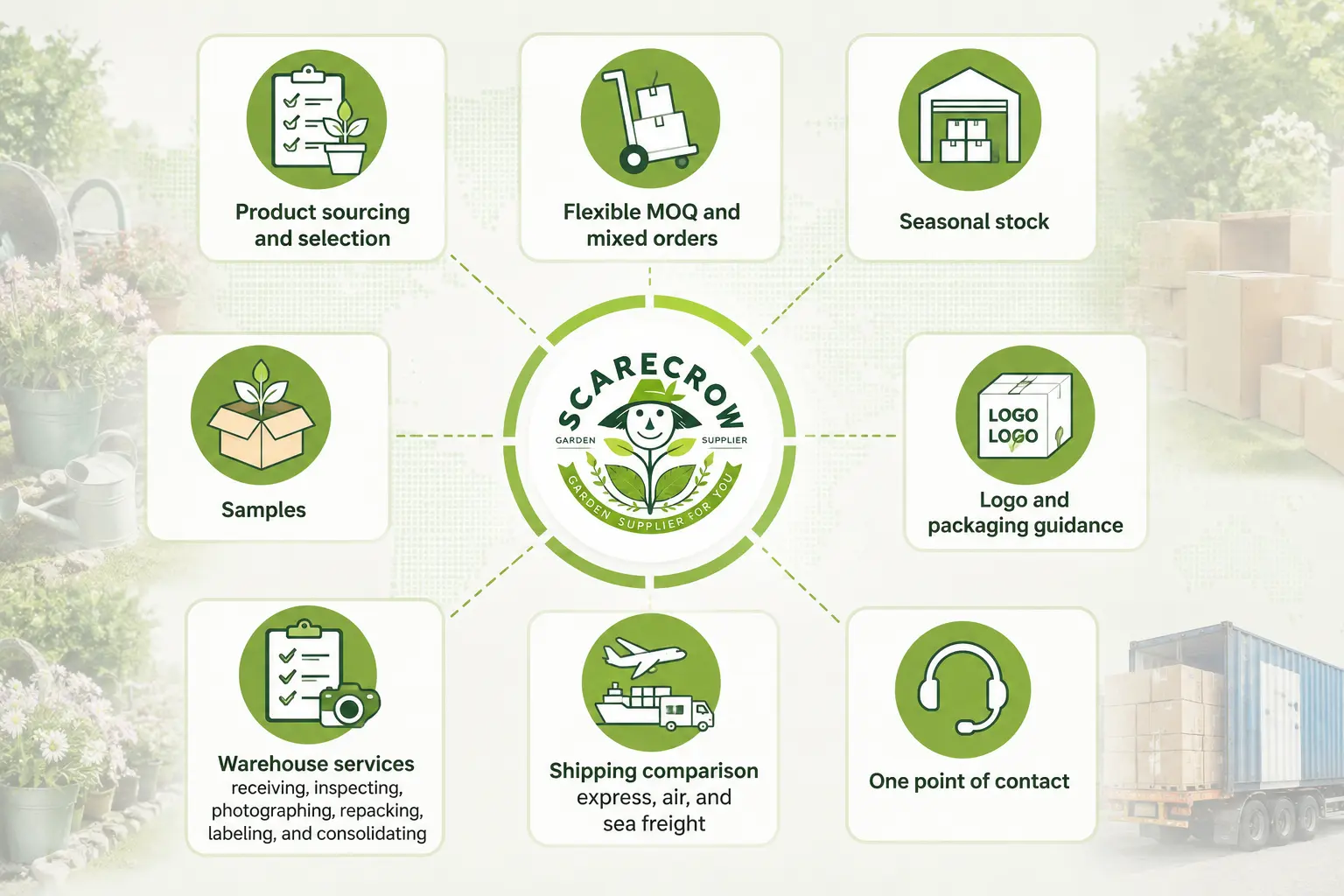
Product sourcing and selection. Tell us what you want to sell and where. We will recommend products, check availability, and flag compliance requirements.
Flexible MOQ and mixed orders. We can support smaller and more flexible orders than factories typically accept. Mix SKUs in a single order.
Seasonal stock. We pre-stock popular garden products in our warehouse ahead of each season. If you need the product fast and it is in our inventory, we can ship without waiting for production.
Samples. We arrange samples so you can verify quality before committing.
Logo and packaging guidance. We will tell you honestly what is realistic for your order size — whether laser engraving works, whether custom boxes make sense, or whether you should start with stickers.
Warehouse services. Receiving, inspecting, photographing, repacking, labeling, and consolidating — all at our warehouse. You see photos of your order before it ships.
Shipping comparison. We quote express, air, and sea freight options so you can compare real numbers.
One point of contact. Instead of managing multiple factories, you work with one team.
You do not need to understand every detail of international sourcing to get started. Provide your product idea, target market, order quantity, and selling season — and we will help you figure out what is realistic, what is cost-effective, and what needs to happen when.
Plan Your First Garden Product Order Before the Season Starts
If you take one thing from this guide: one month is not enough. Three to four months is the real number for sea freight. Plan accordingly.
Ready to get started?
- Send us your product list — photos, item references, or just a description of what you want to sell. We will check availability, MOQ, and pricing.
- Tell us your timeline — when do you need the goods, and what season are you targeting? We will tell you if it is realistic and recommend the best shipping method.
- Get a shipping comparison — provide your delivery country and postcode, and we will quote express, air, and DDP sea freight so you can compare real costs.
You focus on selling. Scarecrow Garden Supplier can help you source, verify, organize, and ship.
Make Your Sourcing Decision Easier
Not sure which model, material, or sample option fits your market? Send us your requirement list and we will help you check practical options.
Written by
ScarecrowGarden
💡About Scarecrow Garden Supplier Co., Ltd.
Scarecrow Garden Supplier Co., Ltd. is a China-based sourcing and wholesale partner specializing in garden tools, landscaping equipment, and outdoor supplies for international wholesalers, distributors, contractors, and brands.
With hands-on experience rooted in real garden use scenarios, we focus on durable materials, functional design, and stable large-volume supply. Our product range covers pruning tools, watering systems, hand tools, outdoor hardware, and customized garden solutions to support both retail and professional landscaping markets.
Beyond products, we help our partners navigate supplier selection, quality control, compliance requirements, and long-term sourcing strategies in China. Through our blog, we share practical insights on product selection, material comparisons, industry trends, and cost-effective purchasing—helping global buyers build stronger, more competitive supply chains.