








Updated 3 months ago
Metal Raised Garden Bed Shapes and Configurations: How to Match Them with Greenhouses, Patios, Backyards, and Retail Displays

ScarecrowGarden
💡About Scarecrow Garden Supplier Co., Ltd.
Scarecrow Garden Supplier Co., Ltd. is a China-based sourcing and wholesale partner specializing in garden tools, landscaping equipment, and outdoor supplies for international wholesalers, distributors, contractors, and brands.
With hands-on experience rooted in real garden use scenarios, we focus on durable materials, functional design, and stable large-volume supply. Our product range covers pruning tools, watering systems, hand tools, outdoor hardware, and customized garden solutions to support both retail and professional landscaping markets.
Beyond products, we help our partners navigate supplier selection, quality control, compliance requirements, and long-term sourcing strategies in China. Through our blog, we share practical insights on product selection, material comparisons, industry trends, and cost-effective purchasing—helping global buyers build stronger, more competitive supply chains.

Metal raised garden beds in different shapes and configurations in an outdoor garden
A wholesale buyer opens a supplier catalog and sees twelve different raised garden bed shapes. Oval. Rectangular. U-shaped. L-shaped. Tall. Short. With wheels. Modular 9-in-1. They all look like “a metal box for plants.” So the buyer picks the cheapest one and moves on.
Six months later, the buyer’s customer — a garden center owner — is staring at a 32-inch-tall square bed and realizing she cannot reach the center of it. Or a greenhouse operator is trying to line up rectangular beds in rows and discovering that the oval beds he ordered leave awkward gaps. Or an e-commerce seller is getting returns because the “large” bed turned out to be too big for a standard apartment balcony.
Shape is not a cosmetic choice. It determines where the product can be used, who will buy it, how it ships, and whether it generates positive or negative reviews. This article breaks down the most common metal raised garden bed shapes and configurations — and helps wholesale buyers match them to the right customer and selling environment.
Oval and Round Beds: Soft Edges, Small Spaces, Safety Story
Oval and round raised beds are the most recognizable shape in the metal raised bed category. The rounded corners are not just aesthetic — they serve a practical purpose.
Where they work best: Small backyards, patios, community gardens, children’s gardens, and retail display areas where visual softness matters. The absence of sharp corners makes them a natural fit for family-oriented marketing — “no sharp edges” is a selling point that resonates with parents and pet owners.
What to specify: Look for models with safety edge trim along the top rim. The corrugation depth matters here — deeper corrugation adds structural rigidity that compensates for the curved shape. Without sufficient corrugation, oval beds can flex under soil pressure.
Who buys them: Retail customers who want a raised bed that looks friendly in a residential setting. Garden centers like them because they photograph well and display attractively on the floor.
Watch out for: Oval beds use curved panels, which means slightly more complex manufacturing than straight rectangular panels. This can affect pricing and MOQ. Confirm with your supplier whether curved and straight panels come from the same production line or require separate tooling.
If your customers sell to home gardeners and family-oriented retail, request a sample set — we can send oval, rectangular, and modular raised bed configurations so you can evaluate the shape, edge trim, and structural details in person before choosing which shapes to stock.
Because shape affects both material usage and perceived value, buyers should also understand how to price metal raised garden beds before building a final product line.
Rectangular Beds: The Workhorse for Greenhouses and Vegetable Growing
Oval beds win on safety and aesthetics. But when the priority is yield — not looks — rectangular beds take over. They line up cleanly, calculate easily, and pack efficiently.
Where they work best: Greenhouse layouts, vegetable gardens, along walls and fences, and garden center shelving where standardized display matters. If your customer is a greenhouse operator who needs to maximize growing area in rows, rectangular is the default choice.
What to specify: Pay attention to the aspect ratio. A bed that is too wide (deeper than 4 feet / 1.2m) makes it difficult to reach the center without stepping on the soil. A bed that is too narrow (under 2 feet / 0.6m) wastes framing material relative to growing area. For beds accessed from both sides, widths around 3–4 feet (0.9–1.2m) are common, but the right width depends on how the bed will be used and how easily the gardener needs to reach the center.
Who buys them: Market gardeners, greenhouse operators, community garden programs, and serious home vegetable growers. These customers care less about aesthetics and more about yield per square foot.
Watch out for: Rectangular beds are the easiest to manufacture, which means they are also the most commoditized. If you are selling rectangular beds, you need a differentiation story beyond shape — material, thickness, hardware, or packaging.
U-Shaped Beds: Access From All Sides
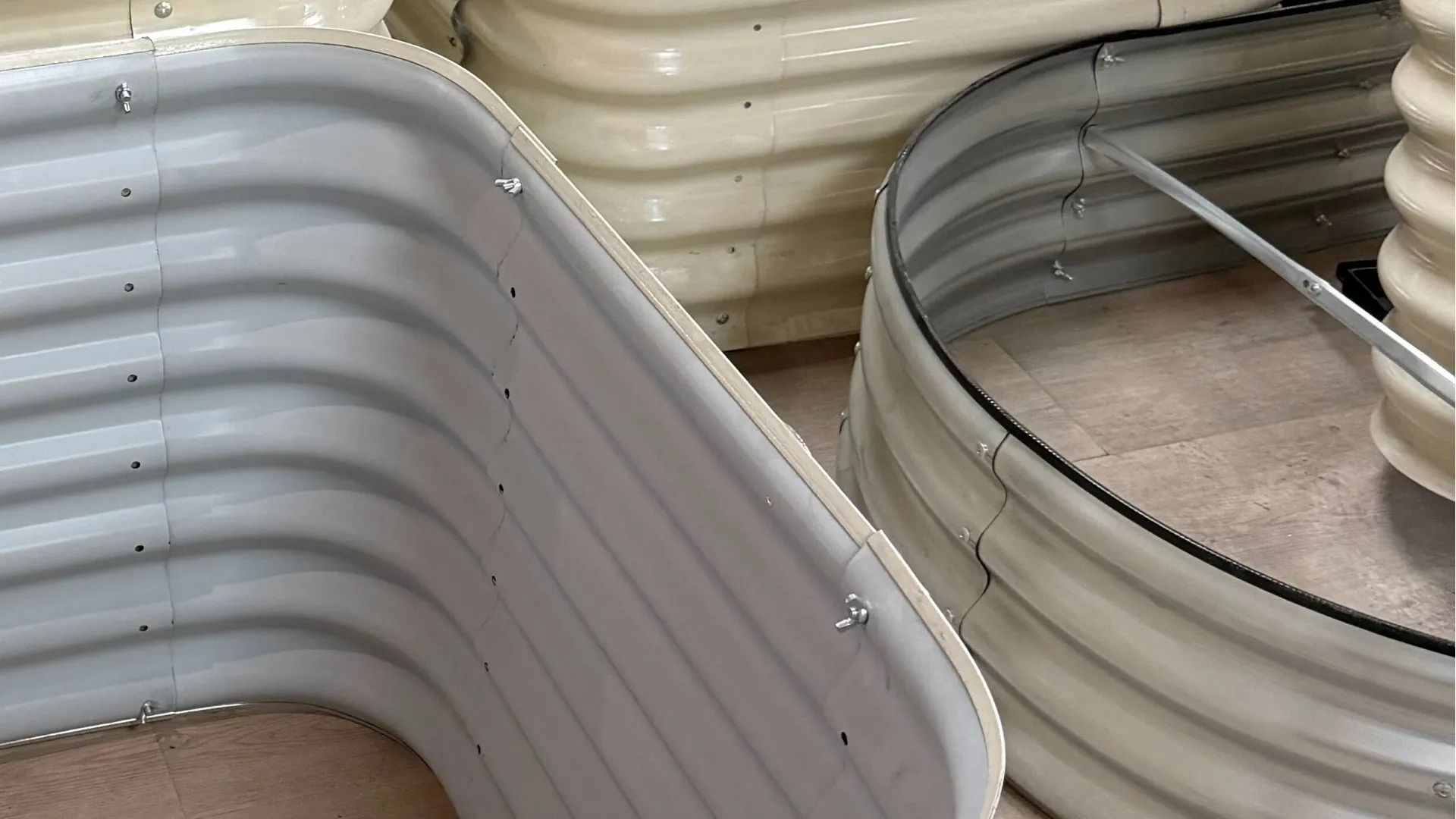
U-shaped beds are designed for accessibility. The gardener stands inside the “U” and can reach all parts of the bed without stepping on the soil.
Where they work best: Larger backyards, greenhouse central areas, retirement communities and assisted living gardens, and any space where the gardener needs to minimize bending and reaching. The U-shape allows access from both the outside and the inside of the bed.
What to specify: The opening width of the “U” needs to be wide enough for a person to comfortably stand inside — typically at least 2 feet (0.6m). If the opening is too narrow, the access benefit disappears. Also check that the panels forming the inner corners are properly reinforced — inner corners bear concentrated soil pressure.
Who buys them: Older gardeners, gardeners with mobility limitations, and customers with larger garden spaces who want an ergonomic growing area. U-shaped beds also appeal to social media-savvy gardeners because they create a visually striking “garden room” effect.
Watch out for: U-shaped beds use more panels than a standard rectangle of similar footprint, which means higher cost. They also require more complex assembly instructions — the configuration needs to be clearly documented with diagrams.
L-Shaped and Corner Beds: Turning Awkward Spaces Into Growing Space
L-shaped beds are designed to fit into corners — along two walls, around a patio edge, or in that awkward yard space where nothing else works.
Where they work best: Corner gardens, along fences, small urban yards with irregular layouts, and greenhouse corners where rectangular beds would leave dead space. If your customer base includes urban gardeners with small or awkward spaces, L-shaped beds solve a real problem.
What to specify: The two arms of the “L” should be proportionate — if one arm is much longer than the other, the bed looks unbalanced and the shorter arm becomes hard to use. Also check the corner joint: this is a structural stress point where two panels meet at 90 degrees. The hardware and connection method at the corner need to be robust.
Who buys them: Urban gardeners, small-space gardeners, and customers who want to maximize every square foot of their yard. L-shaped beds are also popular in landscape design where the bed needs to follow the architecture of the space.
Watch out for: L-shaped beds are often sold as part of a modular kit (the same panels can form an L-shape, a rectangle, or two separate beds). Make sure the instructions clearly show the L-configuration — if the modular kit only documents the rectangular setup, customers will be confused.
Tall and Deep Beds: Less Bending, More Soil, Higher Price
Tall raised beds, including 32-inch models, serve a distinct market where reduced bending, deeper soil and stronger visual presence are important.
Where they work best: Gardeners with back problems, older gardeners, wheelchair-accessible gardens, root vegetable growing (carrots, parsnips, potatoes need deep soil), and retail display where a taller bed has more visual presence.
What to specify: This is critical — tall beds must be narrow enough to reach across. A 32-inch tall bed that is 5 feet wide means the gardener cannot reach the center without a step stool. The most functional tall beds are 2-3 feet wide (0.6-0.9m) in a rectangular or U-shaped configuration. For any tall bed, width and access should be checked carefully. A bed can look impressive in photos but become inconvenient if the user cannot comfortably reach the center. — they look impressive but are impractical for actual gardening.
A 4 × 4 × 2.5 ft bed has a theoretical volume of about 40 cubic feet before accounting for the actual fill method, so buyers should make soil-volume expectations clear to customers. — that is significant weight and cost. Some customers are surprised by how much soil they need to fill a tall bed, and this can lead to negative reviews if not communicated upfront.
Who buys them: Premium retail customers, gardeners over 50, accessibility-focused garden programs, and customers growing deep-rooted vegetables. Tall beds also appeal to customers who want a raised bed that doubles as a design element — a 32-inch tall bed in a dark green or slate color is a statement piece in a modern garden.
Watch out for: Tall beds use significantly more steel per unit, which means higher cost and heavier shipping weight. They also require more structural support — the soil pressure on a 32-inch tall wall is substantially greater than on a 17-inch wall. Look for models with reinforcement rods or braces designed for tall configurations.
Not sure which shapes and heights to stock? Request our latest model list and quotation sheet — it covers oval, rectangular, U-shaped, L-shaped, tall, and modular configurations with dimensions, material specs, and pricing so you can match shapes to your customer profile.
Beds With Base and Wheels: The Balcony and Patio Solution
Beds with a solid base (instead of open-bottom) and optional wheels turn a raised bed into a mobile planter that can sit on hard surfaces.
Where they work best: Apartments with balconies, concrete patios, rooftop gardens, school gardens, and temporary display setups. The base prevents soil from contacting the surface below — important for renters and commercial spaces where staining is a concern.
What to specify: The base needs drainage holes — without them, water pools and roots rot. The wheels need to be lockable — a planter full of wet soil is heavy, and unlocked wheels can roll unexpectedly. A raised bed filled with moist soil can weigh several hundred pounds depending on its dimensions and soil mix, so wheel and base load ratings should be confirmed against the expected filled weight rather than the empty product weight.
Who buys them: Urban gardeners, apartment dwellers, schools, and commercial spaces (restaurants, hotels, office gardens). These customers typically cannot install an open-bottom bed because they do not have ground soil.
Watch out for: Beds with bases and wheels add cost — the base panel, the wheel hardware, and the additional structural support all increase the bill of materials. They also have a higher return rate if the drainage is poorly designed or the wheels fail under load. Test the sample thoroughly before committing to a bulk order.
Modular Kits (6-in-1, 9-in-1): One SKU, Multiple Shapes
Modular kits are the industry’s answer to a retail problem: how do you stock multiple bed sizes without multiplying your SKU count?
A 9-in-1 kit uses one set of panels that can be assembled into nine different length-to-width configurations. A 6-in-1 kit offers six configurations from the same panel set. The customer buys one box and chooses the shape that fits their space.
Where they work best: E-commerce (one product page, multiple configurations), garden centers with limited shelf space, and customers who are not sure what size they need until they measure their space.
What to specify: The instruction sheet is the make-or-break component of a modular kit. Each configuration needs a clear diagram with panel arrangement, bolt positions, and brace placement. If the instructions are unclear, the customer will assemble the wrong configuration and blame the product. Look for kits that include a QR code linking to an assembly video — this reduces customer service inquiries significantly.
Who buys them: E-commerce sellers who want to simplify their product catalog, garden centers that want flexibility in display, and customers who value choice.
Watch out for: Modular configurations are widely used across the market, but that does not mean every product design or component can be copied freely. Specific panel structures, connection methods, product designs, instructions, images and packaging may still require separate intellectual-property review.
Risk reminder: The most common complaint about modular kits is missing or mismatched hardware. When a kit supports 9 configurations, the hardware pack needs to work for all of them. If the factory packs the wrong bolt count for one configuration, the customer cannot complete the assembly. This is a warehouse inspection priority — count the hardware against the configuration chart before shipping.
For modular kits, sheet thickness matters because repeated assembly, side pressure, and panel stability all affect customer experience. You can compare this further in our guide to 0.4mm vs 0.6mm metal raised garden beds.
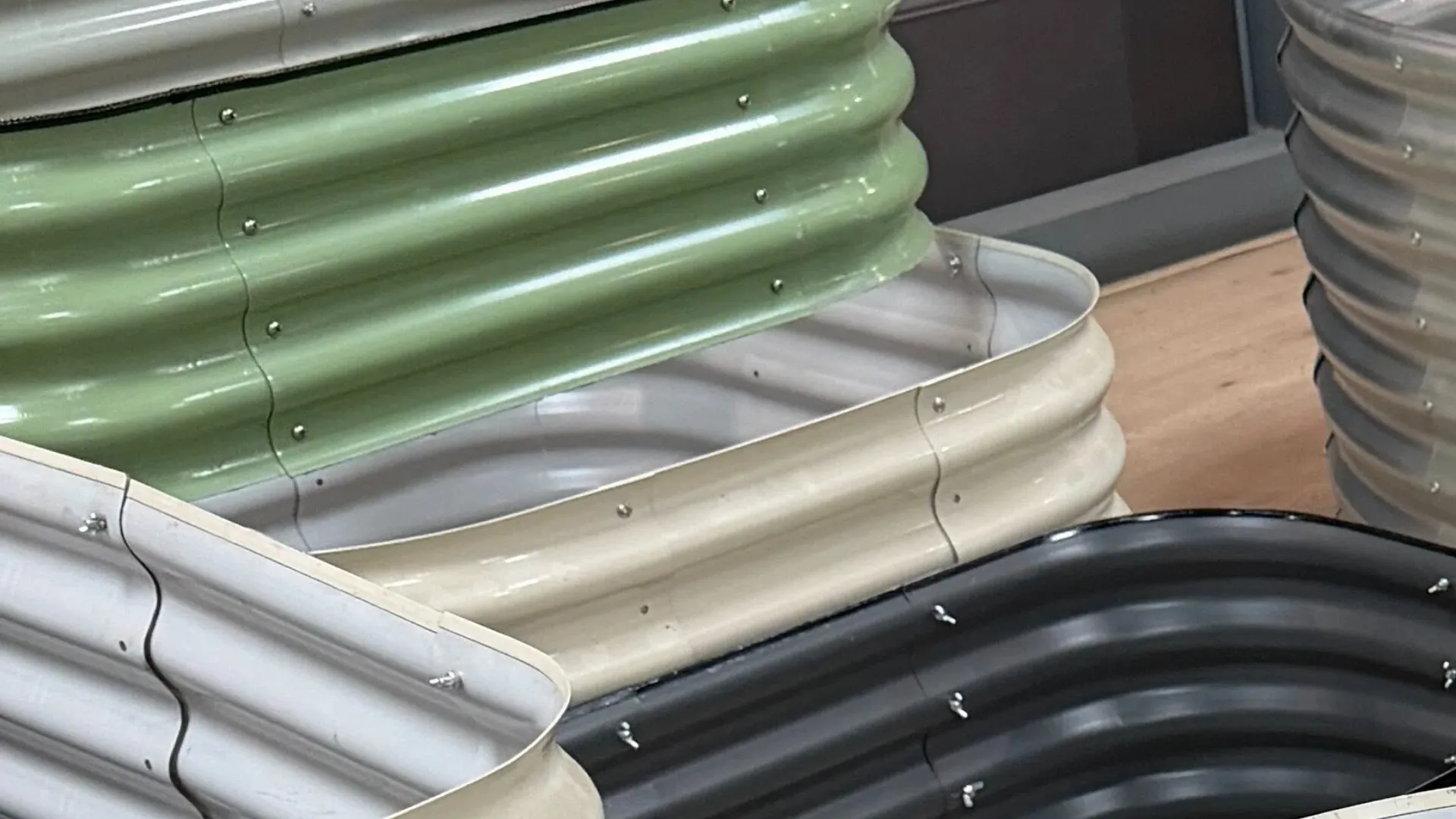
How to Match Shapes to Your Customer Type
Different customers need different shapes. Here is a quick reference for matching bed configurations to buyer profiles:
| Customer Type | Recommended Shapes | Key Selling Points | Watch Outs |
| Greenhouse operators | Rectangular, narrow tall beds | Row efficiency, standardized sizing, yield per square foot | Width must allow reaching the center (max 4ft) |
| Garden centers | Oval, modular kits, tall display beds | Visual appeal, display flexibility, and color options | Modular instructions must be clear |
| E-commerce sellers | Modular 9-in-1, rectangular, 2-Pack bundles | One SKU multiple configs, shipping efficiency, price points | Hardware completeness across all configurations |
| Urban/apartment gardeners | With base/wheels, small rectangular, L-shaped | Fits hard surfaces, mobility, and space efficiency | Drainage and wheel quality are critical |
| Community/school gardens | Rectangular, U-shaped | Accessible, collaborative growing, durable | Tall beds must be narrow enough for all users |
| Landscape designers | L-shaped, tall beds, premium colors | Design statement, custom layouts, premium pricing | Custom sizes may require a higher MOQ: confirm color availability before quoting projects |
| Accessibility/assisted living | U-shaped, tall narrow beds | Ergonomic access, reduced bending, wheelchair-friendly | Opening width and reach depth must be verified |
Shape Selection Checklist: 6 Questions Before You Order
- Does the bed width allow the user to reach the center without stepping on soil?
- If ordering tall beds (24“+), is the bed narrow enough (max 3-4 feet) for practical access?
- If ordering beds with bases, are drainage holes included and adequately sized?
- If ordering modular kits, does the instruction sheet cover every configuration with clear diagrams?
- If ordering U-shaped or L-shaped beds, are the corner joints structurally reinforced?
- Have you confirmed the approximate soil volume required for each bed size and communicated it to your customers? For example, a 4 × 8 × 1 ft bed has a theoretical volume of about 32 cubic feet before allowing for the actual fill method.
Shape should be decided together with material, thickness, packaging, and market positioning. Our current 0.6mm Zn-Al-Mg metal raised garden bed range includes 8", 11", 17" and 32" heights, with Round, Oval/T24, 2N1, 4N1, 6N1 and 9N1 core configurations. Selected L-shaped, U-shaped and other special layouts are available depending on the model. For the full sourcing logic, read our guide on how to choose metal raised garden beds for wholesale.
Next Step: Match Your Shapes to Your Market
The shape of a metal raised garden bed is not a design afterthought — it is a functional decision that determines where the product can be used, who will buy it, and what kind of reviews it will generate. A beautiful oval bed in the wrong garden is a return waiting to happen. A well-chosen U-shaped bed in the right community garden is a customer for life.
Before you place your next order, map your customer types to the shapes that serve them. If you sell to greenhouse operators, prioritize rectangular and narrow tall beds. If you sell to garden centers, invest in modular kits with clear instructions and color options. If you sell to urban gardeners, make sure your beds with bases actually drain.
If you need help selecting raised bed shapes and configurations for your market, send us your target sales channel, preferred height, available space and expected quantity. We can help narrow the options and confirm which configurations are available for sampling or quotation.
You focus on selling. Scarecrow Garden Supplier can help you source, verify, organize, and ship.
Match the Raised Bed Configuration to Your Market
Compare height, shape, available space and customer use before deciding which configurations to add to your product range.
Written by
ScarecrowGarden
💡About Scarecrow Garden Supplier Co., Ltd.
Scarecrow Garden Supplier Co., Ltd. is a China-based sourcing and wholesale partner specializing in garden tools, landscaping equipment, and outdoor supplies for international wholesalers, distributors, contractors, and brands.
With hands-on experience rooted in real garden use scenarios, we focus on durable materials, functional design, and stable large-volume supply. Our product range covers pruning tools, watering systems, hand tools, outdoor hardware, and customized garden solutions to support both retail and professional landscaping markets.
Beyond products, we help our partners navigate supplier selection, quality control, compliance requirements, and long-term sourcing strategies in China. Through our blog, we share practical insights on product selection, material comparisons, industry trends, and cost-effective purchasing—helping global buyers build stronger, more competitive supply chains.