






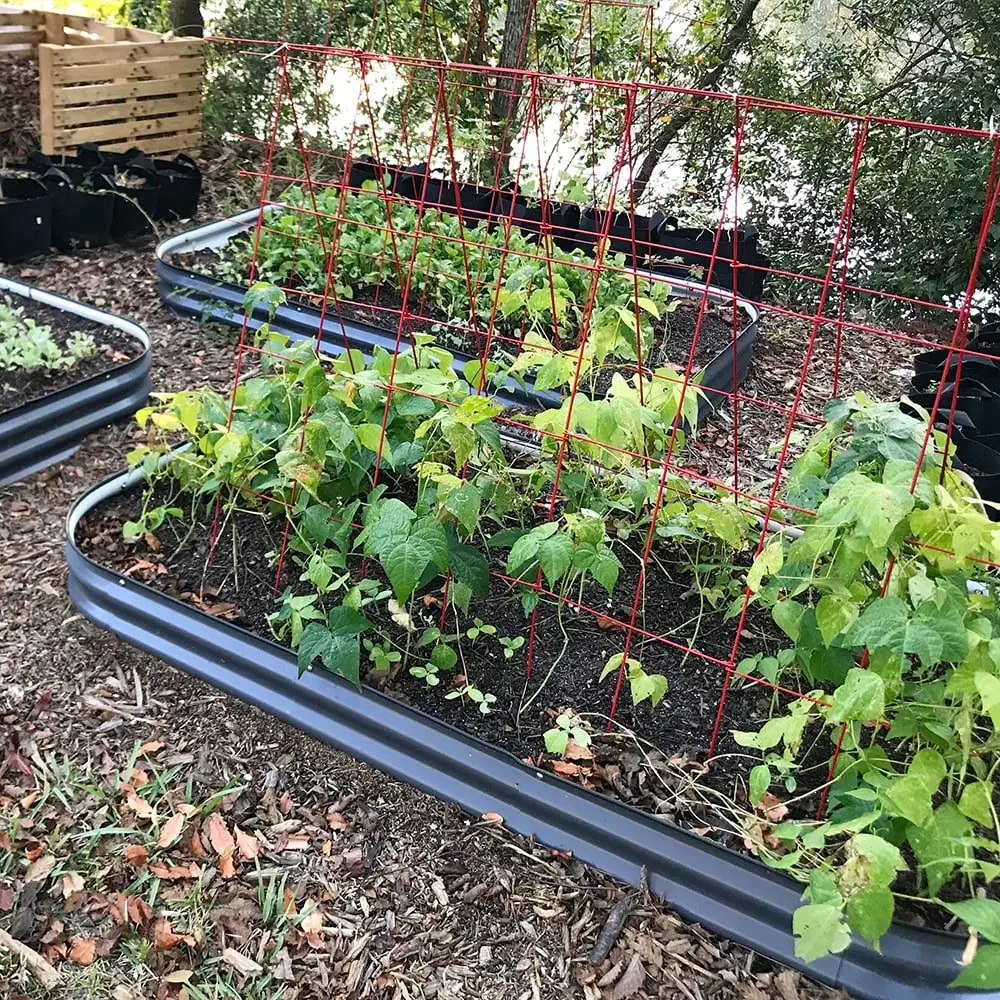
Metal raised garden beds used for outdoor vegetable growing
Two metal raised garden beds sit side by side in a product photo. Same corrugated panels. Same rounded corners. Same color. One retails at $49. The other is at $179. A customer looking at the photo cannot tell the difference.
But when you pick them up — when you press your thumb against the panel, when you fill the bed with 400 pounds of wet soil, when you ship it across the Pacific in a corrugated carton — the difference becomes obvious. And expensive to ignore.
That difference is steel thickness. In metal raised garden bed sourcing, it is the single most consequential specification that does not appear in product photos. This article breaks down what 0.4mm, 0.6mm, and thicker steel actually mean for wholesale buyers — not in theory, but in the warehouse, at the garden center, and in customer reviews.
This guide is based on what we found when we compared three samples in our warehouse — and what happens to each of them when the soil goes in.
What Steel Thickness Actually Affects
Thickness is not just a number on a spec sheet. It changes five things that directly affect your bottom line:
1. How the panel feels in hand. A 0.4mm panel flexes when you press it. A 0.6mm panel resists. This is not a subtle difference — it is immediately apparent to anyone who picks up the product. In a garden center, where customers touch before they buy, this tactile difference is a conversion factor.
2. How the bed holds up under soil pressure. A raised bed filled with wet soil is under constant lateral load. Thinner steel has less resistance to that load. In practice, 0.4mm panels in taller configurations (24 inches and above) can show visible sidewall bowing after the bed is filled. Deeper corrugation helps — a well-corrugated 0.4mm panel is stiffer than a flat 0.6mm one — but corrugation only partially compensates for material thickness.
3. How the product survives shipping. Metal panels are heavy and have edges. During international shipping, thinner panels are more susceptible to bending and denting. A bent panel arriving at a garden center is not a product you can sell at full price — it is a return, a complaint, or a discount.
4. How the product presents at trade shows. At a trade show, your sample needs to communicate quality in 30 seconds. A salesperson handing a 0.4mm panel to a potential buyer is fighting an uphill battle — the panel feels light, flexible, and inexpensive. A 0.6mm panel feels solid. That difference shapes the conversation that follows.
5. How much customers are willing to pay. Thickness is invisible in online photos, but it shapes every other aspect of the customer experience — from assembly feel to long-term durability. Products that feel substantial command higher prices. Products that feel thin do not.
If you are comparing 0.4mm and 0.6mm metal raised garden bed options, request our material comparison video — we demonstrate the flexibility, thickness, and structural difference between all three specifications side by side so you can see exactly what each tier delivers.
0.4mm Galvanized Steel: The Budget Option
At 0.4mm (approximately 27 gauge based on standard steel gauge tables), the panel is noticeably flexible. You can feel it give when you press on it. This is not a defect — it is a material choice that serves a specific market segment.
Where 0.4mm Works
0.4mm galvanized steel is suited for price-driven channels where cost is the primary decision factor:
- Online marketplaces (Amazon, Walmart, Wayfair) where customers shop by price filter and review score
- Promotional bundles and seasonal clearance programs
- 2-Pack value sets where the per-unit price needs to hit a low threshold
- Trial orders for buyers testing a new market at minimum risk
On Amazon, a significant number of budget raised bed brands do not disclose steel thickness in their product listings at all. Products priced at $29.99-$69.99 for a 2-Pack are, based on cost structure analysis, likely using 0.3-0.4mm steel. The fact that these brands avoid mentioning thickness is itself a signal — if the product were 0.6mm, they would say so.
Where 0.4mm Does Not Work
0.4mm is not suited for:
- Premium retail positioning where customers expect a substantial feel
- Tall configurations (24 inches and above) where soil pressure on sidewalls is greatest
- Long-term outdoor use claims (positioning a 0.4mm product as a “20-year bed” is not defensible)
- Garden center display where customers handle the product before purchasing
- Trade show samples where the panel needs to communicate quality instantly
What to Tell Your Customers
If you are sourcing a 0.4mm product, position it honestly. Call it a “budget option” or an “entry-level raised bed.” Do not let your marketing imply durability that the material cannot support. A customer who buys a $49 raised bed expecting it to last a decade will leave a one-star review. A customer who buys it, understanding it is a seasonal or entry-level product may leave four stars.
0.6mm Galvanized Steel: The Stronger Standard Option
At 0.6mm (approximately 24 gauge), the panel has a noticeably more rigid feel. It holds its shape under pressure, resists bending during handling, and gives customers confidence when they pick it up.
Where 0.6mm Galvanized Steel Works
0.6mm galvanized steel is the practical middle ground for wholesale buyers who want a product that feels solid without paying for Al-Zn-Mg coating:
- Garden centers and retail stores where customers touch the product
- Mid-range e-commerce where review profiles matter and returns are costly
- Standard-height beds (up to about 17 inches) where soil pressure is manageable
- Modular kits where panel rigidity affects assembly experience
The step up from 0.4mm to 0.6mm is, in our experience, the single most impactful upgrade you can make for a product that will be handled by customers in person. The cost difference per unit is modest. The perceived quality difference is significant.
The Limitation of 0.6mm Galvanized Steel
0.6mm galvanized steel is stronger — but it is still galvanized steel. The zinc coating provides reasonable rust protection, but at cut edges and bolt holes, the coating is disrupted. Over time, these connection points are where rust typically starts. For markets where corrosion resistance is a key selling point (coastal areas, humid climates, cold regions with freeze-thaw cycles), galvanized steel has a known weakness that thickness alone does not solve.
0.6mm Al-Zn-Mg Color-Coated Steel: The Premium Retail-Grade Option
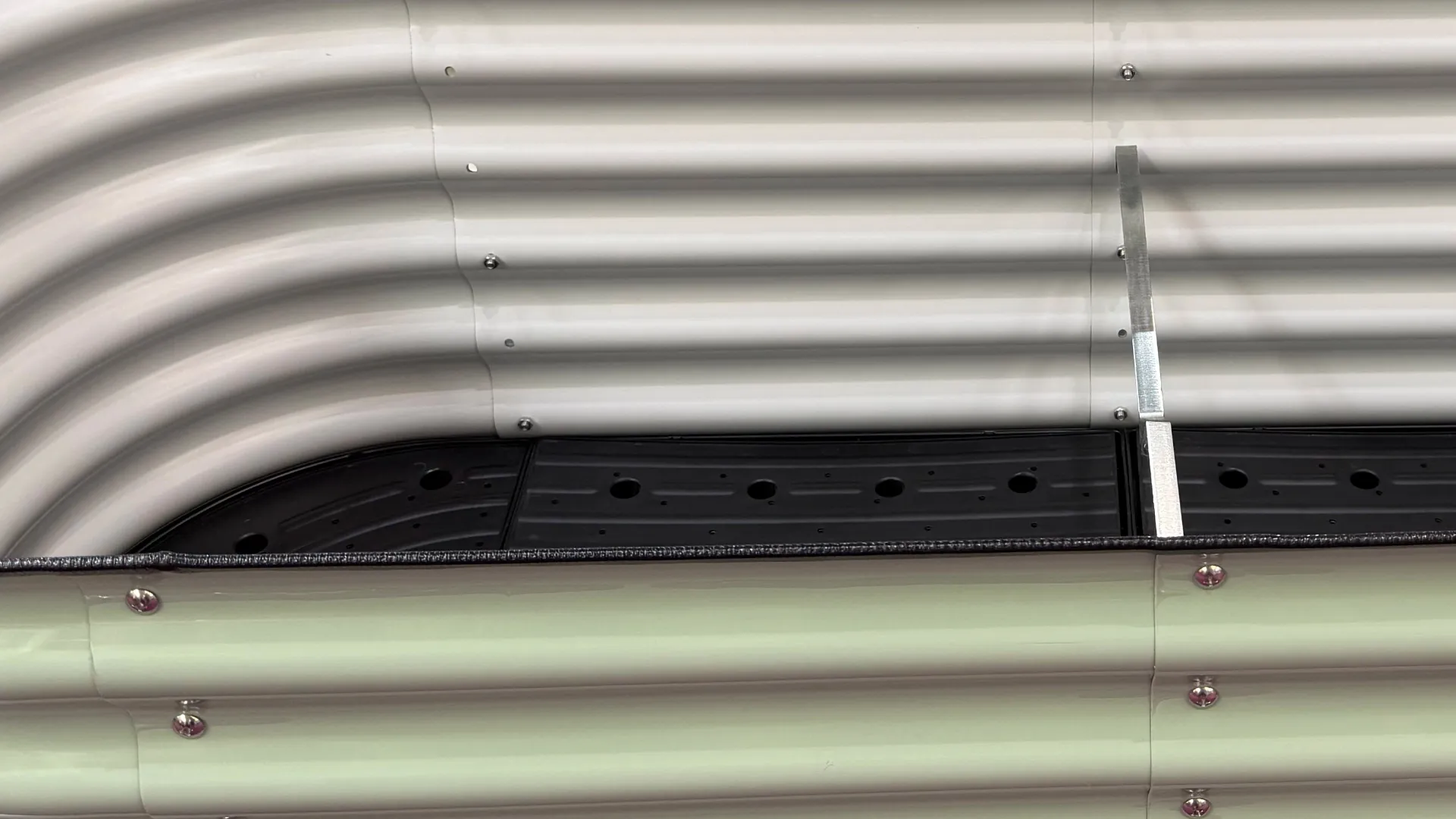
This is the configuration that aligns with what premium brands use. The 0.6mm thickness provides structural rigidity. The Al-Zn-Mg (aluminum-zinc-magnesium) coating adds corrosion resistance that is significantly better than standard galvanizing — industry data suggests improvement of up to 4 times, with some brands claiming up to 20 times (this is a brand marketing claim, not an independent third-party test conclusion).
The property that matters most for raised beds is cut-edge self-healing: when the steel is cut or drilled at bolt connection points, magnesium ions migrate to the exposed edge and form a protective layer. This directly addresses the most common rust failure point — the one that galvanized steel cannot solve on its own.
The color coating is applied at the steel mill, baked into the coil, not painted on afterward. This means consistent color across the surface and better scratch resistance than post-applied coatings.
Where 0.6mm Al-Zn-Mg Works
- Brand websites and DTC channels where material education supports premium pricing
- Garden centers targeting customers who research before buying
- Cold climate markets (Canada, Northern Europe) where corrosion resistance in wet, variable conditions is valued
- Trade show samples labeled as “premium retail-grade option”
- Markets where customers pay 150-300+ for a raised bed
If you are not sure whether your product line should use galvanized steel or Al-Zn-Mg coated steel, our comparison of galvanized steel vs aluminum-zinc-magnesium steel for metal raised garden beds explains the material differences in more detail.
What This Material Costs
Al-Zn-Mg color-coated steel commands a higher unit cost than galvanized steel — both at the material level and in the overall product price. But the question for wholesale buyers is not “what does it cost?” The question is “what can I sell it for?” A 0.6mm Al-Zn-Mg bed positioned correctly can retail at an estimated 3-5 times the price of a 0.4mm galvanized bed (based on market observation). The margin difference is where the material investment pays off.
Thickness Comparison at a Glance
| Property | 0.4mm Galvanized | 0.6mm Galvanized | 0.6mm Al-Zn-Mg Color-Coated |
| Gauge (standard steel) | ~27 gauge | ~24 gauge | ~24 gauge |
| In-hand feel | Flexible, gives under pressure | Rigid, holds shape | Rigid, holds shape |
| Soil pressure resistance | Adequate for low beds, bowing risk in tall configs | Good for standard heights | Good for standard heights |
| Shipping durability | Higher risk of bending | Better resistance | Better resistance |
| Corrosion resistance | Zinc coating; rust starts at bolt holes | Same as 0.4mm galvanized | Significantly better; cutting-edge self-healing |
| Typical retail price range | Starting from ~$30 for small sizes; up to$80 | $60-$150 | $150-$370+ |
| Best-fit channel | Amazon, budget 2-Packs | Garden centers, mid-range retail | Brand sites, premium retail, trade shows |
| How to position | “Budget option” / “Entry-level” | “Stronger galvanized option” | “Premium retail-grade option” |
Thickness is only one part of product selection. If you are still comparing materials, shapes, market positioning, and packaging, you can read our full guide on how to choose metal raised garden beds for wholesale.
Thickness Is Not the Only Variable
A common mistake is treating thickness as the sole quality indicator. It matters — but it works in combination with other factors that are equally important:
Corrugation depth. Deeper corrugation adds rigidity. Birdies Garden Products is known for its deep corrugation structure, which contributes to high sidewall pressure resistance. A well-corrugated thinner panel may outperform a poorly corrugated thicker one. When evaluating samples, press the center of the panel — the corrugation should resist flexing, not just the steel thickness.
Support rods and bracing. Internal tension rods or cross-bracing reduce sidewall pressure significantly. Some modular kits include them; others do not. Their presence or absence affects how the bed performs when filled with soil, regardless of panel thickness.
Hardware grade. 304 stainless steel bolts and nuts at connection points prevent the most common rust failure. Some suppliers reduce costs by using lower-grade hardware. The difference does not show up in photos — it shows up after one winter outdoors. This is a detail that affects customer reviews regardless of how thick your steel is.
Edge treatment. Rolled edges, safety trim, and rounded corner caps contribute to both structural integrity and user safety. Their absence is immediately noticed by customers and reviewers.
We have compared 0.4mm and 0.6mm metal raised garden bed samples side by side in our warehouse, and we also have a material comparison video showing the differences in panel thickness, corrugation, hardware and edge treatment.
For our current wholesale range, Scarecrow focuses on 0.6mm Zn-Al-Mg metal raised garden beds. The 0.4mm sample is used as a market comparison reference rather than our standard product offer.
Besides thickness, the final product experience also depends on metal raised garden bed shapes and configurations, especially when you are matching beds with patios, greenhouses, backyards, or retail displays.
How to Explain Thickness to Your Customers
One of the most practical things you can do with thickness knowledge is turn it into a sales tool. If you are selling to garden centers, distributors, or directly to consumers, here is a simple three-tier framework:
- Budget option (0.4mm galvanized): “An affordable entry point for new gardeners or seasonal use. Great for trying raised bed gardening without a big investment.”
- Stronger galvanized option (0.6mm galvanized): “A more solid feel with better structural support. Good for standard-height beds in typical outdoor conditions.”
- Premium retail-grade option (0.6mm Al-Zn-Mg): “Premium coated steel with better corrosion resistance and cut-edge protection. Designed for long-term outdoor use and higher-end retail positioning.”
Notice what these descriptions do not say. They do not use words like “cheap” or “best.” They do not make absolute durability promises. They position each option for a specific customer and use case — which is exactly what a good retailer needs to close a sale.
And here is what not to say: do not call a 0.4mm bed “cheap” or “low quality.” Call it an “entry-level option for new gardeners.” The first phrasing kills the sale. The second opens a conversation about who the product is for.
What About Thicker Steel?
Some manufacturers offer 0.8mm or 1.0mm steel. According to brand information, Raised Garden Beds Canada uses 0.8-1.0mm RGB steel alloy, emphasizing durability in extreme cold climates. Thicker steel is stronger — but it is also heavier and more expensive to ship. For most export-oriented wholesale programs, 0.6mm represents the practical balance between strength, weight, packaging efficiency, and cost. Thicker steel makes sense when the target market specifically demands it (e.g., extreme climate positioning), not as a default upgrade.
What to Do When Thickness Is Not Disclosed
Here is a practical sourcing rule: If a supplier or brand does not disclose panel thickness, do not guess from photos or price alone. Ask for the exact thickness in millimeters and confirm it in the quotation or specification sheet. For important orders, check a physical sample with a caliper before bulk production.
During our research, we found that most mainstream brands — including Vegega, Birdies, and Garvee — do not publicly state steel thickness on their websites or product pages. Vego Garden is one of the few that mentions 0.6mm in product details, according to brand product pages. On Amazon, budget brands priced at $29.99-$69.99 almost universally avoid mentioning thickness.
This is not an accident. Brands using 0.6mm or thicker steel have every reason to advertise it — it is a selling point. Brands using thinner steel have every reason to let customers assume.
For B2B buyers, this means: always ask for thickness in your inquiry. If the supplier is evasive or says “standard thickness, ” press for the specific number. If they cannot confirm it in writing, it is a red flag.
Pre-Order Thickness Verification Checklist
| Check Item | What to Do |
| Confirm thickness in writing | Ask the supplier for the exact mm thickness. Get it in an email or spec sheet, not a verbal confirmation. |
| Request a sample | Receive a sample panel. Measure it yourself with a caliper if possible. |
| Compare in hand | Pick up the 0.4mm and 0.6mm samples side by side. The difference is tactile. |
| Check corrugation depth | Press the center of the panel. Deeper corrugation should resist flexing. |
| Verify hardware grade | Confirm bolts and nuts are 304 stainless steel. Ask for a spare parts allowance. |
| Match thickness to channel | Amazon/budget → 0.4mm; Garden center/mid-range → 0.6mm galvanized; Premium retail → 0.6mm Al-Zn-Mg |
| Test with soil | If possible, assemble the sample and fill it with wet soil. Check for sidewall bowing. |
| Check the quotation | Does the quoted price match the thickness you confirmed? A suspiciously low price for “0.6mm” may mean the actual product is thinner. |
Next Step: Review Your Garden Product Sourcing Plan
Steel thickness is the invisible variable that determines how your product feels, how it ships, how it performs under soil pressure, and how much your customers are willing to pay. Choosing between 0.4mm and 0.6mm is not about “better” or “worse” — it is about matching the material to your market.
The wrong choice leads to bent panels in transit, one-star reviews from customers who expected more, or missed margin because you undersold a product that could have commanded a higher price. The right choice starts with a sample you can hold in your hand.
If you are considering a premium raised garden bed range, samples of our 0.6mm Zn-Al-Mg models are available so you can check panel thickness, coating, hardware, color and assembly before bulk ordering.Standard heights include 8", 11", 17" and 32", with multiple modular configurations. MOQ starts from 10 sets.
You focus on selling. Scarecrow Garden Supplier help you source, verify, organize, and ship.
Need Help Before Bulk Ordering?
Get the Key Sourcing Details Before You Decide
Ask us for available models, quotation sheet, material comparison video, or sample support for your garden product sourcing plan.

Written by
ScarecrowGarden
💡About Scarecrow Garden Supplier Co., Ltd.
Scarecrow Garden Supplier Co., Ltd. is a China-based sourcing and wholesale partner specializing in garden tools, landscaping equipment, and outdoor supplies for international wholesalers, distributors, contractors, and brands.
With hands-on experience rooted in real garden use scenarios, we focus on durable materials, functional design, and stable large-volume supply. Our product range covers pruning tools, watering systems, hand tools, outdoor hardware, and customized garden solutions to support both retail and professional landscaping markets.
Beyond products, we help our partners navigate supplier selection, quality control, compliance requirements, and long-term sourcing strategies in China. Through our blog, we share practical insights on product selection, material comparisons, industry trends, and cost-effective purchasing—helping global buyers build stronger, more competitive supply chains.