






Updated 4 months ago
Perfect Sample, Failed Bulk Order: Why Garden Product Quality Often Goes Wrong After Confirmation
ScarecrowGarden
💡About Scarecrow Garden Supplier Co., Ltd.
Scarecrow Garden Supplier Co., Ltd. is a China-based sourcing and wholesale partner specializing in garden tools, landscaping equipment, and outdoor supplies for international wholesalers, distributors, contractors, and brands.
With hands-on experience rooted in real garden use scenarios, we focus on durable materials, functional design, and stable large-volume supply. Our product range covers pruning tools, watering systems, hand tools, outdoor hardware, and customized garden solutions to support both retail and professional landscaping markets.
Beyond products, we help our partners navigate supplier selection, quality control, compliance requirements, and long-term sourcing strategies in China. Through our blog, we share practical insights on product selection, material comparisons, industry trends, and cost-effective purchasing—helping global buyers build stronger, more competitive supply chains.

Garden Products Sourcing: How to Avoid Sample vs Bulk Order Quality Gaps | Scarecrow Garden Supplier
Many buyers who source garden products from China have encountered this situation: the sample looks good, you confirm it, place the order, wait 30 to 45 days for sea freight, and when the goods arrive — they are different from the sample.
This is not an isolated case. An experienced buyer once said that when sourcing from China, half of the 16 suppliers he contacted did not reply to inquiries. After finally receiving and confirming the sample, 683 pieces out of a 7,200-piece bulk order were defective — a defect rate of 9.4%. Handling the packaging problem alone costs an extra $250. A good sample only proves that the supplier has once made a good sample. It does not mean the supplier can consistently produce the same quality in bulk.
This article will help you understand why there is a gap between samples and bulk orders, which garden product details are most likely to change, and how to reduce the risk after sample confirmation and before bulk shipment.
Sample approval is only one step in the sourcing process; for the full risk-control framework, read why garden product sourcing problems keep happening when buying from China.
A Good Sample Is Only the Beginning
Many new buyers believe that once the sample is confirmed, everything is settled. But a sample only proves one thing: when the factory is fully cooperating with you, it can make a product at this level.
The problem is that bulk production is not the same as full cooperation. Bulk production means mass production, tight lead times, cost control, a different group of workers, and a different batch of raw materials. What you see during the sample stage is the factory’s best condition. What you see during bulk production is the factory’s daily condition.
So after sample confirmation, what you need to do is not just “wait for the goods to arrive.” You need to record every detail of the sample — size, material, color, weight, coating, accessories, packaging, logo, label, and function. These records are not a formality. They are the standard for comparing the bulk order, and they are also your evidence when problems occur.
If you do not do this, when the bulk goods arrive, you may feel that “something is not quite right,” but you cannot clearly explain what is wrong — because you have no records for comparison.
Why Bulk Orders Change After Sample Confirmation
When bulk goods are inconsistent with the sample, it is not always because the factory is intentionally cutting corners. Some changes are objective changes during production. Some are choices made by the factory to control costs. Some are the result of unclear communication.
Raw material batch changes. The batch of steel sheet, plastic particles, or fabric used for the sample may already be used up by the time bulk production starts. The factory changes to a new batch of material, and the color, texture, or thickness may have slight differences. If the factory does not inform you, you will not know.
The factory changes materials without notice. Some changes are not batch differences, but the factory is actively switching to cheaper materials. For example, the sample uses a 0.6mm steel sheet, but the bulk order is changed to 0.4mm. The quotation only says “galvanized steel” and does not mention thickness, so the factory believes it has not violated anything. Or for butterfly lights, the sample uses a high-quality motor, and the wings move almost silently. But the bulk order is changed completely to cheap motors, and after three hours of continuous operation, they start making creaking noises. The appearance is the same, but the quality is very different.
The sample comes from high-standard small-batch production, while the bulk order comes from a normal production line. Some factories make samples by hand with experienced workers, so the details are done well. But when the bulk order goes onto the production line, workers are paid by piece rate and focus on speed rather than details. The same product can look completely different between the sample and the bulk order.
Peak-season rush production leads to unstable quality. Garden products are highly seasonal. Spring is the peak season. Factories are full of orders, and when they rush production, quality inspection standards become looser. If you place an order in the spring, the factory may want to finish it as quickly as possible. There may not be enough time to check each piece carefully.
No sealed sample or sample record. This is the most common reason. The buyer confirms the sample, but does not retain a sealed sample, does not take detailed photos, and does not write down the material and process specifications. The factory produces according to its own understanding. When the bulk order is different from the sample, you cannot clearly explain the difference — because you have no standard.
No pre-shipment inspection. If no one checks the bulk goods before shipment, all problems will only be discovered after the goods arrive. Sea freight takes 30 to 45 days. Returning the goods is unrealistic, rework costs are extremely high, and discount handling becomes the only way to reduce the loss.
One common reason behind sample-to-bulk differences is price pressure, which is closely related to why the cheapest garden product supplier may cost you more.
Which Garden Product Details Are Most Likely to Change in Bulk Orders
| Detail | Sample Stage | Possible Change in Bulk Order | Why It Is Easy to Change |
|---|---|---|---|
| Steel sheet thickness of metal raised garden beds | 0.6mm, solid feel | Changed to 0.4mm or 0.2mm | The quotation does not state thickness, and the factory chooses based on cost |
| Screw material for raised garden beds | 304 stainless steel | Changed to 201 stainless steel | The appearance is similar, the price difference is large, and buyers may not notice |
| Coating thickness | Even coating, suitable for 3–5 years of outdoor use | Thinner coating, rusts within one year | The quotation only says “powder coating” and does not state the thickness |
| Butterfly light motor | High-quality motor, quiet operation | Changed to a cheap motor, creaking after 3 hours | The appearance is the same; without disassembly and power-on testing, it is hard to know |
| Heating mat cable | Thicker cable, safer | The cable becomes thinner | The power remains the same, but safety risks increase |
| Seedling tray thickness | Thick and strong, does not crack during handling | Becomes thinner and cracks easily when moved | Plastic thickness is hard to judge by eye |
| Greenhouse cover film | UV-resistant, usable for 2–3 years | Changed to ordinary film, becomes brittle after one season; the protective cover yellows, wrinkles, and smells before one season ends | The difference is not visible during the sample stage |
| Watering can color | Even color, consistent with the sample | Color difference within the same batch, darker color | Plastic color batch differences |
| Plant labels | Good material, clear engraving | Changed to a cheaper material | Labels look simple, but material differences can be large |
| Packaging carton | Thickened carton, does not deform during long-distance shipping | Changed to thin carton, crushed on arrival | Carton cost differences are large, and factories easily save on this |
| Accessories | Screws, instruction manual, and labels are complete | Missing screws, missing instructions, missing labels | Accessories are outsourced and easy to miss during combined packing |
You will find that these changes have one common feature: they are not written in the quotation, they are not visible during the sample stage, and they are only discovered after the bulk goods arrive. Thickness, coating, material, accessories — these are the “invisible costs,” and they are also the easiest places to change.
How to Reduce Risk Before Bulk Production
After sample confirmation and before bulk shipment, there is more you can do than you may think:
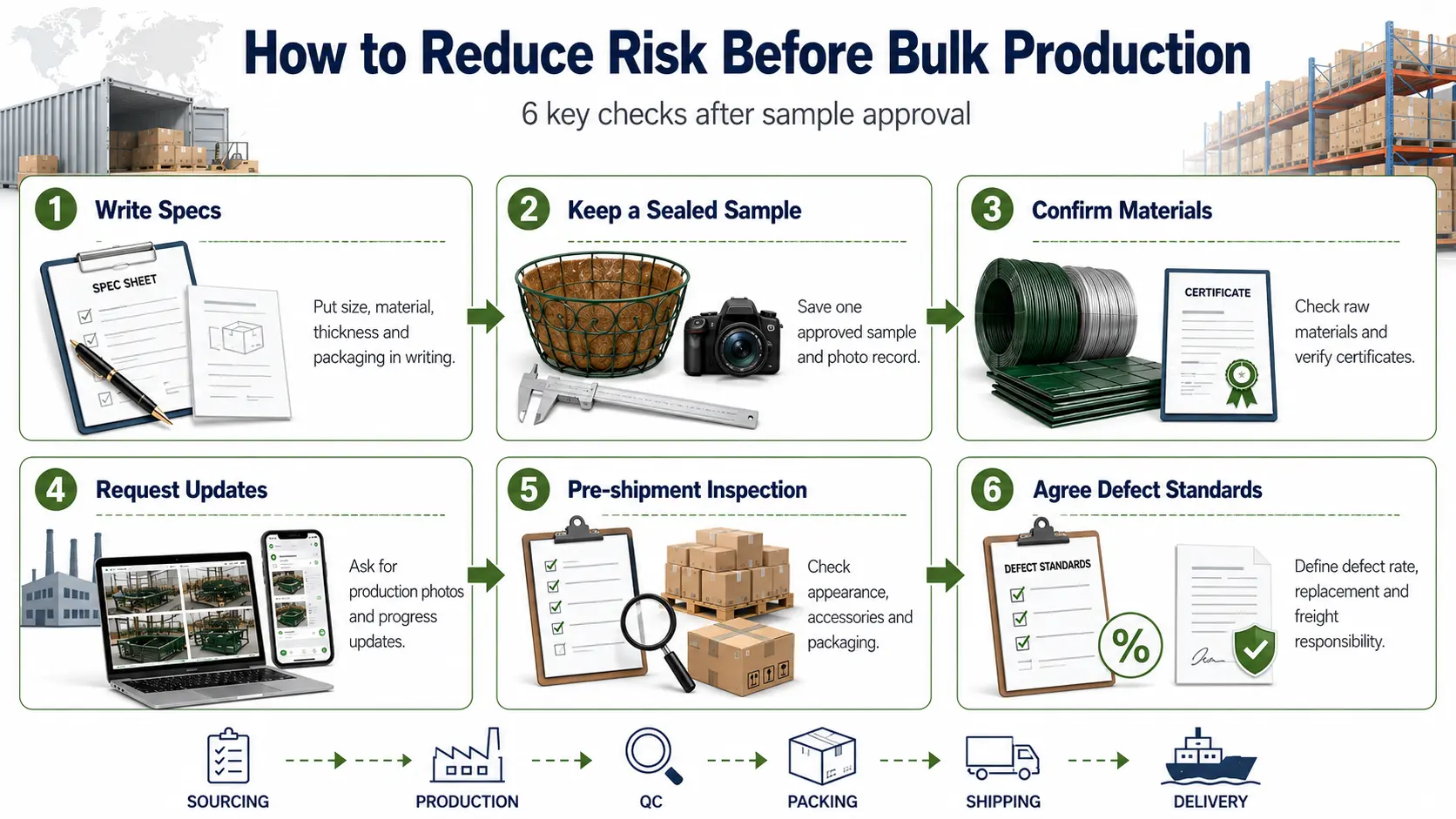
Write the specifications into the contract or PI. Do not rely only on chat records. Size, material, thickness, color, coating, accessories, packaging — write as much detail as possible. Anything written down will at least make the factory take it seriously. Anything not written down will be produced according to the factory’s own understanding, and you will not even have a basis for discussion.
Retain a sealed sample and take photo records. After receiving the sample, take photos of every detail — front, side, bottom, joints, accessories, and packaging. If possible, use calipers to measure key dimensions. Keep one sealed sample as the standard for comparison with the bulk order.
Confirm raw materials. Before bulk production, ask the factory whether the raw materials are the same as the sample. If the factory says, “We changed to a new batch of material,” ask for a new material sample or photos. Also, verify certificates — some factories directly forge certificate images. Check the certificate number and scope of application, and confirm that it covers your market and product.
Request production progress updates. Do not disappear after placing the order. Ask the factory to provide production progress updates and photos during production, especially photos of key processes. This is not distrust. This is normal procurement management.
Arrange pre-shipment inspection. Before the bulk goods are shipped, someone should check the key details — whether the bulk order is consistent with the confirmed sample, whether the packaging is correct, and whether the accessories are complete. Finding and solving problems in China costs far less than handling them after the goods arrive at your warehouse.
Agree on defect tolerance standards and handling methods. Make it clear before placing the order: What defect rate allows rejection? How will defective products be replaced? Who pays the freight? If these matters are agreed in advance, there will be fewer arguments when problems happen.
How Scarecrow Garden Supplier Handles Sample-to-Bulk Checking
For garden product sourcing, sample-to-bulk checking is one of the most important parts of Scarecrow's daily work. Here is how we do it:
- After receiving the sample, we photograph and record all details and create a written specification file.
- Before bulk production, we confirm with the factory whether the raw materials and process are consistent with the sample.
- After the bulk goods arrive at our warehouse, we check item by item — appearance, size, color, accessories, and packaging.
- If problems are found, we handle them in China first and do not let problematic goods be shipped out.
- For mixed orders, where one container includes multiple products, we conduct a unified warehouse inspection before packing and shipment.
This is not advanced inspection technology. It is simply having someone in the middle watching the details for you. But when you are not on site, having someone watch the process and having no one watch it are very different.
If a sourcing agent is involved, responsibility should be clarified before bulk production; this is why buyers should understand your China sourcing agent’s conflict of interest.
Frequently Asked Questions
❔Why are bulk goods from Chinese suppliers different from the sample?
There are many reasons: raw material batch changes, the factory actively changing materials to control costs, samples being handmade while bulk goods are produced on a production line, loose quality inspection during peak-season rush production, buyers not retaining sealed samples or written specifications, and no pre-shipment inspection. It is not always because the factory intentionally cuts corners, but the result is the same for the buyer.
❔How can I make sure the bulk order is consistent with the sample?
Three things are most important: write the specifications into the contract, retain and record the sealed sample, and have someone inspect before shipment. Together with raw material confirmation and agreed defect handling methods, the most common problems can be identified before shipment.
❔Which garden product details are most likely to change in bulk orders?
Thickness, such as metal raised garden bed steel sheets, seedling tray plastic, and greenhouse film; coating, especially on metal products; materials, such as 304 screws changed to 201, or external motors changed to internal motors; color, such as plastic product batch color differences; accessories, such as missing screws and missing instructions; and packaging, such as cartons becoming thinner. These details share one common feature: they are not written in the quotation, cannot be seen during the sample stage, and are only discovered after the bulk goods arrive.
❔Is pre-shipment inspection necessary?
Yes. Especially for garden products — there are many categories, many small details, and mixed orders are common. If no one checks before shipment, all problems will only be discovered after the goods arrive. Sea freight takes 30 to 45 days, and handling costs are extremely high. Finding problems before shipment and solving them in China is the lowest-cost option.
❔Should I inspect the goods myself or ask someone to help?
If you have a team in China, speak Chinese, and understand the details of garden products, you can arrange an inspection yourself. If you are not on site, asking a garden product team based in China to help check is more reliable than trying to manage everything remotely.
Already Have a Sample or Product Reference?
If you already have a sample or product reference photo, you can send us the photos, specifications, and packaging requirements. We can help you check whether the details are clear enough before moving forward to bulk production. Scarecrow Garden Supplier focuses on garden products and helps overseas wholesale buyers handle the full process from sample checking to bulk inspection.
Simplify Your Garden Product Sourcing from China
We help you combine multiple product categories into one sourcing flow with supplier matching, sample verification, and consolidated shipping.
Written by
ScarecrowGarden
💡About Scarecrow Garden Supplier Co., Ltd.
Scarecrow Garden Supplier Co., Ltd. is a China-based sourcing and wholesale partner specializing in garden tools, landscaping equipment, and outdoor supplies for international wholesalers, distributors, contractors, and brands.
With hands-on experience rooted in real garden use scenarios, we focus on durable materials, functional design, and stable large-volume supply. Our product range covers pruning tools, watering systems, hand tools, outdoor hardware, and customized garden solutions to support both retail and professional landscaping markets.
Beyond products, we help our partners navigate supplier selection, quality control, compliance requirements, and long-term sourcing strategies in China. Through our blog, we share practical insights on product selection, material comparisons, industry trends, and cost-effective purchasing—helping global buyers build stronger, more competitive supply chains.