







How to Source Garden Products from China Without Falling Into Low-Price Traps
That quotation that is 30% cheaper than the others may end up costing you more.
This is not alarmist. When many new buyers source garden products from China, the most instinctive way to compare suppliers is by unit price. Two garden pruners look the same in photos and videos. One supplier quotes USD 12, another quotes USD 8 — a 33% difference. Choosing the USD 8 option looks like saving a lot of money.
But the real sourcing cost is not the unit price. The real cost is the unit price plus quality risk, delay risk, after-sales cost, inventory loss, and loss of customer trust. A USD 8 garden pruner may look exactly the same as a USD 12 one in photos and videos, but the actual blade may be 0.05 mm thinner than the USD 12 version. This difference is almost invisible to the naked eye — but when users actually use it, blade thickness directly affects durability. A thin blade is more likely to roll at the edge when cutting. Some pruners use ordinary stainless steel blades, while others use SK5. Stainless steel pruners are more likely to roll at the edge when cutting branches and do not perform as well as SK5. Even more hidden are the spring and fixing screws: cheap springs become loose after only a few uses, and blade fixing screws may rust within a few months, causing the pruner to open and close poorly or even become loose. When your customer buys it and the blade rolls during the first branch-cutting use, the negative review is left on you. What you lose is not the USD 4 price difference, but the profit of the whole batch plus customer trust.
This article will help you understand why low-price quotations often hide higher real costs, which parts of garden products are most likely to have costs cut, and how to compare quotations in a way that shows the full picture.
Low-price problems are only one part of a wider sourcing process issue; for the full framework, read why garden product sourcing problems keep happening when buying from China.
Unit Price Is Easy to Compare, but Real Cost Is Hard to See
The easiest thing for buyers to compare is the unit price because it is a number and looks clear at first glance. But what truly affects your profit is what cannot be seen behind those numbers:
- Defect rate — Cheap garden pruners have a higher defect rate. Who pays for returns and replacements?
- Repacking cost — If the packaging is too weak and arrives crushed, you need to repack the products before selling them.
- Delay cost — Garden products are highly seasonal. If the goods arrive late, you miss the sales season and end up with excess inventory.
- Customer complaints — If the product quality is poor, your customer will not complain to the factory. They will complain to you.
- Replacement cost — If a batch cannot be sold, you need to purchase again. Time, freight, and energy are all costs.
- Brand loss — Your end customers do not care which factory caused the problem. They only remember that your brand is unreliable.
None of these costs will appear on the quotation sheet. But each one may make the “30% savings” meaningless.
Why Some Suppliers Can Offer Extremely Low Prices
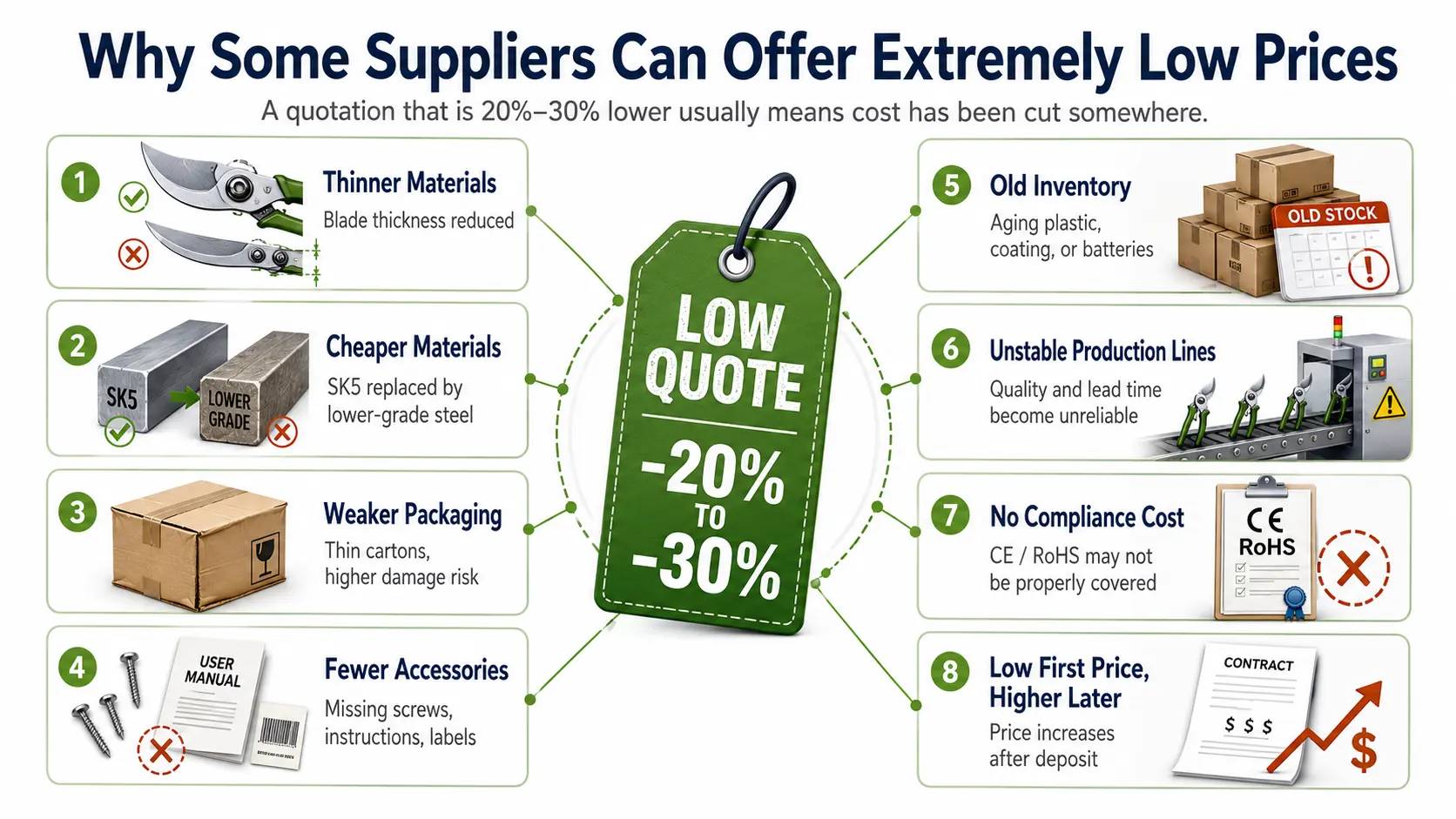
If a quotation is 20%–30% lower, it is usually not because the factory is much more efficient. More often, it is because the cost has been reduced somewhere:
Thinner materials. A blade thickness difference of 0.05 mm is almost impossible to see with the naked eye, but a thinner blade is more likely to deform and roll at the edge after repeated use. The quotation may only say “stainless steel blade” without mentioning thickness.
Cheaper materials. Even when both quotations say “stainless steel blade,” ordinary stainless steel and SK5 have a significant price difference. Simply put: SK5 is sharp when cutting thicker branches and is not easy to dull, while ordinary stainless steel is more likely to roll at the edge when cutting thicker branches. The difference may be around 10 HRC hardness points, and the user experience is very different. SK5 can reach HRC 57–63, with good sharpness retention; ordinary stainless steel is usually around HRC 48–54 and is more likely to become dull or roll at the edge when cutting thicker branches. The quotation sheet may not show the steel grade.
Weaker packaging. The cost difference between thick cartons and thin cartons is not small. During long-distance sea shipping, thin cartons may arrive crushed, products may deform, and you may need to repack them.
Fewer accessories. Screws, instructions, and labels are purchased separately. Removing them is pure profit for the factory. When your customer opens the package and finds missing parts, they will not think “the factory forgot them.” They will think “this brand is unreliable.”
Old inventory. Some low prices come from factories clearing old stock. Old inventory may have been stored for a long time, with plastic aging, coating deterioration, or drained batteries. You may only discover these problems after receiving the goods.
Unstable production lines. Small factories may offer lower prices, but their production lines may be unstable. During peak season, quality may become worse and delivery time may also be unreliable.
No compliance cost. If your target market requires CE, RoHS, or other certifications, compliant materials cost more than non-compliant materials. A low price may mean the factory has not considered compliance at all.
Low price first, then price increases later. Some quotations are only used to win the order. After the deposit is paid, the supplier raises the price using reasons such as raw material increases. Once you have paid the deposit, you are in a difficult position.
Specific Examples of How Cheap Becomes Expensive in Garden Products
Garden pruners: blade material, blade thickness, spring, and screws — four hidden traps, each more difficult to notice than the last.
Two garden pruners that look the same in photos and videos may be quoted at USD 12 and USD 8. Where is the difference? Blade material: SK5 has a hardness of HRC 57–63, cuts thicker branches sharply, and is not easy to dull; ordinary stainless steel has a hardness of HRC 48–54 and is more likely to roll at the edge when cutting thicker branches. Blade thickness: a 0.05 mm difference is invisible to the naked eye, but a thinner blade is more likely to deform after repeated use. Spring: A good spring has a strong rebound and lasts longer; a cheap spring may become loose or break after only a few uses, causing a weak rebound. Fixing screws: the blade itself may be stainless steel, but if the fixing screws are ordinary iron screws or low-grade stainless steel, they may rust after a few months of outdoor use. Once they rust, the pruners may open and close poorly or even become loose. Your customer will not think “the screw is rusty.” They will think “this pruner is broken.”
Greenhouse cover film: it may become brittle after one season, and the cover may turn yellow before one season ends.
UV-resistant film can last two to three years, while ordinary film may become brittle and crack after one summer. Mini greenhouse covers show this even more clearly — cheap covers may turn yellow in less than one quarter, and light transmission drops sharply. They may have many wrinkles, fail to lie flat after unfolding, and affect both appearance and light transmission. After opening the package, there may also be a strong odor, causing customers to worry about whether it is safe to use at home or in the garden. Cheap films may all look the same in samples — transparent and flat — but the difference appears after sun exposure.
Butterfly lights: cheap motors replacing high-quality motors.
The sample uses a high-quality motor, and the wings make almost no noise when vibrating. But the mass production goods are changed to a cheap motor, and after three hours of continuous operation, they start making squeaking noises. The quotation sheet only says “animated butterfly light” and does not mention motor quality. When your customer buys it and the light starts making noise after only a few hours of use, the negative review is left on you.
Seedling trays: too thin to survive retail handling.
A 0.4 mm seedling tray can be handled, displayed, and sold; a 0.2 mm tray may crack as soon as it is moved. The price difference may be only a few cents, but if a batch cracks, the whole batch is wasted.
Garden gloves: the stitching comes apart.
Cheap gloves have sparse stitching and may come apart after only a few uses. Your customer may not be a professional gardener and may only use the gloves once a week, but if the stitching opens the first time they use them, they will not buy this brand again.
Watering cans: the color is different from the sample.
Color batch differences are common in plastic products. Cheap factories do not control color consistency, so the same batch may have obvious color differences. In retail displays, products with inconsistent colors are difficult to sell.
Many of these cost-saving changes are not obvious at the quotation stage and may only appear in bulk production, which is why you should also review why perfect samples can still lead to failed bulk orders.
The Hidden Cost of Failed Seasonal Orders
Garden products have one characteristic that many other categories do not have: seasonality. Spring is the peak sales season. If you miss it, you miss the whole year.
If a batch has quality problems — pruner blades rolling at the edge, springs becoming loose or breaking, greenhouse covers turning yellow, or butterfly lights making squeaking noises — what you face is not just the loss of the product itself:
- Missing the sales season — Returns, replacements, and repurchasing all take time. By the time you finish handling them, spring is already over.
- Inventory buildup — Unsellable products occupy warehouse space and tie up cash.
- Customer complaints and returns — Your retail customers will not wait for you. They will look for another supplier.
- Discount clearance — To recover cash, you may have to sell at a discount, with no profit left.
- More hesitation in the next purchase — The trust between you and your customer has already been damaged, and they may not buy from you next time.
Based on industry experience, the loss from one failed seasonal order can reach several times the product cost.
Now we are promoting the theme of winter gardening products: Winter & Early-Season Garden Product Range
Why Giving the Factory a Reasonable Profit Is Buying Insurance for Yourself
This part is very important.
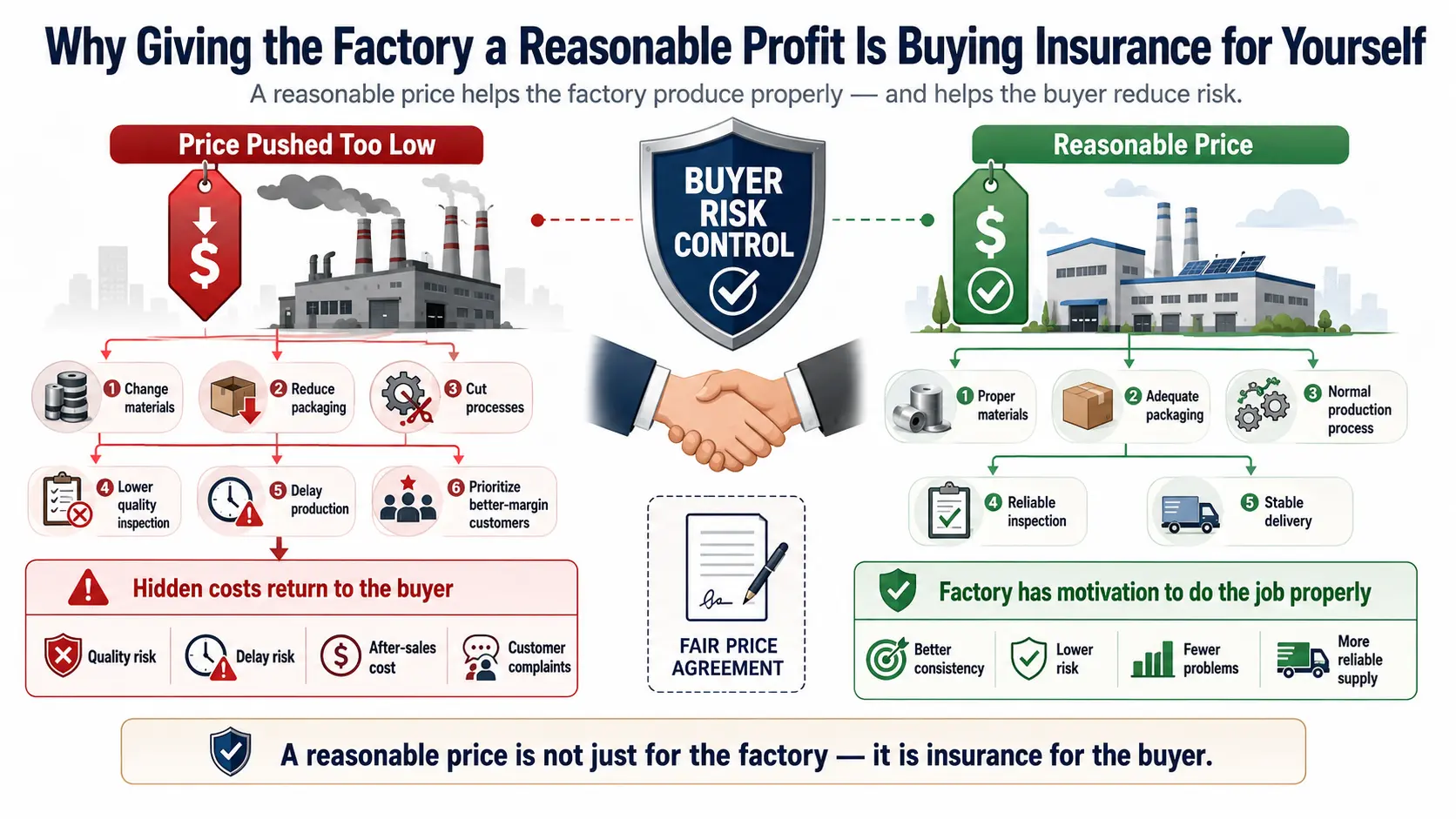
If the price is pushed so low that the factory has no reasonable profit, the factory will recover profit from somewhere else — changing materials, reducing packaging, cutting processes, lowering quality inspection, delaying production, or giving priority to customers with better profit margins.
This does not speak for factories. This is the reality of sourcing. An order with no profit is a burden for the factory. The factory will not tell you “we will not make it.” It will say “we can make it,” and then recover the cost from places you cannot see.
A reasonable price is not only for the factory. It is also a risk control for the buyer.
When you give the factory a price that allows it to produce carefully, the factory has the motivation to do the job properly. If you push the price so low that the factory can only make money by cutting corners, you will be the one who pays the price in the end.
How to Compare Quotations More Safely
When comparing quotations, do not only look at the number. Look at what is behind the number:
| Comparison Item | Do Not Only Look At | Confirm This |
|---|---|---|
| Price | Unit price number | What the price includes: material, thickness, coating, accessories, packaging |
| Material | “stainless steel” | Is it SK5 or ordinary stainless steel? What is the hardness? What is the blade thickness? What is the spring quality? What is the fixing screw material? |
| Coating / Surface Treatment | “powder coating” / “polished” | Coating thickness? Surface treatment process? How many years can it be used outdoors? |
| Packaging | “standard packaging” | Carton thickness? Inner protection? Stacking layers? |
| Accessories | “accessories included” | Which accessories exactly? Screw material? Instructions? Labels? |
| Lead Time | “30 days” | Can it be guaranteed during peak season? How will delays be handled? |
| Defects | “quality guaranteed” | What is the defect rate? How will excess defects be handled? Who pays the freight? |
| Certificates | “CE available” | Certificate number? Does it cover your target market? Does it cover this product? |
| Payment | “T/T” | Payment to a company account or a personal account? Deposit ratio? |
If the quotation comes from Alibaba, price comparison should be combined with our 15 Alibaba supplier risks garden product buyers must check before placing an order.
How Scarecrow Garden Supplier Helps Buyers Avoid the Low-Price Trap
We do not only look at the lowest price. What we help buyers do includes:
- Compare quotations from similar factories and break down the differences — for example, for the same garden pruner, one supplier uses an SK5 blade with stainless steel screws, while another uses an ordinary stainless steel blade with iron screws. Where does the price difference come from, and which option is more worthwhile?
- Recommend based on product use and target market — not every market requires SK5, but if your product is used for cutting thicker branches, ordinary stainless steel will not be enough.
- Help buyers judge whether the price is reasonable — quotations that are too low often hide risks. We have seen too many cases where “30% cheaper” ended up costing more.
- Support sample confirmation and warehouse inspection — after mass production goods arrive at the warehouse, we check details and confirm they match the sample before shipment.
- Support mixed product consolidation — multiple products in one container, with unified inspection, packing, and labeling.
FAQ
❔Should I choose the lowest-priced Chinese supplier?
Not recommended. The lowest quotation often means costs have been cut somewhere — thinner materials, cheaper coatings, weaker packaging, or fewer accessories. The real sourcing cost is the unit price plus quality risk, delay risk, after-sales cost, and inventory loss. Giving the factory a reasonable profit is also buying insurance for yourself.
❔Why do quotations for similar garden products vary so much?
Because there are too many things that are not written on the quotation sheet. For the same “stainless steel blade,” ordinary stainless steel and SK5 have a significant price difference, with a hardness difference of more than 10 HRC. A blade thickness difference of 0.05 mm is invisible to the naked eye, but a thinner blade is more likely to roll at the edge. Spring quality and fixing screw material also affect cost and user experience. These differences cannot be seen on the quotation sheet, but they will appear in mass production goods.
❔Are low-price suppliers always bad?
Not necessarily. Some factories are indeed more efficient and have lower costs, so their quotations are reasonable. But an unusually low quotation often means costs have been saved somewhere. The key is to understand where the savings come from and whether those savings will affect your product quality and customer experience.
❔What should I do if a seasonal garden product order is delayed?
This is one of the most difficult situations. If garden products miss the sales season, the loss is far greater than the product itself. It is recommended to place orders in advance to avoid peak season, confirm the production schedule, track production progress, and arrange pre-shipment inspection. If the goods are already delayed, communicate with your customer as early as possible and prepare an alternative plan.
❔How should I compare quotations from different suppliers?
Do not only look at the unit price. Confirm the material, thickness, coating, accessories, packaging, lead time, defect handling, certificates, and payment terms. Only when you compare these details together can you see the real differences between quotations.
Comparing Several Garden Product Quotations?
If you are comparing quotations from several suppliers but are not sure where the differences are, you can send us the quotation sheets and product requirements. Scarecrow Garden Supplier can help you break down the differences — material, packaging, accessories, and lead time — so you can make a choice instead of guessing.
Simplify Your Garden Product Sourcing from China
We help you combine multiple product categories into one sourcing flow with supplier matching, sample verification, and consolidated shipping.

Written by
ScarecrowGarden
💡About Scarecrow Garden Supplier Co., Ltd.
Scarecrow Garden Supplier Co., Ltd. is a China-based sourcing and wholesale partner specializing in garden tools, landscaping equipment, and outdoor supplies for international wholesalers, distributors, contractors, and brands.
With hands-on experience rooted in real garden use scenarios, we focus on durable materials, functional design, and stable large-volume supply. Our product range covers pruning tools, watering systems, hand tools, outdoor hardware, and customized garden solutions to support both retail and professional landscaping markets.
Beyond products, we help our partners navigate supplier selection, quality control, compliance requirements, and long-term sourcing strategies in China. Through our blog, we share practical insights on product selection, material comparisons, industry trends, and cost-effective purchasing—helping global buyers build stronger, more competitive supply chains.