





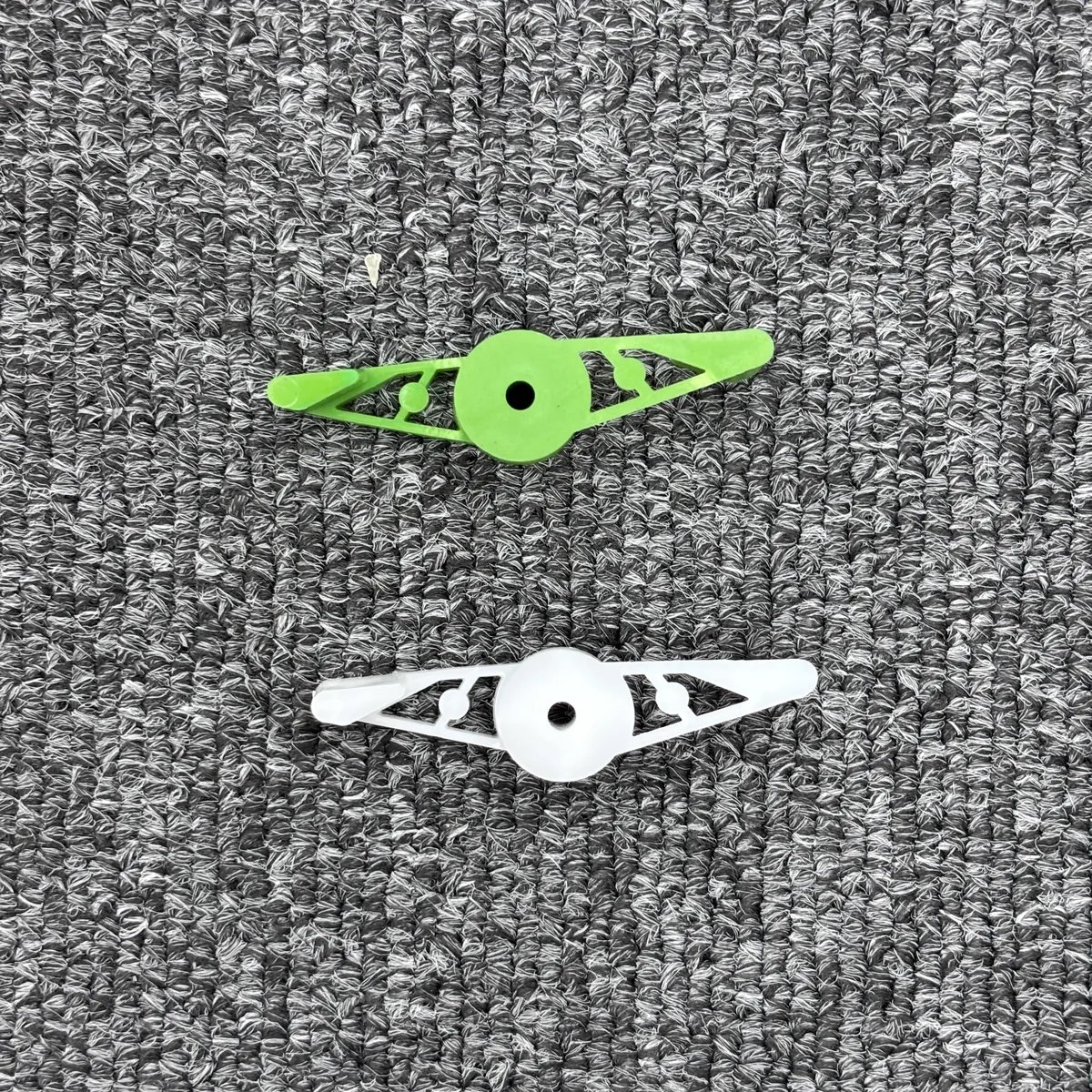
Green and white clips with their arms extending to opposite sides of the central round section.
A kit buyer approving instructional content is not only checking that the parts count is right and the artwork is the current revision. There is a harder question underneath: do the pictured component, the part reference and the described action refer to the same documented product?
Matching the contents and artwork is a separate task, covered in the plant label retail pack artwork and contents check. Those checks do not, by themselves, validate an operating step.
The example below comes from a rejected editorial draft. It is a correction to proposed instructional content, not a report of a faulty card delivered to a customer.
When a matching picture cannot validate an instruction
The old draft proposed a "360° vine clip" illustration and told the reader to thread a shoot through the clip's centre.
For this comparison, that proposed wording is placed beside a two-arm branch-training component. Its photograph shows a central round section with arms extending to opposite sides. That visible structure does not establish the draft's threading action.
The old paragraph did not identify this reference part, and no finished card or illustration from it was supplied. The comparison therefore does not prove that the old author meant this component, or that threading is physically impossible. The action must be withheld for the selected part because no matching model-specific operating evidence has been provided.
Matching a photo, a colour, a number or a file revision helps identify what is being shown. It does not, by itself, establish what the user should do with the part.
The correction, item by item
The correction keeps a supported description and removes the unsupported action.
| Content under review | What is established | Disposition |
|---|---|---|
| "360° vine clip" illustration label | The selected reference shows a two-arm component with a central round section. | Do not carry the "360°" label into this comparison without matching model evidence. |
| "Thread a shoot through the centre" | No matching model-specific instruction has been provided. | Withdraw the action sentence. |
| Replacement parts legend | The visible two-arm structure can be described. | Use "Two-arm branch-training clip shown in an extended position" as a neutral caption. |
| Replacement operating step | The correct action remains unverified. | Leave this action incomplete until matching model-origin instructions support it. |
The neutral caption identifies the visible part. It does not tell the consumer how to install or operate it.
Follow the meaning through the card
When a physical part changes, the content that depends on it needs review. The illustration, callout, action wording, sequence reference and any linked demonstration can all be affected. Replacing a picture alone does not resolve those dependencies.
Not everything needs rewriting. Content can remain when it has no dependency on the changed part or its relevant properties and still has its own valid basis. A packing line, safety note or materials statement cannot be retained merely because it did not name the old shape. Its meaning may still depend on the replaced part.
A consistent callout system helps the reader follow a part through an illustration and a sequence. It cannot make text for one component valid for another.
Nor does a validated action automatically carry over to a substitute with the same marketing name. An instruction checked for an earlier part still needs a basis for the replacement before the same sentence is attached to it.
Separating the parts legend from the instructions
A parts legend identifies what the reader is looking at. An operating instruction tells the reader what to do with it. They can sit on the same card, but they require different evidence.
In this example, the unverified ring label and threading action are not carried into the comparison. The visible part receives a neutral description. The replacement action waits for instructions or an approved product-origin drawing that actually establishes the operation for the offered model.
The result is a supported parts legend and a withheld operating step. The draft remains incomplete for that action; a neutral caption does not make a consumer instruction card ready for release.
The plant ties and support accessories category provides sourcing context. A category listing does not replace operating evidence for the selected model.

Written by
ScarecrowGarden
💡About Scarecrow Garden Supplier Co., Ltd.
Scarecrow Garden Supplier Co., Ltd. is a China-based sourcing and wholesale partner specializing in garden tools, landscaping equipment, and outdoor supplies for international wholesalers, distributors, contractors, and brands.
With hands-on experience rooted in real garden use scenarios, we focus on durable materials, functional design, and stable large-volume supply. Our product range covers pruning tools, watering systems, hand tools, outdoor hardware, and customized garden solutions to support both retail and professional landscaping markets.
Beyond products, we help our partners navigate supplier selection, quality control, compliance requirements, and long-term sourcing strategies in China. Through our blog, we share practical insights on product selection, material comparisons, industry trends, and cost-effective purchasing—helping global buyers build stronger, more competitive supply chains.