






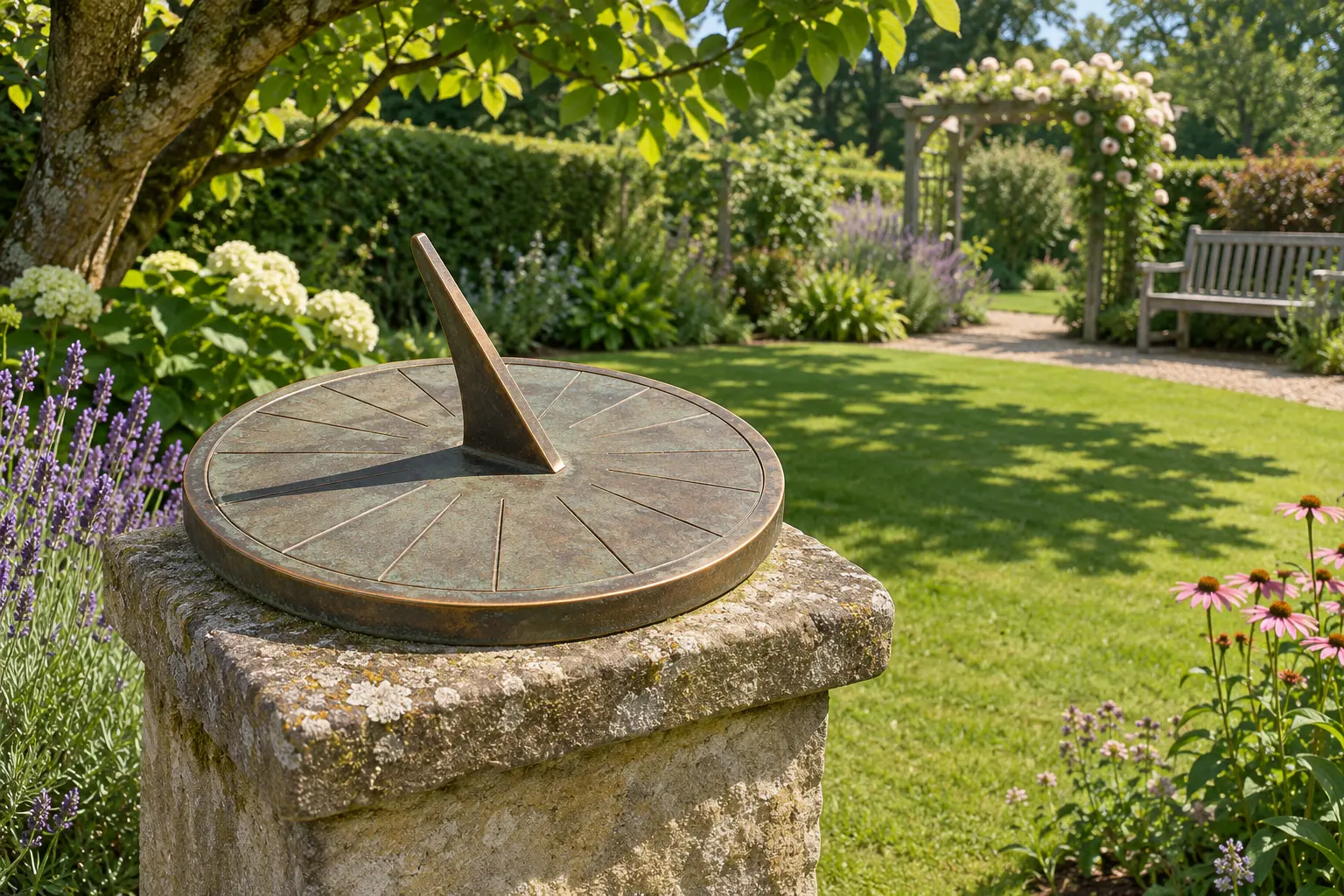
Horizontal garden sundial on a stone plinth in a sunlit garden
A sundial is an instrument, and an instrument needs commissioning
A sundial on a plinth in a border is an ornament. A sundial that reads the time is an instrument, and the difference between the two is installation. Set up the identified dial type in its intended plane and orientation for the site, and establish what time its scale shows.
Identify the dial type, intended location and setup instructions before treating a decorative sundial as a timekeeping instrument. What distinguishes the two lies in the documentation: whether the supplier provides the information needed to commission it, and whether the design allows the necessary adjustments.
Identify the dial type and its documented geographical application
Sundial designs differ in how they relate to geography, and the differences are fundamental rather than stylistic.
For an ordinary horizontal dial with a polar-pointing style, the hour layout and style inclination are designed for the site latitude.
Other dial forms use different geometry. Ask which type is supplied and obtain its documented geographical application and setup procedure.
- Equatorial dials. The dial face is inclined to align with the plane of the equator, and the style points to the celestial pole.
- Vertical dials. Mounted on a wall, and designed for a specific wall orientation.
- Polar and cylindrical dials. Specialized forms with their own geometry.
The practical question for a buyer is whether the dial was made for the latitude where it will stand. A dial described only as “garden sundial” gives no indication. A dial described with a latitude range, or made to a specified latitude, can be evaluated as a possible instrument.
A conventional dial may show local apparent solar time; identify whether the supplied scale incorporates any longitude or clock-time correction. Already corrected scales should not be corrected a second time.
Orientation and positioning requirements
Commissioning a dial depends on which adjustments the design allows, and the buyer needs to know which ones they are.
Level. A horizontal dial must be level, in both axes. A dial on a sloping surface reads incorrectly, and the error varies through the day. The mounting has to allow levelling, and the surface has to hold that setting.
Orientation. For a conventional horizontal polar-style dial, align the style toward the appropriate celestial pole: true north in the Northern Hemisphere or true south in the Southern. Its shadow-casting edge is inclined to the horizontal by the magnitude of the site latitude. If a compass is used, apply the current local correction and check interference.
Style setting. For a horizontal dial, the style's angle to the horizontal corresponds to the magnitude of the site latitude. If the style is fixed at manufacture for a different latitude, the dial cannot be corrected by orientation alone.
Ask how the complete dial is mounted and adjusted. A fixed style does not by itself identify the available mounting adjustments or the site for which the scale is correct.
What the sun and the site have to allow
A sundial needs sun. Check direct sunlight over the intended operating periods.
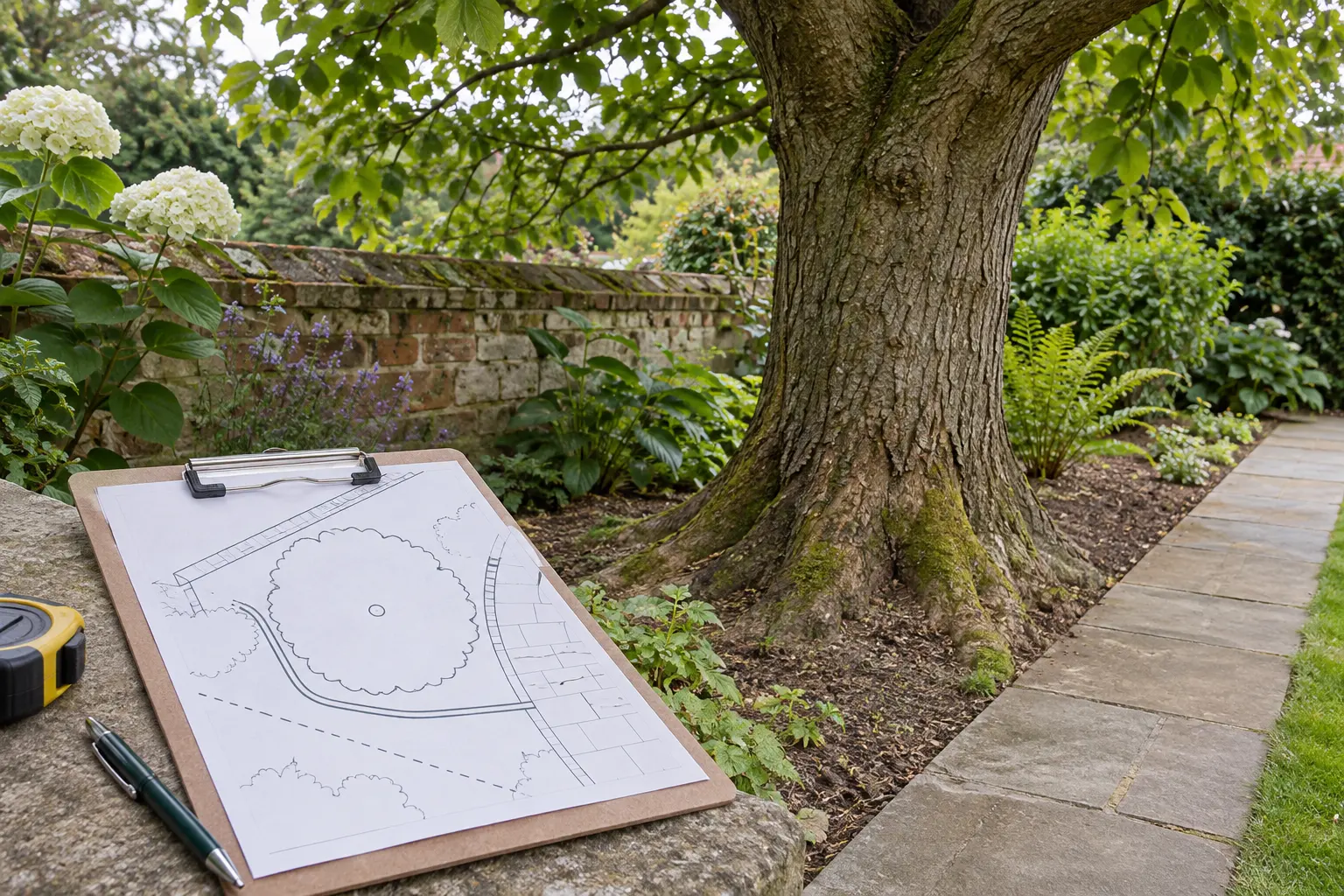
The survey should map, for the intended position:
- The path of the sun across the sky through the day, and through the year, as it relates to obstructions
- Trees, buildings, walls, and hedges, in each direction, with their heights and distances
- Whether the dial's own plinth or an adjacent feature will cast a shadow onto the face
- Seasonal variation: a position that is clear in June may be shaded in December
Account for seasonal sun paths and changing vegetation at the actual latitude.
Observations at several times can identify current shading; use an appropriate site assessment for other seasons.
A dial in permanent shade is an ornament, and should be described as one. That is a legitimate product; the problem is only when it is presented as a working instrument.
The correction between a dial reading and clock time
For an uncorrected conventional dial showing local apparent solar time, conversion to the clock’s civil time may require equation-of-time and longitude corrections, plus any applicable daylight-saving shift.
The equation of time. The equation of time is the date-dependent difference between apparent and mean solar time. Its magnitude varies through the year and changes sign, so both the size and the direction of the correction depend on the date. A published table gives the value for a given date; the sign of the correction depends on which direction you are converting.
Use a published procedure for the direction you need: dial reading to civil clock time, or the reverse for alignment. Confirm the scale’s built-in corrections first. Follow that source’s equation-of-time convention and its east/west longitude instruction, applying only corrections not already built in; treat the applicable daylight-saving shift separately. The longitude conversion is four minutes per degree.
Two points follow for a product description: state what time system the scale shows, and explain what is still needed to convert it at the intended location.
Ask for an explanation of the corrections still needed for your scale, location and date.
What a sundial specification contains when it is usable
A usable dial specification should identify the following fields, where applicable to that dial type:
- The dial type, stated
- The latitude or latitude range it was designed for
- The adjustment method for levelling
- The adjustment method for alignment to the relevant celestial pole
- The style angle, and whether it is fixed or adjustable
- The scale and its divisions
- An explanation of the relationship between the reading and clock time
- Guidance on siting, including the need for unobstructed sun
What to verify before buying a dial
Verify geographical suitability and setup against the selected dial's documentation rather than inferring an accuracy or latitude range. No installation angle, orientation figure, or latitude value can be assumed for a dial, and a dial made for one latitude is not automatically suitable for another. The astronomical relationships described above are general principles from published technical reference material, not specifications of any product.
Will this dial keep time, or only look like it could?
- What type of dial is it, and what latitude was it made for?
- Can it be levelled and aligned to the pole, and how is that alignment established?
- Is the style angle fixed or adjustable, and does it match this site?
- Is sunlight available during the intended operating periods?
- Does the supplier explain the relationship between the reading and clock time?
- Is the dial being sold as an instrument or as an ornament, and does the description say so?
Next step
Give Scarecrow Garden Supplier the installation location and the periods when you intend to read the dial. Ask for the dial type, the latitude it was designed for, the setup instructions and an explanation of any clock-time corrections still needed. Check that the documented design latitude or range is appropriate for your site and that the scale's time system is stated before you treat the dial as a timekeeping instrument.

Written by
ScarecrowGarden
💡About Scarecrow Garden Supplier Co., Ltd.
Scarecrow Garden Supplier Co., Ltd. is a China-based sourcing and wholesale partner specializing in garden tools, landscaping equipment, and outdoor supplies for international wholesalers, distributors, contractors, and brands.
With hands-on experience rooted in real garden use scenarios, we focus on durable materials, functional design, and stable large-volume supply. Our product range covers pruning tools, watering systems, hand tools, outdoor hardware, and customized garden solutions to support both retail and professional landscaping markets.
Beyond products, we help our partners navigate supplier selection, quality control, compliance requirements, and long-term sourcing strategies in China. Through our blog, we share practical insights on product selection, material comparisons, industry trends, and cost-effective purchasing—helping global buyers build stronger, more competitive supply chains.