





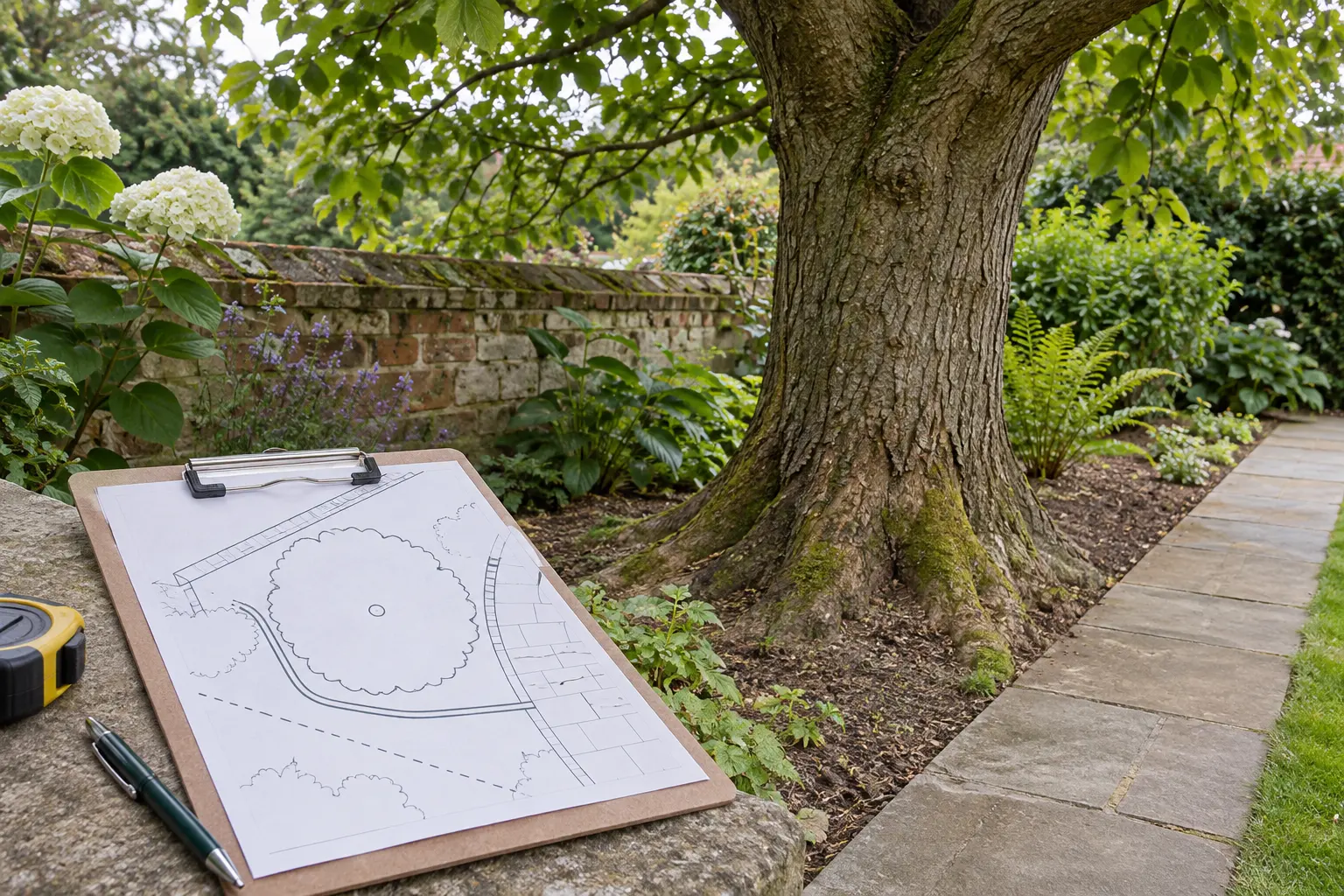
Garden tree beside a path with a site plan showing a proposed root barrier route
A root barrier is a site detail, not a guarantee
A root barrier is intended to influence where roots grow. That does not make every barrier a complete answer to a site conflict. Root growth varies with species, soil structure, water and temperature, and different barrier systems work in different ways. Before choosing a product, identify the specific conflict to address and ask how the selected system is intended to work at that location. [1]
Plan the route, including both ends
Start with a site plan that shows the tree or planting to retain, the feature to protect, and the proposed barrier route between them. Mark the route's start and finish, changes in direction, joints, penetrations and nearby structures or services. Treat this as a buyer's request for a project-specific drawing, not a universal drawing standard.
Ask the supplier or designer what the chosen system requires at each end and connection. A short barrier may not keep a root on a permanently diverted path: Forest Research describes roots negotiating short obstructions and returning toward their former direction. It also reports that roots diverted downwards by some deep barriers can branch near the base, with growth affected by the conditions below the barrier. Those observations show why the exact route, depth and system detail need review; they do not establish a guaranteed result for a different product or site. [1]
Request the manufacturer's installation instructions for the exact model. Confirm how the material is joined, how corners and penetrations are handled, which face or orientation is required, and what limits apply to cutting or adapting it. Do not assume that a detail from one product transfers to another. If the instructions do not show how the route ends or connects to an existing feature, ask for the missing detail before ordering.
Check soil and water conditions
Ask whether the proposed barrier is permeable or impermeable and whether its material, depth and layout could affect local water movement. Forest Research notes that soil water, structure and aeration influence root development; its barrier discussion describes different outcomes under compacted or waterlogged soil compared with loose, well-aerated soil. This is a reason to request site-specific drainage and installation advice, not proof that every barrier will cause a drainage problem. [1]
If the barrier is intended to protect a drain, wall, path or foundation, describe the exact feature and the issue being addressed. Ask the project designer to assess the proposed arrangement and any drainage implications. Do not infer a universal stand-off distance, depth or end-return from a generic product description.
Locate underground services before excavation
A barrier installation involves ground disturbance. For work in Great Britain, HSE's HSG47 describes three basic elements of a safe excavation work system: planning the work, locating and identifying buried services, and safe excavation. HSE's excavation guidance says plans or other suitable information about buried services should be obtained and reviewed before excavation, and that services should be located, identified and marked. Follow the applicable local rules and utility-owner instructions in other jurisdictions. [2][3]
Before work starts, confirm who will obtain and interpret service records, identify what locating work is required, and establish the safe digging method for the actual site. A drawing is useful evidence to review, but HSE cautions that service plans indicate location and number rather than replacing competent on-site locating. Do not start excavation based only on a product drawing or an assumed clear route. [3]
Consider the retained tree
Trenching and other excavation can sever roots. Forest Research describes roots as important to water and nutrient uptake and tree support, and notes that root damage can reduce uptake and affect stability. Its guidance on street-tree trenching discusses protection and avoiding unnecessary compaction, but its specific zones and recommendations apply to that guidance context; do not copy a distance or method into a different project without checking the relevant standard, authority and site conditions. [1]
Symptoms may not appear immediately. University of Maryland Extension notes that root-damage symptoms may take months or years to develop, depending on the situation and the amount of damage. That makes a simple visual check immediately after installation an incomplete measure of future tree response. Where excavation may affect retained roots, ask a qualified local arborist or project tree professional what assessment and protection are appropriate. Check whether a tree-protection order, planning condition or other local requirement applies before work. For England, government guidance explains that work to trees protected by a Tree Preservation Order can require local-authority consent, subject to exceptions. [4][5]
Documents to request before selecting a system
Ask for the exact product identification and current installation instructions; a site drawing showing the route, ends, joints and penetrations; the basis for the proposed depth and layout; information about permeability and any drainage design assumptions; and the project-specific excavation, utility-location and tree-protection documents that apply. Ask which details are product instructions, which are designer recommendations, and which are local project requirements. A sales description alone does not establish site performance or regulatory approval.
Next step
Before choosing a root barrier, send the supplier or project designer a site plan showing the tree, the feature to protect, underground services and the proposed route. Ask for the exact model's installation instructions and a drawing that resolves both ends, joints and penetrations. Confirm the service-location and tree-protection requirements with the people responsible for the work in your jurisdiction before ordering or excavating.
Sources
- [1] Forest Research. Tree roots and trenching.
- [2] Health and Safety Executive. Avoiding danger from underground services (HSG47).
- [3] Health and Safety Executive. Excavation and underground services.
- [4] University of Maryland Extension. Damaged Tree Roots.
- [5] GOV.UK. Tree Preservation Orders and trees in conservation areas. Paragraph 059; Reference ID: 36-059-20140306.

Written by
ScarecrowGarden
💡About Scarecrow Garden Supplier Co., Ltd.
Scarecrow Garden Supplier Co., Ltd. is a China-based sourcing and wholesale partner specializing in garden tools, landscaping equipment, and outdoor supplies for international wholesalers, distributors, contractors, and brands.
With hands-on experience rooted in real garden use scenarios, we focus on durable materials, functional design, and stable large-volume supply. Our product range covers pruning tools, watering systems, hand tools, outdoor hardware, and customized garden solutions to support both retail and professional landscaping markets.
Beyond products, we help our partners navigate supplier selection, quality control, compliance requirements, and long-term sourcing strategies in China. Through our blog, we share practical insights on product selection, material comparisons, industry trends, and cost-effective purchasing—helping global buyers build stronger, more competitive supply chains.