






Young tree with a trunk guard and fastening beside maintained grass
Start with the hazard, not the product
A buyer who asks for “a guard that stops strimmer damage” is asking for something narrower than it sounds. Separate animal protection, mechanical trunk protection, staking and tying, and any herbicide or mulch-management requirement. Verify each claimed function for the selected product.
The dictionary definition is broad. Merriam-Webster records “tree guard” as any of various devices for protecting the trunk of a tree from animal and mechanical injury, which puts rabbits and brush cutters in the same sentence. That is the confusion worth clearing up before a purchasing conversation begins.
Define the intended hazard before selecting a guard. Ask for the manufacturer's stated purpose in writing. A documented purpose for animal protection does not establish resistance to maintenance equipment.
Where the contact zone actually is
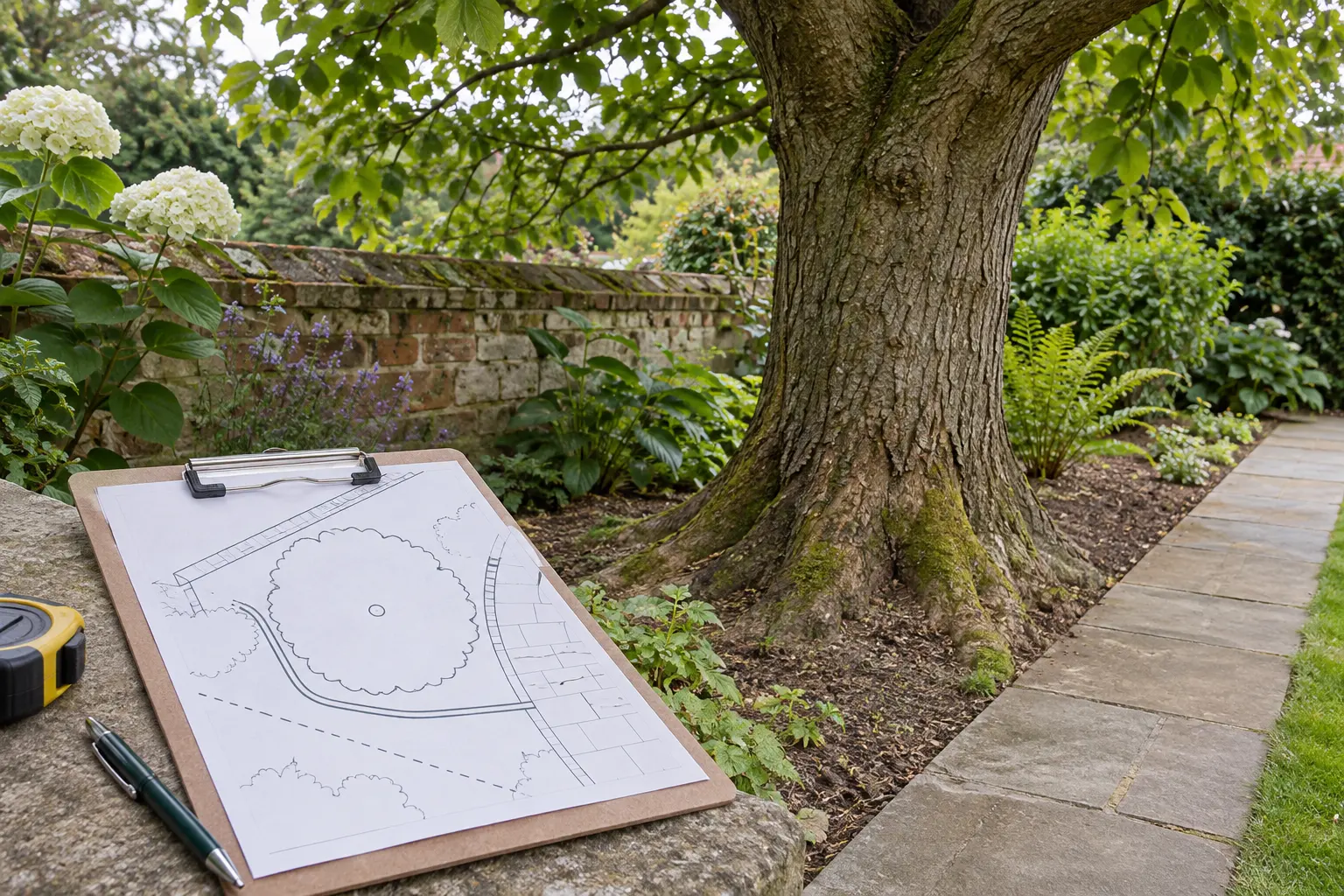
Review where the cutting head or line could contact the trunk, guard or fixings. Ask how those possible contact points are addressed in the exact model’s instructions and protection evidence.
The fixing method is part of the protective system, and it can also be the weakest part of it. A fixing that is not designed for the tree's growth is a problem in its own right, whatever the guard is made of.
The maintenance consequence follows from that review. Plan maintenance so that cutting equipment avoids the trunk, and do not treat the presence of a guard as permission for equipment contact.
There is also the tree's own growth to account for. Allow for trunk growth. Tight tree ties can constrict a trunk, and extension guidance warns against this. That is a reason to check the proposed fixing, not evidence that a guard resists a strimmer. Whatever the guard is made of, the fixing must allow for the expected growth and the documented adjustment or removal procedure.
So ask how the fixing accommodates trunk growth, and when it must be inspected, adjusted or removed. Do not assign a universal service interval without the model instructions and an assessment of the tree.
Openings, joints, and whether anyone can inspect the trunk
An inspection and adjustment procedure belongs in the purchasing record. What you want to establish before ordering is straightforward:
- Can the guard be opened, lifted, or partly removed without cutting it?
- Does the opening align with the side where the maintenance risk is highest?
- Is there a joint, overlap, or fixing point that will rub once the trunk expands?
- Can a person check the trunk base, see whether bark is intact, and remove accumulated debris without dismantling the whole system?
- If the guard is to stay in place for years, what is the documented process for loosening or replacing the fixing?
None of these require you to know the polymer, the wall thickness, or the UV package. They are questions about geometry and access, and they can be put against a drawing, an instruction sheet, or a sample review. Use those three sources to assess the questions, and request further evidence where they do not establish the answer.
One practical reminder for buyers new to this category: the base of a young tree is where the root flare begins. Check the guard's lower edge against the tree's root flare and the planting guidance, and avoid accumulating soil or mulch against the trunk.
Separating documented protection from appearance
A rigid plastic sleeve may look protective. A coil of mesh may look flimsy. Neither impression tells you what the product was designed to resist, and neither constitutes evidence.
Compare the stated purpose with the maintenance equipment and intended use; appearance alone does not establish protection. What to request depends on the claim being made:
| Claim being made | What to request |
|---|---|
| “Protects against browsing animals” | Exact-model written purpose and exclusions, with target species and height of protection |
| “Protects against cutting equipment” | A relevant test report identifying the equipment, contact conditions, result and limits |
| “Will not damage the trunk” | Fixing, inspection and adjustment instructions, with relevant evidence |
| “Lasts X years outdoors” | Stated exposure conditions and the basis for any service-life claim |
Not one of those four rows is evidence a supplier should already have sent. Each one is a document to ask for.
If a supplier cannot supply the second row, the honest position is that the product's resistance to cutting equipment is undocumented. Where resistance to maintenance equipment is undocumented, do not describe it as established. Agree a maintenance method that avoids equipment contact with the trunk and is consistent with the tree and guard instructions.
What to get in writing before you order
Before describing a guard as protection against maintenance equipment, put these five questions to the supplier and ask for written answers:
1. What hazard is the product documented to address, and what is not covered?
2. How does the fixing method avoid rubbing and girdling as the trunk expands?
3. Is there an inspection opening, and what is the procedure for checking the trunk base?
4. What is the stated installation position relative to the root flare and the surrounding vegetation?
5. Are mechanical protection, animal protection, ties, and staking kept as separate decisions in the specification?
If any of those answers is missing, the guard may still be useful. It is simply not yet evidence of protection against a specific hazard, and the specification should say so.
Check each claimed function separately
Do not infer browsing protection, tying, staking or herbicide protection from a mechanical-protection claim. Verify each claimed function for the selected product.
Next step
Send Scarecrow Garden Supplier the maintenance hazard you are actually dealing with, together with photographs of the intended planting position. Ask for the selected guard's written purpose, its fitting instructions and any evidence behind its protection claim. Compare the documented purpose and exclusions with your hazard and planting position, and resolve any mismatch before specifying protection.

Written by
ScarecrowGarden
💡About Scarecrow Garden Supplier Co., Ltd.
Scarecrow Garden Supplier Co., Ltd. is a China-based sourcing and wholesale partner specializing in garden tools, landscaping equipment, and outdoor supplies for international wholesalers, distributors, contractors, and brands.
With hands-on experience rooted in real garden use scenarios, we focus on durable materials, functional design, and stable large-volume supply. Our product range covers pruning tools, watering systems, hand tools, outdoor hardware, and customized garden solutions to support both retail and professional landscaping markets.
Beyond products, we help our partners navigate supplier selection, quality control, compliance requirements, and long-term sourcing strategies in China. Through our blog, we share practical insights on product selection, material comparisons, industry trends, and cost-effective purchasing—helping global buyers build stronger, more competitive supply chains.