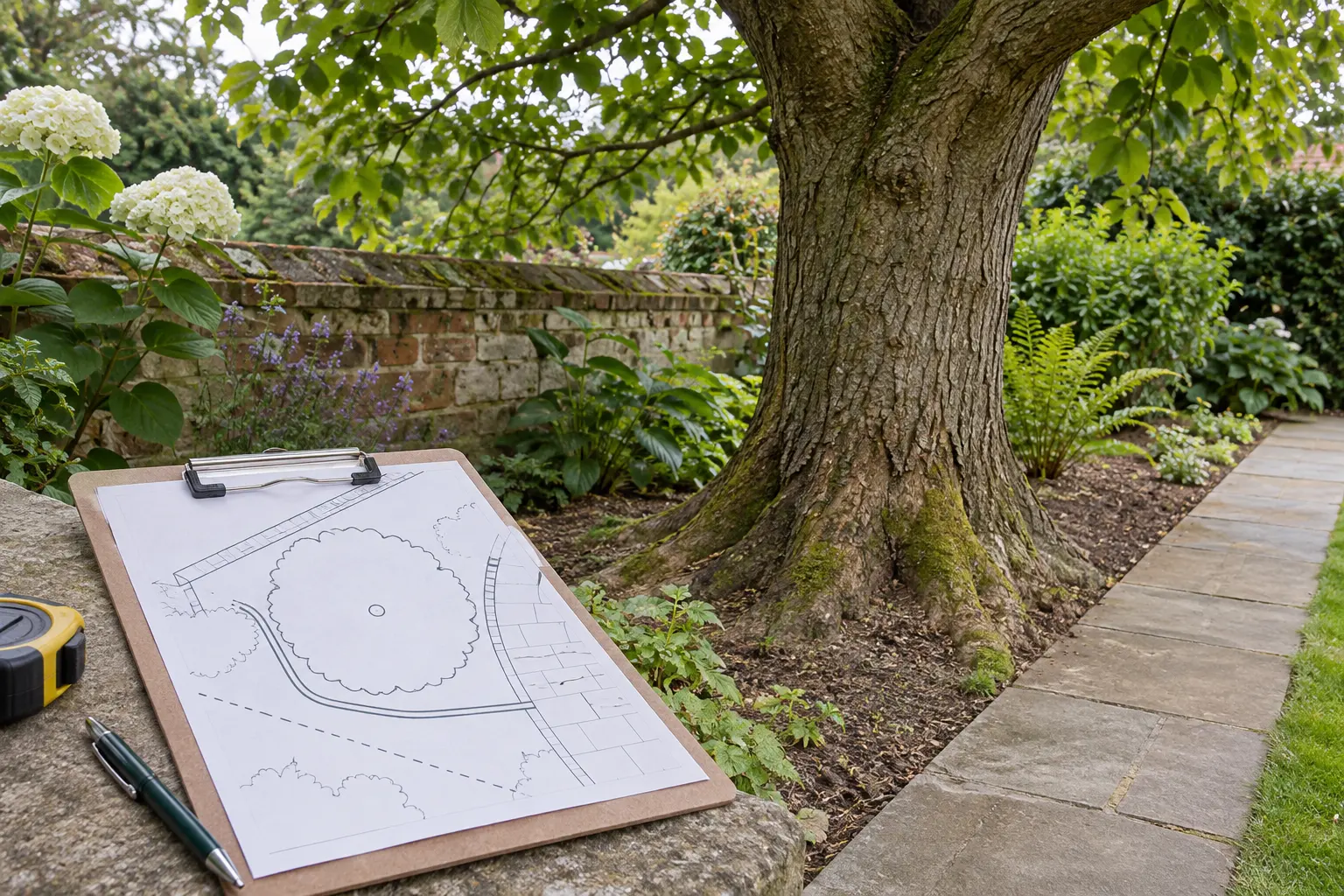





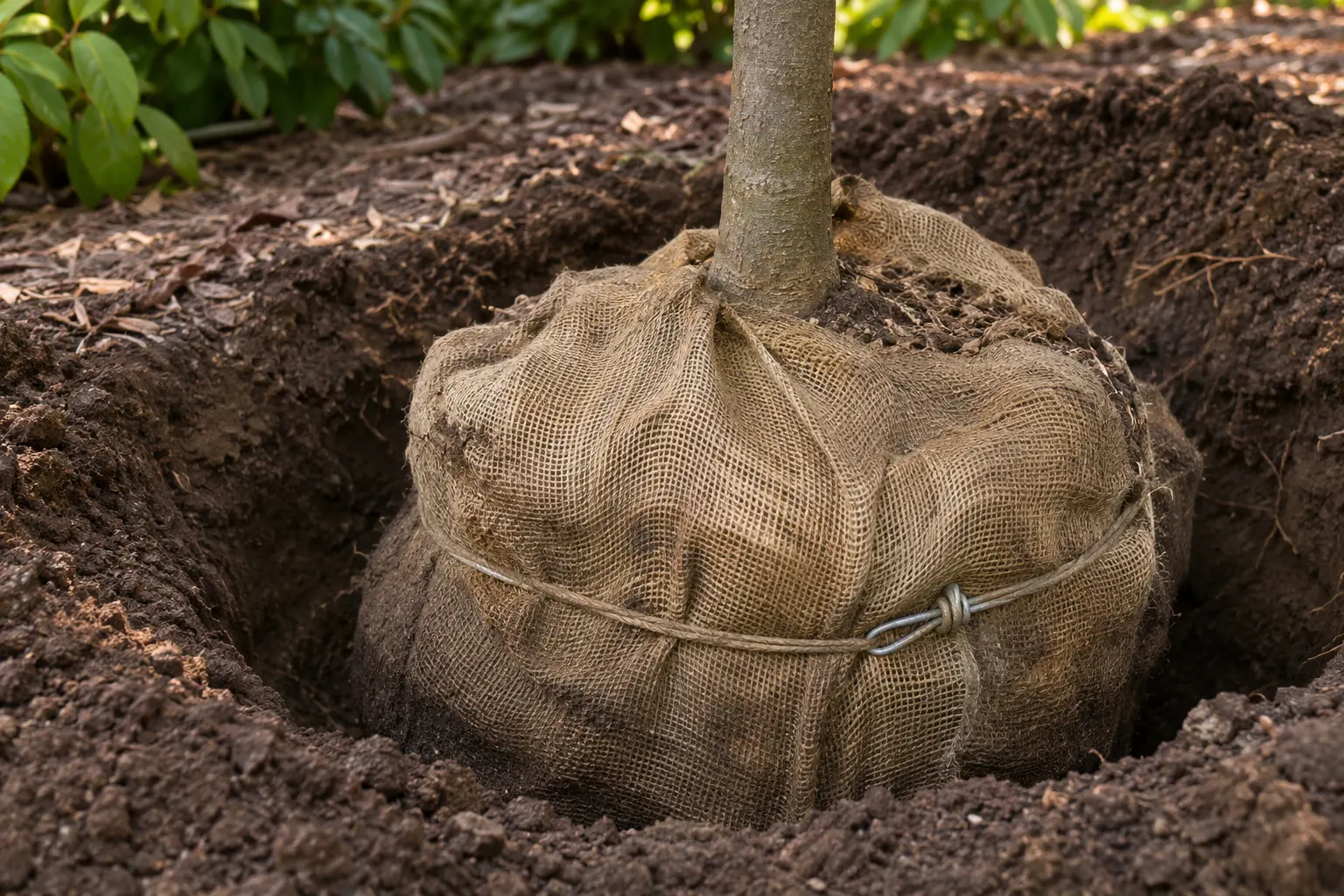
Tree root ball showing burlap wrapping and fastening
The instruction and the material have to agree
A balled and burlapped tree arrives with its roots in a ball of soil, wrapped in fabric and secured. The planting instruction that accompanies it is supposed to describe what to do with that wrapping. Check that the planting instruction addresses the actual wrapping, any treatment and the fastenings present.
This is a documentation problem before it is a horticultural one. The same words, “remove the wrapping,” mean different things for natural jute, for a synthetic fabric, for a treated fabric, and for a wire basket.
Identify the wrapping material, treatment, and fastenings
The first task is a material identification, and it has to be done on the actual stock, not from the order description.
Obtain a written identification of the actual wrapping and any treatment. Do not infer composition, decomposition behaviour or planting suitability from colour, texture or the word burlap.
The fabric. Natural jute or hessian is the traditional material. Synthetic woven polypropylene also appears in the market and can look similar at a distance. The two do not behave the same way in soil, which is why the identification has to come from the supplier rather than from the eye.
The treatment. Is the fabric untreated, rot-resistant, or otherwise treated? Ask what the treatment is for, and whether the supplier's own statements about the fabric are consistent. A description as biodegradable may sit alongside a treatment intended to resist breakdown during storage, and the buyer should ask which applies to the stock in front of them.
The fastenings. Twine, nails, staples, and sometimes a wire basket. Each has to be accounted for. Twine and nails are discrete items that can be located and removed; a wire basket is a structure.
Record the fastenings and any wire basket actually present, and obtain instructions addressing those components separately.
Where the wrapped components do different jobs
The wrapping's job is to support handling of the ball during transport and lifting, and the ball is easily broken if handled carelessly. That is its job during transport and lifting. It is not its job after planting.
A handling function does not establish whether the identified wrapping is suitable to remain after planting.
USU describes the root ball as containing both fine and coarse roots, and relates that retained root system to reduced transplant shock. The wrapping supports handling of the ball. Keep the ball intact under the producer’s handling instructions.
What the planting guidance actually says
Utah State University Extension's guidance on planting landscape trees states that packaging materials should be removed at planting, including burlap, wire baskets, rope, and pots, because they impede roots from growing outward. It acknowledges the practical difficulty: where the ball is loose, the packaging can be removed as backfill is added, to keep the ball intact. For burlap or potting material that must remain, that source advises slitting it in several places. This is not permission to retain trunk ties, wire or an unidentified wrapping; obtain the site-specific planting decision described below.
The cited extension guidance recommends removing packing material, with careful staged removal where needed to keep a loose root ball intact. If removal is difficult, obtain a planting decision for the identified material and tree condition; do not treat that exception as approval to retain any wrapping.
The same guidance covers a related and frequently overlooked issue: the root flare. The root flare, where roots begin, should be at or slightly above the surrounding soil surface. Nursery production of balled and burlapped stock can result in the flare being buried too deep, so the extra soil at the top of the ball has to be cleared to expose it, otherwise the trunk is buried and subject to rot and girdling roots. The guidance adds a threshold: if the flare is buried deeper than about one third of the ball's depth, the tree should be considered for return to the nursery.
The cited guidance recommends a hole at least two to three times the root-ball width, with sloping sides and undisturbed support below; confirm the detail for the actual stock and site.
Resolve conflicting instructions before handover
Check the material declaration against the planting instructions. These are the shapes a conflict can take:
• The nursery's label says to leave natural burlap in place; the planting specification says to remove all wrapping.
• The tree was supplied in a wire basket with a synthetic fabric liner; the label refers only to burlap.
• The landscape contractor's method statement assumes bare-root handling; the stock is balled and burlapped.
• A retail label is copied from a container-grown plant.
The resolution process is straightforward and should happen before the tree leaves the nursery:
1. Identify the actual materials, on the stock.
2. Obtain the producer's material declaration.
3. Compare the planting instruction with the material declaration and with authoritative arboricultural guidance.
4. Where they conflict, obtain a planting decision for the identified material and the tree's condition, and record it.
5. Communicate the decision to whoever will plant the tree.
Resolve conflicting instructions with the producer and the responsible arboricultural adviser before planting.
Keep material identification with the tree's documentation
Traceability closes the loop. Retain the material identification and the agreed planting instruction with the tree record: the order, the delivery note, the planting specification.
What to record:
• Species and cultivar
• Root ball dimensions
• Wrapping material, with the producer's description
• Treatment, if stated
• Fastenings present
• Whether a wire basket is present
• The planting instruction issued, and which authority it followed
• The date of planting, and who planted it
Use the identified wrapping, treatment and root-ball condition to obtain the appropriate planting instruction, rather than applying one remove-or-retain rule to every delivery.
Where the answer has to come from
No single instruction covers every delivery, because the correct action depends on the actual material, its treatment, and the condition of the ball. Wrapping a rule around the label rather than the material is how the wrong decision gets made in a planting crew.
1. What is the wrapping fabric: natural jute or synthetic?
2. Has it been treated, and for what purpose?
3. What fastenings are present, and is a wire basket present as a separate decision?
4. Does the producer's material declaration match the planting instruction?
5. Where is the root flare, and is the flare buried deeper than about one third of the root ball's depth?
6. Is the material identification recorded with the tree's paperwork?
Next step
Send Scarecrow Garden Supplier the wrapping label, photographs of the actual root ball and fastenings, and any planting instructions supplied with the tree. Ask for written identification of the wrapping and any treatment, with the handling information that applies to that material. Compare the reply with the producer’s instructions and have your planting adviser resolve any conflict for the actual root ball before planting.

Written by
ScarecrowGarden
💡About Scarecrow Garden Supplier Co., Ltd.
Scarecrow Garden Supplier Co., Ltd. is a China-based sourcing and wholesale partner specializing in garden tools, landscaping equipment, and outdoor supplies for international wholesalers, distributors, contractors, and brands.
With hands-on experience rooted in real garden use scenarios, we focus on durable materials, functional design, and stable large-volume supply. Our product range covers pruning tools, watering systems, hand tools, outdoor hardware, and customized garden solutions to support both retail and professional landscaping markets.
Beyond products, we help our partners navigate supplier selection, quality control, compliance requirements, and long-term sourcing strategies in China. Through our blog, we share practical insights on product selection, material comparisons, industry trends, and cost-effective purchasing—helping global buyers build stronger, more competitive supply chains.