






Updated 2 months ago
Types of Garden Forks: A Complete Buyer’s Guide to Digging, Border, Compost, Pitch, and Broad Forks
SCARECROW GARDEN SUPPLIER
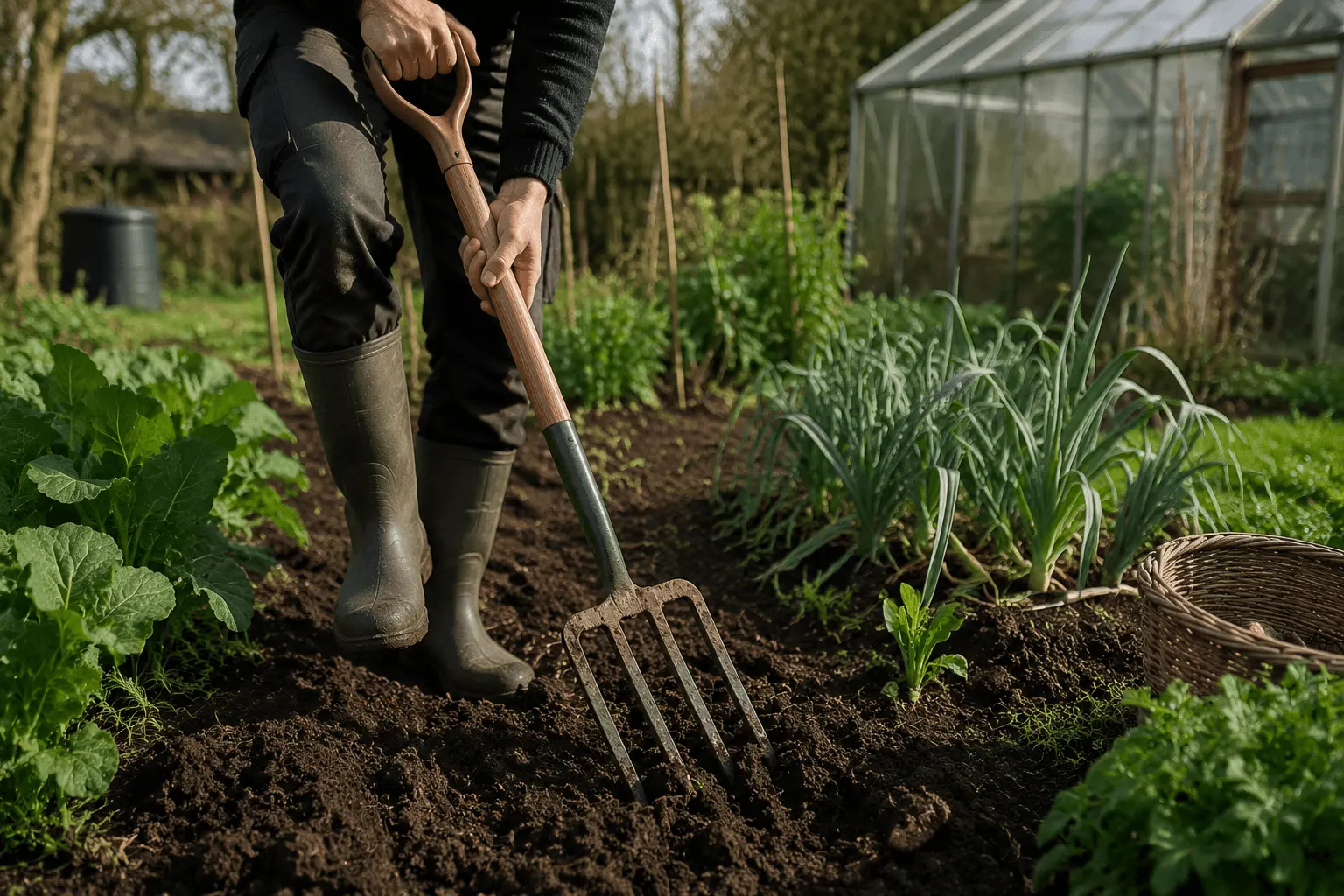
Types of Garden Forks: A Complete Buyer’s Guide | Scarecrow Garden Supplier
Key Takeaways
- “Garden fork” is a catch-all term. Five distinct types — digging fork, border fork, compost fork, pitchfork, and broadfork — serve fundamentally different tasks.
- Tine count, tine cross-section, tine spacing, and handle configuration are the four parameters that define what a fork does and who buys it.
- A digging fork and a border fork may look similar, but the size difference changes the working environment — open ground versus confined flower beds.
- For B2B buyers, stocking the wrong fork type is the most common sourcing mistake — customers return tools not because of quality, but because the fork does not match the task.
- Broadfork is a specialized deep-aeration tool — do not stock it as a general-purpose fork.
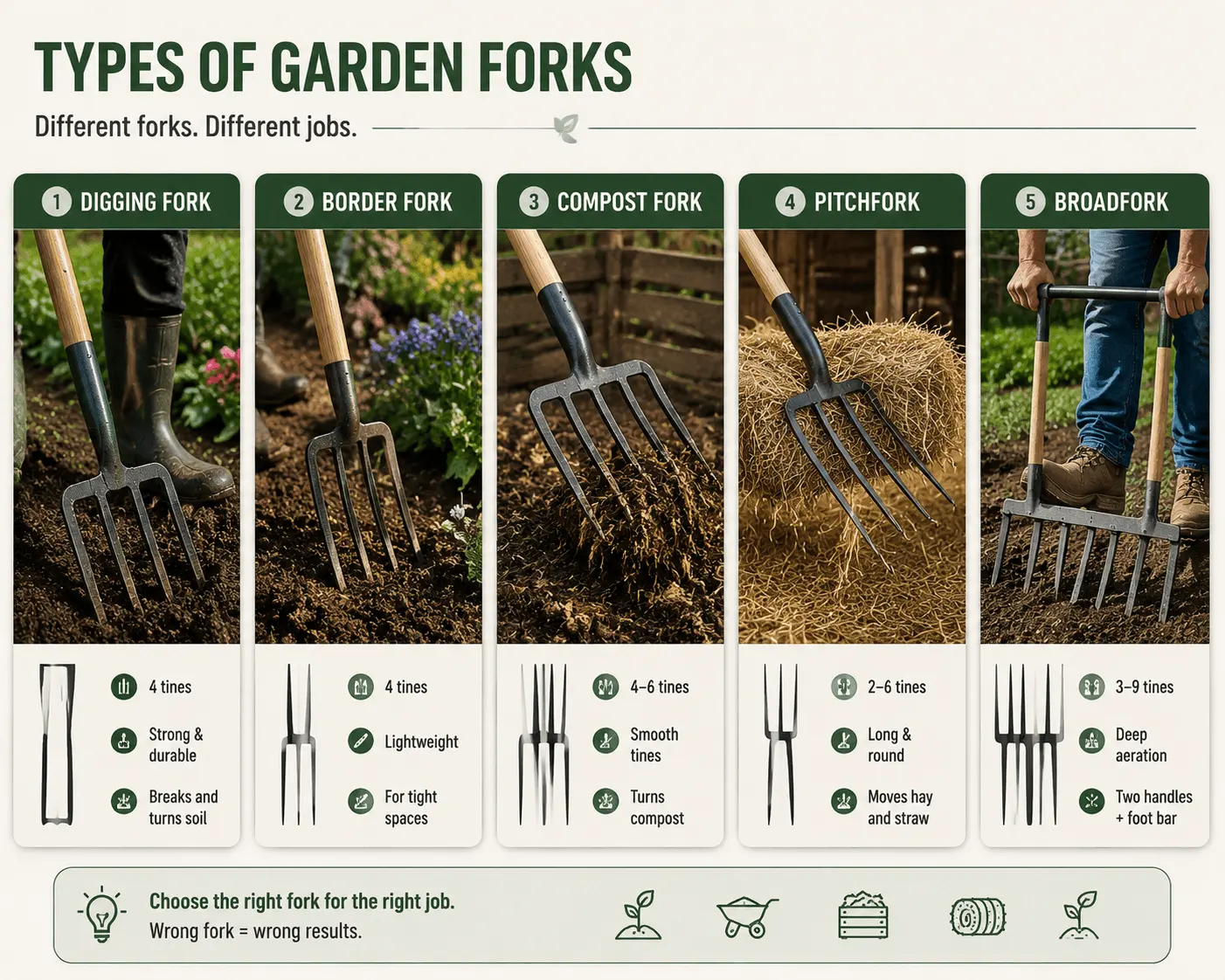
If you source garden tools, you have probably seen “garden fork” on a product page and wondered: which type? A garden fork can be a four-tined digging tool for breaking clay, a lightweight border fork for working between perennials, a wide-tined compost fork for turning heaps, a long-tined pitchfork for moving hay, or a two-handled broadfork for deep soil aeration. These are not variations of the same product — they are different tools for different jobs.
This guide covers the five main types of garden forks, their structural differences, naming conventions, handle options, materials, and B2B selection criteria. The goal is to help buyers match the right fork to the right customer and avoid the returns, dead stock, and customer confusion that come from wrong selection.
Who this guide is for: Garden center buyers, hardware distributors, agricultural supply companies, and private-label brands sourcing forks from manufacturers.
The Five Garden Fork Types at a Glance
| Type | Tine Count | Tine Section | Typical Use | Working Environment | Buyer Note |
| Digging Fork | 4 (typically) | Square, triangular, or diamond | Breaking ground, turning soil, mixing organic matter | Open ground, garden beds, allotments | The core fork for every tool range |
| Border Fork | 4 (typically) | Square or triangular (thinner) | Working in confined spaces, light soil cultivation | Flower beds, between perennials, containers | Smaller version of digging fork — not a substitute |
| Compost Fork | 4–6 | Oval or round (smooth) | Turning compost, moving mulch and manure | Compost heaps, material piles | Tines are smoother and more widely spaced than digging fork |
| Pitchfork | 2–6 (commonly 3) | Round or oval (long, thin) | Moving hay, straw, light loose material | Barns, fields, stables | Not a soil tool — tines are too thin for ground engagement |
| Broadfork | 3–9 | Round (typically 14 mm diameter) | Deep soil aeration without turning soil | Market gardens, allotments, no-dig systems | Specialized tool — two handles, foot bar, full-body operation |
Source note: Fork type classification based on market samples from Toolden UK, Broadfork.eu, and Chinese export manufacturers (Tangshan and Chongqing). The distinction between digging forks (soil engagement) and pitchforks (material handling) is recognized by the Royal Horticultural Society in their guidance on soil preparation and compost management.
Identify The Right Garden Fork Before Quoting
Not sure which “garden fork” your customer means? Send the reference image, target market, and required tine count. We will identify the closest fork type and confirm structural specifications before preparing a quotation.
Type 1: Digging Fork (Garden Fork / Spading Fork)
What It Is
A digging fork is the standard four-tined garden fork designed for breaking and turning soil. The tines are typically square, triangular, or diamond in cross-section — providing the rigidity needed to penetrate ground without bending. The blade width typically ranges from approximately 155 mm to 305 mm, with tine lengths from approximately 235 mm to 390 mm, based on product catalog data.
For buyers sourcing digging forks in bulk, our bulk detachable garden fork provides a practical option for garden centers and distributors looking for a versatile soil-working tool with easy packing and shipping advantages.
What It Does
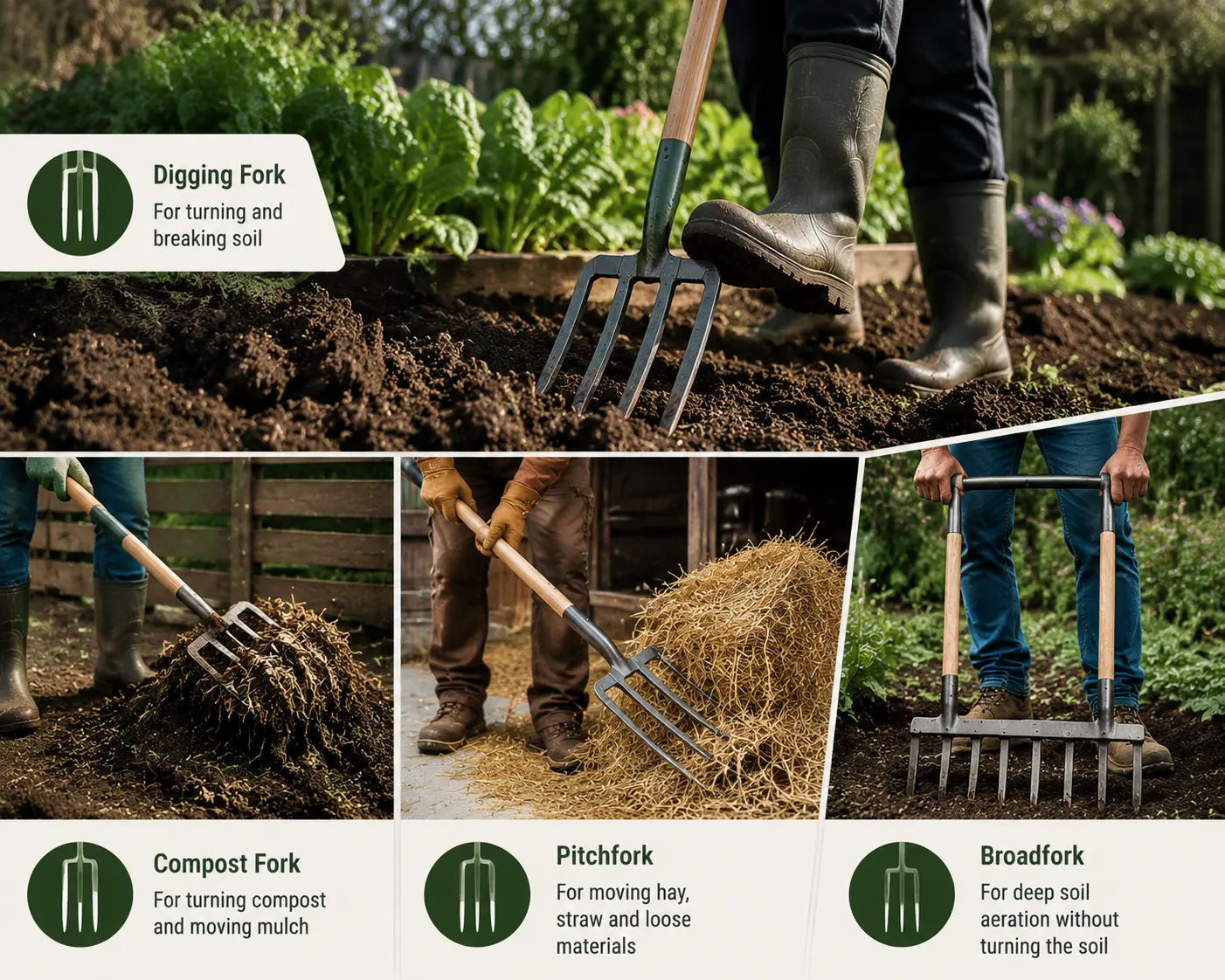
The digging fork’s primary function is soil engagement: breaking up compacted ground, turning soil to incorporate organic matter, and lifting clods for breakdown. The Royal Horticultural Society recommends forking compost into soil — “lightly forked in” — as a method for incorporating organic matter. The fork’s tines penetrate soil with less resistance than a solid shovel blade, making it effective for mixed ground with stones and roots.
What It Does Not Do
- It is not a shovel. A fork lifts and breaks soil; it does not scoop and move loose material efficiently.
- It is not a spade. A fork penetrates and loosens; a spade cuts clean edges and vertical walls.
- It is not a pitchfork. Digging fork tines are shorter, thicker, and designed for ground engagement — not for lifting hay.
Handle Options
Digging forks are available with T-grip, Y-grip, D-grip, and long straight handles. Handle choice affects working motion, leverage, and user posture — see D-Handle, T-Handle, Long-Handle Forks for a detailed comparison.
Type 2: Border Fork (Flower Bed Fork)
What It Is
A border fork is a smaller version of the digging fork, designed for working in confined spaces. The blade is narrower, the tines are shorter and thinner, and the overall tool is lighter. In the UK market, “border fork” is a recognized category; in North America, the distinction is less formal — some buyers simply call it a “small garden fork.”
What It Does
A border fork allows the user to work between established perennials, in raised beds, and in container gardens where a full-size digging fork would be too wide and too heavy. The smaller size reduces the risk of damaging plant roots during soil cultivation.
What It Does Not Do
- It is not a substitute for a digging fork in open ground. The smaller tines and lighter construction mean it will struggle in heavy clay or compacted soil.
- It is not a toy. A border fork is a functional tool — but its lighter construction means it should not be marketed as heavy-duty.
Sizing Note
Based on product catalog data, fork head widths range from approximately 155 mm (small, border-fork size) to 230 mm or more (large, digging-fork size). When sourcing border forks, confirm the actual head width — a “small fork” in one factory’s catalogue may be a medium in another’s.
Build A Balanced Digging Fork & Border Fork Collection
Need both a digging fork and a border fork? We can select non-overlapping models that cover open-ground and confined-space tasks without unnecessary SKU duplication.
Type 3: Compost Fork (Manure Fork)
What It Is
A compost fork has more tines than a digging fork (typically 4–6), with smoother, more widely spaced tines. The design is optimized for turning and moving loose organic material — compost, manure, mulch, and decomposing plant matter.
What It Does
The wider tine spacing and smooth surfaces allow the fork to penetrate a compost heap, lift material, and release it without the material sticking between tines. A digging fork’s closer tine spacing and square section can trap wet compost; a compost fork’s design reduces this problem.
What It Does Not Do
- It is not a digging tool. The thinner, more widely spaced tines are not designed for ground engagement.
- It is not a pitchfork. Compost fork tines are shorter and thicker than pitchfork tines — they are designed for heavier, wetter material.
Market Naming
“Manure fork” is sometimes used interchangeably with “compost fork.” In agricultural supply channels, “manure fork” may refer to a heavier-duty version. Confirm the construction — not just the name — when sourcing.
Type 4: Pitchfork (Hay Fork)
What It Is
A pitchfork has fewer tines (2–6, commonly 3) that are longer and thinner than a digging fork’s tines. The tine cross-section is typically round or oval, and the surfaces are smooth. The pitchfork is designed for lifting and throwing light, loose material — hay, straw, and grain.
What It Does
A pitchfork’s long, thin tines penetrate hay bales and loose straw easily. The wide tine spacing allows material to slide off cleanly when thrown. The tool is designed for a specific motion: pierce, lift, and toss.
What It Does Not Do
- It is not a soil tool. The thin, round tines will bend if forced into compacted ground.
- It is not a compost fork. Pitchfork tines are longer and thinner — designed for light material, not wet compost.
Market Positioning
Pitchforks are primarily agricultural tools — relevant for farm supply, equestrian supply, and rural hardware channels. For urban garden centers, a pitchfork may be a low-rotation item. Chinese export manufacturers produce 3-tine pitchforks in carbon steel and railway steel, with weights typically ranging from 0.6 to 1.8 kg per head.
Type 5: Broadfork (Grelinette / U-Bar / Deep Spader)
What It Is
A broadfork is a two-handled, wide-blade fork designed for deep soil aeration. The user stands on a horizontal foot bar, pushes the tines into the soil using body weight, then pulls the handles backward to lever the soil upward — cracking and aerating without inverting the soil layer. The broadfork originated in France, where it is called a “grelinette,” invented by André Grelin in 1952.
What It Does
A broadfork aerates soil deeply — typically to the full tine length — without turning the soil over. This aligns with no-dig gardening principles, where soil structure is preserved rather than inverted. The tool is used in market gardens, allotments, and permaculture systems where deep aeration is needed but plowing is not desired.
What It Does Not Do
- It is not a general-purpose fork. A broadfork is a specialized deep-aeration tool.
- It is not a digging fork replacement. The two-handled design and foot-bar operation are fundamentally different from a single-handled fork.
- It is not for confined spaces. The wide blade (typically 400–700 mm) requires open ground.
Sourcing Note
The product catalog does not include broadfork models. If your market requires broadforks, they can be sourced separately — but do not assume a standard garden fork can substitute for this function.
Build Three Clear Garden Fork Quality Levels
Create a structured fork range by separating opening, mid-range, and professional options through verified construction. We compare tine section, material, heat treatment, and handle structure — not simply different colors or packaging.
Naming Map: Garden Fork, Digging Fork, Spading Fork — and What They Mean
| Name | Primary Market | What It Usually Means | Potential Confusion |
| Garden fork | General/UK | Catch-all term for any four-tined soil fork | Does not specify which type — could be digging or border |
| Digging fork | UK, North America | Four-tined fork for ground engagement and soil turning | Sometimes confused with spade (both break ground, but different action) |
| Spading fork | North America | Same as digging fork — alternative naming | “Spading” implies cutting, but a fork does not cut — it penetrates and lifts |
| Border fork | UK | Smaller, lighter fork for confined spaces | May be called “flower bed fork” or “ladies fork” (outdated term) |
| Compost fork | General | Fork for turning compost and moving organic material | Sometimes called “manure fork” — may or may not be the same construction |
| Pitchfork | General | Long-tined fork for hay and light material | In popular culture, “pitchfork” is sometimes used for any fork — causing confusion |
| Broadfork | General | Two-handled deep aeration tool | Also called “grelinette” (French), “U-bar,” or “deep spader” |
| Planting fork | Chinese export | General term used by export factories | Does not specify type — confirm structure, not name |
Source note: Naming conventions based on market samples from UK retailers (Toolden, Kent & Stowe), North American brands, and Chinese export trade documentation. The Royal Horticultural Society uses “fork” generically in soil preparation guidance, with context indicating the type.
Key Structural Parameters
Tine Count
Tine count is the most visible differentiator between fork types. Four tines is the standard for digging and border forks. Compost forks may have 4–6. Pitchforks typically have 2–6 (commonly 3). Broadforks have 3–9. When sourcing, confirm the tine count — a “garden fork” with 3 tines is likely a pitchfork, not a digging fork.
Tine Cross-Section
| Section | Characteristics | Typical Application | Manufacturing Note |
| Square | Most common; uniform strength | Digging forks, border forks | Forged or roll-forged |
| Triangular | Sharp penetration; concentrates force at points | Hard-ground digging; stony soil | May indicate bayonet-style design |
| Diamond | Four sharp edges; high rigidity | Premium digging forks | Typically forged |
| Round/Oval | Smooth; material slides off easily | Pitchforks, compost forks, broadforks | Forged or drawn |
For a detailed explanation of tine design, see Garden Fork Tines Explained.
Tine Spacing
Wider spacing suits material-handling forks (compost, pitchfork) — material releases easily. Closer spacing suits digging forks — soil is held and lifted as a block. Uneven spacing is a defect, not a design feature.
Socket and Neck
As with shovels, the socket is where the handle inserts into the fork head. The neck — the transition from the fork head to the socket — is a high-stress zone. A longer socket provides better force transfer. The connection method (rivet, bolt, or press-fit) determines whether the head is user-replaceable.
Handle Length and Grip
| Handle Type | Typical Total Length (with head) | Working Motion | Retail Positioning |
| T-grip | 1,030–1,135 mm | Two-handed downward pressure; maximum leverage for ground penetration | Professional/agricultural |
| Y-grip | 1,000–1,200 mm | Two-handed with Y-branch; balance of control and reach | Mixed professional/consumer |
| D-grip | 1,080–1,200 mm | One-handed control; closer work | Consumer/garden center |
| Long straight | 1,450–1,500 mm | Maximum reach; reduced bending in open areas | Agricultural/landscaping |
Compare Garden Fork Specifications In One Clear Table
Shortlist your preferred fork models and compare them with a structured specification table. We can organize tine count, tine section, head width, tine length, socket depth, handle type, weight, and finish to help you evaluate different options more efficiently.
Materials and Manufacturing
Steel Type
Carbon steel is the most common material for fork heads. Some manufacturers use manganese steel (such as 50Mn, a carbon structural steel with approximately 0.7–1.0% manganese content) or railway steel (recycled rail steel). Stainless steel is available from some brands as a premium option — offering natural corrosion resistance and smoother soil release, but at a higher material cost. The product catalog does not specify steel grades — describe the material as “steel” unless a specific grade is confirmed.
Manufacturing Process
Fork heads are formed through one of several processes: stamping (cost-effective, high volume), roll forging (the core method used in the Luannan production cluster), or forging (blade and socket formed as a single piece, creating continuous grain flow for strength at stress points). Some manufacturers also produce welded forks — where tines are individually manufactured and welded to a base plate. Welded forks are typically lower-cost than forged forks.
A British patent (GB1494071) describes a process where the socket member is fitted over a spigot extending from the fork blank, then the blank is forged to shape the tines — creating a homogeneous structure with grain flow oriented along the direction of maximum stress. This integrated forging method provides strength at the critical tine-to-socket junction.
For a detailed framework separating material, forming method, heat treatment, and surface finish — and what to verify for each — see Forged, Stamped, Tempered, and Boron Steel Shovel Blades. The same four-dimension framework applies to fork construction.
Coating
Coating options for forks are the same as for shovels: painted finish (most basic, common in agricultural-grade tools), powder coating (thicker, more uniform, typical on retail-grade tools), and epoxy coating (used by some premium brands). Coating performance should be described by what it is — not by unverified salt spray hour claims.
Three-Tier Product Structure
| Parameter | Opening Price | Mid-Range | Professional |
| Tine section | Square (stamped) | Square or triangular (roll-forged) | Diamond or triangular (forged) |
| Manufacturing | Stamped or welded | Roll-forged | Forged; integrated socket |
| Socket | Shorter; stamped | Medium; may be integrated | Longer; forged or reinforced |
| Fastener | Typically rivet | Typically rivet or bolt | Typically through-bolt; may be user-replaceable |
| Handle | Basic wood; shorter | Wood (varnished) | Premium wood; longer; ergonomic grip |
| Coating | Painted | Painted or powder-coated | Powder-coated; edge coverage addressed |
| Packaging | Bulk (woven bag) | Individual or small-pack | Retail-ready box or sleeve |
The difference should be structural and measurable — not just a different color or label.
Quality Risks and Common Failure Points
| Failure Mode | What Happens | Root Cause | How to Check |
| Tine bending | Tine deforms under load | Insufficient section; no heat treatment; soft steel | Visual; load test |
| Tine-to-head weld failure | Tine separates from base plate (welded forks) | Poor weld penetration; insufficient weld area | Visual; pull test |
| Socket cracking | Socket splits at stress point | Short socket; poor neck transition; thin wall | Visual; twist test |
| Rivet/bolt loosening | Head wobbles on handle | Undersized fastener; poor fit; insufficient socket depth | Twist test; pull test |
| Tine spacing uneven | Tines are not parallel or evenly spaced | Forming die wear; poor quality control | Visual; measurement |
| Coating failure | Paint chips or peels | Thin coating; poor surface prep; no edge coverage | Visual; tape adhesion check |
| Handle cracking | Wood handle splits along grain | Wet wood; poor grain orientation; knots at stress points | Visual; moisture check |
Important: For a detailed inspection framework covering specification confirmation, tine geometry, socket and connection, coating, and load testing, see How to Inspect Garden Forks.
Approve Garden Fork Samples With Measured Evidence
Before production approval, review the sample with documented evidence. We can organize tine count and section photos, socket close-ups, weight checks, spacing measurements, and agreed strength checks to help your team make a clearer sourcing decision.
What to Ask a Supplier Before Ordering Garden Forks
Tine construction:
- How many tines? What cross-section (square, triangular, diamond, round)?
- Are tines forged as part of the head, or welded separately?
- What is the tine length and spacing?
- Is there a heat treatment? What process?
Socket and neck:
- How deep is the socket? Is it integrated or separate?
- Is the neck reinforced?
Handle:
- What material? What length range is available?
- For wood: what species? Is FSC certification available?
- What is the connection method — rivet, bolt, or press fit?
Coating:
- Painted, powder-coated, or epoxy?
- What color options?
- Is edge coverage addressed?
Packaging:
- How are fork heads protected from mutual contact?
- What is the estimated 20-foot container loading quantity?
Customization:
- Can you mix fork types within one order?
- Can you request custom colors or private-label packaging?
FAQ
What is the difference between a garden fork and a digging fork? “Garden fork” is a general term that can refer to any soil fork. A “digging fork” is a specific type — typically four-tined with square or triangular section, designed for breaking and turning soil. When a customer asks for a “garden fork,” confirm what they intend to do with it before recommending a specific type.
Can I use a digging fork for compost? You can, but it is not ideal. A digging fork’s closer tine spacing and square section can trap wet compost. A compost fork — with wider spacing and smoother tines — releases material more easily. For a general-purpose tool, a digging fork is the more versatile choice, but a dedicated compost fork is better for heavy compost users.
Is a border fork just a smaller digging fork? Structurally, yes — but the size difference changes the working environment. A border fork is designed for confined spaces (flower beds, between perennials) where a full-size digging fork would be too wide and too heavy. It is not a substitute for a digging fork in open ground — the lighter construction may not withstand heavy clay or compacted soil.
Do I need a broadfork in my tool range? Only if your customers include market gardeners, allotment holders, or no-dig practitioners. A broadfork is a specialized deep-aeration tool — not a general-purpose fork. For most garden centers and hardware stores, a digging fork and a border fork cover the majority of customer needs.
What is the difference between a pitchfork and a digging fork? A pitchfork has fewer, longer, thinner tines (typically 3) with round or oval section — designed for lifting hay and light material. A digging fork has 4 shorter, thicker tines with square or triangular section — designed for ground engagement. They are not interchangeable: a pitchfork’s tines will bend in soil, and a digging fork is too heavy and short for efficient hay handling.