










Updated 2 months ago
Garden Fork Tines Explained: Cross-Section, Spacing, Count, and What They Mean for Buyers
SCARECROW GARDEN SUPPLIER

Garden Fork Tines: Cross-Section, Spacing, and Count | Scarecrow Garden Supplier;
Key Takeaways
- Tine cross-section (square, triangular, diamond, round) determines penetration characteristics and structural rigidity — not just appearance.
- Tine spacing determines whether the fork is designed for soil engagement (closer spacing) or material handling (wider spacing).
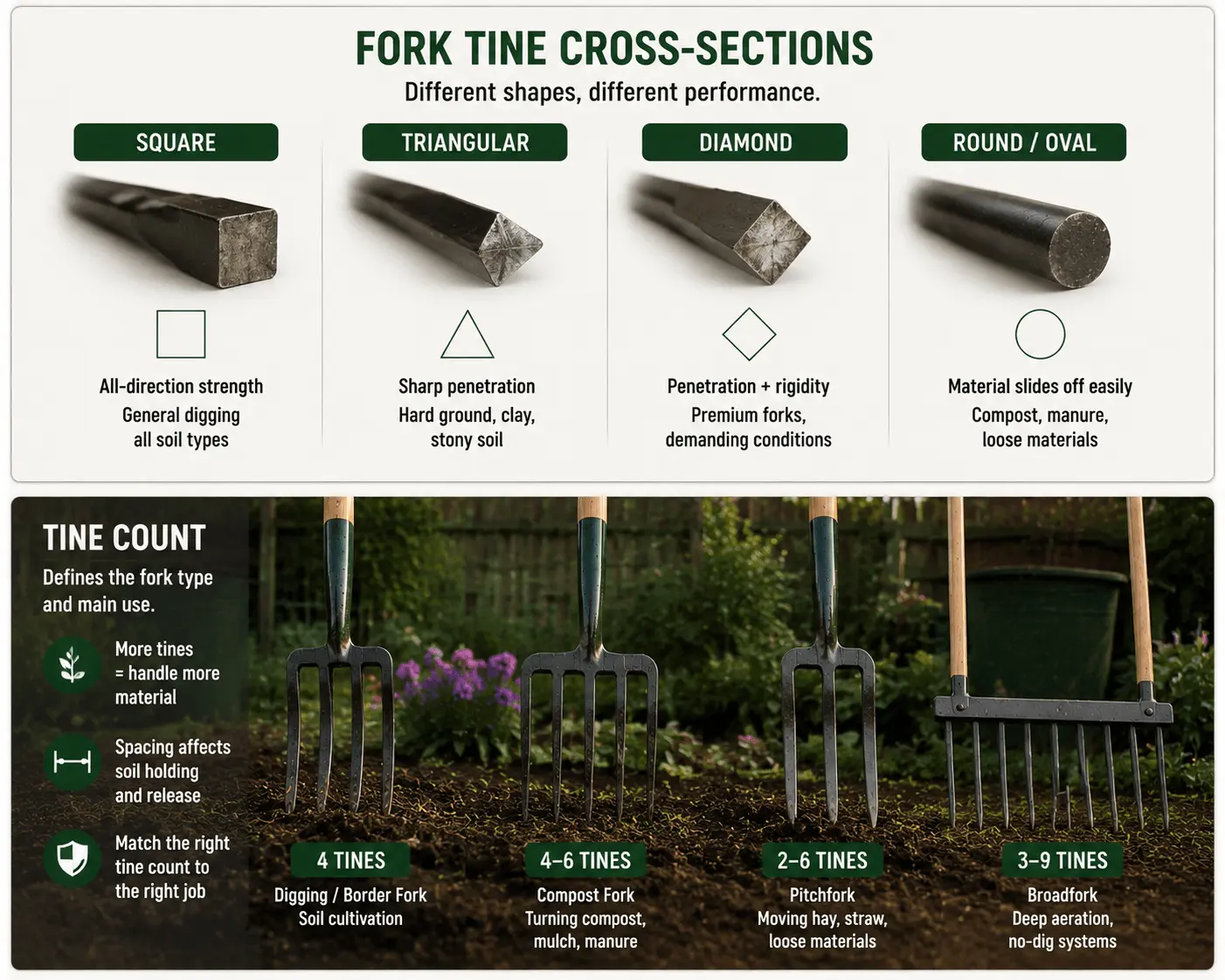
- Tine count is the most visible differentiator between fork types: 4 for digging/border, 4–6 for compost, 2–6 for pitchfork, 3–9 for broadfork.
- Wedge-shaped tine arrangements (middle tines angled inward) are a patented design feature that improves soil penetration and clod lifting.
- Uneven tine spacing is a manufacturing defect, not a design feature — always verify spacing consistency during inspection.
When you look at a garden fork, the tines are the working part — everything else is support. Yet many buyers treat tine design as a cosmetic detail rather than a functional specification. The cross-section shape, spacing, and count of the tines determine what the fork can do, how it performs in different soils, and how long it lasts before bending.
This guide explains the four parameters that define fork tine design: cross-section, spacing, count, and arrangement. For each, it covers what the term means, why it matters, and what to verify when sourcing.
Who this guide is for: Importers, hardware buyers, quality engineers, and product managers who need to understand and specify tine design parameters.
The Four Tine Parameters
| Parameter | What It Determines | Common Options | What It Does NOT Tell You |
| Cross-section | Penetration characteristics and rigidity | Square, triangular, diamond, round/oval | Tine count or spacing |
| Spacing | Whether the fork holds soil or releases material | Close (digging) or wide (compost/pitch) | Cross-section or count |
| Count | Fork type and primary application | 2–9 depending on type | Cross-section or spacing |
| Arrangement | Soil penetration and clod lifting efficiency | Parallel or wedge-shaped | Count or cross-section |
Verify Garden Fork Tine Design Before Sample Approval
Before approving a sample, send us the fork model you are considering. We can confirm tine count, cross-section, spacing, length, and arrangement to help ensure the structure matches your expected application.
Cross-Section: Square, Triangular, Diamond, and Round
Square Section
The most common tine cross-section for digging and border forks. Square tines offer uniform strength in all directions — they resist bending equally whether the force comes from the front, side, or top. Manufacturing is straightforward: the tine is forged or roll-forged to a square section and maintained through the length.
Best for: General-purpose digging, soil turning, and mixing organic matter. The square section provides reliable performance across soil types without specializing for any one condition.
Triangular Section
Triangular tines have three sharp edges running along their length. The pointed leading edge concentrates force at a single line — allowing the tine to penetrate hard or stony ground with less resistance than a square section. Patent literature describes “rigid, sharply pointed tines, triangular in section” designed for hard-ground penetration, where the user can bring their full body weight to bear through a T-grip handle for maximum leverage.
Best for: Hard ground, stony soil, and clay. The triangular section is a specialization — it sacrifices some all-direction strength for superior penetration.
Diamond Section
Diamond (or rhombic) section tines have four sharp edges. This combines the penetration advantage of triangular tines with better all-direction rigidity than triangular alone. Diamond sections are typically found on premium forged forks where the manufacturing process can produce the more complex geometry.
Best for: Premium digging forks where both penetration and structural rigidity are priorities. Typically indicates a higher-quality forging process.
Round / Oval Section
Round or oval tines are smooth — material slides off them easily. This is why they are used on pitchforks (for hay), compost forks (for wet organic material), and broadforks (where deep penetration into soil is needed but the smooth surface reduces friction). Round sections are less rigid than square or triangular sections of the same diameter — they are not ideal for heavy ground engagement.
Best for: Material handling (hay, compost, mulch) and deep aeration (broadfork). Not ideal for heavy clay or compacted ground.
Tine Spacing: Close vs. Wide
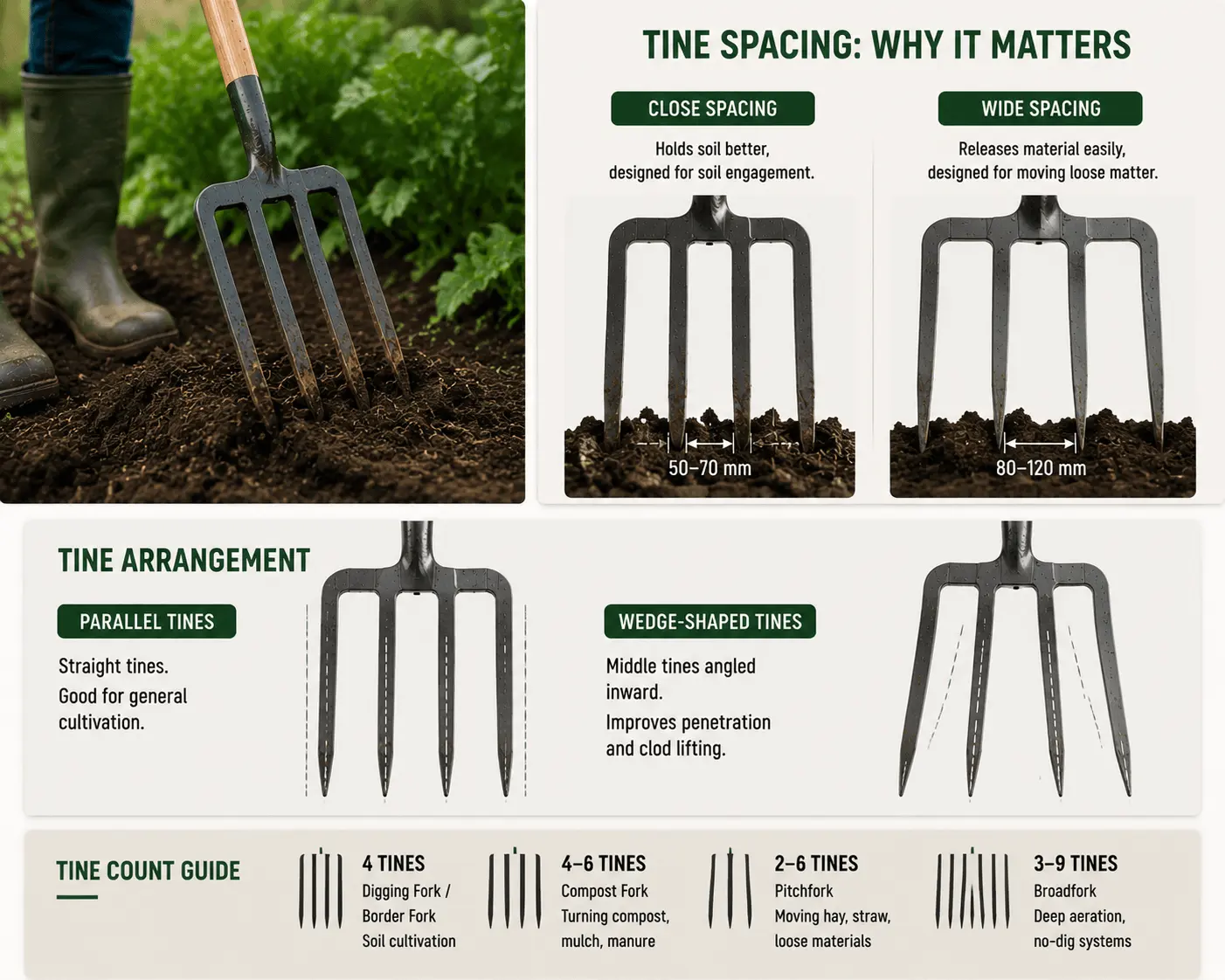
Close Spacing (Digging Forks)
Digging fork tines are spaced relatively close together. When the fork is pushed into soil, the close spacing allows the tines to hold a block of soil between them — the user can lift and turn the soil as a unit. Close spacing also means the fork engages more soil per thrust, making it efficient for turning ground.
Wide Spacing (Compost and Pitch Forks)
Compost forks and pitchforks have wider tine spacing. When the fork is pushed into a compost heap or a hay bale, the wide spacing allows material to penetrate between the tines and then release cleanly when the fork is tilted or shaken. If the spacing were too close, wet compost would stick between the tines and become difficult to release.
The Spacing-Soil Relationship
The ideal spacing depends on the material being worked:
- Heavy clay soil: Closer spacing holds the clay as a block; wider spacing would let clay squeeze through
- Sandy or loamy soil: Moderate spacing works — the soil holds together but releases when the fork is tilted
- Compost: Wider spacing — material needs to release easily
- Hay/straw: Widest spacing — long strands need to slide between tines without catching
Uneven Spacing Is a Defect
Whatever the designed spacing, it should be consistent across all tines. Uneven spacing indicates forming die wear, poor quality control, or post-forming deformation. During inspection, measure the distance between each pair of adjacent tines and confirm consistency.
Verify Garden Fork Tine Shape Before Sample Approval
Need to verify whether the tines are parallel or wedge-shaped? Send us the fork model you are considering. We can provide close-up photos and spacing measurements for each tine pair to help confirm the actual structure.
Tine Count: What the Number Tells You
| Fork Type | Typical Tine Count | Why That Count |
| Digging fork | 4 | Balance of soil penetration and lifting capacity; 4 tines cover enough ground without excessive resistance |
| Border fork | 4 | Same as digging fork — just smaller dimensions |
| Compost fork | 4–6 | More tines provide better support for wet, heavy organic material |
| Pitchfork | 2–6 (commonly 3) | Fewer, longer tines for penetrating and lifting light material |
| Broadfork | 3–9 | More tines cover a wider soil area in a single penetration |
Four tines are commonly used for digging forks, which are one of the core categories covered in our guide Types of Garden Forks: A Complete Buyer’s Guide to Digging, Border, Compost, Pitch, and Broad Forks.
For buyers sourcing standard digging forks for garden centers and hardware channels, our bulk detachable garden fork is designed around the common four-tine configuration for soil penetration, turning, and general garden preparation applications.
Why 4 Tines for Digging?
Four tines provide a balance: enough tines to lift a meaningful block of soil, but not so many that the fork requires excessive force to penetrate ground. Three tines would lift less soil per thrust; five or six would increase penetration resistance. Four is the practical optimum for general digging.
Why 3 Tines for Pitchforks?
Pitchforks handle light material (hay, straw) that does not need to be “held” between tines — it drapes over them. Fewer, longer tines penetrate hay bales easily, and the wide spacing allows the material to slide off when thrown. More tines would catch and tangle the material.
Tine Arrangement: Parallel vs. Wedge
Parallel Arrangement
The most common arrangement: all tines are parallel to each other, evenly spaced. This is the standard configuration for most digging, border, and compost forks. It provides uniform soil engagement across the fork width.
Wedge-Shaped Arrangement
A more specialized design, documented in patent literature: the middle two tines are angled slightly inward, forming a wedge shape, while the outer two tines remain parallel. This wedge design serves two purposes:
Improved penetration: The wedge shape helps the fork enter soil by concentrating force at the center
Improved clod lifting: The inward angle helps hold soil between the tines — the wedge shape grips the clod as the fork is lifted
Patent literature also describes connecting bars between tine pairs — structural members placed near the tine tips to increase rigidity and prevent tine splay under load.
What This Means for Buyers
If your customers work in heavy or stony soil, a wedge-shaped arrangement may offer better performance than a parallel arrangement. However, wedge-shaped forks are less common and may be harder to source. If the factory offers this design, confirm the angle and whether connecting bars are included.
Compare Two Garden Fork Tine Designs Under The Same Test Conditions
Need to compare two tine designs under the same conditions? We can arrange a controlled comparison test with defined soil type, penetration depth, and load measurement to help evaluate actual performance differences.
How to Write Tine Specifications
When creating product pages, packaging, or specification sheets:
| Field | What to Specify | Example |
| Tine count | The number of tines | “4 tines” |
| Cross-section | The shape of the tine | “Square section” or “Triangular section” |
| Tine length | Measured from base to tip | “310 mm tine length” |
| Tine spacing | Distance between adjacent tine centers | “Approximately 50 mm spacing” |
| Arrangement | Parallel or wedge | “Parallel arrangement” |
| Manufacturing | How the tines are formed | “Forged tines” or “Welded tines” |
Do not describe tines as “sharp” or “durable” without specifying what that means. “Triangular section for ground penetration” is a specification; “sharp, durable tines” is marketing language.
FAQ
What tine cross-section is best for clay soil? Triangular or diamond sections are generally better for hard or clay soils because the sharp leading edge concentrates force and reduces penetration resistance. Square sections are adequate for general-purpose use but may require more force in heavy ground. Round sections are not recommended for heavy soil engagement.
How many tines should a digging fork have? Four is the standard for digging forks. This count provides a balance of soil penetration and lifting capacity. Three tines would lift less soil per thrust; five or six would increase resistance. Four is the practical optimum for general digging.
Is uneven tine spacing a quality problem? Yes. Whatever the designed spacing, it should be consistent across all tines. Uneven spacing indicates forming die wear, poor quality control, or post-forming deformation. Measure the distance between each pair of adjacent tines during inspection.
What is a wedge-shaped tine arrangement? A design where the middle tines are angled slightly inward, forming a wedge, while the outer tines remain parallel. This arrangement improves soil penetration and clod lifting. It is a specialized design documented in patent literature — less common than parallel arrangements but potentially better for heavy or stony soil.
Are welded tines as good as forged tines? Welded forks — where tines are individually manufactured and welded to a base plate — are typically lower-cost than forged forks, where tines and head are formed as one piece. The weld junction is a potential weak point under heavy load. Forged tines offer continuous grain flow and no junction weakness. For heavy-duty applications, forged construction is preferable; for light-duty or budget tools, welded construction may be adequate.