






Updated 2 months ago
Carbon Steel vs. Stainless Steel Garden Forks: Material Comparison for B2B Buyers
SCARECROW GARDEN SUPPLIER

Carbon Steel vs. Stainless Steel Garden Forks | Scarecrow Garden Supplier
Key Takeaways
- Carbon steel and stainless steel forks serve different market segments — the choice is not about which is “better” but which matches your customer’s needs and price point.
- Carbon steel is stronger and can be heat-treated for additional hardness; stainless steel offers natural corrosion resistance and smoother soil release.
- Soil adhesion is a practical performance difference: wet clay sticks to carbon steel more than to stainless steel, affecting user efficiency.
- Carbon steel forks require coating (paint, powder coating) for corrosion protection; stainless steel forks do not — but they cost more.
- Do not claim a specific stainless steel grade (304, 316) unless the product has been confirmed to use it.
When sourcing garden forks, the material choice — carbon steel or stainless steel — affects price, performance, maintenance, and retail positioning. Some buyers default to carbon steel because it is cheaper; others choose stainless steel because it sounds “premium.” But neither choice is universally correct. The right material depends on the target customer, the working environment, and the price point.
This guide compares carbon steel and stainless steel as fork materials across the parameters that matter to B2B buyers: strength, corrosion resistance, soil adhesion, maintenance, price, and market positioning.
The Quick Answer
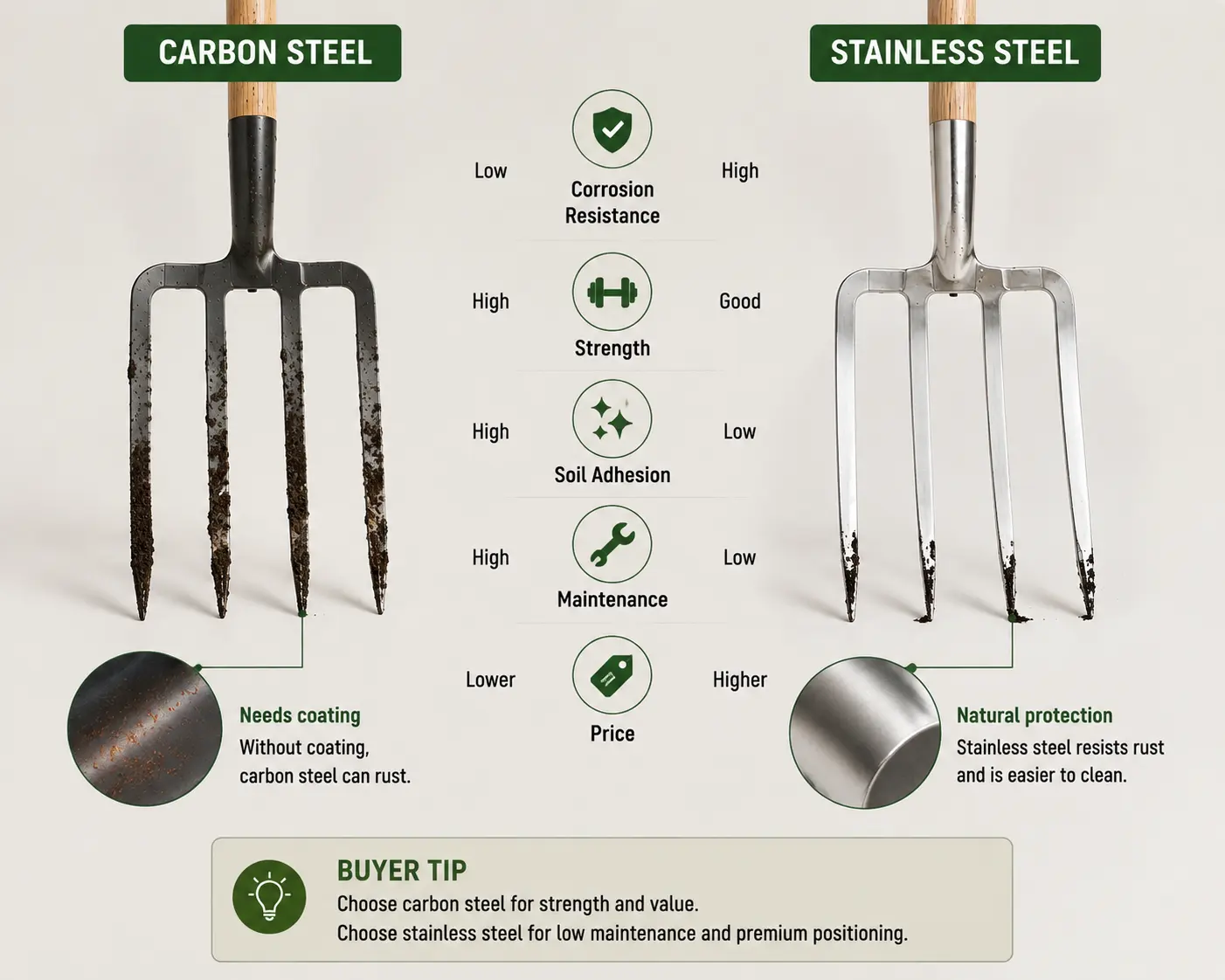
| Feature | Carbon Steel | Stainless Steel |
| Strength | High; can be heat-treated for additional hardness and toughness | Adequate for garden use; generally softer than hardened carbon steel |
| Corrosion resistance | Requires coating (paint, powder coating) — bare steel rusts | Natural corrosion resistance due to chromium content (typically ≥10.5%) |
| Soil adhesion | Wet clay and soil stick to bare or worn-coating surfaces | Smooth surface reduces soil adhesion — material slides off more easily |
| Edge/tine retention | Heat-treated carbon steel holds tine edges well | Slightly softer — tine edges may dull faster than hardened carbon steel |
| Maintenance | Requires regular cleaning and oiling to prevent rust | Low maintenance — rinse and dry |
| Price | Lower — material is less expensive and coating is standard | Higher — stainless steel raw material costs more |
| Market positioning | Mass market, agricultural, professional | Premium retail, gardening enthusiasts, gift market |
Source note: Material properties based on general metallurgical characteristics of carbon steel and stainless steel. Market samples: carbon steel forks from Chinese manufacturers (50Mn carbon steel, powder-coated); stainless steel forks from UK retailers (Toolden). The product catalog does not specify steel grades — describe the material as “steel” unless a specific grade is confirmed.
Compare Carbon Steel And Stainless Steel Fork Options
Need to evaluate both carbon steel and stainless steel options? Send the models you are considering. We can provide material, coating, weight, and price-tier comparison to help you choose a more suitable product direction.
Strength and Hardness
Carbon Steel
Carbon steel is the standard material for garden fork heads. It provides high tensile strength and can be heat-treated — hardened and tempered — to achieve specific hardness levels that resist bending and deformation. Some manufacturers use manganese carbon steel (such as 50Mn, a carbon structural steel with approximately 0.7–1.0% manganese content) for improved wear resistance.
Heat treatment is the key variable: an untreated carbon steel fork may bend under loads that a hardened and tempered one would resist. When sourcing, ask whether the fork has been heat-treated and what process was used. If the factory cannot provide details, describe the material as “carbon steel” without claiming specific hardness.
Material is only one factor affecting fork performance. Tine geometry, spacing, and count also influence working results. See Garden Fork Tines Explained: Cross-Section, Spacing, Count, and What They Mean for Buyers.
Stainless Steel
Stainless steel offers adequate strength for garden use but is generally softer than hardened carbon steel. This means stainless steel tines may bend more easily under heavy load — particularly in compacted or stony ground. Stainless steel is less responsive to heat treatment than carbon steel, so the hardness advantage of carbon steel cannot be fully replicated.
For heavy-duty ground engagement, hardened carbon steel is the stronger choice. For lighter cultivation and aesthetic/low-maintenance appeal, stainless steel is adequate.
Corrosion Resistance
Carbon Steel
Carbon steel rusts when exposed to moisture — this is its primary disadvantage. To prevent corrosion, carbon steel forks are coated: painted (the most basic option), powder-coated (thicker, more durable), or treated with anti-rust compounds. The coating is the protective barrier — when it chips, scratches, or wears through (particularly at tine tips and edges), bare steel is exposed and rust begins.
Coating maintenance matters: a carbon steel fork that is cleaned and dried after use, and occasionally wiped with light oil, will resist corrosion for years. A fork left outdoors or stored damp will rust regardless of coating quality.
Stainless Steel
Stainless steel contains chromium (typically ≥10.5%), which forms a passive oxide layer on the surface that self-repairs when scratched. This means stainless steel forks do not require coating for corrosion protection — the material itself is the protection.
However: Stainless steel is not immune to corrosion. In environments with high chloride exposure (coastal areas with salt air, or agricultural settings with fertilizer residues), stainless steel can develop pitting corrosion — particularly in lower grades. Do not claim that stainless steel forks are “rust-proof” or “never corrode.” They are significantly more corrosion-resistant than carbon steel, but not immune.
Choose The Right Coating For Your Carbon Steel Fork Range
Not sure which coating to specify for carbon steel forks? Send us your target market and price point. We can review paint, powder coating, and epoxy options to help define a more suitable surface protection solution.
Soil Adhesion: The Practical Difference
This is the performance difference that users notice most — and it is often the reason customers prefer stainless steel forks despite the higher price.
The Problem with Carbon Steel
Wet clay and damp soil adhere to bare carbon steel surfaces — and to coated surfaces where the coating has worn. As the user works, soil builds up on the tines, adding weight and reducing penetration efficiency. The user must frequently stop to clean the tines, which slows work and increases fatigue.
Coating helps initially — a fresh powder-coated surface is smoother than bare steel. But as the coating wears at the tine tips (where soil friction is highest), bare steel is exposed and adhesion increases.
The Stainless Steel Advantage
Stainless steel has a naturally smooth surface that resists soil adhesion. Wet clay slides off more easily, and the surface does not degrade over time in the same way that a coating does. This means the fork maintains its penetration efficiency throughout the working session with less cleaning.
Why This Matters for Buyers
If your customers work in clay-heavy soils, the soil adhesion difference is a practical performance issue — not just a cosmetic preference. A stainless steel fork may justify its higher price through reduced user frustration and improved efficiency. For sandy or loamy soils, the adhesion difference is less noticeable, and carbon steel is a more economical choice.
Maintenance Requirements
| Maintenance Task | Carbon Steel | Stainless Steel |
| After use | Clean soil from tines; dry thoroughly | Clean soil from tines; dry (less critical) |
| Periodic | Wipe with light oil to protect bare steel | Not typically required |
| Coating repair | Inspect for chips; touch up if possible | Not applicable |
| Storage | Store dry — do not leave outdoors | Can tolerate damp storage better, but dry storage is still preferable |
For professional and agricultural users who maintain their tools, carbon steel’s maintenance requirements are manageable. For casual gardeners who leave tools in the shed or garden, stainless steel’s low maintenance is a genuine advantage.
Compare Carbon Steel And Stainless Steel Fork Options
Need both carbon steel and stainless steel options? We can source both and organize a side-by-side comparison for your retail range, helping you select the right material positioning for your market.
Price and Market Positioning
Carbon Steel: Mass Market and Professional
Carbon steel forks are the standard for mass-market garden tools, agricultural supply, and professional landscaping. The lower material cost allows competitive pricing, and the ability to heat-treat the steel means carbon steel forks can be built for heavy-duty use that stainless steel cannot match.
For buyers sourcing garden forks for mass-market retail, agricultural supply, and professional landscaping channels, our bulk detachable garden fork provides a practical carbon steel fork solution with flexible specifications for different markets.
Position as: “Professional-grade” or “heavy-duty” for hardened carbon steel; “standard” or “value” for basic carbon steel.
Stainless Steel: Premium Retail and Gift
Stainless steel forks occupy the premium retail segment — higher price, attractive appearance (the polished or brushed steel surface looks distinctive on retail shelves), and low-maintenance appeal. They are often positioned as gifts or as upgrades for dedicated gardeners who value aesthetics and ease of care.
Position as: “Premium” or “low-maintenance” — not as “stronger” or “more durable” (stainless steel is not necessarily stronger or more durable than hardened carbon steel).
Do Not Claim
- “Stainless steel is stronger than carbon steel” — generally not true; hardened carbon steel is stronger
- “Stainless steel never rusts” — it is significantly more resistant, but not immune
- “Carbon steel is inferior” — it is the standard professional material for a reason
- A specific stainless steel grade (304, 316) unless the product has been confirmed to use it
Material selection should be verified together with coating, dimensions, and structural checks. Learn how to review these points in How to Inspect Garden Forks: Tine Geometry, Socket Security, Coating, and Load Testing.
FAQ
Is stainless steel worth the extra cost? It depends on your customer. For gardeners who value low maintenance, aesthetics, and work in clay-heavy soils, stainless steel may justify the premium. For professional users who need maximum strength and heat-treated hardness, carbon steel is the better choice. For mass-market retail, carbon steel with a good coating is the most cost-effective option.
Does carbon steel always rust? Carbon steel rusts when exposed to moisture and oxygen without protection. A well-coated carbon steel fork that is cleaned, dried, and stored properly will resist rust for years. The risk increases when the coating is damaged or when the tool is stored damp. Regular maintenance (cleaning, drying, occasional oiling) significantly extends the life of carbon steel tools.
Can I request a specific stainless steel grade? You can ask, but the product catalog does not specify stainless steel grades. If the factory can provide material certification for a specific grade (such as 304 or 316), you may claim it. If not, describe the material as “stainless steel” without specifying a grade. Do not assume a grade — 304 and 316 have different corrosion resistance characteristics, and claiming the wrong grade could mislead customers.
Why does soil stick to my carbon steel fork but not my stainless steel one? Stainless steel has a naturally smoother surface that resists adhesion. Carbon steel, particularly where the coating has worn, has a rougher surface at the microscopic level that wet clay and damp soil grip. This is a real performance difference, not just a preference — in clay-heavy soils, it affects work efficiency.
Should I stock both materials? If your retail range serves different customer segments — budget-conscious buyers (carbon steel) and premium/low-maintenance buyers (stainless steel) — stocking both covers different needs. If you serve only one segment, choose the material that matches your customer’s priorities.