






Updated 2 months ago
D-Handle, T-Handle, Long-Handle, and Y-Grip Garden Forks: Which Grip Is Right?
SCARECROW GARDEN SUPPLIER

D-Handle, T-Handle, Long-Handle Garden Forks | Scarecrow Garden Supplier
Key Takeaways
- Handle type on a garden fork changes the working motion, the leverage available, and the user’s posture — it is not a cosmetic choice.
- T-grips maximize downward force for ground penetration; D-grips maximize control for precision work; long handles maximize reach and reduce bending.
- Research on long-shafted tools used in stables found that adding 10 cm to a 125 cm shaft significantly reduced back loading — particularly compressive force.
- For retail, D-grip and T-grip forks are more compact for display and shipping; long-handle forks signal professional/agricultural use.
- No handle type is universally “ergonomic” — the right choice depends on user height, task, and working environment.
The handle is the user’s connection to the fork. It determines how force is applied, how the user’s body moves during work, and how much fatigue accumulates over a working session. Yet many buyers treat handle type as a minor specification — a checkbox on the order form rather than a functional decision.
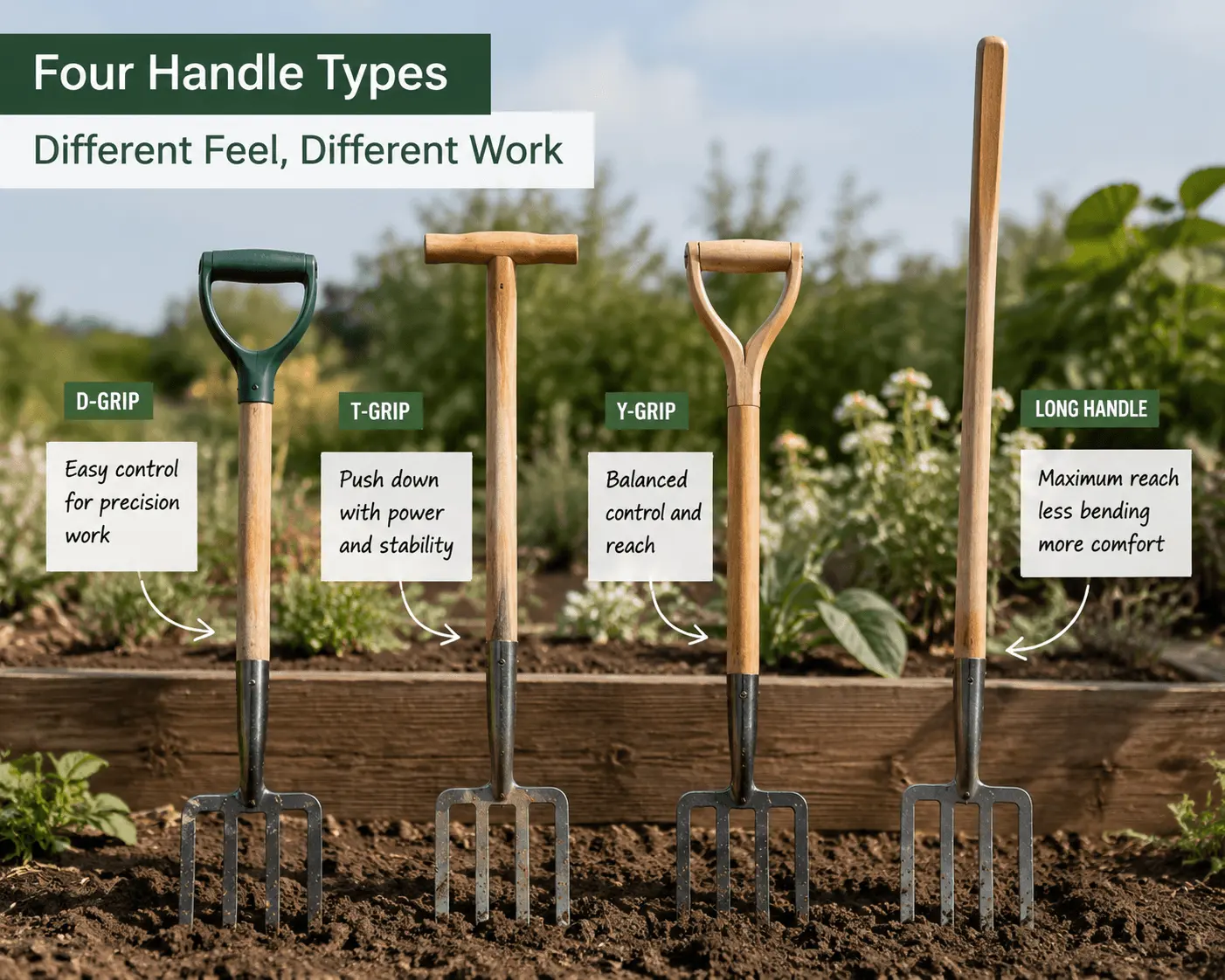
This guide compares the four main handle types found on garden forks: D-grip, T-grip, Y-grip, and long straight handle. For each, it covers the working motion, leverage characteristics, ergonomic implications, and retail positioning.
The Quick Answer
| Handle Type | Typical Total Length (with head) | Working Motion | Best For | Retail Positioning |
| T-grip | 1,030–1,135 mm | Two-handed downward pressure; full body weight via foot bar or handle | Hard ground penetration; deep soil work | Professional/agricultural |
| D-grip | 1,080–1,200 mm | One-handed control; closer work; maneuverable | Flower beds, containers, precision cultivation | Consumer/garden center |
| Y-grip | 1,000–1,200 mm | Two-handed with Y-branch; balance of control and reach | General-purpose digging and turning | Mixed professional/consumer |
| Long straight | 1,450–1,500 mm | Maximum reach; reduced bending; two-handed levering | Open-ground work; large-area cultivation | Agricultural/landscaping |
Handle selection is one part of choosing the right fork. For a broader comparison of fork categories, see Types of Garden Forks: A Complete Buyer’s Guide to Digging, Border, Compost, Pitch, and Broad Forks.
Source note: Handle lengths based on product catalog data for fork models. The ergonomic principle of matching handle length to user height and task is recognized by Utah State University Extension and the NIOSH/CDC publication “Easy Ergonomics: A Guide to Selecting Non-Powered Hand Tools.”
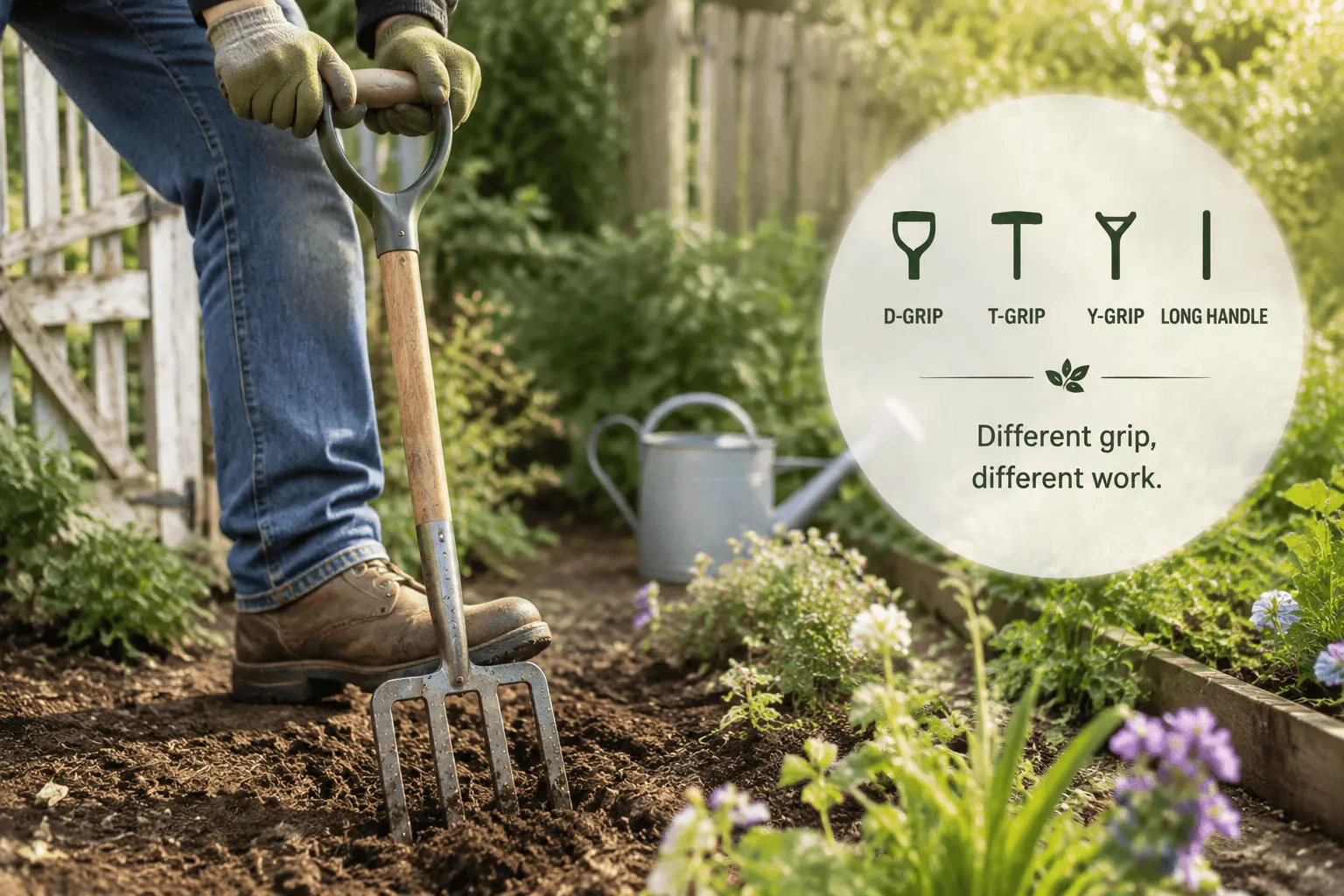
Choose The Right Garden Fork Handle For The Working Environment
Tell us the primary working environment — open ground, flower beds, or mixed use. We will recommend handle types that fit your application without unnecessary overlap.
T-Grip: Maximum Downward Force
How It Works
A T-grip consists of a horizontal bar attached to the top of a relatively short shaft. The user grips the horizontal bar with both hands and pushes downward — using body weight and arm strength to drive the fork tines into the ground. The T-grip allows both hands to apply force evenly, which is why it is the preferred handle for hard-ground penetration.
Patent literature describes a triangular-section bayonet-tine fork with a T-grip designed so that “the full weight of the operator’s body can be brought to bear for maximum leverage” — the T-grip is the handle design that most effectively transfers body weight into downward force.
When to Choose T-Grip
- Users who need to penetrate hard or compacted soil
- Deep soil cultivation where maximum downward force is required
- Users who prefer a pushing motion over a levering motion
Limitations
- Shorter shaft means more bending for tall users
- Less effective for scooping or levering motions
- The T-bar can be uncomfortable for users with smaller hands — grip diameter matters
D-Grip: Control and Precision
How It Works
A D-grip has a D-shaped handle attached to the top of the shaft. The user can grip the D-handle with one hand while holding the shaft with the other, or grip the D-handle alone for one-handed work. The D-grip allows the user to rotate the fork, direct the material, and work in tighter spaces.
When to Choose D-Grip
- Flower bed and border work where precision matters
- Container gardening and raised-bed work
- Users who need to maneuver the fork in tight spaces
- Retail channels where compact size and intuitive grip suit consumer buyers
D-Grip Opening Size
The internal opening of the D-grip should accommodate a gloved hand. Typical internal dimensions are approximately 100–120 mm in width and 80–100 mm in height. If the opening is too small, users with work gloves cannot grip properly — a detail that causes complaints unrelated to fork quality.
Confirm Garden Fork Handle Dimensions Before Sample Approval
Check handle dimensions before approving a sample. Send us the model you are considering. We can provide measured total length, grip opening, handle diameter, weight, and balance photos to help confirm the sample meets your requirements.
Y-Grip: The Middle Ground
How It Works
A Y-grip is a Y-shaped handle where the shaft splits into two branches forming a Y. The user grips the Y-branches with both hands, similar to a traditional digging tool. The Y-grip provides more control than a long straight handle (the user’s hands are positioned for directional force) and more reach than a D-grip (the shaft is typically longer).
When to Choose Y-Grip
- General-purpose digging and soil turning
- Users who want both control and reach
- Markets where Y-grip is the traditional handle style (some European and African markets)
Limitations
- The Y-branch is a potential weak point — check the junction for cracks or poor grain orientation (for wood handles)
- Less downward force than a T-grip (the user cannot apply full body weight as effectively)
- Less one-handed control than a D-grip
Long Straight Handle: Reach and Reduced Bending
How It Works
A long straight handle (typically 1,450–1,500 mm total length with the fork head) allows the user to work with a more upright posture. The longer shaft means less forward bending during soil engagement, which reduces lower-back loading during extended work.
Ergonomic Research
A study on long-shafted tools used in horse stables — including manure forks and shavings forks — found that adding 10 cm to a 125 cm shaft significantly reduced back loading, particularly compressive force. The effect was consistent regardless of the user’s height, the specific sub-task, or the working technique. The study concluded that shaft length and working technique are both important factors in reducing the user’s physical load.
While this study focused on stable tools rather than garden forks, the biomechanical principle is the same: a longer shaft allows a more upright posture, which reduces spinal loading. For users doing extended soil cultivation in open areas, a long handle is the ergonomic choice.
Freivalds’ foundational study on shovel ergonomics (1986) similarly found that optimal handle length depends on the user’s height and the task — a longer handle reduces forward bending but may increase the energy required for lifting. The same principle applies to forks: longer is not always better; it depends on the working context.
When to Choose Long Handle
- Open-ground cultivation where there is room to work
- Users who experience back fatigue with shorter handles
- Agricultural and landscaping supply channels
- Users who are taller than average
Limitations
- Less precise control than D-grip or T-grip
- Cannot be used effectively in confined spaces (between plants, in containers)
- Longer cartons increase shipping cost per unit
- May be too long for shorter users, causing an awkward working angle
Build A Consistent D-Grip & Long-Handle Fork Range
Need both a D-grip and a long-handle version? We can check compatible fork heads and handle combinations for a consistent retail range, helping you create better product coverage without unnecessary duplication.
Handle Material: Wood and Fiberglass
Wood Handles
Wood is the traditional handle material for garden forks. Common tool-handle woods include ash, oak, and hickory, as noted by Penn State Extension. Wood absorbs shock and vibration, reducing hand and arm fatigue during repetitive soil engagement.
What to check:
- Grain orientation: straight grain along the length is strongest
- Knots at stress points: a knot at the socket junction or Y-branch is a structural defect
- Surface finish: smooth, sealed surface protects against moisture
- Moisture content: wood that is too wet may warp; too dry may crack
For wood handles, FSC (Forest Stewardship Council) Chain of Custody certification may be relevant for EU markets under EUTR regulations. FSC certification should only be claimed when actual certificates are valid.
Fiberglass Handles
Fiberglass handles offer an excellent strength-to-weight ratio. They are lighter than wood, do not absorb moisture, and do not split along grain lines. However, the product catalog currently lists only wood handle options for forks — fiberglass is available for shovels but not yet listed for forks. If fiberglass fork handles are required, confirm availability with the factory.
Handle specifications should also be verified during quality inspection, including length, connection security, and finish. See How to Inspect Garden Forks: Tine Geometry, Socket Security, Coating, and Load Testing.
The “Insulation” Myth
Do not claim that fiberglass handles provide “electrical insulation safety” unless the specific product has been designed and tested for electrical insulation. A fiberglass handle is not automatically an insulating tool.
Retail Positioning and Target Users
| Customer Type | Recommended Handle | Why |
| Garden center / consumer retail | D-grip | Compact; intuitive grip; suits occasional users |
| Agricultural supply | Long handle or Y-grip | Open-ground work; reach and reduced bending |
| Landscaping supply | T-grip or long handle | Professional soil work; maximum force or reach |
| Hardware store (mixed) | D-grip + long handle | Different customers need different handle types |
| E-commerce | D-grip (if space-limited) or both | D-grip ships more compactly |
Packaging and Shipping
Handle type affects packaging and shipping costs:
- Long-handle forks (1,450–1,500 mm total length) require full-length cartons. Estimated 20-foot container loading is typically 380–460 dozen, depending on model and packaging configuration.
- D-grip and T-grip forks (1,030–1,200 mm total length) use shorter cartons, allowing more units per container. Estimated loading is typically 400–460 dozen.
- Head-only shipments (fork heads without handles) are the most compact — loading can reach 1,500–2,500 dozen per 20-foot container, depending on fork head size.
For all handle types, the critical packaging issue is protecting tine tips from mutual contact and preventing the fork head from damaging adjacent products in the carton.
Test Comfort With Your Target User In Mind
Send us your user profile and working scenario. We will propose a practical sample-use evaluation rather than a generic strength demonstration, helping you understand how the tool performs in real applications.
FAQ
Which handle type is best for general garden use? For general-purpose use, a Y-grip or D-grip fork is the most versatile. A Y-grip provides a balance of control and reach; a D-grip provides better control for precision work. For users who primarily dig in open ground, a long handle reduces back strain. For users who work in flower beds, a D-grip is the practical choice.
Is a T-grip better for hard ground? Yes. The T-grip is designed to maximize downward force — the user can apply full body weight through the horizontal bar. For hard or compacted soil, a T-grip fork is the most effective handle type for ground penetration. However, it is less versatile than other handle types for non-digging tasks.
Does a longer handle prevent back injury? No handle prevents back injury. Research on long-shafted tools indicates that a longer handle can reduce back loading — particularly compressive force — by allowing a more upright working posture. But this benefit depends on the user’s height, the task, and the working environment. Do not market any handle as “preventing back injury” or “eliminating fatigue.”
Can I get fiberglass handles on forks? The product catalog currently lists wood handle options for forks. Fiberglass handles are available for shovels but may not yet be listed for forks. If fiberglass fork handles are required, confirm availability with the factory. Do not claim fiberglass construction unless the specific product has been confirmed.
What D-grip opening size should I specify? The D-grip opening should accommodate a gloved hand — typically an internal opening of approximately 100–120 mm in width and 80–100 mm in height. Always verify the internal dimensions, not just the external appearance. A grip that is too small for work gloves is a common customer complaint.