






Updated 2 months ago
Digging Fork vs. Border Fork: What Is the Difference and Which Should You Stock?
SCARECROW GARDEN SUPPLIER
Digging Fork vs. Border Fork: What’s the Difference? | Scarecrow Garden Supplier
Key Takeaways
- A border fork is not a cheaper or lower-quality version of a digging fork — it is a smaller fork designed for a different working environment.
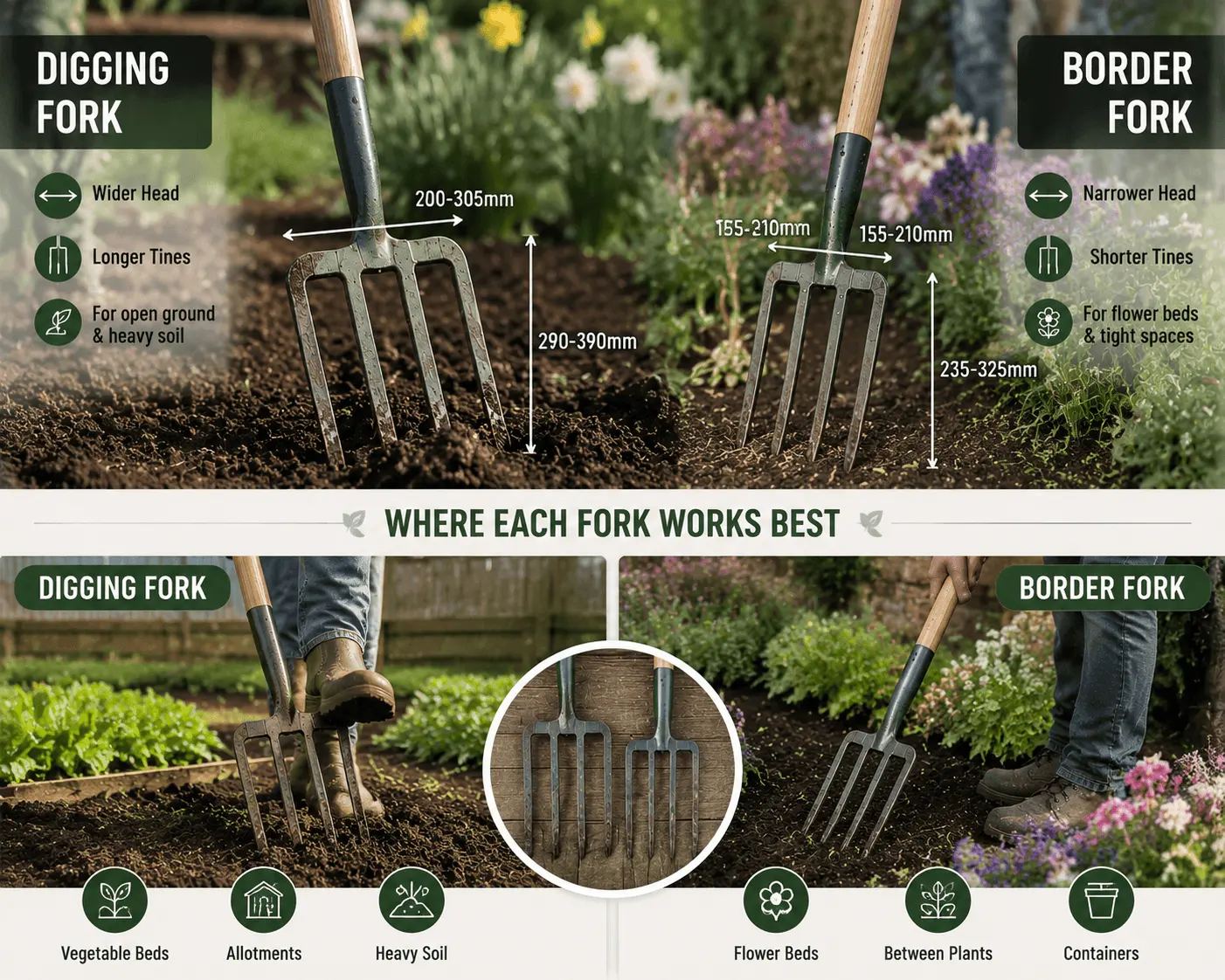
- Head width is the most reliable distinguishing parameter: digging forks typically range from approximately 200–305 mm; border forks are narrower.
- The size difference changes who uses the tool and where: open ground versus confined flower beds.
- Stocking both is not redundant — they serve genuinely different tasks. The mistake is stocking two forks of the same size with different labels.
- “Ladies fork” is an outdated term sometimes used for border forks — do not use it in product descriptions or packaging.
A customer asks for “a garden fork.” You show them a digging fork. They say it is too big — they need something for their flower bed. You show them a border fork. They ask: is this just a smaller version, or is it actually different? The answer matters — because if the customer buys the wrong size, they will return the tool, and if you stock two forks of the same size with different labels, you are wasting shelf space.
This guide compares the digging fork and the border fork across the parameters that matter to B2B buyers: head width, tine length, weight, working environment, and stocking strategy.
The Quick Answer
| Feature | Digging Fork | Border Fork |
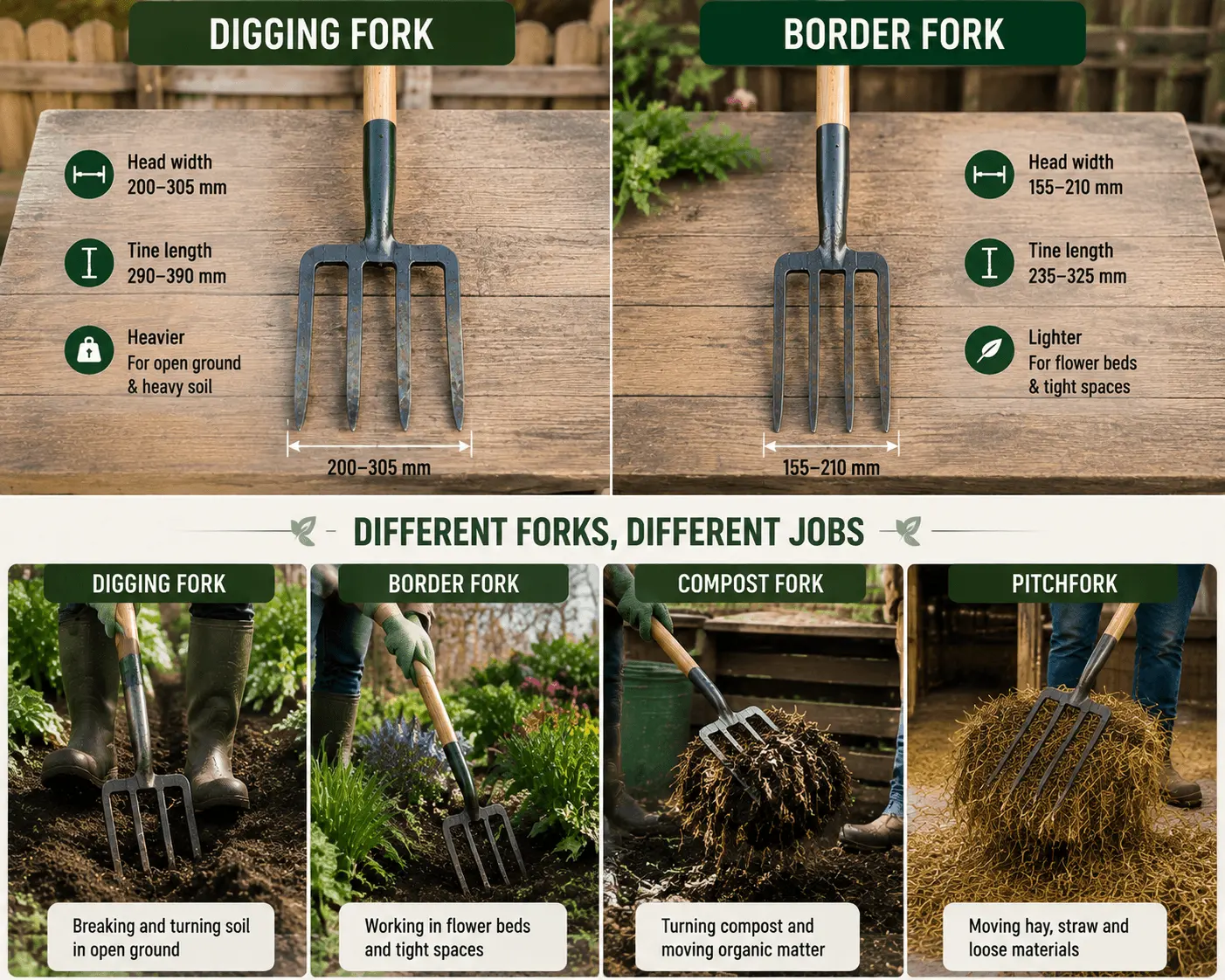
| Head width | Approximately 200–305 mm | Approximately 155–210 mm |
| Tine length | Approximately 290–390 mm | Approximately 235–325 mm |
| Tine section | Square, triangular, or diamond | Square or triangular (thinner) |
| Weight (head only) | Approximately 7–14 kg per dozen | Approximately 6.5–7.5 kg per dozen |
| Working environment | Open ground, allotments, vegetable beds | Flower beds, between perennials, containers, raised beds |
| Soil type | All soil types including clay | Lighter soils; not ideal for heavy clay |
| User | General gardeners, landscapers, allotment holders | Gardeners with established borders, container gardeners |
Source note: Dimensions based on product catalog data (CFR and CFS series). The distinction between digging forks and border forks is recognized in UK garden retail, where “border fork” is a standard product category. The Royal Horticultural Society recommends forks for soil cultivation in both open ground and confined border areas.
For a complete overview of other fork categories, including compost forks, pitchforks, and broadforks, see our guide Types of Garden Forks: A Complete Buyer’s Guide to Digging, Border, Compost, Pitch, and Broad Forks.
Confirm Actual Garden Fork Dimensions Before Ordering
Before placing an order, verify the actual head dimensions of your shortlisted models. Send us the model numbers you are considering, and we can provide measured head width, tine length, and weight for each option.
Head Width: The Defining Difference
Head width is the single most reliable parameter for distinguishing a digging fork from a border fork. Based on product catalog data:
- Smaller fork heads (such as CFR003A at 155 × 310 mm) are closer to border fork dimensions.
- Larger fork heads (such as CFR005A at 230 × 330 mm) are in the digging fork range.
- Mid-range heads (such as CFR004A at 210 × 325 mm) sit between the two — they could be positioned as either a small digging fork or a large border fork, depending on the market.
This overlap is where sourcing confusion arises. A factory may label a 210 mm head as a “digging fork” while a retailer expects a border fork at that width. Always confirm the actual head width in millimetres — not just the name.
Why Width Matters
A wider head moves more soil per fork-load — efficient in open ground where there is room to work. But in a flower bed with established perennials, a 230 mm head cannot fit between plants without damaging roots or stems. A 155 mm head slides into tight spaces, allowing the gardener to cultivate soil around existing plants without disruption.
Tine Length and Section
Tine Length
Longer tines penetrate deeper — useful for breaking up compacted subsoil or incorporating organic matter deep into the profile. Shorter tines are adequate for surface cultivation and lighter soil work.
Product catalog data shows tine lengths ranging from approximately 235 mm to 390 mm. The shorter end of this range suits border forks; the longer end suits digging forks designed for deep soil work.
Tine Section
Both digging and border forks can have square, triangular, or diamond cross-section tines. The difference is not the section shape — it is the thickness. Border fork tines are typically thinner, making the tool lighter but also less resistant to bending under heavy load. A border fork forced into heavy clay may bend tines that a digging fork of the same section but greater thickness would resist.
For a detailed explanation of tine cross-section design, see Garden Fork Tines Explained.
Build A Balanced Digging Fork & Border Fork Collection
Need both a digging fork and a border fork? We can select non-overlapping models that cover open-ground and confined-space tasks without unnecessary SKU duplication.
Weight and User Fatigue
A border fork is lighter — and that is the point. Users working in flower beds and containers are often doing precision work in awkward positions (kneeling, reaching between plants). A heavy digging fork in these conditions causes fatigue quickly.
Product catalog data shows border-fork-size heads weighing approximately 6.5–7.5 kg per dozen, while larger digging-fork-size heads weigh 7.0–14.0 kg per dozen. The weight difference per tool is modest, but over an extended working session, it compounds.
A study on soil-working hand tools (Ramana et al.) measured energy expenditure and cardiovascular load for a digger fork at 20.5–25.4 kJ/min and 110–136 beats per minute — confirming that fork design directly affects user fatigue. While this study focused on full-size digging forks, the principle applies: a lighter tool reduces energy expenditure, which is the border fork’s advantage in confined work.
Working Environment: Where Each Fork Belongs
| Environment | Digging Fork | Border Fork | Why |
| Vegetable plot / allotment | ✓ | — | Open ground; need to break and turn soil |
| Flower bed with established perennials | — | ✓ | Confined space; need to work between plants |
| Raised bed | Depends on width | ✓ | If bed is narrow, border fork fits better |
| Container garden | — | ✓ | Small soil volume; large fork is impractical |
| New ground (previously uncultivated) | ✓ | — | Need to break compacted soil |
| Compost heap | Either | Either | Both can turn compost, but compost fork is better |
| Between shrubs / hedges | — | ✓ | Need precision; wide fork damages branches |
For garden centers and distributors looking to stock a reliable soil-working tool, our bulk detachable garden fork is designed for digging, soil turning, and general garden preparation applications. We can also support wholesale orders with different specifications, packaging options, and market requirements.
Common Sourcing Mistakes
Mistake 1: Stocking two forks of the same size. A buyer orders a “digging fork” at 210 mm and a “border fork” at 200 mm. The size difference is negligible — customers cannot tell them apart, and the buyer has effectively stocked the same tool twice.
Mistake 2: Selling a border fork as a digging fork. A garden center labels all forks as “digging forks.” A customer buys the smaller one for breaking new ground in clay soil. The thinner tines bend. The customer returns the tool, complaining about quality — when the real issue was wrong tool for the task.
Mistake 3: Assuming “smaller = cheaper.” A buyer assumes the border fork is a budget version of the digging fork and prices it accordingly. But the border fork is a purpose-built tool for a specific environment — it should be positioned as a different tool, not a downgraded version.
Mistake 4: Not stocking a border fork at all. A buyer stocks only digging forks, assuming customers will “just use a smaller motion.” But customers working in flower beds need a tool that physically fits — a 230 mm head will not fit between established plants. The customer goes to a competitor who stocks border forks.
Build A Garden Fork Range That Fits Your Customers And Shelf Space
Tell us your customer profile and shelf space. We can recommend a fork range that covers open-ground and confined-space tasks without overlap, helping you create a clearer and more efficient product assortment.
How to Position Border Forks in Retail
For garden centers and hardware stores, the border fork should be displayed and labeled as a distinct tool — not as a smaller version of the digging fork.
Label by task, not by size: “For Flower Beds and Borders” is clearer than “Small Digging Fork.” Customers who see “flower bed fork” immediately know if it is for them.
Demonstrate the width difference: If possible, display the digging fork and border fork side by side so customers can see the head width difference. Visual comparison is more effective than dimension labels for non-professional buyers.
Do not use outdated terminology: “Ladies fork” is an outdated and inappropriate term sometimes used for border forks. Use “border fork” or “flower bed fork” in all product descriptions and packaging.
FAQ
Is a border fork just a smaller digging fork? Structurally, yes — but the size difference is the point. A border fork is designed to fit in confined spaces where a digging fork is too wide. It is not a budget or lower-quality version; it is a purpose-built tool for a different working environment.
Can I use a border fork for digging in open ground? You can, but it is not ideal. The thinner tines and lighter construction may struggle in heavy clay or compacted soil. For open-ground digging, a full-size digging fork is the correct tool.
What head width should I specify for a border fork? Typically, a head width of 155–210 mm suits border fork applications. Confirm the actual width — not just the name. Some factories may label a 210 mm head as a “border fork” when it is closer to a small digging fork.
Should I stock both types? If your customers include both vegetable gardeners (who need digging forks) and flower gardeners (who need border forks), stocking both covers different tasks. If budget or space is limited, start with a digging fork — it is the more versatile single tool.
Why is my border fork lighter than my digging fork? Because it is designed to be. A lighter tool reduces fatigue during precision work in confined spaces. The lighter construction is a feature, not a cost-cutting measure — though it does mean the tool should not be marketed as heavy-duty.