






Updated 2 months ago
Forged, Stamped, Tempered, and Boron Steel Shovel Blades: What Buyers Should Verify
SCARECROW GARDEN SUPPLIER
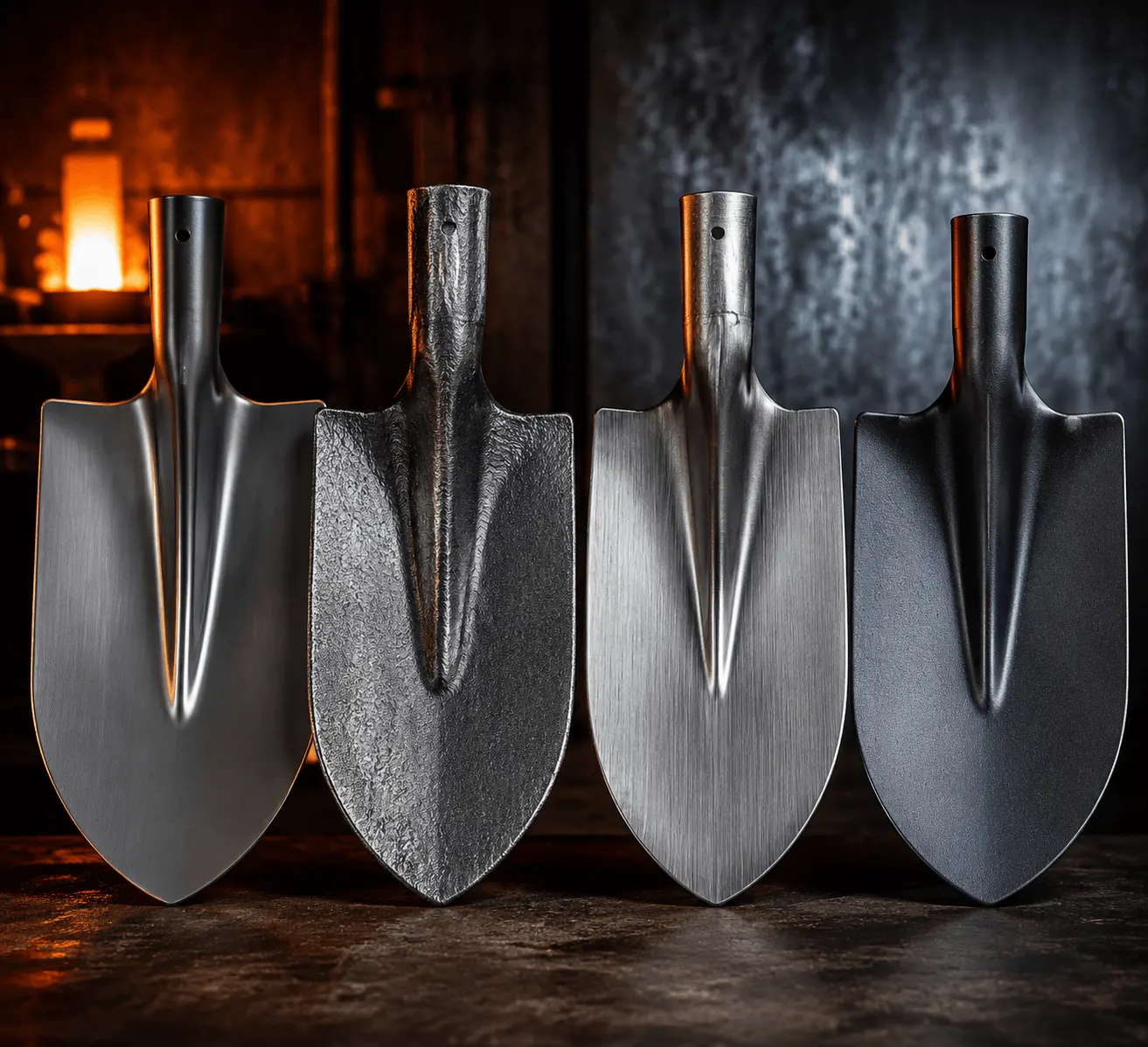
Forged vs. Stamped vs. Tempered vs. Boron Steel Shovel Blades | Scarecrow Garden Supplier
Key Takeaways
- “Forged,” “stamped,” “tempered,” and “boron steel” describe different dimensions of blade construction — they are not interchangeable terms, and no single one guarantees quality.
- Stamping is cost-effective for high-volume blade production; forging creates continuous grain flow for strength at stress points; tempering is a heat treatment process that can improve any steel; boron steel is an alloy choice, not an automatic quality upgrade.
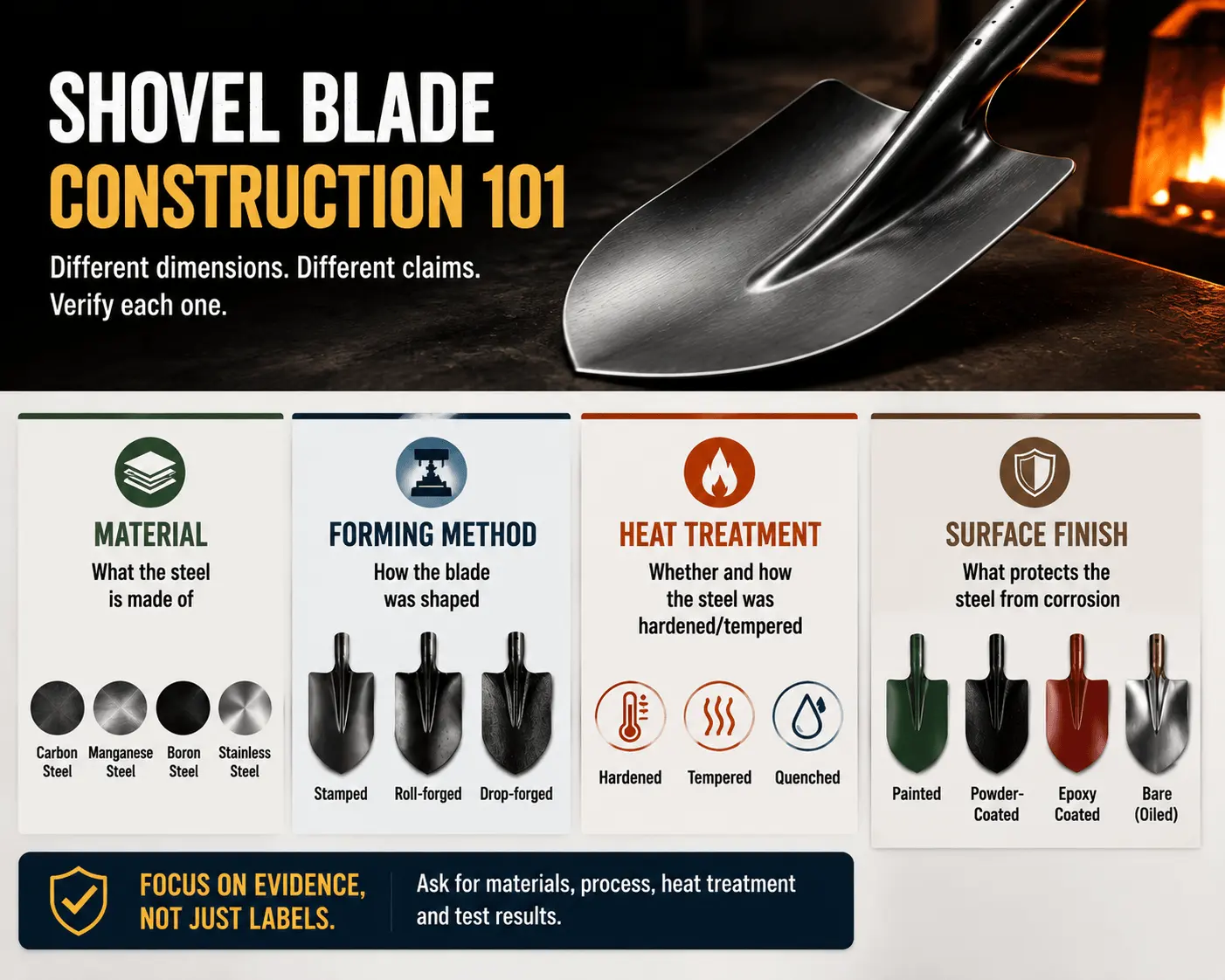
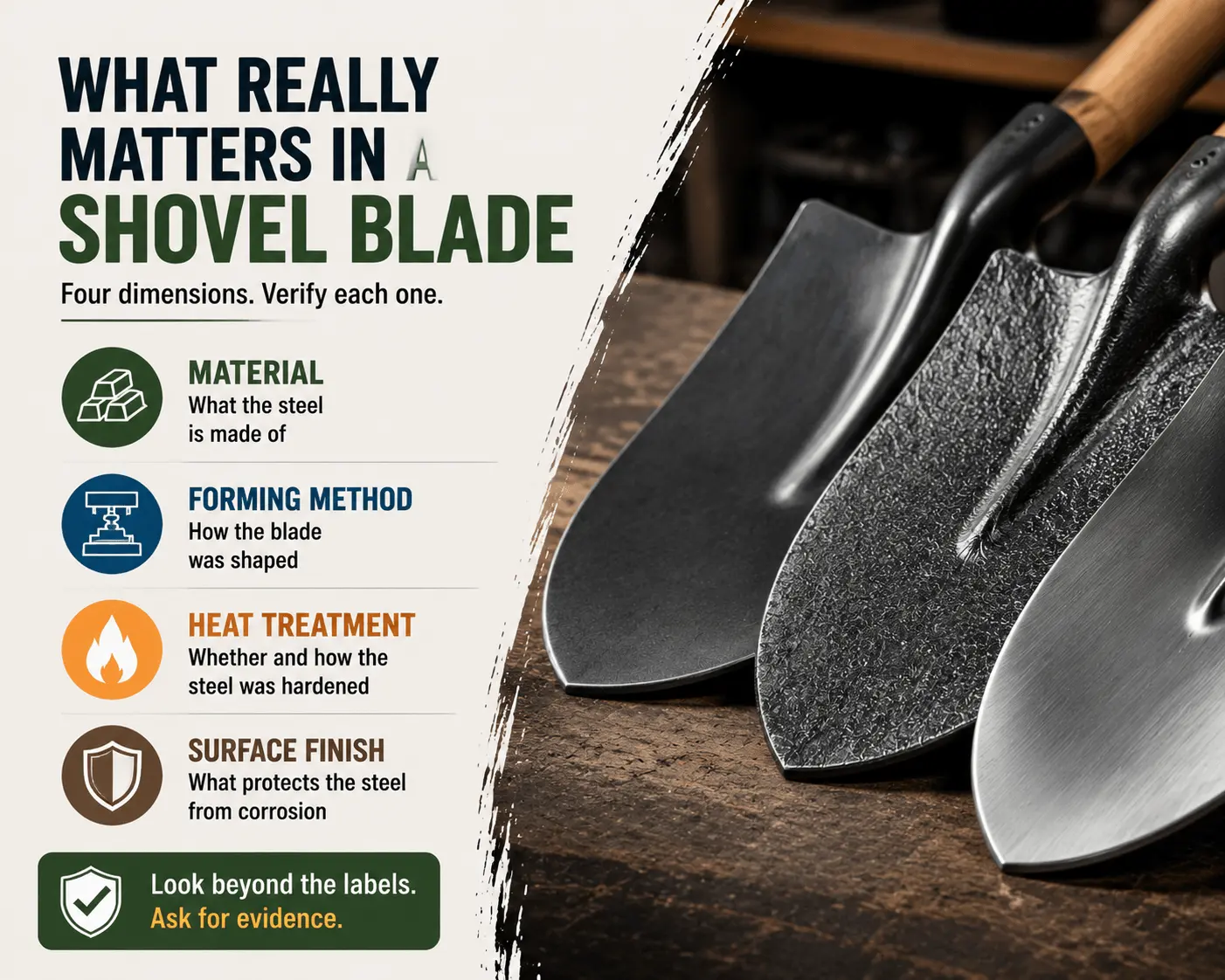
- The most useful framework for buyers is to separate four dimensions: Material / Forming method / Heat treatment / Surface finish — and verify each independently.
- Brand marketing claims (e.g., “50% stronger”) apply to specific products under specific conditions — they cannot be generalized to all tools of the same type.
- What matters in procurement is not the label but the evidence: material documentation, forming method confirmation, heat treatment details, and measurable test results.
When a supplier or brand says a shovel blade is “forged,” “heat-treated,” or made from “boron steel,” what does that actually tell you? For many buyers, these terms function as quality signals — but without understanding what they mean and what evidence supports them, they are just marketing labels.
This guide separates the marketing language from the manufacturing reality. It covers the four dimensions that actually define a shovel blade’s construction: material, forming method, heat treatment, and surface finish. For each, it explains what the term means, what it does not mean, and what evidence a buyer should request.
Who this guide is for: Professional tool buyers, brand owners, and quality teams who need to evaluate construction claims and verify them before placing bulk orders.
The Four Dimensions of Blade Construction
Most confusion arises because buyers and suppliers mix terms from different dimensions. Here is the framework:
| Dimension | What It Describes | Common Terms | What It Does NOT Tell You |
| Material | What the steel is made of | Carbon steel, manganese steel, boron steel, stainless steel | How it was formed or treated |
| Forming method | How the blade was shaped | Stamped, roll-forged, drop-forged | What the material is or whether it was heat-treated |
| Heat treatment | Whether and how the steel was hardened/tempered | Hardened, tempered, quenched | What the material is or how it was formed |
| Surface finish | What protects the steel from corrosion | Painted, powder-coated, epoxy, bare | Anything about the steel’s structural properties |
A blade can be: carbon steel + stamped + tempered + powder-coated. Or: boron steel + forged + untreated + painted. These are four independent choices — knowing one does not tell you the others.
Verify The Process Behind The Product Claim
Product descriptions often highlight performance, durability, or premium materials — but the supporting details matter. Send us the supplier specification or product photo. We will identify which material and process details still need evidence.
Stamped Blades
What It Means
Stamping is a manufacturing process where a flat steel sheet is pressed (stamped) into the blade shape using a die. The steel is cut and formed in a single or multi-stage pressing operation.
What Stamping Does Well
- High volume efficiency: Stamping is the most cost-effective method for producing large quantities of standard blade shapes.
- Consistency: Once the die is set, each blade is dimensionally consistent — important for quality control and packaging.
- Design flexibility: Complex blade shapes, foot steps, and socket forms can be created in the stamping process.
What to Verify
- Steel grade and thickness: Stamping does not determine the material — a stamped blade can be made from any grade of steel sheet. Always confirm the actual steel grade and thickness.
- Post-forming thickness: Stamping can thin the steel at draw points and curves. Verify thickness at critical areas, not just the raw sheet specification.
- Heat treatment: A stamped blade may or may not be heat-treated after forming. Heat treatment significantly affects performance — confirm whether it has been done.
- Edge condition: Stamped cutting edges may have burrs or may be sharpened in a secondary operation. Confirm the edge specification.
Actual blade thickness should always be verified rather than relying only on labels. See 14-Gauge, 15-Gauge, or 16-Gauge Shovel Blades for more details.
What Stamping Does NOT Guarantee
A stamped blade is not automatically lower quality than a forged one. A well-stamped blade made from good steel, properly heat-treated, with adequate thickness and geometry, can perform well for its intended use. The question is whether the construction method matches the expected use case and price point.
Forged Blades
What It Means
Forging is a manufacturing process where steel is shaped by compressive force — typically through drop forging, roll forging, or press forging. In shovel manufacturing, forging can produce the blade and socket as a single piece of steel with continuous grain flow.
The Forging Industry Association explains that forging refines the steel’s microstructure by closing internal vacancies and realigning grain flow to follow the part’s contours — producing a structurally stronger piece with improved mechanical properties.
For buyers evaluating shovel construction options, reviewing an actual product example can help connect technical terms with real specifications. You can also explore our stainless steel garden shovel range to compare blade design, handle options, and product details for sourcing evaluation.
What Forging Does Well
- Grain flow continuity: In a forged head, the grain structure follows the shape of the part — including the critical transition from blade to socket. There is no stamped or welded junction at the stress point.
- Strength at critical areas: The grain continuity provides strength where stress concentrates — at the shoulder, neck, and socket.
- Elimination of casting defects: Forging closes porosity and eliminates the shrinkage cavities that can occur in casting.
What to Verify
- Which part is forged? “Forged” may refer to the entire blade-and-socket assembly, or only to the socket/neck while the blade is stamped. Ask specifically: “Is the blade-to-socket junction forged as one piece, or are they separate components joined by welding or riveting?”
- Material grade: Forging improves the structure of the steel — but it does not change what the steel is. A forged blade made from low-carbon steel may still be inferior to a stamped blade made from high-carbon heat-treated steel.
- Heat treatment: Forged blades may or may not be subsequently heat-treated. Confirm whether tempering or hardening was applied.
What Forging Does NOT Guarantee
The Forging Industry Association notes that forging eliminates the metallurgical discontinuities associated with welding and the structural defects that can occur in casting — but a well-executed stamped-and-riveted blade can still perform adequately for its intended use. Forging is advantageous at high-stress points, but it is not automatically superior in all cases. The question is whether the construction method matches the expected load and service life.
The product catalog includes models specifically marked “Forged spade” — confirming that forged construction is available for specific models. However, not all models in the range are forged. Always confirm the construction method for the specific model you are sourcing.
After confirming construction details, buyers should also verify actual product quality through inspection. See How to Inspect Square Point Shovels for a practical QC framework.
Compare Forged And Stamped Structures Fairly
Forged and stamped shovel structures should be evaluated under the same conditions, not only by marketing descriptions. We can arrange a comparison based on the same use case, blade size, handle, and agreed test method to help identify real differences.
Tempered and Heat-Treated Blades
What It Means
Heat treatment is a process where steel is heated to a specific temperature and then cooled (quenched) at a controlled rate, followed by tempering — reheating to a lower temperature to reduce brittleness while maintaining hardness. The result is steel that is harder and more resistant to permanent deformation than untreated steel of the same grade.
Why It Matters
Heat treatment can significantly improve a blade’s resistance to bending and deformation. An untreated carbon steel blade may bend under a load that a tempered blade of the same grade and thickness would resist. For shovels used in heavy material moving or ground engagement, heat treatment can be the difference between a blade that holds its shape and one that bends permanently.
What to Verify
- What was treated? Heat treatment may be applied to the entire blade, only the cutting edge, or specific areas. Confirm which parts of the blade were treated.
- What process? Ask whether the treatment is hardening (quenching), tempering, or both. These are different processes with different effects.
- Hardness values: If available, ask for hardness measurements (e.g., HRC values) at specified points. However, specific hardness values are not typically listed in product catalogs for garden tools. If the factory cannot provide details, do not claim specific hardness — describe the blade as “steel” and note that heat treatment details should be confirmed with the factory for critical applications.
- Consistency: Heat treatment quality varies between batches. For critical applications, verify that the treatment is consistent across the production run — not just on the golden sample.
What Heat Treatment Does NOT Guarantee
- Harder is not always better. Over-hardened steel becomes brittle and may crack or chip instead of bending. The goal is a balance: hard enough to resist deformation, tough enough to resist fracture.
- Heat treatment does not change the steel’s chemical composition. A heat-treated low-carbon steel blade will perform better than an untreated one — but it may still not match a heat-treated medium-carbon or alloy steel blade.
Boron Steel Blades
What It Means
Boron steel is a carbon steel alloyed with a small amount of boron (typically less than 0.005%). The boron addition significantly increases the hardenability of the steel — meaning it can achieve higher hardness through heat treatment than a comparable carbon steel without boron.
What Boron Steel Does Well
- High strength-to-weight ratio: Boron steel can achieve the same or greater hardness as thicker carbon steel at a lighter weight — allowing for a thinner, lighter blade without sacrificing strength.
- Wear resistance: Hardened boron steel resists surface wear from abrasive materials (sand, gravel) better than untreated carbon steel.
What to Verify
- Is it actually boron steel? Do not claim boron steel unless the specific product has been confirmed to use it. The product catalog does not specify boron steel for standard models. Brands like Corona use boron steel as a market sample — this does not mean all shovels use it.
- Material documentation: Ask for material certification or supplier documentation. If the factory cannot provide documentation, describe the material as “steel” without specifying the alloy.
- Heat treatment is essential: Boron steel’s advantage comes from its response to heat treatment. Untreated boron steel performs similarly to untreated carbon steel. The benefit only materializes when the steel is properly hardened and tempered.
What Boron Steel Does NOT Guarantee
Boron steel is not automatically superior to all carbon steels. A well-heat-treated medium-carbon steel blade may match or exceed a poorly-treated boron steel blade. The alloy is one factor — the forming, treatment, and geometry are equally important. Do not treat “boron steel” as a universal quality stamp.
Build A Clear Technical Data Request Before Sourcing
Need a clearer technical data request? We can prepare a supplier question list covering material, forming process, heat treatment, coating, dimensions, and traceability — helping your team collect the information needed for better sourcing decisions.
How to Write Accurate Product Specifications
When creating product pages, packaging, or specification sheets, here is how to use material and process terms accurately:
| Term | Correct Usage | Incorrect Usage |
| “Forged” | “The blade and socket are forged as one piece” (when confirmed) | “Forged quality” (vague — which part? what quality?) |
| “Stamped” | “The blade is stamped from steel sheet” (factual) | “Stamped construction” as a quality judgment |
| “Heat-treated” | “The blade is hardened and tempered” (when confirmed) | “Heat-treated for superior strength” (unverifiable claim) |
| “Boron steel” | “The blade is made from boron steel (grade confirmed)” (when documented) | “Premium boron steel” (without documentation) |
| “Carbon steel” | “The blade is made from carbon steel” (when grade is not specified further) | “High-quality carbon steel” (subjective) |
Create Accurate Specifications For Your Private Label Products
Build product pages and packaging with verified information. We can help define accurate specification terms, confirm supported material descriptions, and remove unsupported claims that may create customer confusion.
FAQ
Is a forged shovel blade always better than a stamped one? Not necessarily. Forging provides continuous grain flow and eliminates junction weaknesses — advantageous at high-stress points. But a well-executed stamped blade made from good steel, properly heat-treated, with adequate thickness and geometry, can perform adequately for its intended use case and price point. The question is whether the construction method matches the expected load and service life.
What is boron steel and is it worth the premium? Boron steel is carbon steel alloyed with a small amount of boron, which increases hardenability. When properly heat-treated, it can achieve high hardness at a lighter weight. Whether it is “worth it” depends on the application — for heavy-duty professional use, the strength-to-weight advantage may justify the cost. For budget or seasonal tools, standard carbon steel with appropriate thickness may be sufficient.
How do I know if a blade is heat-treated? Ask the factory. If they cannot provide heat treatment details (process, target hardness, measurement points), do not claim it. Specific hardness values are not typically listed in garden tool product catalogs. If treatment is confirmed but specific values are not available, describe the blade as “heat-treated” without specifying hardness numbers.
Can I request material certification from a supplier? Yes. Ask for material test certificates (often called mill certificates or material certificates) that confirm the steel grade. If the factory cannot provide them, describe the material as “steel” without specifying a grade. Do not claim a specific alloy without documentation.
Does “tempered” mean the blade will not bend? No. Tempering increases resistance to permanent deformation — but any steel will bend if the load exceeds its capacity. Tempering means the blade resists bending better than untreated steel of the same grade and thickness. It does not make the blade unbreakable or immune to deformation under excessive load.