











Updated 2 months ago
14-Gauge, 15-Gauge, or 16-Gauge Shovel Blades: What Gauge Really Means for Buyers
SCARECROW GARDEN SUPPLIER
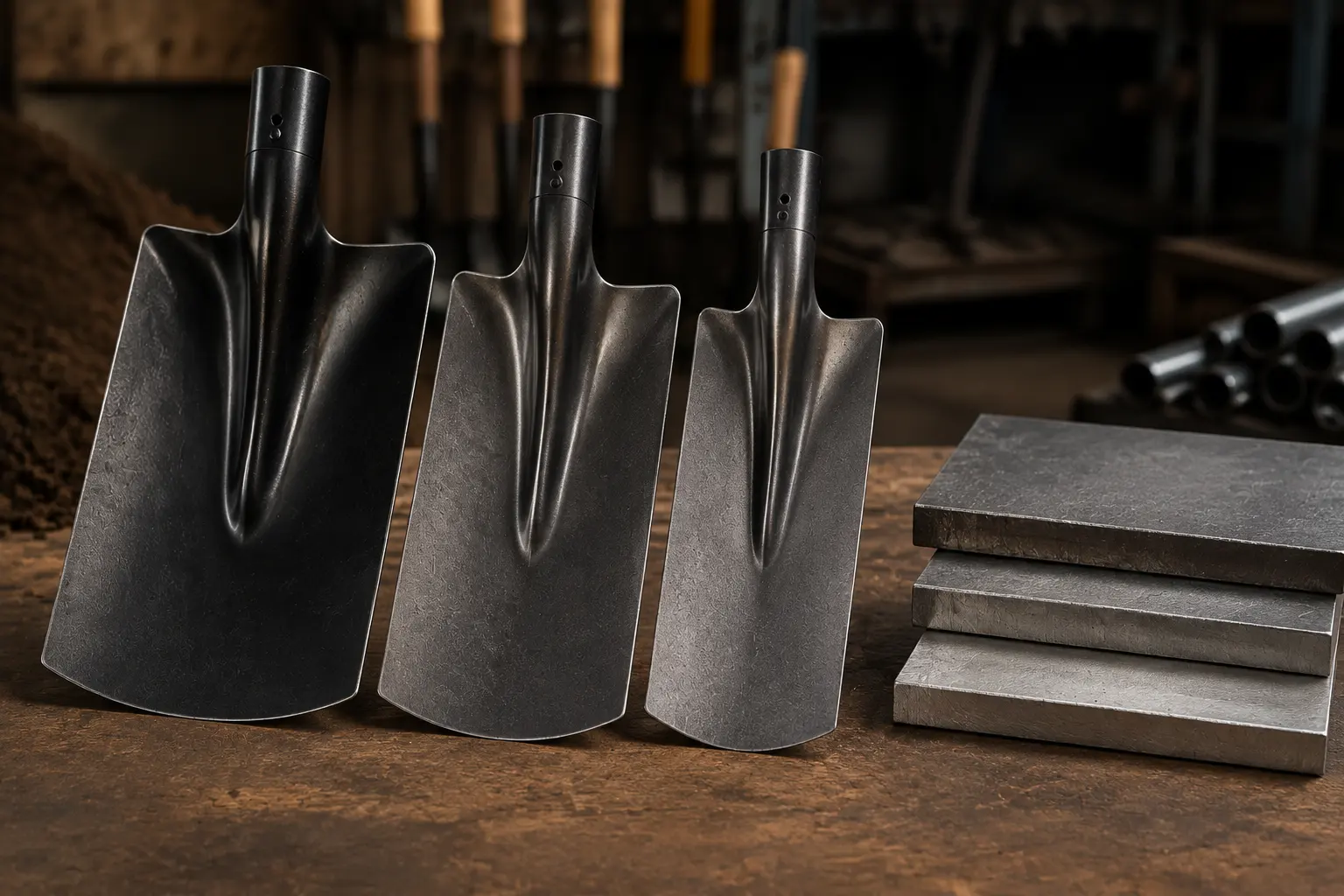
Shovel Blade Gauge: 14, 15, 16 Gauge Thickness Guide | Scarecrow Garden Supplier
Key Takeaways
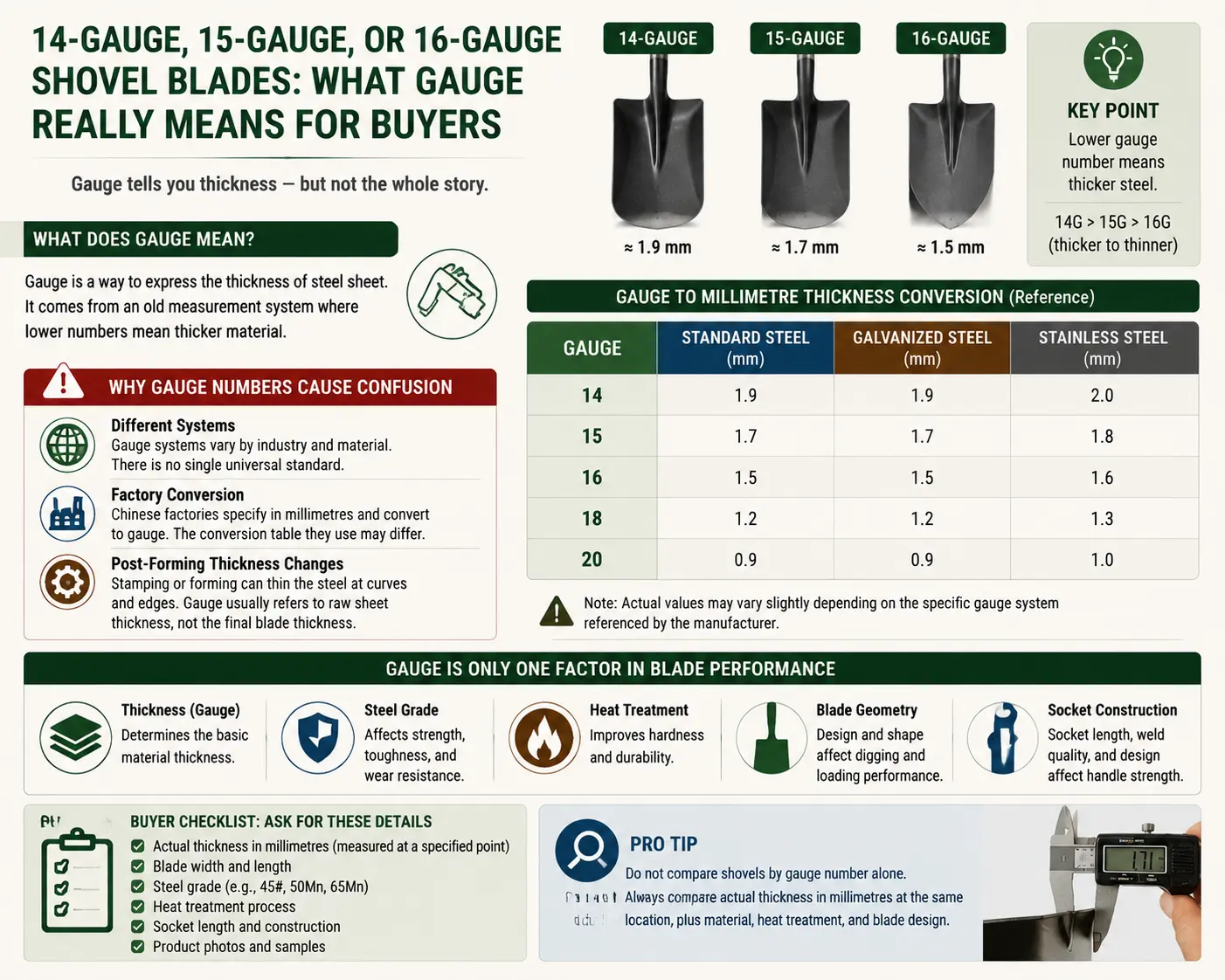
- Gauge is not a single universal standard. The same gauge number can correspond to different actual thicknesses depending on the material system being referenced.
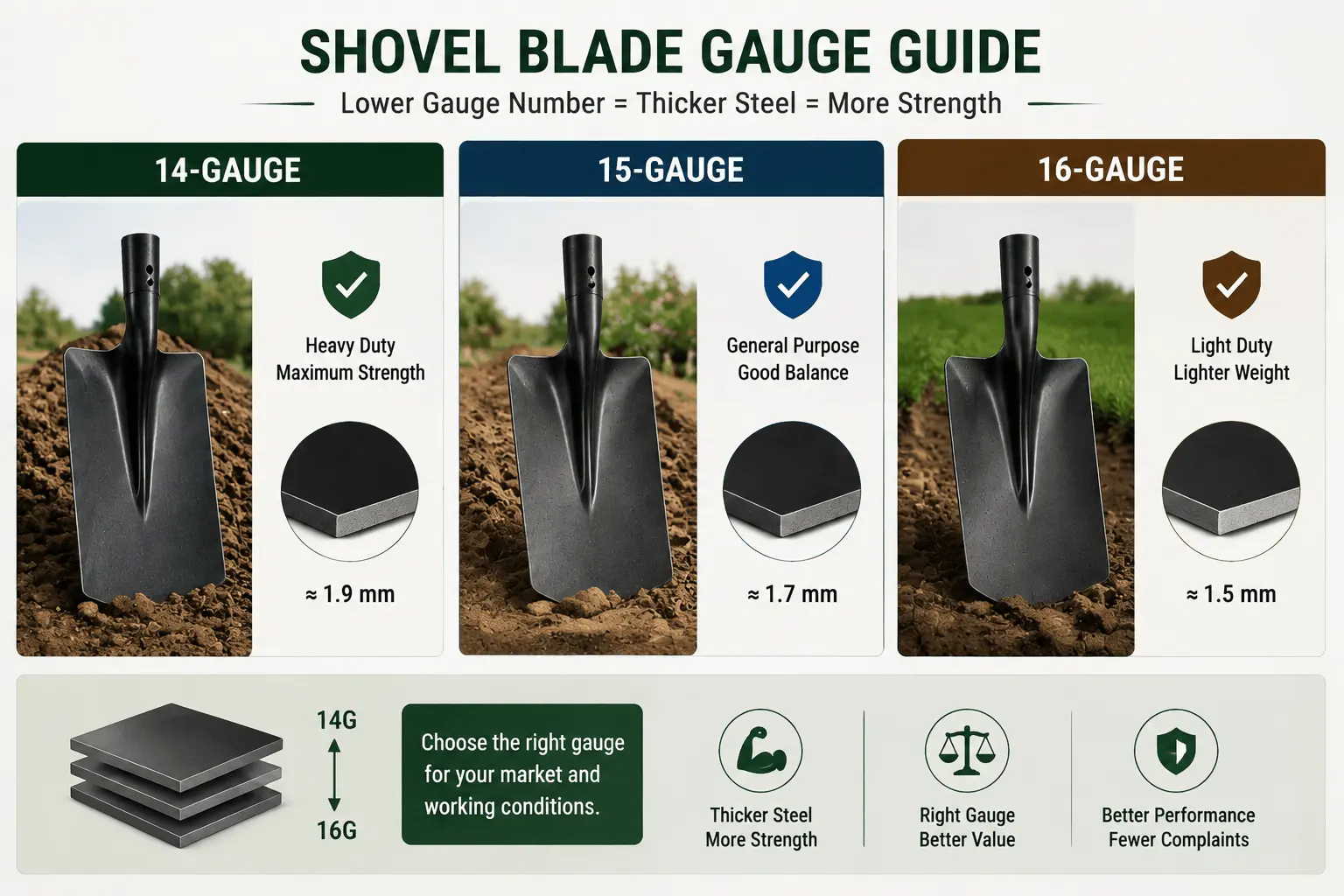
- In the standard steel sheet metal gauge system: 14-gauge ≈ 1.9 mm, 15-gauge ≈ 1.7 mm, 16-gauge ≈ 1.5 mm. Lower gauge number means thicker steel.
- Gauge tells you about thickness — but thickness alone does not determine strength. Steel grade, heat treatment, blade geometry, and socket construction all contribute to real-world performance.
- Chinese factories typically specify in millimetres, not gauge. When exporting to gauge-using markets, the factory converts — but the conversion depends on which gauge system they reference.
- Always ask for actual thickness in millimetres, measured at a specified point on the blade. Do not compare shovels by gauge number alone.
If you have browsed shovel specifications, you have seen the numbers: “14-gauge,” “15-gauge,” “16-gauge.” These numbers appear on product pages, in factory quotes, and in buyer specifications. But what do they actually mean? And more importantly — can you use gauge numbers to compare shovels from different suppliers?
The short answer is: gauge is useful information, but it is not a complete specification. Understanding what gauge tells you, what it does not tell you, and how to verify actual blade thickness is essential for any buyer who wants to make informed sourcing decisions rather than relying on marketing labels.
This guide is for importers, hardware buyers, quality engineers, and product managers who need to understand steel thickness specifications and use them correctly in procurement and quality control.
The Warning: Gauge Is Not a Universal Standard
Here is the most important thing to understand about gauge: it is not a single, globally unified measurement system.
The gauge system has historical roots in the Birmingham Wire Gauge system, which was developed for sheet metal in the 19th century. It is a counter-intuitive system — lower numbers mean thicker material. But the specific thickness that corresponds to a given gauge number varies depending on the material:
| Gauge | Standard Steel (mm) | Galvanized Steel (mm) | Stainless Steel (mm) |
| 14 | 1.9 | 1.9 | 2.0 |
| 15 | 1.7 | 1.7 | 1.8 |
| 16 | 1.5 | 1.5 | 1.6 |
| 18 | 1.2 | 1.2 | 1.3 |
| 20 | 0.9 | 0.9 | 1.0 |
Source note: Gauge-to-millimetre conversions based on standard sheet metal gauge tables. Actual values may vary slightly depending on the specific gauge system referenced by the manufacturer.
This means that when a supplier says “14-gauge,” you need to know: 14-gauge of what? Standard carbon steel? Galvanized steel? Stainless steel? The difference may be small (1.9 mm vs. 2.0 mm), but in quality control, precision matters.
Verify Shovel Quality Beyond Gauge Numbers
Do not approve a shovel by gauge alone. Send us your product specification and we will check whether the actual millimetre thickness, blade size, material, and construction details are clearly defined before production approval.
Why Gauge Numbers Cause Confusion
Problem 1: Different Systems
Different industries and regions use different gauge systems. The sheet metal gauge used for shovel blades is not the same as the American Wire Gauge (AWG) used for electrical wire, or the Standard Gauge used for some non-ferrous metals. When a buyer sees “14G” on a product page, they may assume a universal standard — but there is no such thing.
Problem 2: Factory Conversion
Chinese factories typically manufacture and specify in millimetres. When an export customer asks for a “14-gauge shovel,” the factory converts 14-gauge to approximately 1.9 mm and produces accordingly. But if the factory uses a slightly different gauge reference table, the actual thickness may be 1.8 mm or 2.0 mm — close, but not identical.
Problem 3: Post-Forming Thickness Changes
When a flat steel sheet is stamped or roll-forged into a shovel blade, the material thins at certain points — particularly at curves, shoulders, and deep-draw areas. For example, the “14-gauge” specification may refer to the raw sheet thickness before forming, not the actual thickness at the finished blade’s critical stress points. A blade that starts as 1.9 mm sheet may, for example, measure 1.7 mm at the shoulder after forming.
Problem 4: Coating Adds Thickness
Painted and powder-coated finishes add a layer on top of the steel. A caliper measurement of a finished, coated blade will include the coating thickness — which may add 0.05–0.15 mm. This means a “1.9 mm” measurement on a coated blade may actually be 1.75 mm of steel plus 0.15 mm of coating.
What Thickness Actually Means for Performance
Thicker steel is generally stronger — but “thicker is better” is an oversimplification. Here is what actually determines whether a shovel blade performs well:
Thickness and Bending Resistance
A thicker blade resists bending under load. This is straightforward physics — more material in the cross-section means more resistance to deformation. A 14-gauge (1.9 mm) blade will resist bending better than a 16-gauge (1.5 mm) blade of the same steel grade and geometry.
However, thickness is only one factor. Steel grade, forming method, and heat treatment also affect performance. See Forged, Stamped, Tempered, and Boron Steel Shovel Blades for a deeper construction comparison.
But Thickness Is Not the Only Variable
| Factor | Why It Matters |
| Steel grade | A heat-treated boron steel blade at 1.7 mm may outperform a low-carbon steel blade at 1.9 mm |
| Heat treatment | Hardened and tempered steel resists permanent deformation better than untreated steel of the same thickness |
| Blade geometry | A blade with deeper concavity, reinforced shoulders, or a longer socket distributes stress more effectively — regardless of thickness |
| Foot step reinforcement | A double-folded or reinforced tread area resists foot-pressure deformation that a single-thickness tread would not |
| Neck and socket design | A longer socket and reinforced neck distribute force from the handle into the blade more effectively, reducing stress concentration |
When selecting a garden shovel for wholesale distribution, blade thickness should always be evaluated together with material, corrosion resistance, handle connection, and overall construction. Our stainless steel garden shovel models are designed for buyers who need a durable option for garden retail and professional applications.
The Weight Trade-Off
Thicker steel means a heavier blade — and a heavier tool. A 14-gauge shovel is noticeably heavier than a 16-gauge shovel of the same size. For users doing repetitive scooping work, the extra weight increases fatigue. The question is not always “what is the thickest?” but “what is the right thickness for the intended use?”
- Heavy-duty material moving (construction, agriculture): 14-gauge range is appropriate.
- General-purpose landscaping: 15-gauge range is typical and balanced.
- Light-duty or budget retail: 16-gauge range may be acceptable for seasonal or light use.
Confirm Blade Thickness With Real Sample Measurements
Need measured blade-thickness photos? We can record the measuring position and actual sample result for the shortlisted model, helping your team verify the real construction details before production approval.
What to Ask a Supplier About Blade Thickness
When sourcing shovels, the following fields should be confirmed in writing:
| Field | Why It Matters | What to Ask |
| Actual thickness in mm | The real specification — not a converted approximation | “What is the actual steel thickness in millimetres at the blade center?” |
| Measurement position | Thickness varies across the blade after forming | “Where on the blade is this measurement taken?” |
| Gauge system referenced | If gauge is used, which system? | “Which gauge standard are you referencing?” |
| Pre-forming vs. post-forming | Raw sheet thickness may differ from finished blade thickness | “Is this the raw sheet thickness or the finished blade thickness?” |
| Steel grade | Thickness without grade is incomplete | “What steel grade or category is used?” |
| Heat treatment | Treated steel performs differently from untreated | “Is the blade heat-treated? What process?” |
| Coating thickness | Coating adds to caliper measurements | “Is the thickness specified for bare steel or including coating?” |
How to Verify Blade Thickness
Caliper Measurement
The most direct method: use a caliper to measure the blade thickness at a specified point. For consistency, measure at:
- The center of the blade (between the cutting edge and the shoulder)
- The shoulder area (where the blade meets the neck/socket — a high-stress zone)
- Near the cutting edge (to check for thinning from forming)
Record all three measurements. If the blade is coated, note that the measurement includes coating thickness — or remove a small area of coating to measure bare steel.
Weight Comparison
If you have two blades of the same size and geometry but different gauge ratings, weighing them provides a quick comparison. A 14-gauge blade should be noticeably heavier than a 16-gauge blade of the same size. If the weights are similar, the thickness difference may not be what the gauge numbers suggest.
Functional Load Test
For practical verification, apply a controlled load to the blade and measure any permanent deformation. This tests not just thickness but the combined effect of thickness, steel grade, heat treatment, and geometry. The test method, load point, and acceptance criteria should be agreed between buyer and supplier before testing.
Important: A single load test does not replicate the full range of field conditions. It provides a data point for comparison — not a guarantee of field performance. For a detailed testing framework, see Garden Tool Testing for Buyers.
Compare Blade Structures Under The Same Test Conditions
Comparing two blade structures requires more than looking at photos. Ask for a sample test plan that controls blade size, handle, load point, and acceptance criteria, so different structures can be evaluated fairly before production decisions.
How to Write Gauge Specifications Correctly
If you are creating product pages, packaging, or specification sheets, here is how to use gauge accurately:
Do:
- State the gauge number and the actual millimetre thickness: “14-gauge (approximately 1.9 mm)”
- Specify the measurement position: “measured at blade center, bare steel”
- Note whether the thickness is pre-forming or post-forming
- Use gauge as a comparative indicator, not an absolute specification
Do Not:
- State a gauge number without the millimetre equivalent
- Claim that a specific gauge guarantees a specific performance level
- Compare gauge numbers across different material systems without confirming which system is used
- Use “heavy-duty” as a substitute for actual thickness and material data
Turn “Heavy Duty” Claims Into Real Specifications
Avoid unclear product descriptions based only on marketing terms. We can help convert labels such as “heavy duty” or “premium” into measurable fields for sourcing, comparison, and quality control.
FAQ
Is 14-gauge always better than 16-gauge? Not necessarily. A 14-gauge blade is thicker and resists bending better — but it is also heavier, which increases user fatigue. If the tool is for light-duty or seasonal use, 16-gauge may be sufficient. The “better” choice depends on the intended use, steel grade, heat treatment, and target user. A heat-treated 15-gauge blade may outperform an untreated 14-gauge blade.
Why do different suppliers give different mm values for the same gauge? Because gauge is not a universal standard. Different gauge systems and reference tables may give slightly different millimetre equivalents. Additionally, factories may measure at different points on the blade or report raw sheet thickness versus finished blade thickness. Always confirm the actual measurement in millimetres.
Can I compare gauge numbers from different suppliers? Only if you confirm they are referencing the same gauge system and measuring at the same point on the blade. If these are not confirmed, gauge numbers from different suppliers are not directly comparable. Ask for millimetre measurements instead.
Does coating thickness count toward the gauge measurement? It should not — gauge refers to the steel thickness, not the coating. But in practice, a caliper measurement of a finished, coated blade will include the coating. If precision matters, measure bare steel (by removing a small area of coating) or ask the supplier to specify bare-steel thickness.
How do I know if a factory is using the right gauge? Ask for the actual millimetre thickness, measured at a specified position, and verify it with your own caliper measurement on a sample. If the factory says “14-gauge” but the sample measures 1.5 mm, there is a discrepancy that needs to be resolved before production approval.