






Updated 2 months ago
Square Point Shovel vs. Round Point Shovel vs. Garden Spade: What Is the Difference?
SCARECROW GARDEN SUPPLIER

Square Point vs. Round Point Shovel vs. Garden Spade | Scarecrow Garden Supplier
Key Takeaways
- These three tools are not variations of the same product. They differ in blade shape, blade-to-handle angle, and primary working motion — which determines what task each is built for.
- A square point shovel scoops and moves loose material. A round point shovel digs and penetrates soil. A garden spade cuts edges and does precision work.
- “Spade” and “shovel” are not used consistently across all markets — always confirm the blade structure, not just the name.
- For B2B buyers, stocking all three is not redundant — they serve genuinely different tasks. The mistake is stocking two tools that do the same job.
- The blade-to-handle angle is the single most reliable indicator of whether a tool is a shovel (angled for scooping) or a spade (near-right angle for pushing down).
A customer asks for “a shovel.” Do they mean a square point for moving gravel, a round point for digging a hole, or a garden spade for edging a flower bed? All three tools may appear in the same catalogue under similar names — but they are built for fundamentally different tasks. Understanding the distinction is essential for anyone sourcing, stocking, or labeling garden tools.
This guide compares the three most commonly confused flat-blade and shovel tools: the square point shovel, the round point shovel, and the garden spade. The goal is to help buyers and retail staff match the right tool to the right task — and avoid the returns, complaints, and dead stock that come from wrong selection.
The Quick Answer
Here is the core distinction in three sentences:
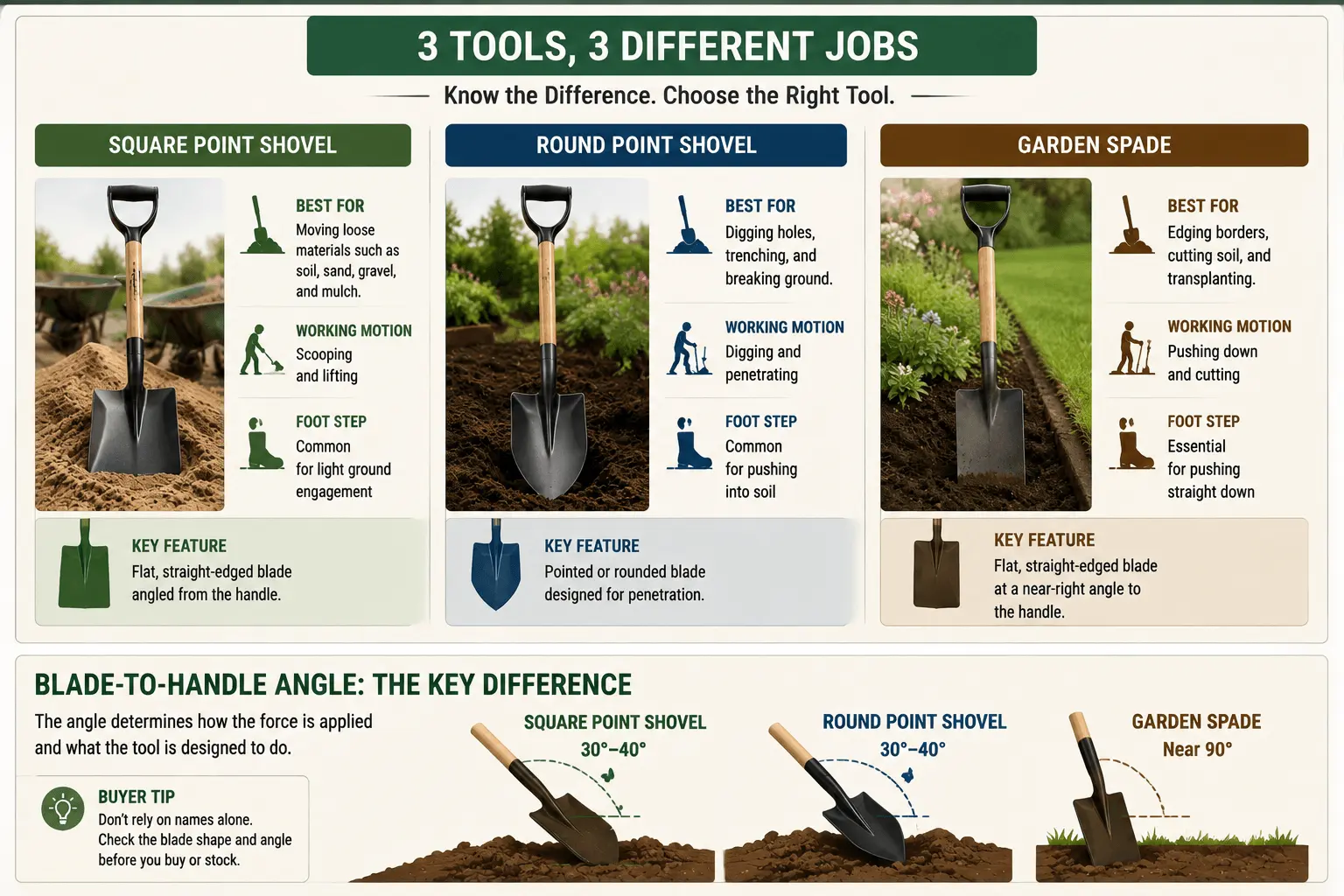
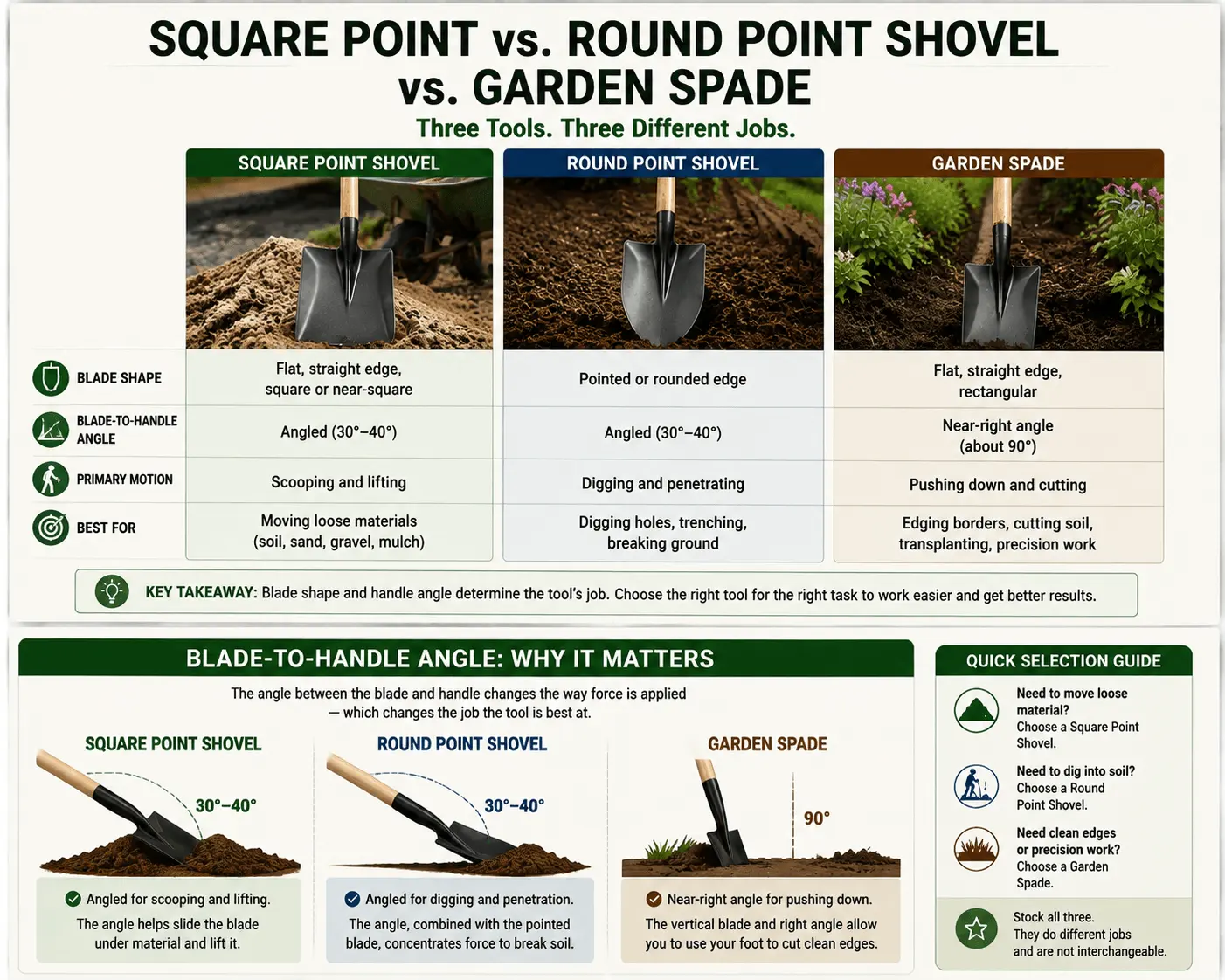
A square point shovel has a flat, straight-edged blade angled from the handle — designed for scooping and moving loose material like soil, sand, gravel, and mulch.
A round point shovel has a pointed or rounded blade — designed for penetrating and digging into soil, with the point concentrating force to break ground.
A garden spade has a flat, straight-edged blade set at a near-right angle to the handle — designed for pushing straight down with the foot to cut clean edges and do precision digging.
| Feature | Square Point Shovel | Round Point Shovel | Garden Spade |
| Blade shape | Flat, straight cutting edge, square or near-square | Pointed or rounded cutting edge | Flat, straight cutting edge, rectangular |
| Blade-to-handle angle | Angled (typically 30–40°) | Angled (similar to square point) | Near-right angle (close to 90°) |
| Primary motion | Scooping and lifting | Digging and penetrating | Pushing down and cutting |
| Best for | Moving loose material (soil, sand, gravel, mulch) | Digging holes, trenching, breaking ground | Edging borders, cutting soil, transplanting |
| Foot step | Common; for light ground engagement | Common; for pushing into soil | Essential; for pushing straight down |
| Not ideal for | Hard ground penetration; precision edging | Scooping large volumes of loose material | Scooping and moving material |
| Typical blade width | 230–300+ mm | 200–280 mm | 150–250 mm (narrower) |
Source note: Task differentiation based on Iowa State University Extension — “Selecting the Correct Garden Tool for the Job” — and Royal Horticultural Society guidance on border creation and soil preparation. Iowa State Extension applies a task-specific principle across garden tools: different tool shapes serve different purposes, whether for raking, digging, or edging. The same principle distinguishes shovels (scooping) from spades (cutting).
Not Sure Which Shovel Structure Your Customer Needs?
Match the tool name to the actual blade structure. Send us a photo or drawing, and we will confirm whether it is closer to a square-point shovel, round-point shovel, or garden spade before recommending the right model.
Blade Shape: What the Edge Tells You
Square Point — The Straight Edge
The straight cutting edge of a square point shovel is its defining feature. This edge is designed to slide under loose material — not to punch through it. When the user pushes the shovel forward along the ground, the straight edge acts like a broom, gathering material into the blade’s concavity. The wide, flat blade maximizes the volume of material collected per scoop.
This is why square point shovels are the standard tool for landscaping, construction material handling, and agricultural material moving. The blade shape is optimized for volume and efficiency in loose material — not for ground penetration.
Round Point — The Concentrated Force
The pointed or rounded cutting edge of a round point shovel is designed to concentrate force at a single point. When the user pushes down and forward, the point penetrates the soil — breaking through compacted ground, clay, and mixed material. The narrower blade reduces the volume per scoop, but the trade-off is necessary: a wider blade would require more force to push into ground.
Round point shovels are the standard digging tool. If your customers need to dig fence-post holes, plant trees, trench for irrigation lines, or break new ground, they need a round point shovel — not a square point.
Garden Spade — The Cutting Blade
A garden spade’s blade is flat and straight-edged, similar to a square point shovel. The difference is the angle. A spade’s blade sits at a near-right angle to the handle — meaning the user pushes the blade straight down into the soil, using body weight and foot pressure, rather than scooping in a levering motion.
The spade’s straight edge makes clean vertical cuts in soil — ideal for creating crisp garden borders, edging lawns, and cutting turf. The narrower blade (compared to a square point shovel) allows the user to work in tighter spaces and make precise cuts.
Working Angle: The Most Reliable Indicator
If you remember one thing from this guide, remember this: the blade-to-handle angle tells you what the tool is for.
- Angled blade (shovel): The blade sits at an angle to the handle — typically 30–40°. This angle creates a lever. The user pushes the blade into material and lifts, using the handle as a lever arm. This motion is for scooping and moving.
- Near-right angle (spade): The blade sits close to 90° from the handle. The user stands on the foot step and pushes straight down. There is no levering motion — the force goes directly into the ground. This motion is for cutting and edging.
This distinction is recognized across horticultural authorities. Iowa State University Extension and the Royal Horticultural Society both differentiate shovels (scooping tools) from spades (cutting tools) based on working angle and primary motion.
When sourcing: Do not rely on the name. A factory may call a tool a “spade” when its blade angle makes it functionally a shovel, or vice versa. Ask for the blade-to-handle angle — or better, ask for a side-view photo.
Handle configuration also changes working motion and user control. Buyers can compare this further in Long Handle vs. D-Grip Shovel: Reach, Leverage, Control, and Retail Positioning.
Task-by-Task Comparison
Here is how each tool performs on specific jobs:
| Task | Square Point Shovel | Round Point Shovel | Garden Spade | Best Choice |
| Moving a pile of soil | Wide blade scoops maximum volume per lift | Narrower blade holds less; less efficient | Blade too flat; material spills off | Square point shovel |
| Digging a post hole in clay | Flat edge cannot penetrate efficiently | Point concentrates force; penetrates clay | Too narrow for deep digging | Round point shovel |
| Edging a lawn border | Blade angle wrong for vertical cutting | Blade shape wrong for clean edge | Straight edge + right angle = clean vertical cut | Garden spade |
| Mixing compost into soil | Good for scooping and turning material | Can dig but less efficient for mixing | Good for cutting and turning in tight spaces | Square point or spade |
| Spreading gravel or mulch | Wide flat blade spreads evenly | Narrow blade makes spreading slow | Not designed for spreading material | Square point shovel |
| Transplanting a shrub | Too much blade; may damage roots | Can dig around plant but blade is pointed | Clean vertical cuts around root ball; precise | Garden spade |
| Trenching for irrigation | Can move loose soil from trench | Point breaks ground for trench | Clean vertical walls for trench edges | Round point + spade combo |
Important: This table shows “best fit,” not “only option.” All three tools can perform most tasks — the difference is efficiency, user fatigue, and quality of result.
Build A Three-Tool Collection That Covers Real Customer Needs
Need a three-tool assortment for retailers? We can select non-overlapping models that clearly cover digging, transferring, and edging tasks. Create a balanced product mix instead of adding similar tools that compete with each other on the shelf.
Naming Confusion Across Markets
The terms “shovel” and “spade” are not used consistently across all markets. Here is where confusion arises:
In North America: “Shovel” typically refers to any long-handled tool with an angled blade used for scooping or digging. “Spade” typically refers to a tool with a flat blade at a right angle, used for cutting and edging. This distinction is relatively consistent.
In the UK and Commonwealth: “Spade” is sometimes used more broadly — a “digging spade” is a common garden tool that functions more like what North Americans would call a round point shovel. The term “shovel” in UK English often implies a larger, more industrial tool for moving material.
In trade documentation: Chinese export factories may use “square nose shovel” for square-blade tools and “spade” for flat-blade tools without distinguishing the working angle. The name on the export document may not match the name your customer uses.
Practical guidance: When sourcing, always confirm three things:
Is the blade straight-edged or pointed?
What is the blade-to-handle angle?
Is there a foot step designed for downward pressure?
These three answers will tell you what the tool actually does — regardless of what the catalogue calls it.
How to Avoid Wrong Display and Labeling in Retail
For garden centers and hardware stores, the most common customer complaint is not about quality — it is about buying the wrong tool for the job. Here is how to prevent it:
1. Separate shovels from spades physically. Do not display a square point shovel next to a garden spade with the same label. Customers cannot tell the difference from the blade alone — but if they pick up the spade and try to scoop gravel, the wrong angle makes it awkward.
2. Label by task, not by name. Instead of “Square Point Shovel” and “Garden Spade,” consider task-based labels: “For Moving Material” and “For Cutting Edges.” This helps customers who do not know the terminology but know what they need to do.
3. Train staff on the angle test. If a staff member can demonstrate the difference between a scooping motion (shovel) and a pushing-down motion (spade), customers leave with the right tool.
4. Stock all three types if your range includes digging customers. A garden center that serves both landscapers (who dig) and homeowners (who edge borders) needs a round point shovel, a square point shovel, and a garden spade. Stocking only two means sending customers to a competitor for the third task.
Create Clearer Product Labels For Your Garden Tool Brand
Need better product labels and comparison copy? We can provide verified specification fields and clear use-case distinctions for your private-label packaging, helping customers understand product differences faster.
Structural Comparison: Beyond the Blade Edge
While the cutting edge is the most visible difference, other structural elements also vary:
| Parameter | Square Point Shovel | Round Point Shovel | Garden Spade |
| Blade concavity | Moderate — enough to hold material | Moderate — similar to square point | Minimal — flatter blade for clean cuts |
| Foot step | Common; for light ground engagement | Common; essential for pushing into soil | Essential; designed for full body-weight pressure |
| Socket/neck | Similar construction across types | Similar | Often shorter — less leverage needed for pushing |
| Handle length | Long (1,200–1,500 mm) or D-grip (900–1,020 mm) | Similar to square point | Often shorter (700–900 mm) — closer work |
| Typical steel thickness | 14–16 gauge range | 14–16 gauge range | 14–16 gauge range |
| Coating | Painted or powder-coated | Painted or powder-coated | Often powder-coated or stainless for retail |
The construction methods (stamping, roll forging, forging) and coating options are similar across all three types — the difference is in the geometry, not the material. For a detailed breakdown of construction and failure modes, see Forged, Stamped, Tempered, and Boron Steel Shovel Blades.
If you are sourcing garden shovels for retail or wholesale distribution, selecting the right structure is only the first step. Our stainless steel garden shovel models are designed for garden applications where durability, corrosion resistance, and consistent quality are important factors.
FAQ
Is a spade the same as a shovel? No. The key difference is the blade-to-handle angle. A shovel’s blade is angled (for scooping), while a spade’s blade is close to a right angle (for pushing straight down). Both can have flat blades, but they are designed for different motions and tasks. However, in some markets — particularly the UK — “spade” is used more broadly and may refer to tools that function like shovels.
Which tool is best for general garden use? For a general-purpose garden tool, a round point shovel is the most versatile — it can dig, scoop, and move material. A square point shovel is better if the primary task is moving loose material. A garden spade is a specialized tool for edging and precision work. For most homeowners, a round point shovel plus a garden spade covers the majority of tasks.
Can I use a garden spade to move soil? You can, but it is not efficient. A spade’s flat blade and right-angle handle position are designed for pushing down and cutting — not for scooping and lifting. The flat blade allows material to spill off the sides. For moving soil, a square point shovel is the better tool.
Should I stock all three types in my store? If your customers include both landscapers and home gardeners, stocking all three covers the main tasks: digging (round point), moving material (square point), and edging (spade). If space or budget is limited, start with a round point shovel — it is the most versatile single tool.
Why does my customer say “spade” but mean “shovel”? In some markets, particularly the UK, “spade” is used as a general term for digging tools, including tools that North Americans would call shovels. The customer may be using the term they are familiar with. Always confirm the blade shape and working angle rather than relying on the name.