








Updated 2 months ago
Square Point Shovels Explained: A Complete Buyer’s Guide to Flat-Blade Shovels
SCARECROW GARDEN SUPPLIER

Square Point Shovels Explained: A Complete Buyer’s Guide | Scarecrow Garden Supplier
Key Takeaways
- “Square point shovel,” “square mouth shovel,” and “flat shovel” often refer to the same tool — but different markets use different names, and some names overlap with tools that are structurally different.
- A square point shovel is designed primarily for scooping, moving, and spreading loose materials — soil, sand, gravel, mulch. It is not a digging tool in the way a round point shovel is.
- Blade gauge (14, 15, or 16) tells you about steel thickness, but gauge is not a universal standard — always verify actual millimetre thickness.
- Handle type (long handle vs. D-grip) changes the working motion, leverage, and retail positioning — not just the price.
- For B2B buyers, the key is understanding what your customers actually do with the tool, then matching blade size, gauge, handle, and finish to that task — not stocking every variant.
If you source garden or farm tools, you have probably encountered the naming problem. A customer asks for a “flat shovel.” Another calls it a “square point.” A UK buyer says “square mouth.” A Chinese factory quotes “square nose shovel.” They may all be describing the same tool — or they may not be. The name alone does not tell you whether the blade is designed for moving gravel, leveling soil, or edging a lawn bed.
A square point shovel is a flat-blade tool with a straight cutting edge, designed primarily for scooping, moving, and spreading loose materials such as soil, sand, gravel, and mulch. Some models include a foot step (tread) that allows the user to press the blade vertically into material, but the square point shovel is not primarily a digging tool — that role belongs to the round point shovel. Understanding the difference between blade types, naming conventions, steel thickness, handle configurations, and construction quality is what separates a well-sourced shovel range from a catalogue of look-alikes.
For buyers looking for a reliable garden shovel option, our stainless steel garden shovel range is designed for retail and wholesale applications, with attention to blade durability, handle connection, and long-term outdoor use.
Who this guide is for: Garden center buyers, hardware distributors, landscape supply companies, construction material buyers, and private-label brands who need to source shovels from manufacturers and want to understand what they are buying before placing an order.
Naming Map: Square Point, Square Mouth, Flat Shovel — and What They Actually Mean
The first barrier in shovel sourcing is not quality. It is language. The same tool carries different names in different markets, and some names overlap with tools that are structurally different. Here is a breakdown:
| Name | Primary Market | What It Usually Means | Potential Confusion |
| Square point shovel | North America | Flat-blade shovel with straight cutting edge; designed for scooping and moving loose material | Sometimes confused with garden spade (also has a flat blade, but different angle and purpose) |
| Square mouth shovel | UK, Australia, New Zealand | Same tool as square point shovel — UK/Commonwealth naming convention | Less ambiguous — “mouth” clearly refers to the blade opening |
| Flat shovel | General/descriptive | Catch-all term for any flat-blade shovel; sometimes used for scoop shovels | Can refer to a wider category including coal scoops and grain scoops |
| Square nose shovel | Chinese export trade | Factory/export terminology for square-blade shovels | Rarely used by end consumers; appears in trade documentation |
| Transfer shovel | North America | Square-point shovel designed specifically for moving material from one place to another | Sometimes used interchangeably with “square point,” but “transfer” emphasizes the scooping function |
| Garden spade | UK, North America | Flat blade with straight edge, but blade-to-handle angle is different (closer to 90°); designed for edging and cutting, not scooping | The most common confusion — a spade looks similar but functions differently |
Source note: Naming conventions based on market samples from Corona, Bully Tools, Kent & Stowe, and Ames True Temper (US Patent D617616 for square point shovel design). Chinese export terminology confirmed through trade documentation. The distinction between “shovel” (scooping, angled blade) and “spade” (cutting, near-straight blade) is recognized by Iowa State University Extension and the Royal Horticultural Society.
One critical distinction: A “garden spade” is not a square point shovel, even though both have flat blades. A spade’s blade sits at a near-right angle to the handle — designed for pushing straight down with the foot, cutting soil edges, and lifting clods. A shovel’s blade is angled — designed for scooping material in a levering motion. We cover this distinction in detail in Square Point Shovel vs. Round Point Shovel vs. Garden Spade.
Not Sure Which “Flat Shovel” Your Customer Means?
Send us the reference image, target market, and required dimensions. Our team can identify the closest square-point or square-mouth shovel structure before quoting, helping avoid incorrect product matching and unnecessary revisions.
Shovel and Spade Types at a Glance
Before diving into square point specifics, here is a comparison of the flat-blade tools you will encounter in the market. Each type is defined by blade shape, working angle, and primary task.
| Type | Blade Shape | Primary Task | Blade-to-Handle Angle | Key Limitation | Buyer Note |
| Square Point Shovel | Flat, straight cutting edge, square or near-square blade | Scooping, moving, and spreading loose material | Angled (typically 30–40° from handle axis) | Not designed for penetrating hard or compacted ground | The core tool for material handling — landscaping, construction, agriculture |
| Round Point Shovel | Pointed or rounded cutting edge | Digging, penetrating soil, trenching | Angled (similar to square point) | Narrower blade reduces material capacity per scoop | The standard digging tool — every tool range needs one |
| Garden Spade | Flat, straight cutting edge, but blade is flatter (less concave) | Edging, cutting soil borders, precision digging, transplanting | Near-right angle (close to 90° from handle) | Not designed for scooping large volumes | Essential for border work and clean-edge garden beds |
| Scoop Shovel (Coal Shovel) | Wide, deep blade, sometimes with raised sides | Moving large volumes of light, loose material (coal, grain, snow) | Varies — often angled | Blade too large and shallow for soil work | Niche — relevant for agricultural and industrial buyers |
Source note: Shovel and spade task differentiation based on Iowa State University Extension — “Selecting the Correct Garden Tool for the Job” — and Royal Horticultural Society guidance on soil preparation and border creation.
What a Square Point Shovel Does — and What It Does Not Do
What It Does Well
A square point shovel excels at moving loose material. The flat, wide blade allows the user to slide it under soil, sand, gravel, or mulch and lift a full load in one motion. The straight edge also makes it effective for spreading — pushing material across a surface for even distribution.
Penn State Extension classifies shovels as tools for “scooping and moving” material, distinct from spades which are for “cutting and edging.” This distinction matters for B2B buyers because customers who buy a square point shovel expecting it to dig through compacted clay will be disappointed — and will return the tool.
What It Does Not Do Well
- Penetrating hard or compacted ground: The flat edge does not concentrate force the way a pointed blade does. On hard ground, the user must push harder to achieve less penetration.
- Precision edging: A square point shovel can rough-cut a border, but a garden spade does this job better — its straighter blade and near-right-angle handle position allow cleaner vertical cuts.
- Deep digging in rocky soil: The wide blade catches on rocks and roots, making it harder to pull through mixed ground conditions.
The Foot Step Question
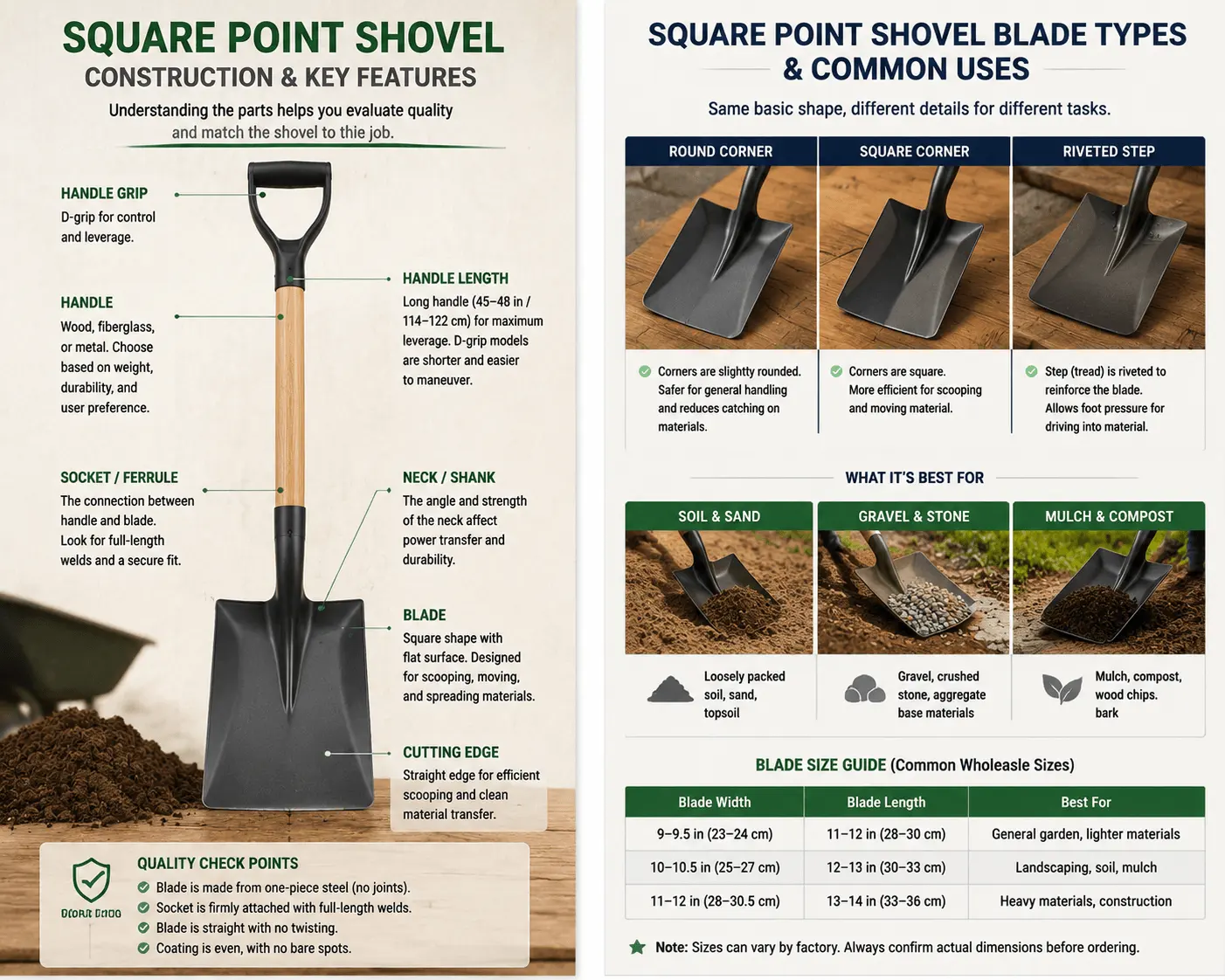
Some square point shovels include a foot step (also called a tread) — a folded or reinforced section at the top of the blade where the user places a foot to push the blade into material. This feature matters when the tool will be used for light ground engagement — leveling soil beds, cutting shallow trenches, or working semi-compact material. For pure material scooping (sand, gravel, mulch), the foot step is less important.
When sourcing, confirm whether the model includes a foot step and what type — forward-turned (blade top folds forward) or side tread (blade sides fold up). The foot step design affects both functionality and manufacturing complexity.
Key Structural Parameters
Understanding what makes one square point shovel different from another means looking at the structural elements that affect performance, durability, and price.
Blade Size and Shape
Blade dimensions are typically expressed as length × width × depth (the depth being the concavity or “dish” of the blade). A larger blade moves more material per scoop but is heavier and harder to control in tight spaces. Blade sizes in the product range typically span from approximately 230 mm to over 300 mm in width, with depths varying from 330 mm to over 500 mm.
The blade’s concavity (how deeply it is “dished”) affects how much material it holds. A flatter blade is better for spreading; a deeper blade is better for scooping and lifting.
Cutting Edge
The cutting edge of a square point shovel is straight. This is its defining feature. The edge may be sharpened from the factory or left blunt — a sharper edge penetrates material more easily but dulls faster and is more prone to damage if used on hard ground. For B2B buyers, the edge condition should be specified: factory-sharpened, semi-sharpened, or blunt.
Foot Step (Tread)
As discussed above. Key specs: presence/absence, type (forward-turned or side), width, and whether the tread is reinforced (thicker or double-layered at the step area).
Shoulder and Neck
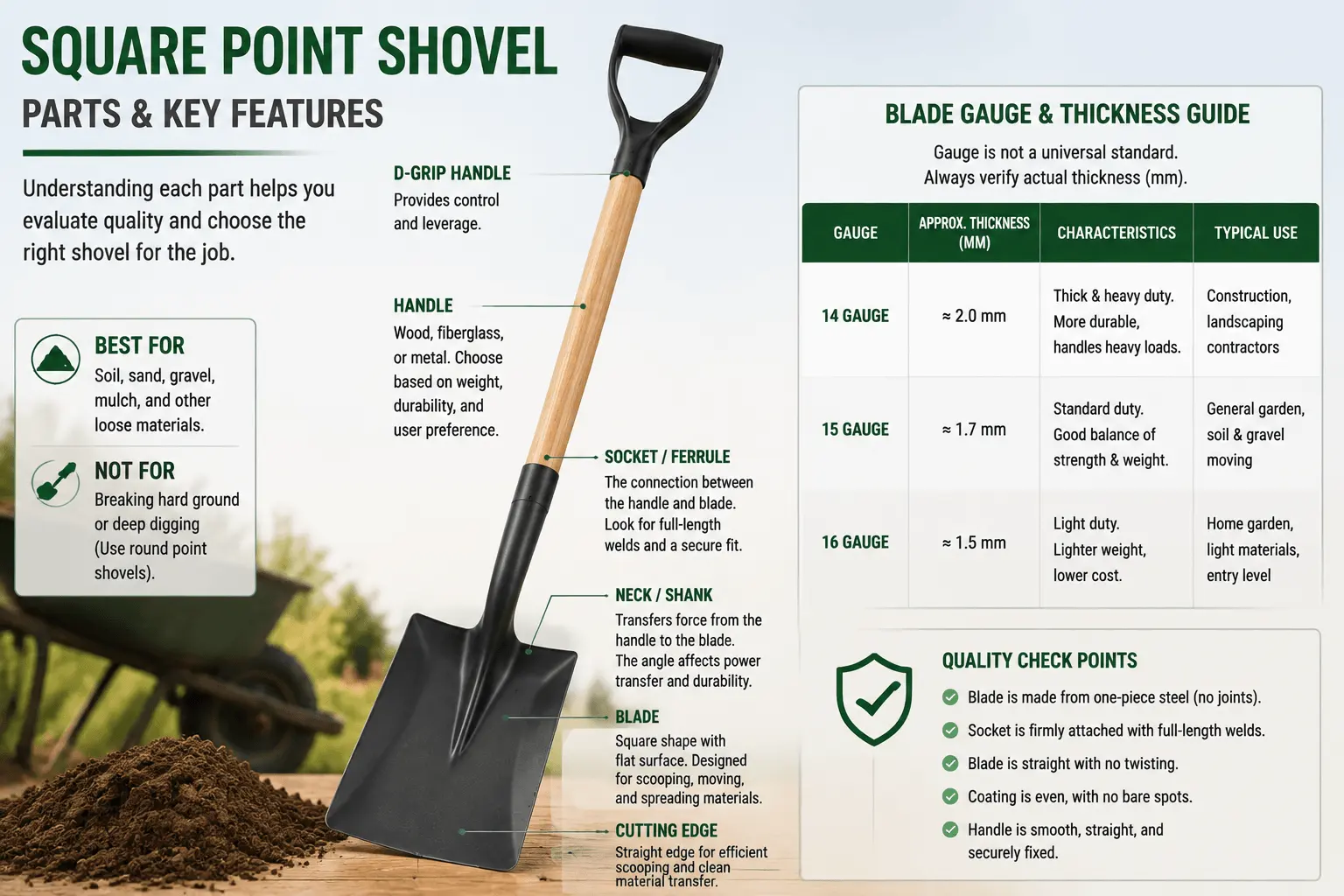
The shoulder is the transition area where the blade meets the socket or neck. This is a high-stress zone — when the user levers the loaded shovel, force concentrates at the shoulder. A thicker or reinforced shoulder resists deformation. The neck connects the blade to the socket; a longer neck generally means better force distribution.
Socket
The socket is the cylindrical or tapered fitting where the handle inserts into the blade head. Socket depth determines how much surface area contacts the handle — a deeper socket provides better force transfer and a more secure fit. The product range includes models with integrated sockets (the SKS series — “Shovel with Socket”), where the socket is formed as part of the blade head.
Handle Length and Grip
Handle options are covered in detail in Long Handle vs. D-Grip Shovel, but the summary:
| Handle Type | Typical Length | Working Motion | Retail Positioning |
| Long handle | 1,200–1,500 mm | Two-handed scooping; greater leverage; less bending | Professional/agricultural; bulkier packaging |
| D-grip | 900–1,020 mm (with head) | One-handed control; closer work; easier to maneuver | Retail/consumer; compact packaging |
| Y-grip | ~1,000 mm | Two-handed with Y-branch; similar to long handle but shorter | Mixed professional/consumer |
| PD handle | ~1,020 mm | Extended D-grip; combines control with slightly longer reach | Mid-range professional |
Compare Shovel Models With A Clear Specification Table
Shortlisting multiple shovel models? We can organize key specifications into one comparison table, including blade size, steel thickness, step, socket, handle, grip, weight, and finish — helping you evaluate differences faster before making purchasing decisions.
Materials and Manufacturing: What the Blade Is Made Of and How
Steel Type
Carbon steel is the most common material for shovel blades. It provides good strength, can be heat-treated for additional hardness, and is cost-effective for high-volume production. When the specific steel grade is not available from product catalogs, describe the material as “steel” without specifying a grade.
Some manufacturers use manganese steel or railway steel (recycled rail steel) — these are specific to certain production clusters and should only be claimed when confirmed.
Boron steel is used by some premium brands (such as Corona) as a market sample. Boron steel offers a balance of rigidity and lighter weight, but the manufacturing process is more complex and costly. Do not claim boron steel unless the specific product has been confirmed to use it.
Manufacturing Process
Shovel blades are formed through one of several processes: stamping (flat steel sheet pressed into shape — cost-effective for high volume), roll forging (steel passed through rollers that progressively form the blade — the core method used in the Luannan production cluster), or forging (blade and socket formed from a single piece of steel, creating continuous grain flow for strength at stress points). The product catalog includes models marked “Forged spade,” confirming that forged construction is available for specific models.
For a detailed framework separating material, forming method, heat treatment, and surface finish — and what to verify for each — see Forged, Stamped, Tempered, and Boron Steel Shovel Blades.
Steel Thickness (Gauge)
Gauge is one of the most misunderstood specifications in shovel sourcing. Here is what buyers need to know:
- Gauge is not a single universal standard. The same gauge number can correspond to different actual thicknesses depending on the material system (steel vs. galvanized steel vs. stainless steel).
- In the standard steel sheet metal gauge system: 14-gauge ≈ 1.9 mm, 15-gauge ≈ 1.7 mm, 16-gauge ≈ 1.5 mm.
- Lower gauge number = thicker steel. A 14-gauge blade is thicker (and heavier) than a 16-gauge blade.
- Chinese factories typically specify in millimetres, not gauge. When exporting to markets that use gauge, the factory converts — but the conversion depends on which gauge system they reference.
Practical guidance: Always ask for actual thickness in millimetres, measured at a specified point on the blade. Do not compare shovels by gauge number alone without confirming which gauge system is being used. We cover this topic in depth in 14-Gauge, 15-Gauge, or 16-Gauge Shovel Blades.
Coating
Coating protects steel from corrosion. The main options:
- Painted finish: The most basic surface treatment. Common in agricultural-grade tools where cost matters. Product catalog models use painted finishes (e.g., orange-red paint). Painted finishes can chip and scratch, exposing bare steel.
- Powder coating: Dry powder electrostatically applied and cured under heat. Thicker, more uniform, and more durable than liquid paint. More common on retail-grade and premium tools.
- Epoxy coating: Used by some brands for corrosion resistance. Provides good chemical resistance but can be more brittle under impact.
Coating performance should be described by what it is — not by unverified salt spray hour claims. ASTM B117 salt spray testing provides a standardized comparison environment, but hours of salt spray exposure do not translate directly to years of outdoor service. For practical quality verification, the ASTM D3359 tape adhesion test and visual edge coverage inspection are more accessible checks.
Build Three Clear Shovel Quality Levels For Your Market
Create a structured shovel range with clear quality differences. We can separate opening, mid-range, and professional options based on verified construction — not simply changing colour or packaging. This helps your customers understand the value behind each level.
Long Handle vs. D-Grip: A Quick Overview
The handle type changes how the tool is used, who buys it, and how it is packaged:
Long handle shovels (1,200–1,500 mm) are the choice for users who need maximum leverage and reach. The longer shaft allows a two-handed scooping motion with less bending — reducing back strain during extended material-moving work. Long handles are common in agricultural, landscaping, and construction supply channels.
D-grip shovels (total length around 900–1,020 mm with head) offer better one-handed control. The D-grip allows the user to rotate the shovel, direct the material, and work in tighter spaces. D-grip shovels are common in retail garden centers and consumer channels where compact size and ease of use matter.
Utah State University Extension emphasizes: “Use rakes and shovels with height-appropriate handles that help you maintain a straight back and avoid hunching over.” The choice is not about which is “better” — it is about matching the handle to the user, the task, and the working environment.
For a detailed comparison of reach, leverage, control, and retail positioning, see Long Handle vs. D-Grip Shovel.
Three-Tier Product Structure: What Actually Changes Between Price Levels
A common sourcing mistake is assuming that a higher price means “better” without understanding what actually changes. Here is what should differ between opening, mid-range, and professional tiers:
| Parameter | Opening Price | Mid-Range | Professional |
| Steel thickness | Thinner (typically 16-gauge range) | Medium (typically 15-gauge range) | Thicker (typically 14-gauge range) |
| Manufacturing | Stamped | Stamped or roll-forged | Forged or roll-forged with heat treatment |
| Socket | Shorter; stamped | Medium; may be integrated | Longer; forged or reinforced |
| Fastener | Typically rivet | Typically rivet or bolt | Typically through-bolt; may be user-replaceable |
| Handle | Basic wood; shorter | Wood (varnished) or fiberglass | Premium wood or fiberglass; longer; ergonomic grip |
| Coating | Painted | Painted or powder-coated | Powder-coated or epoxy; edge coverage addressed |
| Foot step | May be absent | Present; single-fold | Present; reinforced or double-layer |
| Packaging | Bulk (woven bag) | Individual or small-pack | Retail-ready box or sleeve |
The difference should be structural and measurable — not just a different color or label. A higher price tier that only changes the paint color is not a genuine quality upgrade.
Quality Risks and Common Failure Points
Understanding failure modes helps you specify better products and set up effective QC checks.
| Failure Mode | What Happens | Root Cause | How to Check |
| Blade warping | Blade bends or twists under load | Insufficient steel thickness; no heat treatment; poor geometry | Visual inspection; load test |
| Socket cracking | Socket splits at stress point | Short socket; poor neck transition; thin wall | Visual; twist test |
| Rivet/bolt loosening | Head wobbles on handle | Undersized fastener; poor fit; insufficient socket depth | Twist test; pull test |
| Neck failure | Blade separates from socket at neck | Stress concentration at neck transition; poor forging or welding | Visual; structural inspection |
| Coating failure | Paint chips or peels; bare steel exposed | Thin coating; poor surface prep; no edge coverage | Visual; tape adhesion test (ASTM D3359) |
| Handle cracking | Wood handle splits along grain | Wet wood; poor grain orientation; knots at stress points | Visual; moisture content check |
| Foot step deformation | Tread bends under foot pressure | Insufficient reinforcement at tread area | Visual; foot-pressure test |
Important: Coating performance should be described by what it is — “painted finish” or “powder-coated finish” — not by unverified claims about salt spray hours or outdoor lifespan. For a detailed inspection framework, see How to Inspect Square Point Shovels.
Approve Samples With Measured Evidence, Not Guesswork
Before final production approval, we can help record the key evidence your team needs. Request dimension photos, connection close-ups, weight checks, functional videos, and agreed strength tests to confirm the sample meets your expectations.
What to Ask a Supplier Before Ordering Square Point Shovels
When evaluating a shovel supplier, the questions that matter are structural:
Blade construction:
- Is the blade stamped, roll-forged, or forged?
- What is the actual steel thickness in millimetres? (Not just gauge.)
- Is there a foot step? What type? Is it reinforced?
- What is the blade length, width, and depth?
Socket and neck:
- How deep is the socket? Is it integrated or separate?
- Is the neck reinforced? What is the wall thickness at the transition?
Handle:
- What material? What length range is available?
- For wood: what species? Is FSC certification available?
- For fiberglass: what wall thickness? What grip material?
- What is the connection method — rivet, bolt, or press fit?
Coating:
- Is it painted, powder-coated, or epoxy-coated?
- What color options are available?
- Is edge coverage (cut edges of stamped parts) addressed?
Packaging:
- How are blades protected from mutual contact?
- What is the per-carton quantity?
- What is the estimated 20-foot container loading quantity?
Customization:
- Can you mix blade and handle types within one order?
- Can you request custom colors or private-label packaging?
- What is the realistic minimum order for each customization?
These questions prevent the most common sourcing mistake: ordering based on a photo and a price, then discovering structural differences only when the goods arrive.
Wrong Selection Examples: What Not to Do
Mistake 1: Selling a square point shovel as a “digging shovel.” A garden center labels all its shovels as “digging tools.” A customer buys a square point shovel for a fence-post digging project in compacted clay soil. The flat edge cannot penetrate the ground efficiently. The customer returns the tool, complaining it “doesn’t dig.”
Mistake 2: Confusing a spade with a square point shovel. A distributor stocks a garden spade and a square point shovel side by side with no distinction in labeling. Customers who want to move mulch buy the spade (which has less scoop capacity) and customers who want to edge borders buy the shovel (which has the wrong handle angle). Both return their tools.
Mistake 3: Choosing by gauge number alone. A buyer selects a 14-gauge shovel over a 15-gauge model assuming “thicker is better.” But the 14-gauge model uses a lower-grade steel with no heat treatment, while the 15-gauge model uses heat-treated boron steel. The 15-gauge model is actually stronger in practical use — gauge alone did not tell the full story.
Mistake 4: Ignoring handle length for the target market. A buyer sources D-grip shovels with 920 mm total length for a market where users are predominantly tall and work in open agricultural settings. The short handle forces users to bend excessively, causing fatigue and complaints about “poor ergonomics.”
Build Your Complete Tool Range With One Coordinated Shipment
If your product range includes more than just shovels — such as rakes, forks, or other long-handled tools — we can coordinate a mixed order solution. Share your product list and target quantities, and we will confirm model availability, inspection requirements, and packing details for one efficient shipment.
FAQ
Is a square point shovel the same as a flat shovel? Usually, yes — but not always. “Flat shovel” is a generic term that can also include scoop shovels and coal shovels. “Square point shovel” specifically refers to a flat-blade shovel with a straight cutting edge designed for scooping and moving loose material. When sourcing, confirm the blade shape — not just the name.
Can I use a square point shovel for digging? You can, but it is not designed for it. The flat, straight edge does not concentrate force the way a pointed blade does. For digging in soil — especially compacted or rocky ground — a round point shovel is the correct tool. A square point shovel is for moving material that is already loose.
What is the difference between a square point shovel and a garden spade? The blade-to-handle angle is the key difference. A shovel’s blade is angled relative to the handle (for scooping in a levering motion). A spade’s blade is closer to a right angle (for pushing straight down, cutting edges, and precision work). Both can have flat blades, but they serve different tasks. See our detailed comparison in Square Point vs. Round Point vs. Garden Spade.
What gauge should a square point shovel be? It depends on the intended use and price tier. For heavy-duty material moving, 14-gauge (approximately 1.9 mm) is common. For mid-range use, 15-gauge (approximately 1.7 mm) is typical. For light-duty or budget tools, 16-gauge (approximately 1.5 mm) may be acceptable. But gauge alone does not determine quality — steel grade, heat treatment, and blade geometry also matter. Always verify actual thickness in millimetres.
Can I do private-label square point shovels? Yes. Customization options typically include handle type, handle length, coating color, and packaging design. The realistic customization scope depends on the specific model and factory capability. Share your preferred models, branding method, quantities, and destination market, and we can confirm what is feasible without unnecessary tooling costs.
What is the difference between a painted finish and a powder-coated finish? Painted finish is liquid paint applied to the metal surface — the most basic surface treatment. Powder coating uses dry powder that is electrostatically applied and cured under heat (typically 180–200°C), creating a thicker, more uniform, and more durable layer. Both have their place: painted finishes are common on agricultural-grade tools where cost matters; powder coating is typical on retail-grade and premium tools where appearance and durability are selling points.