








Updated 2 months ago
Long Handle vs. D-Grip Shovel: Reach, Leverage, Control, and Retail Positioning
SCARECROW GARDEN SUPPLIER

Long Handle vs. D-Grip Shovel: Which Is Right? | Scarecrow Garden Supplier
Key Takeaways
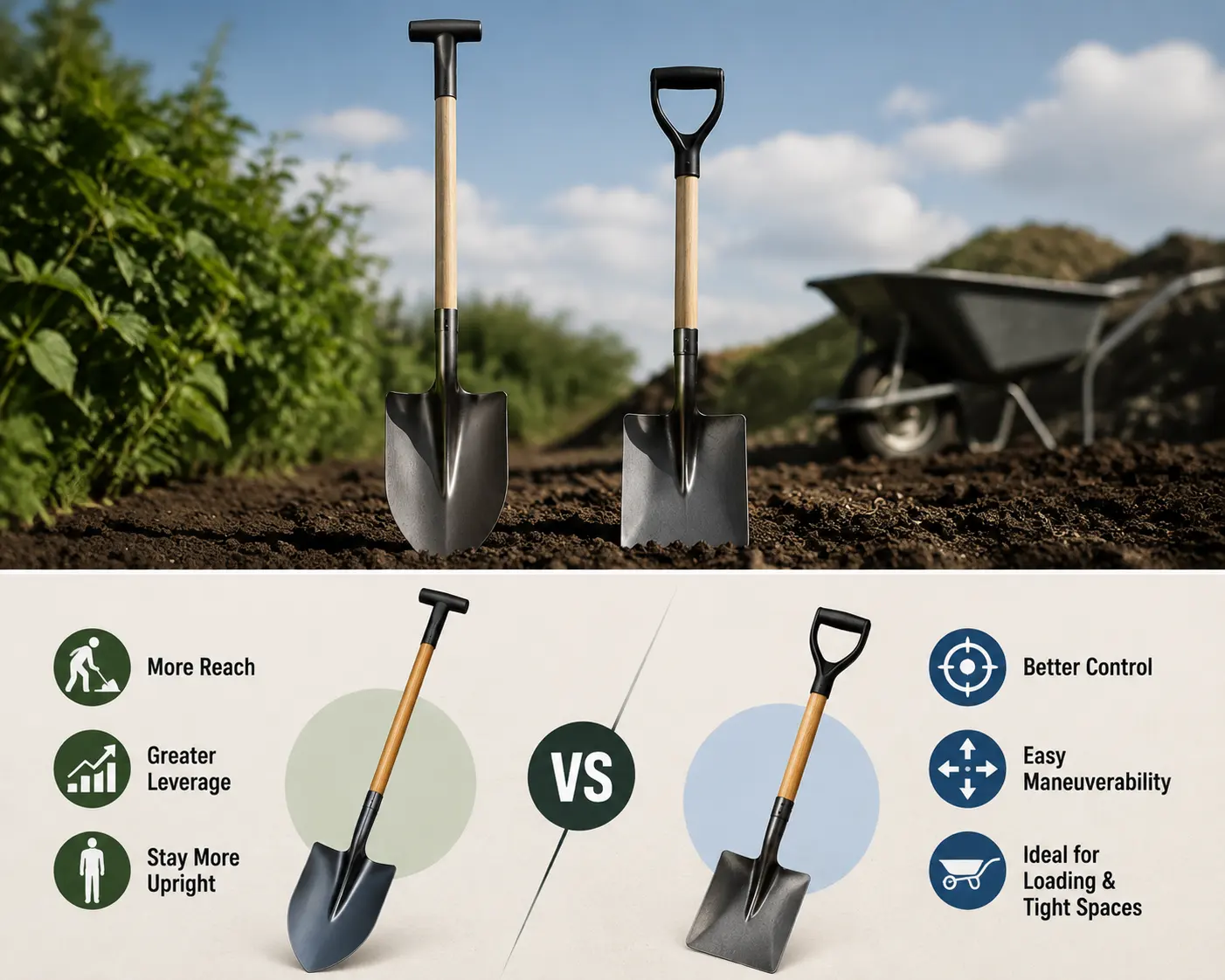
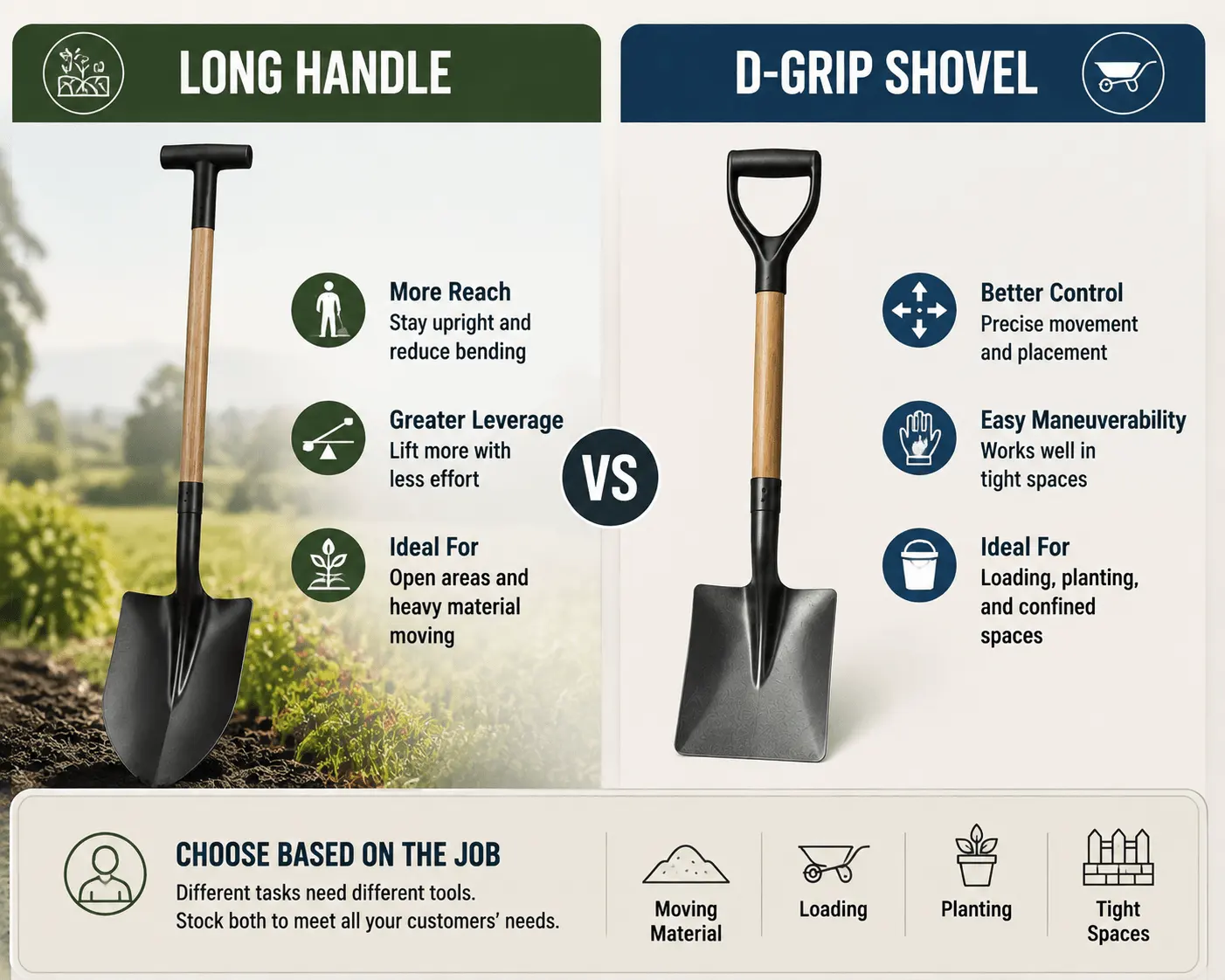
- Long handles favor reach and continuous scooping leverage; D-grips favor control, maneuverability, and closer work. The choice depends on the task, not on which is “better.”
- D-grip opening size, handle diameter, and grip material affect whether the tool works well with gloved hands — a detail many buyers overlook.
- Handle material (wood, fiberglass) and length interact with the grip type to determine weight, balance, and user fatigue.
- For retail, D-grip shovels are typically more compact (easier to display and ship), while long-handle shovels signal professional/agricultural use.
- Ergonomic principles support matching handle length to user height and task — but no single handle length eliminates fatigue or prevents injury for all users.
If you are sourcing shovels, the handle type is not a minor specification. It changes who buys the tool, how they use it, how it is packaged, and how it is displayed. A long-handle shovel and a D-grip shovel with the same blade head are different tools for different working motions — and stocking the wrong one for your market leads to complaints about “poor ergonomics” that have nothing to do with the blade quality.
This guide compares long-handle and D-grip shovels across the dimensions that matter to B2B buyers: working motion, leverage, control, user fatigue, packaging, and retail positioning.
The Quick Answer
| Feature | Long Handle Shovel | D-Grip Shovel |
| Typical total length (with head) | 1,200–1,500 mm | 900–1,020 mm |
| Working motion | Two-handed scooping; greater leverage; less bending | One-handed control; closer work; easier to maneuver |
| Best for | Open-area material moving; agricultural scooping; users who need reach | Tight-space work; loading into containers or wheelbarrows; users who need control |
| Grip type | Straight shaft (no second grip point) | D-shaped grip attached to shaft |
| Retail positioning | Professional, agricultural, landscaping | Consumer, garden center, compact storage |
| Packaging length | Longer cartons; higher shipping cost per unit | Shorter cartons; more compact; lower shipping cost per unit |
| User height consideration | Better for taller users; may be too long for shorter users | Better for average-height users; less height-dependent |
Handle selection should be combined with blade selection. For a complete square point shovel sourcing guide, see Square Point Shovels Explained: A Complete Buyer’s Guide to Flat-Blade Shovels.
Choose The Right Grip Based On Real Working Motion
The best grip depends on how the shovel will actually be used. Tell us whether the tool is mainly for transferring, digging, loading, or confined-space work. We can help match the grip design with the intended working motion.
Working Motion and Mechanics
Long Handle: The Leverage Advantage
A long-handle shovel functions as a lever. The user grips the end of the shaft with one hand and places the other hand lower on the shaft. When scooping material, the lower hand acts as a fulcrum — the long shaft provides mechanical advantage, allowing the user to lift material with less force.
The longer shaft also means the user can stand more upright during the scooping motion — reducing the degree of forward bending. Utah State University Extension emphasizes: “Use rakes and shovels with height-appropriate handles that help you maintain a straight back and avoid hunching over.” For extended material-moving work, a longer handle reduces back strain.
However, the long shaft has a trade-off: it is harder to control in tight spaces. The length that provides leverage in open areas becomes a liability when working between plants, along fence lines, or loading material into a narrow container.
D-Grip: The Control Advantage
A D-grip shovel has a D-shaped handle attached to the top of a shorter shaft. The D-grip provides a second grip point — the user can hold the D-grip with one hand and the shaft with the other, or grip the D-grip alone for one-handed work.
The D-grip allows the user to:
- Rotate the shovel — directing where material is deposited
- Apply downward pressure — using the D-grip to push the blade into material
- Work in tighter spaces — the shorter overall length fits between obstacles
- Lift and load — the D-grip provides a secure hold for lifting material into wheelbarrows, containers, or trucks
The trade-off: the shorter shaft means less leverage and more bending. For users doing extended material moving in open areas, the D-grip may cause more back fatigue than a long handle.
Ergonomics: What the Research Says
Freivalds (1986) — The Foundational Shovel Ergonomics Study
Freivalds’ study “The ergonomics of shovelling and shovel design” (Ergonomics, 1986) is the foundational research on shovel design and user biomechanics. The study examined how shovel handle length, blade angle, and scooping posture affect energy expenditure and user fatigue. Key findings include: optimal handle length depends on the user’s height and the task; a longer handle reduces forward bending but may increase the energy required for lifting; and the blade-to-handle angle affects both scooping efficiency and lower-back loading.
Lewinson et al. (2013) — Shaft Configuration and Spinal Biomechanics
Lewinson’s study “Influence of snow shovel shaft configuration on lumbosacral biomechanics” (Applied Ergonomics, 2013) compared straight and bent shaft configurations. While the study focused on snow shovels, the biomechanical principles apply to all shovel-type tools. The study found that a bent (ergonomic) shaft configuration reduced L5/S1 extension angle impulse by 16.5% and peak flexion by 13.0% — allowing a more upright working posture. The implication: shaft configuration affects spinal loading, and a design that allows the user to stand more upright can reduce back strain.
NIOSH/CDC — Hand Tool Ergonomics Principles
The NIOSH/CDC publication “Easy Ergonomics: A Guide to Selecting Non-Powered Hand Tools” provides general ergonomic principles for hand tool design: grip diameter should allow the hand to comfortably encircle the handle; the wrist should maintain a neutral (straight) position; and grip surfaces should be free of sharp edges. These principles apply to D-grip openings and shaft diameters on shovels.
What This Means for Buyers
- No single handle length is “ergonomic” for everyone. The right length depends on the user’s height, the task, and the working environment.
- D-grip opening size matters. A D-grip that is too small for a gloved hand forces the user to grip awkwardly. A grip that is too large reduces control. Verify the internal opening dimensions.
- Handle material affects comfort. Wood absorbs vibration but can develop splinters. Fiberglass is smooth but can be slippery when wet. Grip material (rubber over-mold, plastic cap) affects both comfort and durability.
- Do not promise injury prevention. Ergonomic design can reduce fatigue and strain — but no handle eliminates the risk of injury. Do not market a handle as “preventing back injury” or “eliminating fatigue.”
Confirm Handle Dimensions Before Sample Approval
Before approving a sample, verify the actual handle dimensions. We can provide measured total length, grip opening, handle diameter, weight, and balance photos to help your team evaluate the product more accurately.
Handle Materials: Wood and Fiberglass
The product range includes both wood and fiberglass handle options for shovels — a wider selection than the rake range, which typically offers wood only.
Wood Handles
Wood is the traditional handle material. Common tool-handle woods include ash, oak, and hickory, as noted by Penn State Extension. Wood provides good shock absorption and is replaceable if the head-to-handle connection allows (such as a through-bolt socket).
What to check:
- Grain orientation: straight grain along the length is strongest; cross-grain or diagonal grain creates weak points
- Knots at stress points: a knot at the socket junction or mid-shaft is a structural defect
- Surface finish: smooth, sealed surface (varnish, wax, or oil) protects against moisture
- Moisture content: wood that is too wet may warp; wood that is too dry may crack
For wood handles, FSC (Forest Stewardship Council) Chain of Custody certification may be relevant if your market requires timber traceability — particularly for EU markets under EUTR regulations. FSC certification should only be claimed when actual certificates and transaction chains are valid.
Fiberglass Handles
Fiberglass handles offer an excellent strength-to-weight ratio. They are lighter than wood and steel, and generally stronger than aluminum under bending loads. Fiberglass does not absorb moisture, does not split along grain lines, and does not rust.
What to check:
- Wall thickness: fiberglass handles are typically tubular — wall thickness determines strength
- Surface condition: over time and with weather exposure, the outer resin layer can degrade, potentially exposing glass fibers that cause skin irritation
- Connection method: the head-to-handle connection on fiberglass handles often uses adhesive or press-fit methods, which may not be user-replaceable
- Grip attachment: the D-grip or end cap is a separate component — check its attachment method and whether it can loosen over time
The “Insulation” Myth
Some marketing materials claim that fiberglass handles provide “electrical insulation safety.” Do not use this claim unless the specific product has been designed and tested for electrical insulation. A fiberglass handle is not automatically an insulating tool. Electrical safety requires specific design, testing, and certification.
Build A Consistent Long Handle & D-Grip Tool Range
Need both long-handle and D-grip versions? We can check compatible blade and handle combinations to help create a consistent retail range with practical structure matching across different customer needs.
Retail Positioning and Target Users
| Customer Type | Recommended Handle | Why |
| Garden center / consumer retail | D-grip | Compact; easy to display; intuitive grip; suits occasional users |
| Landscaping supply | Long handle | Professional scooping; leverage for extended material moving |
| Agricultural supply | Long handle or Y-grip | Heavy material moving; reach into trailers and bins |
| Construction supply | Long handle | Material moving on job sites; leverage for loading |
| Hardware store (mixed) | Both | Different customers need different handle types |
| E-commerce | D-grip (if space-limited) or both | D-grip ships more compactly; long handle may incur oversized shipping |
After identifying the right handle configuration for your target market, you can review our stainless steel garden shovel range to compare available shovel structures, handle options, and product specifications for wholesale sourcing.
Packaging and Shipping Considerations
Handle type directly affects packaging and shipping costs:
- Long-handle shovels (1,200–1,500 mm total length) require full-length cartons. Mixed head-and-handle orders need cartons that accommodate the longest configuration. Estimated 20-foot container loading for long-handle shovels is typically 350–430 dozen, depending on model and packaging configuration.
- D-grip shovels (900–1,020 mm total length) use shorter cartons, allowing more units per container. Estimated loading is typically 400–600 dozen, depending on blade size and packaging.
- Head-only shipments (blade heads without handles) are the most compact — loading can reach 800–1,500 dozen per 20-foot container, depending on blade size. Handles can be sourced separately and assembled at destination, though this requires assembly capability.
For all handle types, the critical packaging issue is protecting the head-to-handle junction from impact and preventing blade edges from scratching each other during transit.
Test Tool Comfort Based On Real User Scenarios
Comfort depends on who uses the tool and how it is used. Send your user profile and work scenario. We can propose a practical sample-use video focused on real handling experience instead of a generic strength demonstration.
FAQ
Which is better: long handle or D-grip? Neither is universally better. Long handles provide more leverage and allow a more upright posture for extended scooping in open areas. D-grips provide better control and maneuverability for tighter work. The choice depends on the user’s height, the task, and the working environment. For a general retail range, stocking both covers different customer needs.
Can a D-grip shovel be used for heavy material moving? Yes, but it is less efficient for extended heavy material moving than a long-handle shovel. The shorter shaft provides less leverage, meaning the user applies more force per scoop. For occasional or light-duty material moving, a D-grip is fine. For all-day material moving, a long handle is the better choice.
What D-grip opening size should I specify? The D-grip opening should accommodate a gloved hand — typically an internal opening of at least 100–120 mm in width and 80–100 mm in height. If the opening is too small, users with work gloves cannot grip properly. Always verify the internal dimensions, not just the external appearance.
Are fiberglass handles worth the premium? For premium retail positioning, fiberglass handles signal modern construction and offer the best strength-to-weight ratio. For budget or seasonal tools, wood handles are cost-effective and perform adequately. The choice depends on your target user, price point, and market expectations. See our detailed comparison in Wood vs. Fiberglass Handles Across Rakes, Shovels, and Forks.
Can I claim that an ergonomic handle prevents back injury? No. Ergonomic design can reduce fatigue and strain by allowing a more upright working posture — but no handle eliminates the risk of injury. Do not market a handle as “preventing back injury” or “eliminating fatigue.” Describe the ergonomic benefit accurately: “allows a more upright working posture” or “reduces forward bending.”