






Updated 2 months ago
Wood vs. Fiberglass Handles Across Rakes, Shovels, and Forks: Cost, Durability, Repairability, and Branding
SCARECROW GARDEN SUPPLIER
Wood vs. Fiberglass Handles Across Rakes, Shovels, and Forks | Scarecrow Garden Supplier
Key Takeaways
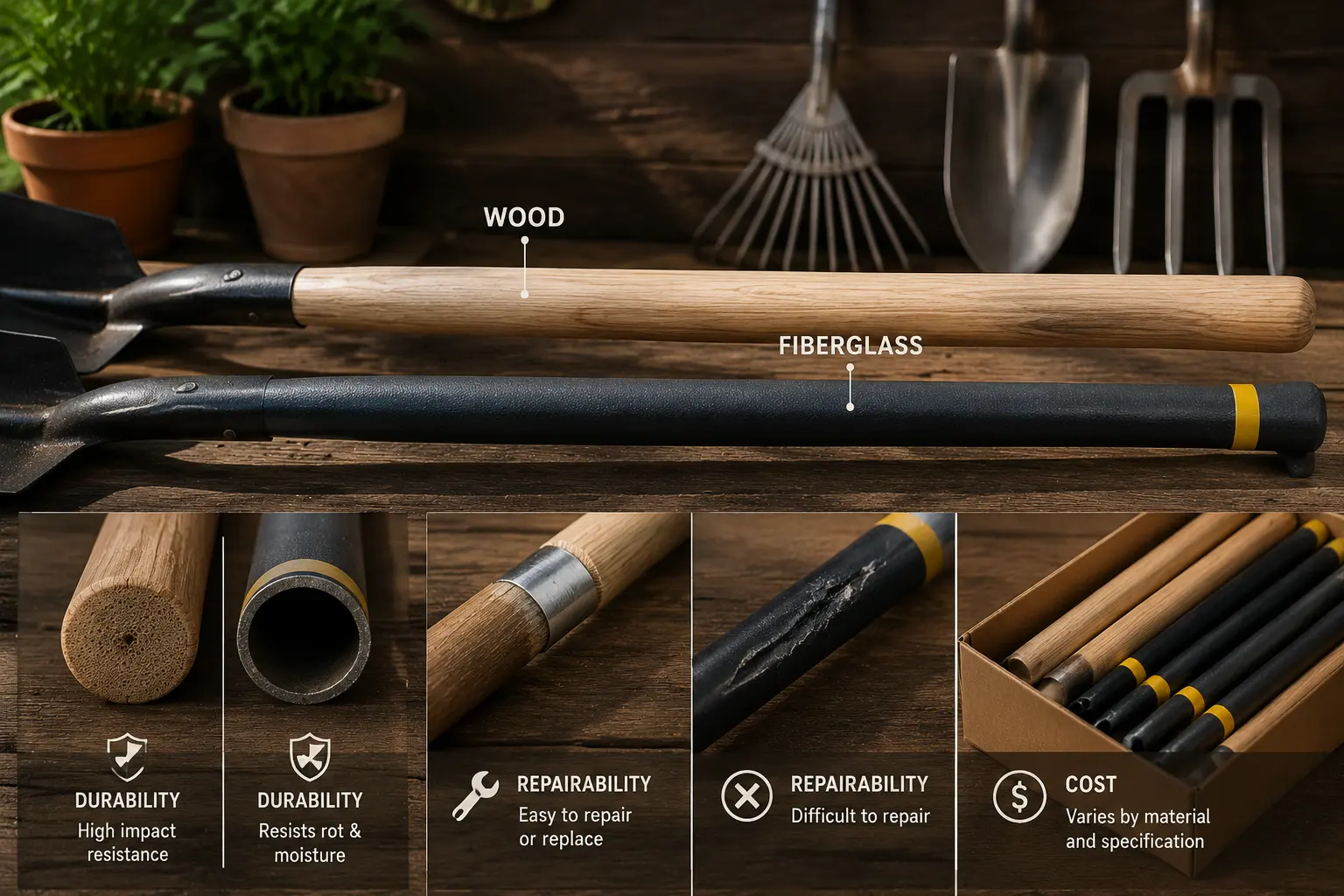
- Wood and fiberglass are not single quality grades. Within each material, there are significant variations in species, construction, surface treatment, and connection method that affect performance more than the material label itself.
- The same handle material behaves differently on different tools. A wood handle on a shovel experiences bending and impact loads; on a rake it experiences torsion and pulling; on a fork it experiences prying. The material is the same — the forces are not.
- Wood handles are repairable and replaceable, which matters for professional markets where tool repair is expected. Fiberglass handles are generally not user-replaceable.
- FSC certification is a chain-of-custody claim about wood sourcing — it is not a performance or durability certification. Do not use FSC as a quality indicator.
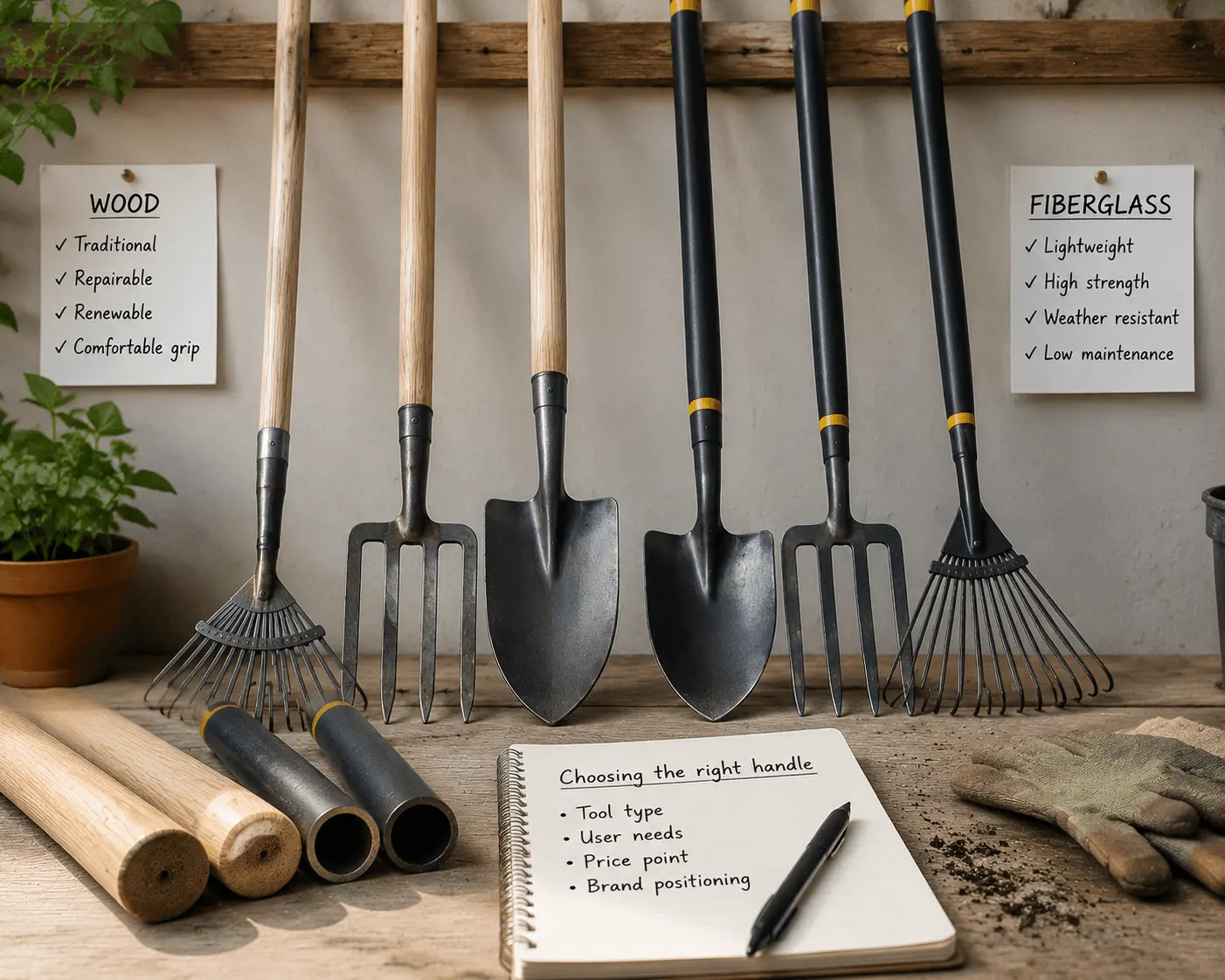
- Neither material is “better.” The choice depends on price tier, target user, repair culture, brand positioning, and the specific tool type.
A digging fork being levered against compacted clay puts concentrated stress on the handle-to-socket junction — the exact point where wood grain deviation becomes critical. This is why fork handle failures often start at the socket, not mid-shaft. The same wood handle on a shovel, absorbing downward impact from foot-step digging, may perform flawlessly for years. The material is the same. The forces are not.
A buyer asks: should I use the same handle material for every tool in my range? The answer depends on which tool — and which force. A wood handle on a shovel absorbs impact well; the same wood on a fork being levered against compacted clay may split at the socket. A fiberglass handle on a fork resists prying; the same fiberglass on a shovel used for daily impact may crack under repeated stress.
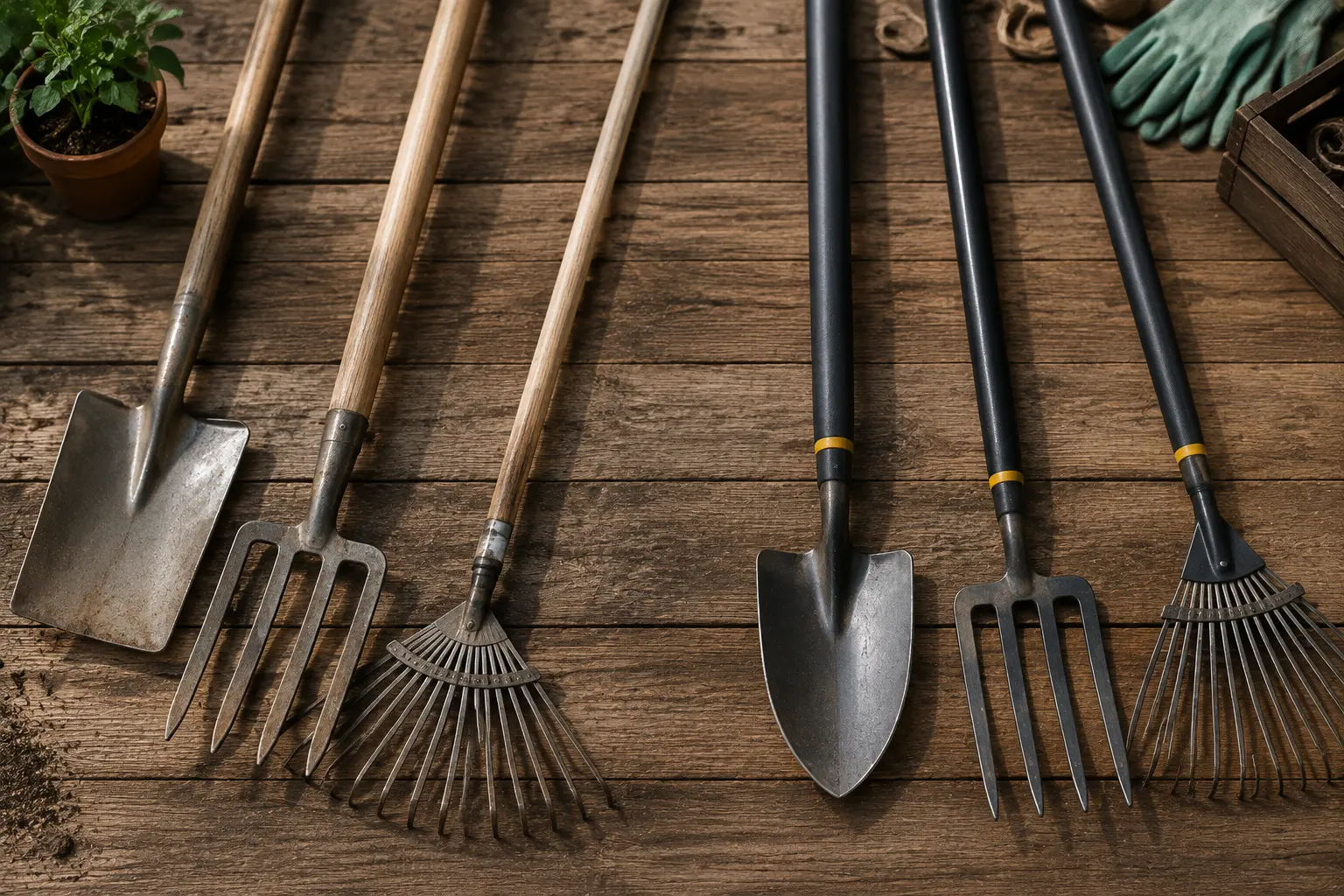
This guide compares wood and fiberglass handles across rakes, shovels, and garden forks. It goes beyond “wood is traditional, fiberglass is modern” to explain how each material behaves under different tool-specific loads, what it costs, how it repairs, and how it affects your brand.
Who this guide is for: Product managers, garden tool buyers, and private-label brands who need to make handle material decisions across multiple tool categories.
Handle selection should also match the overall product range strategy. See How to Build a Long-Handled Garden Tool Range.
Neither Material Is a Single Quality Grade
Before comparing wood and fiberglass, understand that neither is a single, uniform product:
Wood Is Not Just “Wood”
| Variable | What It Means | Why It Matters |
| Species | Ash, hickory, beech, pine, eucalyptus — each has different strength, grain, and moisture characteristics | Hickory is the traditional premium choice for impact tools; ash is common for garden tools; pine is budget |
| Grade | Select (clear grain), common (some knots), utility (more knots and grain deviation) | Higher grade = straighter grain = less likely to split |
| Moisture content | Typically 12–15% at time of assembly | Too high = shrinkage and loosening; too low = cracking |
| Surface treatment | Raw, varnished, waxed, or lacquered | Affects moisture absorption, grip, and appearance |
| Grain orientation | Straight grain parallel to handle axis vs. angled grain | Angled grain creates weak planes that lead to splitting |
Fiberglass Is Not Just “Fiberglass”
| Variable | What It Means | Why It Matters |
| Construction | Solid rod, hollow tube, or composite core | Affects weight, stiffness, and cost |
| Outer layer | Resin coating, textured surface, or over-molded grip | Affects grip, durability, and surface damage resistance |
| Wall thickness (hollow) | Thicker walls = more durable but heavier | Thin-wall tubes are lighter but more vulnerable to impact |
| Connection method | Pressed into socket, bonded with adhesive, or mechanical fastener | Affects repairability and connection strength |
| Surface damage tolerance | Scratches expose fibers, which can wick moisture and weaken over time | Surface damage is the most common fiberglass failure precursor |
The USDA Forest Products Laboratory’s Wood Handbook documents how wood absorbs and releases moisture depending on ambient humidity — this is a material property, not a defect. Understanding this helps you specify moisture content targets and storage guidance.
Choose The Right Handle System For Your Product Range
Choose one handle system — or use both intentionally. Tell us your price tiers, brand style, repair expectations, and target tools. We will compare practical handle strategies to help you build a more suitable retail range.
Wood Handles: Species, Grain, Moisture, Surface, and FSC
Wood Species in Garden Tools
| Species | Typical Use | Characteristics | Notes |
| Ash | Common in garden tool handles exported from China | Good strength-to-weight; straight grain; takes varnish well | Widely available; standard for mid-range tools |
| Hickory | Premium impact tools (axes, hammers); some garden tools | Excellent shock absorption and impact resistance | More expensive; less common in garden tools from China |
| Beech | Some fork and shovel handles | Dense; good stiffness; can be polished | Less common but used in European-style tools |
| Pine | Budget tools | Light; low cost; lower strength | Opening-price tier only |
| Eucalyptus | Some Chinese factory output | Dense; can be adequate if properly dried | Species identification should be confirmed by the factory |
FSC Certification: What It Is and What It Is Not
The Forest Stewardship Council (FSC) Chain of Custody certification tracks wood from forest to finished product. It is a sourcing claim — it tells you the wood came from a managed forest.
FSC is not:
- A performance certification — it does not certify strength, durability, or moisture resistance
- A quality grade — it does not certify that the wood is clear-grained or knot-free
- A treatment certification — it does not certify surface treatment or moisture content
FSC is:
- A chain-of-custody claim — the wood can be traced to its source
- A market requirement — some EU and UK buyers require FSC-certified handles for sustainability claims
- A conditional claim — only valid if the certificate covers the entire supply chain from forest to factory
If your market requires FSC certification, confirm that the factory holds a valid FSC Chain of Custody certificate and that the specific wood species and supplier are covered. Do not print FSC claims on packaging without verifying the certificate scope.
Verify The Actual Handle Before Sample Approval
Verify the exact handle — not the material label. Send us the model you are considering. We can provide measured dimensions, finish details, connection photos, weight, and sample evidence to help confirm the actual product structure.
Fiberglass Handles: Structure, Surface, Grip, and Connection
Fiberglass Handle Construction
| Type | Description | Typical Use | Pros | Cons |
| Hollow tube | Fiberglass tube with resin outer layer | Most garden tool handles | Lightweight; cost-effective | Vulnerable to impact damage; not always repairable |
| Solid rod | Solid fiberglass rod | Some heavy-duty tools | Very strong; impact-resistant | Heavier; more expensive |
| Composite core | Fiberglass outer with wood or foam core | Premium tools | Combines strength and weight optimization | Most expensive; complex connection |
Surface and Grip
Fiberglass handles typically have:
- Resin outer layer: Provides a smooth or slightly textured surface. Can be colored.
- Over-molded grip: A rubber or elastomer grip molded onto the fiberglass at the D-grip or end-grip position. Improves comfort and grip security.
- Color: Fiberglass can be colored during manufacturing — commonly yellow, green, blue, or black. This is a brand element, not a performance indicator.
Surface Damage and Fiber Exposure
This is the most important fiberglass maintenance issue. If the outer resin layer is scratched, chipped, or cracked — exposing the underlying glass fibers — the handle can absorb moisture through the exposed fibers, potentially weakening over time. This is not an immediate failure, but it is a degradation pathway that does not affect wood handles in the same way.
Prevention: Inspect fiberglass handles on arrival for surface damage. Package to prevent impact during transit. Instruct users to avoid striking the handle against hard surfaces.
Different Tools, Different Forces
The same handle material experiences different forces depending on the tool type. This is why a material that works well on a rake may not be the best choice for a fork — and vice versa.
Rake Handles: Torsion and Pulling
| Force | Description | Wood Behavior | Fiberglass Behavior |
| Torsion | Twisting force when turning the rake to flip soil or gather material | Wood grain resists torsion well if grain is straight; angled grain may split under torsion | Fiberglass tubes resist torsion well; isotropic material |
| Pulling | Force pulling the rake toward the user during raking | Wood handles handle pulling well; the weak point is the connection, not the handle | Fiberglass handles pulling well; same connection concern |
| Impact | Occasional impact if the rake strikes a rock or root | Wood absorbs impact through grain compression; may dent but not crack | Fiberglass may crack under sharp impact if outer layer is damaged |
Shovel Handles: Bending and Impact
| Force | Description | Wood Behavior | Fiberglass Behavior |
| Bending | Force bending the handle when levering material | Wood handles can bend and return if grain is straight; may split if grain is weak | Fiberglass handles resist bending well; return to original shape |
| Impact | Force when the shovel strikes ground or the user steps on the foot step | Wood absorbs impact well; hickory is preferred for impact tools | Fiberglass can crack under repeated impact if outer layer is compromised |
| Leverage | Force when using the shovel as a lever to lift material | Wood handles can snap if levered beyond capacity; grain orientation is critical | Fiberglass handles are generally stronger in leverage but may fail suddenly rather than gradually |
Fork Handles: Prying and Torsion
| Force | Description | Wood Behavior | Fiberglass Behavior |
| Prying | Force when using the fork to loosen compacted soil | Wood handles are vulnerable to splitting under prying if grain is not straight; this is the most common fork handle failure | Fiberglass handles resist prying well; may crack if outer layer is damaged |
| Torsion | Twisting force when turning the fork in soil | Same as rake — wood handles resist if grain is straight | Fiberglass handles resist torsion well |
| Downward force | Force when pushing the fork into soil with foot or hand | Wood handles handle compression well along the grain | Fiberglass handles handle compression well |
Key Takeaway
Forks experience the most prying force — making wood handle grain orientation critical. Shovels experience the most bending and impact — making fiberglass a strong choice. Rakes experience mostly torsion and pulling — where both materials perform adequately if the connection is sound.
Cost Structure and Quality Tiers
| Factor | Wood Handle | Fiberglass Handle |
| Raw material cost | Lower (especially pine and ash) | Higher |
| Manufacturing complexity | Lower — cut, shape, drill, finish | Higher — pultrusion or winding, resin curing, over-molding |
| Connection cost | Rivet or bolt — simple | May require adhesive + mechanical fastener — more complex |
| Quality variation | Higher — natural material with grain, knot, and moisture variation | Lower — manufactured product with more consistent properties |
| Opening-price feasibility | Yes — pine or low-grade ash | Difficult — fiberglass is rarely used in opening-price tools |
| Mid-range feasibility | Yes — ash, varnished | Yes — hollow tube, basic outer layer |
| Professional feasibility | Yes — hickory or select ash, waxed | Yes — solid rod or composite, over-molded grip |
Check Replacement Handle And Spare Part Options Before Sourcing
Need replacement-handle or spare-part options? Send us the model you are considering. We can check whether the selected head and handle structure supports practical replacement or spare components for your product range.
Repair and After-Sales
Wood Handle Repairability
Wood handles are the most repairable option:
- Replacement: If the handle splits or breaks, a new handle can typically be inserted into the socket and fastened — provided the socket is undamaged and the handle is available as a spare part
- Through-bolt connections: Professional-tier tools with through-bolts are explicitly designed for handle replacement — the bolt is removed, the old handle is pulled out, and a new one is inserted
- Riveted connections: Opening-price tools with rivets are more difficult to repair — the rivet must be drilled out, which damages the socket
Fiberglass Handle Repairability
Fiberglass handles are generally not user-replaceable:
- Bonded connections: Many fiberglass handles are bonded into the socket with adhesive, making removal difficult without damaging the socket
- Manufactured shapes: Fiberglass handles may have specific cross-sections or over-molds that are not available as standard spare parts
- Surface damage: Minor surface damage can be repaired with epoxy resin, but structural damage typically requires full handle replacement — which may not be practical
After-Sales Implications
| Market Type | Wood Handle After-Sales | Fiberglass Handle After-Sales |
| Professional / trade | High value — repairability extends tool life and reduces replacement cost | Lower value — damaged handles require full tool replacement |
| Retail / consumer | Lower value — most consumers replace rather than repair | Similar — most consumers replace rather than repair |
| Agricultural | High value — repair culture is strong in agricultural markets | Lower value — but fiberglass durability may reduce failure frequency |
Branding, Color, and Consistency
Visual Consistency Across a Range
If your range includes rakes, shovels, and forks, handle material affects visual consistency:
| Approach | Pros | Cons |
| All wood | Traditional appearance; consistent look; easy to match finish and color | May not be optimal for every tool type (e.g., fork prying) |
| All fiberglass | Modern appearance; consistent color; can match brand colors across all tools | Higher cost across the range; not available in opening-price tier |
| Mixed (wood for some, fiberglass for others) | Optimize material per tool type | Requires careful brand management to maintain visual consistency |
Color and Marking Options
| Element | Wood | Fiberglass |
| Color | Natural, stained, or painted | Colored during manufacturing — wide range available |
| Logo application | Laser engraving, screen print, brand stamp, or metal label | Screen print, label, or over-molded logo |
| Grip color | Wood grip or painted | Over-molded grip in any color |
| Consistency | Natural variation in grain and color — part of the wood aesthetic | Consistent color and surface — part of the fiberglass aesthetic |
FSC and Branding
If your brand uses FSC-certified wood handles, the FSC claim can be used on packaging and marketing materials — but only if the chain of custody is verified for the specific product. FSC claims cannot be applied to fiberglass handles (they are not wood products). If your range uses mixed materials, FSC claims must be specific to the wood-handled models.
For private-label brands, handle selection is also part of product differentiation. Learn more in Private Label Garden Tools: What Can Be Customized Without Creating Unnecessary MOQ and Tooling Costs?
Create A Consistent Brand Across Your Garden Tool Range
Coordinate branding across mixed tools. We can review colours, printed marks, labels, grips, and cartons across rakes, shovels, and forks, helping you build a more consistent retail presentation.
Procurement Specifications and QC Checklist
Wood Handle Specification Fields
| Field | What to Specify |
| Species | e.g., “Ash (Fraxinus spp.)” — confirm with factory |
| Grade | e.g., “Select — clear grain, no knots above 5 mm” |
| Moisture content | e.g., “12–15% at time of assembly” |
| Surface treatment | e.g., “Varnished, matte finish” |
| Grain orientation | e.g., “Straight grain parallel to handle axis, maximum 5° deviation” |
| Dimensions | Length, diameter (at grip, at midpoint, at socket end) |
| Hole position | Distance from hole center to nearest edge (minimum) |
| FSC status | “FSC Chain of Custody certified” or “not FSC certified” — with certificate number if applicable |
Fiberglass Handle Specification Fields
| Field | What to Specify |
| Construction | “Hollow tube” or “solid rod” or “composite core” |
| Outer diameter | In mm |
| Wall thickness (hollow) | In mm |
| Outer layer | “Resin coating, [color]” |
| Grip | “Over-molded [material], [color]” or “none” |
| Connection | “Press-fit + adhesive” or “mechanical fastener” |
| Surface inspection | “No visible cracks, chips, or fiber exposure” |
| Dimensions | Length, diameter |
QC Inspection Points
| Check | Wood | Fiberglass |
| Surface | Grain direction; knots; cracks; finish quality | Surface cracks; chips; fiber exposure; color consistency |
| Dimensions | Length; diameter at three points; hole position | Length; outer diameter; wall thickness (if accessible) |
| Moisture | Measure with moisture meter (if available) | N/A |
| Connection | Socket fit; rivet/bolt flushness; gap | Socket fit; adhesive integrity; fastener |
| Straightness | Visual — no visible bend | Visual — no visible bend |
| Weight | Compare to specification | Compare to specification |
FAQ
Is fiberglass stronger than wood? It depends on the force direction and the specific construction. Fiberglass generally resists bending and torsion more consistently than wood — but “stronger” is not the right comparison. Wood absorbs impact better (especially hickory), while fiberglass resists bending fatigue better. The question is: which forces will the tool experience, and which material handles those forces better?
Do fiberglass handles insulate against electricity? Fiberglass is a non-conductive material, but describing a garden tool handle as “insulated” or “safe for electrical work” requires specific design and testing. Garden tools are not designed or tested as electrical safety equipment. Do not make insulation claims unless the product is specifically designed and certified for that purpose.
Can I use FSC-certified wood handles on all my tools? Only if the factory holds a valid FSC Chain of Custody certificate covering the specific wood species and supplier. FSC certification is specific to the supply chain — it is not a general wood property. Confirm the certificate scope before making FSC claims on packaging or marketing materials.
Should I use the same handle material for all tools in my range? Not necessarily. You can optimize material per tool type — for example, fiberglass for forks (which experience high prying forces) and wood for shovels (where impact absorption matters). If you mix materials, manage brand consistency through color, grip design, and packaging rather than forcing a single material across all tools.
How do I prevent wood handle splitting? Specify straight grain (maximum 5° deviation), set knot limits, confirm moisture content at assembly (12–15%), and ensure the pre-drilled hole for the fastener is not too close to the handle edge. Review packaging to prevent transit damage that can initiate cracks. Provide storage guidance — “store dry, do not leave exposed to weather.”