






Updated 2 months ago
How to Build a Long-Handled Garden Tool Range: Rakes, Square Shovels, and Garden Forks for Different Buyers
SCARECROW GARDEN SUPPLIER

How to Build a Long-Handled Garden Tool Range | Scarecrow Garden Supplier
Key Takeaways
- Building a tool range starts with knowing your customer type, not with browsing a product catalogue. Different buyers need different combinations of rakes, shovels, and forks.
- A functional core range can be as small as 4–6 SKUs across three tool categories. The mistake is not stocking too few — it is stocking too many that overlap.
- Price tiers (opening, mid-range, professional) should differ in measurable construction — material, thickness, forming method, connection, handle, coating, and packaging — not just in label or color.
- Mixed orders across rakes, shovels, and forks are possible, but model-specific quantities, packaging, and consolidation need to be confirmed — not assumed.
- Private-label customization ranges from low-risk (labels, packaging) to structural changes (new sizes, new molds) that affect MOQ and tooling cost.
If you sell garden tools, you have probably faced this situation: a supplier sends you a 200-page catalogue with rakes, shovels, and forks in every conceivable combination. You try to pick a range. Three models look identical. Two more are too similar for customers to distinguish. You end up with either too many overlapping SKUs or too few to cover the core tasks your customers need done.
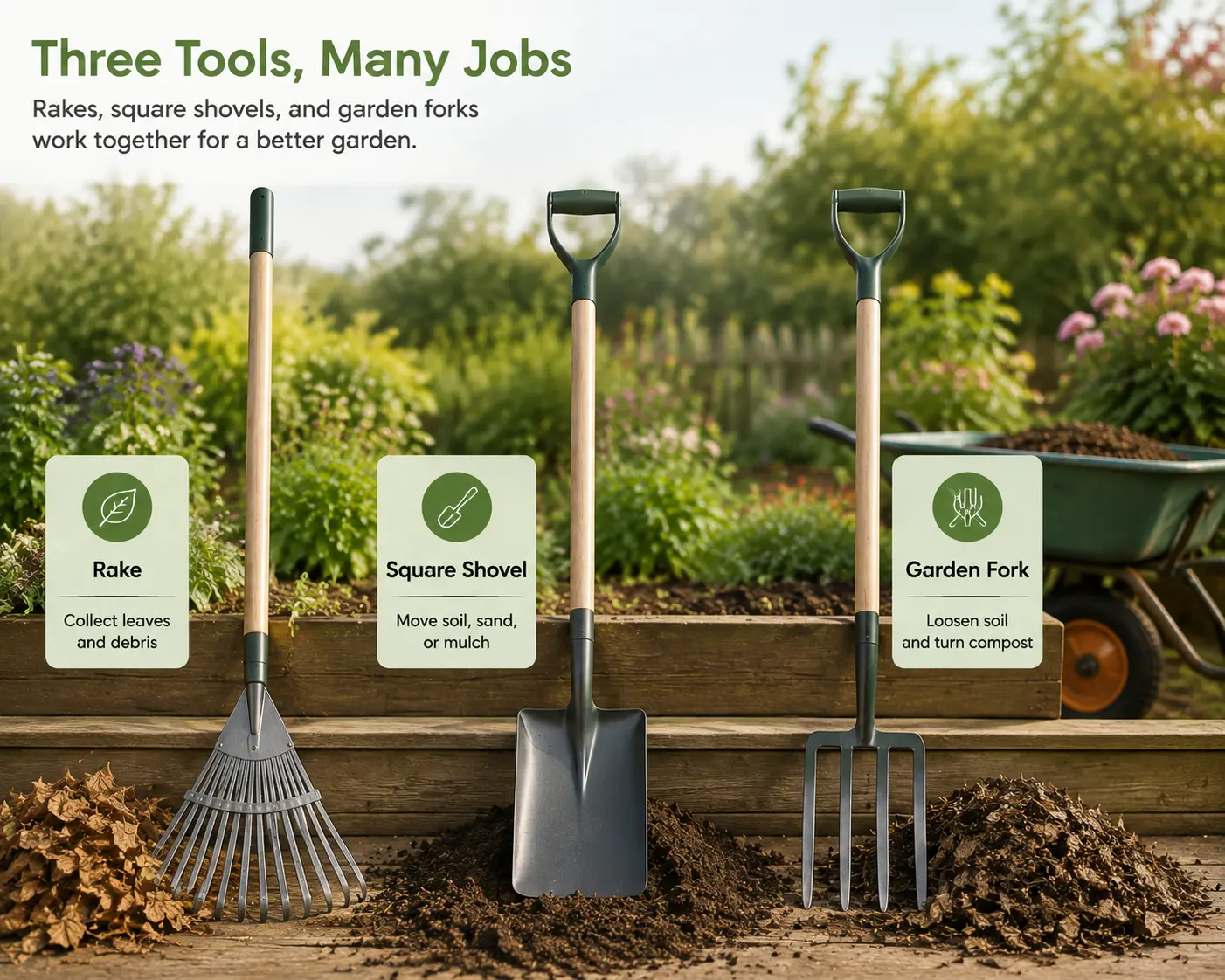
The solution is not to stock more tools. It is to understand who your customers are, what tasks they need to accomplish, and which specific models cover those tasks without redundancy. This guide connects three product categories — rakes, square point shovels, and garden forks — into a single range-planning framework for B2B buyers.
Who this guide is for: Garden centers, regional distributors, hardware stores, landscape suppliers, and new private-label brands who need to source long-handled garden tools and want to build a range that serves real customers without catalogue bloat.
Start with Buyer Type, Not Product Count
Before looking at any product page, identify who you are selling to. The range that works for a garden center serving suburban homeowners is different from the range that works for a landscape supply company serving professional contractors.
| Buyer Type | Primary Customers | Core Tasks | Typical Range Size |
| Garden center / retail | Suburban homeowners, hobby gardeners | Seasonal leaf collection, light soil prep, border edging, transplanting | 4–6 core SKUs |
| Hardware store (mixed) | Homeowners + light trade | General-purpose digging, moving material, leaf collection | 5–7 core SKUs |
| Landscape supply | Professional landscapers, contractors | Heavy soil preparation, material moving, trenching, edging | 6–8 core SKUs |
| Agricultural / farm supply | Farmers, smallholders, equestrian | Ground breaking, compost turning, hay handling, material moving | 6–10 core SKUs |
| Private-label brand (new) | Varies by target market | Depends on positioning — budget, mid-range, or premium | 4–8 core SKUs |
The point is not that these numbers are rigid. The point is that a focused range of 4–6 well-chosen SKUs often outperforms a 20-SKU catalogue where half the models do the same job.
Task Map: What Your Customers Actually Do
Iowa State University Extension recommends that every gardener have at least two rakes — a steel garden rake for soil work and a lawn rake for leaf collection. Penn State Extension emphasizes that choosing the right tool for the task is a form of self-care, reducing strain and improving results. The same principle applies across all long-handled tools: the task determines the tool, not the other way around.
Here is a task map covering the most common jobs your customers need done — and which tool category serves each:
| Task | Primary Tool | Secondary Tool | Why Two Categories |
| Leveling soil / preparing seedbeds | Bow rake or level head rake | Garden spade (for edges) | Rake levels; spade cuts clean borders |
| Collecting leaves / lawn debris | Leaf rake (flexible tines) | — | No rigid-tine tool does this job well |
| Moving loose material (soil, sand, gravel, mulch) | Square point shovel | — | Flat blade scoops maximum volume |
| Digging holes / breaking ground | Round point shovel | Digging fork (for clay) | Shovel penetrates; fork lifts and breaks |
| Edging borders / cutting turf | Garden spade | — | Straight blade + right angle = clean vertical cut |
| Turning soil / incorporating compost | Digging fork | Bow rake (for finishing) | Fork penetrates and lifts; rake levels after |
| Turning compost / moving manure | Compost fork | — | Wider tine spacing releases material cleanly |
| Working in tight spaces (flower beds, raised beds) | Border fork | Shrub rake | Smaller tools fit between plants |
| Moving hay / straw | Pitchfork | — | Long, thin tines for light material |
| Deep soil aeration (no-dig) | Broadfork | — | Specialized two-handled tool |
This map is the foundation of range planning. If your customers do five of these tasks, you need tools that cover those five — without two models serving the same task.
Core SKU Recommendations by Buyer Type
Garden Center / Retail
| SKU | Tool Type | Why It Earns a Place |
| 1 | Bow rake (14-tine, mid-range) | Core soil preparation tool — every gardener needs one |
| 2 | Leaf rake (metal or plastic) | Seasonal high-volume seller — essential for autumn |
| 3 | Round point shovel (long handle) | General-purpose digging — most versatile single shovel |
| 4 | Garden spade (D-grip or long handle) | Edging and precision work — different task from shovel |
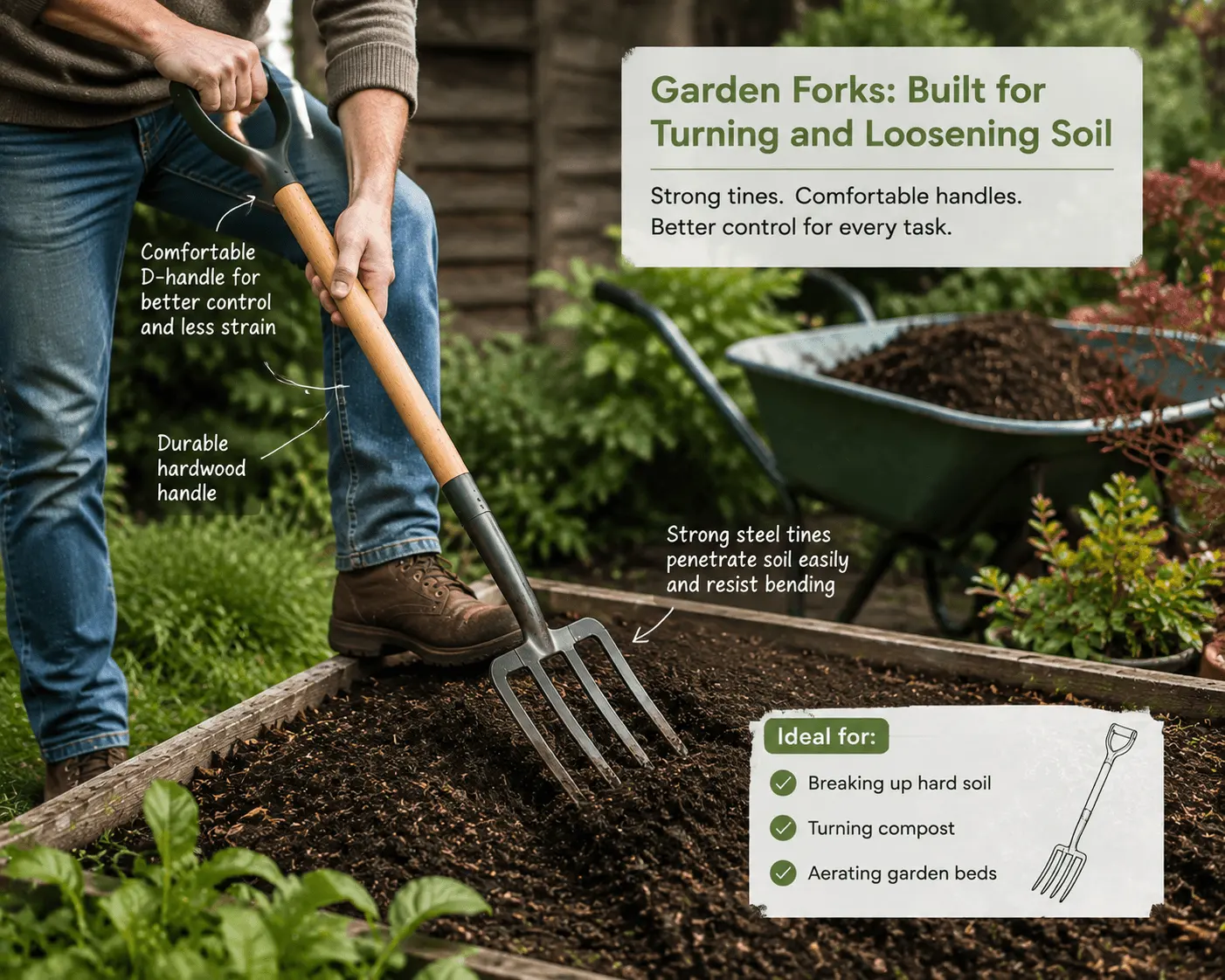
| 5 | Digging fork (D-grip, 4-tine) | Soil turning and compost — different motion from shovel |
5 SKUs cover the core tasks of a suburban gardening customer. Add a shrub rake or border fork if your customers work in confined spaces.
Landscape Supply
| SKU | Tool Type | Why It Earns a Place |
| 1 | Bow rake (heavy-duty, forged) | Professional soil preparation — needs to withstand daily use |
| 2 | Square point shovel (14-gauge, long handle) | Material moving — the core tool for landscaping work |
| 3 | Round point shovel (14-gauge, long handle) | Digging and trenching — essential for site preparation |
| 4 | Garden spade (forged, long handle) | Clean edges and borders — professional finish work |
| 5 | Digging fork (forged, T-grip or long handle) | Soil breaking and turning — for heavy ground |
| 6 | Leaf rake (metal, spring steel) | Cleanup — secondary but necessary for site finish |
6 SKUs cover professional landscaping tasks. The difference from retail is in construction: heavier gauge, forged components, longer sockets, and through-bolt connections.
Agricultural / Farm Supply
| SKU | Tool Type | Why It Earns a Place |
| 1 | Bow rake (agricultural-grade) | Soil leveling and seedbed preparation |
| 2 | Square point shovel (long handle) | Material moving — feed, soil, gravel |
| 3 | Round point shovel (long handle) | General digging and post-hole work |
| 4 | Digging fork (T-grip, 4-tine) | Heavy soil turning and root lifting |
| 5 | Compost fork (5–6 tine) | Compost and manure turning |
| 6 | Pitchfork (3-tine) | Hay and straw handling — if equestrian customers |
6 SKUs cover farm and smallholding tasks. Add a broadfork if your customers include market gardeners or no-dig practitioners.
Three-Tier Price Structure: What Actually Changes
A common sourcing mistake is assuming that a higher price means “better” without understanding what actually differs. Here is what should change between opening, mid-range, and professional tiers — across all three tool categories:
| Parameter | Opening Price | Mid-Range | Professional |
| Steel thickness | Thinner (16-gauge range for shovels) | Medium (15-gauge range) | Thicker (14-gauge range) |
| Forming method | Stamped | Stamped or roll-forged | Forged or roll-forged with heat treatment |
| Socket | Shorter; stamped | Medium; may be integrated | Longer; forged or reinforced |
| Fastener | Rivet | Rivet or bolt | Through-bolt; may be user-replaceable |
| Coating | Painted | Painted or powder-coated | Powder-coated or epoxy; edge coverage addressed |
The difference should be structural and measurable — not just a different color or label. A higher price tier that only changes the paint color is not a genuine quality upgrade. For the full parameter-by-parameter breakdown — including handle, packaging, QC level, tolerance, and heat treatment — see Opening Price, Mid-Range, and Professional Garden Tools.
How to Avoid SKU Overlap and Catalogue Bloat
The most common range-planning mistake is stocking two tools that do the same job. Here is how to prevent it:
Rule 1: One tool per task. If you stock a 14-tine bow rake at 40 cm head width and a 14-tine bow rake at 45 cm, most customers cannot tell the difference. Pick one. Use the other slot for a different task type or a different quality tier.
Rule 2: Different construction, not just different labels. If you offer two quality tiers within the same tool type, they need to be genuinely different — different steel thickness, different socket depth, different handle material. A label change is not a quality tier.
Rule 3: Cross-category coverage. Check whether a rake and a shovel in your range serve overlapping tasks. A bow rake levels soil; a square point shovel moves soil. These are different tasks — but if your customer only needs to move a pile of dirt, they do not need both. Know which task each SKU serves.
Rule 4: Seasonal awareness. Leaf rakes sell in autumn; garden rakes sell in spring. If you stock both simultaneously without considering seasonal demand, you risk overstocking one and stocking out of the other.
Mixed Orders, Sampling, and Consolidation
One of the advantages of sourcing rakes, shovels, and forks from a single supply team is the ability to consolidate multiple tool types into one shipment. But mixed orders require planning:
What to Confirm Before Placing a Mixed Order
- Model-specific availability: Not all models are produced year-round. Confirm which models are in stock and which require production lead time.
- Minimum quantities per model: Mixed orders allow smaller per-model quantities, but each model still has a practical minimum for production efficiency. Confirm model by model.
- Packaging compatibility: Long-handle tools (typically 1,240–1,770 mm depending on model) and D-grip tools (900–1,020 mm) require different carton lengths. Mixed orders need cartons that accommodate the longest configuration.
- Container loading: Estimated 20-foot container loading varies by tool type and handle length. Estimated loading for long-handle rakes is typically 450–500 dozen; shovels and forks may vary depending on head size and handle configuration. D-grip tools load more compactly. Head-only shipments (without handles) are the most space-efficient.
- Inspection scope: A mixed order means multiple tool types in one inspection. Confirm that the inspection covers all models — not just a representative sample from one category.
Sampling Strategy
For a first order, request samples of each shortlisted model before committing to production. The sample approval process should include:
Physical sample of each model for dimensional inspection and functional testing
Side-view photo confirming head-to-handle angle (especially for distinguishing shovels from spades)
Connection close-up showing socket depth, rivet/bolt type, and handle fit
Coating inspection on edges and high-wear areas
Weight and balance check — compare against specification
For a detailed inspection framework, see the QC checklists for each tool category: Garden Rake QC, Square Point Shovel QC, and Garden Fork QC.
Private Label: What Can Be Customized
Private-label customization spans three levels of complexity:
| Level | What Changes | MOQ Impact | Tooling Impact |
| Level 1 (Low risk) | Labels, hang tags, outer carton printing, insert cards | Minimal — can often be done at standard order quantities | None |
| Level 2 (Medium) | Coating color, handle material, grip type, handle length, packaging design | Moderate — color changes may require minimum coil purchases; handle changes may require minimum handle runs | Minimal to none |
| Level 3 (Structural) | Blade size, tine count, head shape, new mold, socket redesign | Significant — new tooling, minimum production runs, and extended lead time | Yes — new molds or dies |
Most private-label projects start at Level 1 or Level 2. Level 3 is for brands that need a genuinely unique product — not just a different label on an existing model. For a detailed guide to customization levels and MOQ drivers, see Private Label Garden Tools.
What Buyers Should Provide
To get a useful private-label response, provide:
- Product models you are interested in (or reference photos)
- Branding method (laser engraving, screen print, label, embossing)
- Target quantity range
- Destination market (affects compliance, labeling, and packaging requirements)
- Preferred handle material and finish
Quality Control and Supplier Coordination
A mixed-tool range means multiple product types under one quality framework. The framework should cover:
Pre-Production
- Specification sheets for each model — tine count, blade dimensions, steel thickness in mm, socket depth, handle material and length, coating type, packaging method
- Golden sample approval — physical inspection and functional test before production starts
- Pre-production sample — confirm the pre-prod sample matches the approved golden sample
During Production
- Random sampling from production batches — compare against approved sample
- Critical checks by tool type:
- Rakes: tine alignment, rivet security, head-to-handle connection
- Shovels: blade flatness, edge straightness, socket depth, foot step symmetry
- Forks: tine straightness, spacing consistency, socket integrity, weld quality (if welded)
Before Shipment
- Packaging inspection — head protection, handle protection, carton rigidity, labeling
- ISTA transit testing if packaging performance is a concern
- Documentation — photo evidence, measurements, test results, defect log, disposition
For tool-specific inspection frameworks, see Garden Rake QC Checklist, Square Point Shovel QC Checklist, and Garden Fork QC Checklist.
Building a Feedback Loop
A tool range is not static. After launch, track what sells and what does not — and why:
- Which SKUs sell through? These are your core models. Protect them.
- Which SKUs sit? Find out why. Wrong task fit? Wrong price? Wrong season?
- What do customers ask for that you do not stock? This is your expansion signal.
- What returns do you get? Returns tell you about wrong selection (customer bought the wrong tool) or quality issues (tool failed under normal use).
Use this feedback to adjust your range quarterly. Drop redundant SKUs. Add missing task coverage. Adjust quality tiers based on what your market actually buys.
FAQ
How many SKUs do I need to start? For most garden centers and retail buyers, 4–6 core SKUs across rakes, shovels, and forks cover the majority of customer tasks. For landscape supply and agricultural channels, 6–8 SKUs may be needed. The key is covering core tasks without overlap — not maximizing catalogue size.
Can I mix rakes, shovels, and forks in one order? Yes, mixed orders are possible and often practical for consolidating shipping costs. However, model-specific availability, minimum quantities, packaging compatibility, and container loading need to be confirmed — not assumed. Share your shortlisted models and target quantities, and we will check feasibility.
Should I stock all three price tiers? Not necessarily. If your market is primarily budget-conscious, two tiers (opening and mid-range) may be sufficient. If you serve both retail and professional customers, three tiers make sense. The tiers must be genuinely different in construction — not just different labels.
How do I know if two SKUs overlap? If two tools serve the same task with the same construction quality, they overlap. A 14-tine bow rake at 40 cm and a 14-tine bow rake at 45 cm are overlapping — most customers cannot distinguish them. Use the slot for a different task type or a different quality tier.
Can I start with a small trial order? For first-time buyers, a trial order with a limited SKU selection is often the best approach. Confirm which models are available in smaller quantities, request samples for approval, and test the market before committing to full-container orders. Share your shortlist and we will check what is feasible.