








Updated 2 months ago
Opening Price, Mid-Range, and Professional Garden Tools: What Actually Changes?
SCARECROW GARDEN SUPPLIER

Opening Price vs. Mid-Range vs. Professional Garden Tools | Scarecrow Garden Supplier
Key Takeaways
- Price differences between garden tool tiers come from measurable construction changes — material, forming method, heat treatment, socket depth, fastener type, handle quality, coating, and packaging — not just “factory margin.”
- A higher price tier should be visibly and structurally different from the one below it. A label change or color change is not a quality upgrade.
- Opening-price tools are not “bad” — they are built for a different use case and price point. The question is whether the construction matches the expected service life.
- Professional-tier tools earn their price through forged construction, heat treatment, through-bolt connections, and premium handles — not through marketing claims.
- Buyers should specify quality tiers using measurable fields (steel thickness in mm, socket depth, fastener type, coating type) rather than subjective labels (“heavy-duty,” “premium”).
A supplier quotes you three prices for what looks like the same shovel. The photo is identical. The blade shape is the same. Why is one 30% more expensive than another? The answer is not “the factory is charging more.” The answer is in the construction — and if you cannot see the difference, it is because no one has shown you where to look.
This guide explains what actually changes between opening-price, mid-range, and professional garden tools across rakes, shovels, and forks. The goal is to help buyers specify quality tiers using measurable construction parameters — not marketing labels.
Who this guide is for: Distributors, retailers, and private-label brands who need to understand price-tier differences and specify them accurately in procurement.
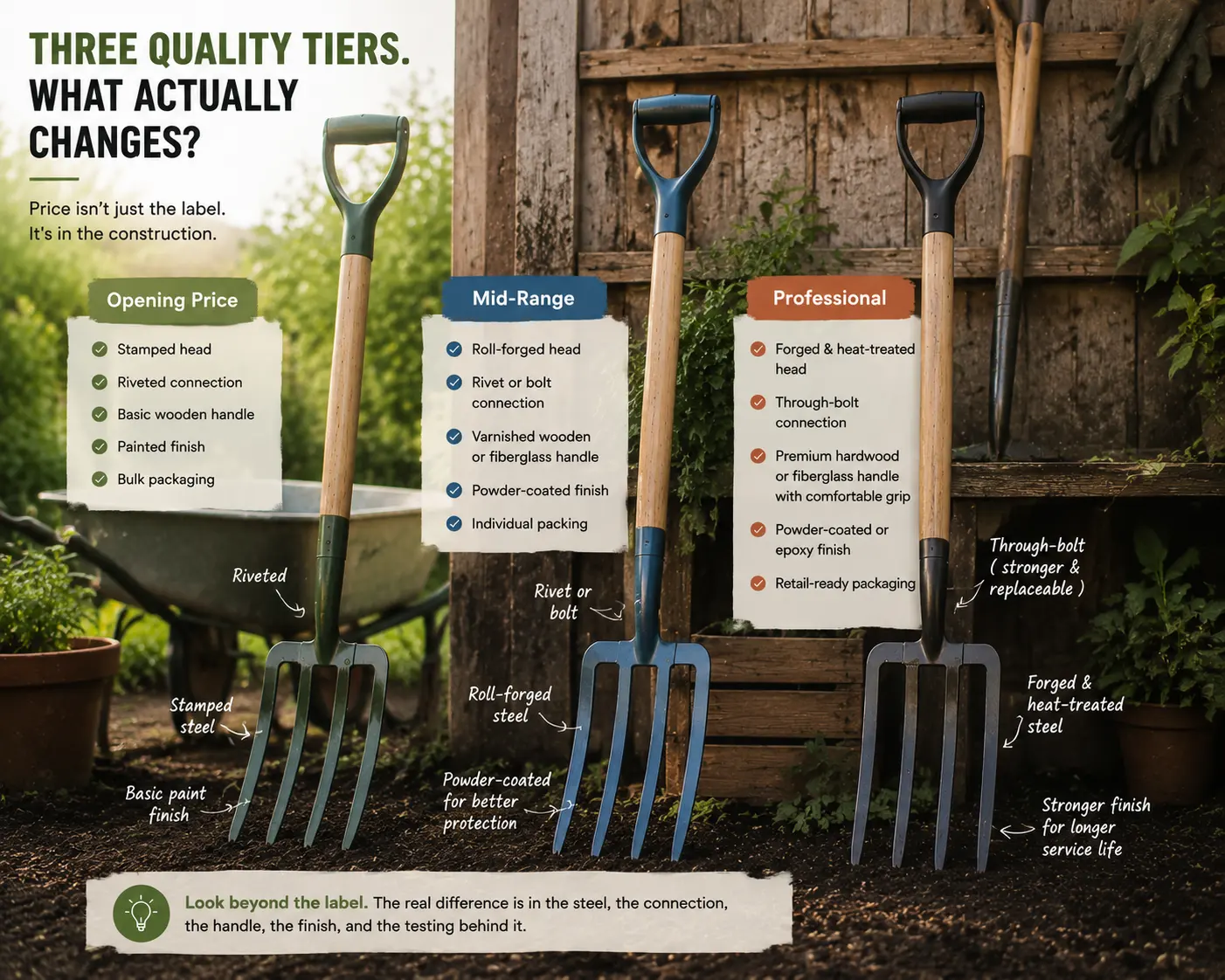
The Three-Tier Difference Matrix
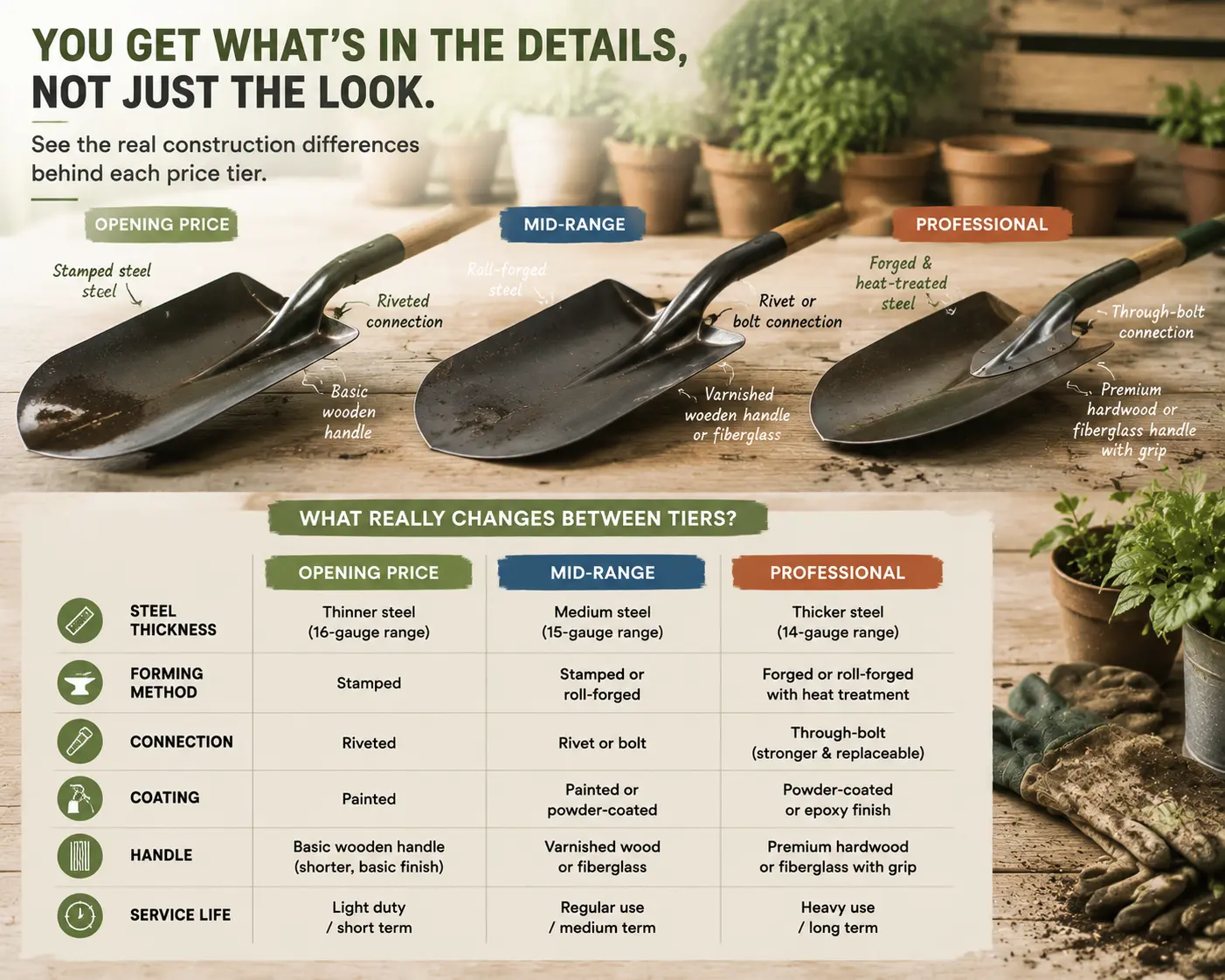
Here is what should change between tiers — across all three tool categories:
| Parameter | Opening Price | Mid-Range | Professional |
| Steel thickness | Thinner — 16-gauge range for shovels (≈1.5 mm); lighter tine section for forks and rakes | Medium — 15-gauge range for shovels (≈1.7 mm); medium tine section | Thicker — 14-gauge range for shovels (≈1.9 mm); heavier tine section |
| Forming method | Stamped | Stamped or roll-forged | Forged or roll-forged with heat treatment |
| Socket | Shorter; stamped; thinner wall | Medium; may be integrated | Longer; forged or reinforced; thicker wall |
| Fastener | Rivet (typically) | Rivet or bolt | Through-bolt; may be user-replaceable |
| Handle | Basic wood; shorter; unfinished or basic varnish | Wood (varnished) or fiberglass | Premium wood or fiberglass; longer; ergonomic grip; may have over-mold |
| Coating | Painted | Painted or powder-coated | Powder-coated or epoxy; edge coverage addressed |
| Foot step (shovels) | May be absent | Present; single-fold | Present; reinforced or double-layer |
| Tine section (rakes/forks) | Flat or square (stamped) | Square or triangular (roll-forged) | Diamond or triangular (forged) |
| Heat treatment | Typically none | May be applied | Applied — hardened and tempered |
| Packaging | Bulk (woven bag) | Individual or small-pack | Retail-ready box or sleeve |
| QC level | Visual inspection | Visual + functional check | Visual + functional + load test |
Source note: Construction parameters based on Forging Industry Association — “How Forgings Compare to Other Processes” — and market samples from Corona, Bully Tools, and Spear & Jackson. ASTM D3359 and B117 provide coating testing frameworks. Specific steel grades and hardness values are not typically listed in product catalogs — describe the material as “steel” unless a specific grade is confirmed.
Material and Actual Dimensions
Steel Grade
Carbon steel is the standard material across all tiers. The difference between tiers is not usually the steel grade — it is the thickness, forming method, and heat treatment. Some manufacturers use manganese steel (such as 50Mn) or railway steel, but specific grades are not typically listed in product catalogs. Do not claim a specific grade unless it has been confirmed.
Boron steel is used by some premium brands (such as Corona) and offers a high strength-to-weight ratio when heat-treated. But “boron steel” is an alloy choice — not an automatic quality stamp. Untreated boron steel performs similarly to untreated carbon steel. The benefit only materializes with proper hardening and tempering.
Thickness
Thicker steel resists bending — but thickness alone does not determine strength. A heat-treated 15-gauge blade may outperform an untreated 14-gauge blade. Always ask for actual thickness in millimetres, measured at a specified point on the blade. Do not compare by gauge number alone — gauge is not a universal standard. For a detailed explanation, see 14-Gauge, 15-Gauge, or 16-Gauge Shovel Blades.
Post-Forming Thickness Changes
When a flat steel sheet is stamped into a blade, the material thins at curves, shoulders, and deep-draw areas. A “14-gauge” specification may refer to the raw sheet thickness before forming — the actual thickness at the finished blade’s shoulder may be less. Professional-tier tools often address this through forging (which maintains more uniform thickness) or through reinforced shoulder design.
Manufacturing and Connection
Stamped vs. Forged
Stamped blades are pressed from flat steel sheet using a die. This is cost-effective for high-volume production and produces dimensionally consistent blades. Stamping is typical of opening-price and mid-range tools.
Forged blades are shaped by compressive force, creating continuous grain flow that follows the part’s contours. The Forging Industry Association explains that forging refines the steel’s microstructure and provides strength at critical stress points — particularly the transition from blade to socket. Forged construction is typical of professional-tier tools.
Roll-forged construction — used in the Luannan production cluster — is a middle ground: steel is passed through rollers that progressively form the blade. This is common in mid-range tools.
Socket Depth and Connection
The socket is where the handle inserts into the head. This is one of the most common failure points across all tool types.
| Tier | Socket | Fastener | Repairability |
| Opening | Shorter; stamped; thinner wall | Rivet | Typically not user-replaceable |
| Mid-range | Medium; may be integrated | Rivet or bolt | May be replaceable (bolt) |
| Professional | Longer; forged or reinforced; thicker wall | Through-bolt | Often user-replaceable |
Penn State Extension notes that when heads and handles are made of differing materials, heads usually outlast handles — making tools with easy-to-replace handles a practical choice for professional markets. For professional markets where tool repair is expected, through-bolt connections are preferable.
Tolerance and Consistency
Opening-price tools often have wider manufacturing tolerances — more variation in tine spacing, blade flatness, and socket fit. This does not mean they are defective — it means the quality control threshold is set for a price point where perfect consistency is not the priority.
Professional tools should have tighter tolerances:
- Tine spacing on rakes and forks should be uniform within an agreed tolerance
- Blade flatness on shovels should show no visible warping
- Socket fit should be tight — no play between handle and head
If you are paying for a professional tier, consistency is part of what you are paying for. Verify it through sampling — not through catalogue claims.
Surface Finish and Edge Details
Coating Differences
| Tier | Coating | Edge Coverage | Adhesion |
| Opening | Painted (liquid paint) | Cut edges may be bare | Basic — may chip under impact |
| Mid-range | Painted or powder-coated | Edges partially covered | Better — powder coating is thicker and more uniform |
| Professional | Powder-coated or epoxy | Edges addressed — including cut edges and tine tips | Best — proper surface preparation and thicker coating |
Coating performance should be described by what it is — “painted finish” or “powder-coated finish” — not by unverified salt spray hour claims. ASTM B117 salt spray testing provides a standardized comparison environment, but hours of salt spray exposure do not translate directly to years of outdoor service. For practical quality verification, the ASTM D3359 tape adhesion test and visual edge coverage inspection are more accessible checks.
Edge and Tip Coverage
This is where coating failures start. Stamped and cut steel parts have cut edges that may not receive adequate coating. Professional-tier tools should address edge coverage — including tine tips on rakes and forks, and cutting edges on shovels. If bare steel is visible at edges, rust will begin there regardless of coating type.
Handle, Grip, and Ergonomics
| Tier | Handle Material | Handle Length | Grip | Connection |
| Opening | Basic wood; unfinished or basic varnish | Shorter | Simple end cap or no grip | Rivet |
| Mid-range | Wood (varnished) or fiberglass | Standard | D-grip or simple over-mold | Rivet or bolt |
| Professional | Premium wood (varnished/waxed) or fiberglass | Longer; ergonomic | D-grip with over-mold; or T-grip | Through-bolt |
Utah State University Extension emphasizes that using rakes and shovels with height-appropriate handles helps maintain a straight back and avoid hunching over. Professional-tier tools often offer longer handles and ergonomic grips — but no handle eliminates fatigue or prevents injury. Describe ergonomic benefits accurately: “allows a more upright working posture” — not “prevents back injury.”
Handle material is one of the key differences between quality tiers. Compare wood and fiberglass options in Wood vs. Fiberglass Handles Across Rakes, Shovels, and Forks
Testing, Inspection, and After-Sales
Testing Differences
| Tier | Factory QC | Sample Testing | Third-Party Testing |
| Opening | Visual inspection | Typically not provided | Not typically arranged |
| Mid-range | Visual + functional check | May be provided on request | Can be arranged if required |
| Professional | Visual + functional + load test | Should be provided | More likely to be arranged |
Acceptance criteria (pass/fail thresholds, load values) should be agreed between buyer and supplier before production — regardless of tier. BS 3388 provides a standardized framework for forks, shovels, and spades testing, but standard compliance must be verified through proper testing, not assumed.
Packaging Differences
| Tier | Packaging | Carton | Labeling |
| Opening | Bulk (woven bag) | Basic carton | Generic |
| Mid-range | Individual or small-pack | Sturdier carton | May include model number |
| Professional | Retail-ready box or sleeve | Rigid carton with insert | Private-label ready |
ISTA transit testing can be arranged for any tier if packaging performance is a concern.
When Opening Price Is Enough — and When It Is Not
Opening Price Is Enough When:
- The tool is for seasonal or light use (e.g., a plastic leaf rake for autumn cleanup)
- The customer is budget-conscious and replacement is acceptable
- The tool is an accessory item, not a core SKU
- The market does not have a repair culture — tools are replaced, not fixed
Professional Is Needed When:
- The tool is used daily by professionals (landscapers, contractors, farmers)
- The tool is expected to last multiple seasons under heavy load
- The market has a repair culture — replaceable handles and through-bolts are valued
- The customer associates your brand with professional quality
Mid-Range Is the Sweet Spot When:
- The customer is a serious home gardener who wants better than budget but does not need professional-grade
- The tool is used regularly but not intensively
- The price difference between opening and professional needs a middle option
How to Write Three-Tier Specifications
When creating product pages, packaging, or specification sheets, use measurable fields — not subjective labels:
| Field | Opening | Mid-Range | Professional |
| Steel thickness | “1.5 mm (measured at blade center)” | “1.7 mm” | “1.9 mm” |
| Forming method | “Stamped” | “Roll-forged” | “Forged” |
| Socket depth | “35 mm” | “50 mm” | “65 mm” |
| Fastener | “Rivet, 5 mm diameter” | “Bolt, 6 mm” | “Through-bolt, 8 mm, user-replaceable” |
| Handle | “Wood, 1,200 mm, basic varnish” | “Wood, 1,400 mm, varnished” | “Ash wood, 1,500 mm, waxed, D-grip with over-mold” |
| Coating | “Painted” | “Powder-coated” | “Powder-coated, edge coverage addressed” |
Do not use “good / better / best” as quality labels. These are marketing terms, not specifications. Each tier should be defined by what is measurably different.
FAQ
Is a more expensive tool always better? Not necessarily. A more expensive tool should be measurably different in construction — thicker steel, forged components, longer socket, better handle, superior coating. If the only difference is the label or color, the higher price is not justified. The question is whether the construction differences match the expected use case and service life.
Can I sell opening-price tools to professionals? Generally not advisable. Professional users put tools under loads that opening-price construction may not withstand — thinner steel bends, shorter sockets loosen, and basic rivets fail. If you serve professional customers, stock at least mid-range or professional-tier tools.
How do I verify that a “professional” tool is actually professional-grade? Check the construction: Is it forged or stamped? What is the actual steel thickness in mm? How deep is the socket? Is the fastener a through-bolt or a rivet? Is the handle premium wood or fiberglass? Is the coating powder-coated with edge coverage? If the answers match the professional column in the matrix above, the tool is professional-grade. If not, the label may be marketing.
What if my factory cannot provide heat treatment details? If the factory cannot confirm heat treatment, do not claim it. Describe the material as “steel” without specifying hardness or treatment. Heat treatment details (process, target hardness, measurement points) are not typically listed in garden tool product catalogs. If treatment is confirmed but specific values are not available, describe the blade as “heat-treated” without specifying hardness numbers.
Should I offer all three tiers? It depends on your market. If you serve only budget-conscious customers, two tiers (opening and mid-range) may be sufficient. If you serve both retail and professional customers, three tiers make sense. Each tier must be genuinely different in construction — not just in label.