






Updated 2 months ago
Private Label Garden Tools: What Can Be Customized Without Creating Unnecessary MOQ and Tooling Costs?
SCARECROW GARDEN SUPPLIER
Private Label Garden Tools: Customization Without Unnecessary MOQ | Scarecrow Garden Supplier
Key Takeaways
- Customization does not mean developing a new product. Most private-label garden tools start with existing models and low-risk branding changes — not new molds or structural redesigns.
- Customization falls into three levels: Level 1 (labels, packaging), Level 2 (colors, handles, grips), and Level 3 (new sizes, new molds, structural changes). Each level has different MOQ and tooling implications.
- MOQ is driven by specific factors — not a single number. Understanding which factor is driving the MOQ (color change, printing run, material purchase, new tooling) helps you find ways to reduce it.
- The lowest-risk way to start is with standard models, neutral packaging, and brand-specific labeling — then expand customization after the market validates the product.
- Every customization detail must be confirmed model by model. There is no “everything can be customized at any quantity” — each claim needs to be verified for the specific product.
You want to sell garden tools under your own brand. The factory catalog has 50 models. You have a logo, a brand name, and a target market. What can you actually customize — and what will it cost you in minimum quantities and tooling?
This is the question every new private-label buyer asks. The answer is not “everything” — and it should not be. The right answer depends on what you want to change, which models you have selected, and what your market actually needs. This guide breaks customization into three levels, explains what drives MOQ at each level, and outlines a practical path from first trial to full private-label collection.
Who this guide is for: New brands, garden centers, regional distributors, and e-commerce buyers who want to source private-label garden tools without unnecessary cost or commitment.
Customization Does Not Equal Developing a New Product
The most common misconception about private-label garden tools is that customization means starting from scratch. It does not. Most private-label projects begin with existing, proven models — the same tools that are already being manufactured and exported. The customization is in how the tool is branded, packaged, and presented.
Think of it this way: the tool’s function — a bow rake, a square point shovel, a digging fork — is already defined by the head design, steel, and handle. What you change is the brand layer on top of that proven foundation.
Before customizing, brands should first define their product range and target buyers. See How to Build a Long-Handled Garden Tool Range: Rakes, Square Shovels, and Garden Forks for Different Buyers.
Three Levels of Customization
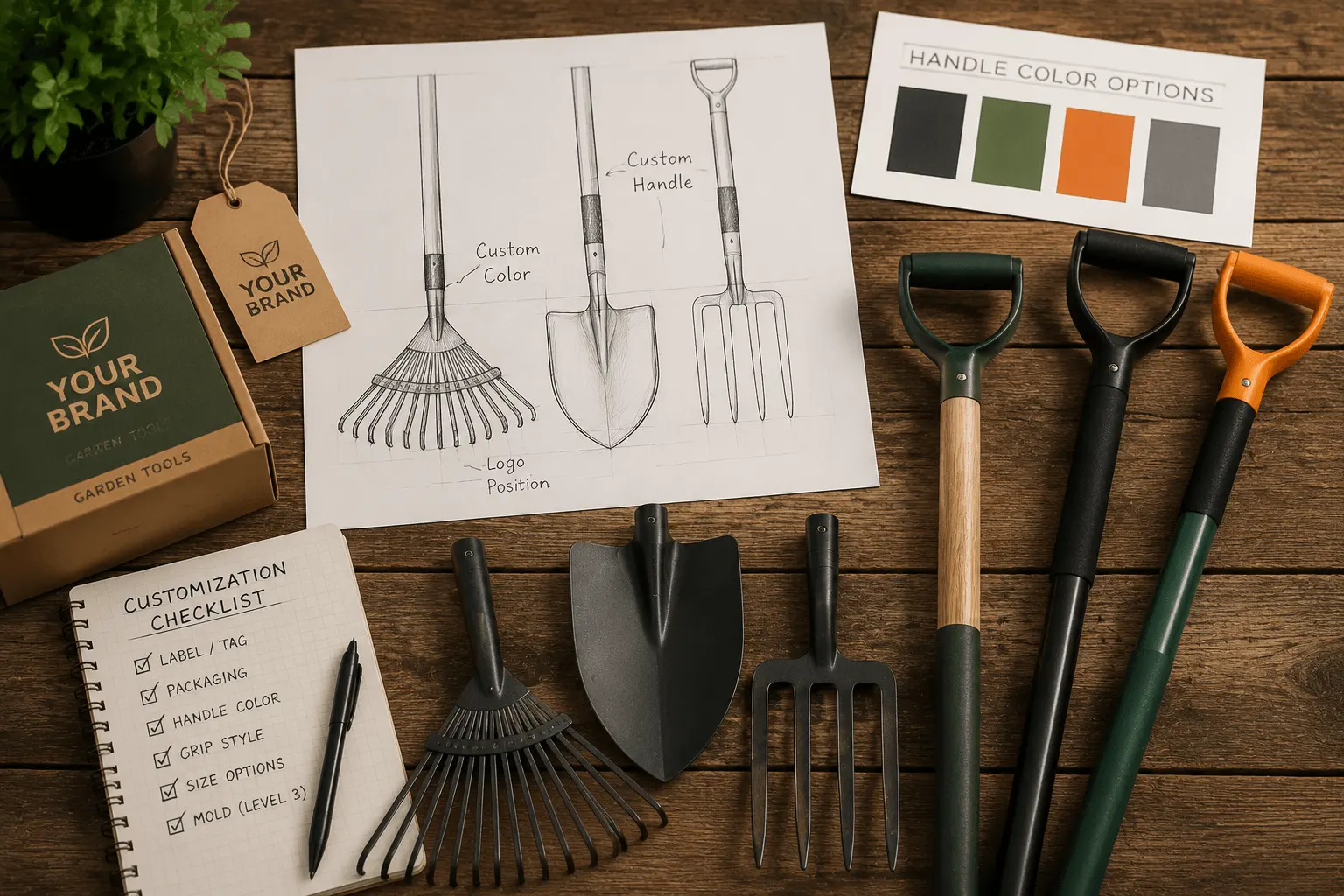
Level 1: Low-Risk Branding (Labels, Tags, Cartons, Inserts)
| Element | What Changes | MOQ Impact | Tooling Impact |
| Hang tag | Brand-specific tag attached to the tool | Minimal — can often be done at standard order quantities | None |
| Sticker / label | Brand label applied to the handle or head | Minimal | None |
| Outer carton printing | Brand name and design printed on the shipping carton | Moderate — carton printing has an estimated minimum run (typically 50–100 cartons) | None |
| Insert card | Product information card inserted into the packaging | Minimal | None |
| Barcode / SKU label | Your specific product codes on packaging | Minimal | None |
Level 1 is where most private-label projects start. You select existing models, apply your branding through labels and packaging, and test the market without investing in tooling or structural changes. The MOQ is typically the same as the standard product MOQ — the customization is in the branding layer, not the product itself.
Level 2: Medium Customization (Colors, Handles, Grips, Packaging Design)
| Element | What Changes | MOQ Impact | Tooling Impact |
| Coating color | Head color changed from standard to custom | Moderate to significant — depends on whether the color is a standard coil color or a custom coil | None (if standard color) / Yes (if custom coil requires steel mill minimum) |
| Handle material | Switch from wood to fiberglass, or vice versa | Moderate — handle production has minimum runs | None |
| Handle color (fiberglass) | Fiberglass handle color changed | Moderate — pultrusion has minimum runs per color | None |
| Handle finish (wood) | Varnish color, wax type, or surface treatment | Low to moderate | None |
| Grip type | D-grip, T-grip, or over-molded grip changed | Moderate — grip tooling and minimum runs | Possible — if a new grip mold is needed |
| Handle length | Length changed from standard | Moderate — may affect packaging and production setup | None |
| Packaging design | Custom retail box, sleeve, or display | Moderate — packaging printing has minimum runs | None (for standard box sizes) / Yes (for custom box dimensions) |
Level 2 is for brands that have validated their market and want to differentiate further. The MOQ impact is real but manageable — the key is understanding which specific element is driving the minimum quantity.
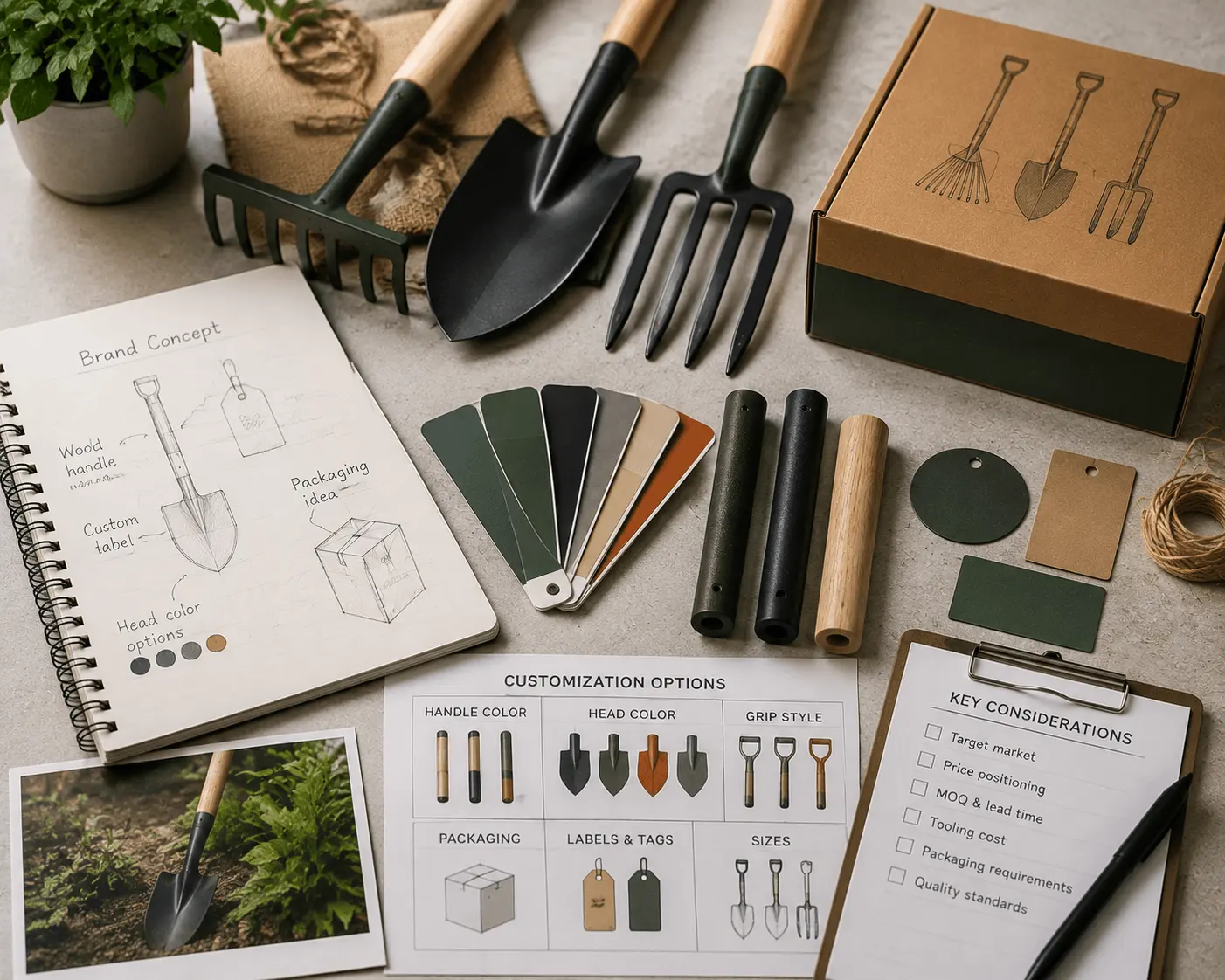
Level 3: Structural Customization (Sizes, Blades, Tines, Molds)
| Element | What Changes | MOQ Impact | Tooling Impact |
| Blade size | Shovel blade dimensions changed | Significant — new die or stamping setup | Yes — new die |
| Tine count | Fork or rake tine number changed | Significant — new head design | Yes — new tooling |
| Head shape | Rake head width, fork head width, shovel blade shape | Significant — new die | Yes — new die |
| Socket redesign | Socket depth or diameter changed | Significant — new tooling | Yes |
| New model | A tool that does not exist in the current catalogue | Very significant — full development | Yes — full tooling |
Level 3 is for established brands that need a genuinely unique product. This level requires investment in tooling, extended lead time, and higher minimum quantities. It is not where a new private-label project should start.
Customization decisions should be based on the quality level you want to position in the market. See Opening Price, Mid-Range, and Professional Garden Tools: What Actually Changes?
Start Your Custom Garden Tool Project With The Right Level
Start with the lowest-risk customization level. Send your product models, branding elements, quantity range, and target market. We will separate simple branding from structural development and help identify a practical customization path.
What Drives MOQ: Understanding the Factors
MOQ (Minimum Order Quantity) is not a single number that the factory picks arbitrarily. It is driven by specific production and procurement factors. Understanding which factor is driving the MOQ helps you find ways to reduce it.
| MOQ Driver | What It Means | Typical Range | How to Reduce |
| Color change (coating) | If the factory uses pre-painted color-coated steel coil, a custom color requires a new coil from the steel mill | Steel mill minimum coil weight — typically several tons | Use a standard color (the mill’s regular stock colors) instead of a custom color |
| Handle production run | Handles are produced in batches — wood handles are cut and finished in runs; fiberglass handles are pultruded in runs | Estimated 500–2,000 handles per run | Use standard handle specifications; combine multiple models that use the same handle |
| Printing run (packaging) | Carton printing, label printing, and insert card printing have minimum economical run sizes | Estimated 500–1,000 pieces for labels; 50–100 cartons for carton printing | Use digital printing for smaller quantities; combine models in the same carton |
| Material purchase | Specific materials (e.g., a specific wood species or fiberglass specification) may have minimum purchase quantities from the supplier | Varies by material | Use standard materials that the factory already stocks |
| New tooling | New dies, molds, or fixtures for structural changes | Tooling cost + minimum production run to amortize | Avoid Level 3 customization unless the volume justifies it |
The Key Insight
If a supplier says “MOQ is 1,000 dozen for custom color,” that number is driven by the steel mill’s minimum coil weight — not by the factory’s preference. If you switch to a standard color, the MOQ drops to the standard product minimum. Understanding this helps you make informed trade-offs: “Do I need this specific color, or can I use a standard color and differentiate through packaging and branding?”
Understand What Is Really Driving MOQ
Send your product models, customization requirements, quantity range, and target market. We can break down whether the MOQ limitation comes from the tool, handle, colour, printing, carton, or new tooling, helping you find a more practical sourcing solution.
How to Start Small: Trial Range Strategy
Step 1: Select Standard Models
Choose existing models from the factory’s current production. These are proven products with established manufacturing processes. Do not start with custom designs — start with what works and add your brand on top.
Step 2: Apply Level 1 Customization
- Brand-specific hang tags or labels
- Brand-specific outer carton printing (if quantity justifies)
- Barcode and SKU labels
- Product information insert cards
Step 3: Request Dual Samples
For each model, request two samples:
Golden sample: The approved reference for production — with your branding applied
Pre-production sample: Produced before the full run — compared against the golden sample
The golden sample is your specification reference. The pre-production sample confirms the factory can reproduce it consistently.
Step 4: Use Neutral Packaging + Brand Labels
If custom packaging MOQ is too high for a first order, use neutral packaging (standard carton without factory branding) and apply your brand labels. This allows you to start with smaller quantities while still presenting a branded product to your customers.
Step 5: Test the Market
Sell the trial range. Track which models sell, which do not, and what customers ask for that you do not have. Use this data to decide:
- Which models to continue
- Which to drop
- Where to invest in Level 2 customization (colors, handles, packaging design)
- Whether any model warrants Level 3 investment (custom sizes, new tooling)
Step 6: Expand Customization Based on Validated Demand
Once the market validates specific models, invest in deeper customization for those models — custom colors, premium handles, retail-ready packaging. Do not customize everything — customize what sells.
Test Your Garden Tool Range Before Investing In Tooling
Start with market testing before committing to new tooling. Send your target products, quantity range, and branding idea. We can check standard models, mixed-order options, neutral packaging, and label solutions for an initial launch test.
What Buyers Should Provide
To get a useful private-label response — one that does not require five rounds of back-and-forth — provide these minimum information items:
| Information | Why It Is Needed |
| Product models of interest (or reference photos) | Determines which existing models can be customized and at what level |
| Branding method (laser engraving, screen print, label, embossing) | Determines tooling and MOQ implications |
| Target quantity range | Determines which customization levels are feasible |
| Destination market | Affects compliance requirements, labeling requirements, and packaging needs |
| Preferred handle material and finish | Determines handle production MOQ and lead time |
| Brand colors (Pantone or reference) | Determines whether custom colors are needed or standard colors suffice |
| Timeline | Determines whether standard production or expedited production is needed |
The more specific you are, the more specific the response will be. “I want custom garden tools” produces a generic catalogue. “I want 500 each of a 14-tine bow rake, a 14-gauge square point shovel, and a 4-tine digging fork, with screen-printed logos on ash wood handles, for the UK market” produces a focused proposal.
Keep Every Approved Detail Under Version Control
Send your product specifications, artwork, samples, and change records. We can organize approved details, revisions, and inspection points into one clear approval file before production.
Intellectual Property, Compliance, and Labeling
Trademark and Brand Protection
- Register your trademark in your target market before launching
- Do not use another brand’s name, logo, or design as a reference for what you want — describe the design you need
- Ensure your supplier agreement includes IP protection clauses
Compliance Considerations by Market
| Market | Potential Requirements | What to Do |
| EU | Regulation (EU) 2023/988 (General Product Safety Regulation) may require risk analysis and technical documentation | Consult a compliance specialist; verify current requirements against the official source |
| UK | UKCA marking may apply to certain product categories | Verify whether garden tools are in scope; consult a compliance specialist |
| US | ASTM standards for consumer products may apply | Verify whether specific standards apply to your product category |
| Australia | Consumer product safety standards | Verify requirements with a compliance specialist |
Important: Compliance requirements are market-specific and product-specific. Do not claim compliance with any regulation unless you have verified the requirement and arranged appropriate documentation. Consult a compliance specialist for your specific market and product.
Labeling Requirements
- Country of origin: Typically required on the product or packaging — “Made in China” or equivalent
- Manufacturer / importer identification: May be required depending on the market
- Product identification: Model number, batch, or production date may be required for traceability
- Language requirements: Labeling may need to be in the local language of the destination market
- FSC claims: Only if the wood handles are FSC-certified and the chain of custody is verified
Project Timeline and Change Control
Typical Private-Label Timeline
| Phase | Duration | Activities |
| Model selection | 1–2 weeks | Review catalogue; request samples; select models |
| Branding design | 1–3 weeks | Design labels, packaging, and branding elements |
| Sample approval | 2–4 weeks | Golden sample production; review; approval |
| Pre-production sample | 1–2 weeks | Pre-prod sample; compare to golden sample; approve |
| Production | 4–8 weeks | Mass production; QC inspection |
| Shipping | 2–6 weeks | Depending on destination and shipping method |
| Total | 10–25 weeks | From model selection to delivery |
Change Control
Once a sample is approved, any change — even a small one — needs to be controlled:
- Specification changes: Must be documented and approved by both parties
- Artwork changes: Must be re-approved and re-sampled
- Material substitutions: Must be verified and re-tested
- Version tracking: Maintain a version log — “Version 1.0 approved 2026-01-15; Version 1.1 changed handle finish, approved 2026-02-01”
Without version control, the factory may make changes that look minor to them but affect your product’s appearance, performance, or compliance. An approval file — containing the approved specification, artwork, sample photos, and inspection points — prevents this.
Build Your Private-Label Garden Tool Collection With Confidence
Ready to build a private-label collection? Send us your shortlist, competitor reference, or product ideas. We will respond with confirmed options, key differences, open questions, and the next practical step.
FAQ
What is the minimum quantity for private-label garden tools? It depends on the customization level. Level 1 (labels, packaging) can often be done at standard order quantities — which vary by model and must be confirmed model by model. Level 2 (colors, handles) increases the MOQ based on the specific factor driving it. Level 3 (structural changes) requires significant minimum quantities and tooling investment. Share your target quantity and we will confirm what is feasible model by model.
Can I start with a mixed order of different tools under my brand? Yes. Mixed orders of rakes, shovels, and forks under one brand are practical and often the best way to start. Each model has its own minimum, but a mixed order allows you to build a range without committing to a large quantity of any single model.
Do I need to provide my own packaging design? You can provide your own design, or we can help create one based on your brand guidelines. For Level 1 customization, simple label and carton designs are sufficient. For Level 2, a custom retail box or sleeve may be designed. The key is that packaging artwork must be approved and sampled before production.
Can I use FSC-certified wood handles for my private-label tools? Only if the factory holds a valid FSC Chain of Custody certificate covering the specific wood species and supplier. FSC certification is specific to the supply chain. If FSC handles are available, the FSC claim can be used on packaging — but only if the certificate scope is verified. Do not print FSC claims without verification.
What if I want a tool that is not in the catalogue? That is Level 3 customization — structural changes or new models. This requires new tooling (dies, molds), higher minimum quantities, and extended lead time. It is typically only justified when the market volume supports the investment. For most new private-label projects, starting with existing models and Level 1-2 customization is more practical.
Can I see samples before committing to a full order? Yes — and you should. Request samples of each shortlisted model with your branding applied. The sample approval process should include physical inspection, measurement against specification, functional testing, and photo documentation. Never approve production based on catalogue photos alone.