








Updated 2 months ago
Propagation Heat Mat With Thermostat: When Is Temperature Control Worth Adding?

hqt
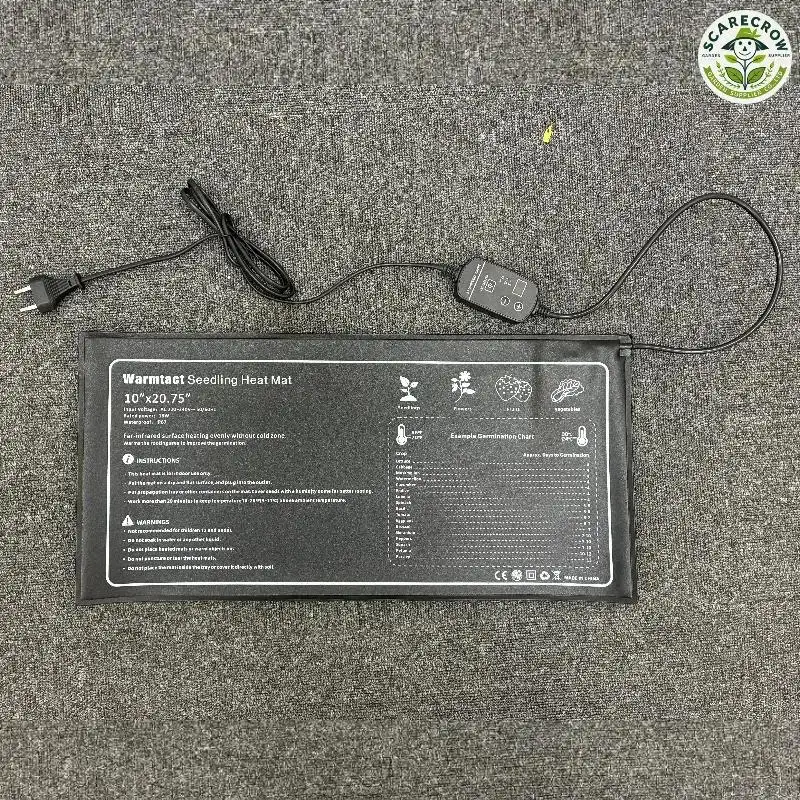
Propagation Heat Mat
A Propagation Heat Mat is designed to warm the root zone beneath seed trays, nursery pots, and propagation containers rather than heat the entire growing room. For seed starting, the practical question is therefore not simply whether more heat is useful, but whether the growing medium can remain within a suitable temperature range as surrounding conditions change.
Adding a thermostat can improve control, but it is not necessary for every application. At Scarecrow Garden Supplier, we offer both standard Propagation Heat Mat configurations and thermostat-controlled options because indoor seed starting, commercial nurseries, greenhouse benches, and retail propagation kits have different operating requirements.
How a Propagation Heat Mat Creates Bottom Heat
A Propagation Heat Mat produces warmth in growing medium through the base of the tray and turns up heat for seeds that are beginning to germinate and growing roots.
A typical heat-transfer path is:
Heating Element → PVC Surface → Seed Tray → Growing Medium → Root Zone
This is useful because substrate temperature can differ from room temperature. Seed trays positioned on cold benches, greenhouse shelving, concrete floors, or near exterior walls may lose heat even when the surrounding air is relatively mild.
Common applications include:
•Seed germination and early seedling development
•Rooting cuttings
•Greenhouse propagation benches
•Nursery propagation rooms
•Indoor growing racks
•Hydroponic starter systems
•Seasonal seed-starting kits
The purpose of a Propagation Heat Mat is therefore controlled bottom heating—not general space heating.
Why Root-Zone Temperature Requires More Than "Extra Heat"
Seed germination is temperature-sensitive, but different plant varieties do not share one universal target temperature. Warm-season crops generally require warmer media than many cool-season crops, while greenhouse conditions can also change significantly between daytime and nighttime.
This makes temperature stability more important than maximum heating output.
| Growing Condition | Main Temperature Issue | Thermostat Value |
| Stable indoor room | Limited temperature variation | Optional |
| Cold windowsill or shelf | Heat loss through surrounding surfaces | Moderate |
| Unheated greenhouse | Large day/night variation | High |
| Mixed crop propagation | Different temperature requirements | High |
| Commercial nursery | Repeatability across batches | High |
| Seasonal home gardening | Simple bottom heating | Low to moderate |
For buyers, this distinction helps determine whether a basic Propagation Heat Mat or a thermostat-controlled system is the more appropriate product.
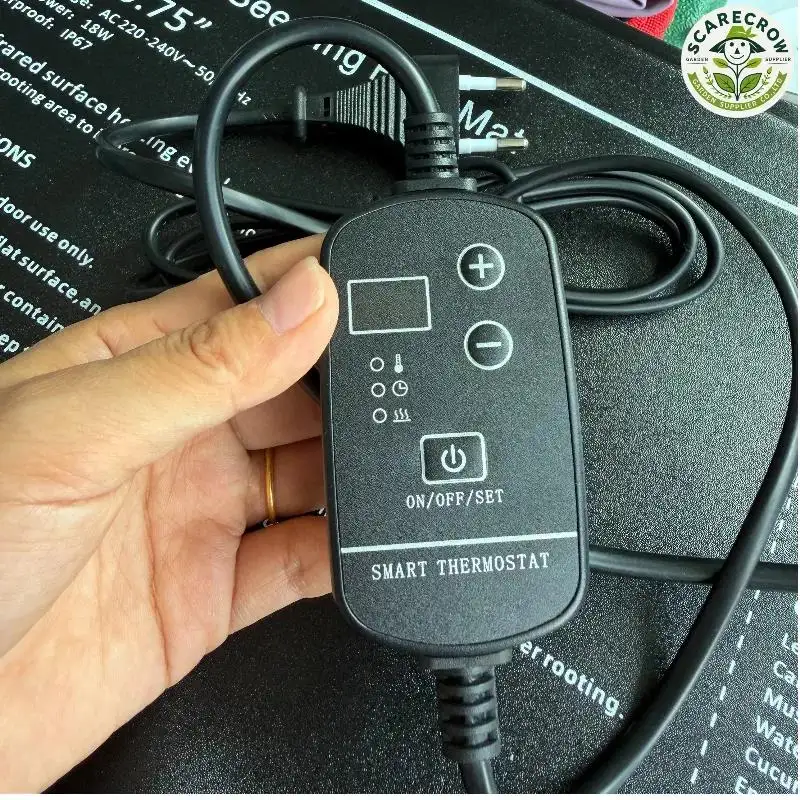
Propagation Heat Mat With Thermostat vs. Standard Heat Mat
A thermostat does not increase the rated heating power of a Propagation Heat Mat. Its function is to regulate heating according to a selected temperature and sensor feedback.
| Decision Factor | Standard Propagation Heat Mat | Propagation Heat Mat With Thermostat |
| Heating Control | Basic continuous heating | Temperature-regulated heating |
| User Adjustment | Limited | Adjustable |
| Sensor Required | No | Yes |
| Stable Indoor Use | Practical | Optional |
| Variable Greenhouse Use | Less adaptable | Better suited |
| Different Crop Batches | Limited flexibility | Easier adjustment |
| Setup Complexity | Low | Moderate |
| System Cost | Lower | Higher |
The thermostat is therefore best viewed as a control component, not simply an upgraded accessory.
When Is a Thermostat Needed for a Propagation Heat Mat?
1. Daytime to Nighttime Temperature Fluctuations in Greenhouses
Greenhouses heat up quickly in the day, and rapidly cool at night. Continuous heating may be less effective in controlling temperature in these situations.
A thermostat on a Propagation Heat Mat may be more effective in responding to the root zone conditions and prevent wasteful heating when the preferred temperature has been reached.
2. Crops Have More Specified Germination Temperature Demands
Control of temperature becomes more important as growers are propagating temperature sensitive crops or when changing crops of different temperature demands.
This concerns:
•Vegetable and herb propagation
•Commercial seedling production
•Rooting programs
•Specialty plants
•Repeated propagation cycles
The main benefit is not simply faster germination, but more consistent growing conditions.
3. Several Propagation Batches Use the Same Growing Area
Commercial nurseries often reuse propagation benches throughout the year.
One batch may require stronger bottom heating in a cooler season, while another may need less. An adjustable thermostat makes the same Propagation Heat Mat system easier to adapt without changing the entire heating arrangement.
4. Heat Mats Operate for Extended Periods
Longer operating periods make environmental monitoring more important.
Growers should consider:
•Root-zone temperature
•Ambient temperature
•Thermostat probe position
•Growing-medium moisture
•Tray thickness
•Heat mat contact with the tray
•Seasonal temperature changes
Incorrect sensor placement can produce misleading readings, so thermostat configuration should be considered part of the complete propagation setup.
When Is a Standard Propagation Heat Mat Enough?
A thermostat should not automatically be specified for every project.
A standard Propagation Heat Mat is often sufficient when:
•Indoor temperatures are relatively stable.
•Seed starting is seasonal and short term.
•One main crop type is being propagated.
•Temperature is checked independently.
•Simplicity is important for retail consumers.
The product is intended for an entry-level propagation kit.
For garden brands, this also creates useful product segmentation: a standard version can serve general users, while a thermostat-controlled version can target more advanced propagation applications.
Size and Wattage Must Be Matched Before Temperature Control
Temperature regulation cannot compensate for an incorrectly sized Propagation Heat Mat.
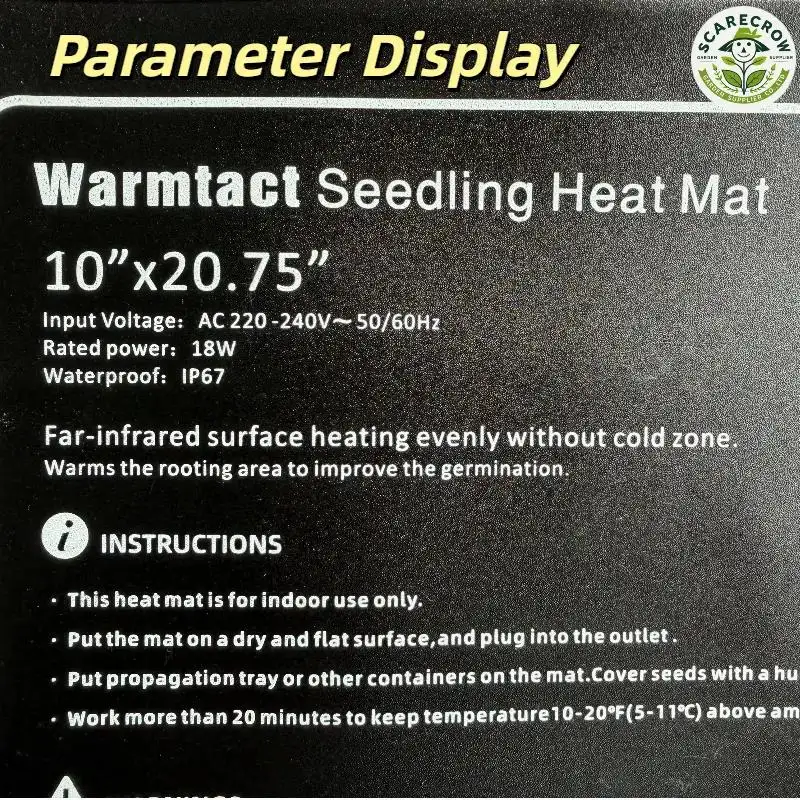
At Scarecrow Garden Supplier, available configurations include:
| Mat Size | Rated Power | Typical Configuration Direction |
| 254 × 527 mm | 18W | Smaller trays and compact growing areas |
| 508 × 527 mm | 45W | Medium propagation setups |
| 1219 × 527 mm | 105W | Larger trays, shelves, or bench areas |
Rated voltage options cover 110V–230V, allowing the product specification to be adapted for different regional markets.
A practical specification sequence is:
Tray Dimensions → Heating Coverage → Ambient Conditions → Wattage → Thermostat Requirement
This approach prevents temperature control from being considered separately from the physical growing system.
Waterproof Construction Matters in Propagation Areas
A Propagation Heat Mat operates around watering, misting, humid air, damp growing media, and wet tray surfaces. Moisture resistance is therefore a core design consideration.
Scarecrow Garden Supplier's Propagation Heat Mat range has a flexible PVC outer structure and a rating of IPX7 waterproof.
Things that Wholesale Buyers will Analyze Are:
•Edge sealing
•Surface Durability
•Waterproof Construction
•Power cable connection
•Cable length and routing
•Cleaning requirements
•Contact tray to mat
•Electrical Specifications
These meet a high demand in situations where moisture exposure is a common element as in greenhouses, hydroponics, and nurseries.
What Should Buyers Check Before Bulk Production?
For an OEM or wholesale Propagation Heat Mat project, Scarecrow Garden Supplier suggests verifying the operational environment prior to finalizing the specifications.
Important information regarding purchasing includes:
•Size of the seed tray and area to be heated
•18W, 45W, or 105W power
•Standard of 110V or 230V
•US, EU, China, or other plugs
•Standard cord or an adjustable thermostat
•Cabling configuration
•Logo and private-label
•Packaging for retail sale, mail-order, or bulk
•Language of the instruction manual
•Warning labels, barcode, and carton markings
Sample evaluation helps before high-volume production, particularly when the Propagation Heat Mat will be sold in various regions.
From Heat Mat to a Complete Propagation Range
A Propagation Heat Mat often performs best commercially as part of a broader seed-starting assortment.
Scarecrow Garden Supplier can coordinate heat mats with related products such as:
•Seed propagation trays
•Humidity domes
•Nursery pots
•Mini greenhouses
•Plant labels
•Other propagation accessories
Plug type, voltage, thermostat configuration, color, logo, packaging, manuals, and market-specific labeling can also be discussed according to the target sales channel.
Choosing the Right Propagation Heat Mat
Whether temperature control is worth adding depends on five linked factors:
Crop Requirements + Ambient Conditions + Propagation Scale + Operating Duration + Required Temperature Control
A standard Propagation Heat Mat remains practical for straightforward indoor seed starting, while thermostat control becomes more valuable for changing greenhouse conditions, repeated nursery production, or applications requiring more precise root-zone management.
Scarecrow Garden Supplier supports multiple Propagation Heat Mat sizes, wattages, voltage standards, plug configurations, and optional thermostat control. Buyers developing a greenhouse, nursery, retail, or indoor-growing range can share their tray dimensions, destination market, packaging requirements, and intended application so an appropriate configuration can be evaluated before sampling.
FAQs
Q1. Does Scarecrow Garden Supplier Offer a Propagation Heat Mat With a Thermostat?
Scarecrow Garden Supplier has a Propagation Heat Mat that has a thermostat, with or without. Choose the thermostat depending on how much control you want over root-zone heating.
Q2. What Propagation Heat Mat Sizes Are Available?
Available sizes are 254 × 527 mm, 508 × 527 mm, and 1219 × 527 mm. These sizes help to accommodate seed trays, propagation shelves, and growing ares of different sizes.
Q3. What Wattage Options Are Available for the Propagation Heat Mat?
Scarecrow Garden Supplier has 18W, 45W, and 105W heat mats. The wattage needed is dependent on the size of the mat, the size of the area to be heated, the room condition, and the type of propagation being done.
Q4. Is the Propagation Heat Mat Waterproof?
Propagation Heat Mats are waterproof. The flexible PVC has an IPX7 waterproof rating. This makes the mat safe to use in moist seed starting, greenhouses, and growing indoors.
Q5. Can Scarecrow Garden Supplier Change the Voltage and Plug?
Scarecrow Garden Supplier can change the voltage to 110V-230V and change the plug type to US, EU, China, etc., on a case by case basis.