








Updated 2 months ago
PS Seed Propagation Trays: Material Properties for Nursery and Greenhouse Growing

hqt
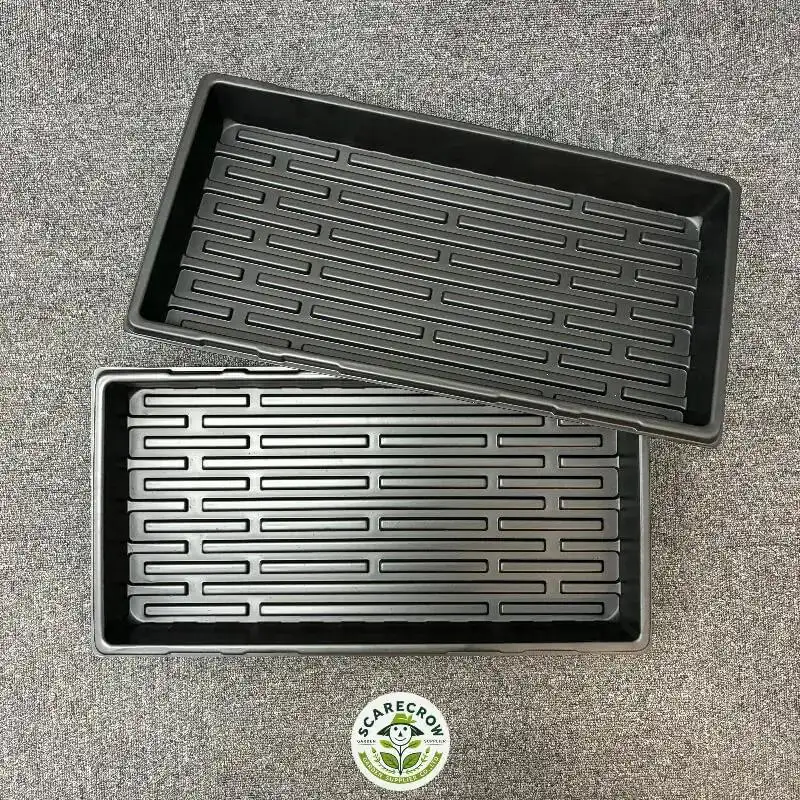
Seed Propagation Trays
Seed Propagation Trays are exposed to more mechanical and environmental stress than their simple appearance suggests. During commercial propagation, trays may be filled with growing media, watered repeatedly, moved between benches, handled during transplanting, packed for distribution and stored between production cycles. For this reason, material selection must be considered together with tray geometry, reinforcement, drainage and the intended nursery workflow.
At Scarecrow Garden Supplier, we evaluate Seed Propagation Trays as complete growing components rather than judging them only by resin type. Our heavy-duty PS seedling tray, for example, combines polystyrene with a reinforced structure designed for routine nursery and greenhouse handling.
Why PS Is Used for Seed Propagation Trays
In a wide range of applications, including Seed Propagation Trays, the thermoplastic PS (polystyrene) offers the necessary rigid body. This characteristic easily attracts growers to trays made of PS. This is because PS trays make it easier to position the trays at the growing site as they retain their shape and do not distort while in use. They are easy to carry as well.
PS has many characteristics that make it attractive for the propagation of plants:
• Structural rigidity: When a tray is filled with growing media, structural rigidity helps avoid excessive flex.
• Dimension stability: This allows consistent design and spacing of tray benches, shelves and packaging.
• Formability: The base, edges and reinforcing features can be molded into designed trays.
• Moisture-resistant structure: The tray does not need to absorb water to perform its function with regular irrigation.
• Practical product weight: Engineering the tray structure allows stair sections to be made light while maintaining required tray rigidity.
However, specifying "PS" alone is not enough. Resin grade, wall thickness, rib layout and molding consistency all influence the performance of finished Seed Propagation Trays.
Material Properties and Finished Tray Performance
Two PS trays with the same external dimensions can perform differently in the nursery. The reason is that mechanical performance depends on how the material is distributed throughout the product.
| Design Variable | Practical Effect on Seed Propagation Trays |
| Wall Thickness | Influences stiffness, weight and resistance to local flexing |
| Reinforcing Ribs | Adds support without relying only on thicker walls |
| Rim Structure | Affects grip and stability during lifting |
| Base Geometry | Supports media weight and tray positioning |
| Cell Layout | Controls plant density and available root volume |
| Drainage Openings | Affect water removal and substrate moisture management |
| Molding Consistency | Helps maintain repeatable dimensions between production batches |
This is why we treat material choice and structural design as one decision. A well-designed PS tray can provide good shape retention, while an inadequately reinforced tray may flex even when the base polymer is sufficiently rigid.
Why Reinforced PS Seed Propagation Trays Matter
Commercial nurseries rarely handle an empty tray only once. A tray may carry growing media, water and seedlings while being lifted repeatedly from different points along its edges.
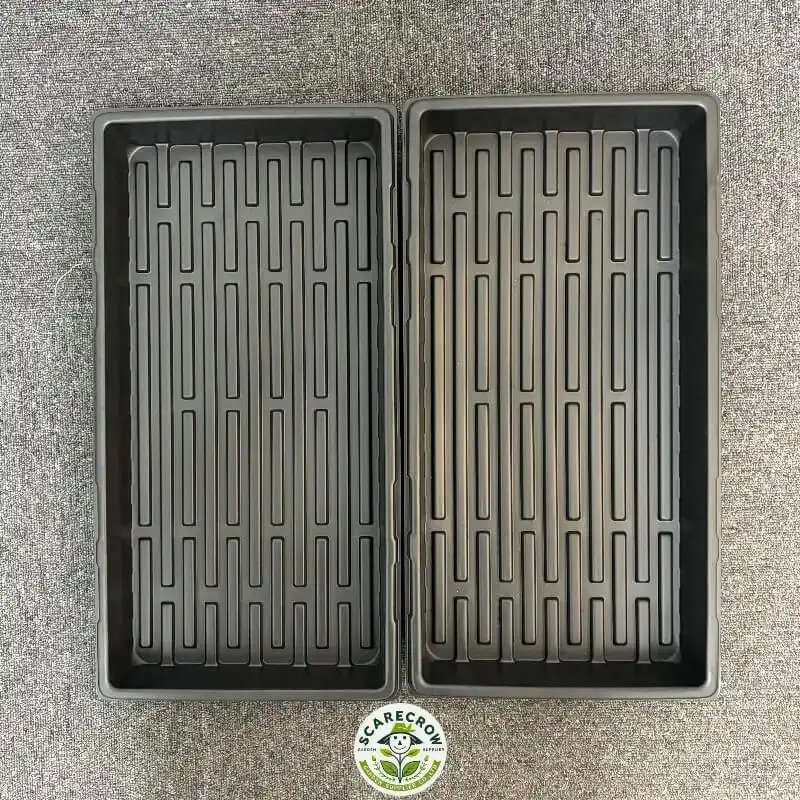
For our heavy-duty Seed Propagation Trays, Scarecrow Garden Supplier uses a reinforced PS construction intended to maintain a stable body during normal filling, moving and handling. The tray measures 54 × 28 × 6 cm and weighs approximately 155 g.
These specifications should be treated together:
• 54 × 28 cm footprint: This helps with planning nursery benches, defining greenhouse work spaces and planning for packing.
• 6 cm Depth: Indicates tray depth, but root space is dependent on cell configuration selected.
• Approx. 155g Weight: Indicates a more substantial tray structure when compared to extremely lightweight disposable formats.
• Reinforced Construction: Helps reduce the weight of the tray while helping to evenly redistribute the stress during handling of the tray.
Effective reinforcement does not mean the use of more plastic. The use of geometry, ribs and structure helps achieve the desired stiffness.
PS vs. PP Seed Propagation Trays
PS and PP are both common plastics in horticultural products, but their material behavior is different. Buyers should choose according to application rather than assuming one polymer is universally superior.
| Decision Factor | PS Seed Propagation Trays | PP Seed Propagation Trays |
| Structural Feel | Generally firmer and more rigid | Generally tougher and more flexible |
| Flex During Handling | Usually lower in a comparable rigid design | Often greater depending on thickness |
| Shape Retention | Well suited to firm tray formats | Highly dependent on structural design |
| Repeated Flexing | Depends on grade and geometry | PP is often selected where flex fatigue matters |
| Temperature Requirements | Specific range should be verified | Often considered for higher-temperature requirements |
| Best Application | Rigid propagation and handling formats | Applications requiring more flexibility or toughness |
The important purchasing point is that Seed Propagation Trays should not be selected by material name alone. Actual greenhouse temperature, handling frequency, tray reuse expectations and equipment compatibility should determine the specification.
Drainage, Cells and Root Development Must Be Considered Together
Material provides the tray body, but growing performance depends heavily on cell and drainage design.
When developing or sourcing Seed Propagation Trays, we recommend confirming:
Cell Geometry
Cell depth and volume determine the amount of substrate available to each seedling and influence rooting space.
Drainage Openings
Ideal drainage systems will allow water to leave the growing medium while being designed to the nursery's irrigation system.
Cell Density
Higher cell counts result in a higher number of plants in a tray, but each plant gets less rooting volume. Lower cell numbers will allow the plants more space.
Tray Depth
Overall tray depth should be matched to crop type, propagation period and transplant timing.
Because these factors vary by crop and market, Scarecrow Garden Supplier confirms cell configuration rather than assuming one arrangement is appropriate for every buyer.
Matching Seed Propagation Trays to Professional Workflows
Different sales channels and growing environments create different technical priorities.
| Application | Key Tray Requirements |
| Commercial Nursery | Rigidity, repeatable dimensions and routine handling stability |
| Greenhouse Propagation | Drainage, bench compatibility and environmental suitability |
| Seed Starting | Cell size, media volume and irrigation control |
| Young Plant Production | Rooting space and tray stability during plant development |
| Garden Centre | Practical durability plus retail assortment compatibility |
| E-Commerce | Nesting efficiency, carton utilization and transport protection |
For this reason, we can evaluate alternative dimensions, colors, materials and tray configurations when the standard Seed Propagation Trays do not match a customer's existing growing or distribution system.
What Wholesale Buyers Should Specify
Before production or sourcing is finalized, a professional Seed Propagation Trays specification should normally define:
• Material and grade requirements
• Overall length, width and depth
• Target tray weight
• Cell quantity and dimensions
• Drainage configuration
• Reinforcement requirements
• Expected greenhouse temperature conditions
• Color
• Logo or private-label requirements
• Retail or bulk packaging
• Carton marks and shipping labels
• Pallet or consolidated shipment requirements
Scarecrow Garden Supplier can also work from a reference tray, dimensions, photographs or target-market requirements to evaluate similar or customized solutions. Where practical, Seed Propagation Trays can be coordinated with plant labels, watering products, garden tools, gloves and greenhouse accessories within the same purchasing program.
Selecting Seed Propagation Trays as a Complete System
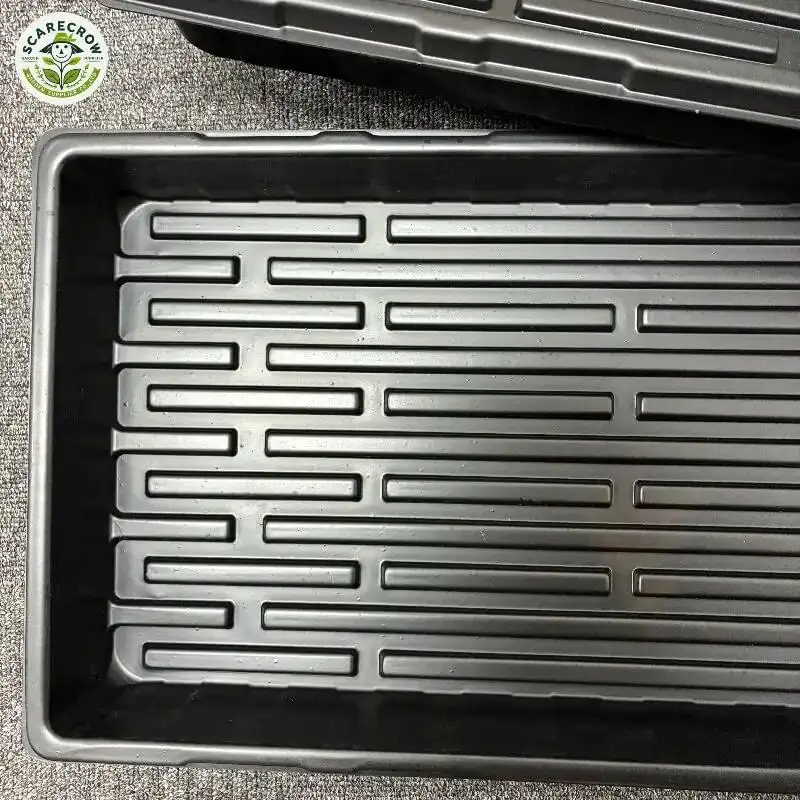
PS offers the rigidity and dimensional stability needed for many professional Seed Propagation Trays, but reliable performance comes from the interaction between material, wall structure, reinforcement, dimensions, cells and drainage.
At Scarecrow Garden Supplier, we use this combined approach when developing and sourcing Seed Propagation Trays for nurseries, greenhouses, distributors and garden retailers. If you have a target tray size, reference sample, material preference or packaging requirement, our team can review the specification and help develop a practical tray and purchasing solution for your market.
FAQs
Q1. Are Private Label Options Available for Seed Propagation Trays?
Yes, Private Label Options exist for selecting the product, as well as labels, logos, instructions, carton marks and other branding. The availability is based on the quantity of order.
Q2. What Size Is the Heavy-Duty PS Seed Propagation Tray?
The tray is approximately 54 × 28 × 6 cm, weighs around 155 g and has a standard reference dimension of 54 × 28 × 6 cm. Other dimensions are possible upon request.
Q3. What Makes These Seed Propagation Trays Heavy-Duty?
Heavy-duty trays have a reinforced Plastic Stabilized Structure which makes these trays very stable during the filling and moving of the trays as well as general manipulations in the nursery.
Q4. Can Scarecrow Garden Supplier Customize Seed Propagation Trays?
This is possible, and can be evaluated based on the customer’s ordering preference. Designs, sizes, components, materials, and colors can be altered.
Q5. Can the Cell Configuration Be Customized?
This is possible, and designs can be altered based on the quantity of order requested. Buyers should provide dimensional specifications and a sample for consideration.