





Updated 1 week ago
Seedling Trays Wholesale for Flower, Vegetable and Forestry Nurseries

hqt
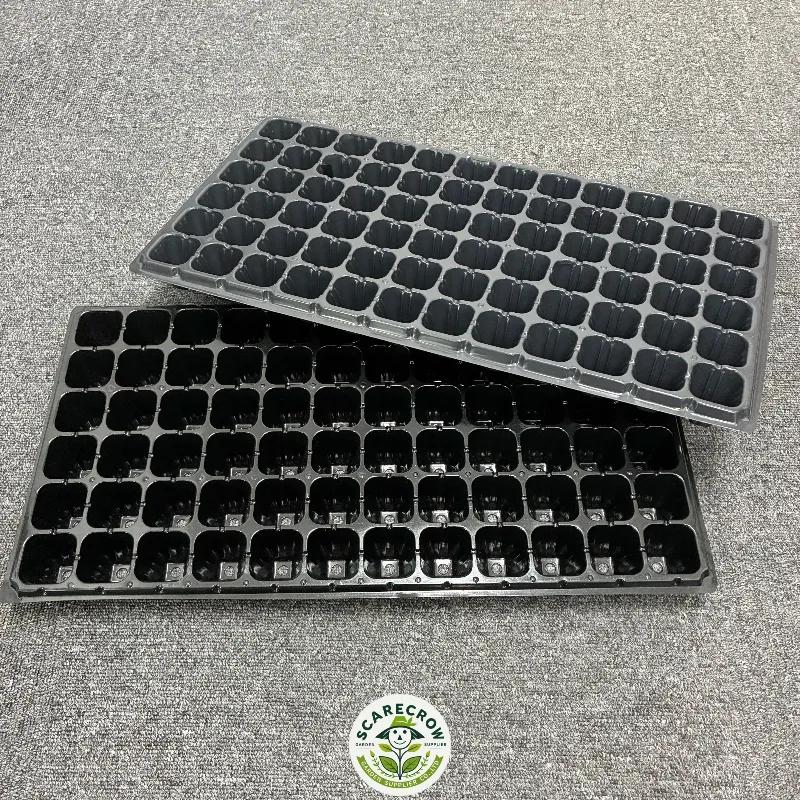
Seedling Trays Wholesale
A 128-cell tray may produce uniform flower plugs yet leave tomato transplants root-restricted before field planting. The same tray can be even less suitable for tree seedlings, where insufficient cavity depth and poorly directed roots may compromise establishment after outplanting.
These problems are not resolved by cell count alone. Cavity volume, depth-to-width ratio, drainage geometry, and time in the nursery determine how the growing medium behaves and how roots develop.
For Seedling Trays Wholesale buyers, the purchasing decision should start with the crop's transplant requirements, and not the number of cells per tray.
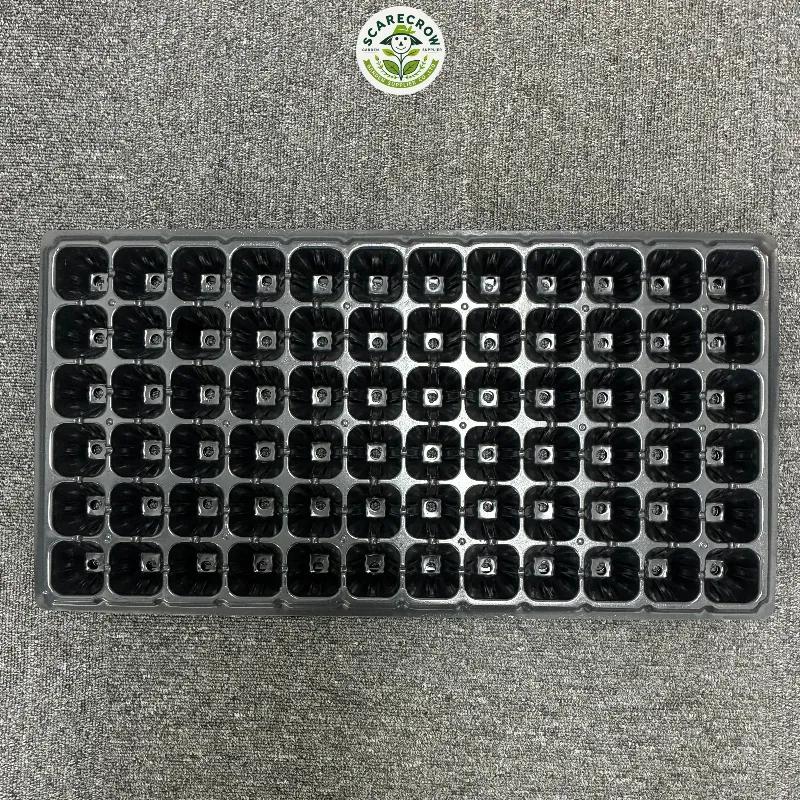
The Scarecrow Garden Supplier has PET composite propagation trays in 21, 32, 50, 72, 105, 128, and 200 cell configurations with integrated drainage holes and a water-guiding design. Choice of configuration is dependent on the growing system and the production cycle.
1. How Should Cell Size Differ Between Nursery Crops?
Cell count is a useful purchasing reference, but it does not describe usable rooting volume. Two trays with identical cell counts may have different cavity depths, taper angles, and substrate capacities.
| Nursery Application | Configurations to Evaluate | Primary Selection Factor | Risk to Check |
| Flower propagation | 105–200 cells for compact plugs; 50–72 for larger plants | Plug uniformity and transplant schedule | Rapid drying or root restriction |
| Vegetable seedlings | 72–128 cells for compact transplants; 21–50 for greater rooting volume | Water reserve and root development | Premature root binding or oversaturation |
| Forestry seedlings | 21–32 cells as initial candidates | Cavity depth and root direction | Circling, deflected, or poorly developed roots |
These configurations are screening options, not crop-specific performance guarantees. Actual cell dimensions must be confirmed before selecting a tray for a production program.
Higher cell counts improve bench-space utilization but reduce the growing-medium volume available to each plant when tray footprints and geometry are otherwise comparable.
That trade-off becomes more significant as propagation periods increase.
2. Flower Nurseries: When High Density Propagation is a Limiting Factor?
Uniform plugs and reliable transplants are often produced in commercial flower production. Little cavities are great for transplanting when there is still lots of room for seedlings to fill in with their root systems.
One limitation is moisture stability.
A small substrate volume holds less moisture. High ventilation or elevated greenhouse temperatures can dry the substrate along the edge of the cell trays faster than the interior cells, causing moisture stress and resulting in irregular growth. Moisture stress can also occur if the germination of the seeds is not uniform.
Intactness of root plugs also can affect the extraction of plantlets. If the root system of the plantlet is not developed enough to bind the substrate, the plug may break apart and not extract with the substrate. On the other hand, if the root system is developed too much, the plug may adhere too much to the substrate, making extraction difficult.
Tray trials should determine the following:
• Is the edge moisture stable between irrigation cycles?
• Do roots bind the substrate enough to extract the plantlets without too much circling?
• Can plantlets be removed at the scheduled transplant stage?
A high-density tray is economical only if the saved space is transplanted at the scheduled stage.
3. Vegetable Nurseries: Why Does Transplant Timing Change Tray Requirements?
Vegetable propagation requires closer attention to crop growth rate and the time seedlings remain in their containers.
Lettuce and many brassicas can tolerate relatively compact cells under appropriate management. Tomatoes, peppers, and cucurbits generally require more rooting volume when produced as larger transplants.
The University of Georgia Cooperative Extension identifies cell size as a factor affecting water availability, nutrient management, and transplant development.
Root Volume and Irrigation Frequency
Larger cells hold more growing medium, increasing potential water and nutrient reserves. However, they may remain excessively wet early in propagation when small root systems use relatively little water.
Smaller cells create the opposite problem: moisture and nutrient availability can change rapidly between irrigation events.
Both conditions influence transplant quality.
For evaluating wholesale options, buyers should examine trays using actual substrates, irrigation methods and schedules. Measure the intervals between irrigation, note the condition of the roots at the time of transplanting and determine what percentage of the seedlings meet the specifications for planting. This helps reveal if a lesser-cost, higher density tray shifts costs to additional irrigation and higher rejections and replanting.
4. Forestry Nurseries: Can Standard Seedling Trays Control Root Architecture?
Forestry seedlings have additional requirements compared to flower and vegetable seedlings. The shape and the substrate size of standard seedling trays may affect the root system architecture of forest seedlings.
If the container sides are smooth, roots may be forced to grow laterally. If the bottom of the container has a restriction, the roots may also grow in a constrained and deformed shape.
There are proprietary seedling and tree propagation trays that address some of the requirements above; however, their website does not provide enough information to establish that these requirements have been met.
Buyers of long-cycle forestry stock should request cavity drawings and assess root architecture before accepting these trays in lieu of forestry containers.
5. How Do Drainage Geometry and PET Construction Affect Reuse?
Water drainage, in itself, does not prevent water logging.
Fine-textured substrates may retain water and, consequently, remain water logged, even after drainage. Highly porous substrates may lose their moisture quickly, especially if the cells are small. The extent of drainage is dependent on the properties of the substrate and the shape of the cavity.
Scarecrow Garden Supplier's product listing indicates that their product is made up of a PET composite and that the drainage openings are round. The design is said to be water-guiding.
In commercial situations, there are two main considerations.
• Drainage:Flood a representative cell containing the growing medium to be used . Look at how the water drains and spreads itself and if it water logs. Check for standing water under the tray.
• Handling: Check for deflection, cracking of the rim, and distortion when loaded. Determine whether there is a limitation for the number of times the trays can be reused, and what the production conditions will be, including the chemicals used in washing and the water temperature.
In exposed production areas, the root zone may become water logged, thereby limiting production.
6. What Should Buyers Verify Before Placing Wholesale Orders?
Scarecrow Garden Supplier has provided approximate tray dimensions (54 × 28 cm), a standard MOQ (200 units), sample availability, and OEM/ODM services. Some details, for example dimensions and customization, depend on selected configuration, and must be verified as well.
For bulk purchase, samples against the following five measurable requirements should be approved:
• Dimension fit: The footprint, pitch and depth of the cavity and its fit with the existing nursery equipment.
• Crop performance: The development of roots and the retention of the growing medium of the crop as well as the yield of seedlings that are transplantable.
• Irrigation: The consistency of drainage and the uniformity of moisture level in the tray.
• Durability: Loaded deflection and extraction damage; stability during stacking and resistance to cleaning.
• Batch: Agreed to dimensional tolerances and material requirements, packing, incoming inspection, and other requirements.
For testing and validation, it is better to evaluate purchase cost in terms of transplants rather than trays. If unit cost of the tray is decreased, for example, due to a bulk purchase, the increased root damage or seedling rejection will increase the operating cost.
For flower, vegetable and forestry nurseries, Scarecrow Garden Supplier can review available cell configurations, samples and other wholesale requirements before order confirmation.
FAQs
Q1. What seedling tray cell counts does Scarecrow Garden Supplier offer?
Scarecrow Garden Supplier offers 21, 32, 50, 72, 105, 128, and 200-cell seedling trays for commercial propagation and wholesale purchasing.
Q2. Which seedling trays are suitable for flower nurseries?
Our 105–200-cell trays are options for compact flower plugs, while 50–72-cell configurations may suit plants requiring greater root space. Final selection depends on the crop and transplant schedule.
Q3. Which trays should vegetable nurseries choose?
Our 72–128-cell trays can be evaluated for compact vegetable transplants. Larger-cell configurations may suit crops requiring more rooting volume or longer nursery periods.
Q4. Can Scarecrow Garden Supplier supply trays for forestry nurseries?
Yes. Our product range includes trays for young tree propagation. Forestry buyers should verify cavity depth, root guidance, and transplant requirements before bulk ordering.
Q5. What materials are used in Scarecrow Garden Supplier seedling trays?
Our listed trays use PET composite plastic designed for repeated nursery handling. Cleaning compatibility and long-term durability should be evaluated under actual operating conditions.