




Updated 1 week ago
Indoor Greenhouse With Grow Lights: Full-Spectrum LED vs. Red and Blue LEDs

hqt
Indoor Greenhouse With Grow Lights
Two LED grow lights rated at the same wattage can produce noticeably different seedlings. One may deliver uniform growth across a propagation tray, while another produces compact plants directly beneath the fixture and elongated stems near the edges. The difference often comes from spectral distribution, mounting distance, and the actual photon flux reaching the canopy.
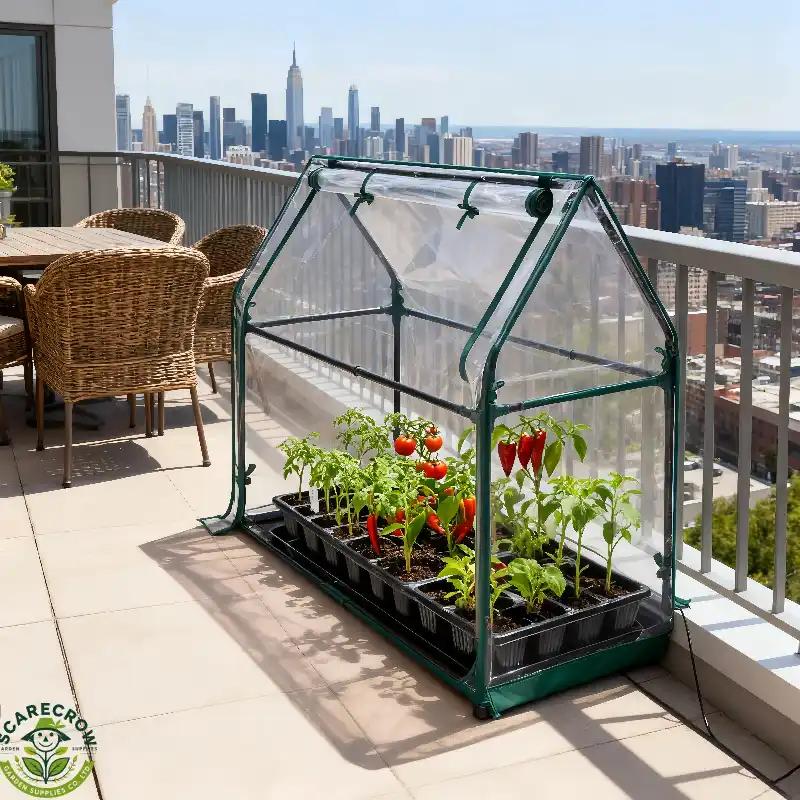
For distributors sourcing an Indoor Greenhouse With Grow Lights, the difference between full-spectrum and red-blue LEDs is about much more than color or energy consumption. It is about the seedling's physiology, the dimensions of the greenhouse, and the operating conditions.
What Actually Changes? Full-Spectrum vs. Red-Blue LEDs
Plants grow and develop beyond the simple function of photosynthesis. Other wavelengths like blue and red spectrums also influence plant growth.
Stomatal regulation and leaf expansion is influenced by blue light in the 400-500nm range. The red spectrum around 600-700nm also influences photosynthesis and is involved in the signaling of the phytochrome.
White full-spectrum LEDs use the 400-500nm blue light and phosphor conversion to produce the longer wavelengths. Red-blue fixtures use selected narrow-band emitters, typically centered in the blue and deep-red regions.
Which Spectrum Is Better for Seedling Propagation?
| Evaluation | Full-Spectrum LEDs | Red-Blue LEDs |
| Spectral output | Broad visible spectrum | Concentrated wavelength bands |
| Seedling morphology | Supports development across multiple species when properly specified | Can influence compactness through the blue-to-red photon ratio |
| Light penetration | Green photons can reach deeper foliage | Less green-light contribution in typical configurations |
| Visual inspection | Easier to identify chlorosis and discoloration | Purple illumination complicates foliage inspection |
| Energy performance | Depends on diode selection, driver losses, and thermal design | May achieve high photon efficacy with efficient narrow-band emitters |
| Application | Mixed seedlings and consumer growing kits | Cultivation with defined spectral requirements |
A high red-light fraction is not automatically beneficial. Insufficient blue photons can contribute to undesirable elongation, while excessive blue light may restrict leaf expansion in some species.
Full-spectrum lighting is generally easier to manage in mixed-species retail kits. However, the term "full-spectrum" is not a standardized guarantee of wavelength coverage or horticultural performance.
Buyers should request the actual spectral power distribution rather than selecting fixtures by marketing labels.
Why Photon Distribution Matters More Than LED Wattage
A fixture consuming 30 W does not necessarily deliver more usable light to seedlings than another fixture with lower electrical input.
Three measurements provide a more reliable basis for comparison:
• PPF (μmol/s): Total photosynthetic photon output from the fixture.
• PPFD (μmol/m²/s): Photon flux density reaching the growing surface.
• DLI (mol/m²/day): Total photosynthetic photons received over the daily lighting period.
For constant PPFD:
DLI = PPFD × Lighting Hours × 0.0036
Seedlings respond to the light they receive, not the electrical rating printed on the packaging.
The Mounting-Distance Trade-Off
In general, the closer the LED fixture is placed to the seedling canopy, the higher the PPFD directly below the fixture. However, short mounting distance can lead to reduced coverage uniformity, particularly for narrow optical beam angles.
In compact greenhouses, this creates two potential problems:
• Central seedlings receive excessive light while edge seedlings remain underlit.
• Increasing fixture height improves coverage but reduces photon intensity at the canopy.
• A PPFD distribution map measured at the intended installation height is more useful than a single central reading.
Buyers should also compare photosynthetic photon efficacy (μmol/J), measured electrical input, and usable coverage area. Neither lumens nor correlated color temperature reliably describes plant-usable photon delivery.
How Does a Humidity Dome Affect LED Performance?
A greenhouse enclosure changes the optical and thermal environment around the lighting system.
Transparent PVC covers transmit visible light, but transmission is dependent on material formulation, thickness, surface condition and wavelength. Condensation droplets further alter the light distribution by scattering and reflection.
When a fixture operates outside the enclosure, the cover sits directly in the optical path. Its effect should be measured rather than assumed negligible.
When lighting is installed inside, electrical protection and heat accumulation become greater concerns.
Three Failure Modes Buyers Should Check
1. Condensation and reduced light transmission
If condensation occurs on the cover of the enclosure, then it can impede the light reaching the plants. Repeat PPFD measurements under dry and humid conditions.
2. Increased temperature within the enclosure
Heat is produced by LED drivers and emitters and, thus, fixtures can still be hot even though the enclosure is relatively cool to the touch. Restricted air flow can increase the temperature within the enclosure, adversely affect the environment for plant growth, and shorten the life of LEDs.
3. Moisture exposure of electrical components
Connectors and drivers are at risk with watering and condensation. Increased relative humidity can increase the risk of condensation forming on the inside of the enclosure. Verify the environmental and electrical protection provided by the lighting equipment and instructions for installation before specifying an enclosed configuration.
A waterproof base for a greenhouse does not make the electrical components attached to it waterproof.
How Should Buyers Validate an LED Greenhouse Kit?
When considering a purchase, comparing nominal LED specifications is not sufficient for wholesale procurement. Sample approval should reflect the assembled product's operating conditions.
We recommend the following four checks:
• Request the manufacturer provide Spectral Power Distribution (SPD), PPF, and photon efficacy for the LEDs. Confirm whether driver losses are included in the measurements.
• Canopy mapping: Measure PPFD at intermediate levels (tray positions) of the canopy including center and corner positions, and record the distance of the sensor from the canopy. Record the configuration of the enclosure.
• Thermal and humidity evaluation: Record the temperature of the enclosure and relative humidity of the air, and look for condensation on the inside of the enclosure.
• Controlled propagation trial: Evaluate the evenness and development of leaves and stems of seedlings of the same species and seed lot grown at the same DLI, temperature, irrigation and in the same growth media.
• The trial should separate spectral differences. When fixtures have unequal DLI, it makes it hard to know if observed growth differences come from the quantity or quality of light.
Retail programs also touch on assembly tolerances, cable routing, replacement parts, and destination-market electrical compliance.
Integrating LEDs in a Greenhouse Structure
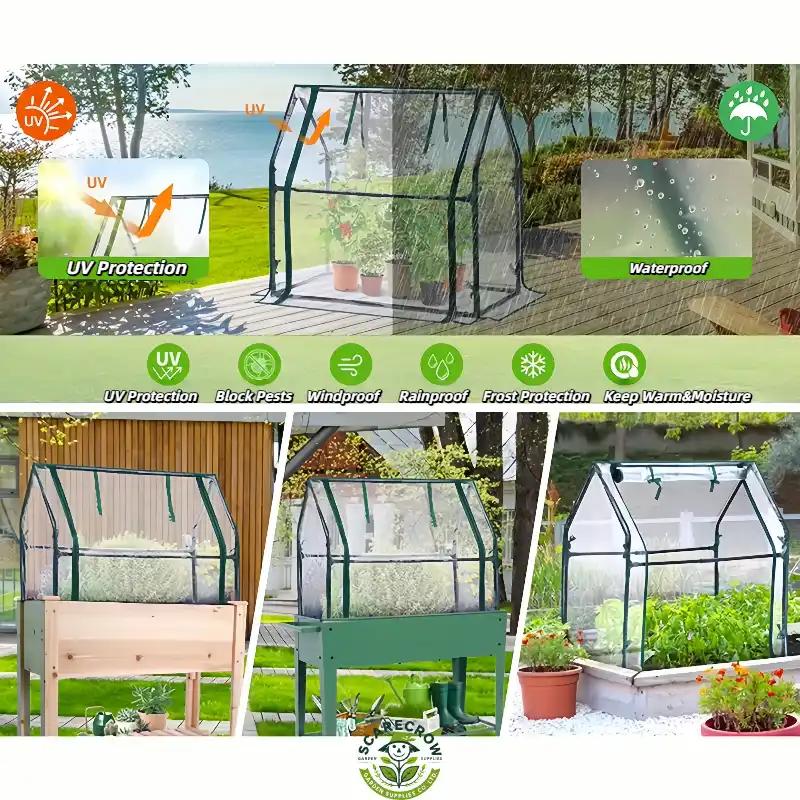
At Scarecrow Garden Supplier, our Mini Portable Greenhouse With Waterproof Base and Humidity Dome, provides a small enclosed space to propagate seeds and care for small plants.
The product design includes:
• A PVC cover framed by iron and PVC.
• Electrophoretic coated metal components and plastic connectors.
• A waterproof base pad that is closed with hook and loop fasteners.
• A tool-free assembly.
The listed product does not incorporate an LED grow light. Therefore, other factors like mounting, electrical, and compatibility require further assessment.
For distributors who want to create a retail package of an Indoor Greenhouse with Grow Lights, cover material, lighting clearance, ventilation and enclosure dimensions need to be agreed upon to complete the kit.
Scarecrow Garden Supplier is open to discuss your needs for greenhouse dimensions, materials, OEM/ODM services and retail packaging.
Contact us for your lighting plan and bulk purchases.
FAQs
Q1: Does Scarecrow Garden Supplier offer an indoor greenhouse with integrated grow lights?
The mini portable greenhouse does not specify integrated LED grow lights. Lighting compatibility and accessories should be confirmed separately before developing a complete growing kit.
Q2: Which LED spectrum is better for indoor seedling propagation?
Full-spectrum LEDs are generally practical for mixed seedlings and visual plant inspection. Red-blue LEDs can also support propagation when photon intensity and wavelength ratios match plant requirements.
Q3: Can red-blue LED lights be used with Scarecrow Garden Supplier's mini greenhouse?
Potentially. Buyers should verify fixture dimensions, mounting clearance, greenhouse cover transmission, heat dissipation, and moisture protection before integration.
Q4: Does the transparent greenhouse cover affect LED light transmission?
Yes. Cover material, thickness, and condensation can reduce or redistribute incoming light. Buyers should measure PPFD with the greenhouse cover installed.
Q5: How should buyers evaluate grow light intensity?
Request PPFD distribution measurements across the seedling canopy, PPF data, and electrical power consumption. Calculate DLI using the intended lighting schedule.